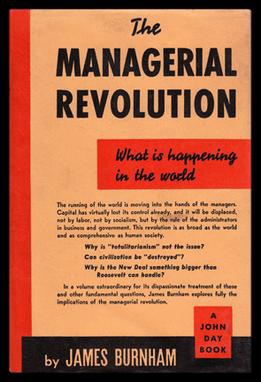
James Burnham, “The Managerial Revolution: What Is Happening in the World” (1941) – Who does half smart like a renegade Trotskyite? From what I can tell of his biography, James Burnham didn’t come to Trotskyism the way you think a political figure born in the first decade of the twentieth century might- after becoming a communist and growing disgusted by Stalinism. No, he went in for Trotskyism directly as a young man, even got to know Leon Trotsky a little. He was a bright young intellectual New Yorker with an eye for power, and something told him Trotskyism was it. This isn’t a diss on Trotsky or his ideology, but on Burnham, when I say that shows he wasn’t as bright as he thought he was. There could be an infinity of reasons to become a Trotskyite and power ain’t one.
I guess Burnham figured that out and went all the way rogue by the time he published this in 1941. “The Managerial Revolution” proceeds according to a parody of the ruthless logic of the two figures Burnham most cribbed from, Trotsky and more than his old mentor Machiavelli. He somewhat gets the ruthlessness, performs it well enough for his audience of little magazine readers (back when little magazines were bigger). The logic eludes him. He tracks a real change in the world but gets the valences wrong, and makes classic mistakes like putting too many chips on prognostications that would play out while he still lived. Above all, he makes the classic mistake of assuming everyone — everyone with thinking about, anyway — thinks like him, all schemes, power, maps, org charts.
The basic point is simple enough- capitalism will be replaced, is being replaced as Burnham writes, by managerialism. Capitalism was/is rule by the bourgeoisie, defined by ownership of capital; managerialism is rule by managers, defined by their managing complex enterprises. Increasing size and complexity of organizations, along with the failures of capitalism, made the rise of the managers inevitable. Governments would be their tool- state management of the economy obviously being more efficient, as shown by both Nazi Germany and the Soviet Union, the New Dealers or some other bunch would show the way in America and that would be that for capitalism. In keeping with his Machiavelli schtick, “this isn’t how I like it, it’s just how it is,” Burnham repeatedly avers throughout the book.
The rise of management as a field, separate from ownership, is an important phenomenon and it’s well worth thinking about what it does to the class dynamic. That said, it seems people who think about it too much tend to overdramatize it- not just Burnham, also thinking here of the people who took the discourse of the “professional managerial class” from Milovan Djilas’ Yugoslavia to dirtbag left podcasts. It makes sense. Managers are bosses in a way owners don’t have to be, and bosses are annoying. But managers weren’t just annoying in Burnham’s time- they seemed like the future. All the stuff you could do with big bureaucracies, with the technology that you needed experts to invent and maintain and bureaucracies to direct, it was all over the place at the time. 1941 is also when the Nazis seemed at their most impressive, post taking over France, pre-Stalingrad.
You still need big bureaucracies and institutions to do a lot of things. Managers, their thought and their place in the class structure, are still important. But it seems like Burnham committed the classic mistake of assuming a static set of subject and object relations (which Machiavelli generally did not- and neither did Marx, Lenin, or Trotsky). Capitalism has proven quite capable of incorporating the wants and needs of managers, who displayed little in the way of class consciousness- what little they had aimed down, not up. Owners haven’t completely ceded the field of management yet. And while they wouldn’t exist without big complex institutions like governments and investment banks behind them, Burnham lived to see that small enterprises, like tech companies, could accomplish a lot. Indeed, the moral/political core of a lot of technical/organizational thought that came after Burnham ignored class distinctions in favor of thinking about whether technologies trended big — think steel foundries or auto manufacturing plants — or small: personal computers and the acid blotter (not that the former work without microprocessors made in giant expensive plants but that’s design thought for you).
Burnham would continue his rightward trajectory into friendship with William Buckley and become an editor at National Review. You have to wonder what ol’ Bill thought of this guy and his rejection of the free market- my understanding is that he didn’t come around to liberal economics for quite some time. I guess “anticommunism makes strange bedfellows,” as James Ellroy said. Or maybe not so strange. The managerialism critique, the idea that our capitalism isn’t really capitalism, that it’s some imposter just pretending, has a powerful attraction on defenders of capitalism tasked with explaining the system’s failures. It’s really the fault of — those people — who think they’re so damned smart, that they can just manage everything, not anything wrong with the system… this has legs, both for standard conservatives and for those who make the leap of “those people” meaning “the Jews.”
In any event, Burnham’s radical years left him with enough rigor to make this less painful to read than a lot of my readings on the right. I could follow along with it relatively well even when he was crashingly wrong, like predicting an Axis victory. It’s more of an odd artifact, the granddaddy of a meme that blobs around the noosphere, acting as a placeholder for critical thought, than anything insightful on its own. ***’
Robert Nozick, “Anarchy, State, and Utopia” (1974) – Yeah, ok, other than eventually getting to von Mises, I’m done trying to read these libertarian hacks for the time being. I read right-wing writing (Nozick would probably object to the classification but fuck him) for a number of reasons: the “know your enemy” thing, the ways in which their writings can illuminate certain historical dynamics, the insights they sometimes contain, sometimes they just turn out to be enjoyable. I suppose the closest Nozick gets to any of those is the “historical dynamic” bit. Namely, between him and Rothbard and, one gets the feeling, many of their liberal interlocutors as the midcentury Consensus era cracked up and we enter the hungover last third of the twentieth century, you get a general impression that a white guy with a degree could just say anything, any words out of his mouth, and get a publishing deal, tenure, and loads and loads of attention.
Because that’s all any of this is. It doesn’t help that it’s technically “analytical” philosophy. At its best, analytical philosophy tries to get to the root of truth as rigorously as possible. I don’t get a lot out of it, even at its best, but I get what they’re trying to do. But applying it to politics is a dicey proposition, and when a hack trying to leap over his old friend (who also did analytical political philosophy) to make a plutocrat-friendly version of objective political truth… just no. Nozick was friends with liberal godfather John Rawls and wrote “Anarchy, State, and Utopia” specifically to counter Rawls’s “A Theory of Justice.” I don’t know if they exactly became blood enemies as a consequence — neither seems like the kind, and also apparently white middle class people just thought personal betrayal was cool in the seventies? — but there it is.
“Anarchy, State, and Utopia” isn’t even an especially elegant construction (Rawls, no prose artist, has his old pal beat by miles there). The closest thing to a through line is the Lockean state of nature. “Let’s just do that again!” Nozick insists. There’s a bit more to it- he opposes the state of nature to Rawls’s “original position,” where if you don’t know how you’re going to be born, you’d prefer to be born into a society that is relatively just, equal, and humane. But what of our RIGHTS, Nozick insists, specifically our property rights, that Locke somehow divined from… somewhere? The state of nature stuff was fatuous enough when it was happening, between Locke, Hobbes, Rousseau, whichever other cosseted Enlightenment guy dreaming up the natural man in his cozy study. How is anyone going to do that post-Darwin? How is anyone going to look at nature and be like “yeah, there’s a human-based normative order here, let’s just do that!”
(And don’t at me about indigenous societies or social darwinism. Indigenous societies often managed (still do manage, where colonial capitalism hasn’t dispossessed them) natural resources very well (not exactly batting a thousand but pretty good), but my understanding is that most of them, pre-contact anyway, didn’t understand “nature” as separate from their societies in the Enlightenment/romantic way Europeans came to do. And social darwinists romanticize nature as much as anyone. They just do it in a nasty, adolescent boy way. They look for norms that aren’t there, too.)
Nozick also tries to dispense with Marx by smugly proving that Marx and Marxists understand value via market valuations- a granddaddy of the “you criticize capitalism yet you buy products, interesting” gambit. What kind of an own is that? For one, it completely ignores the concepts of use value and exchange value, which should not be obscure to someone taking on this subject in the seventies, it’s not some “young Marx” marginalia, it’s right there in Capital. For another… so what? The idea isn’t that markets are always wrong informationally, or even necessarily morally/existentially. The idea is that it’s a rigged fucking game because of historical structures and always will be until those structures are overthrown. Somehow Nozick bridges this into “proving” that workers aren’t exploited by their employers profit-taking? Fuck knows. Fuck this. It’s one of “The Sopranos” better jokes that they have a lame snitch reading this book. *
Murray Rothbard, “Power and Market: Government and the Economy” (1970) – I remember being a baby grad student and setting out to read various important German philosophers: your Kants, your Hegels, your Nietzsches, your Heideggers. My enjoyment and comprehension values varied, but between being a historian and, I figure, being an American, I could never get fully “into” them because it just felt like people saying words out of their mouths. I’m not a scientist, I don’t demand data and scientific method from everything, but I guess I just prefer there to be some more backing to the things people say than that it sounds good. Ironically, given his reputation and some of his other statements, Nietzsche was the one who got closest to being at all empirical, with his early career in classical studies. I’ve gotten something out of all the philosophers I’ve named, especially as I got older and realized that everyone, explicit or not, has some sort of non-empirical basis on which to launch their empirical investigations. I came to think that there’s a degree to which the human capacity for thinking these things at all indicates that such things are worth thinking. Our ability to abstract and imagine the infinite points to something more than empiricism can answer for, even if I generally prefer to make my way with the solid groundings of citations and paper trails.
I thought of this while reading Murray Rothbard, and to a lesser extent other libertarian thinkers recently. Rothbard would probably hate being compared to most of these guys, especially Hegel, cast in Rothbard’s day as the arch-philosopher of the dreaded state. I tend to think Hegel et al would return the favor. To me, this is no “both sides” business. At its worst and most abstruse, the continental philosophical tradition (as opposed to contemporary continental philosophy, more of an industry than anything else) represents people bringing their best lights to difficult and essential aspects of what it is to be human. What Murray Rothbard and his cothinkera represent is a wretched provincial charade of the same thing, taking the portentous stakes, philosophical excuses to not bother with the empirical, and pretentious language of the philosophical enterprise to affirm utter crankery… though it’s somewhat of an insult to cranks, some of whom don’t wind up just saying “whatever I imagine rich people to want” over and over again as though it’s capital-T Truth.
In this book, a portion of his 1962 masterwork “Man Economy, and State,” Rothbard practices what he calls “praxeology.” Have you not heard of that? Well, that’s probably because it’s not a real thing. Austrian School economists dug it out of the corpse of classical learning, isolating a bit of Aristotle here and various others there, to create a basis for understanding the world based on “human action,” defined as purposive, goal-oriented, and if not perfectly-informed than reasonably-informed. From this axiom, you derive other axioms, and go on your merry way. “Power and Market” is axiom after axiom after (strawman) objections to axioms he likes followed up axioms disproving the objections. That’s it. He will occasionally throw in a cherry-picked empirical fact, but not often.
Rothbard is both an outlier and something of a bridge figure in the history of libertarianism (it makes sense that libertarians would have bridges to outliers of thought- if only they’d stay there). He went a lot farther than most libertarians did in terms of denying a government role in pretty much anything, including securing a sound currency or maintaining a common defense. All that can be privatized, too, Rothbard insists, making him the father of “anarchocapitalism.” Of course, we know “ancaps” these days by their tendency to join forces with outright fascists, and we know why- because ancap is feudalism with extra steps, and that’s more or less what a stable fascism would degenerate into, Himmler’s fatuous little rural volks-deutsch daydream. Did Rothbard know that? Did he care? Does it matter? To the extent I understand Rothbard’s trajectory, it was one long process of getting back at his neighborhood- he was a conservative geek, a bowtie dipshit from the beginning, which didn’t make him popular growing up in the thirties and forties in Jewish neighborhoods in New York. He had acolytes but he didn’t seem to have friends- he busted up with Ayn Rand, for instance, when neither one would bend the knee to the other. He wound up plonking himself down with neoconfederates and Holocaust deniers at the Mises Institute in Alabama and there he stayed til he popped his clogs in 1995.
For all he was a weirdo, like I say, Rothbard was also a bridge, specifically between the stormy continental pessimism of much of the original Austrian School economists like von Mises and von Hayek and what would become American libertarianism. It might be hard to remember now that it got its lunch money took by resurgent fascism, but libertarianism used to be an optimistic creed. Sooner or later — probably sooner — everyone would see that the free market was the way to go. It was implicit in everything from technology to pop culture, politics just had to catch up. As for Rothbard’s role in all this, let’s put it this way: at his gauziest and dumbest, von Hayek would never have made the sort of promises Rothbard makes for what would be possible if the government would just cease existing. “Good government” was not an oxymoron for libertarians or many other neoliberals before Rothbard. In characteristic American style, various hustlers like Milton Friedman and Ronald Reagan and whoever else would use aspects of the privatization-mania Rothbard philosophized to pry apart the public sector, without giving away a scintilla of power. Ancaps could screech but they should have cheered- this is what they were for.
In the end, though, I go back to the book itself and it’s structure. What this “praxeology” business reminds me of is a more pretentious version of what you often see in vernacular philosophizing, including the thought patterns of conspiracy theorists and “sovereign citizen” types, some of whom have vaguely anarchocapitalist notions already. You start with a few things you see around you, and apply a set of mental operations to them. If you come into it with a paranoid and/or anti-authority streak, anyone pointing out that your system has some holes in it is just trying to suppress you and your ideas. The reasoning itself that Rothbard followed in his praxeology reminded me of nothing so much as the “lessons” in “Supreme Mathematics” practiced by Nation of Islam offshoot commonly called the Five Percenters. They like to improvise on various axioms and numerological concepts to come up with “science,” a sort of Kabbalah developed by black kids in the depths of the inner city, the playgrounds and the prison yards. To the best of my knowledge, though, praxeology has never inspired music as good as the Wu Tang Clan, and the Gods and Earths haven’t contributed as much as libertarians have to our current mess, nor do they screech like tea kettles about how their method is the only rational method. I know which I prefer. **
William F. Buckley, “God and Man at Yale” (1951) – One conservative archetype we don’t pay enough attention to is that of the tattle-tale. Especially given the way that a lot of American conservatives like to pose as tough guys and the way a lot of liberals also delight in tattling (though usually to a Great Schoolmarm in the Sky, who like most gods is curiously indifferent to their petitioners), this gets lost in the shuffle. But Bill Bennett made his bones in the conservative movement for ratting out a college roommate for smoking weed (only to wind up a degenerate gambler himself). William F. Buckley, for his part, got famous by writing this book snitching on his alma mater, Yale, for not teaching traditional virtues.
Gotta say I have more sympathy for Bennett’s pothead roommate than whoever was running Yale in 1951, but tattling on behalf of “virtue” as understood by a rich twenty-something… that’s not easy to stomach for two hundred pages. And Buckley is very explicit that snitching is what he’s doing. The book is addressed to the alumni and, especially, the trustees of Yale. If they only knew how little Yale was upholding it’s supposed values of Christianity and individualism, they’d come around and crack the whip, get all the commies and atheists out or anyway, provide “balance.”
It’s weird for a few reasons. First, Buckley leads with religion, and how Yale’s religion classes don’t teach religious faith but rather criticize religions as bodies of doctrine and social practice, a lot of the teachers are atheists, etc etc. Reading it seventy years later, it’s hard to get into the headspace, harder than most conservative writing. Religious faith on the part of the WASP-y elite Yale still very much catered to at the time had been waning for a long time by the time Buckley was writing, and didn’t get any healthier after. This decline hasn’t seemed to have hurt conservative politics, or American fortunes in the Cold War, as much as Buckley hinted it might. It’s even weirder when you consider Buckley was a Catholic. Yale was never supposed to teach his kind of religion. But I guess he thought it was the kind of material that would get the old stuffed shirts who act as trustees in the Ivy League fired up.
Then there’s the stuff on economics and social science. The thing is, it’s Yale in 1951. There aren’t any communists. It’s just liberals. They’re broadly skeptical about a lot of things (could probably have used more of that, honestly), including the free market. They had just witnessed the Great Depression and the ways in which government spending got the country back on its feet. No one is calling for workers to seize the means of production. But Buckley is wounded on behalf of the besmirched honor of the markers and the wealthy anyway, for every snide remark Samuelson or whoever (no one’s idea of a screaming lib) put in a textbook. It’s just such picayune stuff.
To the extent this book really has importance beyond launching Buckley’s career, it’s as a chapter in redefining the liberal enemy for the American right. That higher education would go on to become a perpetual target for the right when it looked to drum up cheap heat doesn’t need to be belabored. It’s also part of the game of ambiguity Buckley seems to have played his whole career in terms of negotiating with the far right and it’s concepts. In this book, liberals are the target because they sap America’s moral fiber, leaving it weak in the face of communism. If Yale men don’t say their prayers and learn free enterprise, how could they possibly compete with the Russkies (Yale was and is a prime recruiting ground for the CIA, as Buckley well knew… but maybe early CIA agents weren’t the best example of how to successfully stand up to the Soviets)? Buckley never says why his professors at Yale would do such a thing. He doesn’t come out and call them communists. He leaves it ambiguous. People can fill in what they like.
Seventy years of this bullshit, and the idea that liberalism is all a “cultural Marxist” (read “sneaky Jewish”) plot is now basically accepted by many “mainstream” conservatives. I remember when Buckley’s reputation was as the man who routed the Birchers and the Klansmen from the postwar conservative movement, making it “respectable” (never mind his remarks about the civil rights movement or gay people). He was what online reactionaries today would call an “optics cuck.” Except, he won, and helped define what conservatism would look like for the next fifty years, so I guess he was more of an “optics chad.” And he left the door wide open for the ideological descendants of the Birchers to come back. The ideas didn’t change- just the packaging.
As far as the experience of reading this book goes, Buckley was supposed to be a hot shit prose writer, very “witty.” Well, I’ve read less witty books, to be sure, and this one zipped by reasonably quickly, but I still wasn’t especially impressed. In many ways, he’s not out to impress people like me. He was out to lay the groundwork for a movement. I’m not sure what lessons are really applicable- “snitch to some rich people about meaningless culture war horseshit” isn’t really applicable to my side, alas. **
Albert Jay Nock, “Memoirs of a Superfluous Man” (1943) – Sometime in the late nineteenth century, enough switches flipped in the heads of enough of the Western bourgeoisie that a general societal freakout occurred. That class of society, then at the height of its powers, and almost certainly more powerful than any group had ever been in human history, suddenly came to believe itself beset by dangers and in the grips of irreversible decline. To the extent that this was true, their attitudes towards the situation helped bring it about. I tend to date this freakout to the revolt and suppression of the Paris Commune in 1871, but more than just politics went into it. The pace of change in general — political, social, economic, technological — caught up to the people supposedly in charge, and when they realized they weren’t as in charge as they thought… a lot of things we see in culture, from corn flakes (invented to keep boys from masturbating, a concern of the freakout period) to the slaughters in the trenches of WWI, can, arguably, be attributed to the freakout.
Albert Jay Nock was born in 1870, just as the freakout was starting (maybe), and died in 1945, just as the freakout’s (maybe) ultimate fruit, the Second World War, ended. He was in position to watch the whole thing and give his peculiar takes. That he is known today, to the extent he’s known at all, as one of the godfathers of American libertarianism is both a shame, and also his own fault. He was more than that, but that he became that posthumously comes down to his failings. Libertarianism, for its part, became one of the coping strategies for other eras of crack-up, the aftermath of the sixties and that of the early twenty-first century (assuming we decide not to lump them in together).
What Nock was was a genuine man of letters, and “Memoirs of a Superfluous Man” is in most respects the story of his learning to be such, and what he did once he became one. In this way, it tracks alongside “The Education of Henry Adams,” and Nock cites his fellow cultural pessimist at several points in the text, though he doesn’t try for anything like Adams’ experiments with prose structure, or his gravitas. That cuts both ways. It is nice that Nock has something of a sense of humor and is admirably direct; but he can be direct in some garbage directions and ultimately this work, while fascinating, has flaws that drag it beneath the (extremely high) standard Adams set. Later for that.
Nock grew up in Brooklyn and in an unnamed Great Lakes town, in what appear to be what we would call “upper middle class” circumstances or above. If he ever needed to worry about making a living, or ever had to seriously curtail a lifestyle of travel and good eating, he doesn’t report it. He describes an idyllic childhood of good wholesome fun with little governance from the adult world. He goes away to school and becomes “classically educated.” He is taught Latin, Greek, math, and left to his own devices for most of the rest. In many respects, that is the pivot of his whole story.
Classical education has meant a lot of different things to a lot of different people. To Nock, it meant the key to history. The Greeks and the Romans tried everything in their roughly two thousand years. They learned all one needed to learn about how societies function. Everything else is either just technical improvement, or balderdash (not sure if Nock used the word, but he would use that kind of word). The human condition is what it is, and hasn’t changed since the days of Plato, or much before then either.
Bertolt Brecht, the kind of poet Nock (who could read German) would probably dismiss out of hand, wrote: “I would happily be wise./The old books teach us what wisdom is:/To retreat from the strife of the world/To live out the brief time that is your lot/Without fear/To make your way without violence/To repay evil with good —/The wise do not seek to satisfy their desires,/But to forget them./But I cannot heed this:/Truly I live in dark times!” Other than the forgetting desires bit — Nock has an earthy enjoyment of sex and food — “the old books” taught Nock more or less exactly that. But unlike Brecht’s narrator in “To Posterity,” he keeps on heeding. That cushion of family money probably helps, as does the option to be on the other side of the Atlantic from a lot of the risky business.
How to explain the conditions of the 1870-1945 (i.e. almost exactly Nock’s lifespan) freakout from a classical perspective? Nock never lays it out programmatically, exactly, in what is, after all, a personal memoirs. The two problems he cites most often are “economism” and “statism,” which mostly means treating the progress of either economy or state capacity as good things in and of themselves. Nock can believe this because, as becomes more and more open as the book goes on, Nock has a limited understanding of what constitutes “human.” That’s a nice way of saying he believes most people are less than human. Nock takes from the classics that culture is, essentially, for the elite. Most people can’t benefit from it- one of the claims he throws out there like a rock (and here, Nock is very much a father of libertarianism, a troll’s politics) is the notion that mass literacy is unhelpful, in fact hurtful in that it drives out good literature. The story of history is the story of elites producing culture, the masses enjoying some of the benefits in a passive way, and then for some reason, a combination of uppity masses and either weak or traitorous elites opening the gates and letting the barbarians in.
“What’s to stop the elite from just exploiting the masses, then?” Well, “nothing” is the real answer, but Nock would say something about how laws and politics are thin protections in any event, and really what makes positive change are morals and manners. Morals and manners, in turn, are the products of society and its refinement. Allow society to produce its own brilliance (in the way free marketeers, like many of the people who today think, wrongly, Nock would give them the time of day, think markets can do) and it will take care of things. But hand that power over to the state and you get rule by armed thugs and the society goes to shit. Where “economism” enters into this — where it comes from, why anyone chose to practice it if they had everything going so well in the fifteen-hundreds or early nineteenth century, which seem to be Nock’s historical happy places — is a bit of a mystery. Nock doesn’t come out and blame the Jews, like Henry Adams came close to doing, but you can see how followers might.
As you can probably tell, I don’t believe in any of this. And it wears very thin towards the end, when we leave Nock’s more interesting, younger experiences and basically go into a period where he’s an established journalist and essayist, and details how right he’s been about everything for the last forty years. But for the first two thirds or so of the book- let’s put it this way. In many respects, the saving grace of this memoirs is that Nock is not as much of a classicist as he thinks he is. Sure, he can pepper his works with untranslated (I have an old copy, not the new, hand-holding editions published by libertarian propaganda outfits, and am just fine with that) Greek and Latin and talk as though — even believe — that modern culture is trash, etc. But he’s still an American, a product of what he himself calls an entirely “economistic” culture, a child of the bourgeoisie, not even the ersatz aristocracy that gave us Henry Adams.
If he were just that classicist applying his (mediocre, pre-Nietzsche) classicism to his times, that wouldn’t be worth much, probably. As it stands, his Americanism, and his embeddedness in his times, both (further) warps his ideas and also means he can say some things that are specific to a time and place, and provide insights into those times and places, as well as into politics and culture more generally. Among other things, it’s a bit of a laugh when, along with the lessons imparted by the classics, Nock declares that things like Gresham’s Law (“bad money drives out good”) and something he calls Epstean’s Law (after a friend who may or may not be a time traveling Jeffrey), that basically means everyone is lazy, are basic, ahistorical principles of human life. That’s some good old American dumbassery, right there. That’s one of the basic points Nietzsche tries to get across about classical civilization: they were different enough from us that the way a given user of their thought tries to wedge them into their situation tells us more, in many respects, than what the classics have to say about any given situation.
So what does the juxtaposition of classicism and good old American urdummheit — Nock spends a lot of time telling us about his American forebears, and indulges in a fair amount of Americana-nostalgia, for a guy who also pooh-poohs our “civilization” or lack thereof — tell us about Nock and his times? Well, for one thing, this “civilization” vs “state” vs “society” business is important, less for any insight provided by using any of these floating signifiers and more for how some people, in Nock’s day and our own, understand historical change. You don’t have to believe that “society” is an independent actor, opposed to the state, and the sole source of human goodness to think that changes in social behavior — manners, mores, arts, etc — are determinative (though it probably helps). As silly as it may sound to my mostly materialist, radical readership, not only is that a thing a fair number of intellectuals, from conservatives and liberals to even some utopian socialists, believe, but it is also something like common sense to a shockingly high number of people, if you talk much outside of said materialist/radical circles. This is bad (though sometimes generative) thought. But we can’t ignore it. Powerful people (and powerful amounts of less powerful people) believe it and guide their actions by it. And there’s a grain of truth- what we could call “social microphysics” can be important. Some of the excesses of the woke left can probably be attributed to the ways they are waking up to that fact, with little in the way of guidance…
There’s also the question of education. I think Nock does hit on a tendency to think of knowledge as only being good for strict utilitarian purposes. You learn what you need to learn to serve a function. I guess I wind up echoing that, too, when I don’t mean to, by saying there is a purpose to learning things that aren’t directly “useful” i.e. will allow you to serve a purpose. I felt what he said about a classical education teaching him how to think critically, in a way learning how to be a socially usefully widget wouldn’t do. I just differ on some important points: I do think everyone benefits from education and critical thinking, and I don’t think the Greeks and Romans had some monopoly on teaching about the basic elements of life. I actually think learning critical history — of the whole world — does better what Nock says classical education does, but I guess I’m biased.
While we’re at it, is there much of a point to reading this book beyond what we might learn from it? Well, to my surprise, I found there was. Among other things, classical education seemed to have done pretty well for Nock the writer. Until he gets really pedantic in the back third, his prose quality carried me along. He vividly invokes his social environments, even as you squint at some of his claims. Among other things, he gets across the feel of “reform” circles — he was a follower of Henry George (up until his cultural pessimism swallowed him), a fact some of his libertarian epigones today might have a hard time really swallowing — in the early twentieth century brilliantly… that is, of others trying desperately to negotiate the freakout. In contrast to some other readers, I love books that send me to Wikipedia — which I carry in my pocket, after all — to look up their references. It points to a whole world, now almost lost. One of the ironies of reading this is that Nock thought that truth floated free of context, but those who would try to apply his thought bowdlerize it mercilessly to fit it into their very different contexts… as Nock presumably did to the Greeks and Romans. And so it goes. That is culture, that is civilization, and that is part of why I play this game. ****’
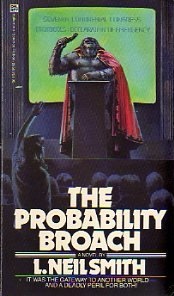
L. Neil Smith, “The Probability Broach” (1979) – A friend of mine who is a recovering “anarcho-capitalist” tried reading this, a depiction of an alternate-history free market utopia and one of the flagship works of libertarian scifi, during the height of his belief in its ideology, and couldn’t get through it, he found it was so bad. Well, now that I’ve read it, I can understand why. Boy howdy, was this a stinker.
A twist on one of my usual disclaimers: I’d love to find really batshit visions I disagree with explored in writing, and I’m not a stickler for plausibility in alternate history stories. I mean, I sort of am for myself, because I think it would be interesting to get a really rigorous, critical-historical take on the exercise, but I’ve obviously not accomplished that. Actually good alternate history stories like “Fire on the Mountain” and especially “The Man in the High Castle” have historical dynamics in their backstories that don’t really wash. But that’s all right. Alternate history stories are, naturally, more about us than about the past or it’s possibilities.
So it’s not really the implausibility of either the world Detective Win Bear goes to, not the one he leaves behind, that bothers me, though the patterns of implausibility in both cases indicate larger problems, like that the author is a dumbass ideologue of a dumb-assed ideology. Win Bear (he’s a Native American, always good to have them on side when you’re trying to make some fatuous settler point) works for the Denver PD in a 1987 that sucks pretty hard, because it’s a conservstive libertarian fantasy of what they thought Carter-Mondale style liberalism was doing to the country. Everyone’s broke, you can’t smoke, maybe some other stuff that rhymes, bureaucrats everywhere, etc. Win has to investigate a murder of a physicist, then some people try to murder him, then of course the physicist was doing alternate world stuff, so he winds up in an alternate world. No one knows about cops, or Denver, in this alternate world! People are happy, and also, for some reason, chimpanzees and gorillas are people and they’re happy too! Everything is privatized, no one pays taxes, everyone is armed.
Do I sound tired to you at this point of the review, dear reader? That’s because I am. The problem with this book was less the world building and more just the complete shit quality of the prose, characterization, plotting, and exposition. Exposition is often a problem in scifi, and especially alternate history, so that’s relatively forgivable. Win has a tendency to get shot, and so while he’s healing up, he has people tell him about the alternate timeline he’s in. The “point of divergence” is that Albert Gallatin, known in our world as an ethnographer (i.e. had a creepy fixation on Native Americans) and Secretary of the Treasury, sides with the Whiskey Rebellion against George Washington’s efforts to enforce tax payments. They win, kill Washington, and almost literally everything is hunky-dory from that day onward. No more constitution (and I will say it is refreshing to encounter an American winger who doesn’t slavishly worship that document, not that what he wants is better), no more taxes, really no more government. Jefferson (!) fixes slavery with moral suasion. The Native Americans gladly sell their land (?!) to western settlers and assimilate. Canada and Mexico join up, voluntarily. The only problem is that followers of the exiled Alexander Hamilton, arch-governmentalist, occasionally show up and do a terrorism, and that provides what skeleton of plot exists in this book.
I would say some of that stuff — especially about race — borders on the offensive, and the offensively stupid. But that’s not really why the book is so bad. It’s an ideological Marty Stu story, which is the real problem. The expression “Mary Sue story” comes from fan fiction, where it was common for writers to insert idealized, flawless versions of themselves on the bridge of the Enterprise or whatever (and it was gendered- women writers were called out for it more often, even though the male equivalent, the Marty Stu, was probably just as widespread if not more so). That’s one of the sad things about really thoroughgoing, join-the-party stockpile-gold libertarianism- the only meaningful conflict they understand is, basically, “normal people versus busybodies.” This is probably one of the reasons why libertarians so often become bigots and fascists- the explanation to the question “of libertarian paradise is the default, why does it exist nowhere?” can very easily become “the Jews, duh,” because it’s not like there’s any other good explanation of what binds “the busybodies” together, especially if you explicitly reject class analysis. It’s one way in which libertarianism really is “classical liberalism” — that ideology’s refusal of conflict and tragedy, well after most liberals got the memo that “freedom” can’t fix everything and adapted.
That’s tragedy, maybe, but “The Probability Broach” is farce, and not a funny one. Statist terrorists keep trying to mess stuff up, both in our world and the libertarian paradise, and keep failing. They’re meant to be extraordinarily dangerous, but are also ludicrously incompetent- after all, if they were competent, they’d be libertarians, right? Compounding this, Smith is a terrible action writer. It’s an art, writing action scenes, and one Smith hasn’t learned. He mostly substitutes gore and endless gun pedantry (he is, of course, a gun pedant, the creepy kind who talks about defending women, when he also delights in depictions of women being harmed, because of a lack of guns, of course) for an ability to write action. It’s a detective story in which no detecting takes place, just bad guys falling into the hands of Win and his new alternate universe friends.
I gotta say, I never expected to find myself wishing I was reading Ayn Rand. But at least she could inject some passion into her work, whatever her many failings as a writer and thinker. Smith can’t even manage that. His writing has the tone of the asshole at the end of the bar who’s figured everything out so hard he never has to do anything, never leaves his hometown or does anything with his life because it’s all bullshit anyway. Give that asshole free reign of his resentments and a very odd historical education, and you’ve got this book. *
Matthew Hongoltz-Hetling, “A Libertarian Walks Into A Bear: The Utopian Plot to Liberate an American Town (And Some Bears)” (2020) (narrated by Kevin Stilwell) – Why did I let you fucking jabronis talk me into beach reading? This fucking sucked. Jia Tolentino better be better or there’s gonna be hell to pay!
In all seriousness: if there’s a group of people who deserve to be spoken of (and to) smugly, it’s libertarian ideologues. I don’t mean guys who just like being left alone to enjoy drugs, guns, and fireworks, and haven’t developed a class analysis. I’m sympathetic to that position (but consider developing a class analysis, guys). I mean the people who really think they’ve figured something out when they decide “government” is the problem and “free” markets are the solution. Especially at this late date, as most of the smarter libertarians become liberals and the meaner ones becomes Nazis, there’s such an unconsidered, Panglossian quality to the whole thing, such a satisfaction with received ideas whilst spinning their wheels frantically to convince themselves they’re free-thinkers, that it’s hard to avoid smugness. Hell, they’re hardly strangers to smugness themselves.
But smugness doesn’t make for a readable work of extended prose. There might be a few prose masters who can pull it off, but it’s a hard sell, and Hongoltz-Hetling is no master. To be fair, he doesn’t seem like he’d claim to be one. He seems like an affable, agreeable sort, a New Hampshire-based journalist. His writing style would be totally appropriate to crafting articles on quirky local stories with some poignant, lightly humorous sentiment at the end. The problem is, he wrote a book that is basically that article-ending sentiment, and a more pressing problem is, I listened to the whole thing.
“A Libertarian Walked Into A Bear” is the story of the little town of Grafton, New Hampshire, primarily in the first two decades of the twenty-first century but ranging to the town’s founding near the time of the American Revolution and the decades in between as well. Grafton is way the hell out there in the woods, at least as far as the east coast of the US is concerned. There are bears. At first, the white settlers hunted the bears and sold their pelts, clearing land so as to farm the rocky bullshit soil of New England. When it turned out that northern New England was in fact a blind alley in continental settler expansion, Grafton began a long slow decline in population and wealth. Bears came back. There weren’t and aren’t resources to do anything about it, or about the town’s other problems. It sucks pretty hardcore for Grafton.
Exacerbating the issues and forming the center of this book was the Free Town Project, an effort by Internet-borne libertarians to settle in Grafton and make it a model libertarian burg. I don’t recall if Hongoltz-Hetling made the numbers clear, but somewhere between a few dozen and a few hundred libertarians answered the call in those halcyon Bush years, when libertarianism could pose as a viable path forward, before the financial meltdown and Black Lives Matter. Predictably, a great many pedants all moving to an isolated rural town didn’t make friends right away, despite newcomers and old hands agreeing that taxes suck (Grafton always hated taxes, as the author takes pains to point out, while smugly dissing the eighteenth century pioneer tax resistors’ bad spelling). As it turns out, New Hampshirites aren’t the native libertarians, just waiting for a spark from outside to ignore a bonfire of liberty. They’re mostly flinty Yankees who chose to live out of the way because they like living with people they always lived with and don’t like outsiders or change. Even when change means fewer taxes, a lot of people were resistant, especially when it was suggested by outsiders with a lot of other funny ideas.
Among other problems with this book, Hongoltz-Hetling does that annoying liberal thing where he accepts the libertarian “government versus liberty” framework, and expects to win the day by pointing out that “government” does good things and absence of it often causes problems. This is, in certain respects, “why don’t you move to Somalia if you hate government so much?” the book. It’s not like I like libertarians. I just hate shitty arguments, that don’t even have any juice to them anymore — I’ve never seen that line hurt a libertarian’s feelings — and especially hate them when they’re presented in a smug, “get a load of these freaks who hate the government!” tone.
There’s two related issues that compound these basic problems above and beyond the basic mediocrity of liberal political journalism. The first is that these freaks really aren’t that freaky. Hongoltz-Hetling puts a lot of weight on one founder of the project who turned out to be a pedophile… who was thrown out of the project before it really got underway (though more for optics reasons than anything else). The rest of the libertarians involved seem like fairly normal, if often pedantic and sometimes pretty gormless, white New Englanders of their generation. Some of them, like a guy who tries to create a church/free space but gets tripped up by taxes (and his refusal to apply for an IRS religious exemption), are even pretty sympathetic. Hongoltz-Hetling seems to be a canny enough writer to get that that guy and a few others are sympathetic, especially after church guy literally dies in a fire in said church. But that doesn’t change the fact that Hongoltz-Hetling looks down his nose at them, and expects us to do the same, from the extraordinarily short horse of contemporary liberalism.
The other problem is this- he does not make the case that libertarianism did that much to accelerate Grafton’s decline or exacerbate its bear problems. Grafton was declining when the libertarians got there. As the author took pains to point out, the locals always resisted the sort of taxation that might have made possible more public amenities that might induce people to move and/or remain there. The root problem really doesn’t seem to be ideology. The root problem seems to be economic marginality. The global economy doesn’t need anything Grafton produces, other than, perhaps, rural isolation for weirdos. Maybe if they had their shit together, the Graftonites could have plugged themselves better into an information/service economy, but that’s not entirely their fault. In their situation, considering what state and federal government generally does — tax their already poor farms, send their sons to war, and send money to develop towns on the opposite end of the country, like the booming Southwest (or research dollars to Dartmouth in nearby Hanover, NH) — you probably wouldn’t like government either. You don’t need to be a libertarian ideologue or servile to the rich to feel that way. The joke about libertarians moving to Somalia isn’t funny (to the extent it ever was) when you realize how badly imperialism and the Cold War screwed over that country, making the sort of “good government” American liberals take for granted impossible.
Of course, that’s not to say people can’t make bad situations worse. The closest thing to a real smoking gun Hongoltz-Hetling puts in the hands of the Free Town Project people (beside from insinuating that the church guy didn’t follow fire codes, without proving it) is that the libertarians encouraged a laissez-faire attitude towards trash disposal and the feeding of wild animals, thereby encouraging bears to become bolder. He lingers on the case of “Donut Lady,” a lady who fed bears donuts every day. The problem is, Donut Lady is a local, not a libertarian settler. Bears were already escalating, attacking pets, before the libertarians came. Moreover, the state, as Hongoltz-Hetling points out, does a shitty job of managing bears anyway, bound by muddled romantic notions of what wildlife “should be,” bureaucratic inertia, and funding issues. When locals take matters into their own hands and cull the bear population, Hongoltz-Hetling treats it like a war crime, when in other parts of the books he acts as though human-acclimated bears are in fact are war with us, and the Graftonite’s inability to do something about it shows their lack of civic virtue!
On top of that, Hongoltz-Hetling speculates that brain parasites from living around animals, especially cats (some prominent Graftonites in the book have cats), might be driving the madness he sees around him (but never conveys as being really mad- more just sad). I’ve literally heard altright guys make the same arguments about liberals and feminists (the trope of the crazy feminist cat lady). I’ve always said, frustrate a liberal long enough and he’ll break out the calipers and start doing biological determinism, but I’ve never seen them do it in response to a tiny group of hapless libertarians before. See something new every day, I guess.
Basically, this is some Daily Show-style profoundly inconsistent and incoherent slop, except not funny. “But the bears!” I can hear you say. “What about the bears, can’t they save the book?!” Well, reader, I give the book an extra half star, less for bear content — the author sees no or few bears and only intermittently passes on bear stories from his informants in a compelling fashion — than for llama content. He does tell one bravura anecdote about a woman’s pet llama rinsing a bear who wanders into her yard. That was cool. But otherwise, this was a shot at one of the fattest targets conceivable that lands flat on its face. **
Friedrich von Hayek, “The Constitution of Liberty” (1960) – It’s honestly getting to be like Charlie Brown and the football, me and these right-wing intellectuals. I mean it when I say I expect more from these people (as it happens, I did encounter a genuinely interesting — and genuinely batshit — reactionary work of genre fiction recently but did not review it because it was for Birthday Lecture research- you shall see). I didn’t expect the world from Hayek. I know how much a “Nobel” in economics is worth. “The Road to Serfdom” might be the single most ludicrously inaccurate prediction of the future taken seriously by “serious” people in recorded history. But I at least expected something more than the sententious performance of intellect, slathered over a fundamental lack of insight or even curiosity, that I got in “The Constitution of Liberty.”
The list of terms in “The Constitution of Liberty” that either aren’t defined or are defined in ways that beg further definition by anyone with a half-awake critical faculty encompass every important concept Hayek uses to make his argument, from “freedom” to “coercion” to my favorite, “civilization.” “Civilization” requires this, this, and that, mostly the unfettered right of people to dispose of their property, at least in the various ways that people near the “height of civilization” as far as Hayek was concerned— basically, his boyhood in pre-WWI bourgeois Europe— were used to doing.. A lot of syllogisms between underdefined concepts, like so many venture capital promises or poorly-laid invasion plans.
I don’t read these books because I think I’ll like them (though I never foreclose the possibility in advance). I read them for various types of insight, both those into “the enemy” and those that are more broadly applicable. There wasn’t a lot of the latter, here. I actually do think there’s some merit — at least enough to consider, if not to adopt whole hog — to the notion that rational planning isn’t an end-all-be-all and that there needs to be room for experimentation in economic processes, and other processes as well… though it is worth noting the idea we simply can’t process the information well or quickly enough has taken some knocks in the “Information Age.” Maybe Hayek’s work on economics would make the point with less baggage (though as a rational economic actor, I wouldn’t bet on it).
I probably should not have made that “rational actor” crack, because the main thing of value to be taken from this book is that it is a mistake to associate libertarianism or “classical liberalism” with rationalism, in any sense of the word. Hayek neither believes people to be rational actors nor that rational economic behavior is necessary to an economic system, and often eschews “rationalism” as the philosophy of top-down planners who think they can make everything anew. I had some inkling of this from reading scholars of the right like Corey Robin and Quinn Slobodian, but it is good to see it on the page. Among other things, this implies much more of an embrace of established rules and hierarchies than we often associate with “free-wheeling” libertarianism (and causes one to raise an eyebrow at how often, including in this book, Hayek averred he was no conservative). Once you open that door — that what we’ve got, from constitutions to borders to religious beliefs, is likely a good inheritance for freedom unless it can be “proven false” (to whose satisfaction, exactly?) was imposed by “central planners” — the walkway to anarcho-capitalists waving the yellow and black to support ICE is clear. So too, more seriously, is neoliberal embrace of the state (and in some but not all cases the nation or even the empire), precisely to enforce the creation and nurturing of markets. States and markets aren’t opposites, as a strain of libertarian thought contends- they necessitate and in some ways constitute each other.
All in all, this was worth reading to “catch the scent” of this particular ingredient in the stew of the modern right. Capitalist ideologues have been trying for a long time to find a figure isomorphic to Marx, but for their side. Sometimes they enlist Adam Smith, who died before Marx was born, has numerous negative things to say about capitalism and rich people, and whose most inspired reader probably was Karl Marx. Hayek is a close second in the sweepstakes as a potential capitalist system-builder (a fervent cult insists on Ayn Rand as the capitalist Marx but that’s just stupid), but try as they might, you can’t really map his powers, his influence, or even his meme-ability anywhere near that to the grumpy old Rhenish grouch. But they tried hard enough that aspects of Hayek’s thought have permeated modern right-wing thinking, even if relatively few of his influencees can say exactly how, beyond mumbling something about price signals. That Hayek’s main influence is actually non-rational, in contrast to how libertarians like to posture, is ironic. That Hayek helped ensconce a shallow performance of intellectual virtuosity shellacked over a curious lack of real critical curiosity… well, that’s hardly unique to the right. That’s ubiquitous, alas. *’
Ernst Jünger, “The Worker” (1932) (translated from the German by Bogdan Costea and Laurence Hemming) – I used to think I was clever, telling leftists how much they had to learn from reactionary sources. I don’t think I was wrong, really, but there’s definitely diminishing returns. I guess I just like sampling many kinds of ideas and writing and wanted a rationale to get friends on board. Maybe a better rationale is that if you expand your knowledge-base you get a broader and more flexible idea of how thought works. You see patterns you might otherwise miss. Dump a bunch of shit into the hopper and see what materializes.
Ernst Jünger typically yields fewer excuses for reading than other right-wing figures, because he’s been assimilated as a “literary” figure, largely on the strength of his First World War memoir/novel “Storm of Steel” and because his politics were pretty heterodox. But he was definitely “in the mix” of fractious ideological politics in the interwar period, hovering around the Conservative Revolutionary faction- antidemocratic German nationalists who were a bit too aristocratic and intellectual for the Nazis (who wound up stealing most of their thunder). Jünger wasn’t much of a joiner, it seems, though good biographical material on him isn’t easy to find in English. Not being a joiner is one of those things that might make it hard to get into print, but sometimes adds staying power to the works that do make it- and avoiding joining the Nazis, as Jünger did, was a pretty good move. They liked him (mostly), he didn’t like them, though was perfectly willing to cooperate with them when they were in power.
On the eve of the Nazi takeover, Jünger published an ideological/philosophical polemic, “The Worker.” Jünger studied entomology and practiced photography at high levels, along with writing and war. His eye attuned to arresting images and subtle categorization schemes combines with his immersion in German philosophy to produce a strange, unsettling, fascinating work.
The basic thrust of “The Worker” appears to be this: far from workers being defined by their relationship to the means of production, what makes a worker is a sort of existential status, conferred not by power-relations but by what could be called task-relations. Roughly, if your life is organized around tasks, you are a worker, in Jünger’s conception. The worker stands in contrast to the bourgeoisie, whose life is organized around self-image, more or less, and security. The bourgeoisie is individualist and thinks in terms of his rights and obligations, even when trying to organize collectively- this is how Jünger dismisses Marxism. The worker thinks collectively even when expressing himself, always thinking in terms of getting the job done.
Technology and politics make the eclipse of the bourgeoisie by the worker inevitable, Jünger argues, and cites rapid industrialization and the First World War as proof. As technology and social organization grows in complexity, the politics that governed past orders become obsolete, and so too do the people that populated them. There’s a lot of philosophical back-and-forth here about forms, types, and dominion, in the way that continental philosophy has with its terminologies. The situation is too dynamic to be specific — Jünger is often maddeningly unspecific and probably often elliptically refers to figures in German life at the time that I don’t know about — but he confidently proclaims that the dominion of the worker — meaning the imposition of the form of the worker, a social order defined around him — is at hand. Moreover, this is tied in (again, largely elliptically) with Germany’s rising from the ashes of its defeat in the war and ending the Weimar/Versailles order.
There’s a lot more to it than that, and there are interesting nuggets and graceful turns of phrase all over this dense book, but that’s the basic gist. He applies his ideas to art and to politics towards the end, all the time coming to the conclusion that man, as conceived of by the bourgeoisie nineteenth century, is all over, that something determined by “the work character” will replace him. Well… is he wrong? I do sometimes make a game of thinking about how I would interact with people from the past. The more I learn, the harder it seems like it would be to communicate with people from even relatively recent history. People, especially bourgeois, educated people, were supposed to have so many accoutrements to their personhood that contemporary people (even people with similar class backgrounds) lack…
But in other respects, of course, Jünger really whiffed the predictive aspect (though he was sufficiently vague that he could’ve raised an eyebrow and say- “did I??” On top of everything else, he lived to be 102!). You can argue that American power (and a lot of Soviet power too) devoted itself in the post-WWII period to suppressing the unholy “dominion” of obsessive, death-and-discomfort-disregarding task-completion-ends-before-means ubermenschen Jünger foresaw. The consumer, not the worker, became the central figure in America’s world-building project, and the Soviet Union, dedicated (in Jünger’s telling) to a fake socially-conscious Marxist idea of work, tagged along. To the extent anyone today on the right reads Jünger and gets past “Storm of Steel” to this work, they mostly see “The Worker” as something (something nicely, technically non-Nazi) to which to aspire, something that has yet to happen.
Jünger lived the life of the scary early twentieth century cultured, amoral ubermensch, from war hero to literary star to guy who scared the Nazis while not deviating from his own eccentric but right-wing politics to extraordinarily long-lived and productive literary institution. Arguably, he lived it longer and more categorically than anybody. I don’t generally think people in the past were better or smarter than people in the present (or vice versa), but I do think that shifts in context change what people look and act like. They really don’t make people simultaneously that educated and, for lack of a better word, crazy anymore. Our contemporary meritocratic bourgeoisie likes to pay itself in the back for its SAT scores but they couldn’t touch Jünger or millions of others like him across the global bourgeoisie in the nineteenth and early twentieth centuries. Unlike a lot of the crazy, absurdly well-educated people who made life so interesting, Jünger was also actually smart- perceptive, adaptable. That didn’t mean he was right about things, but he was smart.
So I’m not trying to dunk on the guy, or any rate bag on his brains, when I say that in a lot of parts of “The Worker” I found myself thinking about two contemporary figures: Elon Musk and Mike Rowe. In terms of intelligence, sensitivity, culture, capacity for expression, there is no meaningful comparison between those two utter dullards and Jünger. But Jünger himself makes clear that the task is what matters, and capitalism harnessed task-centric thinking to its own machine for producing legitimacy. Given his denunciation of the fineness of bourgeois distinctions and the “museal” quality of culture the dying bourgeoisie produced, how could Jünger complain if something rather a lot like his “total work character” or “typus of the worker” gets dumbed down (that is, rendered into an effective tool for a task) into the sentimental, emotive American idiom and sold to schmucks by the bourgeoisie to get them to work harder, disregard safety regulations, absolutely refuse to unionize? Jünger rather pointedly ignores America in “The Worker.” But the idea that the “real” class distinction is between those who do the work and those who don’t, and that management and labor are on the same side against whoever… well, Jünger would no doubt quibble, or else fuck off on a hike to take acid (he was friends with Albert Hoffman!) and collect bug samples. Being a continental ubermensch of Jünger’s vintage means never having to say you’re sorry.
Like I said, none of this is to draw a straight line between “The Worker” and Musk’s bro-Pinochetery or Rowe’s abject “dirty job” cosplaying. It’s highly unlikely either have read Jünger or would understand this book meaningfully. Rather, and here we get back to the beginning of this review, I think it’s useful, or anyway poignant and interesting, to look at how ideas and tropes migrate, appear and reappear, in varying contexts according to disparate but often related logics. Broadly speaking, Jünger and Musk face some of the same problems — legitimizing hierarchy — in radically different but genetically/temporally related contexts. The differences in context are many and don’t need explication beyond pointing to the vast decline in literary standards between the thirties and now. The similarities include a widespread disbelief in established authorities on the part of classes that are supposed to support them and a prevailing sense of emergency. What do you need in an emergency? Jünger makes nods to Carl Schmitt’s “state of exception” towards the end of “The Worker,” Musk just tweets about coups. Tragedy, farce, etc.
I suppose, to subcategorize like “The Worker” with Jünger would a bug, we could say that both Jünger and Musk attempt to make effort — putting in the hours, as CEOs are indeed wont to do, sometimes — the marker of a worker’s legitimacy whilst avoiding much of, if not all, of the sentimental baggage previous iterations of the same concept carried. Neither Musk nor Jünger are/were your father’s management hack. No gold watch at retirement, no cuckoo clock, no country songs. What you get are appeals to youth, force, power, the future (which in turn validate the “cooler” aspects of the past). Of course, with Musk, things are just stripped down to their lowest common denominator appeal, whereas in “The Worker” you have a product of high-end (if occasionally fatuously) European thought… I know which I prefer, but I also know what does “the work” it was intended to do at this moment in time. Ah, well. *****
Andy Ngo, “Unmasked: Inside Antifa’s Plan to Destroy Democracy” (2021) – I know I’ve lamented before the lack of interesting voices on the contemporary right. This constitutes a problem for me on a number of levels: one of my tasks is to read this shit, good or bad, and it would be nice if more were good; historically, there have been plenty of good right-leaning writers; and I suppose some part of me still wants to find worthy opponents. I knew Andy Ngo, grifter and professional victim, wouldn’t be the guy to provide any of that stuff, when I picked up his big leap from Twitter to bound paper books. My expectations were not high. Ngo still managed to disappoint.
Remember when people talked about how slick right-wing media was, back when cable news and talk radio were still a-forming and Fox News and Rush Limbaugh were taking the world by storm? Well, presumably now that they know that their base exists in the decaying minds of the old (and the pre-decayed minds of the willfully ignorant young), it seems they don’t really try that hard anymore. Or maybe books are such loss leaders, something to give an uncle for Christmas, it just doesn’t matter?
In any event, I went in expecting slickness. I thought it would be a smooth propaganda pill. It wasn’t. “Unmasked” is a poorly organized, underedited mess. Speaking as someone who has given some thought to the mixture of reporting, political polemic, and memoirs that Ngo is attempting here, “Unmasked” is mostly a good indicator of what not to do.
The usual question in the culture at large and when dealing with the right in particular is “is this person lying, or stupid?” I asked myself that plenty of times reading “Unmasked,” but structurally, the more relevant question is often “Is Andy Ngo (and his editors) completely incompetent, or is he/are they trying to be fancy?” The ways in which this text arranges reportage, history, polemic, and Ngo’s personal story (it leans a lot on Ngo getting his ass kicked by antifa once, and his parents fleeing Vietnam after Uncle Ho stole his mom’s slaves or something) make zero sense, and there’s no introduction that tries to explain. The chapter order seems like they put them through random.org to make a table of contents, and within chapters, there’s often little rhyme or reason as to what paragraph goes where. The dispiriting conclusion I came to is that Hachette, a mainstream press (they also published antifascist Talia Lavin’s “Culture Warlords,” in the same catalog!), decided that their audience just didn’t give a damn. You’d figure Regnery might have more pride of workmanship, if not respect for their readership.
This is basically “Spooky Stories To Tell In The Dark” but aimed towards Fox News grandpas instead of towards pre-teen children. You’d figure trying to appeal to an audience that had completed their formal education, not just begun it, would make Ngo and his editors more attentive to form, not less, but alas. You could make something, not necessarily “good,” but at least interesting and provocative out of this. But no. And really, why bother? No one is reading this to learn anything, except maybe for me and some other antifascists trying to dope out what the other side is thinking.
They aren’t thinking. This is a dangerous thing for me to think- surely someone somewhere is thinking something, and if I assume they’re not I could get complacent. I’ll buy that some cops are thinking. Maybe some think tank types, and perhaps someday I’ll find an actually interesting contemporary right-wing thinker toiling away in obscurity, probably on a blog somewhere. But for the most part, no. They’re feeling and reacting. This is a Fox News segment in prose. Ever try to read the transcripts of a Fox News show? Ever try it for three hundred pages? You’re not going to get any actual thought there. The thought comes from behind the scenes- what combination of (small, often false, always decontextualized bits of) information, images, and sounds will make our target audience’s lizard brain react the way we want it to? Without images and sounds, not only does it lack anything for the human brain, but the lizard brain within the human brain is left hungry, too.
Among other things, Ngo made the baffling choice to try to do riot porn (at one point he tries to ding the left for calling it that but basically forgets his point midway through the paragraph) in text. That’s hard even for good writers. Andy Ngo is a bad writer, and his attempt to document seemingly every time a Portland teen winged a water bottle at a riot cop line just makes the whole thing tedious. To the extent there’s a method here, I guess it would be just sheer repetition to get across a sense of crisis and beat down resistance to it. It’s another Fox News standby that might work in prose from a good writer, but again, we’re stuck with Ngo.
Lying, or stupid? That question comes into play with what rhetoricians might call “ethos”- how Ngo sells himself to sell his story. The most effective post-Watergate anglophone right-wing propaganda has relied on humor. You can do gravitas and danger to get across a specific point — like “we need to invade Iraq” — but it was humor that laid the groundwork, like the meme “anyone who cares about peace is an idiot, a pussy, and a hypocrite, and poorly-dressed to boot.” Reagan’s smile, Stone and Parker’s and Judge’s jokes, the altright’s memes… well, Ngo goes in a different direction. He is completely humorless throughout. GIS reveals an older millennial who can, indeed, smile, but it’s the smile of lost livestock, not that Reaganite sneer. Ngo is harmed, not harmer. He insists he is merely center-right, whatever that means now. He probably means it, no matter how much cover he gives the likes of Patriot Prayer and the Proud Boys.
The closest thing to an intrinsic interest to “Unmasked” is in how Ngo weaponizes gormlessness. Graduate students don’t have a ton of analytical advantages beyond just time to develop them, but they’ll have an edge in understanding this: Ngo is that student who wanders into your cubicle genuinely unsure of why he got that patronizing, generous B. He deserved a B- but he wants an A- at least. He tried so hard! You can point out a few things he got wrong, some bad writing tics like overuse of passive voice (Ngo likes his passive voice). But you can’t just tell him “you said nothing and repeated cliches for five pages” without literally reading the whole damned paper aloud to him, with commentary. So you bump him up to B+ so he’ll leave your cube, unless the passive voice was so egregious you can hold on to that unadorned B.
Put a camera in your cube, and who do you think a viewer would sympathize with? The overeducated lout trying to get back to his Twitter browsing or the nice clean cut kid explaining how hard he tried? It’s precisely that dynamic Ngo tries to exploit. It’s the closest to smart he gets. Are the gormless really gormless or do they fake it for effect? One of the good lessons of the wonderful “The Good Soldier Svejk” is that it doesn’t have to be either/or. Few people are so gormless they can’t figure out basic patterns, like that when they lean into their gormlessness with a sucker, they get sympathy, or money, or better grades, and so it is with Ngo. And there’s no bigger bunch of suckers than the Fox News audience he’s cultivating.
So Ngo acts shocked, shocked! That angry people in groups he routinely denounces maybe don’t want him around and are willing to physically chase him from their presence. Shocked, shocked! That people don’t like capitalism or think maybe it has a relationship with racism. Is he really shocked, really that gormless, or is it an act meant to help get him over, differentiate him from real right-wing ideologues? Does it matter? For my money, only if you can operationalize the difference. Let know if you can.
How bad is it when a non-historian’s half-assed historical section is the best part of a book? Not a good part, mind, but it’s less actively mendacious than the rest of the book. When Ngo relates that the East German government made a big deal out of being antifascist while deploying the Stasi (the ORIGINAL cancel culture!) against its people, does he actually think that has anything to do with antifa, or is he being cynical? Who cares. One place that seems to hint against gormlessness is his consistent habit of misgendering and deadnaming. If he was that simple and non-ideological, Forrest Gump with a GoPro, he could show some basic respect. He doesn’t even bother with fun conspiratorial cork board stuff! Just notes Democrats are less febrile about antifa than Republicans and that the NLG bails them out of jail. Jesus. When you can’t even bother with that, what can you do? ‘





 Too Much Berard