Review- Kaplan, “The Collaborator”

Alice Kaplan, “The Collaborator: the Trial and Execution of Robert Brasillach” (2000) – This book grapples with questions that should interest me more than they do. What are words worth? How does the answer to the previous question change during wartime? What constitutes treason, or crime of any kind, when it amounts mainly to words?

American scholar of French history Alice Kaplan attempts to answer these questions by examining the case of Robert Brasillach. Brasillach was a fascist intellectual. In some ways, he’s the kind of far-right intellectual you don’t see much of anymore: a genuine homme de lettres, critic, novelist, poet, read by his intellectual opponents due to his power to shape the discourse from his post at the right-wing paper Je Suis Partout. In other ways, he’s a familiar figure: an edgelord and a shitposter, hiding by turns behind irony and sentimentality, the former mostly in his political/critical writings and the latter in his novels and poems.

He started out as a student with Action Francaise, the French royalist proto-fascist grouping, which had a significant intellectual wing to go along with its street fighters. Kaplan depicts Brasillach as being swept away by the romance of fascism as the ideology grew stronger. Always anti-democratic, Brasillach was enamored of the newness, youth, optimism, virility of fascism, the rallies and the parades and the in-group camaraderie and on and on. He was also a committed anti-semite, placing the Jews at the top of a list of enemies including leftists and parliamentarians that were supposedly degrading France. In his writings, he compares Jews to monkeys and rats, and when the time came, was entirely in favor of their being deported from France, most of them to their deaths in the concentration camps.

What exactly he did during the war became a bone of contention in the trial. He was drafted into the French army and taken prisoner by the Germans, where, already pro-Nazi, he began his formal career as a collaborationist. He continued writing during the Occupation, publishing pro-Nazi pieces, encouraging the puppet Vichy regime to crack down harder on dissidents, and living it up with his Nazi and collaborator buddies during a time of want for most French people.

To me, what renders a lot of the back-and-forth inspired by the Brasillach case that Kaplan tries to sort out moot is Brasillach’s participation in another favorite pastime of the contemporary far right: doxxing. In the pages of Je Suis Partout, Brasillach outed resistance members, communists, and Jews in hiding. Kaplan is careful to point out that we do not know if any of Brasillach’s doxes actually led to any arrests… but it wasn’t for lack of trying on Brasillach’s part. A doxxing then meant a lot more then mean phone calls and stalking by basement-dwelling chuds, it could mean torture and execution. As far as I’m concerned, even if you don’t think being a fascist is a punishable offense by itself, doxxing constitutes direct collaboration with fascist occupying authority with intent to kill.

The Resistance arrested him around the time Paris was liberated by the allies. Brasillach’s entire imprisonment and trial took place under the shadow of the ongoing war and France’s fledgling reconstruction of its own nationhood. The charge against him was treason- giving aid and comfort to the enemy and degrading the nation. Notably, his propagandizing for French participation in the Holocaust was not emphasized in the case, happening as it did before the Nuremberg Trials came up with the idea of crimes against humanity- otherwise, they could’ve gotten him like they got Nazi propagandist Julius Streicher.

Kaplan goes into great detail about those involved in the case, not just Brasillach. She discusses the two attorneys, for the prosecution and the defense, at great length. Both signed the Vichy pledge of loyalty to Marshal Petain; family legend has it the prosecutor helped the Resistance, but we have no real way of knowing. Virtually all of France’s lawyers signed the pledge- they were part of the state apparatus, after all, and Vichy was the state until DeGaulle had consolidated sufficient control over the Resistance (and the German grip slipped some). The jurors were drawn from lists of Resistance-friendly Parisians, and Kaplan profiles them, too, telling about their lives mostly in the working class suburbs of Paris, their small but noble acts of resistance, etc.

Brasillach’s lawyer tried to get him out of it by citing his career, from the high-end Ecole Normale to his collections of poetry and translations- not, Kaplan points out, the sort of thing that would appeal to this jury. Moreover, Brasillach himself came to compare himself to the Resistance, in poems and statements- both were just carried away by difficult times and ideology, or something like that (something tells me we may see contemporary fascists try that one before it’s all over). Nobody bought it. The prosecution layered on — and thereby made the whole thing “problematic” — insinuations of Brasillach as being gay or womanly, as being in love with the Nazis, a way to further inflame and disgust the jury. I agree that’s messed up, though Kaplan herself seems to agree there was a distinct erotic edge to Brasillach’s feelings for fascism. Either way, the jury voted to convict and execute Brasillach.

He appealed to de Gaulle to save his life, and so did a number of prominent French writers (including Camus but not including Sartre or de Beauvoir, for those keeping score at home). French intellectuals had become alienated from the purge of collaborationist elements and the complicities and complexities it continuously revealed. De Gaulle refused- some say due to being confused by a picture of Brasillach with French fascist leader Jacques Doriot, where Doriot was in German uniform and de Gaulle thought Doriot in uniform was Brasillach in uniform. Either way, Brasillach was shot, and became a martyr to the French far right to this day.

Kaplan concludes by saying that Brasillach should have been found guilty of treason, but not have been executed. I tend to disagree and think that his doxxing during wartime earned him a bullet. I see Kaplan’s point about making martyrs, but a living Brasillach could be an inspiration to the French far right, too. Speaking extra-judicially, I think Brasillach got what was coming to him, and think he should serve as an example to other fascist propagandists. ****
Review- Kaplan, “The Collaborator”

Review- Whitman, “Hitler’s American Model”

James Whitman, “Hitler’s American Model: the United States and the Making of Nazi Race Law” (2017) – This book has a funny tone. Whitman, a prominent legal scholar, acts shocked and sickened by the very idea that anything American might have influenced Nazi Germany’s policies. He continually braces the reader to prepare themselves for the revelations he has in store. I don’t know- is it that weird of an idea that Hitler took inspiration from America? Maybe I’m just jaded or have just read too much about fascism to be shocked by that kind of thing anymore.

The warnings also serve to pad out this slim volume. When I think of American influence on Nazism, I think about the ways Nazis from Hitler on down cited the American westward expansion as an inspiration for their bloody campaign for lebensraum on the Russian steppes. But Whitman is a lawyer concerned with lawyerly things. And so he looks mainly to American race law, most notably immigration and citizenship law as well as the Jim Crow laws. He argues that the Nazis, when they looked abroad for examples, found the best developed sets of laws pertaining to race in the United States (and, he says, the British dominions- it’d be interesting to see more on that). He further argues that what they saw influenced Nazi race law.

This book stirred up a certain amount of controversy (perhaps why Whitman felt the need to do so much hand-holding), on some reasonable grounds. Influence is notoriously elusive. Whitman can find plenty of examples of Nazis praising American race law, citing it in legal research, and so on. But can he proves influence? He tries to, by showing how the Nuremberg Laws, the core Nazi anti-semitic legistlation, was preceded by a Nazi legal conference that discussed the American example extensively. But how much that really proved essential to the Nuremberg Laws — which, Whitman allows, are quite different from American race law, in some instances even softer (no “one drop” rule for Jews, for instance) — is up for debate. So is the influence of law and lawyers on Nazi Germany in general, given it’s “Fuhrer principle” and rebuking of “sterile legalism.”

From the cheap seats, I’d split the difference. Intellectual historians deal with influence all the time, and while they haven’t made it any less elusive they have learned to deal with its iffyness. From an intellectual history perspective, the Nazis saw themselves as part of a community of racist white states, of which they sought to be the most advanced. They saw the US as part of that community, an advanced part in terms of its techniques of racism, and not for no reason. But this is more along the line of the frontier-lebensraum connection. Whitman wants to establish an almost legal culpability for American law, and it’s unclear that he does. I’m not sure how much that matters- the courts being adjudicators of law and not necessarily justice. The American-Nazi connection passes the muster of justice, if not that of the notional letter of notional law. ****

Review- Whitman, “Hitler’s American Model”

Review- Littell, “The Kindly Ones”

REREAD (sort of) MINNIT with PETER: Jonathan Littell, “The Kindly Ones” (2006) (translated from the French by Charlotte Mandell) (performed for audiobook by Grover Gardner) – Since I got my current job, I’ve taken to listening to audiobooks while doing the various boring computer-bound tasks the job entails. I never got into them before- too slow, no opportunity to take notes. But I find with the right kind of book it’s ok, plus I’ve gotten sick of most podcasts, which either seem to be grade school-level recitations or regurgitations of twitter dramatics. Shouts out to the SHWEP (Secret History of Western Esotericism Podcast) for keeping it real (and esoteric!).

Audiobooks are also a way to do rereads without feeling like I’m retreading. Rereading “The Kindly Ones” would be a major task- clocking in at over 900 pages (or nearly 40 hours of audio time, unabridged, ably performed by actor Grover Gardner) and not being exactly forgiving to the reader, in form or content. These 900 pages come to us from the point of view of an unrepentant (though not exactly free from guilt) SS war criminal. While protagonist Max Aue is determined to make clear to us that most of us would do as he did in the same situation, that it wasn’t some unique depravity of Germany or the Nazis that made the Holocaust possible, he is possessed of a fairly uniquely set of circumstances himself. He’s a highly-educated, cultured young man (in that, not unique among his generation of SS bureaucrats), and his family situation is the stuff of Greek tragedy, which has all sorts of effects on his personality and actions. His evil is not banal, though to a certain extent his drive to self-expression which frames the whole book is.

I guess it would make sense to say what actually takes place in the novel. After an extended introduction where Aue, an old man sometime in the 1970s or after, explains why he’s writing (and why he’s not- he’s not looking for an out, at least he tells us that), we start with the beginning of Operation Barbarossa, the Nazi invasion of the Soviet Union. Aue, an officer in the Sicherheitsdeinst (SD) or Security Office portion of the SS, is sent to observe the actions of the Einsatzgruppe, SS units that were charged with protecting the German rear during the invasion. This generally meant mass killings, first of commissars and Communist party members, then retaliatory killings of civilians en masse, and always, mass slaughters of Jews. Aue witnesses the notorious Babi Yar massacre as well as numerous smaller killings and plays a minor role in carrying out some of them. There’s a lot of observing in this novel. Trifling critics have claimed Littell set up Aue to be everywhere at the “greatest hits” of the Third Reich, like a Nazi Forrest Gump. That’s flatly untrue. To the extent Aue’s career rings false, it’s that he meets a lot more high-functioning Nazis than necessarily makes sense, but his career — the Einsatzgruppe, helping decide the “Jewish question” in the Caucasus where old tribes of Jews had existed from time immemorial, Stalingrad, inspecting Auschwitz, involvement with the liquidation of the Hungarian Jews — isn’t that outrageous for an SS officer who could survive it all. And it doesn’t include a lot of important things, like Leningrad, any involvement with the Officer’s Plot beyond hearing about it, or anything to do with the Western Front, the latter an especially notable move for an American author.

As he’s observing and reporting all of these things, he has his personal life to deal with. He used to do incest with his twin sister when they were kids and he never got over it. His father, a WWI and Freikorps veteran, disappeared when they were little and his mother remarried a Frenchman who Aue hates. The kids were packed off to boarding school where little Aue developed a taste for sodomy that remains the only sex he has, with a lot of rhapsodizing about how being fucked brings him closer to his sister, etc. etc. He narrowly avoids being outed and fighting a duel in the Caucasus. He gets shot through the head in Stalingrad but survives, experiencing bizarre dreams of being rescued from the icy Volga by a zeppelin pilot who resembles Louis-Ferdinand Celine. Aue reunites with his sister and her husband, an old-school Junker conservative, for a bit and then in all likelihood kills his mother and stepfather, though he can’t remember it. After that, he’s pursued by two Columbo-esque Kripo cops and is protected by Bond-villain-esque Doctor Mandelbrod, who sends him to observe and try to wring more productivity out of Auschwitz. Finally, between his personal situation and the collapse of the Third Reich, Aue finds himself in a fever dream of further depravity and destruction which only ends with the novel. This paragraph and the one preceding it are very abbreviated and there’s all kinds of other intriguing bits in the novel, including Aue’s involving himself with the fascist literary scene in France and an interesting run-in with a Soviet commissar in the ruins of Stalingrad. It is, as they say, a lot.

Insofar as a novel full of death, depravity, and endless bureaucratic infighting and quibbling can be catnip to anyone, this one was catnip to me because I like a lot going on in a book and I think it makes a historical argument more than anything. Littell clearly did the reading in the history of Nazism, the Eastern Front, and the Holocaust. And excitingly (to me) he doesn’t stick with any one writer’s explanation of how it all occurred and let it direct the text. There’s some of Christopher Browning’s “Ordinary Men” here, especially in the depiction of the rank and file of the Einsatzgruppe, but Aue and his peers are no ordinary men, even if you left aside all of Aue’s family drama. There’s more than a dash, alas, of the totalitarian school, drawing parallels between the Soviet Union and Nazi Germany, the kernel of truth in which is generally drowned in tendentious Cold War overgrowth. The witness-bearing I see as, along with being a literary device, Littell’s tip of the cap to the diarists of the period and of the encyclopedic scope of works like Raul Hilberg’s “Destruction of the European Jews.” Examples could doubtless be added by people who know the literature better than I do. And maybe this is a stretch too far but I think Aue’s family situation is a way to bring the West as a whole into it by stirring Greek tragedy, one of the ur-texts of Western civilization such as it is, into the pot. But there isn’t one thesis that the book is illustrating. There’s a lot going on.

Littell wrote the book in French and was the first American to win the Prix Goncourt. But Anglophone (and, I’m told, German) critics first freaked out over it (in a bad way) and then ignored it- I’m told its English sales numbers were disappointing. They dismissed it as a horror story, as trash, exploitation, as overly long, evidence of French perversity. It doesn’t take much to bring out the provincialism of the New York Times literary page and this was more than enough. I first heard about it in an essay by Walter Benn Michaels where he contrasts the emphasis on structural responsibility, the smallness of the individual in the face of world-historical forces, that “The Kindly Ones” makes with the individualism of the memoir and memoir-esque writing that Anglophone critics seem to prefer. I think Michaels is right in this instance- the same critics will sit through all sorts of horrors if there’s a nice edifying moral or personal fulfillment in the end. Maybe it’s just the historian in me, but Littell’s depiction of the Holocaust and of Aue’s fucking himself with various objects in a fever delerium didn’t make my skin crawl nearly as much as Junot Diaz’s depictions of men “dating” preteen girls as though it was just normal in the Dominican community. Personally, I think reading “The Kindly Ones” is a salutary exercise, much more so than going through another contemporary memoir in my opinion, and, as Aue promises in the introduction, full of interesting incident. *****

Review- Littell, “The Kindly Ones”

Review- Stern, “Proud Boys and the White Ethnostate” and HoSang and Lowndes, “Producers, Parasites, Patriots”

Alexandra Minna Stern, “Proud Boys and the White Ethnostate: How the Alt-Right Is Warping the American Imagination” (2019) and Daniel Martinez HoSang and Joseph Lowndes, “Producers, Parasites, Patriots: Race and the New Right-Wing Politics of Precarity” (2019) – Another two promising but at bottom disappointing attempts to explain the contemporary far right. I’d argue that Stern’s work is both the more promising of the two and ultimately the most disappointing. She starts to grapple with interesting topics like how the alt-right looks at time and the centrality of gender panics on the far right but ultimately does not interrogate either nearly enough. The Proud Boys barely enter into it at all, despite the title and the efforts of the group to intimidate the author.

Instead, we get definitions of things like “ethnostates” and “trad” as a descriptor, which Stern accuses the alt-right and its enablers like Tucker Carlson with smuggling in to the American imagination. This begs the question- where do the ideas in question come from, and why does anyone listen, if anyone does (and who is that anyone)? The alt-right emerges as an actor a lot like the liberals’ idea of Russia, an existential force for chaos and evil, poisoning an otherwise noble body politic. I think this is backwards- the alt-right is a morbid symptom, not the disease itself. Stern’s overview of alt-right facts is probably useful for some (in many ways, this is a brief primer, like Angela Nagle’s work without the twitter-beef baggage and shoddy editing) but it’s a missed opportunity for a real scholar (Stern is a professor of obstetrics and a historian, an interesting combo) to sink their teeth in to what we’re seeing. **’

HoSang and Lowndes fare little better. “Producers, Parasites, Patriots” was exciting to me because I thought it would get to grips with how concepts have changed on the right due to the historical conditions of the last twenty years or so. It does so, a little, especially in an early chapter on the racial politics of producerism. But ultimately, it is a book of inside baseball amongst the critical race theorists. HoSang and Lowndes have a point — that racial signifiers are increasingly migrating from strictly being applied to PoC to being applied to categories of white people and vice versa as neoliberal precarity screws with everything — and they hammer it home, to the exclusion of other worthwhile avenues (where does climate change enter into the precarity-driven differentiation scheme?). Moreover, to avoid accusations that they’re downplaying the significance of the white-on-black racism we’re used to seeing, every chapter and many sub-chapters have ponderous warning labels about how racism is still racism even if racists like Allen West, etc. **’

Coda: what, then, do I want out of books on the contemporary far right? Easier to say what I don’t want. I don’t want inter-left axe-grinding and the interference with thought that produces, like you see in Nagle. I don’t want Cletus Safari where we gawk at the yokels like in Vegas Tenold. I don’t want the tepid social science toe-dipping, like these two books and one or two others like it. I don’t want sneering dismissal or febrile fear-mongering.

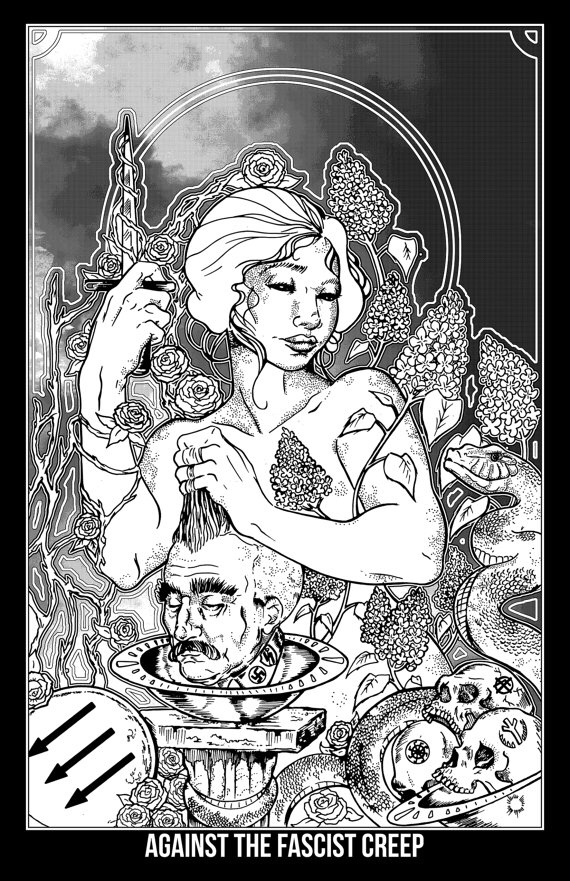
Alexander Reid Ross comes closer to the ideal with “Against the Fascist Creep,” but he gets into axe-grinding territory against anyone who’s gotten a little tired of hearing of him and others calling red-brown alliance wolf. Elizabeth Sandifer makes a noble effort in “Neoreaction a Basilisk” but at the end of the day it’s too narrowly focused on a relatively minor current, the titular neoreactionaries, to bear that much weight.

All this begs for the approach of critical intellectual history. Is it possible to attain at the moment? I’ll fudge and say “partially.” We lack the sort of distance in time that the best historical writing needs. Any conclusions are necessarily tentative. But you can start with a granular understanding of the forces at work in recent history, an ability to depict the dynamics of a moving target rather than static pictures, and a desire to encapsulate something large and diverse as both a coherent whole and a changing, fluid thing. Someone who can bring these to bear could really make the topic their own.

Review- Stern, “Proud Boys and the White Ethnostate” and HoSang and Lowndes, “Producers, Parasites, Patriots”

Review- Malaparte, The Skin

Curzio Malaparte, “The Skin” (1949) (Translated from the Italian by David Moore) – Curzio Malaparte was born Kurt Erich Suckert in the German-speaking part of Italy. He was an early supporter of the Fascist party, although (and here this “although” is often used in an exculpatory sense, but not really by me) he clashed a lot with the Fascist authorities and later in life became both a Communist and a Catholic. Really rounding all the twentieth century bases, there! He wrote a book on coups d’etat that’s still read today by nerds into that kind of thing, and if wikipedia is to be believed, this is why he was put into internal exile by Mussolini.

Internal exile or no, he still saw a lot of World War II. “Kaputt” takes place on the Eastern Front, where Malaparte was a reporter- I read it early in grad school, my introduction to the author. “The Skin” takes place in freshly-Allied-occupied Naples in 1943. Malaparte finds himself a translator for high-ranking American officers, who he likes in a patronizing kind of way. The Americans strike him as utter innocents, unable to understand Europe, unable to understand themselves as conquerors even as people practically beg them to act as such…

Like “Kaputt,” “The Skin” is made up of chapter-length vignettes loosely connected. I remember noticing in “Kaputt” that Malaparte put a lot of emphasis on the supposed Asiatic character of a lot of the Soviets he saw. In “The Skin,” you get a similar emphasis on the amount of black soldiers deployed by the Americans and the Free French, so I think Malaparte did have his racial bugaboos. Prostitution is the central metaphor here- Naples, having been conquered so many times over, is experienced in selling itself to conquerors, but the Americans hold their noses and remain above it, even while Malaparte depicts them as wading through European decadence and corruption up to their necks. There’s several stories lingering on sex work, especially interracial sex work, and many of the rest are about an international society of decadent gays that find their way to Naples, I guess, by following their decadence-radar. I think the centrality of these poorly aged metaphors maybe serves to explain why “Kaputt” is the Malaparte go-to (to the extent people are going to Malaparte) rather than “The Skin.”

Away from these metaphors, Malaparte adeptly combines the surreal and the all-too-real. My favorite story is probably the one where the American officers are served a fancy fish dinner by the remnant of the Neapolitan aristocracy. No one can fish in Naples’ heavily-mined waters, so they get served fish from the aquarium, including mythical beasts like sirens. Malaparte’s exchanges with the Americans are also often pretty good, with a good comic rhythm that almost inevitably ends with the American officer calling Malaparte a bastard but being unable to dismiss him. In all, an idiosyncratic work less good than “Kaputt” but worth reading for people into writing from the ideological gangfuck of pre-1945 Europe. ***’

Review- Malaparte, The Skin

Review- Stern, “The Politics of Cultural Despair”

Fritz Stern, “The Politics of Cultural Despair: a Study of the Rise of the Germanic Ideology” (1961) – German-American expat Fritz Stern was among the first to undertake intellectual history as directed at Nazism. In this instance, he looks at three German intellectual figures as precursors of Nazism: Paul de Lagarde, Julius Langbehn, and Arthur Moeller van den Bruck. They were most popular in the 1870s, 1890s, and 1920s, respectively. All three were “of a type;” self-made outsiders from petty bourgeois backgrounds, alienated from a Germany that seemed to be modernizing in all the wrong ways, reactionary but not down with the traditional elite, and scholars rather than organizers. All three embraced a view of history where Germany’s historical mission was as high and mighty as those holding it back — liberals, socialists, and almost inevitably, Jews — were low and ubiquitous. All three attracted big readerships.

You learn a lot about these three and their contexts, and a picture of German intellectual life in the late 19th/early 20th century as promising but with some deep issues emerges. Of course, being a mid-century intellectual, Stern throws himself bodily to protect poor innocent misunderstood Nietzsche, whose sister presumably made him say all that “blond beast” crap, but the picture is still a clear one for all that. It fills in a lot of context for what would come in the 1930s. This helped open doors that figures like George Mosse and other intellectual historians of fascism would walk through.

As the title and subtitle indicate, Stern sees the contributions of these men as twofold: as contributors to a Germanic ideology of romantic racialism and antisemitism, and as both early sufferers from and exponents of “cultural despair,” the idea that society was irredeemable short of (counter-)revolutionary change. Stern puts a lot of chips on cultural despair as an important concept, something that conditioned the German people to undertake extreme measures. In many respects, the emotional reality of this feeling — one gets the feeling Stern is doing some reporting here of something he witnessed while in Germany — is stronger and more relevant than the actual ideological content of what the three thinkers or those they influenced in the Third Reich actually believed.

This is a provocative thesis but I don’t really agree with it. Stern was a much more dab hand with ideological differences than many of his fellow American historians of the postwar consensus decades, but he seems to accept with them that ideology is a kind of sickness that can be explained psychologically or sociologically rather than a set of ideas and practices that deserve to be understood politically. Among other issues, this undermines his writing on his three subjects. They tend to run together, exemplars of a type — feckless intellectuals projecting their fantasies onto a complex reality — rather than individuals with differences and agendas. This is especially clear in the case of Moeller van den Bruck, who had more of a direct political impact than the other two, and was part of a movement, the Conservative Revolutionaries, that involved very serious intellectuals such as Ernst Junger and Carl Schmitt (neither of which are so much as mentioned). You don’t need to agree with or see as rational a given movement in order to try to understand it on its own terms.

All the same, the book is pretty good, well-written and with clear points, even when I disagree with them. Stern’s priors are clear- admirer of “real” German culture and foe of the ideological fervor, left and right, that would have loomed so large as he came of age during the Weimar period. And he’s not all the way wrong, especially with the terror of modernity that he saw gripping not just Germany at the end of the nineteenth century, but much of the western world. Moreover, it doesn’t seem like we’ve seen the last of something that looks an awful lot like Stern’s “cultural despair” rearing its head with the sense of thwarted greatness and petty malice that sweeps the land. ****

Review- Stern, “The Politics of Cultural Despair”

Review- de Grazia, “How Fascism Ruled Women”

Victoria de Grazia, “How Fascism Ruled Women: Italy, 1922-1944” (1992) – I had read de Grazia’s great book on the spread of American-style consumer capitalism in Europe in the early/mid-20th century, so was excited to pick this one up. She situates Italian fascism’s policies towards women as existing in a luminal space between the ideology’s misogyny, women’s efforts to make political space for themselves, and processes of modernization that both pre- and post-date the fascist era. For all of its totalitarian pretensions, the fascist state was never able to control and/or eliminate civil society the way Hitler or Stalin could. But it could promise just enough to the more bourgeois women’s groups to get them hopelessly entangled with the regime while eliminating any ability to act independently. More radical groups were quashed along with the left more generally.

There’s a lot of interesting stuff here. The Italian right believed itself to be in demographic decline (despite the numbers showing otherwise- their real problem was male labor migrating away) which put pressure on women to be mothers. Anglo-American consumption habits were both a lure and a threat, a level of living the regime wanted to be able to promise but also resented, in part because of the way it allowed women more independence from the home. Some bourgeois Italian feminists attempted to create a “Latin Feminism,” feminism that “respected Italian tradition,” which basically amounted to them getting their cut of power without sharing it with women of the lower orders, but even that didn’t hold the fascist regime’s interest. All told, a fine historical work tracing the delicate networks of continuity and discontinuity in women’s politics before, during, and after the fascist regime. *****

Review- de Grazia, “How Fascism Ruled Women”

Review- Rossliński-Liebe, “Stepan Bandera”

Grzegorz Rossoliński-Liebe, “Stepan Bandera: The Life and Afterlife of a Ukrainian Nationalist” (2014) – Ukraine! Tough country. Learning history seriously put a crimp in my desire to live in other time periods/places. Even leaving aside the toilet arrangements, in so many times and places there are just no good choices. Ukraine is one such place that finds itself in that position time and again, including right now. In this book, German historian Grzegorz Rossoliński-Liebe takes us back to an even harsher time, which has all too many echoes of contemporary Ukraine.

How to even describe Ukraine’s situation in the early twentieth century? Well, for one thing, there was a lot of disagreement about where it began and ended, who was a Ukrainian, and what being Ukrainian meant. After WWI, there were major Ukrainian populations in three or four countries and in none of them were they well-treated, between the famine and the terror in the USSR and minority status in Czechoslovakia (where they were at least left alone) and Poland (where they weren’t). Eastern Ukrainians were more culturally Russian where western Ukrainians were in uneasy proximity to Central Europe and especially the Poles.

Ukrainian nationalism was profoundly frustrated, especially in the west where, after the fall of the Austro-Hungarian Empire, there was no major power for them to look to the way Eastern Ukrainians looked (and look) to Russia. Frustrated nationalism in the early twentieth century was dynamite, dynamite sweating out little beads of nitroglycerin and waiting to blow. One of the men who slammed down the plunger on that little bundle of explosive joy was Stepan Bandera.

The son of a Greek Catholic priest (don’t ask me how Greek Catholicism came to be the national church of western Ukraine, I do not understand it) and raised in the Ukrainian part of postwar Poland, Bandera was the right (or, really, exactly wrong) kind of crazy for his time and place. A nationalist extremist from the beginning, he made his name by taking an already angry nationalism and bringing it to a higher boil, ever to the right, ever more purist, ever more violent. Schoolmates report the young Bandera as sticking pins under his fingernails and whipping himself with his belt in order to prepare for the tortures he expected from the Polish secret police. He was a real character.

He joined the Organization of Ukrainian Nationalists (OUN) as a youth and proceeded to help take the group in an ever more violent, fascist, and antisemitic direction. He built a following with younger, mostly Poland-based members. Like Hitler, he was one of those guys where people argue over whether he was truly charismatic or not — he was a dweeby little twerp who looks for all the world like Stephen Miller — but clearly had something that got him over with angry young Ukrainians. One thing that probably helped was the stark simplicity of his answers to the complex questions of Ukrainian nationality. Ukraine has a unique destiny, it’s defined by Ukrainian blood, and anyone foreign and anyone who stands in the way — Poles, Russians, Jews, democrats, communists, anyone who questions the Provydnik (leader) — need to be exterminated. This message proved popular and soon Bandera’s branch of the OUN has outstripped more moderate Ukrainian nationalists and began undertaking terror campaigns.

Bandera was in Polish jail for conspiracy to kill the interior minister when the Nazis invaded. From the beginning, Bandera and the OUN hailed the Germans as liberators (note- these were not Ukrainians who suffered from the famine in the USSR, this was Ukrainians who were somewhat discriminated against in Poland) and as the people who could help bring about an independent Ukraine. As these groups do, OUN had split, there was an OUN-B (for Bandera) and an OUN-M (for Melnyk, another fascist chieftain). When the Nazis invaded the Soviet Union and quickly rolled over much of Ukraine, these two competed to become the puppet government of Ukraine. Bandera had more popular appeal but Melnyk appealed more to the Germans, in large part because he was less egotistical and more pliable.

The early parts of the Nazi war against the Soviet Union saw massive atrocities carried out by both Axis soldiers and local civilians against Jews and other minorities. The book has numerous sickening depictions of Ukrainian nationalists teaming up with the Nazis to beat, humiliate, and kill Jews. Both OUN factions saw this as a positive thing at the time, the beginning of the great cleansing that would lead to a Ukrainian national rebirth. In some cases, the Germans even intervened to slow the Ukrainians down- they were getting too messy, too disorderly.

Of course, in the end, the Nazis did not want to see an independent Ukraine, even as a loyal puppet state. They wanted a slave colony. They were happy to use Ukrainians as muscle (like in the SS-Galizien division) but had no intention of making Bandera, Melnyk, or anyone else leader of a Ukrainian state. The Nazis wound up arresting Bandera, keeping him in a special division of one of the camps, a nice sort of place for high-end political prisoners like the last of the Hapsburgs and Otto von Bismarck’s grandson.

This turned out to be important, because both Bandera and the OUN (and it’s tedious subfactions and minor rivals) survived the war. While not giving up their fascist ideas, they pivoted towards the west and sought to aid in the American side of the Cold War. The CIA, as well as British and West German intelligence, made cat’s paws of numerous Ukrainians (and many others) with dubious war records, allowing thousands to slip into new lives in the west. They didn’t turn out to be that useful — there would be no “rollback” in Eastern Europe — but it allowed them to hold on. Moreover, they could enlist the Cold War propaganda establishment, including academic historians, to whitewash their crimes, defining away their fascism and turning a blind eye to the atrocities.

Bandera got got by the KGB in Munich in 1959 (the KGB tried to frame a Nazi war criminal in the West German government- too bad that didn’t work, would’ve been a two for one). This was probably a convenient time for him to die, from a Ukrainian nationalist perspective. He wasn’t too much use — the Americans thought he was too egotistical to work much with — and the promised Third World War that would allow the Ukrainians their next bite at the apple likely wasn’t going to materialize by then.

Instead, Bandera became a martyr, and more than that, a synecdoche for right-wing Ukrainian nationalism more generally. Diaspora Ukrainians carefully tended to his cult for decades. Soviet propaganda helped, too, by insisting any Ukrainian they didn’t like, even if it was just for speaking Ukrainian where they weren’t supposed to, was a Banderist. This made him a symbol for resistance even among Ukrainians who didn’t share his violent ultranationalism. Bandera managed to outlive a Melnyk, Bulba, and the other little fascist chieftains of the area to become this symbolic figure in time for Ukraine’s independence in 1991. While a many Ukrainians, especially in the more russified east, don’t really care about Bandera or his cause, a critical mass (especially in the west) see him as a key symbol for what the Ukraine should be. This is, to say the least, unsettling. In nearly the same breath, Ukrainian nationalists will uphold Bandera, insist that Bandera did nothing wrong and was a democrat (he hated democracy), and say anyway, it’s all the fault of those nasty Jews like Soros. If it’s for a western audience, they’ll throw in Putin too.

I, for one, love big fat serious books about the ideological madness of the twentieth century, and this fits the bill. It was Rossoliński-Liebe’s dissertation, and he’s very careful with his historiography (which always takes me back to my early grad school days, all that wrangling over defining fascism- good times) and evidence. If there’s one thing he didn’t address enough, I’d say it was “why Bandera” — why he got to be the symbol instead of his rivals. Was it just the martyrdom? The extremity? I don’t know. I do know this book got Rossoliński-Liebe in some trouble- between his claims about national hero Bandera and the gauntlet he throws at nationalist (and Cold War) historiography, when he came to Ukraine the only place he could do a reading was, ironically, the German embassy. Everywhere else was threatened to the point where they cancelled (and one gets the idea the Ukrainian academic establishment wasn’t thrilled to help out either). Bandera, who wasn’t above petty shit like that — no fascist, no matter how bloodied, is ever anything other than petty — would have been proud. *****

Review- Rossliński-Liebe, “Stepan Bandera”

Review- Civico, “The Para-State”

Aldo Civico, “The Para-State: An Ethnography of Colombia’s Death Squads” (2016) – More uplifting material! Italian anthropologist and… life coach? According to his website? Aldo Civico originally set out to do an ethnography on the peasants forced from the land in to urban slums in Colombia during its last spate of protracted civil war. Among these people he found people connected with those most responsible for their plight- ex-members of right-wing paramilitaries, most of them part of the infamous Autodefensas Unidos de Colombia, or AUC. While the communist guerrillas in FARC did not play with kid gloves, it’s estimated that it’s the right-wing paramilitaries that were responsible for a majority of the civilian killings and forced displacements over the course of the war. The people Civico first found were cast-offs from the period wherein the Colombian government, less in need of the services of independent right-wing whack jobs and their private armies, began demobilizing the paras, who typically either found employment in the drug trade or none at all. And so Civico set out to understand the culture they came from.

Most of it is what you’d expect. A few leaders mouth platitudes about how bad the communists were and how they were the ones really looking out for the campesinos, etc. The lower-level soldiers mostly talked about needing to join one group or another during the war, and preferring the paras for various reasons- the guerrillas had wronged them somehow, or the paras paid more, etc. Civico does get them to open up about violence- how violence for its own sake, spectacular violence, was at the core of what the paras did, how even leaders routinely got involved in killing every now and again “to keep in practice.”

Civico throws a lot of theory around. The stuff from Lacan, et al, is generally unhelpful, and most of them are insights Civico could have come to himself. His borrowing of Deleuze and Guattari’s idea of the “war machine,” the organically-evolved reticular body of people and forces that coheres to wage battle either against or orthogonal to the more orderly bodies of the state, is more interesting. The AUC really did harness inchoate social forces in Colombia — from the decentralized power of local landlords (and later drug exporters) to Catholicism to the particular vision of the good life of land-bound order to the reality of Colombia’s embedment in global capitalism — to create a lethal force along the grain of existing Colombian society and against those who would change that grain. Deleuze and Guattari typically see the “war machine” as opposite from and destroyed by the state, but Civico points out that war machines like that often wind up reducing opposition to a certain kind of state, clearing room for a given form of order- or, in right-wing Latin American terms, engages in cleansing (limpieza) a given space or society. The government can forsake them, but in many respects, these groups are the precondition for the sort of governance the government had — has — in mind. Never underestimate the murderous rage or native organizing capacity found in the space where money and privilege meet the shock of resistance. ****

Review- Civico, “The Para-State”

Review – Ross, “Against the Fascist Creep”

Alexander Reid Ross, “Against the Fascist Creep” (2017) – It took a weirdly long time for me to get around to this book, as I have read many (and lousier) examples of writing on our contemporary fascists… I think part of my brain slotted it as “anti-fascism,” which obviously I support but about which I don’t feel the need to go out and keep up with the literature. Memetic association with AK Press, I suppose.

Like most of our books about recent fascism, “Against the Fascist Creep” serves as something of a primer, and also advances a thesis on what should be done. Ross, an anarchist writer, also makes some provocative statements about fascism as a whole, dipping a toe into the perennial intellectual wrangling around defining fascism. Most of the latter turns on the “fascist creep” of the title- not gross haircuts with unwholesome habits saying repugnant things to trigger the libs (though it’s presumably a happy accident), but fascist entryism into and poaching from the left. This is both an interesting subject and an invitation to some fancy footwork around definitions of “fascist,” “radical right,” “populist” (and “left” for that matter) that Ross doesn’t quite carry off- some of his definitional portions get confused and this confusion finds its way to spots throughout the analysis, where you’re not sure whether he’s talking about fascists or mere “radical right-wingers” and what either might mean. This gets especially confused around Ross’s analysis of ideologies like anarcho-capitalism and libertarianism, frequent sites both of entryism and genuine sympathy to fascist ideas from people like von Mises and Rothbard, but that don’t quite fit the categories Ross lays out…

But for the most part, it’s an interesting and informative analysis. Anarchists have, by and large, borne the brunt of fascist attempts to enter the left, from infiltration of the punk scene to “National-Anarchists” trying to get tables at their book fairs. The snob in me wants to say this might have something to do with their lack of theoretical sophistication… but the trying-to-be-better-comrade in me also has to say that it probably has something to do with the ways in which anarchists emphasize going along the grain of people’s lived experience, and that many of them have been alert to these things more consistently than, say, democratic socialists have always been.

Inter-left inside baseball aside, the space of fascist entryism is an interesting one. I go with the Robin definition of left and right- the right is about bolstering (or reinscribing) hierarchy, the left is about distributing power downward and horizontally (liberalism is about rules- I say that in jest, but only partially). But, naturally, not everyone goes with the program. Horseshoe theory is mostly nonsense, but there is a point where people on both sides of the spectrum meet up- undertheorized anti-system sentiment. AFAICT, this is what Ross means when he distinguishes “fascism” from “the radical right”- fascism has an anti-system bias, or anyway rhetoric. This is far too much of a thin reed — most fascists usually wind up liking capitalism, the police, the army et al just fine — for me to place much emphasis on. But it is useful as a heuristic to see who on the far right could try to play entryism with the left. “Radical rightists” like the John Birch Society or the Minutemen would find it tough, given their attachment to both the structures AND the symbols of traditional power. But those who can eschew the symbols — skinheads, “national anarchists,” right-counterculturalists, “national bolsheviks” et al — can make a better try, especially when people’s guards are down. Ross does a good job encapsulating many of these efforts- his narratives are clear, interesting, well-written.

I’m not going to recap them here (just read the book if you want that- there’s so many weird little groups and fashy randos running around). There is a degree to which I was right about my initial impression- in certain respects, the thesis (if not all of the content) is about the left — how it needs to be careful about fascist entryism and vigilant in antifascism — than about the right. I want to illuminate a few interesting points about the stories Ross tells-

First, the dynamic wherein fascists after the end of the war flocked to the proverbial last men standing- who tended to be outsiders and space-takers when the fascist regimes were still in good shape. So you wind up with people flocking around fascist occultist woo-slinger Julius Evola, who Mussolini would barely give the time of day to, and the few remaining Strasserites (Nazis who were a little more mad about bankers than the dominant Hitler wing of the party) or “conservative revolutionaries” in Germany, never-wases like Oswald Mosely, or National-Bolshevism, a small but surprisingly hardy and insidious germ of fascist entryism.

Call it an example of the “cunning of history,” or natural (read- the Russians killed and/or the CIA stashed away everyone more important) selection, but this, in certain ways, helped them in a left-entryist strategy more than if more competent, central fascists had survived. Strasserites and Nat-Bols can pretend to be leftists, if you don’t look too close. Followers of Evola and other cultural fascists can even more more easily infiltrate the arts and various subcultures. Their very marginality under actual existing fascism provides an alibi- they weren’t really fascists, the arguments go, because Hitler/Mussolini/whoever didn’t take them seriously and sometimes vice-versa. Of course, that argument doesn’t hold water — Strasser was also a vicious antisemite, Evola if anything wanted a crueler state than Mussolini wanted, etc etc — but that requires research and argument, and entryists look for spaces where people won’t bother with that… like countercultures, spaces where people go more by feel — the feel of rebellion, of authenticity, whatever — than by thought.

Second, even taking into account Ross’s desire to warn and energize his readership, it really is notable, when you read about them one after another, how widely fascist entryism has extended its tendrils. Not always effectively, mind- I’d say it goes wide, but not notably deep. But especially in the period between the downfall of the global oppositional, anti-capitalist left in the late 1970s and, basically, the alarms that white behavior in the wake of the Obama election in the US began to ring, people really seemed to have their guards down about who fascists are, what they do, and why they should be driven out of anywhere they take a hold. When people lose the ability to name the structures of power — which, then and now, means capitalism and what comes with it — that opens the door to all kinds of silliness, which can turn insidious where it isn’t simply useless.

Anti-system — as opposed to anti-hierarchical-structures (like capitalism and racism) — thinking took hold hard in this time, and a lot of people who should have known better flirted heavily with what amounted to red-brown politics, though it seldom called itself by that name. People knew what Gavin McInnes was, or what Jim Goad was, or what Death In June was singing about, or what the post-Soviet Nat Bols were, in the nineties just as much as today. They just didn’t care, or felt there were bigger fish to fry in the form of “the system,” generally defined more by mundanity than oppressive power… This affected a wide range of actors: European Greens, anti-Zionism, anti-globalization movements, numerous artistic and literary figures who confused edginess with insight and freaking out the squares with a meaningful goal… we’re still shaking off the aftereffects of how badly the global left managed the fin de siecle, in this way as in many others, and some of them still don’t manage this stuff very well. In part, this is because the left for decades failed to articulate a meaningful critique of fascism, either relying on a Trotskyite (or Stalinist) catechetical definition, which doesn’t have much room to develop even where it’s strong, or else basically letting liberalism turn these issues into moralism, which tend to lose their force once, well, people stop taking the moral (or its messengers) seriously. It’s good we’re doing it now. Let’s hope it’s not too late. ****’

Review – Ross, “Against the Fascist Creep”