Caítlin Kiernan, Tinfoil Dossier books (2017-2020) – Horror! When it comes right down to it, a lot of the things that a lot of my friends like — not just like, define their lives by — are things I don’t like or, more often, that passed me by like a ship in the night. One of those things is horror. First, I was scared. Then, after years of reading about war, I was indifferent. I felt superior to those intrigued by — it was sometimes right to say “fans of” — mere serial killers. Their body counts were nothing next to what goes on in war, and their tedious psychological contexts always seemed dull next to what goes into war. Eventually, as my differences from others came to take on a somewhat less overweening position in my sense of self, I came to understand what my friends saw in horror movies and fiction, or at least to listen to them more. And some of them have been good enough to listen to me. In some respects, we draw similar things out of our respective generative uglinesses.
So I didn’t turn away when I started hearing about Caítlin Kiernan’s Tinfoil Dossier series. Among other recommendations, it combined what they like — horror, specifically material drawn from the Cthulhu mythos and The X-Files — and something closer to what I like: investigations, conspiracies. Cult stuff is one place where the horror kids interests and mine connect productively (not unlike antifascism as a bond between me and that other group I was always around but one of, the punks). The Tinfoil Dossier is a series of three short novels about rival conspiracies. From what one can tell, some seek to preserve the world against threats from outside of the knowable parts of space-time, some seek to hasten the end those threats can bring to human existence, others pursue obscurer ends.
I say “as far as I can tell” because Kiernan does not usually condescend to clarify. Sometimes, that frustrates me in writing, but Kiernan has the writing chops (one key- she doesn’t drag shit out, a little confusion goes a long way!) to carry it off with aplomb. You’re seldom sure who works for whom. The closest thing to a stable pole in her world is Albany (named after the city in which they’re inexplicably, but compellingly, based), the super secret Men in Black style organization that tries to prevent the end of the world and usually only just barely succeeds. Albany people, sometimes called “Agents of Dreamland,” go back and forth across the world trying to keep cultists and whackos, often with weird creepy powers, from completely destroying the world by summoning Cthulhu or implanting those zombie mushrooms in everyone or sinking the world to commune with dark sea god Dagon, on and on.
Unlike Will Smith and Tommy Lee Jones, agents like The Signalman (named after his large silver pocket watch) do not, in fact, make this look good. Albany routinely manipulate what few people with “special talents” that they can find who aren’t already spoken for by an Elder God to work for them, often using blackmail, brainwashing, or addiction. And even with abilities like being able to summon “the Hound of Tindalos,” a post-Lovecraft addition to the mythos that’s a sort of messed-up energy being that comes out of angular space and turns you into blue goo, they still mess it up a lot. Terrible stuff happens to them, all the time. And they’re not even dealing with Illuminati-style organized conspiracies! Just, like, small generational cults of fishy Welsh women who, admittedly, can do some fucked up magic. Kiernan writes a good action set piece, along with the other fun aspects of her writing. My favorite is when one of the Welsh ladies summons dark cold ocean water into a private jet going over a desert. That was freaky!
Kiernan tells the stories a-chronologically. Bits and pieces of the past, near-present, and future blob in and out of the narrative according to their own logic. I don’t think I’m spoiling anything major when I say, Elder Gods or not, humanity is still fucked. The waters rise, with or without Dagon, even if the human story goes on, unpleasantly human, to the Lovecraft cultists of the world. These were fun! I will read more horror, or anyway, put horror stuff in my rotation as I have been. ****’
John le Carré, “A Murder of Quality” (1962) – A little while back I read “The Spy Who Came In From The Cold” and it was outstanding, so I decided to read all of John le Carré’s Smiley novels, and maybe more of his work after that if I wasn’t sick of it by then. “The Spy Who…” was Le Carré’s third Smiley book. I read his first novel, “Call for the Dead,” a little while later, and that one was pretty good, and now I’ve filled in the gap with “A Murder of Quality” which, when you get down to it, isn’t really a spy novel but a crime novel.
George Smiley, Le Carré’s rumpled, diffident master spy, gets called in for a domestic job by one of his secretaries from the war. This secretary had gotten a job managing a Christian magazine. I assume the Anglican Church probably has a magazine, too, but I knew straightaway it would be a “chapel” magazine, that is, a publication for non-Anglican English Protestants. The secretary wrote the magazine’s advice column, and she got a creepy letter from a subscriber saying she was about to be murdered… then she was! Fuck!!
Naturally, given how weird it all is, she calls on her former boss Smiley, who hasn’t got a lot to do these days so decides to lend a hand. When you’re in the British spy biz you usually have all kinds of hoity-toity connections, and that comes in handy here. Stella, the murdered woman, was the wife of an instructor at Carne, an extremely fancy boarding school, where the brother of one of Smiley’s war friends also works, giving him an in to go investigate.
Le Carré said this novel was partially inspired by his brief time teaching at Eton. I guess he didn’t like it! He makes Cold War East Germany sound a lot more pleasant than British boarding school. While international intrigue doesn’t really figure into this whodunnit, in a way, it is more of a spy novel than a crime novel. A spy, Smile, attempts to infiltrate an alien and sinister society and manipulate its ways in order to learn its secrets. He only barely invokes the specter of the rape of minors — the main thing I think of when I think of British boarding schools — to get across how terrible it is! Mainly, everyone there seems to operate on some sick combination of self-loathing and self-love, propelled by institutional inertia and the miracle of compound interest on a foundation started four hundred years before.
I don’t want to spoil it, but what at first seemed like a murder (then murders!) based on class spite come to be based more on individual sociopathy. This was a little disappointing, truth be told. There were some decent exposition-switchbacks in the end but the real story seemed to come out of nowhere. I don’t think whodunnit was Le Carré’s thing, really. But he’s such a master of language, characterization, and pacing, it was still a respectable read, and I look forward to picking up the next Smiley. ****
China Miéville, “Embassytown” (2011) – I’m probably going to do a video on this! With a special guest star, as part of a new thing I’m doing. But I still figured I’d give a review.
China Miéville seems like a pretty cool type, genuinely committed to both genre fiction and to revolutionary socialism. In “Embassytown,” he does more or less straight up scifi! Though of course, Miéville seems the type to dislike having the phrase “straight up” ascribed to his writings, and there’s more than a little horror in here as well. In humanity’s future amongst the far-flung stars, there’s a settlement called Embassytown! It’s a little human spot on a planet dominated by a species they call the Ariekei, or the Hosts. In classic Miéville style, the author enumerates their many gross-sounding features but does not give a clear picture of what they look like. Roughly deer-like moss-bugs with coral extrusions that hold their eyes, multiple pairs of wings that are actually ears and/or arms, two mouths, various slimes, you get the picture. The Ariekei and the humans live more or less peaceably, with the humans sticking to the town with its breathable air and trading stuff back and forth, mostly goods the Ariekei biologically engineer.
The Ariekei speak a language, or rather, Language. It has two important features: first, they talk it out of both mouths at the same time, with said mouths each making different noises to make one word, and second, they can’t lie. Speech is thought for them, and vice versa, and they can only think/speak stuff that actually is. They have no word for “that,” for instance, just ways to specify what thing they are talking about. This creates communications problems! They couldn’t communicate with humans at all until the human started breeding people as twins of such a high empathy that they basically think the same thoughts? Or something? And can speak sufficiently in tandem to speak Language. Then, the Ariekei can understand. These twin pairs are called Ambassadors, and they and their handlers more or less run the human show on Embassytown, though a vaguely Hanseatic-themed human confederation technically has it as a colony.
Woof! All this happened in the past of the novel. In the present day, Avice is a child of human settlers who grows up on Embassytown and goes on to become an “Immerser,” which is to say, she can navigate the eerie nether space that is Miéville’s way of getting around the light barrier. She comes back with a linguist husband named Scile (who she doesn’t sleep with?) who is intrigued, naturally, by Language. Avice is also a simile in Language. In order to do similes, the Ariekei need for the thing they’re invoking to actually happen. So, using a human intermediary, they draft the child Avice to do a thing. She didn’t like it, which probably has to do with why she went out to space. But she returns to Embassytown just in time for a power play- the metropole sends a new type of Ambassador. They’re not twins! Just two guys! But it turns out that their Language is such hot shit that the Ariekei get addicted to it! Fuck!
I’m being a little facetious in my descriptions, as I seemingly can’t help but be with Miéville’s flashily “subversive” cleverness, but it’s a cool idea and it works well. It also ends a long middle period where the book wanders a little, as Avice slowly describes herself getting enmeshed in weird power/Language politics, with Ariekei who try to learn to lie, with other simile-children, with her husband and his increasingly unfortunate ideas about it all. But shit kicks off once the Ariekei get a load of EzRa (the Ambassadors all have names that are names that are also combos of names or at least nicknames- CalVin, DalTon, MagDa, etc). They quickly need to hear EzRa (who I don’t imagine as my friend Ezra, he’s a lot cooler) to function. And then they build up tolerance. And then EzRa refuses to fully cooperate with the other humans, because they’re fucked up and like being, as Miéville puts it, a “god-drug.” Then the Ariekei technology, seemingly all congealed out of bio-soup similar to that which the Ariekei come, get addicted to EzRa, and build up tolerances, and stop functioning, etc.
Soon shit starts to be some weird space-alien-drug-language-zombie-apocalypse situation! It’s pretty cool. You can’t ding Miéville for invention. The day gets saved, sort of, by some inter-species communication and language stuff. I’m not going to get too much into it, both to avoid spoilers, and because I want to get into the questions I’ve got with my friend on video! Stay tuned! ****’
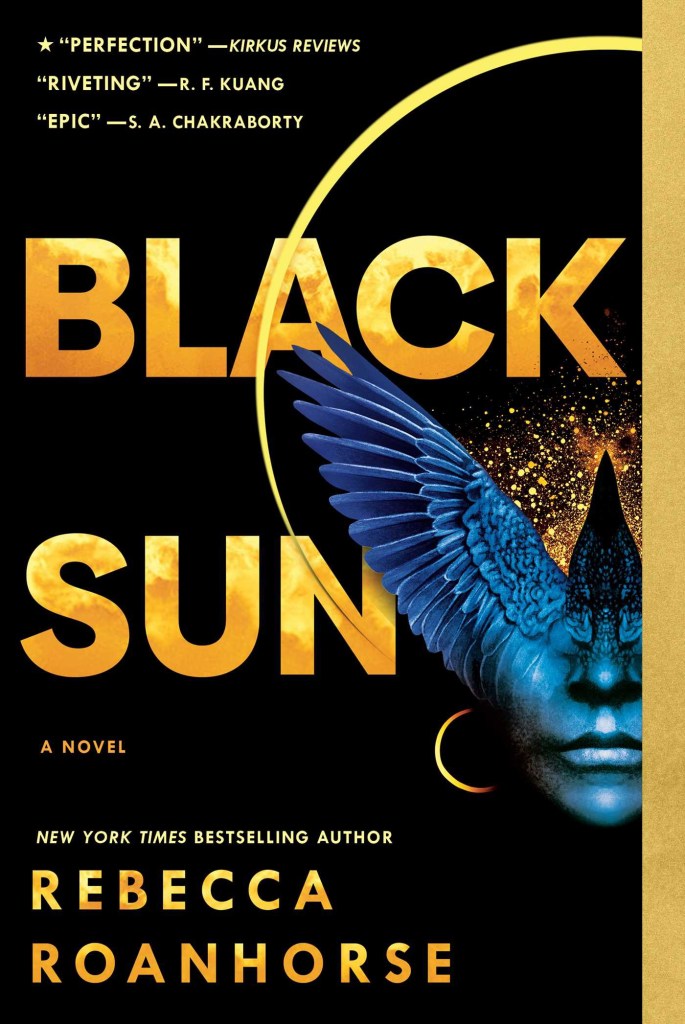
Rebecca Roanhorse, “Black Sun” (2020) (read by several actors) – I didn’t especially like this novel, one of the most hyped and praised fantasy works of the last few years, but more than even most books, it’s impossible to separate my reaction to it from broader context. “Black Sun,” like many speculative fiction novels in the last five to ten years, is meant to be a great victory for inclusion and new perspectives in its genre. Set in a secondary world based on Mesoamerican and Southwestern Native American history and mythology and written by a black woman who claims membership in one of the Navajo nations (according to Wikipedia, said nation disputes this claim), it promises a new departure in fantasy. No more “white farm boys going on quests,” as Roanhorse put it in one interview, no more whiteness-as-default. This was going to be something new.
Well… it isn’t. It just isn’t. It’s the same old fantasy crap with vaguely Mesoamerican trappings, and really, not that much of that. Special child of destiny, blah blah, Han Solo-style outcast rogue, etc etc, the world is on the precipice of dangerous transformation, yadda yadda yadda. And you know… that’s fine, I guess. I don’t love it, I don’t hate it. I like to paraphrase Adam Clayton Powell’s reaction to the Mafia hijacking of the illegal lottery in his district: “I am against the numbers in any form, but until the numbers aren’t played in Harlem, I want the black man to have the same chance to profit from it as the Italian,” or words to that effect. As long as anodyne same-same bullshit is what we’re doing, women, people of color, queer people, marginalized people of all kinds, deserve the same chance to write banal fantasy novels as anyone else, and throw in the same bowdlerized versions of what they think of as their culture as any white guy doing his Wagneresque nonsense.
But like… what a wasted opportunity! A Mesoamerican-based fantasy novel that actually tried something ambitious could kick ass! Hell, there probably are some… they’re probably out of print and don’t have social-media-active authors and/or fans to do shitty publishers’ promo departments’ work for them… but I do think it’s worth thinking about, with this explosion of interest in diverse representation in media, and at least some understanding of the histories and patterns of thought of historical cultures, why we get stuff like “Black Sun” instead of the more interesting works we should be able to expect.
Let’s start with what is missing in “Black Sun.” The plot is hackneyed and poorly-paced, the language dull, and the imagery not especially creative, but those problems are surmountable (though in descending order). What’s really missing is any sense of difference in the world. The characters act, talk, and think like genre stereotypes, though admittedly genre stereotypes of our time rather than the ones from days of yore by which we’re supposedly inundated. There is no indication that this culture, based, supposedly, on entirely different roots than European culture, produces different thought, or social structure, or really anything, even aesthetics. Roanhorse depicts the characters as dressing a bit different than standard Renn Faire garb, but you’d figure the one thing the author of this sort of work would nail down would be that the world would —look— different, and she doesn’t manage that. I thought the whole basis of this stuff was a sort of bourgeois liberal variety of ethnic essentialism, a kind of Twitter-bound Herder’s sense that every group has a unique way of thinking and seeing the world based on culture, environment, heredity, etc., but you don’t see any of that here, and you don’t see it in works that play similar roles but with different ethnicities represented, either- in or out of genre fiction. It’s maddening!
Some of the problems are not unique to the failures of the liberal representationalist model in genre fiction, but are broader problems, especially in SFF. There’s a lot of worldbuilding and it’s not done especially gracefully, and again, Roanhorse has the opportunity to make a world that seems really different — that has a different lived-in experience than however many Middle Earths and Westeroses — and whiffs it. The world isn’t the most laboriously built-out one you see these days, to Roanhorse’s credit, but it possesses the schematism that characterizes a lot of contemporary SFF worldbuilding. What I mean by that is you wind up in a world that may have secrets, but is otherwise ordered in rather rigid categories, worlds that could very easily be summed up in charts. You have these nations (that should be a worldbuilding gimme- it should not be new news to people who went through liberal education recently that the nation state should not be taken for granted!), you have these factions, these gods, and this type of person is characterized by X, Y, and Z, while the other type of person from whatever faction can be characterized by A, B, and C, on and on.
Tolkien’s worlds weren’t like that- Gygax, Arneson, et al had to do a lot of work to rationalize his world (and Moorcock’s, and Vance’s, and who knows how many others) into playable schema. To say there’s been a dialectic between games and SFF writing might have been accurate in their day- at this point, the overlap is nearly comprehensive and defines SFF writing more than it does games. This isn’t a problem in and of itself- some good fiction has been inspired by games. But it can be a problem when the schematic categories of gaming come to define, in an insufficient critical way, worldbuilding, and in some cases character work and other aspects of writing. It doesn’t help matters that some of the most successful franchises of all time are heavily schematic: Harry Potter and it’s houses, Game of Thrones and it’s factions, on and on. It doesn’t help that such categorizations loan themselves readily to the kind of fandom identifications that help drive sales (you have to figure the recent craze for astrology plays into this dynamic too- “I’m a Taurus Ravenclaw etc etc!”), – and to the sorts of stories — star cross’d love across the ill-delineated faction lines being most prominent — that people want to read (over and over again). I don’t know if whole online communities are going to start delineating themselves by Roanhorse’s four castes of the academy of the holy city or whatever just yet. I can’t say whether Roanhorse wanted that to happen when she wrote the book, or that it matters- because that’s the thing with tropes and cliches, it’s not some conspiracy. It’s just the path of least resistance.
It seems that a community of fiesty critics and writers have arisen that share some of my issues with contemporary SFF, and they have recently taken to describing the dominant strain in it these days as “squeecore.” These critics name the following as the traits of squeecore: a shallow emotional range that mostly does either maudlin or glib; heroes who feel like adolescents even when they aren’t; genre send-ups that were stale twenty years ago; aversion to the dark or strange; influences from anime and video games; humor “stuck in the aughts”; superficial dedication to diversity and other liberal values, generally affirmed by the triumph of the hero. The original promulgators of this critique were maddeningly unspecific about who they had in mind, and mostly only named big figures well outside of striking range (like Joss Whedon).
I think the concept is a valuable contribution to the critical discourse, but could use some work. There’s a certain “opposite day” tendency in the criticism that sees qualities lacking in squeecore — mainly darkness and sexiness — as the sine qua non of quality genre fiction and as lacking in the unfortunate SFF of today. I don’t think that’s quite right. Maybe it’s not the quality of darkness and sexiness they want, but you can’t say that “Black Sun” doesn’t do dark, or sex. It’s just anodyne, predictable, and even if the situations — the inevitable world-doom/structural oppression combo the heroes will fix however many bloated books in because hashtag-love-wins; the sexual politics ported in straight from contemporary Twitter — weren’t so hackneyed, the writing is not up to the task. Dark and sex won’t fix the problem, and really I think few aesthetic fixes will. But maybe I think that because my aesthetic sense is limited. My solutions are pretty limited, as well- learn more, I guess? Challenge yourself? A ruthless criticism of everything existing? Maybe that would help me critique contemporary literature more effectively but something tells me it is, to borrow a phrase from one of my critical masters, shooting nerf darts at a T-Rex.
Because why should Rebecca Roanhorse or her many, many readers care? Why should they challenge themselves? Why should they be more critical? They’d clearly rather not. It won’t win you any popularity contests- you’ll still deal with the same chuds who hate anything thoughtful, even anodyne liberalism and boring writing, plus all the anodyne liberals and boring writers will hate you, too. And it’s not like Roanhorse wrote a bad book, just a mediocre one. And the world’s burning and emerging fascism etc etc. I get that. I will say that I think many of the same faculties that could maybe get us out of the whole “burning world” business with something like civilization intact are the same that maybe might get us a better literature, genre and otherwise. Similarly, I think that a lack of imagination, of criticality, and of ability to take on a range of difficult emotions and ideas, and the complacent belief that because you’re not awful then you must be good enough, really isn’t helping, anywhere. **’
Hao Jingfang, “Vagabonds” (translated from the Chinese by Ken Liu) (read by Emily Woo Zeller) – Here’s the thing with Ursula Le Guin: she didn’t go on for six hundred-odd pages at a pop. I know, I know, Saint Ursula could do no wrong and if she did write about the feelings of scifi people for six hundred pages we’d all eat it up and ask for seconds, but, the point stands. We should not neglect something that differentiates genre fiction from literary fiction, historically: a keen awareness of the reader’s patience. True, many a SFF classic strains that patience, but it usually does so with worldbuilding and action sequences, and a lot less with attempts to plumb the depths of character.
Critics sometimes compare Chinese scifi writer Hao Jingfang with Le Guin, which is where this opening gambit comes from. But even leaving aside the fact that Hao’s freshman effort weighs in at a robust 624 pages, the comparison shows the weak chops of a lot of genre criticism these days. You don’t need to hate “Vagabonds” to see the differences- I didn’t love it, I didn’t hate it, I’m confident in saying Hao is no Le Guin (which she doesn’t claim to be, as far as I know). “A woman writing scifi that’s not about space battles and has characters with inner lives and social commentary, must be a second coming of Le Guin!” is just dumb even if you think Hao has the chops to merit the comparison on quality grounds.
“Vagabonds” is about a small group of kids raised on a Martian republic in the 23rd century or so, who go visit Earth for a few years, and then come back. Hao depicts Mars as a sort of technocratic utopia; Earth, meanwhile, is its capitalistic, nationalistic self. You don’t see much of the trip, except as flashbacks narrated by the main character, Luo Ying. What you see is their homecoming. Most of them went out when they were thirteen and came back eighteen. And now they’ve got feelings and opinions about the comparative merits of Mars’ system versus that of Earth!
Given that this is a writer from China, it’s pretty impossible to avoid seeing some overlay of comparisons between China and “the west” here. Ken Liu, the translator and a big SFF writer himself, downplays these comparisons in an essay somewhere, but it came off pretty literal-minded. The strict technocracy of Mars — everyone lives in one big (glass! Lot of sand on Mars) city, everyone’s basic material needs are met, everyone joins an “atelier” workshop when they graduate and they’re all coordinated according to master plans established by engineers and scientists — does not strongly resemble China’s current system. But it kind of does seem like the symbolic relationship between the two systems does rather resemble that of contemporary China and contemporary US/Western Europe. Hao represents Mars as serious, planned, aimed towards high values, but also authoritarian (though not notably violent) and conformist. She depicts Earth as free, fun, valuing the individual, but also corrupt and shallow.
Well… the kids have feelings about it. There’s an interesting bit early on where Luo Ying interacts with a film director from Earth. The director is starting to dislike Earth’s shallow consumerism as Luo Ying starts to disdain Mars’ authoritarianism, they pass like ships in the night, both idealizing the systems the others are trying to escape. Time goes by and Luo Ying and her peers grow more and more restless with a life of assigned workshops and such. They act out by doing stuff like “borrowing” planes and flying around Mars’ valleys and so on without permission. They get angst, make plans. Luo Ying finds out terrible things about her parents, who were also dissenters, and her grandparents, who helped engineer the Mars system and possibly her parents demise.
It’s not bad, but it’s also not great. There’s a lot of characters, and most of them are hard to distinguish, especially the rebel Martian kids. Hao does a lot more telling than showing when she wants to get across the heightened emotional states of her characters, and you gotta figure translation isn’t helping. But also, like… no one seriously addresses a serious believablity question. A fragile ecology in a place where the atmosphere and temperature could kill you — Mars has not been terraformed, in this story — easily seems kinda like not the place to complain about “authoritarianism”? Especially when said system isn’t that violently repressive and mostly sticks to managing the technical systems keeping everyone alive? I get that these are kids and kids complain and act up. And they don’t really overturn anything- that would be besides the point, which seems to be, every system has it’s good and bad points but people need to express themselves etc etc. All well and good but it kind of seems impertinent when the wolf (or radical decompression) is at the door, and isn’t an interesting enough idea to really rocket the book past it’s sleepy pace and uninteresting characters… or to Le Guin comparisons, though Hao is young yet. ***
James Ellroy, “Widespread Panic” (2021) – James Ellroy returns to his bread and butter in this story of blackmail and obsession in fifties LA. You can argue he’s never left his bread and butter, but his most recent series, which he interrupted with this book, is a little off the beaten path. “Perfidia” and “This Storm” take place during WWII, involve more geopolitical intrigue, an effort at a sort of Balzacian encapsulation of the whole time and place of wartime Southern California, and also get into the strange and unlikely master plots that animated arguably his single greatest novel, “Blood’s A Rover” (don’t go off and read BAR if you want to start reading Ellroy, read the beginning of its series, “American Tabloid,” first)… but can’t quite nail it like that book could.
I’m still along for the ride wherever Ellroy, to my mind the great living American crime writer, wants to go… but it was nice to reunite with the more mundane LA scumminess that’s his old go-to. Our narrator this time is Freddy Otash, a (version of) a real life Hollywood private dick, supposedly one of the bases for Jack Nicholson’s character in “Chinatown.” As in real life, Otash in “Widespread Panic” is an ex-LAPD cop who works for “Confidential” magazine in the 1950s. “Confidential” turned the scandal rag into an art form and an ideological statement, and is among the main influences on Ellroy’s famous telegraphic/bebop-inflected writing style. Otash has the run of fifties Hollywood, gathering gossip on the stars for “Confidential,” arranging blackmail and shakedowns using the information he finds, threatening or just mauling anyone who threatens the business, etc.
If you’re looking for tightly-plotted detective work ala Ray Chandler or whoever, you won’t find it here. The plots here are mostly forgettable. Otash gets tangled up with figures ranging from JFK to James Dean. Importantly to Ellroy’s whole thing, he also gets tangled up with a variety of women- a floozie actress who leaves him for one of the bad guys, a giant college basketball player who flirts with him but refuses to have sex with him, an ex-communist with a deadly grudge, and one of Ellroy’s classic good hardass Midwestern women who have to make it in this awful town types.
The women are important thusly: in Ellroyland, like I discussed in my Jacobin piece on him long ago, romantic love for women constitutes the highest good a man can reach for, and what distinguishes good men from bad. Otash feels himself superior to the main villains in this novel, the minor actor Steve Cochran and Nick Ray, the guy who directed “Rebel Without A Cause,” despite the fact that, from most readers’ perspective, they’re a lot alike. They’re depicted as violent men who are obsessed with control and with voyeurism. They obsess over women and pursue them both openly and on the sly- they are stalkers. Otash is friends with James Dean for much of the book, but loses him to Nick Ray’s evil cadre surrounding the “Rebel Without A Cause” production. Ellroy puts a lot of weight on a scene where Otash finds the “Rebel” crew — Dean, Ray, Sal Mineo, etc. — do a frat-style “raid” on a sorority house. It’s a little more violent than what Animal House would get up to, but mostly involves yelling at women and stealing their underwear. Bad behavior, no doubt, Otash is right to be disgusted… but he does the same shit! He routinely breaks in places and does weird voyeuristic shit! All Ellroy protagonists do, and Ellroy used to himself! He’s a weird dude!
How, then, does Ellroy cop a judgmental attitude towards his villains? It comes down to a few differences that would register to most of the people reading this as aesthetic more than anything, but which for Ellroy make up the heart of his romantic-noir ethics. It’s in the way you go about things, and what backstops what you do. If you love the right kind of woman — a hard, difficult, protagonistic woman who is just off on her own weird trajectory — then you are among the blessed. Steve Cochran and Nick Ray just run around fucking whatever, which Ellroy protagonists also do, but you know, they either stop when they meet The One (or A One, anyway) or view all future assignations through the lens of one of the Divine Women.
I found myself wondering what the relationship between Ellroy’s protagonist-thugs, the divine (whether expressed as a woman or more conventionally), and rebellion as I read this curious book. Like “Confidential,” Ellroy does not love or necessarily even respect duly appointed authority, but he tends to despise those who rebel against it. Ellroy protagonists, Otash included, routinely rip off their (invariably crooked and thuggish) bosses in police departments or wherever else… but they don’t make a principle out of it. Rebellion as a principle is verboten in Ellroy. Much of the early part of “Widespread Panic” concerns Hollywood communists. They’ve already been raked over the coals by HUAC, and can’t really do much, but Otash and Ellroy still give them some juice. The runaround he gets into with them, politics aside, is a little… it’s fine, but not as good as the other parts.
Considerably more compelling in this vein of rebellion is Otash’s disgust for the (somewhat anachronistically early- the main action of the book ends in 1956) emerging counterculture. He doesn’t hate gay men, like his erstwhile pal James Dean, or drug abusers (Otash pops benzies like they’re going out of style). But he does hate people who go around acting like they can upset the applecart, morally or culturally speaking. Part of that might be good business- a blackmailer has much less to do in a morally permissive society. But beyond that, it seems to me that maybe Ellroy thinks copping an attitude of rebellion — whether it’s riding motorcycles too fast and making “blue movies” or following the Moscow line — means abandoning the straight and narrow, not defined by staying away from booze, drugs, sex, violence, and betrayal — that’s boring — but defined by certain patterns of devotion, like those Ellroy’s protagonists have for the divine women.
Satan was the first rebel, after all, and whatever else you want to say about the politics of Ellroy’s takes, there’s few better at getting across the airheaded but vicariously vicious posturing of rich, decadent types who think they’re above morality or respect, let alone devotion. This comes out in Ellroy’s treatment of the case of Caryl Chessman, a convicted (and confessed) rapist who became a Hollywood cause celebre. I’m also opposed to the death penalty, but Ellroy made opposition to gassing (they used gas in California back then, creepily enough) the guy seem like pure envy- they love Chessman, these Hollywood liberals, Nick Ray included, because they want to be bad like him, because they lack the sort of moral rectitude that differentiates an Ellroy protagonist… even when said protagonist is also a murderer and a creep. That Otash tells this all from Purgatory, where telling his stories brings him closer to salvation… well, it’s a weird and thought-provoking book, and I’d say upper-mid-tier Ellroy, which at this point means top-tier of contemporary fiction. ****’
Neal Stephenson, “Termination Shock” (2021) – I recently had the inspiration to google “Neal Stephenson net worth.” The internet seems to know what every even mildly famous (Stephenson once said he was probably about as famous as the mayor of Des Moines- figure maybe we could bump him up to, I dunno, El Paso mayor status now?) is worth, or at least gives a confident-sounding answer. The answer the Internet gave for Neal Stephenson is eighty-five million dollars. That’s a lot! It makes sense, given that he’s been a bestselling writer for a while, but more so because he is a friend of — and his work is an inspiration to — tech billionaires, including the current biggest of all, Jeff Bezos. Something tells me those nerds probably let slip a few tips to the old beard-monger (he’s not that old or that beardy these days, granted) when they’re in their cups, geeking out with the dude who wrote “Snow Crash.”
I’m a materialist, so I’ll just say it: I think Stephenson’s proximity to/immersion in the world of rich tech people has dulled his imagination, blunted his literary ambitions, and (along with what I can only imagine is soft-touch editing) encouraged several of his bad traits as a writer. I’m a dialectical materialist, of sorts, so, naturally, I will complicate this assertion. I don’t think money necessarily leads to bad art. I do think that the mental/cultural/aesthetic space of contemporary rich people ala Bezos is so profoundly anodyne that spending enough time in it will, almost invariably, infect a person with its banality. Moreover, depicting the anodyne space of “bizjets” (as Stephenson invariably calls private jets at this point), high-end hotels, conferences, etc in a way that doesn’t numb the mind… well, my favorite filmmaker, Michael Mann, has to expend all his talent to make settings like that compelling, and he only has to do it over the course of a two hour movie, with frequent dips into more interesting environments (“The Insider” is one of his harder movies to watch in part because of this issue).
Neal Stephenson is, in fact, a major talent, though I wouldn’t say a prose stylist in the way Mann is a cinematic artist. His talent is a cobble of ideas, capable genre chops, ambition, and flaws. You know what doesn’t have cobbles, or if they do, they’ve been artfully arranged by mercenary art school grads for maximum soullessness? The world of billionaires. And that is the world where we live in for most of “Termination Shock,” Stephenson’s go at a climate change novel.
The idea here is that in the near future, a Texas billionaire (who, god help me, I can’t help but imagine as Rod Strickland, Hank’s boss on “King of the Hill”) starts shooting sulfur into the atmosphere to abate climate change. He invites the Queen of the Netherlands — Stephenson likes to introduce her in any given section with her fusillade of names, but mostly, she goes by Saskia — and elites from other low-lying areas to look at his Big Gun for shooting sulfur-shells into the atmosphere and help advance his plans. This puts Saskia, here depicted as just a sensible, self-aware lady trying her best, into a whole political thing. Meanwhile, Canadian Sikh action-guy Laks (Stephenson is a words and ideas guy who loves action-guys, more later) goes to the Punjab to connect with his roots through learning advanced Sikh stick-fighting, and winds up in some weird fighting with the Chinese in the Himalayas. Then these things get connected!
I’m aware of where criticisms of Stephenson usually land- on the politics of his ideas and postures, and sometimes, as an afterthought, on his prose. I’ve been doing this long enough that I accept that his politics won’t be like mine, and I more or less accept his prose, too. The big red flag for most people will, naturally enough, be geoengineering (trying schemes to reverse climate change). I am not a scientist or engineer. Here’s what I know: most people I know with an opinion on geoengineering are firmly against it, and that includes a substantial subset made up of every actual scientist I know and have heard opine on the subject (a substantial minority of science-enthusiast friends are pro-geoengineering); that our system, and especially the individual billionaires involved, probably shouldn’t be in charge of anything more important and dangerous than a pair of soft shoes. So, basically, not too dissimilar to nuclear power, except I could see a situation where nuclear power was key to the future, and even Stephenson seems to only see geoengineering as a temporary measure…
Anyway! Stephenson clearly —likes— geoengineering schemes- why wouldn’t he? He likes big, ambitious technoscientific schemes. But you might be surprised how little he dwells on opposition to geoengineering, especially for a dude who in other novels makes his dislike for critics of ideas he sees as important through turning them into truly obnoxious villains. True, his characters invokes “the Greens” as an ever-present force blocking progress, but that’s mild stuff, for Neal. The politics he’s concerned with is great power stuff and in the end, he treats them all alike- looking out for their interests (except the US, which he treats as something of a basket case that can’t really act in its own interest- fair enough). There’s some China-baiting but by the time the book reaches a denouement, the Chinese are not the problem. By the end of the book, he’s making a decent point, even, not about geoengineering so much as maybe, even if we “need” billionaires and terrible governments to do big important projects, they should also not cowboy around doing whatever without talking to each other. I think most of can agree that communication is good (the most communication I want to make with a billionaire is “hand it over and get in line for your turnips with everyone else” but, you know).
So, no, it’s not the politics that makes this probably the worst Stephenson novel. Rather, the politics is infected by the same anodyne, under-thought but over-elaborated, quality that makes the plot, writing, and characterization bad. Basically, it’s a very dull seven hundred pages. It’s a thriller — Stephenson has clearly long loved airport thrillers ala Grisham but has only indulged in writing them the last decade or so — that seldom thrills. That sucks, because Stephenson has packed big books before with stuff. If it wasn’t discussion of ideas, it was fun incident. But, god help me, the world Saskia inhabits just can’t be interesting no matter how hard Stephenson tries (I don’t know how hard he’s trying). Witnessing the aftermath of climate catastrophes (like a pretty horrifying-sounding beachside mass-drowning in sea foam) having a love life, getting ratfucked by the Chinese and their deepfake schemes, could be interesting, but aren’t. They’re written like so many depictions of flying around in “bizjets” and attending conferences. It is almost determinedly boring, like he’s trying to prove some kind of point.
What of characters not trapped in the “air-conditioned nightmare” of beige rich life? What about Laks the Sikh stick-fighter? Well, it’s a little more interesting. It sounds absurd at first, that India and China would restrict their wrangling over deglaciated Himalayan real estate along their 1962 ceasefire line by having “volunteers” fight with sticks, rocks, and fists. Stephenson waxes thoughtful on the long history of “performative war,” which wasn’t particularly persuasive on why someone wouldn’t just use a knife or a gun, and why the invariable casualties (rocks can also kill you!) wouldn’t produce the sort of outrage that would escalate the situation… but it is true that not everyone uses every weapon they have. Stephenson relies on the example of nuclear weapons- I thought more about fascist versus antifascist confrontations. Who knows what will happen post-Rittenhouse verdict — and if the fascist right thinks they’d have more than a momentary advantage if things went to the gun, they are wrong, guns are plentiful in this country and they can’t organize for shit — but for now, there are practices that contain the escalation of the violence.
So, in principle, the “Line of Actual Control” storyline passes the sniff test, and the action was more interesting than Saskia flying (herself- you see, she trained as a pilot, so she’s not just some useless scion of unearned wealth, oh, no!) around. But let’s talk about the non-grossly-wealthy characters in “Termination Shock.” These are mostly Laks, who briefly becomes a social media celebrity for leading a crew of Indian stick fighters against Chinese opposite numbers, and Rufus. Rufus is the inevitable standin most Stephenson novels have for the wisdom of the American heartland. This time, the stand-in is, like Nas, “all races combined into one man” instead of being just a white guy, but mostly Stephenson identifies him as a Comanche. He gets involved in the action by rescuing Saskia and the Dutch royal crew from thirty to forty feral pigs when they visit Texas at the start of the book.
Here’s the thing- Rufus’s story, about how he got obsessed with feral pigs after one ate his kid, how he developed state of the art feral pig hunting techniques, how he read Moby-Dick after someone compared him to Captain Ahab, etc etc… it’s both the best part of the book, action wise (and comes to a halt once the Texan geoengineering billionaire hires him to attend to the dry fart of the plot), and the prime symptom of the patronizing ventriloquism Stephenson has long done with working-class characters, and which has gotten worse as time has went on and as Stephenson moves in more rarified social circles. Rufus is a noble savage in a peculiarly old-school mode, not so much Tanto as the sort of Native American imagined by Enlightenment types- simple, noble, formal, thoughtful, rational even if attached to strange cultural norms. He is contrasted to ignoble savages, like (white American) people who try to fight Laks for being Sikh, and, implicitly, the white heartland Americans who have let Stephenson down by supporting Trump and otherwise seceding from consensus reality. As for Laks, he’s Stephenson trying to write his way into the head of a good-hearted, smart but not especially verbal, athletic/mechanically-inclined guy. You get these a lot in Stephenson novels, but they’re usually side characters, and so you don’t see the strings quite as much. Let’s just say Stephenson’s loquacity as a writer and the supposed strong silent types he writes make for some odd contrasts.
One thing you can say for Stephenson’s working class puppets- in the end (and the back quarter is much better than the preceding parts), everyone is a puppet, blown along by forces greater than themselves, even queens and billionaires and people trying to make new countries out of geoengineering-happy low-lying rich countries (and a few impoverished Pacific Island countries fronting for them). Climate change, capitalism, and great power conflicts are so big no one can entirely manage it, even the billionaires or powers like India and China. That’s true enough. But between the lack of much to say about this state of affairs, and the hundreds of pages he makes you spend in beige billionaire hell…between both Stephenson and Kim Stanley Robinson writing climate change novels that are, above all else, failures to imagine radically different ways of arranging things (even when both have imagined precisely that in other works!), it’s not an encouraging picture. **
James S.A. Corey, “Leviathan Falls” (2021) (read by Jefferson Mays) – Well, at long last, here we are! At the end of The Expanse! What a long, strange trip it’s been… well, a long trip, anyway. As you know, I’m behind on reviews and trying to catch up. That is a problem, because this book is deeply unremarkable and I remember little about it. And it’s sad, because I do think the Coreys (it’s a house name for two guys) tried to do something ambitious here. Humanity, in its hour of need, “groks a rock” (a giant alien data storage device) and learns the history of the universe! In honestly pretty bad pseudo-dreamlike prose. Jellyfish-neuron-people figured out space, also figured out how to use alternate-universe-energy, built gates between stars, and then got iced by the alternate-universe beings. Now those alternate universe beings are mad that humans are using the juice again. Also, the (former, sort of) dictator of humanity decides to try to hive mind us up, like the jellyfish folk, on the idea we’d be both more able to cope with the universe, and happier.
It’s not terrible but not great, not so much bad in and of itself and more dispiriting that this is the best we can do. Among other things, I’m not saying that the Coreys need to hop on “team hive mind” but pretty much everyone right away rejects it, even after former-dictator guy tries the soft sell (he soon goes hard, natch). Certainly the characters do, because, after all, they are Characters, with Feelings and Development and Subplots, so no go. But wouldn’t the extras maybe kinda like being part of a larger whole and forgetting their egos? I’m pretty egotistical and even I can see the appeal. Arguably the most dispiriting part was when characters, in their internal monologues, would list off the things humanity would “lose” if we became an all-powerful, strife-free hive mind. If I remember right, these things we stood to lose include “prayers,” “jokes,” “first dates,” etc. There they go, tempting us with a good time!
Eventually, perspective dullard Jim Holden apotheosizes and saves the galaxy, but at a cost. Heart o’ gold zombified thug Amos gets to live on and on, various other characters that I guess I’m supposed to have feelings about, after spending thousands of pages with them, go their various ways. Fine, fine. I guess this is what people want. I’m just kind of baffled. It all seems… mismatched. The ambitions of space, the familiarity of every dynamic they threw up there, the sheer size of the work and how little gets done with it. I guess people want… same-same, repeated at nauseum, and in settings you’d think would reward creativity? That last part… is it spite? Probably not. People just like variety, is probably the simpler answer. I don’t know. The end. ***
Gene Wolfe, “The Urth of the New Sun” (1987) – Gene Wolfe wrote “The Book of the New Sun,” a quartet of novels (that can — I would say should — be read as one) that ranks among my favorite works, and probably the hardest to describe among literary favorites of mine. It is the story of Severian, an orphan raised by a guild of torturers and executioners in some far future Urth (the spelling turns out to have more meaning than flavor- maybe? See below) where the sun is guttering out. Severian has a perfect memory, clinical depression, a way with the ladies, a destiny, and arguably the greatest prose stylist in scifi/fantasy history behind him. The story is told in past tense- Severian is using his perfect memory to recall his youth, his adventures, and his ascension to the role of “Autarch,” emperor/representative of Urth, and due to scifi shenanigans he has more than one consciousness in him. The story goes back and forth across space and time, and if you get lost, it’s in the best possible way.
Wolfe — an unassuming man, for all of his talents, who died a few years back, not a strutting fool and/or a gormless nerd like so many big name scifi/fantasy writers — decided his follow-up would be… a follow-up. “The Urth of the New Sun” follows Severian in his ascendance past the Earth (or Urth?). This is an interesting decision for Wolfe to make. We leave the New Sun books as Severian the Autarch learns that being Autarch is basically about answering for Urth at some sort of divine/alien space/time tribunal. He gets on a spaceship and goes, the end, more or less. Do we really need a tale of Severian on the spaceship?
Well, having read it, I’d now say “no,” we don’t need as, it turns out, the world needed (but probably doesn’t deserve) The Book of the New Sun. Among other things, Wolfe can’t quite manage the creative farrago he did in the original series, strategically revealing what was going on behind all the weirdness, keeping other things concealed, switching out truths for lies and vice-versa until you barely cared anymore and just went with the story. This one does something like that but less so- the flipped cards stay flipped (“floop the pig!” as they’d say on a show that I think might have drawn some inspiration from Wolfe), confusing aspects stay confused, it is less elegant.
But it’s still pretty good. Wolfe’s prose style — dense and allusive but always flowing and alluring, not unlike a lava flow, how beautiful and crushing it is — carries the reader along. It might have helped had I read this closer to when I read the New Sun books, as there’s a lot of call-backs, but it’s hard to forget Thecla, Jonah, the Green Man, and the rest (some of Severian’s lovers — Severian being a lady’s man on top of everything else isn’t as cheesy as it sounds but is the closest to cheesy Wolfe gets here — are a bit interchangeable, tragic women of power usually)… Just sometimes hard to forget where Wolfe left off with them.
Especially because his spaceship, in keeping with relativity (or some other science stuff, who’s to say really), is also a timeship! And kind of a… temporal realm ship? There’s some Kabalistic metaphors here, where Severian and company, after some spaceship stuff, wind up higher up the Sepiroth, the Tree of Existence, snd then have to go back home. Among other things, this probably confirms what some of the old Wolfe-heads say- Urth ain’t Earth, but it’s close (and possibly upside-down- there’s reasonably good hints that the city where Severian is born is meant to be alternate dimension far future Buenos Aires, but the Plata/Gyoll flows the wrong ways, the jungles and mountains are on the “wrong” direction, etc).
In the end, Severian does the thing. You kind of know he will. The suspense of that was never the point, though seeing what Wolfe could yank out of his bag of tricks to complicate matters is part of what you’re plonking down time and money to see. There’s some time travel (including retconning/retroactively-establishing stuff in the prior books), some Christian symbolism (Wolfe was a devout Catholic, but I question how the claims made that his works are directly devotional), and then Severian finally gets to get a rest. Wolfe wrote two more series, the Book of the Long Sun and the Book of the Short Sun, in the same, err, multiverse? I’ll get to those, at some point, but I think this is a good, if perhaps more protracted than necessary, stopping point for Severian’s story. ****
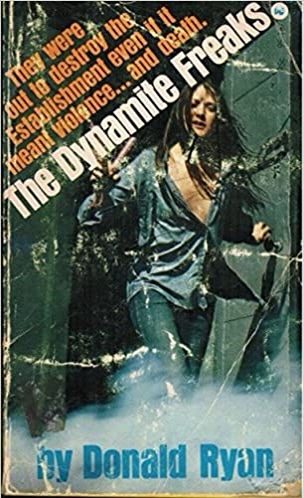
Donald Ryan, “The Dynamite Freaks” (1972) – I picked up this little pulp cheapie at a pretty great used bookstore in upstate New York. They had a lot of titles like these, what I think of as “exploitation paperbacks” – lurid titles and covers, stories ground out by the dozen by pseudonymous hacks. Now, people who collected those sort of books are dying or going to retirement homes, and their books — and the scifi and romance heads, and the collectors of dozens of cheap paperback editions of what were at the time deemed classics — are dumped on the used book market, to get scooped up by the likes of me. You see it more outside of higher-end used book markets like those in New York and Boston- upstate, Cincinnati, other places I’ve been.
Anyway! This exploitation novel exploits the New Left and the counterculture, especially the wave of bombing undertaken by groups like the Weather Underground. If you were expecting a sensitive sociological portrait of what would drive people to blow up banks, well, you’re not gonna get it here. You’re also not going to get much in the way of moralizing or a cop/right-wing protagonist bringing those dirty hippies to rough justice, either. Remember, these were contemporary exploitation novels, published by entrepreneurs trying to stay with a shifting audience and keep them buying.
There’s a lot more sex in “The Dynamite Freaks” than there is violence, though there’s a good amount of both. The main character, recent college graduate Carol Waring, and most other women in the book are described primarily via talking about their breasts (weirdly enough, this skeezy book very seldom talks about other sexualized parts of the body). Carol winds up in the clutches of a hippie communist terrorist gang basically because she was a grind in college and the first guy who paid attention to her (despite the author taking pains to convey that she is, in fact, very hot) was a hippie communist, so there you go. The closest thing to a “good guy” protagonist is a dude from her college who goes looking for Carol on behalf of her parents, and who muses that if only he had slept with her, she might be ok now. It’s that kind of book.
Selection pressures have drawn forth the best pulps of earlier eras, especially the thirties and forties, so when we think of pulp from that time, we think of tightly-crafted crime novels by the likes of Hammett and Chandler. To the best of my knowledge, no one’s done that for this era. The main blog dedicated to this stuff is “ain’t it cool” level criticism (run by a Trump chud to boot). So when you dip into this stuff like I do occasionally, you never know what you’re going to get, craft-wise. I do get the impression that latter-era pulp often disregarded plotting in favor of what could be called “sensation” (thanks, Spillane, thanks, Fleming), but that could be bias based on the aforementioned selection pressures.
In any event, there’s not much plot to “The Dynamite Freaks.” Carol starts out pretty in deep with dirty hippie Kurt and his band of miscreants, plotting to blow up a statue at her university graduation (and show off her body in a bikini under her robes- it is that kind of book), and only gets deeper until she meets a gruesome end borrowed from what happened to the Weatherman around the time they thought they were going to bomb a GI dance. The dude tracking her sucks at tracking and fighting (despite supposedly being a Green Beret?). The juice is all in the author (Donald Ryan is a pseudonym… or perhaps a “house name”) trying to twist the knife of transgression. For someone who grew up with the Internet, it’s quaint, almost touching, and at times disturbing by turns, what midcentury straight guy types do in art to shock. They seem to think that depictions of smoking doobies, of many different levels of violence, and of both consensual sex and of rape are more or less in the same category and will yield similar responses- shock and titillation. “Ryan” makes sure to throw in as many exacerbating details as possible- race stuff, family stuff. Violins for the poor little rich girl given everything by (a rather sexualized) daddy (with a heavy overtone of “watch this rich bitch get what she REALLY wants” as a sort of carnival barker come-on), etc.
I could appreciate the craft, such as it was. It also made me think about what “square” society thought was going on with the whole new left/counterculture thing. A lot changed, quickly- and even more seemed to be changing, superficially, while remaining fundamentally the same (different haircuts, same capitalism). There is a certain reciprocity between the sensationalism of the book and the motivations of the hippies in it. Spoilers- Kurt is taking money from a right-wing politician to do bombings that the politician can then use for political gain. In the end, Kurt declares he’ll take money from anyone to keep doing his thing- he’s only in it for power, more or less for its own sake.
A lot of people did a lot of shit in the sixties for a lot of reasons, and we look at them in various ways for various reasons of our own. We way overstate the importance of collegiate radicals like SDS/Weather Underground, for instance, and almost completely ignore waves of working class radicalism at the same time. Weather Underground might be the militant group in the world with the highest books-written-about (or by! lots of memoirs) to effective actions ratio… and hell, here they are, more or less, in pulp novel form. Maybe we keep thinking about the white collegiate radicals because they’re hard to figure- they could have been anything, they became… that, not just revolutionaries, but mostly shitty, vain revolutionaries who then all got book deals (the ones who actually seemed to mean it didn’t get rich and often wound up in prison for decades). Maybe they thought like Kurt did, that they could somehow ride their youthful bravado and a changing society to ultimate power, severely misunderstood the situation, and used their privilege to come back in… or maybe I’m just reading into a cheap, sleazy, diverting airplane read. ***





 Too Much Berard