Norm Macdonald, “Based On a True Story: Not a Memoir” (2016) (read by the author) – Norm Macdonald was probably the funniest motherfucker I have shared this planet with thus far. My roommate and I had tickets to see him perform in Boston when we learned about his death. Like everyone else, we had no idea that he was sick. From the cheap seats, Macdonald was what I think of as “pure comedian.” He wasn’t notably charming, or handsome or compellingly ugly, he didn’t push envelopes in terms of hot button content or naughty words, wasn’t from a fresh identity category (don’t think Canadian counts), didn’t have an angle to him other than being just extraordinarily funny and utterly committed to the bit, to making people laugh. I’ve known of a few people a bit like that, not as successful as Macdonald, naturally, and they can make the lives of the people around them hell, but it really is it’s own kind of art.
I don’t know whether the story that someone asked Macdonald for a celebrity memoir and he handed in this comic novel is true, but it would make sense that Macdonald would seize the opportunity such an opening would give him. Your pure comic, more even than most comics, relies on the absurdity of life in general for material. What’s a more compound absurdity than the celebrity tell-all memoir and the life it kinda-sorta depicts?
So, Macdonald tells “his” story, using one of his go-to joke modes, old-timey phrasing and anecdotes summoning up hardscrabble pseudo-wisdom, as a tone and even plot structure for the whole book. This version of Macdonald is both a wholesome son of the rural great white north and a deviant of the first order. He regales us with cliches of rural life at least as funny as Stella Gibbons’ in “Cold Comfort Farm” before bringing us to Star Search and Saturday Night Live, where he makes his way via threats of violence, strategic illegal morphine sales, and sheer delusional self-belief. There’s a brief stint in prison for stalking Sarah Silverman, then he gets caught up in gambling.
This is where “Based on a True Story” comes relatively close to living up to its name- Macdonald was a problem gambler. He talks about it as hinging on that one moment, after you’ve thrown the dice but before they land- the moment of hope. I’m not a gambler, but that made me relate. Macdonald decides to throw away the credit he had built in Las Vegas in one last gambling spree, either making millions of dollars and buying a ranch in Montana, or losing it all and killing himself with dilaudid. He forces his (irl friend and cohost) Adam Eget, depicted as a manchild gambling prodigy along for the ride, winds up in hock to a mysterious figure in the Salton Sea, meets God but doesn’t pay much attention to Him, and tries to kidnap his ghostwriter, a fallen intellectual who occasionally bursts in to tell his version of the story.
Macdonald read the story himself (except for ghost writer parts- I thought they were Judah Friedlander, but were not) and so nails the delivery on every line. Not everything is a laugh line, of course, but he masterfully builds the tension and plays bait and switch with expectations to lead to gut busting laughs throughout. Things never go to the place, emotionally, you’ll think they’ll go. He’s never sentimental — part of his genius was the way he played with sentimentality but never gave in to it — so it meant that when I felt nice hearing his voice after his death, there was no bullshit heartstring tug to cheapen it. It was just a hilarious, well-written comic novel that played with memoir, celebrity culture, and crime fiction. It was funny, the one thing Macdonald wanted to be, and the one thing he was more than anyone. *****
Garrett Cook, “Charcoal” (2021) – I got this book as a special preorder from Clash Books, which puts the “lit” back in literary, as they say! It’ll be out for the rest of you hoi polloi next year. I knew to order it because I’ve been following Garrett Cook’s career since our days at the dear departed Marlboro College. Lit and Garrett promised a literary horror experience, and delivered.
We begin in the scariest place of all- art school! Shannon Rodriguez is a student MassArt who has talent and drive but also substantial self-doubt. This is made worse by the fact she’s a Dominicana in a largely white male dominated space and someone with a lot of childhood trauma. Professors skeeve on her, “that guy” that’s in every class doesn’t take her seriously. Art is hard.
What for it but to become part of a Faustian lineage? Thomas Kemp, a nihilistic artist in Victorian London dedicates himself to wickedness and sadism, making art out of other’s pain, eventually going so far as to inflict as much as he can himself in order to depict it. He has his ashes, when he dies, made into drawing charcoals. A skeevy professor suggests Shannon use them (for a consideration, of course) to really bring out the artist in her. She does, and it does, but it threatens to bring her down. Kemp himself was part of a chain of artists sponsored by a shadowy supernatural force, one interested in pushing art and evil to its extremes. The opportunities and costs are high, as is usually the deal with your Faust situations.
One good thing Cook does is vary up prose style considerably between works. There is none of the flippancy found in his earlier “bizarro” (roughly, surrealist horror) work. That’s not to say everything is self-serious, and the close attention to interpersonal detail in one or two relationships that you can see in other works comes out here- dorm room romances amidst communal couches and cheap weed. But Kemp and the charcoals bring Shannon to another world, as manifested by the murders of crows that follow Shannon around — in reality? In imagination? — consuming her traumas, past and present, making her…
Well, here, Cook presents few easy answers. Just what is the relationship between monstrosity and art? Is Shannon producing better work under Kemp’s influence, or is that just something her douchebag professors and peers say? What exactly is the potential cost to Shannon (note, it involves murder, but mostly of people who suck)? “Charcoal” was written and published in the midst of numerous debates about the relationship between art and artist. It also comes from a scene, horror fiction, that has not altogether handled these questions well (on any “side”) and depicts an art world that’s pretty bad with reconciling morality (or just functional, non-harmful behavior) with its ideas of genius. At some points in the book, Cook seems to come down on the side of the idea that artists of sufficient evil do deserve to be cast aside, but I don’t think that’s necessarily the point, or the only perspective taken.
I don’t want to spoil the ending, but in the end, Shannon has to reckon with her own power and agency, and when she does, this opens doors. It’s not a direct splitting off with the evil engine behind her artistic rise- it is not a “cancellation.” I’m not entirely sure what it is. A reconciliation, perhaps? In any event, this was a thought-provoking and well-written work, and you all should buy it when the publisher starts putting it out for more wide release, especially all you horror heads. ****’
James S.A. Corey, “Tiamat’s Wrath” (2019) (read by Jefferson Mays) – It’s hard not to come to a book with preconceived notions of how it’ll be, harder still when you read (in this case, listened to) seven of its series predecessors in a given calendar year. Somehow, I got it in my head that the Expanse series picks up after a nadir of boredom and pointless a book or two back. Maybe it does, some, but that preconception took some hard knocks while listening to this, the most current and penultimate Expanse novel (there’s another one coming at the end of next month, and yes, I’ll probably listen to it- might as well finish the damn thing, I’ve come this far).
There’s some cool stuff here. The scientist Elvi, from several books back, comes back and discovers a diamond the size of a star, some sort of enormous memory bank for the civilization that built the ring-gate network that has given humanity a set of shortcuts across the galaxy. The Laconians, a sort of paramilitary that took over humanity a few books back, try to blow it up, on the idea that could draw a response from some of the ancient godlike aliens that created the gates and/or killed the gate-creators, thereby opening a comms channel. It causes some freaky, time-dilating disasters. That’s kind of interesting.
But at the end of the day the book has more to do with the maneuverings and relations of boring characters than it does with cool space stuff. We gotta see what the space-dullards we’ve spent thousands and thousands of pages are up to! They’re resisting Laconia, duh, and the Laconians become more obviously evil, definitely non-preferable to whatever workaday exploiters the solar system previously had, confirming the good moral sense of Naomi, Alex, Bobbie and the gang. Chief perspective-dullard Holden, a real Harry Potter of a narrator but with all too many parents instead of too few, is at the center of the action, naturally, even though he’s supposed to be in exile. They do some resistance stuff and save some kids. One of the gang gets pseudo-alien-zombified, if you’ve played the classic RPG Deadlands think “harrowed” but scifi rather than horror-western themed. There’s some palace intrigue with a teenage girl and heir to the empire, which could be a cool concept but the Coreys (it’s a house name for two guys) are kind of phoning it in at this point. At least, unlike their maitre George R.R. Martin, they seem likely to finish their series.
By the end of it, the Laconian grip is tenuous, shit is all kinds of fucked, and it seems likely there will be a showdown between humanity and the alien god-killers that the Laconians provoked. I’ll say it- other than bare curiosity about where the genre is going, I will only care about the last installment, “Leviathan Falls” (recalling the title of the first book!! So long ago), if shit gets good and freaky with these aliens. And I want to — see — these fuckers, at least their ships. The Coreys aren’t Liu Cixin, they don’t get to keep the aliens offscreen (well, they’re nerd-famous, they could probably “get to” scribble their characters names onto the screenplay of “Serenity,” publish it, and make millions, but you know). For now, this was a diverting but mediocre read that promises more than it delivers, though this many books in, it’s more my fault than anybody else’s for buying. ***’
Stella Gibbons, “Cold Comfort Farm” (1932) – It seems like parody should not be able to outlive its reference point in memory, but clearly that’s not the case. Think of all the stuff Looney Tunes lampooned, stuff kids wouldn’t know about. It’s not just that Looney Tunes was funny even if you didn’t know the reference points (though it was)- it’s that you can tell they’re lampooning something, something from the adult world, maybe something you’ve had some intimation exists, like opera or classic movie stars, or maybe not; either way, that sense makes it funnier.
Stella Gibbons wrote a bunch of books in her time but only one that anyone remembers (this irked her throughout her life, apparently): “Cold Comfort Farm,” a parody of a form that on the surface, doesn’t seem to be a thing anymore. These were the “loam and lovechild” novels of the late nineteenth and early twentieth centuries, where sad salt of the earth types suffer in the English countryside. When people cite examples of this subgenre, some big names like Tom Hardy and D.H. Lawrence come up, but they always had other stuff going on in their books- mostly, Gibbons seemed to be aiming at writers, many of them women, who were highly popular at the time but utterly obscure now.
“Cold Comfort Farm” probably has something to do with that obscurity, because it was a huge hit and still a cult favorite, well after the “loam and lovechild” genre has vanished (I assume it has? Let me know if it hasn’t!). The narrator, Flora Poste, is an interesting, and I thought quite contemporary, in a prophetic way, type: the young woman who is over it all but still in the thick of it, too smart for just about anything, including being too smart for stuff. Her parents die — she’s not too bummed, this takes place in some sort of parody future of late imperial Britain, all her parents and lovers are off managing the empire — and she has to go live with relatives. The most palatable of bad options is Cold Comfort Farm, off in Sussex.
It’s grim! Run down, full of almost Dunwich/Innsmouth-style subhumans, a clan of them kept in place by Great Aunt Ada Doom (who saw something nasty in the woodshed as a child). There’s intimations of deep trauma and doom, boundedness to the lousy East Anglian soil, purple speeches (in the style of the novels Gibbons is lampooning) set off by asterisks, a lot of dialect, etc. As a project, Flora decides to straighten things out around there.
Gibbons makes the book funny despite my not knowing the source material. What she doesn’t manage — what I think she couldn’t even try within the bounds of her project — is to make a compelling plot. Flora just does things. She faces little opposition to her polite optimistic pushiness beyond some caviling. She dresses up the wild girl wandering the moors in the latest London fashion and sets her up with the squire’s son, who just needs a little encouragement to do right by her. She gets rid of evangelical Uncle Amos by telling him about the soul-saving potential of taking his hellfire preaching show on the road in a Ford van, thereby letting cousin Rueben take over the farm, the one thing he wants. She foists vain fuckboy Seth on Hollywood, thereby bringing some money to the farm and keeping him from impregnating all the help. Ada Doom wants to stop everyone from leaving but she can’t. The end.
It has to be this way, because the whole thesis of the novel is that the problems of the “loam and lovechild” tragic novels aren’t real problems. They say you have to love a genre to do a good parody of it. I think that’s an American thing. Brits are meaner. Gibbons, I think, didn’t love these books, and she was out for blood, and she got it. If the local yokels could offer opposition — if their problems were even difficult to manage — that would, backhandedly, pay homage to the subgenre Gibbons was determined to skewer. So! It’s a fun novel. The writing is good. It’s funny. It’s a little boring once you get what’s going on. I bet it would have made a good cartoon! ****
Robert E. Howard, “The Coming of Conan the Cimmerian” (2003) – More genre homework. Lovecraft and Howard, Howard and Lovecraft, handing the torch (and a metric shittonne of baggage) down from the pulps to the nascent scifi/fantasy scene, subjects of adoration, exorciation, tribute, parody, pastiche, and endless imitation. They were friends, too! Penpals, natch- neither got out much. Howard killed himself when his mother died. People talk about the irony, this big, strong man, creator of rugged, devil-may-care heroes, living with his mother and unable to live without her. To me, it’s less ironic and more painfully sad. I’m close to my mom, too, though I think I can navigate the end of her life without terminal self-harm.
Anyway! Conan! He’s got thews, whatever those are (apparently it’s an old word for “strength” and not a weird word for “thighs” like I at first assumed) and he knows how to use them. This collection of Conan stories includes about half of the original Howard stories from the thirties, and nothing but Howard stories. This is somewhat rare- interlocutors, bearers of the torch (or handlers of the baggage), votaries of the cult, have interpolated their own work into the Conan mythos (and his other works, and Lovecraft’s stuff too), most notably fantasy writers L. Sprague DeCamp and Lin Carter but plenty of others too. Other Conan collections mix them in like you couldn’t tell the difference.
You can tell the difference. I wasn’t wild about any of the Conan stories. But there’s a sense of mystery, limitlessness, and foreboding in Howard’s Conan stories that just isn’t there in the various imitators. They say that Conan is a male power fantasy, someone for the nerds reading the pulps to project onto, and that’s true enough in both Howard’s and DeCamp/Carter/whoever’s versions. But the element of escaping into a different kind of world stands out much more starkly in Howard than in the imitators. This is ironic, as later fantasy worldbuilds much more extensively and generally more rigorously than Howard ever did (there’s a similar disconnect between Tolkien and later fantasy, though it’s hard to say that Tolkien did not worldbuild with rigor).
Conan’s world is loosely-jointed history fan fiction, the creation of a young autodidact stringing together evocative words, names, and dynamics from the emerging fields of archival history, anthropology, and archaeology. It’s it’s “gigantism and ineptitude,” to use Borges’ phrase, it resembles mythology and draws us more closely in, to a feeling if not to a reality, than the more schematic, “logical” takes on worldbuilding that followed DeCamp and the others and that feel like maps for theme parks much of the time.
Theme parks work better than mythologies if you want a real plot to follow. Plots aren’t something Conan does in the story. Conan is just Conan. He finds himself in situations- plots are something others weave, and Conan bashes his way out of them with strength and courage. This is because Conan is a barbarian, and barbarians are simple, strong, straightforward, whereas the civilized are complicated, individually weak if collectively strong, and tricky. This is drawn from various old historical ideas, some of which gained new currency during the extended bourgeois freakout about “degeneration” that was in full swing by the time Howard was born.
The starkness of the divide, along with being a little laughable to people who know history better, also “works” on an atmospheric level. Howard clearly prefers barbarians but doesn’t skimp on what the way of life costs- Conan is always confused except in battle, and lives a bare and frustrating life. He comes from an impoverished people, unimaginative to the point where even their gods are dull, to whom the Viking-manques Conan fights amongst in some of the stories seem opulent. Civilization could solve some of these problems but brings up others. Life is basically bad.
There’s also the well-known racism in the stories. It’s probably less bad, anyway less hateful, than Lovecraft’s. Howard’s register was less Lovecraft’s terror, and more rage. To the extent that rage had a real target, it was sophistication- wizards piss Conan off, even when they’re helping him. People being uncivilized, as the black people in Conan invariably are, isn’t a problem to Conan, but presumably is to the reader. It’s also worth noting that “orientalism” wasn’t a critical term of abuse at the time, but a mode of entertainment (not unlike “minstrelsy”). It makes sense- living in a coal-smoke town or lonely plains shack, without movies, tv, or radio, hearing tales of the sumptuousness of some other part of the world, studded with intrigue where yours was dull and workaday, would be compelling. The Conan stories are orientalist to the hilt, in both that sense and the (degraded contemporary version of) Said’s sense. It doesn’t justify anything, necessarily, but the lines of superiority-inferiority aren’t always that clear (as they generally were in minstrelsy), and I think one could go into it with relatively good intentions… but yeah, it’s jarring to modern sensibilities.
All in all, these stories really aren’t great in and of themselves — the sameness of the plots, such as they are, the frequency of deus-ex-machina resolutions, the thinness of the characters and needless multiplicity of indistinguishable cultures (Koths! Hyboreans! Etc) — but it’s worth reading these to understand the shape of the genre more, maybe move on to other sword-swinging writers inspired by Howard, ala Charles Saunders, Fritz Leiber, etc. Maybe I’ll try out Solomon Kane one of these days, too. ***
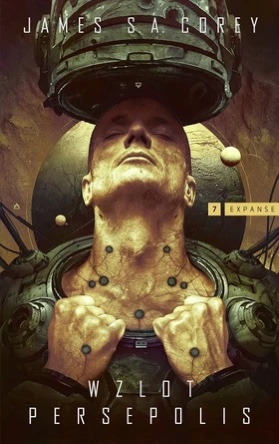
James S.A. Corey, “Persepolis Rising” (2017) (read by Jefferson Mays) – This is the seventh Expanse novel! There’s one more currently out and another coming in November. Might as well finish them!
This one was better than the previous two installments, which entailed the Coreys (it’s a house name for two dudes) putting their world of a few-centuries-hence solar system settlement through the wringer. It’s not as good as some of the other, earlier novels. It’s thirty years after the last book! I guess there’s access to anti-aging drugs, because except for a rueful thought and allusions to graying hair here and there, most of the characters established in the series are still doing pretty good. Perspective-dullard Jim Holden and his Strong STEM Woman ladyfriend Naomi are about to retire from the adventuring life and let their remaining friends take over the “Rocinante,” the “Millenium Falcon”/“Serenity” of the series, but we know that means shit is going to hit the fan.
When the Coreys blew up their world in the previous two novels, there were two main culprits. We spent most of our time with the radical Asteroid Belters of the “Free Navy.” Their friends, a faction of the Mars Space Navy with an inscrutable agenda and took off through a series of alien interstellar travel rings to a faraway system. It’s those folks, now called Laconians after their new home, who come back thirty years later to ensure Holden can’t retire. It turns out they’re led by a megalomaniacal space admiral, Duarte, who has a plan to unify humanity into a big space empire. They come out of their space gate and start throwing beaucoup high tech space weapons around, and capture the space station where Holden and crew are waiting to go their separate ways.
Here’s the thing with the Laconians: the Coreys humanized them until they really didn’t seem that bad, and all the fighting really did seem pretty pointless. This is something of a problem with their worldbuilding in general and, I think, with the view on humanity they peddle in this series. They basically seem to think that political ideas are bunk, cover for “tribal” power conflicts and a desire for power embedded in “human nature.” It’s funny- in midcentury, you summoned the power of the thought of (real or purported) high minds, Freud, Marx, Nietzsche, the Founding Fathers, to end discussions, now you do it with the power of things beneath the mind- human nature, pathology, etc…
Anyway! The Laconians think they should be in charge of humanity because Duarte has a genius master plan to expand across the stars and because they’ve got good military discipline, they’re rational. Those aren’t great claims on the loyalty of a species, I’ll grant. But nobody else has a great claim, either, in Expanse-world, and I think that’s due to a combination of mediocre writing on the Coreys part, and their mediocre thinking about what drives human loyalties. The closest they came to anything sensible were the Belters, a sort of proletarian nationalism ala Sorel developed among the asteroids and space station habitats. Even that is weakly developed and contingent, especially thirty years after Holden brokered a deal that granted the Belters a lot of power in the solar system. There’s some allusion to a “Martian Dream” of terraforming planets and with it, redesigning society, but it doesn’t seem to mean much and also seems to have mostly upped sticks to Laconia. What the Earthers are up to other than cruising along due to inertia (and the dreaded welfare state!) and almost being apocalypsed in previous books by the Free Navy is hard to say.
So, when the Laconians come in and start taking stuff over with a minimum of violence, stated intentions of including everyone in their project, and seemingly overwhelming force… why do people care? Why bother resisting? I can almost hear nerds sputtering “but… but World War Two!!” Well, what about it? The Nazis had an agenda, one that really didn’t work for people other than them. Even then, most of the resistance came from people who had a belief system that motivated them: either a belief in a special relationship between their nation-state and the eternal that getting conquered by Germans would tend to traduce (DeGaulle, Churchill, etc) or else a belief in some humanistic order that the Nazis utterly opposed (mostly Communism, to a lesser extent liberal democracy). And even then, and even with all the provocations the Nazis, some of the worst (both in the sense of wickedness and the sense of incompetence) occupiers in history, most people didn’t rebel.
So the underground resistance angle that animates much of the story really doesn’t make a ton of sense to me. The rulers of the space station the Laconians trap most of our characters on are basically the Spacer’s Guild from “Dune” minus the freaky bits. Even Drummer, the viewpoint character who runs the organization, admits it’s not much as a political motivating force. Why does anyone care, especially enough to risk their lives? It kind of makes sense for Holden, he’s always doing dumb shit. And from there, it sort of makes sense for his crew. But they all act like it’s a no-brainer! I get that granting anyone power gives them the ability to abuse it. I just don’t see what power the Laconians tried to seize that the spacers guild or one of the planets didn’t already have, especially considering the harsh rules that space habitation necessitates?
Even after people start killing Laconians, the response isn’t that harsh. The Laconians commander, Singh, is one of the more interesting characters, but also raises questions. He’s pretty weak! He vacillates between harsh and lenient responses to provocation, but even his harshness isn’t that harsh by normal conqueror standards, let alone conquerors on a delicate space station. Why did the Laconians put this guy in charge? There’s various tantalizing hints about Laconian culture, a brutal utilitarianism under a veil of philosophical rationality, but we don’t really get enough to understand their motives. I guess I’m supposed to think it’s just “human nature” again?
Anyway, this book wasn’t bad. It had some cool battles, both fleet actions and underground guerrilla space station stuff. The characters feel more broken-in, even the new ones- the Coreys elegantly convey how the bonds of the “Rocinante” family changed and deepened over the decades they skipped over. The Laconians are the closest thing to a good idea the Coreys have had for a while, and it’s linked to their other good idea, the protomolecule, the ancient alien weapon/engineering tool that makes stuff all weird and eldritch but also powerful. It seems the Laconians rampant use of protomolecule stuff might be summoning up whatever killed off the protomolecule-masters long ago. This is kind of a weird transitional book, leading to the last two, but it wasn’t all bad. I just wish the Coreys either got better ideas, or didn’t lean so hard on their mediocre ones. ***’
I entered “dullard Bachelorette contestant” into GIS and got this
Michael Mahoney, “Gothic Violence” (2021) – In case you go looking for it, the author of this book goes by “Mike Ma,” and is a D-list fascist social media figure, a former running boy for Milo Yiannopolous (one only wonders what absurd abuses Yiannopolous would make a notionally straight dumbass go through to belong in his circles; and one is much more shaken by the knowledge that whatever Mahoney did for Yiannopolous, it was likely more honest and less demeaning than anything else Mahoney had ever done). I don’t play with these fascists and their nicknames- when I reviewed Mahoney’s last book, the worst book I read last year, I hadn’t bothered to google him. I saw Mahoney give his new novel five stars and beg for purchases of his self-published work and reviews to help further juice sales, but only by people who had read it, he insisted. Well, who am I to deny such a cri de couer? Especially when I can illegally download the book online (if Mahoney wants one red cent from me, he can come find me in Boston and have the “authentic experience” he is always whining about trying to get his thirteen-twenty-nine)?
At first, I was thinking this one might be better than “Harassment Architecture,” Mahoney’s prior and first literary effort. After all, “Gothic Violence” has a plot, which should be a marked improvement on its predecessor, which didn’t really have one. “Gothic Violence” follows a Mahoney-Marty-Stu narrator character who belongs to a group of Florida-based fascist surfers who use violence of various kinds to disrupt our corrupt social order. “Surf Nazis Must Conquer,” or, a callow brain-damaged Chuck Palahniuk’s take on “The Turner Diaries” – doesn’t sound good, sounds better than “Harassment Architecture.”
Well, Mahoney manages to disappoint even these low expectations. He can’t concentrate on a plot because he fancies he has important things to say. He thinks he’s an aesthete and a philosopher. So you get long (this isn’t a long book, but still) passages of undergrad writing workshop-style prose describing dreams and visions, interspersed with what there is of the plot and various manifesto-style passages about this or that thing that bothers him (his trans panic, a lot of stuff about lifting weights and drinking raw milk). It hasn’t got much more focus than “Harassment Architecture,” even with the notional inclusion of a plot.
Mahoney attracts attention for his prominence on “accelerationist” social media (“accelerationist” was a lefty thing, for a long time, still is in some quarters, but has mostly migrated to the fascist right- like “libertarian”). To the extent there’s a point to all this, it’s the destruction of our social order through violence and terror and the reemergence of “natural” “strong” men, our natural leaders, yadda yadda. Would these strong natural men have as much patience as Mahoney seems to expect they’d have for his shitty maunderings, or would they whack him with a stick to stop the noise? The idea that anyone even remotely close to an ubermensch, however defined, would want to bother with books like this isn’t the dumbest part of the “might makes right” apocalypse scenario, but it’s the part I thought about most often.
At the end, after his gang routs the system from Florida, the Mahoney-Marty-Stu wanders the beach and encounters a magical hangman who makes some dumb speeches, and then Mahoney makes his own little speech (he doesn’t indicate the hangman hangs around to listen- the closest to realism this book gets) about how whether damned or saved, he will never be ordinary (he says “average,” because he is stupid, a bad writer, a worse “traditionalist,” and can’t help but punt to rationalist-statistical language, even at the apotheosis of his transcendence- what he means is ordinary).
The only way in which any of this — this book, Mahoney’s performance of self, the whole tableau — could be regarded as anything other than ordinary is that it’s unusually shoddy, amateurish. Even then, it’s probably about ordinary for self-published work in that regard, too. He cribs flagrantly from a cheap list of recent literary figures — Palahniuk, Brett Easton Ellis, Tao Lin — that rank high among both the noxious cultural weeds (I have some time for Palahniuk but he probably hasn’t been good for literature) and the commonest role models for young men who fancy themselves literary. He can’t help but make fussy little points about lifestyle while he’s trying to pretend to be above it all. Completely predictable ones, too, for deeply insecure boys of his generation: lifting weights (why always lifting? Sheer muscle mass won’t help you that much), undercooked meat, old clothes, the usual mask-off context-collapse “I need to bolster my manhood and don’t care who notices how frantic and embarrassing my efforts in that direction are” stuff. Celebrity culture stuff, can’t keep himself from that, either- weirdly old, too, he was born in the nineties but obsesses over The Strokes, of all bands- are they retro, now?
Above all, you see the desperate desire for self-expression, the utter incapacity to get a point across, the dim quarter-awareness (less in the content than in the tone) of the bourgeois boy raised to believe that he has things to say that, in fact, he has nothing at all in his mind that’s worth the breath coming out his lungs, not that that’s going to stop him. That combination is as ordinary as grass, and has a banal origin: we didn’t tax his parents enough to force him to work for a living. Just another thing for us to fix- stick it on the list. ‘
Robert Evans, “After the Revolution” (2021) – Robert Evans hosts a bunch of podcasts! That’s close to all I know about him. A lot of people I know like his podcasts. I vaguely know some people who dislike him because he works for Bellingcat, which produces a lot of Russiagate paranoia, but it doesn’t seem he works that beat. I don’t listen to many podcasts these days but I heard somewhere he wrote a sci-fi novel about America after it fractures in a civil war. Evans also worked as a conflict journalist in places like Syria so I thought it’d be worth looking into, especially as he distributes it as a free ebook.
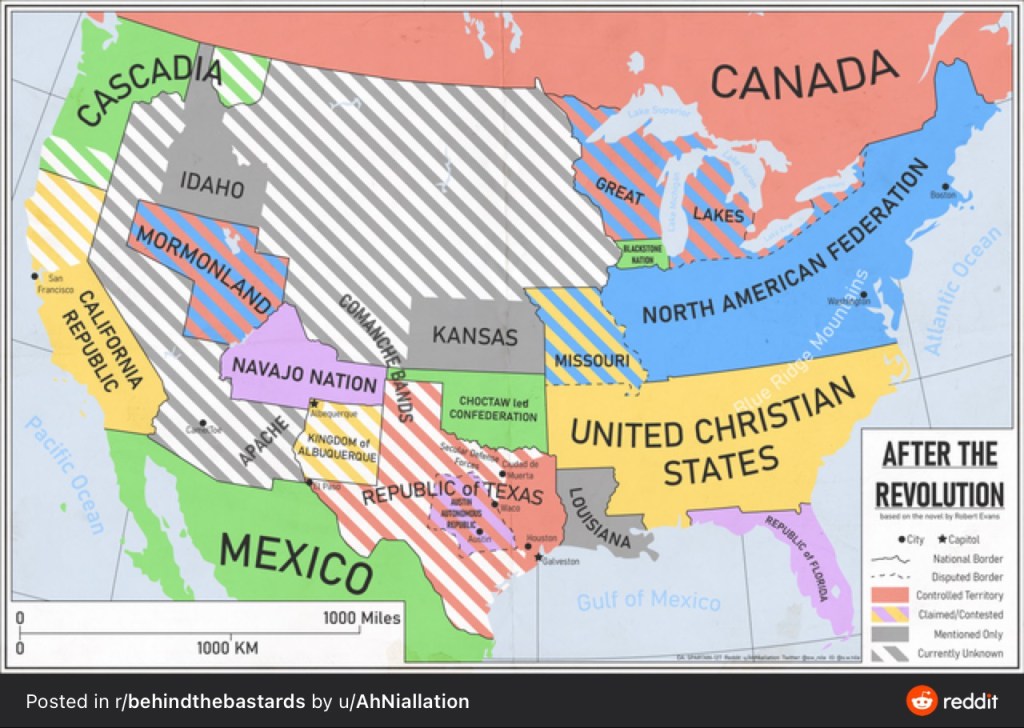
It’s the 2070s! The US broke up decades before. Most of the action takes place in Texas, which became a sort of weak libertarian republic, and basically allowed factions both right and left to control parts of its territory. There are three viewpoint characters. Manny is an Austin-based “fixer” for journalists from abroad looking to report on the wars in North Texas between Christian militants and the forces of the Republic and leftist militias. Sasha is a high school girl in the “AmFed,” the American rump state in the northeast, who runs away to join the Kingdom of Heaven, the “neo-Calvinist” (autocorrect wants to say “bro-Calvinist” and there’s some truth to that) ISIS-analogue growing on the plains. And then there’s Roland, a radically biologically modified former supersoldier missing large chunks of his memory who gets bribed into a “one last job” by an old friend. They all get embroiled in a surprise offensive that the Kingdom launches that threatens to overrun Texas.
One of Evans’ many podcasts is called something like “It Can Happen Here,” about the possibility of a civil war in the US, and my understanding is that it basically layers his experience doing conflict journalism onto American conditions. That’s more or less what you get here too. Sasha, for instance, is pretty straightforwardly a white American Christian skin for the sort of young people who got radicalized online and ran off to join ISIS in the 2010s. The Kingdom is ISIS, there’s an equivalent of the Syrian Democratic Forces defending Austin (without, interestingly, as much of the ethnic angle, though there’s more people of color there than among the Kingdom), there’s the “Christian states” in the South kinda-sorta supporting the Kingdom kind of like Saudi, the Emirates, Turkey etc supporting Islamist militias against Assad (paranoiacs who insist that Evans is a NATO pawn will presumably think he soft-pedals that angle here for Reasons), etc etc.
Evans makes the good choice to not linger too much on worldbuilding, and where he does, it’s on something stranger (more anon). Mostly he does action, and he’s a decent enough action writer, not one of the greats but this is a respectable first try. His extrapolations on technology — the key importance of drones, some bio-modification stuff I’m not sure I “buy” but which is fun — work pretty well and aren’t overplayed. The Kingdom is mounting an offensive based on a new technological exploit- I’m normally not into that as a plot point in scifi but it works here, as Evans depicts the Kingdom as first and foremost opportunistic, an infection exploiting weaknesses, from the corruption and pointlessness of life in Texas and the AmFed to technological flaws, half-consciously, and we’ve seen that everywhere in the twenty-first century from the altright (remember them?) to… well, mostly other right-wing formations… Manny at first wants to make enough money to escape to Europe, but gets waylaid by the offensive. Sasha gets smuggled into the Kingdom, likes it at first, then finds herself in an arranged polygamous marriage with a rapey douchebag.
This leads us to Roland, the post-humans, and the strange role Evans gives them. It’s worth noting that along with contemporary wars and ideological madness, Evans also writes a lot about drugs from a participant-observer perspective- the post-McInnes Vice magazine mix. As far as I can make out, post-humanism in this world originates with the US military, who “chrome up” soldiers with nanotech, gene modification, internal computers, etc etc. It’s all more organic than Terminators — think blood nanobots rebuilding shot-up tissue rather than “liquid metal” — but Roland’s powers meet or exceed many of those of your T1000s. But these ain’t your granddaddy’s robotic, mission-oriented cyborgs! Their extreme abilities also come with extreme desires for extreme experience. The history comes in bits and pieces, but it seems that Uncle Sam’s cyborgs, after being used for numerous war crimes in the 2020s, go rogue and try to take down the state in a vaguely anarchist direction! Things get fucked, they lose, many of the post-American states pass strict regulations on bio-modification (the Kingdom renounces all of it but does some creepy backdoor nonsense with it), and so the post-humans mostly retreat to the abandoned, climate-ravaged deserts, mountains, and plains of the continent.
It’s too much to say they “save the day,” but a major player in the story, the thing that stops it from being a tale of Protestant ISIS ravaging Texas, is the post-human nomad city of Rolling Fuck. Rolling Fuck is basically Burning Man as Burning Man would like to imagine itself. They wander the plains, having crazy sex, drug, and danger experiences enabled by their demigod-like powers (I don’t like the way people call superheros gods these days- I get it’s meant to refer to pre-Christian gods but we are all products of monotheism and I’m sorry, if you’re not omnipresent, you aren’t like god as we know Him). They stay out of politics. But then the Kingdom makes the dumb move of jacking some of their people. At first, they try to send Roland and Manny in to sneak them out. That goes south, so Rolling Fuck goes to war.
Like I said, the action and plotting are decent, especially for a first time novelist. It is… “trauma informed,” and I’m curious to see how that will play out as trauma-thinking wends its way further into the popular consciousness. Knowledge costs- Manny knows war-torn Texas at his expense, Sasha learns fundamentalism is Bad at her expense (not as harsh as it could have been- Evans knows the boundaries of what his public will accept, probably for the better), and no one pays more than Roland, for learning what it’s like to be post-human and having post-human experiences, being a walking hub of history’s wheel. Even where Evans doesn’t make Roland’s prior experiences clear, there’s just a constant fusillade of self- and other-inflicted bodily abuse, just constantly taking tons of drugs and also getting shot all the time.
Knowledge costs, it’s traumatic, but it also makes you human, or post-human. Not just on its own- it can make you sneaky, like Roland’s ex-handler, or subhuman, Sasha’s bro-Calvinist boyfriend. It needs proper management, “technologies of the self” if you will- Rolling Fuck’s drug and sex experiments, and its war ritual of sending little drones to collect the information of the people it slaughters and playing their little social media videos for the civilians back on the truck. Arguably, the implied values and worldview behind this is as interesting as the post-civil-war stuff, for its leaps and its gaps both. It’s a flexible view of humanity, more flexible than the “standard” current view, but I wonder at its bending and breaking points, particularly the idea of what seems to be a universal idea of trauma… but anyway. All in all this was pretty good, especially for a free ebook by a podcaster. ****
Natalie Ironside, “The Last Girl Scout” (2020) – This fucking ruled. It’s two hundred years after a mid-21st century nuclear war! Some shit is still fucked — heavily nuked areas are still radioactive and have “roamers,” zombies more or less, products of biowar weapons, roaming around — but civilization has rebuilt in some areas. One such is the Ashland Confederated Republic, a communist federation of survivors in Kentucky, Tennessee, and parts south (until you get to the “exclusion zones” around nuked-out Birmingham and Atlanta… I guess they didn’t bother with Nashville? It’s ok). Across the Ohio River they face off with the Blacklands New Republic, a white supremacist fascist state. You might wonder why survivors of an apocalypse would, a hundred years later, decide to take up early twentieth century ideologies, complete with trappings (the Ashlanders still debate about Trotsky; the fascists have Arditi and often use Italian or German phrases). Well, post-apocalyptic (or generally futuristic) atavism has been a thing in scifi forever, with monarchies, feudalism, the Wild West, and god knows what else coming back after the bombs fall- so why not ideological struggle circa 1937? I dig it!
Natalie Ironside, an IWW organizer, doesn’t mess around, and her main character, Magnolia “Mags” Blackadder, is a commissar, the supposed avatar of communist evil. But this is a state where communism works, more or less, and the commissars are there to ensure the rights of soldiers (keeping those pesky officers in line) and in general be kind of wandering Jedi of the revolution. Mags is young, her family got all fucked up in a famine, she’s a transwoman, and she lives for her work- advancing the Revolution and fighting fascists. She’s sent on an impossible mission- crack The Citadel. Deep in the “Exclusion Zone” in the Acela Corridor, the Citadel shines bright with the sort of technological salvage the communes could really use to up their automation game and advance towards utopia. It also shines with menace- few who have tried to take the Citadel have ever come back. Except for Ohio Nazis (“I fucking hate Ohio Nazis”)- they’re going to the Citadel and coming back. It’s ominous.
First, of course, Mags needs to gather a team. There’s the Prof, her old professor at the academy who knows Old American tech. There’s Connor, whose wife was horribly killed by a vampire (there’s vampires) last time out to the Citadel. There’s TJ, who they kind of pick up at an anarchist bar along the way, but they seem cool? And most importantly, there’s Jules. Jules is a renegade fascist Arditi, a transwoman and survivor of harrowing abuse at the hands of her former co-fascists. She labors under a crushing weight of trauma and guilt. She and Mags meet up and it’s love at first sight. They talk trauma and fuck all the way from the anarchist zone of the communist state (there’s some amusing insults back and forth between anarchists and communists but they work together in the crunch) in the Appalachians to the Baltimore suburbs where the Citadel waits.
There’s a few different kinds of action in the book and Ironside handles them all with aplomb. There’s a lot of fights, both “unbalanced” horror-style violence — her vampires are genuinely scary — and action-movie style fights dealing with unfriendly bandits and fascists. There’s also a lot of emotional relationship talk! Having read a lot of military science fiction due to Reasons lately, I’ve read a lot of both lately — your military scifi always has dudes thinking about love — and I think Ironside ranks with the best of them at military action and beats them all hollow on the relationship stuff. She comes out of the fanfiction scene and this is self-published, and if I’m being honest I think it could have benefited from professional editing — it gets repetitive — but not at the cost of Ironside’s style (hell, you ever listen to people talk relationships? Or politics? It’s repetitive!). It works quite well as stands.
There’s so much more, even in the first part, that I can’t give due consideration to — a friendly early 2000s hipster girl vampire (kind of a Marceline type)! Kaiserine/Nazi vampire experiments brought stateside by Operation Paperclip AND involving a gay WWI vampire romance that goes bad because one vampire becomes a Nazi and the other a Communist! A fascist prison camp/bordello for transwomen! Terrible revenge! Tac nukes! — and it’s just a hell of a lot of fun.
And then there’s the second part! If I’m being honest I think this could have been a separate book. It’s rare when I want more of a novel, but I wanted more of this one. After the Ohio fascist plan revolving around the Citadel goes up in smoke, the fash say “yolo” and try to bulldog the Ohio River anyway, just as a meeting of the Soviets is happening! The Soviets are doing the math and are realizing — except for some lame Stalinoid class reductionists — that they need to take these fash sons of bitches down. They can’t coexist. They’re expanding in the west against the Indigenious portions of the Republic. Who knows when they’ll find some other superweapon? They can’t do “force against force” — there’s more people in the fertile Ohio farmland than in the rocky Appalachia soil — but they can subvert the fash from beneath (which I like because it’s the fascists’ straight up worse nightmare). But the fash strike first! Mags, Jules, a new lover of theirs, and some of the rest of the old crew are sent into enemy territory to help light up the kindling under the fash’s asses.
This is also overstuffed with cool shit — fash vampire long-range raids to take out artillery! Guerrilla action! Inter-fash political bullshit! Commie spies using their control over the illicit cigarette and coffee trade to smuggle arms to the gay underground in fash cities! Forgiveness and revenge! More emotions talk! — to the point where, like I said, I would’ve liked to see it as its own big book. But it’s cool as is.
If I hazard a criticism beyond the editing/structure, I’d say that in the action, she could use to vary up the patterns of setback and victory a little. Ironside has made clear that she is not telling stories of dystopia, even with all the terrible shit that happens in the book and it’s background, she is telling stories of hope. We can build back better, together- we can be who we are and find love and peace. That’s cool! I would say it creates a pattern wherein we are frontloaded with tragedy — setbacks in the action and revelations of terrible trauma for the characters — and backloaded with victories. That’s fine as a first-level pattern. The victories feel earned. But I think she could heighten the tension and drama by having more setbacks and more contradictions — in the process of achieving victory —. She’s got the characters with depth for it, and the knowledge; clearly, she knows her stuff about politics, war (something tells me she’s followed the news out of Syria), ecology, etc. But, hell, when she wrote a book this fun, she can do her own thing. It’s been a long time since I “geeked out” over fiction, but here I am. *****
James S.A. Corey, “Babylon’s Ashes” (2016) (narrated by Jefferson Mays) – Well, the two Coreys (“James S.A. Corey” is a house name for two dudes) decided they’d do space Tolstoy. They even make it explicit in the last chapter, with one of their characters reading and expounding on the old Russky wife-hating sage. Indeed, they bring back pretty much every viewpoint character from the previous four books who aren’t dead, and a few more besides, to give their take on the goings-on.
And what ARE the goings-on? The Solar System is fucked after the last book, when a coalition of Asteroid Belt extremists and shady Martian-colonist naval officers blast the fuck out of Earth with asteroids. Without Earth, ecological collapse threatens the system. There’s an alien gateway that can get people to other solar systems out by Neptune, but the extremists control it. Like I said, it seems the Coreys got sick of the “Alien”-esque workaday space world last book and decided to apocalypse it. That wasn’t a great move, but was somewhat interesting. Now they need to clean up their toys and get them somewhere else. They spend hundreds of pages doing it! And it’s not that good, or that interesting.
The many viewpoint characters give you a bunch of looks at the world of the Expanse, but that world isn’t interesting enough to sustain the weight. It’s not bad, and it can definitely sustain good action, like in the first three books. But when interest has to come from the details of the world, it’s not enough. The Coreys don’t make anything that original or interesting. The closest is the Belters, which is good as they’re the pivot of the whole thing. A space-bound culture raised on stations, ships, and asteroid, they have kind of a proletarian thing (exploited by Inner Planets) and kind of a nationalist thing and kind of vision of everyone being space-based? It’s fine that the movement is confused. Movements are often confused. But the Belt, it’s people, and it’s politics don’t feel real enough to sustain the action or my interest that much, especially as a movement willing to get behind a genocidaire who also destroyed their lifeline, ie the Earth (the rest of the system has not been meaningfully terraformed). This is because Belter politics are a grab-bag of features of demotic politics and nothing coherent. It doesn’t scan. Martian and Earth politics and society are even less fleshed out.
All of this would be forgivable if the action delivered, but it doesn’t. It’s scattered and confused, and the Coreys take time out to deliver little homilies on “human nature,” how we’re “tribal” — lot to be said about the resurgence of that adjective in recent decades — and greedy but things are still worth it and anyone who tries to radically change things is bad, blah blah the usual. I don’t like normal Tolstoy that much. American pop scifi Tolstoy is hard to take. Eventually they go out to the alien gate and there’s a fight in the gate and it’s fine, people are gonna expand into the galaxy but the Belters will get some stuff etc. I’ve been told the one that comes after this is better, and the blurb I read shows some promising surprises, so we’ll see. **’






 Too Much Berard