In San Antonio Review, I write about critic Michael Trask’s searing examination of “neoidealism” in American thought and letters during the 1970s, here.
In DigBoston, I have a look at Kim Stanley Robinson’s new novel, “The Ministry for the Future.” It has strengths and weaknesses and you can find my discussion of them there.
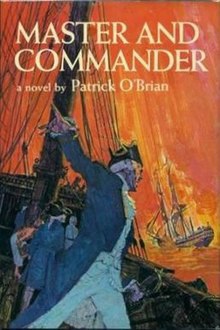
Patrick O’Brian, “Master and Commander” (1969) – In many respects, my decision to read this book (to the extent it was mine- it was elected by the Citizens of Melendy Avenue Review, a fine body of people you should join!), came down to genre homework. The Aubrey-Maturin sea adventures, of which this is the first, have had an outsized effect on adventure fiction of all kinds. It’s fair to say I’ve read people doing Patrick O’Brian in space (David Weber), Patrick O’Brian with dragons (Naomi Novik), Patrick O’Brian in weird alternate history scenarios (S.M. Stirling), etc. So I figured it made sense to read the original article, though of course you’ll have people saying I should go back to C.S. Forester and the “Hornblower” novels, or back before them, or back and back until you wind up with Homer… but most seem to agree O’Brian in particular had a special stamp. His work might have been my biggest single gap in my genre education, other than the gaping lacuna of romance, the English language’s biggest genre… someday…
But “Master and Commander” wasn’t just homework. It turned out to be a lot of fun. The year was 1800! The Napoleonic Wars were raging and things are going pretty well for France and not so great for Britain. But the latter have the Royal Navy (and the English Channel, arguably the most consequential twenty-one miles of water in history). Big sailing ships were almost certainly the most complex technological systems then in existence. Building, crewing, maintaining, sailing, and fighting them involved massive expenditures of both capital and labor, and the development of complex systems of control. If you could make the investment, it paid off big, like it did for the British and eventually the Americans. If you couldn’t, catching up was damned near impossible, as the French and later the Germans found. Just putting guns, even a lot of guns, on something that floats won’t do it.
What you needed were institutions, a culture even, to run such big, complex systems in the absence of a lot of the technological and administrative aids we take for granted, even mass literacy. “Master and Commander” takes you right into that culture and into those systems. I guess that’s a dorky way of saying that O’Brian immerses the reader in how the Royal Navy and its ships worked. We learn of the different types of ship, and especially sloops, smaller ships of the type with which we spend the most time in the book. There’s a lot about rigging and sails, masts, ropes, spars, navigation, stuff being at port and starboard and leeward and windward. We see the rituals of the service, both above decks with the officers and below with the men. There’s a lot of gritty detail about how the Royal Navy operated, which I’ll get into when I discuss plot. “Rum, sodomy, and the lash,” as the Churchill quote (and much better Pogues album) put it, are all present and accounted for to one degree or another.
Of course, most historical fiction readers (and I understand this as paradigmatic historical fiction- is that right?) aren’t reading for systems, though immersion in the rich details of the past are definitely an appeal. At the heart of the book lie relationships between men. The most important is that between Captain Jack Aubrey and Doctor Stephen Maturin. It starts out with Stephen shooshing Jack at a concert, but they soon wind up bosom buddies. Jack has a ship, the sloop “Sophie,” his first independent command, but senior officers stripped her of most of her better men, including her surgeon. So he hires on Stephen, who’s overqualified but glad to get off Minorca, the tiny Mediterranean island where things start, and have adventures with Jack and see new animals and plants and stuff. Stephen is a man of learning, a naturalist, something of an Enlightenment philosophe type (but no damned radical); Jack is a bluff, honest, impulsive Englishman, who likes women, food, a good fight, and prize money.
One of the more interesting things to me in this book is the way in which money moves things (not too different from that other perennial favorite depicting manners and mores of the same period, Jane Austen). The Royal Navy had an entrepreneurial streak certain management writers of today would admire- they would send ships out cruising for enemy shipping, and let the officers and men keep much of the loot they took. It turned out to be a pretty good system when your goal was to disrupt the Europe-wide economic bloc Napoleon was trying to create, and had crews of poor (often kidnapped) men with few options led by officers, like Captain Aubrey, from the petty nobility or bourgeoisie who could use the scratch to launch themselves up Britain’s greasy social pole. Of course, O’Brian and his characters don’t really see it that way- they see it as great fun. Men out on their own, in a hierarchy of real talent and respect, cruising the seas and mixing it up… and O’Brian gets the reader to have fun with it, too, and seeing the system behind it is just part of the fun. These are worldly men who accept the world and make the most of it.
There’s a lot of fun action, from early “shakedown” cruises where Captain Jack gets his misfit crew to work together on the rigging and the guns properly, to battles with other ships (often bigger and more heavily-armed, but clever strategy and brio wins the day… usually), to sneaking up on coastal fortifications and blowing them up. There’s false flags (which I thought weren’t allowed, but apparently were?) and other mischief. Stephen serves as our landlubber eyes, asking Jack and other sailors how stuff works, but there’s way, way too many sails and masts and ropes and decks and widgets and whatevers to actually keep track. You just let it wash over you. The character work is quite good in its way, unobtrusive and effective- you learn to like the other officers from small interactions.
They get a year or so of fun doings until Royal Navy politics rears its ugly head. Jack is a simple man who enjoys simple things, like sex, including with an important naval bureaucrat’s wife (Stephen, for his part, seems only to have oh-so-platonic eyes for his bestie, Jack). Said bureaucrat screws Jack out of a big score “Sophie” took and puts him on a milk run, escorting a mail ship. Saucy Jack takes some scores on coastal Spain, tipping off some big ass French and Spanish ships, and gets captured (O’Brian knows where to draw the line in terms of what dash and elan can accomplish).
And then… well, it’s not a big problem, but it is pretty anticlimactic. After some amusing scenes where both Jack and Stephen become bros with their captors — officers and doctors can always talk shop, even if they were trying to kill each other not so long ago — they get swapped out, and Jack looks like he’ll get in trouble for losing his ship (and pissing off too many other officers by showing them up/sleeping with their wives)… but he doesn’t. There’s another anticlimax earlier, where some intrigue involving Stephen, the ship’s second in command James, and the United Irishmen (rebels in colonized Ireland, just recently suppressed), basically comes to nothing after having been built up for a while.
Still and all, it’s fun times. I could see people getting tired of the nautical terminology, or just wanting Jack and Stephen to hurry up and bang already, but clearly both the terminology and the suppression of the homoeroticism involved is part of the genre fun. I think it more or less fully earns the hype and its exalted place in genre fiction, and I look forward to reading the next one. ****’
James S. A. Corey, “Leviathan Wakes” (2011) (narrated by Jefferson Mays) – I figured I’d give the Expanse series a try. People recommend the tv show to me but I wanted to try the books first, and I do make some cursory efforts to “keep up” with what’s big in scifi. At this rate it’ll be years before I get to the show, especially if my work tasks change again and I can’t do audiobooks, but we’ll see. I haven’t got much time for hour-long tv shows these days anyway.
In any event, this wasn’t great but it was good. It’s written by two dudes (“James Corey” is a “house name”), one of whom was George R.R. Martin’s personal assistant. It appears they learned much from Martin: short chapters alternating viewpoints (with the viewpoint character’s name right up top), idealists becoming more worldly and cynics learning to believe in something, blood splashed liberally around, detailed and interesting (if not mind-blowingly original) worldbuilding.
The two main characters are Miller, a world weary cop on a habitat in the Asteroid Belt, and Holden, an idealistic officer on a merchant spaceship (truth be told, the authors kind of slather the idealism on heavy towards the end to give their duller character a personal crisis). A cluster of murders, crises, and general fuckery set the Solar System on a collision course towards war, unearth ancient evils, and of course bring the two characters together to fix things.
The Expanse takes place a few centuries from now, when Mars, much of the Asteroid Belt, various moons are settled by people (but not terraformed). There’s no “faster than light” technology propelling us to the stars- everything takes place with the good ol’ solar system. It resembles, in many ways, the workaday space setting of the “Alien” movies: megacorporations, polyglot proletarian communities of spacers, confined utilitarian environments, etc. I like that sort of thing, though I do think the authors could have mixed it up a little more. Maybe it’s just the historian in me but I’m a little irked that they depict the community feeling of “Belters” (residents of Asteroid Belt stations) as basically the sort of nationalism we see on Earth, just cut and pasted onto outer space. Especially given the ways they distinguish Belters from “Inners” (people who live on the inner planets) — they’re physically different in some ways, speak their own patois, developed a culture around the harsh necessities of space habitation — you’d think there’d be a good opportunity to see how different ideas of community might develop…
This pattern repeats itself in a few places. There’s some (rather pro forma) invocation of the wonders of space travel, but this is no final frontier and there’s nothing really that imaginative, in either the world or the plot. The closest is an ancient evil non-human intelligence that “infects” a space station and gives it an eldritch consciousness. But in the end, that mostly amounts to an opportunity for some creepy H.R. Giger-inspired body horror and a very human-scale redemption narrative. The characters are also pretty by-the-numbers. Space cop is “in love” with a dead (conventionally attractive, natch) girl he’s meant to find. Space officer/dad of misfit space family has to learn to be more flexible but not give up his moral compass. Gruff space men are gruff. But the book hits the old beats enjoyably enough, like a well-practiced barroom rock band. I’m willing to try out the next one. ****
George Pelecanos, “The Big Blowdown” (1996) – George Pelecanos appears to be one of the big crime writing dudes of the last few decades. I first heard of him as a writer for “The Wire.” Or, rather, I heard of him because Ishmael Reed (a “problematic fave” of mine) tore him a new one when Reed was “on one” about “The Wire” being racist and chumpy a few years back. Pelecanos was a secondary target for Reed’s wrath, after Richard Price, but it did call attention to the gallery of big time crime writers who worked on “The Wire,” including Pelecanos (also including Reed’s fellow birthday lecture subject Dennis Lehane, who Reed did not name check in his diss, for whatever reason). So I figured I’d give Pelecanos a read. Sorry, Mr. Reed.
“The Big Blowdown” takes place in Washington DC mostly during the late forties. The soldiers are back home from the war, the dames are sexy, no one leaves home without their “deck” of filterless smokes, and even low-level crooks like the characters in this book dress sharp (the main character is a clothes horse with an interest in women’s shoes- I wonder if Pelecanos is into historical lady footwear? A charming personal detail if so). Pete Karras is a local boy, son of Greek immigrants and combat veteran, who drifts into organized crime with his childhood bestie Joe. He gets into trouble because he’s too nice to working-class immigrants who owe his boss money (the boss and his flunkies all have “old stock” Yankee or German names- wonder if there were many mobs like that running around?). Joe judas-goats Pete into a crippling ass-whooping. Pete leaves the life and becomes a cook at a diner. Joe stays.
This is a crime novel but not a mystery. There is a whodunit of sorts in the background that becomes important to the plot — someone is cutting up sex workers — but it’s pretty obvious quite soon who is doing it and it’s not the point of the book. The point mostly lies with Pete’s relationships and with the historical background/mood. Pete shows what was cool about forties manhood — the dames love him and he can kick ass even when limping — but Pelecanos isn’t shy about what all that cost. Dames love him but he can’t keep a good relationship. He’s married, routinely cheats, can’t connect with his toddler son. He’s something of a loser. When Joe and the mob he still works for come around to shake down the diner where Pete works, Pete and his hardass Greek immigrant employers prepare for a showdown with the mob. “Closure” for Pete and Joe’s relationship — in classic tough-guy fiction fashion, men’s relationships with women (mother excepted) are chapters but relationships with other men are books — and survival for the defiant diner become intertwined. There’s a side plot with a kid from a Pennsylvania steel town trying to find his addict sister in the big city that gets tied in, too.
The main peculiarity here is that the first forty pages or so of the book involve Pete’s childhood and then his service in the war. It establishes Pete’s relationship with Joe, I suppose, and the immigrant milieu in which they live. The war stuff makes clear Pete is a badass. But it seems to me other detective fiction does similar stuff without making such a big thing out of it. I was never especially curious about the childhood of Sam Spade or Philip Marlowe, I have to say. Part of it seems to be Pelecanos’s devotion to immersing the reader in his world. He draws Balzac comparisons from critics, and you can see why that would have attracted the producers of “The Wire.” He doesn’t do a half-bad job with it, either, but I’m not sure it’s the best thing for a crime story, compared to a lighter touch on the characterization and world building. The novel does tighten up considerably towards the end, when the pacing really comes on line, where it counts. All told, not a bad book.
I am developing a thesis that the nineties/early 2000s were an interesting time for crime writing for a few weird reasons. There’s some funny negotiations with sex and race, white tough guy writers dealing with earlier iterations of the “anti-oppression” ideas we see today, taking angles where they can. One of the best crime writers of that era, Eddie Little, a real life ex-con who literary fraud James Frey ripped off, had his characters spool out whole theories of how people of different races should talk to each other (with such rules as “if someone of a given race isn’t there, you can shit talk them all you like”) in between scores. Little wrote two books full of grit and jailhouse braggadocio-turned-flight-of-fancy, then relapsed into heroin use and died, leaving American crime fiction the poorer. As for Pelecanos, his characters, mostly Greeks, interact with black people in ways that make me wonder if they were meant to be rebukes to “political correctness”- a sort of rough and ready equality where both sides interact and rib each other (slurs included) and nobody’s keeping score… Pelecanos has a helpful black gangster give a speech about how he doesn’t want to be integrated, he wants to be on top of his own thing… I don’t think that’s the point of the book at all but it does make me wonder about the genre and the time. ****
Fritz Leiber, “A Specter is Haunting Texas” (1969) – Fritz Leiber is probably best known for his sword-and-sorcery books, which I should read some day. I picked up this scifi volume of his at a library sale, amused by the title. I knew nothing about it going in.
It turns out to be the story of Christopher “Scully” LaCruz, a ham actor from Circumluna, an orbital society of scientists and “longhairs” who escaped from a mid-twentieth century nuclear war, two hundred fifty years before the action of the book. Scully goes down to Earth (wearing a special exoskeleton to cope with the gravity) to lay claim to a mine in Canada that he inherited. He winds up in Dallas, where he finds out that Canada, and much of the rest of North America, got taken over, post-apocalypse, by Texas. Now, Texas was an empire, inhabited by hormone-fed eight-foot-tall (Scully is also tall from having lived in zero G, but skeletally thin where the Texans are beefy) back-slapping, gun-toting yahoos, every Texas stereotype come to massive, cartoonish life. I couldn’t help but picture the first Texan Scully meets, the political fixer Elmo, as a gargantuan Hank Hill. The Texans run a sort of neo-feudal empire, enslaving the Mexicans and making cyborgs out of many of them (and all of them run about four feet tall).
Scully doesn’t really care about this, he just wants his mining claim so he can have enough money to save his theater troupe or something. But he gets sucked into various plots. First, one Texan faction tries to use him against the President (every President of Texas dies by assassination, traditionally). Then ragtag revolutionaries who want to overthrow the Texans and liberate the Mexicans enlist him in their cause. He’s a reluctant revolutionary at best, but as a ham, can’t resist a crowd that sees him as El Esqueleto, the skeletal harbinger of Death- redoing the old trope of Mexicans as greeting white people from abroad as gods. Also, he wants to get laid with two revolutionary women, one a tiny Mexican and another a huge Texan. So he goes on a tour northwards towards his mining claim, inspiring uprisings and learning ghastly truths about what the Texans are doing to the Earth’s mantle.
Leiber was closing in on sixty when he wrote this book and altogether it feels somewhat painfully like a middle-aged man trying to be With It circa 1968. Though, in a way, as both a scifi writer and an actor (he came from a theater family and acted some himself), Leiber could probably claim better hedonism and mind-expansion bona fides than most of the youth at the time. I think his sympathies were probably with “the youth,” both in the novel and in society at large, but from a foggy and at times patronizing distance. Both Scully and, I think, the author, treat revolution as essentially a child’s game, theater.
The whole thing is played as farce — like the sort of comedy Scully might put on with his company, get it?! — and you get the thing you get in a lot of writing by men circa 1960s-2000s where there’s a lot of stereotyping going on and you’re not sure how much of it is “genuine” vs satirical. You’re also not sure how much it matters. The whole premise of the world of the book is reversion to type on a racial scale. The Texans are the whitest white yahoos, having assimilated the rest of the white people of the continent to their empire. Mexicans are spicy, superstitious, physically small, and given to revolutions launched by dramatic gestures. Black people have “hip republics” on the coast, and the one black character is a jive-talking Buddhist monk. Native Americans live in teepees, Russians have genetically engineered themselves into bear-people, there’s a ranting genocidal German-Texan engineer, etc. Luckily for us all the book didn’t have any Jews or Asians. Leiber would presumably point to his farcical white characters as proof he’s an equal opportunity offender. Meditations on gender, or anyway, the mentality of women, in a similar vein pop up throughout as well.
I’m less interested in offense here than I am in the fact that two hundred odd pages of ethnic farce with a bit of sex farce thrown in for variety gets old. I can almost feel people out in readerland thinking “aha! A writer who cares not for restricting moralism in prose! It must be good!” I, too, find the social moralism in a lot of contemporary criticism constraining but to borrow a contemporary phrase, “this ain’t it, chief.” The book didn’t lack for zip and it was oddly prescient, in some ways, like the prominence of Texan (and other southern) tropes and practices in reactionary white American manhood going forward. But in general, there’s not enough going on, ideas- or action-wise, to really justify the broad farcical elements. ***
Richard Allen, “Skinhead” (1970) – My readings on the right have brought me to this underground cult classic. It is part of the “youthsploitation” wave of pulp novels of the era, where cheap publishers rushed out material on the range of youth subcultures then making the news. Many of them were written by a middle-aged alcoholic Canadian hack named James Moffat, who wrote under numerous psuedonyms, including Richard Allen. As Allen, he wrote a dozen-odd skinhead novels that became quite popular within the subculture and became both passed-around artifacts and subjects of artistic parody.
No one has ever accused skinheads of being the most sensitive readers, and part of me is a little surprised they took to these books the way they did, given the undisguised contempt the author has for the subculture. For Moffat/Allen, skinheads were a symptom of modern culture gone awry, barbarians at the gates of a civilization too weak (due to egalitarianism and the welfare state) to fend them off. At the same time, he has a sickly fascination with the virility and violence of Joe Hawkins, his skinhead main character. Joe is something of an East End ubermensch, who takes what he pleases, be it blood, money, or sex, with violence and cunning. He does lose a fight or two but always gets revenge. One can see how the character would appeal to a certain type of young man.
This book was published in 1970, relatively early in the career of the skinhead subculture. As such, the politics involved were much more muted. Joe and his friends are racist and hate hippies and radicals, to be sure, but they care about beating up black people and Asians about as much as they care about beating up rival soccer fans. Moffat/Allen doesn’t seem to really make the connection between his preferred social order, where men are real men, hierarchy is gladly accepted, and Britain is great again, and the sickly fascination he has for Joe’s violence against shared enemies, but others would, and I wonder if the author does in later books.
Moffat/Allen clearly had some pulp writing chops and the novel zips right along. I don’t think I encountered a single sentence where the only verb was a variation of “to be,” a good sign for pulp. But there’s two major problems here that prevent me from recommending it as (highly, highly “problematic”) fun. The first is the author’s ideological hectoring. No one was (is, afaict) as attached to orderliness and The Rules as the Anglo-Canadian pedant, and Moffat/Allen makes sure to point out for every bad thing happening (which he leers and drools over), there is a social welfare policy encouraging it. This attachment to order, presumably, is what prevented him from seeing the Joe Hawkinses of the world as allies, as later far-right nerds would. More importantly, there basically isn’t a plot. The book begins with a depiction of Joe’s father and his corrupt docklands milieu, where faux-radicalism and pilfering go hand in hand and dock leaders plan strikes for malicious reasons. I thought that it would end with the skinheads attacking strikers. That would have been interesting and have dramatic unity, but no. Instead, Joe just does a bunch of crimes and gets away with them, the end. I guess that’s all you need for “youthsploitation,” but I prefer my voyeurism to at least have the decency of a plot. This is an interesting literary artifact but that’s about it. **’
Patrick Rothfuss, “The Name of the Wind” (2007) – A lot of people like this book. There was huge hype and lasting affection around it when it came out in the late 2000s, that magical time when we thought we had seen how bad it would get. It came highly praised by the likes of Ursula Le Guin. I have a lot of friends who like it. The friends I have who like it (when I posted about it on my social media, other friends with other opinions emerged, but that’s neither here nor there) use words like “poetic.” And Patrick Rothfuss himself seems like a decent sort, a harmless, fun-loving nerd who doesn’t appear to be using that performance of self as a guise to exploit others, as we see done (:cough: Joss Whedon :cough:) elsewhere in the nerd-o-sphere. His blog is all raising money for charities and pictures of his nice family.
So you can see why I might want to go easy on this book. Respected writers like it. More importantly, friends like it, and use language for it I feel weird challenging- am I really going to just diss my friends’ sense of aesthetic? Most pertinent of all, most of the time, when I really gun for a book, the author sucks in some way, like Mike Ma being a fascist or Sheila Heti contributing to tweeness and pretense in literature, to cite two recent examples. I can’t really say that about Rothfuss, who, I reiterate, seems like a decent, blameless guy.
But I will not go easy. I will reflect my experience. This book baffled me with its utter mediocrity. It bored and frustrated me. A lot of the time, when millennial critics say something bored them, they mean it offended them. This is not the case here- I would have taken some offense if I could’ve gotten it, just to spice things up. Similarly, when they say a piece of writing frustrated them, they imply there was something else they wanted the piece to be, or in non-fiction, wanted the author to acknowledge some hobby horse of theirs. I guess I wanted this to be good fantasy, but I’ll damned if I can say specifically how other than “be more exciting and interesting, and maybe shorter.”
“The Name of the Wind” is, mostly, the tale of one Kvothe. Kvothe lives in what we could see as a generic post-George-RR-Martin fantasy land- roughly medieval European technology level and social arrangements (though with post-Columbian-Exchange crops, like chocolate- I will admit that took me out of things a little early on), magic and monsters largely in the background… for now. Because this was supposed to be a big deal trilogy, there is an extended framing device, a good seventy-five pages or so dealing with demon spiders emerging in this little rural town, before we get to the meat of the story. The owner of the inn in this little town isn’t all he appears. A Chronicler shows up who knows who he is- Kvothe, big time badass wizard warrior. Chronicler wants his story and Kvothe, after some back and forth, agrees to give it, and that provides the action for much of the rest of the book. The demon spiders don’t come back- presumably they do in the second book or in the third book that Rothfuss probably at this point won’t write.
The biggest problem, if I had to pick one, with this book is that Kvothe is, as pointed out to me by a fan of the book, an utter Marty-Stu, a wish-fulfillment of the most banal fantasies of badassery that the first decade of the twenty-first century could conjure up. Kvothe relates his upbringing amongst traveling performers. From the beginning, he’s whip smart and savvy. He also talks like a twenty-first century adult, but we’ll get into that issue later. He meets an old wizard who teaches him some magical basics and of course, he picks it up faster than anyone. His lows are heroic lows- his family slaughtered by mysterious wights from ancient lore, first he survives in the woods all on his own, then makes his way by his wits on the streets of the big fantasy city of Tarbean. He then makes his way to the University to learn magic (and about the wights) and impresses the masters so much they pay HIM for his first term! He makes enemies — a mean professor, Snap- I mean, Hemme, and a snooty aristocratic boy Malf- I mean, Ambrose — and shows them up magnificently with his magic chops and street smarts. He’s a musical genius, too, and girls totally want his fifteen year old self. Above all, he’s collected and self-contained.
“Well, it’s HEROIC fantasy,” I can hear some of you say. Sure. And there’s a number of ways to make such a character interesting. One would be to make him a less reliable narrator, like maybe he has to dial back some of his stories (there is an interlocutor character along with Kvothe and Chronicler). Even if you want to keep him that heroic, you can make the challenges he faces interesting, or ones to which he isn’t suited. You can also set him in an interesting world, worthy of the hero’s talents.
Rothfuss fails to deliver on any of those options. Kvothe is understood to be reliable throughout. The lack of interesting challenges and the failure of worldbuilding reenforce each other. Magic and science aren’t separate in this world, so Kvothe learns a lot of both, seemingly more of the latter, but he does so so effortlessly it’s basically uninteresting. The details of the magic system, laid out in pseudo-scientific trappings, were left underexplored but were also so dull I didn’t really want to know any more.
Rothfuss seems to have been going for “gritty,” which led to one of his more interesting decisions- making young Kvothe constantly worry about money. He’s poor and the University costs, at least after first term. This is something of a departure for fantasy, but it isn’t handled well. It’s sort of a low-grade irritant throughout the book, worrying about Kvothe’s finances and doing exchange rates on the various units of currency he uses.
Most of the action takes place in generic medieval city-space and while several cultures are mentioned and attributes ascribed to them, none of them are particularly distinct. There’s lore, intimations of old, deep mysteries (like the murderous wights), but none of it is anything fantasy readers haven’t seen many times before, interspersed with similarly anodyne action. There’s numerous songs and poems but I’ll be damned if I remember any of them, and I finished the book the day I’m writing this.
Then there’s the writing. He didn’t want to do exalted high-fantasy diction. I get that. He doesn’t make even as many concessions to it as does George RR Martin- fine, I guess, you want to stake your own territory. But god help me if Kvothe and basically everyone else in the book (except some yokels done in painful yokel-speak) don’t just talk like anodyne twenty-first century people, with the occasional lapse into flowery language of the kind a marketing intern would make up for a renaissance faire. If your magic is (mostly) science and your cultures aren’t any different from ours except for having lords and ladies (which we might as well have, given where inequality is going), and everyone is going to talk more or less like the people at your friendly local gaming store — a little more verbal and descriptive than at the other stores in the mall, but basically the same dialect — why the fuck did you bother writing fantasy? What was the point?
What this most forcefully reminded me of was less another given piece of literature and more a moment in my life. That’s the moment in college — around the time this book was probably being written, in fact — that it dawned me that most nerds are boring as shit. They might be good or bad, smart or dumb, but nerd culture as a whole did not represent what I wanted out of culture. Cruelly, one of the better things about nerd culture, the participatory element found in role-playing games, fan fiction, etc., bore this out the most. Given the vast scope of possibilities laid out before them, most nerds will ineptly reproduce what came before, the ones who won’t just turn the creative possibilities before them into their personal toilet, that is. Rothfuss presents himself as an every-nerd, and, god love him, after reading “The Name of the Wind” I can’t disagree. I feel about as good about this as I would about roasting some of the decent nerds I knew, but wasn’t friends with, in college- but the hell with it, he made his pile and is doing fine. I’ll give him the extra half star for being a decent dude and deserving more honor, for at least trying fantasy, than shitty litfic gets, not that he or anyone really cares. **
Stephen Graham Jones, “The Only Good Indians” (2020) – An old friend of mine sent this book my way. It’s a horror novel written by a Native American writer, set in contemporary times with mostly Native American characters. Interestingly, most of the characters refer to themselves and their co-ethnics as “Indians.” Jones seems to imply in one bit this is a generational thing- most of the characters are in their thirties, and it’s younger characters who prefer “Native American,” “indigenous,” and so on. I usually use “Native American” to be safe but have been corrected by people claiming authority for using both “Native American” and “Indian,” so, who knows?
The premise of this book is that four young men from the Blackfeet tribe of the upper Midwest go hunting the week before Thanksgiving. They bring their truck onto the part of the hunting grounds reserved for elders of the tribe, which is bad. They find a big herd of elk and blinded by greed, enthusiasm, and the joy of killing, fire rapidly into it, which is pretty bad. A game warden catches them and makes them throw a lot of the meat away, which would seem to make him a party to the badness, but that doesn’t come up- either way, more bad shit. Worst of all, one of the four gruesomely and gracelessly killed a pregnant elk and the calf inside her. He tries to make it right — even bargains with the game warden to let him take the corpse, to make use of all of it — but it won’t be that easy.
Ten years later, mama-elk-spirit comes back for revenge. I don’t feel like that’s a spoiler because it’s revealed in the first third of the book. Spoilers, I think, would be revealing exactly what she does and how to stop her. We’ll just say that she does more in terms of getting her marks to damage themselves and those around them than she does directly attacking people. She can shapeshift, and summon either a herd of elk or the spirit of her herd. It’s not entirely clear, but I think that’s ok, a good thing even. Fiction with monsters these days, influenced by role-playing games where monsters come with stats, often lay out exactly what it is monsters are and aren’t capable of. Good on Jones for keeping it uncanny.
I’m not much of a horror guy (though I probably read more horror this year than I ever have, given my birthday lecture was partly about Lovecraft) so I’m not the best judge, but the action seemed well-paced and horrific without being gratuitous. The character work is what really shone for me. Jones sketches out his characters quickly and completely without a lot of rigamarole, so it really has an impact when stuff happens to them. Even the monster feels real, especially for a vengeful elk spirit.
There is exploration of Native American identity here in a way that is genuinely interlaced with delivering the genre goods, no mean feat in this age of tacked-on morals. I was intrigued by the different ways the characters processed their Native American (invariably, in their inner monologues and conversations, “Indian”) heritage- omnipresent, a determinant factor in their lives (all were reservation-born), a source of both pride and impediments they wish to escape, an altogether different relationship with history, space, and race than white people like me are used to, but never presented by Jones in a reductive or essentialist way. Jones also isn’t so lazy as to make the character stand-ins for different ways of being Blackfeet or Native American. They’re all ambivalent in their own ways about their identities and how they intertwine with their personalities. In keeping with his highly competent interweaving of the themes with the genre action, this shows in how the characters deal with the elk spirit: not so “traditional” as to believe in it right away, not so “modern” as to dismiss it entirely, suspended between very real-seeming doubts and suspicions of the sort that would occur to people when the uncanny and horrifying occurs. All told, a strong genre work. ****’
Olaf Stapledon, “Star Maker” (1937) – Do people still say that things “blow their minds?” I feel like you get a lot less of that sort of rhetoric now that it’s associated with online goobers and the hucksters who fleece them. Maybe it’s just an artifact of when I grew up. I knew teens and very young adults who were into getting their minds blown and expanding them in the various by-then traditional countercultural ways. Maybe it makes sense, in my thirties, I know fewer such enthusiasts. Seemingly every surprise since 9/11 has sucked pretty hard and I think this has made my generation skeptical of the idea you’re going to surprise them in a good way, which seems pretty basic to the concept of having one’s mind blown.
So, did Olaf Stapledon “blow my mind” with “Star Maker?” To a certain extent, yes, he did. I don’t know if I can still manage the sort of feeling of a thirteen year old seeing “The Matrix” for the first time, but I did feel a certain degree of awe. Perhaps the feeling could be compared to finding an old holy text in your tradition that is new to you. None of it was truly new to me but seeing it in its original form was an interesting and even moving experience.
The feeling is both tempered and encouraged by the simplicity and starkness of the text. As Stapledon himself put it, by most literary standards, it fails as a novel. It’s closer to a fictional report. An anonymous Englishman is standing on a hill in the 1930s when all of a sudden his consciousness is flying among the stars. After a few chapters of learning to control his flight, the narrator finds intelligent life somewhere and learns to cohabitate the brains of its inhabitants. After learning of these “Other Humans” and their ways, he teaches a local philosopher how to also zoom his consciousness around and they go exploring the galaxy. By and by, they form a group mind with representatives of all of the intelligent life they find. They realize that with their minds, they not only travel faster than light, but that they travel back and forth in time. They use this to bear witness to the struggles of life in the cosmos.
And struggles there are, as the group’s mental travel, at first, only takes them to worlds experiencing something like “the crisis” as understood by someone like Stapledon, a pacifist and (non-communist) progressive of the 1930s. Industrial society leads to class and national conflicts, scientific progress undermines old spiritual verities, ideologies of both extreme individualism and extreme collectivism run rampant. In many respects, what Stapledon is getting at is a lack of balance, a concept that will become important to this sort of thought later in the century but seems wasn’t part of the vocabulary at the time. The narrator reports on various planets full of varying life forms, including plant-folk and what amount to big sentient boats, and how they cope with crises that sound a lot like what was going on on Earth at the time.
But this is a story, for much of its run anyway, about ascendance- a sort of secular scientific/spiritual “Pilgrim’s Progress.” Eventually, the group mind learns how to contact more advanced civilizations. Lead among them are a symbiotic race of fish and aquatic arachnids that seem to have both their technological and their spiritual game pretty well figured out. They can do space travel, and their minds are clear of “attachments” and distractions and aware of the interconnectedness of things- that appears to be what Stapledon means by “spiritual,” missing out in the western Buddhism craze by a few decades. But at every level of ascendance, there are pitfalls- technological disaster, the temptation of interstellar empire. The group mind witnesses terrible wars, all the more terrible as they force the enlightened civilizations to become warlike and de-civilize themselves. But advancements in technology and in spirituality, including telepathy, eventually do away with war and lead to a galactic utopia.
This is very much a story of the apotheosis of mind. Stapledon values peace and love but sees neither as necessary properties of mind. As it turns out, even the stars have minds, and have violent objections to being manipulated by the planetary powers, which nearly leads to galactic catastrophe. The nebulae have minds. Everything has a mind!
In the end, the group mind (Stapledon switches between “I” and “we” pronouns for it) encounters the titular Star Maker at the end of the cosmos. The group mind has now spent millions of years contemplating the cosmos, the way the design of it seems to point towards higher and higher complexity and unity. Stapledon makes much of how the simple human mind of the narrator, separated from the group mind, can’t even adequately describe the utopian societies (or even the more highly advanced dystopian ones). This might seem like a cop-out, but together with what Stapledon does get across, it convincingly conveys a sense of scale and grandeur. But at the same time, the group mind has witnessed untold pain and misery. For every intelligent race that made it into the galactic utopia, hundreds more got close and perished, and thousands or millions more never got beyond their own planet. Moreover, the galaxy is dying. Energy is running out, the laws of thermodynamics doing their thing. It won’t be possible for all of the galaxies of the cosmos to commune, reaching that final level up. What was the point?
Well, I don’t want to give too much away. We’ll just say the Star Maker sets the mode for the cosmos, as Stapledon understands it- mind, all the way down. Not love and not life- mind. The answers the Star Maker gives to the group mind narrator prove both deeply unsatisfactory but entirely consistent, and while the narrator briefly protests, he/they ultimately accept. He then gets beamed back to England. He knows what’s going to happen to Earth and our species and knows it’s not the happiest (or worst) story, but he’s determined to play his part in it anyway. In 1937, the light was dimming throughout the world with the rise of fascism and the threat of world war, but he ends with the two lights to guide us: the inner light of love and creativity, and the outer light of the stars, pointing to infinity, or, anyway, as close as our finite minds can get.
This book is dated in a lot of ways. Seemingly everywhere, even with the fish-sea-spider-symbiosis people, there are two sexes and two genders and they more or less map onto human men and women as understood by a (progressive) man of the time. While Stapledon respects the speed of light limit on physical travel, his mental travel is pretty magical. He gets a lot of tech stuff ahead of his time — Freeman Dyson more or less ganked the “Dyson sphere” from him — but Stapledon completely whiffs on computers or anything digital, understandably enough for 1937 I suppose, but there’s not even Capek-style robots anywhere.
Most of all, there is the more or less unquestioned hierarchy of joint technical and spiritual achievement that structures the entire book. He doesn’t shit on “primitive” people, good liberal that he was, but does pity them and consider them less than in terms of complexity. This is a stupid idea. Yes, pre-industrial people would have trouble understanding the internet if you explained it to them. But I have trouble understanding agriculture and the woods, certainly in the way people who lived their lives by them understood them. The idea that earlier times were simpler, for better or for worse, is a fallacy. Complexity comes in a lot of guises. Of course, fans of science and space exploration insist their enthusiasms are the most specialest — I mean complex! — of all things, but that doesn’t mean we need to buy it.
Still and all- I couldn’t help but be impressed and even moved by this small, strange book. I don’t quite belong to the faith tradition — space utopianism, more or less — of which it is a foundational text. It sounds nice and if life goes that way I’ll happily go along, but I don’t quite believe in it. Among other things, I think values other than mind alone have some claim on us, even if I mostly live the life of the mind myself. But I’m not a Christian (anymore) and some parts of the Bible are pretty impressive, too. As various vernacular editions of the good book laid the foundation for their respective languages’ literary traditions, so did “Star Maker” set out many of the tropes and priorities of far-future “ideas” scifi, including Ursula Le Guin, Iain Banks, Vernor Vinge, and so on. That the ur-text of the genre was set out in this simple, report-liturgy way, makes it all the more poignant, to me anyway. ****’
Jack Mahoney, “Fair Trade” (2020) – I’m not one hundred percent certain I know what a “thriller” is, and especially where the line is drawn between thrillers that depict crime and conventional crime fiction. As it happens, I know the author of this new thriller, so I asked him. He said “Fair Trade” and its predecessor, “Clearcut” (which I read as a manuscript- it’s good to know writers, sometimes!) are both crime fiction and thrillers, but what distinguishes “Fair Trade” from his other, non-thriller crime novels are the emphasis on generating the emotion of suspense and de-emphasis on figuring out a puzzle. Thanks for the clarification!
“Fair Trade,” the second of the Adrian Cervantes series, certainly does deliver suspense and thrills aplenty. Adrian is an Army Ranger whose unit was betrayed in Iraq during a delivery of cash. None of his squad survived a helicopter crash in the northern hills except Adrian. Nursed back to health by some friendly Yazidis, Adrian goes back stateside with a mission: deliver a fair share of the cash his squad got fucked over for to each of his squadmate’s families. He exists in a liminal space, not formally dead or alive, existentially AWOL, living off his share of the cash and his sense of mission.
This installment brings him to New York. It doesn’t look like his buddy Barry’s family needs the money- Barry’s wife married a rich agribiz dude who works “fair trade” deals in Central Africa. But just as Adrian meets the family, Barry’s son gets kidnapped by some very professional operators, who demand an oddly specific ransom amount out of Mr. Fair Trade’s price range. Adrian and Barry’s post-collegiate daughter Lori go into action and discover betrayal by a hipster-douche boyfriend, narrowly escape death at the hands of mercenaries, find out terrible secrets of the agricultural business, and have a fling. Adrian is a badass but not a superman, Lori is resourceful and insistent, and the action is fast-paced and more-or-less believable. The author provides the sort of interesting explanations of both combat situations and Adrian’s social engineering feats that make a feature of this sort of writing (think “The Bourne Identity”) without dragging the pace. In the end, Adrian is prepared to make another “fair trade” – him for the boy, as it seems whoever did the kidnapping might be tied in with whoever betrayed his Ranger squad, and wants Adrian for their own purposes.
One thing I wonder about thrillers, based largely on the Cervantes books and movies and TV I’ve seen: they seem tied to a realism so stringent as to verge on blandness, sometimes. Adrian moves through a world of high-end hotels and apartments, office complexes, abandoned lots and parks, among people dedicated to tasks. Their relevant attributes are largely those of tactical significance. Sometimes, this can be revealing of the character of a given person or place, as with the big bad in this installment. I understand that the thriller mode needs to be stripped down to deliver the pulse-pounding goods, but I did find myself cherishing the descriptive and character moments in “Fair Trade” and in other similar works. Michael Mann is good with this, often giving little background tid-bits on his characters that flesh things out within the attention economy of the stories he tells. How much color can a thriller hold before it ceases to be a thriller? I guess I’d ask if I had to frame it as a question. My impression is that some thriller writers “color” by throwing in a lot of gun-pedantry and militaria, which I’m glad the author does not, but I think the answer is “more than the Cervantes novels presently have.” Still, the core of the experience is there: if you like the experience of being thrilled, you should pick these books up. ****’



 Too Much Berard