Review- Ellroy, “This Storm”

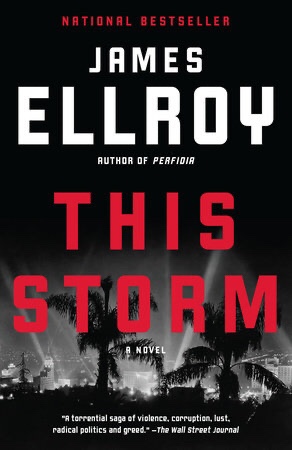
James Ellroy, “This Storm” (2019) – How to even describe a late-stage Ellroy novel? Nearly six hundred pages of cop-fantasy fugue gets at the gestalt. Ellroy described his early method as transcribing the crime fantasies he came up with while bumming around LA, frequently homeless and high on shoplifted cough suppressant. His later method, as far as his very few interviews let us see, is to hole up in his house sans internet or tv, marinade his brain with old LA newspapers and jazz and classical records, and let his imagination, full as ever of wild schemes, outre ultra-violence and chintz, spool out into a book every few years. Nice work if you can get it, I suppose, though he had to go through hell to get there, what with his mother being murdered when he was a kid and him being raised essentially feral…

Anyway, “This Storm.” Title taken from a line in an Auden poem. Set in LA and Baja California in 1942, second part of a planned quartet of wartime LA crime novels. Ellroy’s trademark telegraphic/police report style enhances the effect of a constant drip of incident, new (sometimes new old- these books link up with his previous books and share characters) characters, layers upon layers… a group of characters, mostly the shady, violent cops Ellroy loves, stumble upon a massive conspiracy involving a gold heist and some kind of totalitarian left-right alliance to sabotage America, during and after the war. As a historian, it’s deeply amusing to me to see Ellroy, a smart guy and lover of history but not a theorist, walk backwards from his kiddie-crime-book inspired rogues gallery of commies and Nazis into something like the classical totalitarianism school concept of mid twentieth century history.

Different characters want different things but most of them want some combo of gold and a “clean solve” to a baffling triple murder connected with the gold. The most interesting is Dudley Smith, as close to a classic Ellroy ubermensch as any Catholic (he’s ever so Irish, y’see) will be (Ellroy might be the last mainline Protestantism snob alive), is seduced by the right side of the right-left gold alliance. This comes in the form of the Sinarquistas, a sort of Mexican fascist movement that actually existed. While Smith and other Ellroy fascists have some right-wing values — order, for sure, and hierarchy — for them, it’s mostly fetishistic, a matter of the look and the violence (this is presumably what attracted Ellroy to the Nazi right as a teen). Communists, in Ellroy’s telling (at least this time around- he was a little more sympathetic towards the end of the Underworld USA trilogy, which I wrote about in Jacobin many moons ago), are a little more self-righteous but much the same- in it for the excitement and the opportunity to lord it over others.

Not to get persnickety with what is, after all, a crime novel and not a political treatise, but it’s not like Ellroy’s USA exactly has some grand point to it other than murder, sleaze, and chintz. One of Ellroy’s great strengths is that he doesn’t even pretend there’s anything at the bottom of it. He continually has his characters refer to it as “this white man’s country.” It’s not subtle and he doesn’t really try to justify it. In the end, he makes clear the totalitarians are just crooks with an added layer of ideological excitement going for them, so… not sure what it all adds up to, but as Ellroy will be the first to tell you, he’s not a political animal these days and he won’t talk about Trump. So there.

There’s a lot else going on, too. There’s divided loyalties, between characters who are sometimes too generic, types, strongarm cops and strong-willed arriviste women. There’s a depiction of a gay Japanese-American dealing with the internment of his community on top of all the crime mess, the sensitivity of which belies Ellroy’s usual provocativeness. And there’s Ellroy’s invocation of nighttime LA which really makes me want to go get a drink at a Chinese restaurant at 1 in the morning, which between living in greater Boston and living under covid doesn’t look too likely…

At this point, one doesn’t read an Ellroy novel for the plot. Starting with the end of the Underworld USA trilogy, they got too big, too fantastic, hallucinogenic even, which I saw as a fitting end to the trilogy but now just appears to be the man’s MO. But the immersion into Ellroy’s nighttime, nightmare world of blackmail, violence, chintz, the fetishitic invocation of the objects and rituals attached to them… for those who have come with Ellroy this far, “This Storm” is worth it. To those beginning the journey, I say go to “American Tabloid” and start from there. Don’t say I didn’t warn you. ****

Review- Ellroy, “This Storm”

Review- Le Guin, “The Lathe of Heaven”

Ursula K. Le Guin, “The Lathe of Heaven” (1971) – George Orr dreams effectively- that is to say, some of his dreams come true, shifting reality behind them. That’s the premise of this Hugo Award winner from scifi legend Ursula K. Le Guin. Orr doesn’t want to do this anymore, and his attempts to self-medicate his dreams away lead to him being put in the care of psychiatrist Dr. Haber, who sees the potentialities of Orr’s ability when combined with Haber’s hypnosis chops. Haber soon has Orr dreaming up all kinds of things to improve their lot and that of humanity, generally leading to unintended consequences. Dreaming away overpopulation (this is the seventies, when people were worried about that) leads to a great plague obliterating much of humanity. Dreaming away war between nations leads to war between planets, and dreaming away racism leads to everyone being the same gray color (something tells me people would still develop something like racism, but hey, it’s a scifi novel). Orr, something of a natural Taoist, wants to stop getting in the way of the Way of things; Haber, almost a parody of the sort of scifi ubermensch Le Guin and the rest of the New Wave in scifi were trying to get away from (and their authors), insists on their (mostly his) ability to change the world for the better. Eventually, Haber’s faustian power grab does himself in and nearly destroys consensual reality while they’re at it. Short, effective, and moving, this one earns its place in the canon of speculative fiction. *****

Review- Le Guin, “The Lathe of Heaven”

Review- Lehane, “Mystic River”

Dennis Lehane, “Mystic River” (2001) – This isn’t a hard one to review — I have plenty to say about it, as you’ll see — but it’s a strangely hard one to rate. I know you probably don’t read for the star ratings but I take them a little seriously. There’s a lot to dislike but a fairly sound structure and solid writing. This is the story of three men from “East Buckingham” (still not sure why Lehane made up a Boston neighborhood instead of using Dorchester or South Boston as is his usual wont). East Buckingham is Lehane-land, white blue collar Boston, incestous and besieged by the forces of change, in this instance rapid gentrification. The locals manufacture things and the locale manufactures childhood trauma. One of the men, Dave, is kidnapped by child molestors when he’s 11, in the presence of the other two, Sean and Jimmy, but escapes. Twenty-odd years later, Jimmy’s teenage daughter is murdered. There are Connections and it winds up being bloody and tragic before the end.

This was meant to be Lehane’s big cross-over novel, from crime to mainstream literature. One of the consequences of this is that the investigation of the crime, by Sean who’s a state cop and by Jimmy who’s an ex-con store owner with underworld connections, gets relatively short shrift compared to depictions of grief and trauma. Truth be told this is something of a dirge of a novel. It’s not done poorly, but a dirge it still is.

The depictions of the characters are decent, though I wouldn’t say necessarily realistic. There’s a certain cruelty to Lehane’s depiction of childhood as the necessary and unqualified determiner of adulthood that strikes me as wrong even as it is piquant. Dave is weak, a victim- that’s why he got in the car, that’s why he’s the person he is today. Sean had the advantages of a stable two parent home and some money, so he’s a hot shit investigator. Jimmy is a sort of tragic Southie ubermensch, always right in his instincts, and even when he’s wrong, as his wife assures him in the epilogue, is it really wrong if it’s the king of the neighborhood doing it?

Does it count as spoilers if the book is almost twenty years old and was made into a hit movie which was a pretty faithful adaptation? Well, in the spirit of niceness, SPOILER ALERT: the autistic kid did it. I was going through the book hoping Lehane had come up with something better than that, that Clint Eastwood was the asshole in this scenario for making that the plot of the movie, but nope. It’s right there on the page.

“Lazy,” “boring,” and “gross” are probably the three most overused terms in popular Millennial criticism and I do try to avoid them. But Lehane’s conviction that crime is basically an infection, a product of soullessness passed on via inflicted trauma or just blind chance (in the case of the autistic kid), leads him to a lazy, boring, and gross conclusion. The kid has an accomplice, an allistic kid who’s just depicted as an evil brat- this is Columbine era, remember, “Doom” and permissive parenting, both of which Lehane cites, was supposedly creating a generation of blank-eyed murderous sociopaths. But probably worst of all is his depiction of autism as soullessness. The kid is just a blank. Jimmy can see it, with his near-perfect antennae for evil, but doesn’t connect it up in time for him to not murder the wrong man (and you can probably guess who that is) for the murder of his daughter.

The infection model of evil is even more pronounced in Dave, who is depicted as having pedophilic feelings basically as a consequence of having been abused himself. Is there any science to back this sort of thing, or is it just bullshit? I guess it might qualify as a folk belief of Lehane’s people, and here I don’t mean the Irish or something dumb like that. I mean whites who fetishize blue collar authenticity even as it’s vanishing, even as it probably never existed quite like they think it did. The holders of a sort of stoic-cum-Catholic-cum-barstool-philosopher’s take on the problems of the world as being somebody’s unaccountable fault and everyone’s unaccountable fault. The sort of thing you see now that people are starting to criticize policing as a one-stop solution to social problems- “what about the sickos?” And no matter how often you patiently explain that van-diddlers are vanishingly rare next to child abuse coming from within the circle of trust, they saw on channel whatever just the other day about a weenie-waggler outside of a school so…

Well, channel whatever, for all it’s biased depiction of reality, doesn’t make stuff up out of whole cloth (usually) and there is the issue of bad coming out of good structures, killers coming from good families, etc. I guess it’s just a matter of what you choose to emphasize. Stories of making circles of trust less hermetically sealed, giving potential victims the ability to reach out and protect themselves, are less popular than stories of sickos getting theirs, for the time being anyway. So what to make of “Mystic River,” then? It’s not a simple story of a sicko getting his. It’s both less and more than that. So I’ll place it in a category of limbo, and have more to say about Lehane’s oeuvre come my birthday lecture this year. **’

Review- Lehane, “Mystic River”

Review- Macdonald, “The Moving Target”

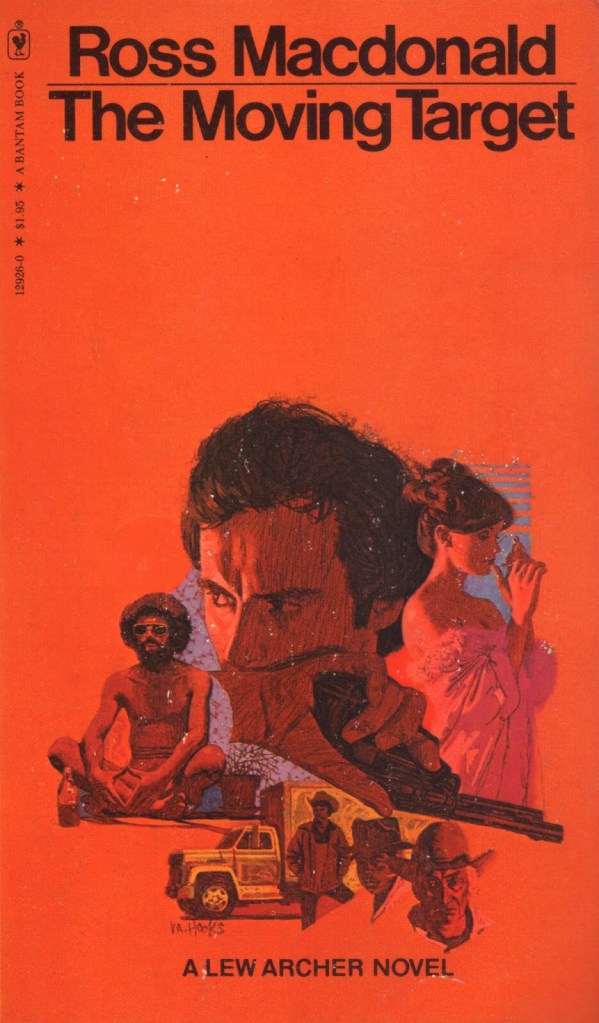
Ross Macdonald, “The Moving Target” (1949) (narrated by Tom Parker) – Corruption and sex in the Southern California sunshine are the order of the day in this hardboiled detective novel. Ross Macdonald and Ray Chandler apparently didn’t get along- Chandler thought Macdonald a softie who couldn’t write, and Macdonald thought Chandler an unrealistic hardhead. That being said, to most readers, Chandler and Macdonald will read a lot alike. That’s a good thing, because both are excellent. Macdonald’s Lew Archer is a chiller, less existential private eye than Chandler’s Marlowe, but takes plenty of chances to observe the philosophical and social quandaries of the milieux he finds himself in. In “The Moving Target,” this consists of a rich family, the Sampsons, whose patriarch Ralph has disappeared, and the lowlives with whom Ralph, a former oil wildcatter, was spending time to feel more alive. The latter included a tumbledown alcoholic movie actress, a sun-worshipping cult leader, and a British gangster (and importer of undocumented workers- Archer takes the workers’ side, but in a Chandler-esque too-cynical-to-really-challenge-the-structures way). Of course, the seediest milieu of all is that of the rich and depraved, so the problem came from inside the house, but Archer finds himself with more crimes than he knows what to do with. Money and a sickly sort of love drive things from disappearance to kidnapping to murder, leaving Archer to clean up the mess. All in all, a decent first episode for this long-lived detective series. ****

Review- Macdonald, “The Moving Target”

Review- Stross, “Accelerando”

Charles Stross, “Accelerando” (2005) (narrated by George Guidall) – One thing that has struck me lately is how, outside of the “New Wave” of scifi in the late sixties through the seventies, scifi will depict the most outlandish developments — often transcending the merely human plane — in fairly conservative ways, literarily speaking. Probably this is a good thing- I’m generally more interested in inventive concepts and gripping plot than I am in literary experimentation. But it is interesting, beyond prose, how often old tropes find their way into these stories of dashing future exploits.

Both family/lineage stories and, to a much lesser extent, monarchy find their way into the posthuman explorations of noted blogger and novelist Charles Stross in “Accelerando,” arguably his flagship work. “Accelerando” started life as nine short stories, linked together by three generations of the Macx family, who experience (and affect) the rapid changes of the twenty-first century. We start with Manfred Macx in a recognizable near-future and as a recognizable near-future (or present) type- the peripatetic internet entrepreneur/techno-hobo, wandering around Europe drinking beers and coming up with “six ideas before breakfast” about how to hack normal economics into post-scarcity, AI-and-human-upload-friendly forms. He makes some deals with some uploaded sentient lobsters to start mining in space, and takes real hell from his dominatrix tax lawyer wife Pamela. Their kid, Amber, does some shenanigans to divorce from her mom, moves to a Jupiter orbital platform as a teen where she eventually makes herself queen, and before long leads a group of other space-teens to an alien communications portal just outside the solar system, or uploads of their brains anyway. The son her left-behind body has, Sirhan, meanwhile tries to write the history of the post-singularity future as assorted post-humans and AIs turn out to want to make the solar system unfriendly to biological life.

There’s a lot going on here. What starts as a hippie-ish dream of “ajambic” post-scarcity gift-economy economics becomes a nightmare of sentient corporations creating “Economy 2.0” and dismantling the planets to make “matrioshka brains,” concentric rings of massive super-computers to run simulations of intelligences forever. This supposedly solves the Fermi paradox of why aliens haven’t come knocking- at a certain point, most advanced civilizations basically upload themselves up their own asses and don’t want to bother exploring away from the good bandwidth. Despite having been on the cutting edge of technology for a century, the Macx clan winds up helping to lead a relatively-technologically-backwards group of humans who want to keep their bodies into forming colonies in deep space, away from their “vile offspring.”

Probably another reviewer would want to geek out over the other technological gee-whizzery Stross comes up with, and there’s plenty of it, much of it very creative, but I want to talk about the underlying paradigm a little. Beyond the family lineage stuff and the space-monarchy (potential birthday lecture topic in future years- a brief history of space monarchies), everything is very rules-based. Getting ahead means hacking the rules. Amber essentially hacks both corporation and sharia law to liberate herself from Pamela, and Pamela hacks sharia right back to try to retrieve her. Manfred’s whole career is finding strange loopholes, creating automated corporations and doing other shenanigans. Sirhan is more conservative, more rules-attached, and by that time the “rules-based order” to borrow a phrase from international relations has gone pretty distinctly anti-human. Force seldom seems to decide anything. Hacking and shenanigans does. When parasitical aliens hijack Amber’s crew in a simulation space, they don’t just threaten to blow up her spaceship once she starts maneuvering against them, which would be pretty easy because it’s just a flying canister with computer-stuff in it. It’s a consistent vision of the future, but one that clearly gelled pre-9/11 and came into full form pre-Trump, and is more than a little eye-roll-worthy. Stross is every basically decent technie nerd that cannot, will not, understand structural conflict, especially between classes, and thinks progress is basically finding the right systems to render conflict irrelevant. He’s far from the worst in that clade and has a sense of humor about the “rapture of the nerds” — it doesn’t really work out — but still. An entertaining yarn with a lot to think about, down to both Stross’s vision and his limitations. ****

Review- Stross, “Accelerando”

Review- Jackson, “We Have Always Lived in the Castle”

Shirley Jackson, “We Have Always Lived in the Castle” (1962) – They’re creepy and they’re kooky/they’re altogether (something?)/nuh-na-na-na-na-na-nah/The Blackwood family!

Listen: a goth, I am not. In fact, I used to be pretty anti-goth before I learned to just let people enjoy things without my interference (to be fair, I was outnumbered by goths and pro-goths who hadn’t gotten that memo yet, either). To a certain extent, it’s the narcissism of small differences, different shades of interest in the tragic- my emphasis on conflict and the agon, theirs on the outcome, the beauty of the dead and damaged… or in less exalted terms, I like wars and they like murders… or that all could be bullshit. Either way, like I said in my Mishima review last time, I’m altogether not much of an aesthete, so the goth (or punk, or really most subcultures) way wasn’t for me.

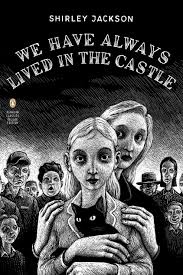
So what do I get out of gothic literature? And does Shirley Jackson’s oeuvre really count? I think the answers to those questions are “not as much as other people” and “yeah, basically, at least this book does.” In “We Have Always Lived in the Castle,” we are taken into the mind of Mary Katherine Blackwood, from a family of creepy murdered people the only survivors of which are her cohabitants sister Constance and uncle Julian. They live in a creepy old house in creepy old small town Vermont. Mary, or Merricat as she is known, lives her life according to the sort of rules and rituals made up by someone who stopped growing up at around twelve, or around the time most of her family was poisoned to death by… somebody. She buries things in the yard and nails other things to trees for their magical, protective properties. She’s into mushrooms, especially deadly ones, and her cat Jonah. Her sister consumes herself with cooking and other domestic tasks, and Uncle Julian obsessively documents the day in which his family was poisoned and he himself rendered invalid. It’s a gothic scene, I think we can all admit.

Her post-murders applecart is upset by the intrusion of her materialistic cousin Charles. Charles wants the family money, and is quite willing to turn Constance against Merricat to get it. He’s no match for her, though, and her means of removing him leads to what was for me the most interesting part of the book, a conflagration at their house followed up by a mob attack on the family- the Blackwoods had become fell legend for the small-minded Yankees they lived amongst and the fire became a bacchanalia for their greed and violence. Between the villagers and cousin Charles, you can’t help preferring the Blackwoods for who they are, creepy and potentially murderous though they are. Presumably, this was the effect towards which Jackson aimed.

All told, I could get why this is such a well-loved novel by so many people I know. It was definitely meticulously put together, and I’m interested in having more looks at Shirley Jackson’s work, especially her short fiction. That said, it’s not especially calculated to grab me. The stakes — the maintenance of Merricat’s way of life and the mystery of who murdered her family — didn’t interest me that much, for reasons not really the author’s fault. I wouldn’t say I related to Charlie or the villagers as opposed to the Blackwoods. Maybe I most related to Uncle Julian, who wanted to be fed, watered, and left alone to his historical researches… or maybe I just relate to the world outside the suffocations of the gothic, even if I can appreciate the intricacy and skill of its structures. ***

Review- Jackson, “We Have Always Lived in the Castle”

Review- Marks, “Fire Logic”

Laurie Marks, “Fire Logic” (2002) – The word I find myself reaching for to describe this fantasy novel is “mature.” It has a very mature outlook on relationships, not denying the passions of its youthful protagonist, Zanja, but also depicting studied, thoughtful portraits of older characters, addicts, people from different and rival cultures. Marks doesn’t indulge in the lengthy worldbuilding of a lot of other fantasy writers- if anything, she errs on the other side, making the rival Shaftal and their Sainnite occupiers less distinct than might make sense. But that’s probably part of the point- Marks depicts well the spiraling violence of an insurgency/counterinsurgency situation, and concludes that Shaftal and Sainnite should put aside their differences and learn to live together on the same land. I get that, I guess, but maybe being an old insurgency student myself I can’t help but think that the Sainnites invaded Shaftal and it’s on them to rectify the situation, possibly by exiting. But anyway- Zanja is not from Shaftal, but from a tribal society living nearby (which the Sainnites eventually massacre in the sort of war crime that doesn’t exactly make you agree with Marks’s peacenik agenda… unless it does, I guess). She’s trained as a diplomat, and is a fireblood- here, many people are imbued with magic from one of the four classical elements. Zanja’s fireblood makes her intuitive, lightly precognitive, as well as willful and fickle. She falls in love with an earth witch who’s addicted to a Sainnite drug, and gets involved with the Shaftal resistance to Sainnite rule, before she begins to see the futility of the situation and its conflicts with her life and those who are close to her. Marks writes decent early-modern (they have gunpowder but only for pistols?) action scenes and her depictions of same-sex relationships seem to me to hold up well now, and must have been a revelation for 2002. Sometimes, her maturity and restraint get the better of her and the narrative drags somewhat as characters go back and forth over their assorted agonizing decisions and efforts to heal. There’s worse things to drag down a narrative, but it made reading more of a slog than it needed to be. ***’

Review- Marks, “Fire Logic”

Review- Wyndham, “The Day of the Triffids”

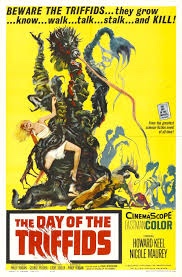
John Wyndham, “The Day of the Triffids” (1951) – I’ve heard this called the grand-daddy of post-apocalyptic fiction. On the one hand, this sounds wrong — I feel like there are earlier examples, like “The War of the Worlds” — but on the other hand feels right in a genre relevance sense. The apocalypse, unlike most, is a two-parter. First, a species of carnivorous plant called the triffids appear. This isn’t much of a problem at first, because people can control them, despite their deadly poisonous stingers and increasingly apparent ability to communicate with one another. Then one day, a mysterious shower of comets — or something that look like comets — blind the vast majority of people on Earth (one wonders if Jose Saramago read this one).

Biologist Bill is one of the lucky ones with sight- he was in the hospital with a triffid sting to the eyes and hence couldn’t see the comet shower. By the time he’s able to get up and out of the hospital, civilization is already collapsing. Wyndham effectively describes the pathos of roving gangs of blind people attempting to loot to survive, the sighted either lording it over the blind as kings, trying and failing to help them, or trying to secede from the rest of the species.

If “Day of the Triffids” created post-apocalyptic conventions, it did a very good job, as it all colors within the lines: Bill rescues a sighted girl and they promptly fall in love; they entertain but reject various humanitarian theories of how to deal with the crisis as doomed, through no fault of themselves, of course, they’re still the good guys; they meet up with a group of like-minded survivors led by someone making philosophical/sociological points that all lead to “free love;” Bill and Josella get separated and Bill undertakes all kinds of adventures getting her back.

It’s all well done. The triffids are genuinely creepy, even if a lot of surviving in the early parts of the book is more about avoiding disease and hunger than avoiding them. The anti-humanitarian lessons are contrived but not forced, in a literary sense. The characters are well-realized, especially for midcentury science fiction that doesn’t make a display of literary qualities. It’s worth reading both from a history-of-genre perspective and on its own merits. ****’

Review- Wyndham, “The Day of the Triffids”

Review- Vinge, “A Fire Upon the Deep”

Vernor Vinge, “A Fire Upon the Deep” (1992) – Hard(ish) scifi space opera “goes to the dogs” in this one! Ha, ha, not figuratively, but in the sense two human children wind up in the clutches of rival factions of medieval dog-like pack-mind aliens. The action in “A Fire Upon the Deep” is split between Johanna and Jefri, last survivors of a human colony that gets eaten by a super-advanced malignant AI, and a crew of spacers hired by a human from the same society, Ravna, who goes looking for the ship they were on. The ship had to bail on dog-alien planet and, of course, also contains a way of defeating the Blight, as the evil AI is known.

This is a big (600 pages or so) book with a wide sweep. We go from hyper-advanced space colonies to dog-alien castles and encounter a number of interesting Vinge concepts along the way. Perhaps the most important are the “Zones of Thought.” As it turns out, Earth is in the Slow Zone- the closer to the galactic core you get, the slower the speed of light is, and in turn the slower do neurons fire and advanced tech becomes impossible even if it could be designed. The advanced space civilizations exist in the Beyond, where faster-than-light travel is possible, and the Transcend, inhabited by god-like energy beings. You have to be careful not to get caught in the “Slow Zone” nearer the galactic core, or in a zone storm, where your tech stops working. Vinge also tells us what the space internet looks like- a lot like usenet newsgroups from the nineties, an interesting take from the pre-social media days. The pack minds of the “Tines,” as the humans come to call the dog-aliens, are fleshed out, with gestalt personalities, telepathic communications (and confusions if packs get too close), and multi-generational layering. This is echoed in the shared mind of one of the human shipmates, who was reanimated by a Transcend god-thing that the Blight kills, and is left with some of the god’s abilities and personalities along with his reanimated baggage. Heady stuff! Vinge takes his time with all this, too, which turns out for the best even if it makes the book a little long and slightly confusing in some places.

Vinge sets up multiple ticking clocks, from the threat of the Blight, to the race between Ravna’s crew and the Blight’s fleet to seize the spaceship with the anti-Blight weapon, to the impending rumble between rival groups of Tine eugenicists (one mean, one less mean) that endangers the human children they’ve taken in. The clocks are always ticking but he still takes the time to throw in other complications: betrayals, horrifying discoveries about perfectly nice plant-people, the imperial ambitions of cute butterfly-aliens, the humans helping the Tines up the tech tree, etc. Vinge throws in a lot and most of it is good. One thing you don’t get a ton of is the libertarian posturing I’m told Vinge indulges in (he’s won the libertarian “Prometheus” scifi award multiple times), and that I can do without. All told, a decent, if perhaps overstuffed, scifi adventure with a lot of neat concepts. ****

Review- Vinge, “A Fire Upon the Deep”

Review- Miéville, “Kraken”

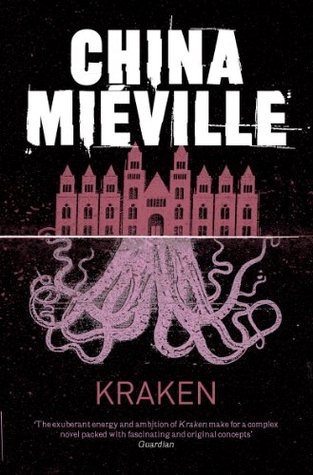
China Miéville, Kraken (2010) – Gotta say… I was always a whale guy in the squid-whale dichotomy. I know, I know, the cool kids are all about cephalopods these days, but that just makes me back my mammal friends all the more. And there’s no “Moby-Dick” about squid. Miéville’s “The Kraken” ain’t it, either.

To be fair, I doubt it’s trying to be, and what it amounts to is something pretty decent. As the back copy will tell you, somebody steals a dead giant squid (and its tank) from a London museum, which sends its caretaker Billy into a world of competing cults, magical weirdos, magic cops, and assorted terrors. The big dead squid has big juju and it’s own cult of squid-worshippers, and so magical London — which is less officially hidden than generally ignored — is all in an uproar over what to do about it.

Most reviews don’t go much past the back copy, and I think there’s two reasons for that. For one, spoilers- there’s a big twist in the end and no one wants to give it away. Second, and I think more importantly, the plot swirls maniacally and is littered with all kinds of stuff China Miéville thought was cool. There are at least five agendas to attend to, including that of Billy, the closest thing to a central viewpoint character, and each of these agendas have assorted arcane obstacles and helpers, all of which require explanation.

What does some of this include? Well: a gang boss who is a sentient tattoo on someone’s back and who makes people-machine hybrids; another gang boss who’s a dead magician; some magic cops, one of which is based on Amy Winehouse, who summon cop-ghosts from old police procedurals; magic Nazis; an ancient Egyptian demiurge of trade unionism who can embody himself in statues (and action figures); a cockney embodiment of evil; an iPod that’s bad at music but good at magical protection; several apocalypses; chronically depressed teleporters; “Londonmancers” who manipulate the city in various ways; were-squid . And I’m leaving stuff out.

When the plot comes together, it ultimately works, especially knowing Miéville’s body of work and his commitments (he’s a big leftie and former ISO member, for those playing the home game). It’s a long, confusing, but mostly fun ride getting there. It all depends on what proportion of and which of the things Miéville throws against the wall make your eyes roll. Without getting into spoilers, the magic in “The Kraken” relies on metaphors, and so the denizens of magical London take metaphor extremely seriously, to the point of silliness at times. But for the most part, Miéville’s storytelling and vast powers of invention prove winning. ****

Review- Miéville, “Kraken”