Frank Herbert, “Dune Messiah” (1969) – I like Dune! It’s ridiculous, but good. This is the first time I tried the first sequel. Different friends of mine say that different of the sequels are good, but disagree on which, and no one I know seems to think that all of the sequels Frank Herbert wrote are good… or that the many more written by his son, Brian, are any good at all. But I figured the only way to do it, if I was going to do it at all, was to begin with the beginning, so when I found “Dune Messiah” on a free pile, I picked it up.
It’s twelve years after the end of “Dune,” and Paul Atreides rules most of the human-inhabited galaxy (and if there are aliens, we don’t see them, though some of the humans get freaky enough). The Harkonnens, the evil clan that killed his dad, is foiled. The imperial family has been thrown down and forced to give one of their princesses to Paul in marriage (not that he does anything with Princess Irulan, only having eyes for his Fremen lover Chani). Paul’s Fremen warriors, the baddest dudes around, have spread the word of the Maud’dib in a jihad that has killed around sixty billion people. Most of the remainder worship Paul as a messiah, the Kwisatz Haderach (say what you want about Frank Herbert, he comes up with cool names for things and people), and he has some pretty cool powers, like being able to see into the future. His sister, Alia, can not only see into the future but also has had full knowledge of the lives of all of her ancestors she was in the womb! So she’s fourteen but, you know, more or less omniscient except when the plot dictates she not be.
The previous power players in the galaxy are upset by the rise of Paul. The Bene Gesserit sisterhood, to which his mother belonged (and she’s just in the wind somewhere), had put the pieces into place to make Paul the Kwisatz Haderach, but he refuses to do what they want. The old noble families, including the imperial family through his wife Irulan, feel dissent for obvious reasons. Less obvious are the motivations of the freaky specialized mutants, the Spacer’s Guild, who are like weird spaceship fishmen who take the Spice drug to steer ships through hyperspace, and the Tleilaxu, weird biotech people who make zombie-clones and often “bio-hack,” as people now say, themselves. I guess the Spacers want an independent source for Spice, rather than letting Paul keep his Arrakeen monopoly, but Herbert both makes them a pivot of the plot, but they’re also definitely the bad guys he respects the least.
Between them, these players hatch a plot to do in Paul and Alia. The plot is really complicated, and moreover, to the extent it plays out at all – to the extent that the good guys don’t use their prescience to see through them, and all the measures they took to prevent the prescience from doing just that – it mostly does in drawn-out, boring conversations. Paul is in a snitty little mood throughout. It turns out he doesn’t like being the Maud’dib that much. He doesn’t like being worshiped, or constantly having to deal with conspiracies, and is less than thrilled over how many people have been killed in his name by his followers. He doesn’t want to just let the noble houses/Bene Gesserit/Spacers and whoever win, especially because they want to kill him and others close to him. But in many ways, he wins via the expedient of staying alive long enough to walk away, and become a different kind of legend.
But like I said, until some assassination attempts towards the end – which themselves are repeated, almost beat for beat, with different zombie-cyborg-assassins made out of friends of the family, if I remember right? – a lot of what happens in this book is conversation. The original Dune was also a bit slow and wordy. But there was more going on, and everything felt fresher. The strings show more here, the strain of a decently smart guy trying to depict a story of epochal geniuses with minds expanded beyond where humanity could go. In Herbert’s mind, that involves a lot of circular conversations made up of declarative sentences and high-nonsense philosophical aphorisms about power, fate, etc. Herbert had a better bag of tricks than others purporting to depict genius – Isaac Asimov, Orson Scott Card, Tom Harris from the thriller side of things – in that he stocks a lot of the genius less in what people say and more in how they observe things due to their super special vaguely-cybernetic training… but that can get a little old, too, especially when the plot does not move at the sort of pace you’d like. So this is a sort of middling effort. I’m thinking about whether it’s worth continuing, or just reading the wikipedia entries. ***
E.C. Tubb, “The Winds of Gath” (1967) – I picked this up, one half of an Ace Double, a “flipper” which features two novels in one volume- you flip the book over when you finish and you’ve got another scifi novel. It’s also the first of a thirty-odd volume space opera series by Edward Charles Tubb, an English scribbler from mid-twentieth century. The series stars Earl Dumarest, a space wanderer from Earth, considered a lost planet by the interstellar human diaspora. Presumably, him trying to find Earth again, and the circumstances of his leaving in the first place, will unspool as the B-plot across series, which usually have some planetary adventure, it seems, as their main thing.
The first outing for Dumarest isn’t bad, but is a tad derivative. The beginning is probably the best part. Dumarest is basically an interstellar hitchhiker, part of a subculture who wander from planet to planet, staying on a given planet only long enough to save up enough cash to get into spaceship-steerage again to see the next place. Someone outbids the ship Dumarest is on, so it doesn’t go to the destination he thought it would, but rather, to a weird backwater called Gath. In the grand space opera tradition, Gath is a whole planet defined by a small set of characteristics. It’s positioned such that at certain times of the year, you can hear “the music of the spheres,” the interstellar wind, or something. Other than that, it’s a barely-inhabitable dump. Getting stranded there sucks, because it’s basically a planet for very rich, very bored tourists, and it’s hard to get your stake to leave.
Dumarest, of course, being a scifi protagonist and only Earthman around, is resourceful and independent. It’s interstellar wind season, so a lot of tourists are around, and he tries to make some money and/or connections with them. The depictions of being down and out in space are kind of cool, well-conveyed- I wonder if Tubb maybe hadn’t been a stranded hitchhiker before. But the rest of the world-building Tubb does here really borrows a lot, a lot, from then-recent scifi hit “Dune.” Among the tourists are a matriarchal clan of kind-of-ok people and a clan of evil sadists. There turns out to be a resource on the planet that could break the monopoly on necessary scifi business held by creepy interstellar humanoid mutants. Single combat proves important. There’s dudes whose brains are computers and wouldn’t you know it, they have agendas. Along with the Dune derivations, the interstellar winds of Gath turn out to be kind of lame, not even up to Frank Herbert level trippiness- you just wind up seeing your past and it freaks you out, also, it rains real hard. The depictions of the rain were more interesting than the depictions of the more psychical phenomena. I’ll probably give this series a second try if I find the next book somewhere in my wanderings, as this one wasn’t wholly without interest, but a somewhat uninspired first out. ***’
John Scalzi, “Redshirts” (2012) – Fun (?) fact: John Scalzi is one of the last white men to have a work nominated for the Hugo Award for best novel! This was in 2018, and he shares this distinction with Kim Stanley Robinson. From a cynical perspective, you can say the two men represent the two “acceptable” faces a white male writer can present to the SFF world, at least if you want awards. Robinson has the wonk face, the thoughtful digester of papers and reports about space technology and climate change, a leftist but a thoughtful (read: not especially revolutionary) one. You can also call it “the far face” – it almost certainly helps that he’s been in the field since the eighties, hasn’t thrown racial slurs or weird sex stuff around in his books, and is not on twitter. Scalzi has the nerd face, a sort of Joss Whedon figure (but, doing scifi novels instead of TV and films, does not squat atop our culture in quite the same way Whedon does), lots of quips, lots of genre self-awareness, you can map his work, bit by bit, on TVTropes. His is the near face- he’s on twitter, a lot, and seems to have a well-considered idea of where to stick the knife in, on there- into anybody who kicks against the idea that current scifi (that is, the scifi scene that has made him at least somewhat rich and famous) is the best scifi we could hope for, at least those with the temerity to kick on Al Gore’s Internet. I shouldn’t have to say this, but seeing as this is going out notionally public: I don’t think white men are oppressed, or have bad chances in contemporary SFF, I think the SFF scene as it exists now has prescribed roles for everyone, including women, PoC, etc., and for in-the-club white dudes, the above seems to describe the workable roles. Not my fault!
I’m probably making this more about internal SFF scene politics because A. I’m trying to figure what, if anything, it all means myself, as a pretty outside observer and B. the book itself does not bear that much interest. It’s not a bad book, but it suffers in comparison to an earlier work with similar ideas and energy, namely, the movie “Galaxy Quest.” Like in “Galaxy Quest,” a cheesy scifi space-exploration show – like Star Trek at its most pro-forma – intrudes on the real world. In “Galaxy Quest,” there’s a pretty clever explanation as to why: an alien civilization gets our TV signals, sees the cheesy show, and bases its space exploration on it. “Redshirts” starts out with a somewhat more ambitious premise: the characters lives are being written, as they live, on Earth, as a cheesy scifi serial. So the characters – who are the sort of disposable lower-ranking officers who can be disposed of by scifi writers to show the danger of a given planet or other away team mission, the titular “redshirts” – go through some sort of wormhole and wind up in Hollywood, begging a bunch of low-rent network producers for their lives.
Scalzi’s not a bad storyteller, structurally speaking, does decent action scenes, brings the “mystery” of why the ship is so strange and so many people die along pretty well, and obviously knows his tropes. The problem is, he has too many indistinct characters and none of them really land. There are more redshirts in “Redshirts” than are necessary, except maybe insofar as to give them analogs in the real world and therefore cross-dimensional storylines- this one gets swapped out for a producer’s dying son, that one falls (platonically?) in love with the actor who plays him in our world, etc. I suppose it makes sense that only a few of the characters on the ship have any character – the main characters on the show, who survive numerous terrible incidents while the redshirts die all around them. But it’s a bit of a problem when the less fleshed-out characters are the characters in your book! And there’s seemingly at least one, upwards of three too many!
Those dorky little aliens in “Galaxy Quest” weren’t, like, Ibsen characters or something, but they had characteristics. The washed-up TV stars they drafted into helping them were pretty cliche, but they were well-written and funny. This is more than Scalzi manages for any of his characters in “Redshirts.” I’m probably making it sound worse than it is. Like I said, it wasn’t utterly without good characteristics. But if you’re going to work in a story groove that’s already been pretty well-worn – especially by one, well-loved work like “Galaxy Quest” – you really need to distinguish yourself, and “Redshirts” doesn’t do much to do that. But I guess that’s what the SFF public – or anyway, the SFF scene loudmouths who edit, publish, review, and give awards to books – want! ***
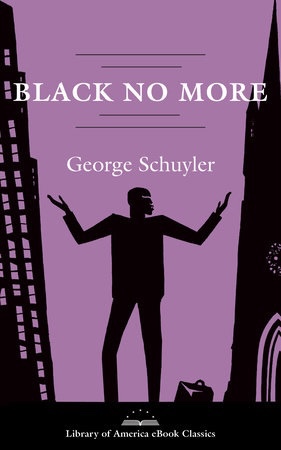
George Schuyler, “Black No More: Being An Account of the Strange and Wonderful Workings of Science in the Land of the Free, A.D. 1933-1940” (1931) – I’ve probably harped on this before in this space, but I never agreed with the nice-internet-people nostrum that satire is only satire if it “punches up,” that is, only targets people above the socioeconomic scale, vis-a-vis the author (and I guess the reader, too?). I’m not a strict prescriptivist, I don’t think we need to stick with the classical definitions of things… but I think it is a bad redefinition, the kind that trades in thousands of years of thought on something for a momentary comfort, or an edge in online arguments. This attempted redefinition only has any currency because we’ve decided that being funny is somehow sacred, in the same way that courage was once considered and still is by some, that it’s the sort of virtue you can’t apply to an enemy and see them as a real “bad guy.”Anyone is perfectly saying that they –don’t like– satire that “punches down,” against the downtrodden. I usually don’t, especially not with satire of contemporary societies! But I think it really doesn’t cut ice to say that somehow satire isn’t satire because it does something you don’t like. That’s part of the conceit of the genre, from Juvenal’s day on down – it is a mirror, it takes in society as a whole. Don’t like it? Blame light, blame glass, blame yourself for looking and being the way you are.
Well… “Black No More” is a satire in the old mold, all right. The satirical conceit is like any other conceit: it’s not literally true, like any artist the satirist makes their choices of what to depict and how. But if the satirist is smart, they can make it seem as natural as the reflection you see (and, generally, loathe, one way or another) in glass or water. George Schuyler was a Harlem Renaissance guy who grew to hate the Harlem Renaissance. Child of a black military family who knew poverty and prison before becoming a writer, Schuyler gadded about the literary scene for some time, doing journalism, travel writing, criticism, and occasional fiction. This is technically scifi- it’s about a scientist (a black scientist, if anyone’s keeping track) who invents a process for rendering black people into white people, flawlessly and cheaply. Schuyler handwaves a lot of the science (which goes along with his ideas on race more generally- more anon) away, and soon enough, new white people are taking the US by storm.
On the one hand, Schuyler was a “race isn’t real” guy. He insists that, for instance, that differences in facial structure and accent wouldn’t give the game away for black people turned white (though I also think he has the process involve some kind of facial/bodily reconstruction? He’s vague). On the other, he has the US come close to collapse once it becomes clear that its black population is going to shrink almost to nothing. Without race, the whole culture starts to lose its grip, and massive upheavals occur in politics and society.
We see this mostly through the person of Max Disher, a charismatic and morally flexible young black insurance agent in Harlem at the beginning of the story. When he hears of the black-no-more process, he immediately takes it, because he wants nicer things and also is obsessed with a white lady who rejected him a gin joint. Max immediately becomes a success in the white world by joining a KKK-like organization and leading it against the threat of crypto-black people. Among other things, the process is not genetic, and the offspring of ex-black people come out as black as they would otherwise (the doctor who invented the process promises that he will have special infant clinics that can “fix” that). As luck would have it, the racist group’s leader’s daughter is the mean white lady of his dreams, and he gets married to her as he grows the organization.
As you can probably tell, the plot isn’t the point here, really. The point is Schuyler’s look, as acidic as it is panoramic, of American society and its hypocrisy around race. Schuyler depicts white racists, like Max’s new father-in-law, as stupid. But Schuyler depicts black “race leaders,” including very obvious parodies of W.E.B. Du Bois, Booker T. Washington, and Schuyler’s employer at the time, NAACP head Walter White, as utter frauds, pompous boobs living off the credulous. He shows them as willing to sell every notional value out immediately for white approval or for simple living expenses, mostly via trying to insist that black people stay black rather than de-racinating themselves. Of course, this is also what Disher’s new racist friends want. As tensions rise and white society falls on itself, trying to find a new scapegoat and mostly landing on “ex-blacks,” the movement Disher helped start finds itself in a position to take national power… only to find that racial purity, backed by anything like a “rigorous” understanding of race, doesn’t really work, either. In the end, everyone gets what’s coming to them, mostly violently.
So Schuyler doesn’t think race matters… but it’s also at the center of the society he depicts, the identity and needs of every character, and the whole story he tells. This doesn’t make him a hypocrite, necessarily. It sort of does make him a satirist of the old school- where would Juvenal be if he lived in the supposedly clean Rome of the early Republic, what would Thackeray have to do with himself in a society less grotesquely unfair than early Victorian Britain? This does get into one of the weaknesses of satire as a genre: that its most common topic is hypocrisy, the distance between professed value and observed deeds. The more inflated the sense of virtue and the more obviously dirty the deeds beneath them, the more entertaining pricking hypocrisy with pins can be.
Pretty much any period, given how people are, can be a good target for hypocrisy-baiting… but I’m not sure that applies to all times and places equally. Sometimes, the pretense of virtue wears thin, and it’s pretty obvious that the emperor has no clothes. Pointing it out isn’t that funny. By the time Schuyler was writing, the pretenses of white American society were pretty thin indeed. Scientific racism no longer held the stranglehold on anthropological thought it once did (though it was still a major intellectual force), the general skepticism of the Roaring 20s and the reaction to the Depression that came after was in the air… so Schuyler really has three main targets. There’s the ignorant “booboisie” (H.L. Mencken was a great publisher and booster of Schuyler, and they shared a lot of misanthropic attitudes- some called Schuyler “The Black Mencken”), mostly of the South, insisting that segregation was necessary for civilization. That’s pretty easy to lampoon. Then there’s black “race leaders.” I wouldn’t say Schuyler was “punching down” here, even if I thought such was the instant DQ some of the internet thinks it is. People like Du Bois probably had more power than a scribbler like Schuyler. I would say that, whatever their flaws, the black leadership of this class at the time was actually pretty smart, and the idea they were useless, feckless boobs really doesn’t wash- Schuyler couldn’t see the future, but he was awfully sure about the present, and the future has a tendency to knock people like that down a peg.
Above all, though, Schuyler’s target was people in general. People are stupid, greedy, concuspient, and inevitably bring about their own doom in what can only be called parodies of tragedy. We’re back at the familiar territory, why this book belongs in “Readings on the Right,” even though Schuyler had yet to break with the NAACP and go all the way to the arms of the as-yet-unfounded National Review, as he would later do, by this point. Even though race is bullshit, it’s definitional and will collapse society if it’s taken away because people are bullshit. Race is about what we deserve- it just sucks that George Schuyler, who sucks less, has to be inconvenienced by it, and listen to other people talk about it (some of his more well-known critical essays were about how it’s wrong to classify writers by race). We know where this goes. Trying to improve things is pointless, usually perverse, almost always involves improving things for (and worse, forcing interactions with) lame, stupid people, so, most misanthropes wind up opposed, to one degree of violence or another, to attempts at liberation or amelioration. You’d figure more people would think that, if people are as lousy as all that, that you should make power arrangements as equitable as possible so no one can lord it over you (roughly my position, on bad days), but it seldom seems to work out like that, with your freestanding public cynics.
This is one of the reasons why satire can be real iffy as a genre. As Clint Eastwood once put it, “we all got it coming, kid” – we are all, in some sense, hypocrites worthy of ridicule, or in some way or another shown up by the world around us. This applies to most of our ideas and social institutions as well. But that doesn’t mean just any “snarking” (to use a hideous newish word) does the job, or justifies a book. Among other things, it helps to either have interesting imagery (Juvenal, Ishmael Reed- the latter a big fan of Schuyler’s) or a plot (Confederacy of Dunces, Arrested Development) if you’re going to do longform satire, and Schuyler hasn’t really got either going for him. It’s funny in places and he clearly has some writing chops, but it also feels more like a phoned-in rant turned into a novel than anything else. ***
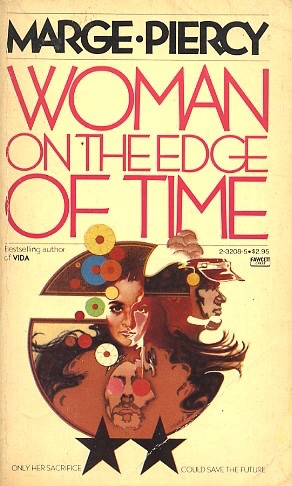
Marge Piercy, “Woman on the Edge of Time” (1976) – Damn… this fucking ruled. A classic of seventies feminist science fiction, “Woman on the Edge of Time” advances multiple visions of the future with daring only rivaled by its vision of its present, the hungover, pessimistic seventies. Consuela Ramos, a middle-aged Chicana woman, starts seeing visions around the second time she is committed by the state to an insane asylum. These visions, however much Connie is annoyed by them at first, are unusually consistent: a person named Luciente, unfailingly polite and positive, telling her about a future, the year 2137. Eventually, Luciente is able to pull Connie’s consciousness into something that is either that future, or a very convincing vision thereof.
Piercy, a major feminist poet of her day as well as a novelist, is unsubtle without being at all cliche- people often conflate the two, but they don’t deserve to be put together. The contrast between Luciente’s future in the village of Mattapoisett (on Buzzard’s Bay in Massachusetts, not far from Piercy makes her home) and Connie’s present in the asylum might seem like obvious contrasts, but Piercy makes it about more than “good versus bad” or even “free versus oppressive.” It really is life versus death, or human versus machine. The asylum claims to heal, but really just warehouses the poor, sick, and obstreperous until they’re finally utterly disposable, either dead or drooling, passive zombies. Mattapoisett is the product of a successful revolution. The inhabited parts of the world, after decades of ecological catastrophe, now live in confederations of small communities that practice socialist economics, small-scale democratic governance, and generally a lot of “person-centered” culture.
Here’s the deal: the world Luciente presents to Connie is a good deal more hippie-dippy than I’d both think realistic, or even prefer, for a near-utopia. I don’t fetishize smallness, I certainly don’t fetishize nature, and it sounds like these people go to a lot — A LOT — of meetings, for everything from figuring out land use to interpersonal conflict. I’m more of a “fully automated luxury gay space communism” guy. Connie, even once she gets over the disbelief in what she’s seeing, is a little skeptical, too. Everyone has to work on farms? No flying cars? What kind of future is this??
Well, two things. First, Piercy is smart enough to not make it too hippie-dippy. It’s not a full utopia. There is conflict, and the people aren’t always great at dealing with it. Yes, people work on farms- but with profit and rent removed, everyone in general has more leisure time, and most people do other stuff, too, including advanced science, art, etc. Specialization is, in general, less of a thing in this future (again, not totally to my taste, but it’s not as dystopian as some back to the land fantasies). And there is technology- people have what amount to Apple watches, there’s advanced biotech, etc., and, eventually, you see something like flying scooters. That leads to the second thing- Piercy’s sheer power of description, and the wholeness of her vision, make you believe it, and if not necessarily want that future — at least not as much as I’d want Banks’ Culture future — you can see it as a thing of beauty, both reflective of its own time (and how!) and with meaning for ours, and for times to come. You come to know the inhabitants of Mattapoisett, see how they live, work, love, raise children, and die, and there’s a weight to it, a realness even in spite of the utopianism, that you don’t get with just any hippie bullshit. Among other things, I think it’s pretty important a woman wrote this- there’s sexual liberation aplenty, but the real kind, not the stylized sexual assault that countercultural men were often after.
I said that Piercy realizes her time as fully as she does Mattapoisett in 2137. She does- its grit, its grime, its exhaustion, its hopelessness, the many, interlocking ways it can beat people down, the way people learn to accept, even love, their oppressions (and oppressors). Connie isn’t, in any meaningful sense, crazy. She has had just enough hope — hope for education, hope for love, hope for societal progress — that when those hopes were dashed, by family, money, and bad luck, she had few places to turn. If she were more beaten down, she wouldn’t be where she is (she needs to pretend to be more beaten down for plot reasons later in the book). She’s not a plaster saint. She’s cantankerous, and she did something hard to forgive: after the love of her life died, she got drunk and depressed and hurt her little daughter. She paid endlessly for that, but still feels the guilt. Part of her attachment to the ghost of Luciente is seeing her daughter in this future-person.
Like I said- not subtle, but never cliche, and always powerful. Fuck subtle. The man comes for Connie’s head. A group of hotshot doctors (another point of divergence between me and the viewpoint of this book is I’m slightly more pro-psychiatry- but hell, it was the seventies) are cutting open the heads of “violent” patients like Connie and putting hormonal control switches in there. As her own day on the table comes closer, Luciente’s future starts to fade out. It becomes harder and harder for Connie to see. A few times she slips into another future, a cyberpunk avant-la-lettre (William Gibson honors Marge Piercy as a godmother of his genre) hellscape of destroyed nature, inscribed gender roles, and corporate control. If Mattapoisett is going to survive, not only will its inhabitants and the rest of the post-revolutionary future have to fight for it- so will Connie, in her own time. Maybe that’s what seals why I can admire this future, so far in many ways from my own aesthetic- the people earned it through organization, solidarity, courage, the will to fight and risk all… and it is never a certain accomplishment.
This is a singularly beautiful, intriguing, and readable book. But… if I’m going to be as honest as the future Piercy wanted for us, as honest as Piercy is herself here… I did the thing I always wind up doing when I read a second wave feminist author, and upon googling, found Piercy signed off on some bullshit anti-trans public letter. All of the commentary I saw on this was profoundly disappointed. You might see it coming from JK Rowling or Mary Daly or whoever. But among other things… all the Mattapoisett people use gender neutral pronouns! All children have three mothers, some of whom can be men, and are grown in vats before being implanted in one of them! Connie witnesses a man breastfeed! At first, she’s repulsed by the whole setup, she has fairly essentialist ideas, but she rejects them by the end, sees the beauty of it! What gives, Marge?! Anyway, I’m not about to “cancel” Marge Piercy or decide I don’t like — love is the right word — this book. It’s not about “separating art from artist.” It’s about appreciating both as what they are, and aren’t. Both are profoundly human, here, for better and for worse. *****
Naomi Alderman, “The Power” (2016) –A kind friend and patron of the art of literary criticism sent me this book in the mail, saying he had mixed feelings about it and wanting to know my takes!
Let me start by talking about some other books altogether. For a while there, it looked like journalistic accounts of fictional genre disasters might become a big thing, or maybe it only seemed that way to me after Max Brooks’ “World War Z” was all over the place in 2006 or so (it is a profoundly 2006 kind of book). “World War Z” is deeply silly, so I didn’t appreciate how well Brooks did with it until I read a book in the same vein about an AI/robot uprising which was extraordinarily bad. Apparently Brooks also did a bad job writing about a war between people and Sasquatches? Writing! It’s not easy, folks!
No less a figure than Barack Obama (who was big-upped but not by name in “World War Z” – like I said, big time 2006 vibes) named Naomi Alderman’s “The Power” one of his favorite books of the year when it came out. It’s a somewhat more high-concept deal than “World War Z” or the robot book- women develop the power to basically shoot lightning from their hands. It starts with teenage girls, but they can pass it on to other women, and soon enough, pretty much all women can zap people right up.
So… I get this would be a big deal, should it happen “in real life.” But like… people can already kill people, women very much included. Yes, it would be convenient to be able to kill people from a distance with something that is just in your body (though there’s all sorts of limits in terms of how much juice a given woman has, how well they can control it, etc). I mean, it would be weird if half of all people just had a gun on them at all times that they wouldn’t even have to conceal, or draw to use! It would be weirder still if this situation were in-born, and gendered.
But I’m not convinced such a situation would collapse society, which it does in “The Power.” But I’m more convinced that it would collapse society – among other things, societies are maybe more delicate than we thought when I was a kid – than I am that it would result in millennia of matriarchy, and that said matriarchy would be, more or less, opposite-day patriarchy, like a world Quinn and the gang might wind up in on “Sliders.” The framing story is an interaction between a lady editor (named Naomi Alderman) and a dude writer (named an anagram of Naomi Alderman) about the dude trying to write a historical novel of the rise of global matriarchy! So, they reconstituted our society not just down to having publishing houses like ours, but also, as the book progresses, women wipe out refugee camps for fun, wipe out depictions of men ala the Taliban, etc etc.
Look, two things: one, I don’t think future histories need to be credible or even believable to be good or fun. Two, I absolutely think women are capable of abusing power. But the way Alderman handles both the unspooling of this story and the story of women proving as beastly as men just seems kind of pro-forma, a going through of the motions. Like… wouldn’t they come up with more interesting ways of being fucked up and wrong? Different ones, anyway? Given that they’ve got superpowers and all, and the different socialization of women, that first few generations who get powers at least? Why just have them replicate what men do already?
The characters and the writing aren’t awful but aren’t enough to restore the interest lost by whiffing on the execution of the premise. To probably contextualize too much, this was written around the time Black Mirror made its comeback, going from charming and subversive-seeming indie favorite to big-market, overly-lugubrious butt of “what if your mum was an app??” jokes. That’s what “The Power” feels like, to me. **’
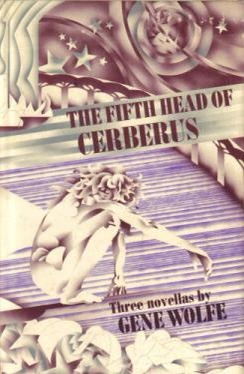
Gene Wolfe, “The Fifth Head of Cerberus” (1972) – I’m way, way behind on reviews. I finished this one a little while ago. By coincidence, I also listened to a podcast just now about how lousy overly-literal political metaphors in speculative fiction can be, and how good ones don’t belabor the point and get on with it. Well, this group of linked novellas, arguably the first major work of great scifi/fantasy “writer’s writer” Gene Wolfe, follows this post-dated advice. It’s less a metaphor for colonialism than a projection of a melange of colonial practices into humanity’s space-faring future. Those of you who have read Wolfe’s “Book of the New Sun” – which is an investment but well worth it – know that Wolfe makes intricate worlds with deep pasts, but does not dump them on the reader in inelegant chunks (like a certain book reviewer does in his bad attempts at fiction). His worlds unspool as his character discover them in the process of figuring out their own mysteries and living their lives.
I feel like I might be alone in this, but I enjoy the titular first story the best out of the three linked novellas. A man relates his boyhood on the colony world of Ste. Croix, one of a pair of inhabitable planets in a solar system settled by mostly-French colonists. At first grasp, the worlds of Ste. Croix and Ste. Anne resemble something like the Caribbean or Brazil, maybe with French-ruled Indochina mixed in. I don’t recall Wolfe specifically saying it was hot and humid on Ste. Croix but it feels that way anyway- a backwater, culturally static, strict hierarchies that let their hair down behind closed doors in various fucked up ways, a ruling class that prioritizes its control over the lower classes over its notional independence from outsiders.
The narrator is a child of this ruling class… sort of. I don’t want to spoil it, but it turns out that the planters, merchants, and bordello-keepers (guess which one the narrator is raised by!) of Ste. Croix take the whole “reproduction of the ruling class” thing literally… so a lot of his tale is basically him figuring out his strange origins, without much in the way of reference to outside standards of normality (i.e., ours) to act as a reference point. It takes some doing and Wolfe does it well. Among other things, he was an early linker of the possibilities of bio-tech and the creepy ethos of colonialism, a solid connection… you gotta figure a successful CSA would put a lot more chips on gene-editing than, say, spaceships…
All of the stories relate to the “extinct” “aborigines” of Ste. Anne and Ste. Croix. Legends describe them as shapeshifters. There’s even a theory that they killed the original French colonists and then just assumed their shapes! Who ever heard of such a thing? We get some interesting looks at what later generations of pedants would call “indigeneity” and the way the “gaze” of anthropologists, etc. reduce and make major mistakes about situations that colonizers have an investment in misunderstanding. There’s no big denouement- we never know for sure if the aborigines are still out there, let alone that they rebel against their human overlords, etc etc, like a simpler book might insist on. Instead it insists on lingering on how we know what we think we know about others, and what others see in us, and without the posturing and moralizing such questions usually come freighted with in contemporary speculative fiction. It’s hard to write much about it without giving too much away, and a lot of the fun is in Wolfe’s sublime prose and pacing, anyway. So go read it, if this sounds at all good to you. *****
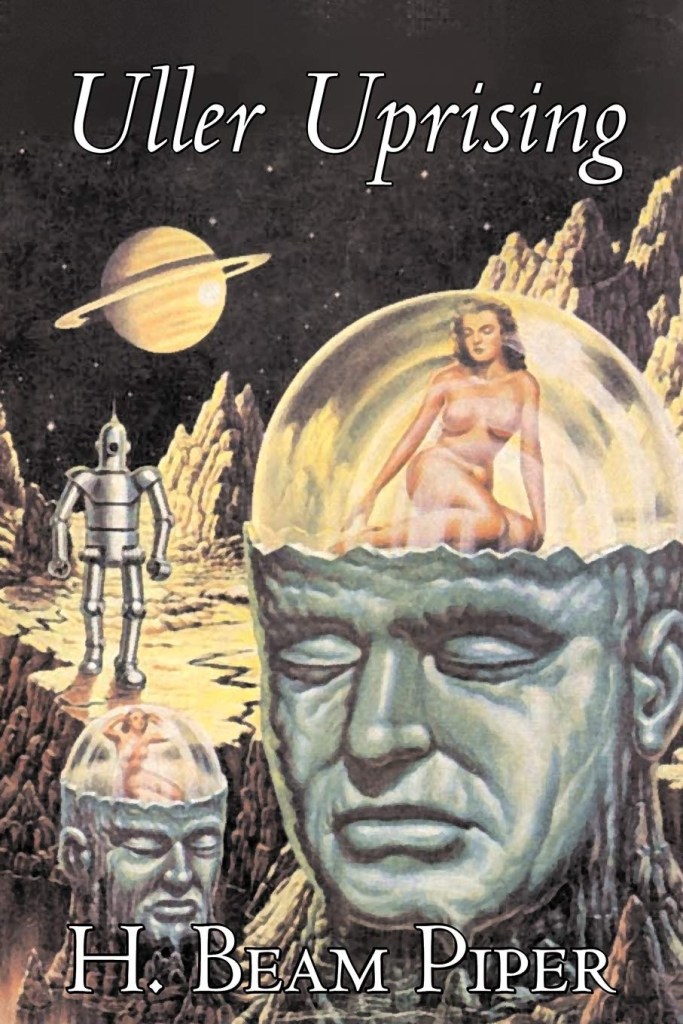
H. Beam Piper, “Uller Uprising” (1952) – Well, I think after two books, I can put this dude on the list of “old scifi hands I’ve learned enough about, and who aren’t compelling enough to pursue anymore.” I read “Kalvan of Otherwhen,” one of the original “conquering a primitive alternate dimension” stories about a Pennsylvania state trooper conquering, like, Hittite Pennsylvania… a fun premise, but wasted in dull depictions of maneuvers across the map of the alt-Keystone State. I’ve now given the beginning of Piper’s Terra-Human Empire series a shot. The first novel is about humans who have lightly settled a pair of planets that supply some kind of space-resource. The natives have gotten restless! They’re, like, partially-silicate lizard people.
“Uller Uprising” is basically the Sepoy Mutiny, but in space, with humans taking up the role of British people and the space lizards as the people of India. But it’s a version of the Mutiny as told by a right-wing troll scifi writer. So the humans/British “only” want to mine their unobtainium (using lizard labor, effectively slaves but treated nicer than local practices, you see) and bring “progress” to the lizards, and dang old “progress-hating” “bigoted” (!!) lizards impelled by a lizard-prophet try to massacre them. At first the humans seem overwhelmed, but they get reinforcements and figure it out. Better, they steal a nuke mean lizards were going to use on them, so, you know, it’s ok when they use the weapon that readers still had a supernatural dread of in the early fifties.
I say it’s trollish because Beam knows who actually had a grievance in India in the nineteenth century and he knows it wasn’t the British. He just likes the British side better, and likes stories of massacring mobs of “fanatical,” underarmed, underorganized opponents (still a popular trope, everywhere from zombie stuff to contemporary military stories), and wants a moral excuse to do so. Piper was known as a “contrarian” or whatever, like a lot of those old guys — Niven, Heinlein, whoever — were supposed to be, but they still always wanted the moral high ground, they couldn’t just tell stories about killing sentient beings for fun. So Piper goes out of his way to show how smart and sensible (but tough!) the human corporation in charge is, how irrational the lizards in the sway of their prophets are, how the “good guy” rational lizards (think a patronizing British depiction of the Sikhs) are treated fine, the few humans with lizard-liberationist leanings are fools who quickly learn the score and marry tough human army guys, etc. The main character is descended from Argentine Nazis and is meant to be a Prussian officer stereotype, just for fun.
The action is better than in “Kalvan.” Piper could have had a good book here. It wouldn’t even have to be, like… “good” in some moral or political sense, not hardly. But the action quality is not enough to make up for the smirking and ultimate lack of originality- if you know what happened to the Mutiny, you know what’s going to happen here. And don’t give me some shit about the joys of non-virtuous writing, or whatever. I’ve probably read eight books by good “edgy” writers for every (likely shitty) one you have, and this ain’t it, chief, not with all the cheating in the rigging Piper does. **’
Nalo Hopkinson, “Brown Girl in the Ring” (1998) – I gotta level with you all, readers: until maybe a month before I started this book, I thought it was about a brown girl living in a ring habitat, as seen in Larry Niven’s “Ringworld,” which I recently reviewed. This is why I paired that book with this in the election gimmick I did, where I had Citizens vote on themed pairs of books! I thought it would specifically show up the racism of classic scifi writers. Niven wasn’t the worst with that but he wasn’t the best, having contributed to the pretty racist “Lucifer’s Hammer” with Jerry Pournelle. I thought the brown girl would be in the ring and show all those engineering Marty Stu’s what for, or something.
This wasn’t that! It’s actually an old Carribean children’s song sung to a ring game kids would play. Many of the chapters are opened by the lyrics of similar games. It also stands for the ring around which semi-post-apocalypse Toronto, the setting of this novel, is surrounded. First Nations sued Ontario so bad they had to give up on its biggest city! The Toronto-dwellers are trapped. This was written in the nineties so maybe the city was a bit less tidy/gentrified than it is today… Arguably, “the ring” is also the ring of combat against the fate to which Ti-Jeanne, the titular girl, might otherwise be stuck in.
Ti-Jeanne is a young woman with a baby, a missing mother, a formidable grandmother who practices West Indian spirit magic, and a fuckboy ex-lover who has one foot in and one foot out of post-apocalypse Toronto’s gang scene. She doesn’t have it all that bad, as far as survivors of a trapped dead city go. You see a fair amount of the city going about its life, surviving in its ruin, making little farms and businesses and stuff.
Alas, Ti-Jeanne also has a tendency to see spirits, and the future. She’d rather not be involved with the spirit world of her grandmother, dreaming of running off to the burbs with her ex-, Tony, but the spirit world has its own idea. So, too, does the Prime Minister of Canada, who needs a heart. Despite the fact that they’ve perfected using pig organs in this future, the PM wants a human heart, for political reasons. So, her fixers contact the gangs in the Toronto wasteland for a fresh human heart. Guess who the gang boss, Rudy, jobs it out to? Tony, the fuckboy ex, who stole from Rudy to fund his drug habit! Fuck!!
Ti-Jeanne and her family come into conflict with Tony, who can never decide if he wants to use grandma Gros-Jeanne’s magic to disappear and escape, or to just cooperate with Rudy. Rudy, in turn, turns out to be a lot scarier (and more connected to Ti-Jeanne) than anyone figured, largely through the strength of using the dark side of the West Indian/Caribbean magical tradition, making zombies and enslaving duppies, the spirits of the dead. He wants to finish off the assorted Jeannes and consolidate his hold over Toronto.
Rudy comes for Tony and Ti-Jeanne, with gunmen and dark magic. Ti-Jeanne has to accept her role as a seer and ritual daughter of the spirit of the crossroads, even though it’s scary and weird. Good magic, in the fine old way, doesn’t help as directly as evil magic in scary situations, but evil magic comes with much higher costs.
In general, this was pretty fun. Some of the blurbs and what have you recommend reading it for social commentary, but I didn’t see much of that, beyond the idea that men are maybe a tad unreliable. I think people just say that about books with protagonists who aren’t white men, or upper class white women. It doesn’t need the answer to racism or a particularly innovative plot, when it has well-paced action, some good gore and spooky stuff, and cromulent characters. It can be a good, fun book, which is all anyone needs it to be. ****
Larry Niven, “Ringworld” (1970) – The “soft versus hard” distinction in science fiction, like a lot of similar guidelines, should not be taken too seriously or schematically. Among other things, some of the most distinguished hard scifi writers can’t quite keep themselves from one or another magic-like technology: faster than light travel, various unobtaniums. And why shouldn’t they? Especially the “golden age” writers, who lived through so many technological developments that would have seemed like magic when they were kids? To me, the distinction seems to be more about what bases writers use for their speculation.
So, despite faster than light travel and various super-materials, I think it makes sense to call Larry Niven’s “Ringworld” hard scifi. I say all that less because the distinction is that important in and of itself, but because this is paradigmatic of the kind of scifi that begins with an engineering concept and works it’s way out from there. Larry Niven basically decided to one-up his buddy, the scientist Freeman Dyson. Dyson came up with the “Dyson sphere,” where super-advanced spacefaring civilizations could use all the matter not otherwise in use in their solar systems to encircle their suns in shells of matter, thereby absorbing all of the sun’s energy and unlocking limitless technological potentials (for everyone to sit around and browse the internet all day, later writers insisted). Niven said, why bother with the shell? Why not just a ring? A ring that encircles a star, with about the radius of Earth’s distance from the sun. You could implant all kinds of habitats on it and spin it. Bingo- trillions of square miles, all the room you’d need.
Ring habitats have since become a trope in science fiction, so I maybe didn’t have the same sense of wonder readers were supposed to get at the sheer scope of the idea when I read it (or the same feeling that the perspective characters were supposed to have encountering it). We only get to the ring about halfway through the book. First, a crew must be recruited by a member of a weird old muppet-looking alien race. It includes a member of a cat-people race whose culture is basically Klingon, and two inhabitants of post-scarcity spacefaring Earth, a bold rational enterprising man and a naive sexy lady who may or may not be preternaturally lucky. The muppet-alien wants to know what the deal is with an astronomical anomaly (in keeping with classic scifi, every alien race has one main characteristic, and for the “puppeteers” as they’re known, it’s caution that shades into cowardice). That anomaly is the ring.
Messed up by its automated defenses, the crew crash lands on the ring. The creators of the ring — or anyone with anything near the technological know-how to create such a stupendous artifact — are nowhere to be found. There’s oceans the size of planets, a massive eye construct, deadly laser plants, villages full of primitives who worship engineers as gods, etc. In order to get home, the crew needs to find out what happened to the “Ringworld engineers,” as they’re known. So there’s a whole series of adventures they have to go through to figure stuff out, the various alien representatives bickering all the while. Many of the adventures serve more to show off the features Niven came up with for his world — giant rotating shades to create the illusion of night and day! Hyperfast elevators to the top of the walls of the ring that the engineers could use! — than to advance the plot.
This was pretty fun scifi. Not mind-blowing, far from enlightened attitudes (especially about gender and about progress), but basically enjoyable. I’m aware Niven was one half of the genocide-fantasy-pair Niven and Pournelle and a big right-wonder, backer of Reagan’s “star wars,” and if you know how to read that stuff back it shows up here. There’s that weird sort of social-technological darwinism, that the most rational and enterprising people (ie, those most like scifi protagonists, ie, those most like how a lot of scifi writers fondly imagined themselves) develop the best tech so they beat everyone else, only laid low by cosmic accident, etc. Stick to that too rigorously and you can wind up some odd places. Still, it was pretty good for a recreational read. ****





 Too Much Berard