Mahoney – “Gothic Violence”

I entered “dullard Bachelorette contestant” into GIS and got this

Michael Mahoney, “Gothic Violence” (2021) – In case you go looking for it, the author of this book goes by “Mike Ma,” and is a D-list fascist social media figure, a former running boy for Milo Yiannopolous (one only wonders what absurd abuses Yiannopolous would make a notionally straight dumbass go through to belong in his circles; and one is much more shaken by the knowledge that whatever Mahoney did for Yiannopolous, it was likely more honest and less demeaning than anything else Mahoney had ever done). I don’t play with these fascists and their nicknames- when I reviewed Mahoney’s last book, the worst book I read last year, I hadn’t bothered to google him. I saw Mahoney give his new novel five stars and beg for purchases of his self-published work and reviews to help further juice sales, but only by people who had read it, he insisted. Well, who am I to deny such a cri de couer? Especially when I can illegally download the book online (if Mahoney wants one red cent from me, he can come find me in Boston and have the “authentic experience” he is always whining about trying to get his thirteen-twenty-nine)?

At first, I was thinking this one might be better than “Harassment Architecture,” Mahoney’s prior and first literary effort. After all, “Gothic Violence” has a plot, which should be a marked improvement on its predecessor, which didn’t really have one. “Gothic Violence” follows a Mahoney-Marty-Stu narrator character who belongs to a group of Florida-based fascist surfers who use violence of various kinds to disrupt our corrupt social order. “Surf Nazis Must Conquer,” or, a callow brain-damaged Chuck Palahniuk’s take on “The Turner Diaries” – doesn’t sound good, sounds better than “Harassment Architecture.”

Well, Mahoney manages to disappoint even these low expectations. He can’t concentrate on a plot because he fancies he has important things to say. He thinks he’s an aesthete and a philosopher. So you get long (this isn’t a long book, but still) passages of undergrad writing workshop-style prose describing dreams and visions, interspersed with what there is of the plot and various manifesto-style passages about this or that thing that bothers him (his trans panic, a lot of stuff about lifting weights and drinking raw milk). It hasn’t got much more focus than “Harassment Architecture,” even with the notional inclusion of a plot.

Mahoney attracts attention for his prominence on “accelerationist” social media (“accelerationist” was a lefty thing, for a long time, still is in some quarters, but has mostly migrated to the fascist right- like “libertarian”). To the extent there’s a point to all this, it’s the destruction of our social order through violence and terror and the reemergence of “natural” “strong” men, our natural leaders, yadda yadda. Would these strong natural men have as much patience as Mahoney seems to expect they’d have for his shitty maunderings, or would they whack him with a stick to stop the noise? The idea that anyone even remotely close to an ubermensch, however defined, would want to bother with books like this isn’t the dumbest part of the “might makes right” apocalypse scenario, but it’s the part I thought about most often.

At the end, after his gang routs the system from Florida, the Mahoney-Marty-Stu wanders the beach and encounters a magical hangman who makes some dumb speeches, and then Mahoney makes his own little speech (he doesn’t indicate the hangman hangs around to listen- the closest to realism this book gets) about how whether damned or saved, he will never be ordinary (he says “average,” because he is stupid, a bad writer, a worse “traditionalist,” and can’t help but punt to rationalist-statistical language, even at the apotheosis of his transcendence- what he means is ordinary).

The only way in which any of this — this book, Mahoney’s performance of self, the whole tableau — could be regarded as anything other than ordinary is that it’s unusually shoddy, amateurish. Even then, it’s probably about ordinary for self-published work in that regard, too. He cribs flagrantly from a cheap list of recent literary figures — Palahniuk, Brett Easton Ellis, Tao Lin — that rank high among both the noxious cultural weeds (I have some time for Palahniuk but he probably hasn’t been good for literature) and the commonest role models for young men who fancy themselves literary. He can’t help but make fussy little points about lifestyle while he’s trying to pretend to be above it all. Completely predictable ones, too, for deeply insecure boys of his generation: lifting weights (why always lifting? Sheer muscle mass won’t help you that much), undercooked meat, old clothes, the usual mask-off context-collapse “I need to bolster my manhood and don’t care who notices how frantic and embarrassing my efforts in that direction are” stuff. Celebrity culture stuff, can’t keep himself from that, either- weirdly old, too, he was born in the nineties but obsesses over The Strokes, of all bands- are they retro, now?

Above all, you see the desperate desire for self-expression, the utter incapacity to get a point across, the dim quarter-awareness (less in the content than in the tone) of the bourgeois boy raised to believe that he has things to say that, in fact, he has nothing at all in his mind that’s worth the breath coming out his lungs, not that that’s going to stop him. That combination is as ordinary as grass, and has a banal origin: we didn’t tax his parents enough to force him to work for a living. Just another thing for us to fix- stick it on the list. ‘
Mahoney – “Gothic Violence”

Review – Evans, “After the Revolution”

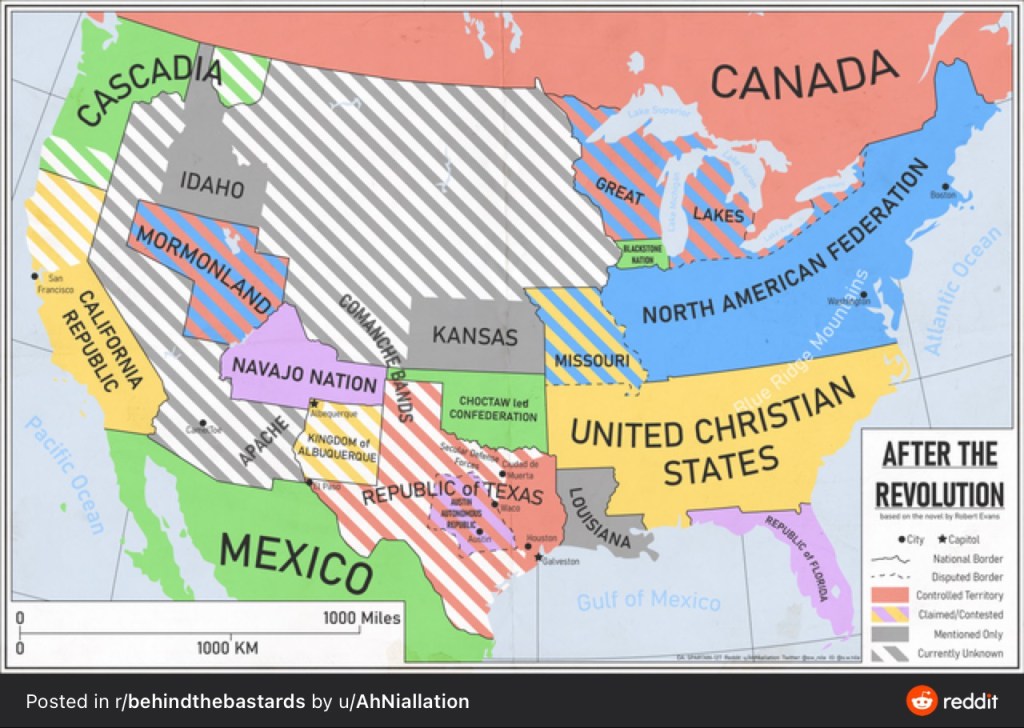
Robert Evans, “After the Revolution” (2021) – Robert Evans hosts a bunch of podcasts! That’s close to all I know about him. A lot of people I know like his podcasts. I vaguely know some people who dislike him because he works for Bellingcat, which produces a lot of Russiagate paranoia, but it doesn’t seem he works that beat. I don’t listen to many podcasts these days but I heard somewhere he wrote a sci-fi novel about America after it fractures in a civil war. Evans also worked as a conflict journalist in places like Syria so I thought it’d be worth looking into, especially as he distributes it as a free ebook.

It’s the 2070s! The US broke up decades before. Most of the action takes place in Texas, which became a sort of weak libertarian republic, and basically allowed factions both right and left to control parts of its territory. There are three viewpoint characters. Manny is an Austin-based “fixer” for journalists from abroad looking to report on the wars in North Texas between Christian militants and the forces of the Republic and leftist militias. Sasha is a high school girl in the “AmFed,” the American rump state in the northeast, who runs away to join the Kingdom of Heaven, the “neo-Calvinist” (autocorrect wants to say “bro-Calvinist” and there’s some truth to that) ISIS-analogue growing on the plains. And then there’s Roland, a radically biologically modified former supersoldier missing large chunks of his memory who gets bribed into a “one last job” by an old friend. They all get embroiled in a surprise offensive that the Kingdom launches that threatens to overrun Texas.

One of Evans’ many podcasts is called something like “It Can Happen Here,” about the possibility of a civil war in the US, and my understanding is that it basically layers his experience doing conflict journalism onto American conditions. That’s more or less what you get here too. Sasha, for instance, is pretty straightforwardly a white American Christian skin for the sort of young people who got radicalized online and ran off to join ISIS in the 2010s. The Kingdom is ISIS, there’s an equivalent of the Syrian Democratic Forces defending Austin (without, interestingly, as much of the ethnic angle, though there’s more people of color there than among the Kingdom), there’s the “Christian states” in the South kinda-sorta supporting the Kingdom kind of like Saudi, the Emirates, Turkey etc supporting Islamist militias against Assad (paranoiacs who insist that Evans is a NATO pawn will presumably think he soft-pedals that angle here for Reasons), etc etc.

Evans makes the good choice to not linger too much on worldbuilding, and where he does, it’s on something stranger (more anon). Mostly he does action, and he’s a decent enough action writer, not one of the greats but this is a respectable first try. His extrapolations on technology — the key importance of drones, some bio-modification stuff I’m not sure I “buy” but which is fun — work pretty well and aren’t overplayed. The Kingdom is mounting an offensive based on a new technological exploit- I’m normally not into that as a plot point in scifi but it works here, as Evans depicts the Kingdom as first and foremost opportunistic, an infection exploiting weaknesses, from the corruption and pointlessness of life in Texas and the AmFed to technological flaws, half-consciously, and we’ve seen that everywhere in the twenty-first century from the altright (remember them?) to… well, mostly other right-wing formations… Manny at first wants to make enough money to escape to Europe, but gets waylaid by the offensive. Sasha gets smuggled into the Kingdom, likes it at first, then finds herself in an arranged polygamous marriage with a rapey douchebag.

This leads us to Roland, the post-humans, and the strange role Evans gives them. It’s worth noting that along with contemporary wars and ideological madness, Evans also writes a lot about drugs from a participant-observer perspective- the post-McInnes Vice magazine mix. As far as I can make out, post-humanism in this world originates with the US military, who “chrome up” soldiers with nanotech, gene modification, internal computers, etc etc. It’s all more organic than Terminators — think blood nanobots rebuilding shot-up tissue rather than “liquid metal” — but Roland’s powers meet or exceed many of those of your T1000s. But these ain’t your granddaddy’s robotic, mission-oriented cyborgs! Their extreme abilities also come with extreme desires for extreme experience. The history comes in bits and pieces, but it seems that Uncle Sam’s cyborgs, after being used for numerous war crimes in the 2020s, go rogue and try to take down the state in a vaguely anarchist direction! Things get fucked, they lose, many of the post-American states pass strict regulations on bio-modification (the Kingdom renounces all of it but does some creepy backdoor nonsense with it), and so the post-humans mostly retreat to the abandoned, climate-ravaged deserts, mountains, and plains of the continent.

It’s too much to say they “save the day,” but a major player in the story, the thing that stops it from being a tale of Protestant ISIS ravaging Texas, is the post-human nomad city of Rolling Fuck. Rolling Fuck is basically Burning Man as Burning Man would like to imagine itself. They wander the plains, having crazy sex, drug, and danger experiences enabled by their demigod-like powers (I don’t like the way people call superheros gods these days- I get it’s meant to refer to pre-Christian gods but we are all products of monotheism and I’m sorry, if you’re not omnipresent, you aren’t like god as we know Him). They stay out of politics. But then the Kingdom makes the dumb move of jacking some of their people. At first, they try to send Roland and Manny in to sneak them out. That goes south, so Rolling Fuck goes to war.

Like I said, the action and plotting are decent, especially for a first time novelist. It is… “trauma informed,” and I’m curious to see how that will play out as trauma-thinking wends its way further into the popular consciousness. Knowledge costs- Manny knows war-torn Texas at his expense, Sasha learns fundamentalism is Bad at her expense (not as harsh as it could have been- Evans knows the boundaries of what his public will accept, probably for the better), and no one pays more than Roland, for learning what it’s like to be post-human and having post-human experiences, being a walking hub of history’s wheel. Even where Evans doesn’t make Roland’s prior experiences clear, there’s just a constant fusillade of self- and other-inflicted bodily abuse, just constantly taking tons of drugs and also getting shot all the time.

Knowledge costs, it’s traumatic, but it also makes you human, or post-human. Not just on its own- it can make you sneaky, like Roland’s ex-handler, or subhuman, Sasha’s bro-Calvinist boyfriend. It needs proper management, “technologies of the self” if you will- Rolling Fuck’s drug and sex experiments, and its war ritual of sending little drones to collect the information of the people it slaughters and playing their little social media videos for the civilians back on the truck. Arguably, the implied values and worldview behind this is as interesting as the post-civil-war stuff, for its leaps and its gaps both. It’s a flexible view of humanity, more flexible than the “standard” current view, but I wonder at its bending and breaking points, particularly the idea of what seems to be a universal idea of trauma… but anyway. All in all this was pretty good, especially for a free ebook by a podcaster. ****

Review – Evans, “After the Revolution”

Review- Corey, “Babylon’s Ashes”

James S.A. Corey, “Babylon’s Ashes” (2016) (narrated by Jefferson Mays) – Well, the two Coreys (“James S.A. Corey” is a house name for two dudes) decided they’d do space Tolstoy. They even make it explicit in the last chapter, with one of their characters reading and expounding on the old Russky wife-hating sage. Indeed, they bring back pretty much every viewpoint character from the previous four books who aren’t dead, and a few more besides, to give their take on the goings-on.

And what ARE the goings-on? The Solar System is fucked after the last book, when a coalition of Asteroid Belt extremists and shady Martian-colonist naval officers blast the fuck out of Earth with asteroids. Without Earth, ecological collapse threatens the system. There’s an alien gateway that can get people to other solar systems out by Neptune, but the extremists control it. Like I said, it seems the Coreys got sick of the “Alien”-esque workaday space world last book and decided to apocalypse it. That wasn’t a great move, but was somewhat interesting. Now they need to clean up their toys and get them somewhere else. They spend hundreds of pages doing it! And it’s not that good, or that interesting.

The many viewpoint characters give you a bunch of looks at the world of the Expanse, but that world isn’t interesting enough to sustain the weight. It’s not bad, and it can definitely sustain good action, like in the first three books. But when interest has to come from the details of the world, it’s not enough. The Coreys don’t make anything that original or interesting. The closest is the Belters, which is good as they’re the pivot of the whole thing. A space-bound culture raised on stations, ships, and asteroid, they have kind of a proletarian thing (exploited by Inner Planets) and kind of a nationalist thing and kind of vision of everyone being space-based? It’s fine that the movement is confused. Movements are often confused. But the Belt, it’s people, and it’s politics don’t feel real enough to sustain the action or my interest that much, especially as a movement willing to get behind a genocidaire who also destroyed their lifeline, ie the Earth (the rest of the system has not been meaningfully terraformed). This is because Belter politics are a grab-bag of features of demotic politics and nothing coherent. It doesn’t scan. Martian and Earth politics and society are even less fleshed out.

All of this would be forgivable if the action delivered, but it doesn’t. It’s scattered and confused, and the Coreys take time out to deliver little homilies on “human nature,” how we’re “tribal” — lot to be said about the resurgence of that adjective in recent decades — and greedy but things are still worth it and anyone who tries to radically change things is bad, blah blah the usual. I don’t like normal Tolstoy that much. American pop scifi Tolstoy is hard to take. Eventually they go out to the alien gate and there’s a fight in the gate and it’s fine, people are gonna expand into the galaxy but the Belters will get some stuff etc. I’ve been told the one that comes after this is better, and the blurb I read shows some promising surprises, so we’ll see. **’

Review- Corey, “Babylon’s Ashes”

Review- Corey, “Nemesis Games”

James S.A. Corey, “Nemesis Games” (2015) (narrated by Jefferson Mays) – Ehhhhhh I did not like this one as much. It feels like the Coreys have gotten sick of the workaday space world of “The Expanse” series and are throwing it away. I guess that’s not that bad- the world is fine but not something to which I feel great attachment. But in this one they tried to do too much with too little and it just wasn’t that great.

To explain what happens in “Nemesis Games” I’ll need to talk more about the spaceship crew-ersatz family at the core of the Expanse series. I haven’t done this before because most of the characters involved are boring. Admittedly, I’ve written about main character perspective-dullard Holden in these reviews, but he’s unavoidable. Like the Game of Thrones series, all of the chapters in the Expanse books are told from the perspective of a rotating set of characters. Each book has Holden as a perspective character, plus a few new ones. This one retains Holden, but the other perspective characters are the other crew on his ship, the ragtag chosen family of the “Rocinante.” There’s his girlfriend Naomi, his engineer/go-to thug Amos, and his pilot Alex. Naomi is strong and sensible in that stock scifi lady way, Amos is a tough guy who has “no moral core” save for loyalty to the crew and sentimentality about kids (which is to say he has all the moral core readers expect), Alex has… a Texas accent, because Texans settled Mars early? You can see why I didn’t dwell on them before. They’re fine for what they are but you don’t read these books for the character study.

We start off with everyone scattering! Doing errands. Naomi has a mysterious summons to her Asteroid Belt home. Alex goes to Mars to say sorry to an ex. Amos departs for Earth to bury one friend and visit another in jail. Holden is left alone out in space to bother people. Then some shit goes down! But alas, other than a sense of general frenetic activity, this shit is not well laid out. Someone’s stealing spaceships, and someone wants Naomi to do something sketchy, and then asteroids start landing on Earth! It’s all connected, somehow. Shit is getting ugly!

The problem is, none of it feels earned. I don’t want to say “real,” though verisimilitude can be an issue too. The main thing is this- the baddies (spoilers, if you care) are rogue militant Asteroid Belt settlers and some dudes from the Martian space navy. To the extent this has any basis in what came before in the books at all, it’s in one of the weakest points of the Coreys worldbuilding. Earth, Mars, and the Belt are depicted as all basically having Earth-country-style nationalisms. The Belters in particular feel put upon by the Earthers and Martians. But it always felt superficial- the Belters have silly argot and accents, part Hispanic, part South Asian, and are portrayed as hardscrabble due to living on asteroids and space stations. Especially now that the “gates” opened in previous books and settlers can go to other solar systems, the whole Belt way of life looks pointless, as does terraforming Mars. Well… it’s hard to suspend disbelief when you realize that such programs were always pointless, given that they were supposedly impelled by “overpopulation” and welfare statism on Earth. The Coreys just kind of hand-waved most of that away with stuff about the innate desire for “frontier living” etc.

I didn’t buy it, but I didn’t have to for most of the books. In this one, I was much more pressured to buy, because it formed the motivation for this random Belt faction coming out of nowhere and pulling off all kinds of crazy shit and doing genocidal asteroid damage to Earth. It strained credulity in other ways, too. We’ve followed the head of the “Outer Planets Alliance,” a Belter terrorist group turned political party, since the first book, and now we’re supposed to believe this wise, badass warrior could get completely flummoxed by the existence of a splinter faction? It’s hinted that this faction had some kind of major outside help, and I guess it’s from the Martian navy? But beyond similar hard-to-believe politics stuff (that, again, happens under the nose of their government and takes them completely by surprise), there’s no set up. It’s just kind of lame, and even hard to follow at times.

The book’s not all bad. There’s some decent action sequences. The stuff with Amos on Earth, where he needs to survive the apocalypse alongside a girl who tried to kill his whole crew a few books back, was fun. In general, it was ok seeing some of the old viewpoint characters again, as they get swept into the big drama. The sense of scale is admirable. I’m glad the Coreys decided to be ambitious. It just seems their eyes were bigger than their stomachs. Their sense of big picture just isn’t there, and it reminds me of George R.R. Martin, their maitre, in a bad way. I wonder if there’s a genealogy- the coup/conspiracy-based strategizing of the likes of French revolutionary Louis-Auguste Blanqui and the “propaganda of the deed” of turn of the century anarchists, which gets bowdlerized into the deeds of villains in early pulp fiction, which turns into an understanding of how villainous plans and politics just work… because none of it really passes muster.

Neither does the philosophizing about human nature, it’s supposed tribalism, etc., that the Coreys put in assorted characters’ mouths. It’s a funny coincidence that those memes with Vin Diesel going on about the power of Family came out when I was listening to this, because to the extent the series has a message, it’s basically the message of those memes. The ultimate bad guy (introduced in this book out of nowhere) is someone who doesn’t understand, who corrupts, family (and is Naomi’s abusive ex, natch- the Coreys don’t do the worst possible job with that relationship but it feels as pro-forma as a lot of the rest of the setup here). That’s fine for an end-of-movie/book/season speech you can zone out for. It does not for great scifi plotting make. ***’

Review- Corey, “Nemesis Games”

Review- Smith, “The Probability Broach”

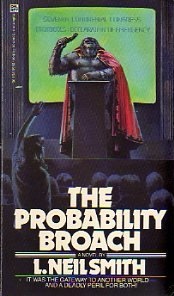
L. Neil Smith, “The Probability Broach” (1979) – A friend of mine who is a recovering “anarcho-capitalist” tried reading this, a depiction of an alternate-history free market utopia and one of the flagship works of libertarian scifi, during the height of his belief in its ideology, and couldn’t get through it, he found it was so bad. Well, now that I’ve read it, I can understand why. Boy howdy, was this a stinker.

A twist on one of my usual disclaimers: I’d love to find really batshit visions I disagree with explored in writing, and I’m not a stickler for plausibility in alternate history stories. I mean, I sort of am for myself, because I think it would be interesting to get a really rigorous, critical-historical take on the exercise, but I’ve obviously not accomplished that. Actually good alternate history stories like “Fire on the Mountain” and especially “The Man in the High Castle” have historical dynamics in their backstories that don’t really wash. But that’s all right. Alternate history stories are, naturally, more about us than about the past or it’s possibilities.

So it’s not really the implausibility of either the world Detective Win Bear goes to, not the one he leaves behind, that bothers me, though the patterns of implausibility in both cases indicate larger problems, like that the author is a dumbass ideologue of a dumb-assed ideology. Win Bear (he’s a Native American, always good to have them on side when you’re trying to make some fatuous settler point) works for the Denver PD in a 1987 that sucks pretty hard, because it’s a conservstive libertarian fantasy of what they thought Carter-Mondale style liberalism was doing to the country. Everyone’s broke, you can’t smoke, maybe some other stuff that rhymes, bureaucrats everywhere, etc. Win has to investigate a murder of a physicist, then some people try to murder him, then of course the physicist was doing alternate world stuff, so he winds up in an alternate world. No one knows about cops, or Denver, in this alternate world! People are happy, and also, for some reason, chimpanzees and gorillas are people and they’re happy too! Everything is privatized, no one pays taxes, everyone is armed.

Do I sound tired to you at this point of the review, dear reader? That’s because I am. The problem with this book was less the world building and more just the complete shit quality of the prose, characterization, plotting, and exposition. Exposition is often a problem in scifi, and especially alternate history, so that’s relatively forgivable. Win has a tendency to get shot, and so while he’s healing up, he has people tell him about the alternate timeline he’s in. The “point of divergence” is that Albert Gallatin, known in our world as an ethnographer (i.e. had a creepy fixation on Native Americans) and Secretary of the Treasury, sides with the Whiskey Rebellion against George Washington’s efforts to enforce tax payments. They win, kill Washington, and almost literally everything is hunky-dory from that day onward. No more constitution (and I will say it is refreshing to encounter an American winger who doesn’t slavishly worship that document, not that what he wants is better), no more taxes, really no more government. Jefferson (!) fixes slavery with moral suasion. The Native Americans gladly sell their land (?!) to western settlers and assimilate. Canada and Mexico join up, voluntarily. The only problem is that followers of the exiled Alexander Hamilton, arch-governmentalist, occasionally show up and do a terrorism, and that provides what skeleton of plot exists in this book.

I would say some of that stuff — especially about race — borders on the offensive, and the offensively stupid. But that’s not really why the book is so bad. It’s an ideological Marty Stu story, which is the real problem. The expression “Mary Sue story” comes from fan fiction, where it was common for writers to insert idealized, flawless versions of themselves on the bridge of the Enterprise or whatever (and it was gendered- women writers were called out for it more often, even though the male equivalent, the Marty Stu, was probably just as widespread if not more so). That’s one of the sad things about really thoroughgoing, join-the-party stockpile-gold libertarianism- the only meaningful conflict they understand is, basically, “normal people versus busybodies.” This is probably one of the reasons why libertarians so often become bigots and fascists- the explanation to the question “of libertarian paradise is the default, why does it exist nowhere?” can very easily become “the Jews, duh,” because it’s not like there’s any other good explanation of what binds “the busybodies” together, especially if you explicitly reject class analysis. It’s one way in which libertarianism really is “classical liberalism” — that ideology’s refusal of conflict and tragedy, well after most liberals got the memo that “freedom” can’t fix everything and adapted.

That’s tragedy, maybe, but “The Probability Broach” is farce, and not a funny one. Statist terrorists keep trying to mess stuff up, both in our world and the libertarian paradise, and keep failing. They’re meant to be extraordinarily dangerous, but are also ludicrously incompetent- after all, if they were competent, they’d be libertarians, right? Compounding this, Smith is a terrible action writer. It’s an art, writing action scenes, and one Smith hasn’t learned. He mostly substitutes gore and endless gun pedantry (he is, of course, a gun pedant, the creepy kind who talks about defending women, when he also delights in depictions of women being harmed, because of a lack of guns, of course) for an ability to write action. It’s a detective story in which no detecting takes place, just bad guys falling into the hands of Win and his new alternate universe friends.

I gotta say, I never expected to find myself wishing I was reading Ayn Rand. But at least she could inject some passion into her work, whatever her many failings as a writer and thinker. Smith can’t even manage that. His writing has the tone of the asshole at the end of the bar who’s figured everything out so hard he never has to do anything, never leaves his hometown or does anything with his life because it’s all bullshit anyway. Give that asshole free reign of his resentments and a very odd historical education, and you’ve got this book. *

Review- Smith, “The Probability Broach”

Review- Corey, “Cibola Burn”

James S.A. Corey, “Cibola Burn” (2014) (narrated by Jefferson Mays) – Back to the Expanse! This time the drama takes place on a planet on the other side of an ancient alien wormhole. But humanity doesn’t leave the cynical maneuverings that characterize the Coreys’ (its two guys, James Corey is a nom de plume) gritty workaday space solar system as established in the previous four volumes. Some squatters, survivor of the collapse of a colony on Ganymede that we saw a book or two back, went through the wormhole first and settled a seemingly earth-like planet. Alas, according to the rules, an Earth-based megacorp has dibs. They can’t even agree what to call it! The megacorp wants to call it New Terra, the squatters call it Ilus. In any event, they start fighting. Who’s called in to mediate but Jim Holden, space-dad and classic perspective-dullard, the protagonist who has less character than all the others but whose dogged insistence on heroic goals drives the story forward?

This one is pretty fun, taking as its motto the old writing workshop advice, “chase your characters up a tree, and once they’re there, throw rocks at them.” The corporate security people and the settlers do tit-for-tat terror on each other. The settlers are desperate for a place to live, and the leader of the corporate team is depicted as a kind of Colonel Kurtz psychopath, except speaking in corporate tough talk rather than whatever Brando was doing, so Holden can’t get them to knock it off. In the midst of all this, the planet turns out to be less a planet and more a planet-sized factory made by the same long-dead intergalactic alien civilization that made the wormholes… complete with defensive systems. These systems go off one by one, creating additional headaches for Holden et al at an agreeably frantic pace.

The other perspective characters include Elvi, a naive corporate scientist with a big-girl crush on Holden, Havelock, a corporate security guy, and Basia, an accidental (he only wanted to do property damage!) settler terrorist. I guess talking about them is as good a place as any to talk about this book and colonialism. Various people have told me the show is a good, “subversive” take on the difficulties of colonialism. I haven’t seen the show — I want to get through the books first — but that’s not really how I see this book. The actual issues of colonialism aren’t really here, because there is no indigenous culture (unless you could the long-dead builders of the planet). There is some racism on the part of the corporate security people, who are mostly from cushy, established Earth, and the squatters, who are hardscrabble Asteroid Belt types, but that’s about it. If anything, there’s more of your classic inter-settler squabbling, like Elvi the scientist earning the ire of the settlers for trying to get them to do less mining (and pooping) so she can do more science on a fresh, untainted biosphere. The violence of both sides is understood as being about greed, sociopathy, and in-group loyalty, the kind of thing basically-good people like Basia and Havelock can transcend, not really about power and who wields it for whose benefit.

There’s still enough of the Coreys’s master, George R.R. Martin, here to make any politics beyond “people are generally bad, except for your (often chosen) family, who you should be good to and open to expanding” supremely unlikely.But that’s ok, as far as I’m concerned, because it’s fine for a scifi adventure to be a scifi adventure without a scathing political critique behind it. It’s almost heartwarming, seeing the authors gesture at a broader point but landing on the usual bromides about family and empathy… anyway, I actually think the Coreys best Martin in terms of delivering on promises, and I’m not just talking about that last ASoIaF book we’re not getting. I mean resolving plots in a satisfactory number in an acceptable span of verbiage, balanced worldbuilding — the concept of the Expanse is about as thin, conceptually, as that of Westeros, but the Coreys haven’t built as much on such shaky foundations as Martin has — and not automatically going for the most cynical/grimdark resolution every time and calling it “tragedy.” Elvi gets over Holden and it’s fine- in Westeros, presumably she’d die horribly. Havelock learns some lessons without getting tortured. Even Holden’s girlfriend, Naomi, a cardboard Strong Female in most instances, shows some vulnerability in a human kind of way. All in all, not bad. ****’

Review- Corey, “Cibola Burn”

Review- Menon, “The Beast With Nine Billion Feet”

Anil Menon, “The Beast With Nine Billion Feet” (2009) – It’s actually almost pleasant to read a book that’s just not very good because it’s not very good, without some additional factor- disappointment, ideological madness, ubiquity. Upon googling the book a little more, it appears that it is meant to be a “young adult” novel. What does that even mean considering how many grown-ass adults read “YA”? But it makes sense. The protagonists are two kids growing up in Pune, India in 2040, and the prose is indeed simple enough for middle schoolers to get through probably (not that that isn’t true for plenty of adult novels, or that there aren’t smart middle schoolers, etc etc conceptual problems). Googling late informed me of the YA nature of this book, and googling (but apparently not enough) got me into it- specifically, googling “Indian science fiction.” I’m curious about scifi from outside the usual Anglo-American context, and reading the great Liu Cixin whetted my appetite further. This book came up.

Tara and Aditya are two kids growing up in future-Pune, thirteen and sixteen respectively. Their dad is a brilliant geneticist who had to go on the run because he supported a sort of free-software regime for genetic modification. Truth be told the future isn’t all that different. There’s more gene modification but nothing that freaky- smart parrots, designer kids. Virtual reality is pretty big. India is still recognizably India, Tara wonders if she should gene-modify her dark skin. She meets some creepy twins who don’t have belly-buttons and their sinister mom. She befriends the twins despite their creepiness. Meanwhile, Aditya is a gene-hacker but gets in various kinds of low-grade trouble. The dad comes back. The creepy mom wants to do in the dad, somehow, or get him involved in her bad patented-gene schemes.

None of this coheres very well. Menon can’t quite nail where to set up his looming threats for best effect, like an earnest but incompetent haunted house manager. I’d say it “keeps you guessing” except it’s hard to be bothered. It also seems to be setting up for a sequel, but it’s been eleven years so who knows if it’s coming? And he doesn’t even tell you what the beast with nine billion feet is. I give it an extra half star because of my inability to judge YA but I’m pretty sure this isn’t a great example of that, either. **’

Review- Menon, “The Beast With Nine Billion Feet”

Review- Corey, “Abaddon’s Gate”

James S.A. Corey, “Abaddon’s Gate” (2013) (narrated by Jefferson Mays) – Book Three of the Expanse! It’s getting downright… expansive! That rascally protomolecule has set up a portal of sorts at the edge of the solar system. What’s on the other side of the portal? Is it a sort of… star… gate?

Forgive my levity! This is a pretty good scifi novel. It doesn’t try anything crazy or innovative but that’s basically fine- it delivers the good. The workaday, no-lightspeed-travel spacefaring world the Coreys (its two guys, it’s a trade name) set up threatens to become a little less workaday as a result of the doings of the protomolecule. The protomolecule started out as an alien weapon, first zombifying people, then becoming a weird space-station sized intelligence, then becoming a star gate. All the space navies of the system — Earth’s, Mars’s, the rag-tag Asteroid Belt — are there to try to figure out what it’s deal could be.

Of course, perspective-dullard Jim Holden and his crew get sent out to do a thing out there. It turns out it’s all part of some setup a new perspective character has to ruin his reputation and do him in! She has money, a willingness to murder many people, and special combat glands. But the universe — and the protomolecule — have plans of their own. Holden’s ship gets sucked into the gate, and a bunch of navy ships, including one with the perspective-villainess, follow.

“Time moves at a different speed in the nether zone,” as Jez put it on “Peep Show.” The gate turns out to be a kind of cosmic foyer. If you know how, you can use it to get to other solar systems. But you can’t fly too fast! There’s a sort of monitor-station in the middle that can alter the laws of physics. One rule is if you go too fast it stops you, hard. After trying to clear his name from the perspective-villainess’s frame up, some space marines shoot a grenade at Holden on the monitor station, so the monitor decides to slow down the speed limit even further, severely donking up all the ships and killing many.

No one knows what to do! Except the perspective characters and their friends, when put in combination. These include Holden, the woman trying to destroy Holden, a Methodist preacher-lady, and the security head on the biggest ship, an Asteroid Belt rebel ship they stole from some Mormon settlers. They’ve all got their own problems. Holden is always getting visited by the ghost of Miller, a grizzled cop protagonist from the first book whom the protomolecule uses as a messenger (Miller wasn’t that compelling the first time around, but whatever). Clarissa, Holden’s nemesis, has to try to kill Holden and then (spoiler alert) makes good. Ana, the preacher, and Bull, the security guy, deal with the grisliest beast of all- internal spaceship politics. Holden receives information from the interstellar civilization that made the gates and the monitor that if the humans keep fucking up, the solar system is toast. But of course, humans being human :world-weary, writerly sigh: they keep fucking up, and the protagonists need to stop them.

There’s a fair amount of cool stuff here. I like internecine struggle in space, the madness of type-A motherfuckers in tin boxes in a vacuum going nuts at each other over their desperate plans. The villains are ok, though I kind of spoiled it for myself by learning that the big villain was played on the tv show by David Strathairn, who’s great, but it’s definitely typecasting. The fucking-with-physics is cool, though goes against the “this is HARD scifi, no magic here!” thing the series’s boosters promulgate. The battles get a bit confused, trying to keep track of who’s where on this huge ship. The Coreys, like their maitre George R.R. Martin, are at their worst when they try to make points about humanity, but they don’t intrude too badly here. We’ll see how it goes with the next one, when humanity starts star-gating around. ****’

Review- Corey, “Abaddon’s Gate”

Review- Corey, “Caliban’s War”

James S.A. Corey, “Caliban’s War” (2012) (narrated by Jefferson Mays) – The second installment in the “Expanse” books marks a substantial improvement from the first, which wasn’t bad itself. The improvements in this yarn of adventure in a human-settled frontier solar system will make me explain parts of the world! Which I didn’t feel that much compelled to do in reviewing “Leviathan Wakes.” I guess the important thing to mention here is that the big plot point in “Leviathan Wakes” was that an evil megacorp recovered an alien weapon called the “protomolecule.” The protomolecule is like a germ that kills anything it touches and then reanimates it, but all mutated and fucked up. At first I kind of rolled my eyes at what seemed an obvious zombie play- 2011 being around high zombie season. But to the authors’ credit, the protomolecule is weirder than that- it disassembles life and reassembles it into strange shapes, towards some unknown purpose it is pursuing methodically.

We shouldn’t make more of this than it is- in the first book, it was mostly an occasion for zombies and some body horror. In the second, someone has weaponized the protomolecule to make monstrous super-soldiers. They’re pretty “Alien”-y — silent, black, big heads, big claws — but why mess with a proven concept? At the beginning of the book, one of these monsters takes out a bunch of up-armored space marines on Ganymede, one of Jupiter’s moons. This causes Earth and Mars, the two big solar system superpowers with interests on Ganymede, to get in a shooting war, because each thinks the other fragged its guys.

This leads to a chain of reaction we follow through our viewpoint characters, most of them new to the series. Martian space marine Bobbie survives the Ganymede monster attack, but through various circumstances winds up in fish out of water situations working for Earth-bound UN (the UN runs Earth, a bit of a laugh but whatever) apparatchik Avasarala, another viewpoint character. Ganymedan botanist Prax finds his daughter kidnapped just as stuff collapses on his moon- coincidence?! No, obviously. And of course, there’s Holden, captain and dad-figure to a crew of misfits on the space corvette Rocinante. They all find themselves in assorted races against time — stop the Mars-Earth war, stop the polymolecule which even those who want to weaponize can’t control, find Prax’s daughter. Naturally, these all come together, as do the characters.

The new characters are a mix. A lot of Bobbie’s character is “she’s a woman, and a badass, and physically huge!” which is cool but not a big deal. Prax is analytical, unused to adventure, dedicated to finding his kid, the kind of NPC you need to keep safe on escort missions in a lot of video games. I liked Avasarala, it was cool to have an old lady bureaucrat as a main character in this kind of story, doing political machinations and shit. She wore a little thin as the book went on — we know, she swears a lot and likes her husband — and she’s basically beat for beat Olenna Tyrell from “Game of Thrones” (one of the writers was George R.R. Martin’s assistant!), but is still pretty good. There’s more of a wrinkle to Holden — being involved in violence messes with him — than in the first book but he’s still what I think of as a “perspective dullard.” Ever notice how often main characters are way dull? Harry Potter is the king of perspective dullards, but they’re everywhere, and Holden is one.

That’s fine, though, I’m not here for a character study. I’m here for action, and the authors — “James Corey” is a pen name, it’s two dudes — deliver pretty well. The action isn’t all violence, either. Prax is at his best showing us Ganymede experiencing an ecological collapse after Mars and Earth start shooting each other in its atmosphere- turns out, space colonies are fragile! Avasarala does some fun political maneuvering with people (men, mostly) who underestimate her, but not so much as to make her actions low stake. Bobbie is slower to come to her own but does in the end, with some pretty cool space/Jovian moon battles. And Holden ties it all together, a little tiresome at times, but shepherding the action out to the moons of Jupiter for a big showdown. Then there’s a pretty good sting at the end to set up the inevitable sequel. All in all, a good ride.

There’s a bit of the “Chamber of Secrets” problem here. The first two Harry Potter books ended with confrontations with various manifestations of Voldemort in the school basements. So far, every Expanse book ends with a raid on a remote protomolecule-infested lair. I remember wondering if Harry Potter books would always end that way, then I read “Prisoner of Azkaban,” the best Harry Potter book, which broke the mold. “Abaddon‘s Gate,” the next Expanse book, should maybe mix it up, but the action in “Caliban’s War” beats anything Rowling came up with. ****’

Review- Corey, “Caliban’s War”

Review Links- Trask, “Ideal Minds” and Robinson, “The Ministry for the Future”

I’ve had two reviews published recently.

In San Antonio Review, I write about critic Michael Trask’s searing examination of “neoidealism” in American thought and letters during the 1970s, here.

In DigBoston, I have a look at Kim Stanley Robinson’s new novel, “The Ministry for the Future.” It has strengths and weaknesses and you can find my discussion of them there.

Enjoy!

Review Links- Trask, “Ideal Minds” and Robinson, “The Ministry for the Future”