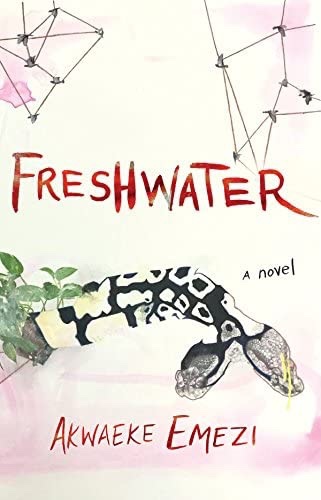
Review – Emezi, “Freshwater”

Akwaeke Emezi, “Freshwater” (2018) (read aloud by the author) – Readers and reviewers spoke of this book as a revelation. I didn’t find it to be that, entirely, but I have an advantage: I’m a genre fiction reader. The idea of a fractured self expressed through mythological/religious tropes isn’t a new one on me, or the juxtaposition of ancient belief systems and contemporary living. So when Nigerian author Emezi has their autobiographical stand-in, Ada, experience possession by multiple spirits – ogbanje, not exactly friendly, not entirely demonic – as a way of explaining what someone steeped in western psychiatry would call multiple personalities, I wasn’t as blown away as the sort of person who usually reads somewhat-experimental fiction given big pushes by mainstream literary publishers with pastel covers might be.

It’s still a decent idea, though. Ada starts her (the character uses she/her pronouns and mostly identifies as a girl and a woman, even if one of the spirits inside her is a man- Emezi is nonbinary, though doesn’t deny the autobiographical element here) journey with the ogbanje early in her childhood in Nigeria. She’s not just a third culture kid, she might be a fourth or fifth, with an Igbo Nigerian father and a Malaysian mother who raise her in a variety of places, even if Nigeria anchors her childhood and America her young adulthood. She’s sexually assaulted by a boyfriend in college (which she starts at sixteen) and that’s when some of the ogbanje come to more or less take over her body for extended periods of time, putting Ada in the backseat. 

Most of the book is written from the first person perspective of one or another of these spirits. They relate their perspective, the actions they either see Ada perform or foist on Ada, their conversations with Ada and sometimes with rival spirits inside of her. The spirits are insightful, dependent on their human host while somewhat contemptuous of her (but more so of other people), possessed of some virtues, like loyalty, but no morality to speak of- and hungry for blood and suffering. Ada appeases them mostly by cutting herself and by getting into bad relationships with men. Sometimes, Ada tries to destroy the spirits or rout them from her, other times, the spirits try to get Ada to let them loose into the spirit realm, i.e., kill herself. Neither succeed, and Ada eventually learns to live with the ogbanje, as well as other, less identifiable spirits who seem to have her welfare, or a version of it, more in mind. 

At some point, and maybe someone has started already, but someone will have to write about the impact of post-1965 US immigration policy, specifically as it relates to favoring highly-skilled knowledge workers and students, on literature. Immigration, sojourning, exile, etc. have always been themes in literature, and structural aspects of the creation of literary communities. I do think there’s a prominence to immigrant literature, and especially to the literature of immigrants from middle-class (or above) backgrounds today, of third- (fourth-, fifth-) culture kids, in contemporary English-language letters, that’s worth studying. Among other things, this may be the work of a contemporary black author that I’ve read that has the least to say about race, though it has a lot to say about Nigerian and Igbo culture. If anything, the spirits contrast Ada’s experiences and attitudes with those of black American schoolmates more than white people, though Ada does meet plenty of those- though, mostly it seems, international students from Europe, including her main love interest, a dreamy Irish fuck-boy named Ewan. Ada came to America when she was sixteen, and moves across oceans and continents perhaps not in perfect comfort… but her discomfort comes more from being inhabited by spirits and having bad interpersonal relationships than from bigotry, homesickness, dislocation, or the usual woes one associates with immigrant experiences. 

I wrote about this some when I discussed Jhumpa Lahiri a few weeks ago. I feel like foreign students and young professionals have been a part of my life more or less since high school or college, if not before, and are a fixture of life for most Americans who go through higher education, probably most inhabitants of the other rich countries as well. The paradox is that, coming from hundreds of different cultures all over the world, they’re the most heterodox bunch imaginable in some ways… but given the ways that schools and employers select, they tend to be much more homogenous in terms of class background, and of course, the experience of migration, of adaptation to the host country, of embedding in institutions that have now, in some cases decades hence, made adaptations to the presence of immigrants, migrants, guest workers and so on, has a certain group-making effect, too. 

Here’s a trope I see in both the literature and in conversations both had with friends and acquaintances from the sort of international-student/knowledge worker milieu and have overheard them have themselves: Americans are generally blander, less interesting, less emotionally-alive than “internationals.” The internationals live, the Americans (usually, but not always, white) kind of shuffle through life in a cloud of privilege and occasional disaster. This tracks, I’d say. Among other things, you have to have some initiative to bother schlepping all the way over here. Generations of life as the global hegemon will tend to make the upper-middle-class-and-above scions of said hegemony a little dull, I bet. Combine the aftereffects of WASP culture and the hollowness of consumer culture, and you get people who put their surface feelings up front for all to see (and hear!) but who you don’t really get to know, if there’s anything to know, for years or decades. I sometimes wonder if the real divide in the world is between people whose countries have meaningful historical memories of defeat and occupation, and those who don’t. The unflattering emotional depiction of Americans I just painted can be applied to the next most prominent group of people today who haven’t seen a military occupation for almost a millennium, the English, and inhabitants of its other settler colonies. You could paint it positively – people from countries that haven’t experienced that kind of defeat as more optimistic, or whatever – but it’s hard to sell that pretty much any time after 9/11. 

So, Ada lives in America but barely notices Americans. I don’t say this as a complaint, but I do think it’s notable, and I also think it relates to how Ada (and Emezi) treat the ogbanje. Every now and again Ada worries that she’s crazy. But less than you might think! She worries more that she’s in pain, she’s depressed, she has terrible relationships, she can’t find a place in the world. Yes, the ogbanje try to kill her- but they also protect her and give her an odd sort of power. This, whatever else it is supposed to be, is an interesting way to express how a young woman with one foot in a modesty culture and another in hook-up culture might experience her sexual power (and its strict limitations vis-a-vis extracting humane behavior from the men in her life). She doesn’t need to be rid of the ogbanje. That’d be American nonsense, the ogbanje would say, and which it seems Ada, and perhaps Emezi, would accept. Such is life for the alive international versus the dead single-culture and/or Anglo. 

The flip side is, in a story told by quasi-demons with little in the way of consistent framework beyond momentary sating of desire, there’s not a great need for continuity. Characters pop up, one of the ogbanje explain that they are very important to Ada, big stuff happens to them, and then they’re gone, for someone else to come along and reflect the relationship between Ada and the spirits for a chapter or two. On top of this, if you’re expecting anything particularly spectacular, even within Ada’s head, as she and her demons battle it out (including demons battling with each other), you’re going to be disappointed. A snake shows up in her bathroom as a baby, there’s some somewhat distended writing, the spirits and Ada argue in the “marble room” of her brain- a fancy waiting room, essentially, Basically, it does seem like the daring-concept tail wagging the literary-execution dog, at times. In keeping with the point I was making earlier, “international” navel-gazing, even from international rich kids, is generally better than the same produced in the Anglo-American world, but it only ever delivers so much without the injection of something more. ***’

Review – Emezi, “Freshwater”

Review – Fountain, “Billy Lynn’s Long Halftime Walk”

Ben Fountain, “Billy Lynn’s Long Halftime Walk” (2012) – I came at this one precisely backwards. I saw the Ang Lee adaptation of this Iraq War film – really, more of a movie about surviving the Iraq War – with my roommate. We had heard it was very peculiar and a box office disaster, in part due to Lee’s decision to film at a very high frame rate. My roommate had just gotten a Blu-Ray player, or whichever technology it is, and so the painfully sharp images, which remind me of nothing so much as certain PBS productions, were right there in the living room. I didn’t even know it was based on a novel until I started asking around for good literary depictions of chaotic crowd scenes. A friend recommended this book, I found it used, here I am.

It’s good! The titular Billy Lynn is a nineteen year old private in the Army infantry. He’s there because he got in trouble back home and because he wasn’t sure what else to do with himself- his family isn’t exactly poor, but it’s not very functional. Billy’s squad was involved in a firefight in Iraq that wound up becoming a symbol of American courage (and lethality) as the Iraq war soured, won his squad and himself medals, and killed Billy’s best friend and mentor, Shroom. The Army brings the squad back to the US to be shown off at various events (especially in battleground states- this was 2004). The tour culminates at a Dallas Cowboys thanksgiving day home game, in Billy’s native Texas, where the squad is expected to meet and greet various big wheels and take part in a halftime show with Destiny’s Child.

Fountain weaves numerous threads — the squad’s efforts to get decent pay for selling their story to Hollywood, Billy’s sister (who was the origin point of the trouble that sent him overseas) desperately trying to get Billy out of going back to Iraq in two days, Billy finding unlikely love with a cheerleader, weird fights with roadies — around Billy Lynn. He skillfully keeps the threads wrapped around a central concept- the war sucks, but it also became the squad’s home. They can only really understand and be understood by each other. They’re not “boots” (to borrow a term from Marine, as opposed to Army, culture)- they don’t think the Army is great or civilian life without merits or the war good. They just are what they are — infantry grunts — and they can no more walk away from that than abandon selfhood. It changes their consciousness, not just their loyalties.

It’s not enough to say that Billy and the squad despise civilian America, like 21st century freikorps types. Pretty much all of them want to go back, when their hitch is through- they see themselves as, and are, hardened fighters, but not necessarily as a career. But there is a lot to despise in a 2004 patriotism-themed Dallas Cowboys outing- waste, ugliness, fake piety and endless fairweather patriotism. The aughts were a time when you could see America as a blind giant, monstrously strong but utterly incapable of using its strength in a sensible way, whether in the Middle East or just, maybe, giving the PTSD-suffering infantry squad some hint of what they’re expected to do during a halftime show in front of thousands and broadcast to millions. The halftime show was, presumably, the chaotic mob scene that my friend recommended I look at, and it is a fine scene, all of the endless money, noise, and sex of civilian America turned up to 11 and whirled around a group of confused teenaged soldiers. 

From the cheap seats — mine, and that of Ben Fountain, who does not seem to have been in the military (he thanks people in the acknowledgment for filling him in on service life), it seems that the life of the grunt is the life of a young man, distilled. Put him into a tribe of young men, isolate him from others, and then put the group into extreme situations. There’s power there — who has gained or exercised power in this world without putting young men in isolated groups, putting arms in their hands, and directing them against those who stand in their way? — but that power gets put in the hands of others, who are generally indifferent to the grunts’ fates. Billy and his comrades try to tap into a little bit of it- to sell their story and make some money (typically, just enough money to get their families out of some lousy situation, not enough to be rich), to get laid, to slack off, to drink and gamble and live the life most young men want to lead amongst other young men. But the structures around them — that they take part in, by coercion but also by accepting default — channel most of their power to the structure’s end. 

I guess if I had a criticism of this book, it’s the comparative lack of narrative thrust and, basically, stuff happening. Two fights — including one involving lethal violence — with a bunch of random roadie stagehands forces along the action, and feel wedged in. In general, though, limited agency on the parts of grunts makes a certain degree of sense. Even when offered a way out, there’s a certain extent to which Billy simply can’t take it, can’t be other than what he is. He and his sergeant can spite some money men looking to exploit their story, to finally bite back at a civilian world that has used and confused them, but that’s about it. Still- that seems reflective, of the lot of life of those who serve, and, if I dare make a comparison between (sacred) troops and (profane) civilians, of most of our lots. Fountain deserves a lot of credit for taking risks — setting the story during one day (with flashbacks), playing around with format in some places, having an important character be dead and only exist in Billy’s memory and imagination — and making this story as compelling as it is. ****’

Review – Fountain, “Billy Lynn’s Long Halftime Walk”

Reviews – Vidal, “Burr”

Gore Vidal, “Burr” (1973) – My first Gore Vidal novel! Without quite meaning to, it seems that Gore Vidal set himself up pretty well for posthumous approval. I don’t know how many people my age or younger actually read his work, but plenty of them quote approvingly encounters with his long list of enemies: William Buckley, Norman Mailer, Truman Capote, Henry Kissinger. He was also on The Simpsons that time! Enough to endear yourself, much more than similar big white chiefs of midcentury American literature have done with twenty-first century literate types.

I got “Burr” from a library free pile, and hence, am violating my usual practice- I like to read series in chronological order. I didn’t know when I picked it up that “Burr” is part of Vidal’s “Chronicles of Empire” series, where he does his thing by following American history and writing scabrous thing about respected patriotic idols. “Burr” is the volume that takes place earliest in American history, but is not the first published. Rats! 

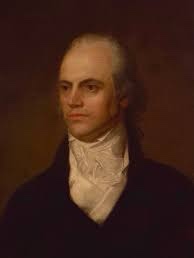
Anyway, as the title implies, Aaron Burr, revolutionary war hero, lawyer, vice-president, guy who shot Alexander Hamilton, alleged would-be conqueror of Mexico and/or the American west, all around scoundrel and bon-vivant, is the central figure in this book. The book takes place in the 1830s, after Burr has returned to the United States after being pseudo-exiled for treason and murder. He’s old, now, and has worked for some time as a lawyer in New York, leveraging his reputation for clever wickedness to his professional advantage. The narrator, Charlie Schuyler, is a young lawyer with literary dreams who is tasked with taking dictation of Burr’s memoirs, but with a hidden agenda. Various political poo-bahs in New York want Charlie to prove that Martin Van Buren, current president Andrew Jackson’s heir apparent, is Aaron Burr’s illegitimate son! Charlie is a somewhat angsty, weak-willed type, so he never quite commits to either Burr or to his handlers, or to the political passions that roil the city, or to anything other than a bad “Captain Save-A-Ho” fantasy in his love life. He’s a good receptacle for Burr’s story. 

Burr details the Revolution, his politicking in New York (he helped found Tammanny Hall, among other deeds), forming the Democratic-Republicans with Jefferson, almost becoming President, fighting the duel with Hamilton, and his shenanigans out west in fine high style. Burr prides himself on being an eighteenth century-style gentleman: urbane, disinterested, something of a scoundrel, adventurous, horny. In this, he sees himself as vastly superior to the rogue’s gallery we call the Founding Fathers: through Burr, Vidal depicts Washington as a vain blunderer with a gigantic ass, Jefferson as a sinister egomaniac who believes his own ever-changing lies, and Hamilton as tragic in large part through his failures to be the upper-class gentleman he desperately aped and sucked up to, despite the talents Burr acknowledged he had. 

In general, Burr and Vidal depict the era of the American founding as less of an epic of genius and more as a rather grubby tale of ego and greed. He reverses most of the conventional valuations of the period, not just about personalities. Burr didn’t mind the Articles of Confederation and saw the Constitution as a scam. Gentlemen as Burr understood them continually lost, and schemers – a class reading would say “proto-bourgeoisie” or vaguely caesarist/ideologue types ala Robespierre and Jefferson – won out. Out of the first five Presidents of the US, Burr has the most time for John Adams, who was at least a straightforward and intelligent opponent, and James Madison, whose brains Burr acknowledges but pities for letting himself become an appendage of Jefferson. 

Jefferson is the heavy for much of the book, and really, he makes a good one. A gentleman is always himself- Jefferson makes himself whatever is convenient for Jefferson. Burr depicts the various twists and turns in Jeffersonian thought — from borderline Rousseauian anarchism when he was in opposition, to interpreting the Constitution to mean he could buy a third of the constitution — as having even less to do with principle than most scholars now, emerging from decades of filiopiety towards the founding fathers, would find in it. Jefferson wanted power, wanted to throw red meat to the mob so they’d approve his tyranny, and only his incompetence — Burr carefully notes his shabby dress, his broken down houses with unworkable “inventions,” his generally ungentlemanly demeanor — kept him from being a Robespierre. 

Burr, for his part, models himself after that other half of the French revolutionary (shitty) outcome coin- Bonaparte. I’ll need to read more of Gore Vidal to really make this call, but in this one, Vidal comes off as squarely an American Bonapartist. It’s not so much that conquering Europe is good. It’s just that out of bad options, a smart dictator is preferable to feeble febrile weirdos like Jefferson. Burr considers himself a gentleman above the democracy- but his honor and good humor doesn’t allow him to despise the people, like Hamilton does openly or Jefferson does on the sly. To the extent Burr had a politics beyond frank (as opposed to secret, hypocritical) self-advancement, it was giving the people what they wanted- glory, conquests and adventures to either participate in or live vicariously through, and beyond that, being allowed to live their little lives in peace and relative prosperity. 

This is where Burr’s western adventures come in. Vidal, contrarian that he is, still can’t quite land on treason as being cool- if nothing else, that would cut across the rep he builds for Burr as being an honest crook. So he doesn’t represent Burr as trying to break off the (then-) western parts of the US as a private empire, or to sell it to Britain or Spain, with which the Jeffersonians accused him. Instead, Burr recounts a somewhat confused but fun tale of trying to gather armies of western pioneer folk to take over Mexico, and make him King or Emperor Aaron. He would have gotten away with it, too, if not for that lousy meddling James Wilkerson! But really, he implies, what gentleman of character wouldn’t want to get out from under Jefferson’s Virginian oligarchy and light out for conquests new?  It’s no coincidence that the major political figure of the time that Vidal paints in a relatively positive light is Andrew Jackson, who, it seems likely, at least paid Burr’s schemes some attention before Burr got pinched. Jackson’s a rougher-hewn, less interesting Burr, as far as Vidal is concerned, the best we’re going to get. But Burr was in Europe for most of Jackson’s career, exiled as a traitor (even if he was cleared by a federal court) and murderer (he argues Hamilton basically set himself up as a martyr for… well, a martyr for the elimination of Aaron Burr from polite society). He can’t get the real Napoleon interested in any schemes, alas, so he slinks back to New York to practice law and romance widows out of their money. 

This book is a little over seven hundred pages in my edition, and quite action packed. Charlie has his own life, involving literary and political intrigue, trying to “redeem” a working girl, and bloody murder, and beyond the political there’s shocking personal revelations about both Charlie and Burr. These are a little less interesting to me, and the big one about Charlie you kind of see coming. Most of these come down to questions of birth legitimacy and illicit love, and you can see why Vidal would incorporate this into his historical vision. The real America, he implies, is the one from the other side of the sheets, not in some Howard Zinn history from below sense (though there’s a soupcon of that), but in the sense of a subversion, sometimes just a plain inversion, of the received story. Burr is a devil figure in the sympathetic version of “Old Nick,” as a gentleman you can rely on to be naughty, and it appears Vidal has taken bits and pieces of old American lore, the Progressive school of history that would have been coming out of favor around the time Vidal was in college, with its emphasis on the venality of the great figures of the American past, some personal grudges (there’s a sort-of funny Buckley pastiche character), and his own interest in transgressive sexuality and behavior to make a sort of devil’s dictionary of American history. I look forward to reading the other installments. ****’

Reviews – Vidal, “Burr”

Review – Lahiri, “The Namesake”

Jhumpa Lahiri, “The Namesake” (2003) (read aloud by Sarita Choudhury) – I cheated a little; usually, for my contemporary literary fiction audiobooks, I only go back as far as 20008-2010 or so. I let this one in on the idea that Jhumpa Lahiri and her stories of upper-middle-class immigrant angst do play an important role in our contemporary literary landscape.

This is the story of the Gangulis, a Bengali Indian-American family. Ashoke and Ashima leave Calcutta for Cambridge when Ashoke goes to MIT for grad school in the late sixties, then moves to the Massachusetts burbs when he gets a job as an engineering professor. They have a son. They tried to follow a Bengali naming tradition where an elder relative names the child, but due to slow mail speed between the US and India and some health crises, they do not get a name from the intended grandma. Pressed by the bureaucratic imperatives of American life, they have to improvise a name, and the little shaver winds up with the handle Gogol Ganguli. The Russian satirist is Ashoke’s favorite writer and he was reading him during a traumatic moment in his life, so. 

A fair amount of young Gogol’s first-generation-cum-Gen X angst gets channeled towards annoyance with his weird name. He’s a brown kid in a white town. He’s far from poor and has a stable and loving family, but has to deal with a certain amount of racism and also back and forth between his parents insistence on preserving at least a little of his Bengali cultural heritage and fully embracing Americanism, and the fact that even if he commits to either option, he doesn’t quite fit in with either culture. He does ok, though, becomes an architect and all, and finds something resembling balance towards the end, but has to go through some difficulties to get there. 

I will say… as someone who grew up in Massachusetts in the late twentieth century, and had South Asian classmates whose first names did strike us white kids as odd and amusing, we wouldn’t get or care that “Gogol” was any different from any other “weird-sounding” name. I guess the Gogol thing maybe more gets something else across. If the MIT career path didn’t let you know, these are smart, cultured people. America is impressive to them for its material wealth (though they’re a little miffed by how uncommon domestic help is, compared to West Bengal where they never had to sweep their own floors!), not for its cultural accomplishment. It’s not just sentimental attachments that lead the Ganguli parents to cling to Bengali ways- American ways seem cheap, rootless, no weight of past or custom behind them. It’s not just supposedly timeliness customs, either- it’s also things like the expectation that educated people will develop degrees of culture that even rich, educated Americans mostly don’t bother with. I’ve run into this with similarly-situated immigrants or first-generation Americans in my life, not just from South Asia but from all over. 

So, there’s stuff to say and to think about, here. “The Namesake” says some of it, in inoffensive prose. The book isn’t great but it’s not terrible. It’s a little boring, but, I try to project myself to what a thirty year old in 2003, when it was written, might think. Depending on where this literate Gen Xer lived and what they did, they might, or might not, already be used to families like the Gangulis, to the existence of third-culture kids, to the idea that immigrating to the US isn’t always a picnic even if it isn’t always a nightmare compelled by desperation, either. But any educated American twenty years later is already profoundly accustomed to these elements of twenty-first century life, through knowing neighbors, classmates, coworkers, through numerous Netflix shows and comedy specials, just the general back and forth of life… or else, they don’t want to be used to it, likely out of bigotry (that’s not to say a Hari Kondabalu fan can’t also be bigoted, but you get what I mean). That’s not to say that the lives of professionally comfortable but existentially somewhat fraught immigrants and their kids isn’t worth examining. And there’s surely worse examinations- among other things, you can now find numerous YA-type novels to instruct you on the realities of people not dissimilar to the Gangulis, the appropriate subject positions that their mostly-white readerships can take towards people like their characters and authors, on and on. It’s just not a revelation, now, to me anyway. 

I will say that reading this did seem to give me a better idea of what is going on in contemporary literary fiction. To the best of my knowledge, Lahiri isn’t a big target of critical-social-media bile. But reading this helped me get the idea that, in the background of what a lot of contemporary literary people are trying to rebel against, stands the sort of big, bourgeois novel of diversity, ala Lahiri, Zadie Smith, and whoever else that became such a big thing in the 2000s. I’ve had some peeks at Gen Z literary culture — if a middle-aged nerd like me knows much about it, it can’t be that cutting edge, but I see a little — and as far as I can tell, their big models are the closest you’d have to an alternative from this same period (or maybe a little later- five years is a long time, for non-historians). They seem to idolize “alt-lit,” spare, divorced (supposedly) from politics (especially cursed “identity politics”) and moralizing, notionally avant garde but also, you know, easy to read, and easier to posture around. Bret Easton Ellis’s idea of literature, as opposed to Lahiri’s. They see a few things — long novels, moralizing, progressive politics, sentimentality, cuteness — as tics of the millennial literati they despise (despite the fact that alt-lit was a millennial thing, too, really- historical facticity isn’t their strong suit… anybody’s strong suit, seemingly). 

Presumably, people on both sides of this half-unconscious generational literary squabble would be confused, if they bothered to listen to a clout-less middle aged man like me, when I denounce glazed-over “alt” “lit” types such as Ellis and Tao Lin in the same breath as moralizing bourgeois chonk-writers like Franzen or whatever is left of the new-sincerity McSweeney’s types, because an opposition between these camps seems to structure their idea of what literature is… Lahiri’s work doesn’t quite fit, but, it’s earnest, literally about multicultural life as practiced, and over three hundred pages long, so, would presumably be in that millennial camp. Man! Imagine if you thought those were the options! Then consider that that’s how some of the people who are supposed to be the voices of an upcoming generation see the matter! ***

Review – Lahiri, “The Namesake”

Review – Smallwood, “The Life of the Mind”

Christine Smallwood, “The Life of the Mind” (2021) (read aloud by Allyson Ryan) – Here’s what I can say for this book: I do not think Christine Smallwood is actively lying to us. This is a marked distinction from her cohort of literary fiction writers. I’m not sure if I’d say that Jonathan Franzen, Lauren Oyler, Patricia Lockwood, Bret Easton Ellis, Sheila Heti, Tao Lin, the rest of the grubby crew and, hovering above them all, the ghost of David Foster Wallace, necessarily lie more habitually than literary fiction writers of old. Their lies are more boring than any other cohort that comes to mind, I’d stake that claim. Their capacity to tell the truth, even by accident, to comprehend anything outside the very small worlds that they have collaborated in constructing, is probably less than that of any other generation of prominent writers, probably since the Enlightenment period, if not before. And this despite (because of?? the hacks would ask with an arched eyebrow, because they’re stupid) their unprecedented access to the world, it’s people, it’s learning, through travel, information/communication technology, etc. 

So… Smallwood is ahead of the game, here. Whether or not the experience of her narrator, who like Smallwood herself is an English PhD in contemporary New York, trying to make a living as an adjunct professor, reflects Smallwood’s own material circumstances isn’t really the point. Whether she knows adjunct hell personally or not, Smallwood can get the experience across honestly. Constant, niggling insecurity and doubt, watching friends move on with their life while you’re still scraping a living, the knowledge that luck and independently acquired wealth are the main tickets to success, even more than schmoozing or playing the game or whatever, the knowledge that you’re barely a deckhand on a sinking ship, a garnish that our system allows to exist — or not — mostly because there has always been humanities instructors… yeah. She’s not lying about that. This is not a dishonest book. That’s something, all things considered.

But it’s not a good book, either. Some of you may be familiar with my Hook test: does a contemporary work “exploring” identity and authenticity say anything that mediocre nineties jam band Blues Traveler did not say – in under three minutes! – in their hit 1994 ditty “Hook”? Well, “The Life of the Mind” I think does pass the Hook test- it gets across that the titular type of life is, at this point, not a life fit for a cur dog. Blues Traveler, being in the nineties, was reasonably sanguine about the material circumstances in which people compelled to sell their authenticity would live, but Smallwood doesn’t have that going for her. And authenticity is fairly low down on her list of problems, compared to career stagnation, depression, impending climate catastrophe, etc. So she passes the Hook test. Hooray!

She doesn’t pass the “why isn’t this an essay?” test, or the “why is this a book at all?” test. It’s boring. The closest thing to interest we get are the variety of ways Smallwood finds to describe her heroine’s gynecological problems after a miscarriage that she keeps a secret from everyone. She can’t produce life in much the same way she can’t produce thought, can’t get students to meaningfully engage with literature, can’t have real relationships! Get it?! Again- not offensively stupid, like a lot of what you get in contemporary literature, not a contemptible, transparent lie, but… I get that boredom is part of reality- believe me, I lived low-level academic life, I get that. I get that it deserves to be depicted in literature. I think there’s been some decent examples, even. Charles Portis gets boring across in a way that is not boring itself, for example. Prison literature often does, too. Among other things, Smallwood does not write in interesting English prose. She doesn’t write as catastrophically badly as a Sheila Heti, but in a way that just makes the experience duller than if she did. 

Let’s put this in the context of two things I’ve heard about literature. One is a common lament from people who bemoan its current state (does anyone really think we’re in a good place right now, in terms of literature? I have a friend who tells me they disagree, when I bemoan it in a group chat we’re in, but who has never once elaborated and doesn’t seem likely to). It’s an equation between boredom, dishonesty, and privilege. Our literature is boring, cheaply derivative, dishonest, and irrelevant because it’s written by people with immense amounts of privilege. Even the writers who come from marginalized backgrounds still, usually, have the privilege of wealth, or education, or connections, or failing that just plain good luck- they have the privilege of getting published, getting paid to do this stuff at all. The idea here is usually that if contemporary writers were a little more “real” – if they weren’t gilded brats gazing determinedly into their own navels, and if they didn’t write about same – then literature today would not be as bad at it is. 

But the thing is- this isn’t dishonest, or entirely irrelevant. It’s just boring and doesn’t say anything especially original about its subject, and doesn’t do anything else interesting, like have a good plot or subplot, or do anything unusual or notable with language, either. In some ways, that’s even appropriate to its topic- humanities academia generally doesn’t reward or encourage originality or anything that might fascinate, either, on its low levels, though it dangles the idea you might get to do something like that, eventually, if you burn a few decades and get tenure (the most boring Black strategy in Magic: the Gathering ever conceived?). That doesn’t make it any better to read. It turns out that being real, and considering the lived reality of people who have to work for a living, is not some royal road to quality literature! 

Here’s the other thing said, specifically said by my dad, a number of years ago, when he read “Blood Meridian.” He didn’t like it – Dad is a pacifist who avoids movies where the dog might die, so the bloodiness of McCarthy’s masterpiece wasn’t for him, and he was never a Faulkner guy and whatever else he was doing McCarthy was doing Faulkner there – but he was intrigued by it. He said something like, by borrowing from such sepulchers of our language as Faulkner, Shakespeare, and especially the King James Bible, McCarthy was trying to say that even this, this violence and depravity, deserves a cathedral of words. I’m not sure that’s what McCarthy was going for- I’m not sure McCarthy is sure, my theory has always been he lucked into “Blood Meridian” and never accomplished anything remotely like it before or since. But I’ve often thought about this concept. 

It’s a bit too much to say that Smallwood constructed a word-cathedral for adjunct life. You could say that makes sense- even if we think every experience deserves some sort of word-construction, adjunct life is low church, it deserves a chapel, at best, and even if you don’t like that ecclesiastical metaphor, adjunct life is surely smaller than the conquest of the American West. So- is this an appropriate word-chapel for the life of an adjunct in the early twenty-first century? Maybe! Maybe it is. Does that mean I have to like it? Or honor it? Like Dad gave some honor to Charlie “Cormac” McCarthy of Providence, Rhode Island for his giant gnostic punctuation-lite cowboy epic? 

The hell if I know. Maybe I should! Maybe I’m just too close. Maybe those of you who did not make the curious life decision to subject your one and only youth to the rule of graduate-level education in the humanities will find “The Life of the Mind” to be new news. But I don’t think that’s it. At a certain point, and maybe I’m old-fashioned or small-minded or a bad reader or whatever, but I think something has to sustain the reader’s interest. People across the critical spectrum try to isolate that “something” – there’s been a “plot versus vibes” debate in some areas of critical social media that, even at my remote distance, makes me want to get a lobotomy – but I don’t think it’s a simple variable. And whatever it is, I don’t think it’s here. Sorry for my vagueness. Sometimes, the closest you can come to describing a vague, poorly-illuminated object is to describe what it isn’t, it’s negative, the hole it leaves in the picture, and that’s all I got for you today. Your mileage may vary. **’

Review – Smallwood, “The Life of the Mind”

Review – Roth, “The Human Stain”

Philip Roth, “The Human Stain” (2000) – I started reading Philip Roth in basically the dumbest way: I picked up “The Plot Against America” as a teenager who was interested in alternate history fiction. Needless to say, I didn’t get whatever I was looking for, and wasn’t that interested in what was on offer from the man then enjoying his position atop the American literary heap. Many years later, my second Roth was “American Pastoral.” I didn’t and don’t like that one. I could see the talent. But you’re just not gonna hook me with “did you know that the New Left was an oedpial (or in this case, elektral) rebellion against :checks notes: Philip Roth’s generation, and to an extent, Philip Roth and his friends, personally??” And I’ve studied the New Left enough to not be, as they say, a fan.

But I read more, because I’ve committed myself to reading “important” writers, out of historical/critical interest even if I don’t think I’ll enjoy them. By the time I was reading “Portnoy’s Complaint,” I was pretty glad this commitment (compulsion?) led me back to Roth. There really is no one quite like him in terms of craft. I do think one of the reasons I can appreciate his work more now is because I have spent a number of years thinking about the craft of writing myself, though obviously not to the same effect (or in the same fields). 

“The Human Stain” is about a dude getting cancelled! Except not really. It is funny to see some of the ways the “political correctness”/cancellation discourse has changed, or hasn’t. This was published in 2000 and was written, and is set, during the Clinton/Lewinski impeachment imbroglio. It’s in this background that Roth’s self-stand-in, Zuckerman, relates the story of Coleman Silk, star classicist and academic power-player at Athena University in the Berkshires, brought low by political correctness… or was he? Silk loses his job because of a campaign, a few years before the action of the novel starts, to do him in when he refers to two black students – who had never shown up in his class, he didn’t know who they were or what their race was – as “spooks.” 

This is about a lot more than the hounding of an innocent high-end academic, though. In fact, we see relatively little of Silk’s booting, even as we learn the ins and outs of his life both before and after. It’s even implied that Silk could have fought, and likely won, but chose not to. Zuckerman meets Silk as Silk emerges from years of writing the indictment of the university that slandered him, that he sees as having killed his wife (his wife died during the contretemps)… and as Silk has decided to abandon the writing project. Silk has something else in his life- an affair with one of the cleaning staff at the school, who’s about half his age (note- she’s thirty-seven, Silk is seventy-one). Faunia, his new lover, has her own stuff going on, having lived through a history of abuse, survived the death of her two children, and is currently being stalked by her deranged Vietnam vet ex-husband. 

I guess you could say that the strength of this novel is that everyone “has their own stuff going on,” as I so eloquently put it (with the interesting exception of Zuckerman, Roth’s narrator alter-ego, who we hear less about). We learn all about Faunia, her ex-husband, the French theory-lady who leads Silk’s accusers, various members of Silk’s family, and above all, Coleman Silk himself. In keeping with this book, and with Roth himself, Silk is a complex, fascinating, deeply frustrating character, who has led a brilliant life and done dark, fucked-up things. I don’t know how many spoilers we need to have for a decades-old literary fiction novel, but, just in case, SPOILERS: Coleman Silk, who spent his academic career depicting himself as a kind of Harold Bloom figure, complete with Jewish background, is, in fact, a black man who has spent decades “passing.” We go, unsparingly, into the logic of the decision, the will with which the young, ambitious, light-skinned black boy Silk decides to abandon his family and his beloved mother in order to live his dreams of success and, more than anything, of individuality- to be a him, rather than part of an “us.” 

We get all of this over the course of a novel of average length, and more. It’s easy to describe this novel, and most of its features, in such a way that it sounds like the complaint of an obnoxious mid-twentieth century white American male intellectual, pissed that time is passing him by. These tropes are the sort of thing that a substantial portion of the critical internet, your Toasts and your Booktoks and what have you, were connected to a network in order to pass negative, usually “snarky,” judgment upon: the “political correctness gone mad” scenario that impels the book, the “they were the REAL racists!” angle, the woman depicted as an anti-intellectual “natural” woman-child and everything a seventy-something pedant needs, of course the French theory lady persecuting the old-school intellectual is sexually frustrated, etc. etc. And, in classic Roth fashion, there’s validity to all of that. Roth was an obnoxious midcentury intellectual over-achiever who did not care for any of the moralizing – good, bad, or indifferent – that has, historically, gone with pretty much every politics – left, right, and center – that took hold in America during his lifetime. He couldn’t necessarily have predicted our current situation, but he did have a good hard look at the nineties (a depressingly large portion of the landscape hasn’t changed since), and still dangled all these features out there, like a matador’s cape. 

And, like Johnny Cash’s matador, he “killed just one more” (well, probably more than that, if his subsequent novels are any good). Nothing is simple for Roth, even when he says it is, he almost always complicates it with the left hand what he has narrators declare in ignorance about with his right (he actually comes pretty close to uncomplicatedly condemning the internet, but, hell, who can blame him). Things aren’t what they appear- but for Roth, that’s never a reason to ignore the appearances, or soften the aspects of either the depths or the surfaces of the human tragedies we create in order to spare our sensibilities. What this results in, when it works, are gripping narratives, needing little or nothing in the way of formal tricks, verbal pyrotechnics, or genre hooks to sustain the reader’s interest- just prose, polished to diamond clarity and hardness, about the complexities of being alive. I can’t really encapsulate everything that happens here, except to say it is, indisputably, human, in all the messiness that implies. *****

Review – Roth, “The Human Stain”

Review – De La Pava, “A Naked Singularity”

They made a movie of this book, and I’m told it was bad

Sergio De La Pava, “A Naked Singularity” (2008) (read aloud by Luis Moreno) – It’s like “Infinite Jest,” but good! This was recommended me by a friend early on in grad school. I’ve had her copy for most of a decade, as she tends to flit amongst the continents and isn’t anchored by physical belongings (plus this copy is donged up a little and would not sell at the used places). I tried reading it physically but wasn’t in the mood, then, when I started having a “contemporary lit fic” slot in my audiobook rotation, thought this would do the trick.

Sergio De La Pava originally self-published this, but then a publisher picked it up and it won some awards. Gotta say, it does feel a little older than it is, more 2000 than 2008, when it got picked up. A lot of stuff about how weird and off-putting television is, and pretty much none about how weird and off-putting the internet is, for instance. This is one feature, along with its length and discursiveness, that led me to compare it to “Infinite Jest” – Wallace had that weird Gen X fear of/fascination with TV, too. 

That said, the saving grace of “A Naked Singularity” versus “Infinite Jest” is that the former has incident and life, where the latter has pretentious noodling and the stink of death. I don’t use either of those descriptors lightly, for different reasons. I heard the word “pretentious” applied to me a lot, it won’t surprise you to know! And it didn’t help that the best response I could muster would be pointing to the fact that most of the people using it weren’t using the word properly. They couldn’t tell me what I was pretending to be. Well, they didn’t have to, because they meant “annoying” (can’t really disagree with them there, in retrospect) “in an intellectually-themed way.” In any event, that made me have a flinch reaction to the word, not so much because it was hurtful to me and more because it seemed just too easy and underthought. But “Infinite Jest” does pretend, and so did David Foster Wallace- pretend to be avant-garde, pretend to be humanist, pretend that there was anything “new” in whichever version, at least the third, of “new sincerity” it and he were trying. And it reeks of death not just because of the subject matter, but because it’s clear that Wallace’s answer, insofar as he fails in eluding question, is to batten down the hatches from the mean old world and cultivate a set of virtues that sound less New Sincerity and more Second Great Awakening… 

Anyway! There’s my review of “Infinite Jest,” if you’re wondering. I wouldn’t call “A Naked Singularity” an entirely successful novel, but again, has an emphasis on incident (a good idea if you can’t really summon up convincing internal space, which De La Pava sort of can and which Wallace could not) and is, for lack of a better term, lively. This is the story of a few days in the life of Casi, a young Colombian-American lawyer in the New York City public defender’s office (De La Pava is, or at least was, also a public defender). Casi’s a hot shot- takes on too much but always succeeds, has gotten all twelve of the cases he’s taken to trial to a not-guilty verdict (in keeping with judicial reality, the vast majority of his cases are plea deals sans trial). He lives in an apartment with Brooklyn with a variety of white, TV-obsessed Gen-Xer neighbors. He gets into philosophical discussions with them, with his family in New Jersey, and sometimes with other lawyers. These are generally less compelling than his efforts in the legal direction – we get some good sequences of Casi trying to hold back the tide of bullshit drug war prosecutions destroying lives – but they’re not the worst in the genre. 

The most consequential, for the plot anyway, philosophical discussions Casi gets into are with Dane, an older public defender. Dane plays the sort of devil/archon figure I’ve been increasingly thinking plays an important role in early twenty-first century literature. Dane foists a sort of perfectionist Nietzscheanism on Casi over Italian lunches. First telling a story of how he shit his pants during a trial, then telling a story of how he dedicated himself to a philosophically perfect defense only to blow it in the end, Dane slowly convinces Casi, over Casi’s own philosophical takes and good sense, to do a heist. How much Casi is convinced by Dane’s philosophy, and how much he’s inspired by some bad turns in his own life – losing his first case, coming up against some limitations in both legal, personal, and family life – is hard to tell, but Casi does tell Dane about a client who is moving a lot of money in the drug trade, and eventually agrees to take the score down. With swords.

This is a shaggy, lumbering work, sometimes agreeably and sometimes annoyingly so. The heist is a bit silly – swords! – but not badly done for all that. The sequences involving the criminal justice system are good, very human in an unsentimental but deeply felt way. The heist has some bad consequences, but not as bad a sudden cold snap that shuts down New York for a few days and gives the TV-obsessed neighbors some good scenes. The attempts at futurism – the rise of “video vigilantes,” jokes about media consolidation – are both somewhat prescient but still don’t quite land. He also intersperses a narrative of the great boxer Wilfredo Benitez, which is cool and all and kind of goes along with “Latino wiz kid knocked around by life” theme, but, you know… it’s kind of funny, the ways in which contemporary literature did, and did not, follow the path De La Pava laid out here, making this book feel both very current and like something of a time capsule simultaneously. ****

Review – De La Pava, “A Naked Singularity”

Review – Acker, “Empire of the Senseless”

Kathy Acker, “Empire of the Senseless” (1988) – No less a figure than Sarah Schulman praised Kathy Acker big-time as the sort of transgressive, innovative figure you don’t get in the arts these days, as both cities like New York and San Francisco and the minds of their inhabitants take on capitalist bourgeois values. Schulman depicts Acker’s death in the late nineties as a great tragedy for American letters, the cutting off of a great young voice… It says something that you can still be “young” in literature at fifty, about the age Acker was at the time (she was vague about when exactly she was born), but Acker could be said to have “written young” – energetic, transgressive. 

Certainly “transgressive,” if by that we mean “depicts things people would rather not have depicted, generally in less-than-easy-to-scan prose.” We come out the gate with pedophilia, incest, apocalypse. Thivai and Abhor, outlaws, cyborgs, sometimes-lovers, wander semi-post-apocalyptic Paris. We’re not sure exactly what they’re doing – that would be sensible, and that’s not the empire we’re in, as the title reminds us – but they’re after something and meet all kinds of characters whilst they’re after it. 

Here’s the deal: it’s hard to shock people who grew up with the internet, or anyway, hard to shock them with –content–. You can sometimes get a content-tone combo, some disjunction, that can do the trick. I don’t claim to be unshockable. But writers like Ackerman at the tail end of the twentieth century who wanted to be shocking and relied on weirdness, edginess, or just randomness to do so… that doesn’t age well. As the back blurb of “Empire of the Senseless” puts it, “Navigating the chaotic city, they encounter mad doctors, prisoners, bikers, sailors, tattooists, terrorists, and prostitutes…” Terrorists, sure, you might not want to encounter. Mad doctors… well, depends how mad. The rest of them? Who sees tattooists as especially edgy or noteworthy these days, anymore than any other craft worker, like a chef or a bricklayer? I imagine you could drop this book in a high school library in many parts of this country, and if you alerted the school committee to its presence, they might put it on the list to ban… but they might not bother, either. 

There’s also the way the first few chapters include basically part of the plot of “Neuromancer.” The characters join with youth gangs of “Panthers” to do a cyber-heist to aid an AI with a name based on “Winter-something.” Pretty blatant! Supposedly, this is the sort of thing Kathy Acker just did, a sort of “intertextual” practice, and there’s interviews with both William Gibson and Acker and Gibson doesn’t seem to mind. Still and all… kind of seems like New York artsy writers ripping off genre writers and getting high-class plaudits for it. Granted, this was a period where some from the critical establishment were trying to take on board the existence, and effervescence, of science fiction, especially cyberpunk. Both cyberpunk as a literary movement, and the sort of theory-inflected cool-kid vibe the cyberpunk-theorists were trying to pull off, dissipated into the general cultural churn soon after, but it was definitely a thing…

All told, not sure what to make of this. Acker definitely is doing something and she definitely had chops. But it’s hard to react to this as much other than a time capsule. I’m a historian- I like a good time capsule. But I don’t think that’s what Acker was trying for, and there’s limits to how much time capsule qua time capsule can hold my attention. I’ll try some more Acker sometime, especially as I don’t think I’m letting go of fin de siecle literature and history as a topic any time too soon. ***

Review – Acker, “Empire of the Senseless”

Review – Shields, “And So It Goes”

Charles Shields, “And So It Goes: Kurt Vonnegut, A Life” (2011) (read aloud by Fred Berman) – Poking around the goodreads review of this book, I saw someone make a good point: you can’t object to the fact that a middlebrow hack wrote this biography, in a classic middlebrow hack way, because Kurt Vonnegut was, by his own admission, a middlebrow hack. Moreover, Vonnegut was a man who wanted to be loved, showered with affection and awards, even more than he eventually came to be after he lived to become one of the most beloved figures in American literature towards the end of his life, for being that middlebrow hack.

I think this goodreads person raises a good point, but I disagree with it. Being a middlebrow hack — the dude wrote a lengthy essay about how John Lennon’s “Imagine” is the “song of the [twentieth] century,” which, when you consider it’s a puling sentimental plea for a pretty dystopian-seeming utopia written by a man with an extensive record of violence, does make some sense but not in the way Shields wants it to — Shields can’t see the miracle in front of him. Kurt Vonnegut, with every temptation of his times and of his own character and circumstances, produced some of the best American literature of the century. The middlebrow hack – by his own self-hating description – who couldn’t break out of Saturday Evening Review for years is one of the greats- and I’m pretty sure his biographer, here, just is not. 

His work is both respected and genuinely loved- Vonnegut’s the only good writer I used to see name-checked regularly in online dating profiles, when I was looking at them more. It deals with the biggest, heaviest themes of literature in an accessible, humorous style. Vonnegut was sufficiently experimental with form and narrative that he gets slotted into the “postmodernist” box, but not being a pedant or intentionally obscure – he always prized clarity in writing – that assignment really doesn’t stick, as far as I’m concerned. His many imperfections as a writer became signatures of personal style. His imperfections as a man, which Shields lovingly details here, did not lead to him being posthumously “cancelled” – he is, arguably, the only one of the big straight white male writers of the American midcentury who has entered the 2020s with his reputation more or less intact. Some of that is probably down to his presentation of self, but, and maybe I’m being romantic here, I really do think the quality of his writing has done a lot to keep it alive. 

Shields doesn’t talk much about that. It’s clear from the outset that this is, indeed, “a life,” as publishers often subtitle tedious biographies. That is, it traces the subject’s parentage, childhood, education, publishing career, marriage(s), affair(s), friendships (especially with other famous people), children, grudges, decline, etc. To the extent such books pay attention to the books the author wrote (“a life”-style biographies are especially common for writers, but not unknown for actors, painters, even politicians), it’s to figure out some very basic themes that tie back with the author’s points about the subject’s psychology. Any reference to literature outside of the subjects’ work usually only happens in the context of the subjects’ publishing relationships- and publishers and editors tend to document themselves well, write a lot of letters, et al, so relations between authors and publishers and editors feature a lot in such biographies. 

That’s more or less the model this biography follows. We learn a lot about Kurt Vonnegut Jr.’s upbringing in the bosom of a wealthy and cultured German-American family in Indianapolis, which curdled pretty early on as the family’s fortunes declined. Vonnegut’s mother killed herself, and his domineering older brother insisted that Kurt ignore his inclinations towards writing to become a physical scientist, like him. Shields depicts young Kurt Jr as sensitive and humorous, swinging between easy successes and baffling failures. Plenty of grist for the psychologizing mill, here. 

Probably the most interesting thing about all of this is a glimpse at the pre-1941 German-American milieu, back before the two world wars ground German identity in this country into kitschy dust. The Vonneguts identified their German-ness with education, culture, success, humanism, contributions to the civic spaces in which they lived, and so did a lot of German-Americans. There was almost an idea they were better Americans than the Anglos, with their yahoo-ism and crooked institutions. World War One was a massive blow to this community, with laws passed against the teaching of German, imprisonment of German cultural and political leaders, even a ghastly massacre of German dog breeds. There was less febrile backlash with World War Two, but arguably, something worse happened- many German-Americans, the Vonneguts included, were skeptical about the war. This was understandable, given what had happened in World War One, but turned out to be wrong… and then the enemy in the next war that they were wrong about turned out to be committing some of the worst atrocities in history in the name of the supremacy of Germans. Not, as they say, a good luck. The German-Americans had a deal — a full, undisputed embrace of postwar white normalcy — and they took it. 

Whether or not he embraced isolationism as a college cut up at Cornell — he did, and was no fan of FDR, either — Vonnegut still joined the army after dropping out of Cornell. This, of course, proved to be one of the pivotal events of his life. It solidified his hatred of authority and his pessimism regarding humanity, and witnessing the firebombing of Dresden provided the basis for, arguably, his greatest and most successful novel, “Slaughterhouse-Five.” Like a lot of dudes who came back to the States after seeing some shit overseas, he wanted two fundamentally incompatible things: he wanted calm and prosperity, complete with its conventional accouterments of wife, kids, house; and he wanted to not deal with bullshit, he wanted to do something with the perspective he gained, to tell and live the truth. 

This doesn’t excuse, or necessarily even make sympathetic, the kind of things Vonnegut and others like him (his friend Norman Mailer went even more off the rails) did in response to this dynamic, primarily treating families they started in the first postwar flush of normalcy-seeking shoddily. Vonnegut came to treat his drive to be a great writer not just as though it was his sole motivator, but that it should be his family’s, as well- and his first wife, Jane, went along with it, uprooting her life to move around with him, cooking and cleaning and raising his kids as he left a good job as a General Electric PR flack (secured by his brother, the genius scientist) and decamped them to Cape Cod, pecking out stories, plays, eventually novels. This is where Shields’ seemingly endless resource of publisher gossip comes in. Does it shock you, dear reader, to find out that Kurt Vonnegut was something of a primmo donno, that he wasn’t the most reliable producer of drafts, that he was foolish with money? Well, if it does, you’ll have a shit ton of fun with this book. Same goes for the idea that Vonnegut, especially left on his own when he takes a teaching job at the Iowa Writers Workshop, was something of a philanderer, and not that nice to either his wife or his mistresses, seeing them basically as adjuncts to his becoming. When they became inconvenient, like Jane did once she became a god-bothering Christian and there weren’t that many kids in the house anymore and he had money besides, he tended to leave them aside. 

As it happens, I do think stuff like that belongs in a Vonnegut biography. I think it can be useful to relate a writer’s personal life to his output, in a variety of ways. It doesn’t deserve the proportion of “And So It Goes” that it gets, at the expense of analysis that Shields clearly isn’t interested in, and probably hasn’t got the chops for- doesn’t claim to. Beyond that, it’s just not that interesting. Moreover, I don’t think Shields has the degree of insight he thinks he has, even as he admits only meeting Vonnegut twice before he died and never really interviewing the guy. You don’t need that much in the ways of interviews to get that Vonnegut was a lifelong melancholic depression sufferer, who also experienced hard blows like a mother and sister committing suicide and, you know, surving a terrible war atrocity. Being a depression sufferer doesn’t make the behaviors that depression can encourage any better- it doesn’t make the people the depressed person harms any less harmed. Vonnegut didn’t always tell the truth about himself, but he seldom hid that he was a depressed, often petty (he was always mad he didn’t win enough literary awards), somewhat lecherous, not generally pleasant man. 

Shields does some “artist compelled by demons” stuff here but doesn’t get at what actually made Vonnegut special. Nowadays, when someone describes something as “touching” it sounds like ad copy for the Hallmark channel, and when some calls something “relatable” it’s a joke about how bizarre the world has become (something Vonnegut would have gotten, even if he was arguably lucky to die before the internet became what it became). But even when his characters were getting “unstuck in time,” evolving into seal-people, flying to Traflamadore, freezing the world with Ice-9, etc., they were embedded in human dilemmas and realities that we need, but often fail, to touch, that we can relate to but seldom have related to us by official culture. Vonnegut both got the mire of existence in which we live, and could envision other realities, other ways of being- which got his novels slotted into scifi pulp publishing for most of his early career. Speaking of dilemmas, he honored the scifi writers – his saintlike Kilgore Trout was based on Theodore Sturgeon – but did not want to be one, for basically petty reasons- money, esteem. 

Shields is almost troublingly – dare I say “touchingly”? – blind to almost all of this. He gets that people came to like Vonnegut. He gets that Vonnegut’s writing discussed various themes and issues before many other major writers took them on. He places Vonnegut in the context of the social changes we associate with the sixties and the decades thereafter, which is relevant enough, even if most of what Vonnegut had in common with his hippie readers was a certain fecklessness. He points to parallels between characters in Vonnegut’s novels and people Vonnegut knew, situations in novels and situations in Vonnegut’s lifes, of varying levels of picayunity. And that’s about it, as far as actually understanding Vonnegut’s books go. 

Less than being annoyed by this, I’m baffled. In what world is Vonnegut’s middle-aged philandering and drinking more interesting than trying to understand the thought-world that created his work? It is not “hot goss” that writers show up at Iowa unprepared to teach in any meaningful sense and to buy time and make contacts for other projects. It’s not that interesting that Vonnegut’s kids had kind of lousy times, in part because of their feckless, sometimes harsh dad. So why write this? Is it just a souvenir for fans? I guess it’s my own fault for not looking harder for a more analytical biography- as Vonnegut would recognize, people often make their own issues, even if they are, at the same time, “overdetermined” (to use the kind of word Vonnegut never would). Oh, well. **

Review – Shields, “And So It Goes”

Review – Awad, “All’s Well”

Mona Awad, “All’s Well” (2021) (read aloud by Sophie Amoss) – Chronic pain! I think it’s a pretty common subject for books, but mostly self-help and those popular medical books that waft sadness and desperation when you see piles of them in undiscriminating used bookstores. Fewer novels about it, but I’m sure there are examples other than “All’s Well.” I don’t have chronic pain (I get headaches a few times a week, sometimes, but that’s it), but this one seemed to get the impression across pretty well, the way it can render the world both unreal and hyper-real, dreadful cycles of hope and disillusionment, helped along in this instance by the tones of the reader.

Miranda has chronic pain due, in her telling, to falling off stage while performing one of the bard’s less-loved plays, “All’s Well That Ends Well.” She was a reasonably successful theater actress before that! I didn’t know that was really a thing, I figured they were all angling for movies/tv (or, like my dissertation advisor, waiting until he found a book on US diplomatic history to be inspired to decide in early middle age to become a highly successful diplomatic historian?), but I guess not. Anyway, we run into Miranda years after this, after her life has more or less collapsed. Her leg, back, and hips in constant pain, she can’t act, and she takes a job teaching drama at a small New England liberal arts college, where drama is an afterthought of an underfunded English department. Her husband left her after, from his perspective, his lively, interested wife transformed into a bed-ridden hag obsessed with her own pain. It’s an unfair characterization — mine, his, hers — but there’s few things in this world less fair than the physics of nerve endings. She doesn’t like her coworkers, she doesn’t like her students, and they’re all just sort of stuck with each other, much like Miranda is stuck with pain, according to the carousel of doctors, therapists, and chiropractors that make Miranda feel worse, emotionally and sometimes physically.

Near the beginning of the book, Miranda makes a stand: she is going to have her students put on “All’s Well That Ends Well.” Revisiting the site of the trauma? She doesn’t say, exactly- it just has ritual importance for her. The kids don’t want it. They want witches, swords, and blood- they want MacBeth. I don’t know chronic pain. I do know academic underemployment- I know what it’s like to have something between a status job (without the compensation of the kind of pay that comes with status) and a service job (without the compensation of knowing camaraderie between workers that often comes with service jobs). Outsiders usually don’t get the differences between fellows, adjuncts, rankings of professors- they’re all just “professor” to them. But trust me, the students can feel out when you’re low-ranking, underpaid, overworked, and especially if they’re rich kids used to, umm, a certain degree of service, they will push on the ones in whom they can detect the servility of the department. So between that dynamic, and the tossed-together half-friendships, too desultory to even call frenemy relationships, among low-rankers in academic departments that Awad shows Miranda having… that stuff struck real. 

The point is, it looks like a hot, rich girl student who does drama and gets lead roles despite sucking at acting (according to Miranda, not an entirely reliable narrator) is gonna lead a student rebellion, backed by her program-funding parents, to force Miranda to let them do MacBeth. What’s a woman to do? Hit up the bar! In one of those overpriced vaguely-Celtic pubs you see in bougie towns, three strange men approach her, feed her wholesome drinks, and start doing weird shit in these vaguely psychedelic performance set pieces, and making vague offers. 

This was a pretty good book, mostly in terms of Awad’s strong summoning of difficult feelings of decay. But I gotta say- you’re gonna do a Faust thing? The Faust has gotta sign. Miranda doesn’t sign, really. She just sort of slides into letting the three men remake her life. They fund her “All’s Well” production. More than that, they give her something like a superpower- with a touch, she can transfer her pain to others. She zaps the queen bee drama student lady so bad that the only role she’s fit for, when she comes back, mad with pain and vengeance, is the role of the ailing French king in “All’s Well.” She zaps the most patronizing of her therapists. She eventually zaps one of the other department folk! Alas, one she liked better. And she gets better and better! She becomes a dynamo, an inspirational director who gets to do as much sex as she wants with the hot college handyman/prop-master.

She eventually gets —too— better. She runs those drama students ragged! She freaks people out with her insane enthusiasm! The coworker she zaps doesn’t come back to work! It appears that the three strange men had some hidden fees, and her ability to tell reality from dream is part of that fee. The performance of “All’s Well” the kids put on becomes a kind of “theater of cruelty” and, honestly, the book sort of falls apart towards the end. Awad is better with the real, and its unreal aspects, than she is with the surreal. Maybe that’s just my prejudices- I don’t think many people do surrealism that well. In any event, this was a decent read, and I think some of the readers of this might enjoy it even more than I did. ****

Review – Awad, “All’s Well”