Review – Lerner, “The Topeka School”

Ben Lerner, “The Topeka School” (2019) (read by Peter Berkrot, Nancy Linari, and Tristan Wright) – Well, well! An actually ambitious contemporary literary novel! And it’s… good? Perhaps great? You know, I’m going to go with “it’s great.” Perhaps it’s not for everyone but I thought it was great. Moreover, I “disagreed” with it, to the extent it has a thesis, and still think that! And it’s not even in one of the more-or-less official dissident categories that cranky lefty readers like me are “supposed” to reach out towards- right-wingers (conveniently, usually from outdated flavors of fash), people who are shitheads in their personal lives, etc. No, my disagreement is what seems to be a sort of left-liberal outlook on our current pass, the sort of thing that’s supposed to be poisonous to thinking and writing, in our bestiary. And it’s by a poet whose previous two novels look like the sort of stuff I’d hate, praised by the likes of Jonathan Franzen! But here we are.

This is primarily the story of the Gordons, a transparent and admitted stand-in for the Lerners: an upper-middle class family in Topeka, Kansas at the end of the twentieth century, composed of two psychotherapist parents (the mother is somewhat famous) and a highly successful but neurotic son set to graduate high school in 1997 (apparently there’s a second Lerner brother but he’s nowhere to be found in the Gordons). The stories are mostly told in the past tense, and we linger most with the son, Adam, a high school debate champion who is now a successful novelist and father in Brooklyn. We learn of his parents’ courtship and troubles, their efforts to live a psychoanalytically-informed, lightly culturally liberal life in increasingly conservative Topeka, anchored by a psychological institute that was there (for some reason) and was apparently hot shit between the fifties and the nineties. The present tense stuff we get entails mostly a final chapter, with Adam discussing experiences in contemporary New York, and brief interludes from the perspectives of a high school classmate of his, Darren, who was mentally ill, probably on the autism spectrum, and gets involved in some terrible violence.

What’s so great about “The Topeka School”? It’s an intellectual novel (partially) about intellectual life as lived, and seems to come from an honest place, without self-flattery or its cousin, self-flagellation. The language gets Lerner’s points across with the flourishes one might expect from a poet, but never gets in his way. The characters make sense, and, miraculously for a novel steeped in psychoanalysis, are fleshed out deeply, feel lived in, but that fleshing out is never tedious. It kept my interest. That’s a lot, for a contemporary novel without a genre hook (and for many contemporary novels with such hooks!).

All compliments in the negative, what “The Topeka School” avoids, but there’s positive goods too. I especially enjoyed the painful scenes of Adam’s debate career (there’s another champion debater who writes pretty good contemporary fiction: Sally Rooney). I knew I didn’t care for formal debate. I didn’t realize how much of it involved literally spewing out as many bullshit arguments as quickly as you could, so as to browbeat opponents, to the (adult!) judges approval. Apparently, “Lincoln-Douglas” debates, which prioritize declamation and thoughtfulness over “owning” the other guy, are increasingly popular in scholastic competitive debate, but as Lerner makes clear, determined shitty teen pedants can make those awful, too. Lerner’s good with stuff like that- the feeling of these debates and preparation for them, parties with the gangsta-fied rich white high school kids of suburban Kansas in the late nineties, passive-aggressive scenes between analysts in highly entangled relationships, and other scenes that make one question whether leaving the oceans was a worthwhile choice for terrestrial life.

The debate stuff enters into “the point” of the novel. People say that novels shouldn’t have points, that that should be left to nonfiction, which should in turn be all about the thesis. I almost believe the opposite. Thesis-heavy nonfiction books are often repetitive drags to read. I think a novel that makes an argument can often be fun and can avoid a lot of pitfalls. There are many, many bad examples of pointed novels and pointless nonfiction (and of pointless novels and thesis-heavy nonfiction), I know, but I think at this point one of the problems of anglophone fiction is that it often makes a fetish of pointlessness, or else of points so childlike that they haven’t really got a point to an adult reader (hence, maybe, the rise of an adult YA fiction readership…).

Anyway! The debate stuff is just the most prominent example in “The Topeka School” of characters slipping into non-signifying speech or glossolalia, talking a mile a minute but saying nothing. Teenage Adam goes to a therapist (at his parents’ employer, natch) who plays glossolalia tapes at him to get him to “open up.” Little kid Adam gets a concussion that messes with his memory and speech and gives him migraines for the rest of his life, and his parents witness college-aged Adam slip into nonsense-speak after he gets dumped. His (at the time married) dad has a bad trip on acid when courting his mom in New York in the sixties and loses control of his speech. But the debate stuff above all, and “the spread” — where one debater deluges another in bullshit — is the central metaphor for this problem, for the way language slips the bounds of civilization — of which it is the main support — and threatens to undo all that it’s done, to become a non-communication.

This is relevant, in the Trump years! I think the idea here is that the lives of the Gordons and those around them in the late nineties/early aughts are canaries in the coal mine of a communicative apocalypse that led to Trump, of the meaningful speech that builds society giving way to the glossolalia that is always under the surface. Lerner doesn’t say why, exactly this happens- the internet is an unwelcome, ungemutlich, porn-laden presence, and the fecklessness of the guardians of civil society in the book, the psychologists (including Adam’s parents and a refugee from Nazi Germany), probably doesn’t help. The antidote is to learn to speak together, meaningfully- and here, Lerner cites the Occupy-style “people’s mic,” at the end of the book, where he and his family are protesting ICE and telling off cops who tell his kids not to chalk on the sidewalk.

There’s much to be said about this! I agree with the basic framework of the thesis: there is indeed something different and at the very least unhelpful — perhaps “sinister” and “wrong” are warranted adjectives here — about many characteristic modes of recent discourse compared to discourse within living memory. I disagree with the notion that those who take up so much of public life discoursing in a way orthogonal to what were once commonly (maybe not so commonly?)-held conventions of truth and rationality are practicing glossolalia. Or else, I need to borrow a scene from another novelist who thinks a lot about contemporary communication, and arguably stole a march on Adam/Ben when they were in middle school-

“‘Cut,’ the journalist says, turning into the camera. ‘Just cut. The Babble Brigade has started again.’

“The soundtrack now consists of thousands of people speaking in tongues under the high-pitched, shit-eating chuckles of L. Bob Rife.

“‘This is the miracle of tongues,’ Rife shouts above the tumult. ‘I can understand every word these people are saying. Can you, brother?’”

As a certain clade of my readership will no doubt have caught on, this is from Neal Stephenson’s “Snow Crash,” a novel with a distinctly mixed reputation these days (I still think it’s good). The basic plot of the book is that Rife, an evangelical billionaire, wants to un-do the sundering of human language effected by the fall of the Tower of Babel (in Stephenson’s telling, a neurolinguistic virus created by Sumerian hackers to overthrow the tyranny of priests and create humans with personality- neuro people and people who know anything about Sumerian are among the major detractors of “Snow Crash”) and with it, the creation of separate languages- and separate human consciousnesses. We can all be a mishmash hive mind gabbing away in tongues, like God intended? The worst thing a hyper-literate nineties edgy dude could imagine (to be fair, I don’t like it either).

The point here isn’t that “Snow Crash” is better or worse than “The Topeka School” (a real apples and oranges comparison), but that Stephenson gets the power equation with language more than Lerner seems to. Rife has a purpose in mind with glossolalia, and he can understand it just fine. It communicates- just in a different mode than the one the protagonists of “Snow Crash” (and the writer and the audience) prefer and have built an existence around. Similarly, Trump may not “make sense” in the way a finely-written essay might, but he absolutely conveys meaning. You can argue that the internet has a higher static-signal ratio, and I think you’d be right, but there’s plenty of message there — hate, lust, desperation, affection for cats — if you listen. You can make use of these communicative techniques to build community, of a sort. I mean, look at this essay, or the rest of my writing- clearly, not my sort of community. But there it is.

Intermittently, Lerner seems to get that, or anyway gets there’s power at work, it’s not just a descent into nothingness. In the last chapter, he encounters a shitty dad of a child misbehaving in a sexist fashion and who won’t do anything about it, and a shitty cop trying to intimidate him and his kids. I think Lerner tries to depict their communications — the dad’s repetitions of cliches and refusal to engage, the cop’s tough guy woofing aimed at children — as part of the decline of speech. But their speech communicates, differently, but clearly. Similarly, he seems to get that the debate glossolalia he once indulged in, practiced like a sport, isn’t value-neutral madness, but a domination ritual. It’s meant to dominate another, and adult judges reward it, see it as grooming for further power positions.

Lerner also discusses hip hop and fighting. In trying to be cool — in Adam’s case, rebelling, before returning to, his parents gentle liberal humanism — the Topeka boys fight a lot, and try to do rap, both supposedly inspired by hip hop culture. Fighting is harsher than it used to be, Lerner argues, due to these white boys taking on hip hop posturing (and watching early televised MMA, with its ground fighting and elbows); attempts at rap were the first real poetry Adam tries, before becoming a renowned poet as an adult. The fighting is seen as entirely negative, a degeneration, a morbid symptom, and that seems reasonably fair. Adam gives his efforts at rap some credit for building his poetical skills, but is sufficiently ironic about his expensively bred white corpus mouthing phrases about bitches and gats so as to see it as basically foolish, a failed communication. Are either failed communications, or are they borrowings to express things that always were there under the surface of the lives of these boys? Is it entirely impossible that they could have found an outlet for their desire for conflict that kept hip hop’s power (and the knowledge that an elbow often does better than a fist at close range) without taking on board dysfunctions?

And then there’s Darren. Darren can’t communicate, never could, except in inept lies and sporadic violence. Adam and his friends intermittently bully him and people at his parents’ center try to treat him. Nothing works. The deck is stacked- broken home, almost certainly some degree of developmental disability, he just never had a chance. Some of the high school seniors start letting Darren hang around, semi-ironically (how often is anything that any privileged teen does entirely sincere?). When it becomes clear they’re playing with him, Darren uses a pool cue to cold-cock a girl. That’s the last we see of him until Adam comes home to Topeka for a poetry reading, and there’s Darren with the Westboro Baptist Church protestors.

This might be the wrongest part of a book the theses of which I have several disagreements. And even here, Lerner’s Darren is still human, thoughtfully portrayed. He’s pitiful and enraging in turn. There’s an interesting discursus Lerner makes on the man-child and his place in middle American life, the way in which that by being the same gender and race of the dominant type of the empire, man-children like Darren are allowed to be mascots, sometimes even muscle for an officially permitted body, in a way women or people of color with similar inability to grow up aren’t. Of course, they always know they’re on the outside… but… the idea that the Darrens of the world represent the Trump base, what happens to us when the communicative bridges collapse… that doesn’t work. WBC muscle, maybe, but not the Trump base. That’s more like the cop, or the shitty office worker dad, Lerner encounters in the end. My take is that Lerner is smart and perceptive enough to write his way into the mind of a loser enough to get us to believe him, but not enough to really get what makes those losers — or the worlds made by people cynically appealing to senses of inarticulate loss and rage — what they are. They’re just a mystery. You know how “serious” novelists love their unsolvable mysteries.

Well… I think that’s a fine position for a novelist, as long as they’ve got the chops to back it up. I’m dedicated to not treating these things like a mystery, and I’m not at all certain I’ll succeed! Moreover, if we’re writing passes for Celine, Kipling, Mishima (do we write passes for writers who co-signed or lied about communist atrocities, or is it either we pretend they didn’t on the left and the right and the center never forgives them? Asking for a friend), Norman Mailer, and so on, we can allow that a liberal with some mildly useless liberal opinions can write a great novel expressing those opinions, especially when there’s a lot else going on in said novel. That’s what Lerner accomplished here. Five stars? Ding half a star for liberalism? Fuck it, no. Five stars! *****

Review – Lerner, “The Topeka School”

Review – Houellebecq, “Serotonin”

Michel Houellebecq, “Serotonin” (2019) (translated from the French by Shaun Whiteside) – I have a little test I like to subject contemporary literature to; I call it The Hook Test. I take a novel about the muddle of contemporary identity — who are we? what does contemporary society/technology etc mean for our senses of self? Is sincerity and/or happiness possible or even desirable, and under what conditions? on and on — and I read it, and then I ask myself: “did this novel say anything about its subject that noted nineties band Blues Traveler didn’t say better, more succinctly and with more effective imagery in their 1994 hit ‘Hook’? Is there any way in which this novel (usually at least a hundred pages and several hours worth of reading time) is actually superior to the three-minute pop song by a band I can tolerate but do not love? Did the expensively-educated litterateur have anything to offer next to the New School dropout and libertarian who makes irresponsible decisions about crossbows, besides, of course, the class cachet of being seen with a literary novel?”

As you can probably tell, I find most contemporary literary writers fail that test. Jonathan Franzen, Sheila Heti, Lauren Oyler, Karl-Ove Knausgaard, Tao LinJeffrey Eugenides, Otessa Moshfegh, Bret Easton Ellis, Teju Cole- not one of them beats that fat dude from the nineties, as far as I’m concerned, not in substance and frankly not in style, either, though jam bands really aren’t my thing. I am more impressed with what Blues Traveler did than with that list, and you have to figure it includes some future Nobel laureates. I don’t think Blues Traveler said anything really profound in “Hook.” They just illuminated some aspects of contemporary life (and what does it say that we’re still dealing with the same bullshit, in more or less the same frames just with more bandwidth, as a pop song from 1994?) in a reasonably succinct, witty way, and showed some chops in doing so- not anyone could have played that song the same way. People paid a lot of money and given a lot of respect — to say nothing of space, hundreds of pages versus a few minutes — to say something about the same subjects that kind of lame band took on fail to do that.

Interestingly, I can think of one contemporary writer who has both passed and failed The Hook Test: Michel Houellebecq. He passed it with “The Elementary Particles” and “The Possibility of an Island.” From where I sit, he barely cleared the bar with “The Map and the Territory.” But to the extent “Submission” was about contemporary identity and not just a thought experiment/sexual fantasy, it fails the test. And his latest, “Serotonin,” undoubtedly enters into the same space as “Hook” and it fails next to it big time, as ignominiously as Knausgaard or Cole (if not as crashingly bad as Franzen or Oyler).

This sucks, for a few reasons. It sucks because “Serotonin” was not an enjoyable read, obviously. It sucks because Houellebecq can do better, or could, anyway, almost twenty years ago now. It also sucks because Houellebecq was, arguably, the last of the great right-wing writers. There used to be a lot of them- you really can’t appreciate any aspect of modern culture, including both popular and “literary” writing, without at least respecting what artists from the right brought to the table (or, for that matter, artists who cheered on the depredations of any communist tyrant you care to name). I did a whole YouTube video about it! And named Houellebecq as one of three remaining good right-wing fiction writers, and the only one who came from “literary” fiction (though his best work uses a lot of scifi elements). I guess there isn’t really much reason to lament the breed going extinct, except that it’s a bad weather sign for where both literature and the right are going. But I still find it a bummer in and of itself.

That said, it’s worth noting here that the critics are all wrong to say that “Serotonin” is some big deal political novel, a cri de coeur from the euroskeptic right. The book mostly deals with the inner life of Florent-Claude, a sad agriculture bureaucrat. And by inner life, I mostly mean how he’s lonely and horny and nothing makes him happy. Florent-Claude’s love and sex life are considerably more exciting than one would think, from that description- I wonder if that’s down to national differences, no one would write an American sad sack lamenting his life with a sexy younger (Asian, because why not) girlfriend, or the many passionate and highly erotic love affairs he had before then, if they really wanted to get quotidian desperation across. All that’s a problem for rock stars and, I guess, Frenchmen.

Florent-Claude ghosts the sexy Asian lady, tries some antidepressants, and wanders around France trying to find people from his past. He finds an old friend from agricultural college who’s descended from the Norman aristocracy and who’s trying to make a go of it farming his ancestral land. This is where the politics supposedly enters into things. Global competition and EU rules — which Florent-Claude helped implement in his capacity as a bureaucrat — are strangling the traditional agricultural class of France. These same forces created the anodyne world in which Florent-Claude cannot help but feel inauthentic and unhappy. You can’t lead a simple life in a nice rural space with its own peculiar cheeses and stuff anymore!

That’s a big part of it, for the French, and the differences between the French vision of a disappearing good life and the American provided most of the interest that Houellebecq failed to give this book. The big thing with the French is local peculiarity. This mostly comes out in consumables- unique cheeses and wines and stuff for each region or even each town. You need a highly sensitive sensibility to care about that stuff, to be able to tell the difference between “traditionally” made cheeses and ones that cut corners. When Americans talk about “local tradition” they usually mean “will the federal government make us stop treating people like animals.” The good life as understood by Americans accepts — demands — a much greater degree of homogeneity, less sensibility. Arguably, America won the Cold War with the promise of refrigerators and dishwashers, the same in millions of identical, but gleaming clean, kitchens on tv (well, death squads too, can’t forget the death squads). Some people — parts of our own bourgeoisie, too — try to figure out how to have all that nice stuff plus, like, bespoke local dairy products. It’s a balancing act and takes a lot of resources, and it’s no guarantee small producers will win out.

Anyway, Florent-Claude hangs out in rural Normandy, accidentally happens upon a German pedophile, and witnesses his Norman friend and some of their friends do a last stand for protectionism of their dairy products, which culminates in some gun violence. F-C then encounters an ex with a kid, has a big sad, keeps taking antidepressants, throws a rhetorical bone to Jesus who he doesn’t believe in (maybe Houellebecq will pull a Huysmans — we know he’s a fan — and go super-Catholic?), considers suicide, then that’s it, book over. People were like “omfg he predicted the gilles jaunes!” “Serotonin” was written before those started but published after. I don’t know, I was under the impression the French did a lot of protests like that? Some critic somewhere said something like “Steve Bannon could have written this book.” Maybe- you’d figure in speech, at least, Bannon would have gotten to the political juice earlier, not maundered about women and impotence so much, but he’s also dumb and a middle aged man, so who knows?

It increasingly seems like Houellebecq could pass the Hook Test, back when he could, by an old litfic technique- lean on genre. “The Elementary Particles” and “The Possibility of an Island” both had strong scifi elements. There was all the same alienation from contemporary society, the “decline of the west” stuff, the provocations and casual sexism, but there was also more stuff to pay attention to. I didn’t want to believe this would happen, but at this point, Houellebecq really does read like a grayer-toned and smarter version of the authenticity-ponderers that are his anglophone contemporaries. Why shouldn’t he? It’s not like he gives a shit- presumably he just writes for money and/or some little attention-high, that’s the vision of the world he promulgates in his books, anyway. This is less of a waste of time than a lot of other contemporary litfic. Houellebecq is intermittently capable of honesty and close observation, more than the Hetis and Eugenideses of the world. But the fact I’d even put him
in that space is a bad sign. That’s what makes this book hard to read at times, not the same provocations Houellebecq’s been doing since people thought John Edwards might be President someday. **’

Review – Houellebecq, “Serotonin”

Review – Gibbons, “Cold Comfort Farm”

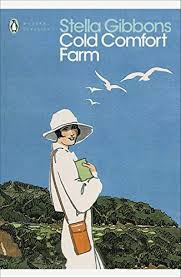
Stella Gibbons, “Cold Comfort Farm” (1932) – It seems like parody should not be able to outlive its reference point in memory, but clearly that’s not the case. Think of all the stuff Looney Tunes lampooned, stuff kids wouldn’t know about. It’s not just that Looney Tunes was funny even if you didn’t know the reference points (though it was)- it’s that you can tell they’re lampooning something, something from the adult world, maybe something you’ve had some intimation exists, like opera or classic movie stars, or maybe not; either way, that sense makes it funnier.

Stella Gibbons wrote a bunch of books in her time but only one that anyone remembers (this irked her throughout her life, apparently): “Cold Comfort Farm,” a parody of a form that on the surface, doesn’t seem to be a thing anymore. These were the “loam and lovechild” novels of the late nineteenth and early twentieth centuries, where sad salt of the earth types suffer in the English countryside. When people cite examples of this subgenre, some big names like Tom Hardy and D.H. Lawrence come up, but they always had other stuff going on in their books- mostly, Gibbons seemed to be aiming at writers, many of them women, who were highly popular at the time but utterly obscure now.

“Cold Comfort Farm” probably has something to do with that obscurity, because it was a huge hit and still a cult favorite, well after the “loam and lovechild” genre has vanished (I assume it has? Let me know if it hasn’t!). The narrator, Flora Poste, is an interesting, and I thought quite contemporary, in a prophetic way, type: the young woman who is over it all but still in the thick of it, too smart for just about anything, including being too smart for stuff. Her parents die — she’s not too bummed, this takes place in some sort of parody future of late imperial Britain, all her parents and lovers are off managing the empire — and she has to go live with relatives. The most palatable of bad options is Cold Comfort Farm, off in Sussex.

It’s grim! Run down, full of almost Dunwich/Innsmouth-style subhumans, a clan of them kept in place by Great Aunt Ada Doom (who saw something nasty in the woodshed as a child). There’s intimations of deep trauma and doom, boundedness to the lousy East Anglian soil, purple speeches (in the style of the novels Gibbons is lampooning) set off by asterisks, a lot of dialect, etc. As a project, Flora decides to straighten things out around there.

Gibbons makes the book funny despite my not knowing the source material. What she doesn’t manage — what I think she couldn’t even try within the bounds of her project — is to make a compelling plot. Flora just does things. She faces little opposition to her polite optimistic pushiness beyond some caviling. She dresses up the wild girl wandering the moors in the latest London fashion and sets her up with the squire’s son, who just needs a little encouragement to do right by her. She gets rid of evangelical Uncle Amos by telling him about the soul-saving potential of taking his hellfire preaching show on the road in a Ford van, thereby letting cousin Rueben take over the farm, the one thing he wants. She foists vain fuckboy Seth on Hollywood, thereby bringing some money to the farm and keeping him from impregnating all the help. Ada Doom wants to stop everyone from leaving but she can’t. The end.

It has to be this way, because the whole thesis of the novel is that the problems of the “loam and lovechild” tragic novels aren’t real problems. They say you have to love a genre to do a good parody of it. I think that’s an American thing. Brits are meaner. Gibbons, I think, didn’t love these books, and she was out for blood, and she got it. If the local yokels could offer opposition — if their problems were even difficult to manage — that would, backhandedly, pay homage to the subgenre Gibbons was determined to skewer. So! It’s a fun novel. The writing is good. It’s funny. It’s a little boring once you get what’s going on. I bet it would have made a good cartoon! ****

Review – Gibbons, “Cold Comfort Farm”

Review – Huysmans, “Là-Bas”

J.K. Huysmans, “Là-Bas” (1891) (translated from the French by Keene Wallace) – Joris-Karl Huysmans served for respectable decades as a civil servant and wrote decadent novels in his spare time, until he converted to Catholicism and wrote sufficiently Catholic novels to generate enough sales to quit his day job. That sums a lot of it up, right there. My understanding is that Huysmans didn’t see himself as a decadent- he lived a simple bachelor lifestyle, and started out his literary career as a Zola-style naturalist. But disdain for his time and place — late nineteenth century France — and a fascination with the wicked led him to decadent literature, first with “A Rebours,” easily the most important literary novel of interior decoration going, and this novel about satanism. Huysmans wasn’t an aesthete dandy, like the main character in “A Rebours,” and like his narrator in “Là-Bas,” he never became a satanist. He liked to watch, especially things that either confirmed his disdain for his times, transcended it, or both.

“Là-Bas” contains elements of what would become the genres of horror and crime fiction, as bored writer Durtal, lackadaisically finishing a book on medieval serial killer Gilles de Rais, decides he needs to find some real devil-worshippers, “for research,” of course. A lot of the novel is Durtal kicking it with his doctor friend Des Hermies (interesting name) who knows a lot about the occult, and a humble church bell-ringer named Carhaix, who represents a (mildly patronizing) picture of the vanishing “good Catholic” of France, someone with a downright medieval level of devotion. They’re joined by their hatred of the (supposed) mediocrity and corruption of their era. The Middle Ages were a better time, they declare, though with much more Gallic irony and acceptance of things like squalor and foolishness — Durtal and Des Hermies disregard much of what the church actually says — than you get with a lot of medieval nostalgists. But how are these three going to find the black mass Durtal wants to see (Des Hermies is too “over it” to bother and Carhaix is too much the good simple Catholic)?

“Cherchez la femme” as a roughly contemporary Francophone literary figure would have it- Durtal starts getting anonymous horny letters. A little detective work reveals they come from Madame Chantelouve, the wife of a literary Catholic friend. In keeping with his then-contemporary neuroticism, Durtal can’t decide whether he wants to go through with an affair or not, but once he finds out that Chantelouve has connections with the biggest contemporary Satanist, a real bad dude. Eventually, she leads him to a black mass- Durtal, naturally, doesn’t participate, just watches. This scene, along with the recitations of Gilles de Rais’s murderous career, are what put “Là-Bas” on the censor’s desk as often it appeared there. The depictions of blasphemous deeds aren’t that much to anyone who’s seen all that shit done on MTV by scrubs like Marilyn Manson, but the speech the satanist priest makes against god and Jesus is pretty impressive, even in translation. After all this, Durtal and his bros eat dinner among the bells again and Durtal thinks, “maybe I’ll be Catholic after all,” maybe a little out of shock from what he’s seen but more in reaction to the way it confirms contemporary banality.

This is a weird, interesting book, less for the peculiarities of the occult scene and more for its form, pacing, and general ethos. French antimodernism is both less “catchy” than the usual Anglophone (or German, or Russian for that matter) variants but also usually a bit smarter, with a sense of actual tragedy. To the extent this is a mystery story, it’s less a whodunit and more what they used to call a “city mystery” – as cities expanded during the industrial revolution, people wrote loosely-plotted novels revealing their seamy undersides; part crime novel, part travelogue, part pornography. What lies at the heart of fin de siecle Paris? A deep rot, naturally, an underground war between good and bad occultists (but even the good ones are sketchy and basically off-camera), the base materialism of the age causing people to seek out older truths, but only when they think no one’s watching, etc. If you want to be an artist, you have to seek out truths that transcend the age, and that’s hard to do- the church might be the path of least resistance, even if it also produces occultists (the big bad satan priest is, naturally, a defrocked Catholic priest).

Again, Huysmans was an actual writer and a smart person and he was writing before whatever threshold in the mid-twentieth century was passed before we had to make all of these thing schematic. “Good” and “evil” barely show up- in fact, the throughline with the Gilles de Rais stuff, the payoff for Durtal narrating his notes, isn’t De Rais’s evil- it’s his redemption. When he got caught, after some brief tergiversation, he confessed and threw himself on the mercy of Mother Church, which he once served alongside Joan of Arc. According to Durtal, the parents of the children who De Rais brutalized and slaughtered all forgave him, prayed for him at his execution site, before they did him in. This, more than anything, is what Durtal/Huysmans sells to us as the greatness of the Middle Ages: not our sense of good and evil, cleansed of modern accretions, but an alien sense — none of it “makes sense” — that allows for an alien greatness. You wouldn’t see that in a contemporary good-evil narrative, I tend to think. The battles between occult forces would be hard to game out in any of the RPG systems I know about. It’s genuinely irrational, and that’s hard to get across, but Huysmans did it, even with his viewpoint characters of drawing room detectives. ****’

Review – Huysmans, “Là-Bas”

Review – Ward, “Sing, Unburied, Sing”

Jesmyn Ward, “Sing, Unburied, Sing” (2017) (read by Kelvin Harrison Jr., Rutina Wesley, and Chris Chalk) – This is a perfectly decent example of contemporary literature! Ward tells the story of a young mixed-race boy named John, his black mother Leonie, and some bad trips, both physical and psychological, that they take. The story is set in more or less contemporary Mississippi. Leonie and Jojo live with Leonie’s elderly parents in a rural part of the Gulf Coast. The two take a trip with Jojo’s toddler sister Kayla and a friend of Leonie’s north to Parchman, the ex-plantation prison where Leonie’s lover and Jojo and Kayla’s white dad, Michael, is being released after serving a stint for drug dealing.

Parchman, Angola, Sugarland… I’m aware that the prisons of the north, your Atticas, Sing-Sings, Norfolks, are no happy valleys, but those old southern plantation-prisons skeeve this New Englander right the fuck out. Ward leans into that haunting feeling. Jojo’s grandfather did time in Parchman and tells the boys stories that never seem to come to a conclusion. On the way up to the prison, the travelers encounter many of the inconveniences that come with life when you’re poor. Car trouble, police trouble, drug trouble, above all puking baby trouble. It is a genuinely uncomfortable ride, in a highly relatable, human way that Ward gets across effortlessly.

Leonie was the most interesting character for me, especially because she is a rare thing in literature: a bad mother, portrayed unsentimentally (the voice actor puts a little “poet voice” in her, all breathy, but it comes to work for the character) but sympathetically. Is there any more agreed-upon villain than the bad mom? Whole theories of crime, of civilizational collapse, have been placed on her head! Murderers can be made cool and relatable, terrorists, thieves, seemingly every crime under the sun, but not a shitty, selfish, indifferent mother (as someone whose mother is none of these things, I relate to why people would be repelled). So Leonie is interesting- she’s those things because she is weak. Aspects of her life that tried to make up for her weakness just mire her further: she genuinely loves Michael, and so has babies with him that she can’t properly care for. Guilt over that makes her mothering worse. Guilt and trauma — her brother was murdered, her lover arrested and imprisoned — drive her to drug abuse, which doesn’t help anything. Some people don’t have what it takes to raise kids. It doesn’t make them evil. They probably shouldn’t then have kids, but people make mistakes. Ward conveys well the weird lassitude of the structurally fucked.

Ward’s humans are humans, and so are her ghosts. The family is immersed in the supernatural traditions of the black people of the Gulf area. Leonie’s mother (dying of cancer- no one has a good life in this book with the possible exception of a crooked white druggie lawyer) practices conjurings and prays to the divine feminine in various forms. Leonie sees her brother’s murdered ghost when she gets high. Jojo has a more impertinent ghost problem- the ghost of a Parchman inmate, who did time with his grandpa, following him home from the jail. Jojo doesn’t want to deal with ghosts, he’s only thirteen and has to take care of a toddler most of the time because of his weak mom and absent dad. He tries to find ways to get rid of him. Terrible revelations from his granddad are what the ghost is after, but he doesn’t go away, and soon enough Jojo is seeing more ghosts, all the black lives ended by violence in that cursed part of the world.

All in all, “Sing, Unburied, Sing” was pretty good. Being me, I preferred the human parts to the ghostly. But the ghosts weren’t too much of an intrusion. Mississippi is probably roughly midway on my list of states to visit — mostly as a fan of blues music, I’d like to see the Delta — but this didn’t exactly light a fire under me to go, more due to its painfully vivid summoning up of inconveniences (you really, really want to get that baby some pepto or dimetap or something) than its horrors. It’s good to see literature carrying on. ****’

Review – Ward, “Sing, Unburied, Sing”

Review – Trollope, “The Prime Minister”

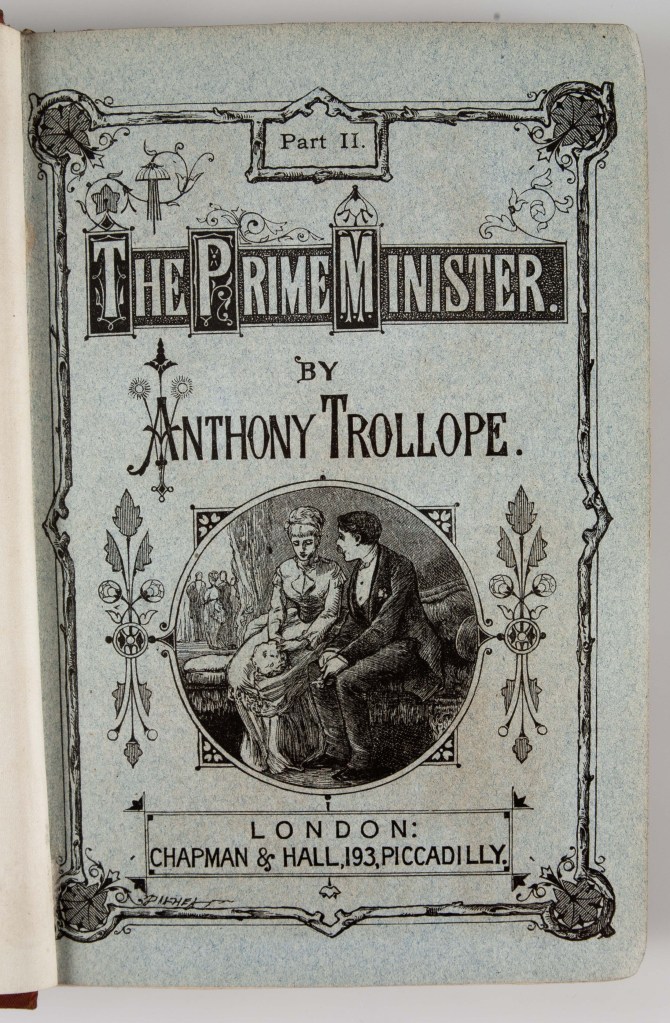
Anthony Trollope, “The Prime Minister” (1876) – I read about one Trollope a year. He’s probably my favorite Victorian novelist. I like the (relative) frankness with which he deals with his society. This is the fifth of six novels in his Palliser series, all having to do with Plantagenet Palliser, fabulously wealthy aristocrat and politician troubled by conscience. There’s always a lot going on in a given Trollope novel, though, at least the big ones (this one is big) – some politics, some marriage biz, a crime or two. “The Prime Minister” is no exception, with two main plots. As the title would lead you to expect, Planty (can’t remember if anyone calls him that in the books, but I do) becomes Prime Minister, in this case, of a coalition government, trying to ride herd on both Liberals and Conservatives. He’s a bit of a drag, possessed by notions of duty and a simple desire to be useful- all of his fabulous wealth and power means nothing to him, you see. It’s up to his wife, the Lady Glencora, to play the social game that could make the whole thing work. She overdoes it; he underdoes it; it doesn’t work well.

Then there’s the plot involving Emily Wharton and who she should and shouldn’t marry. She’s the daughter of a rich solicitor from a respectable family, who’s in love with Ferdinand Lopez, a financier in the City. Her dad doesn’t like it, because Lopez is foreign (Portuguese!), possibly a Jew (not a lot of Portuguese Jews, in Portugal anyway, circa 1876 but ok) (also he converted), and his parents weren’t gentle-folk. Various people prevail on Daddy Wharton to see past his prejudices and so they get married. But it turns out the old man was right! Lopez is a scoundrel. He seems nice enough for the first third of the book. But he reveals himself, once he marries Emily, as something worse than crooked (which he also is): he’s pushy. He talks about money in indelicate ways, even with ladies and Dukes! He gets his, in the end, and Emily marries a nice English gentleman.

Those of you who know me know I don’t apply a political or moral litmus test to what I read. I don’t really think Trollope was a ravening anti-semite: I think he was a Little Englander. To my mind, a Little Englander is someone who prefers English flaws to foreign virtues, on the idea that God or nature or whatever has made England and the English such that they can only really be happy and settled with each other. This doesn’t answer why they then sail around the world bothering other people so much, but no one ever said English bigots were consistent. That said, I think if there’s any type of novel to judge on a moral basis, it’s the Victorian triple-decker, and I do think this one’s a little bullshit. Among other things, the smugness — that the crusty old Englishman’s bigotries always wind up correct, even when (especially when?) he hasn’t got any good reason for them — turns the whole thing into a protracted sadistic morality play, watching Lopez descend further and further into cringeworthy servility and lying, the opposite of Trollope’s bluff, independent, somewhat stupid English gentleman, the height of creation.

Oddly enough, the Irish, or anyway Phineas Finn, hero of previous novels in the series, come out ok, if anyone is keeping score at home. Finn stands up for his buddy Plantagenet even after old Planty gets in trouble because his silly wife trusts Lopez. Finn knew his place, Lopez didn’t. “Knowing your place” does not for great literature make. There’s still enough enjoyment in Trollope’s writing and wide-scope depiction of Victorian Britain to make this not totally terrible, but it’s not one of the better Trollopes in my opinion. ***

Review – Trollope, “The Prime Minister”

Review – Fiedler, “Love and Death in the American Novel”

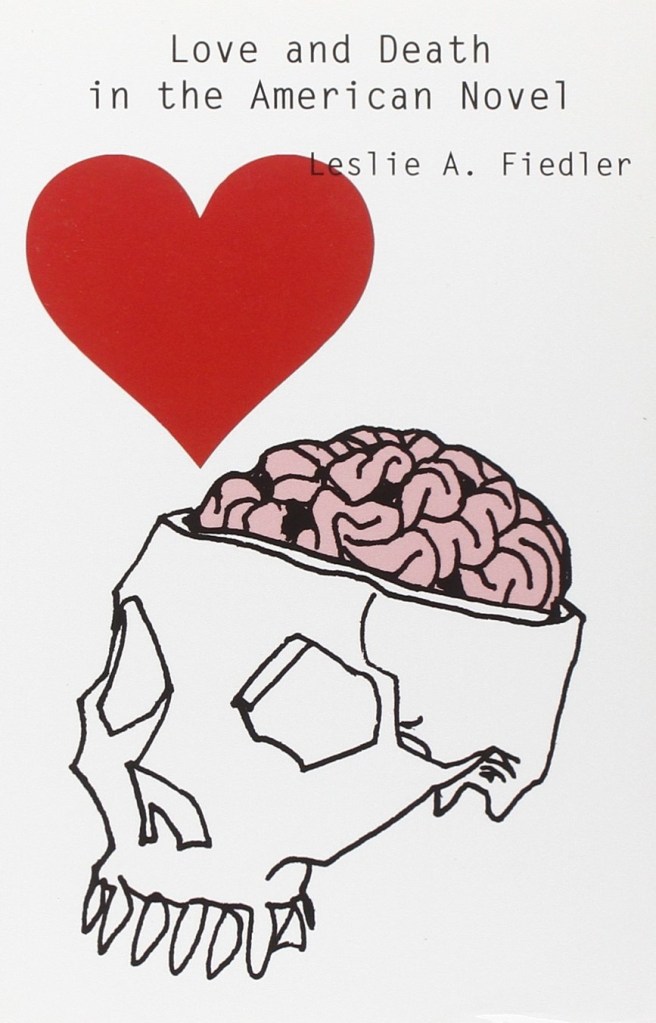
Leslie Fiedler, “Love and Death in the American Novel” (1960) – This book is rich and filling like a big old German cake. I knew a little about what it said — among other things, had seen Meadow Soprano argue about Fiedler’s read of “Billy Budd” with her mother — but had no idea it would be so wide-ranging and ambitious, or that it would toss off huge statements with a devil-may-care bravado you seldom see in the academy these days (and when you do, it’s by hacks who can’t carry it off). In no wise did I agree with all of Fiedler’s points here, or even his main point, to the extent my historian, no-lit-classes-taking ass can have an opinion. But I was along for the ride, all six hundred pages, and exhilarated throughout.

Fiedler stormed out of Montana State University with a capital-T Thesis! American novelists, high and low, display profound discomfort with love (especially sexually active love between a man and a woman) and seem to much prefer death as a consummation than orgasm in the conventional sense. To make this point, Fiedler writes a history of the novel, its history in English (comparing it to French and German contemporaries), and the American novel, all to end with a chapter apiece on “The Scarlet Letter,” “Moby Dick,” and “Huckleberry Finn,” read in the light of the history and theory he spins out.

My understanding from the cheap seats is that the historiography of the novel and of literature more generally has “moved on” some since 1960, but Fiedler’s points are still compelling, if not always entirely convincing. The English language novel as we know it, Fiedler argues, began with sentimental novels of seduction, ala Samuel Richardson, who wrote “Pamela” (seduction rebuffed, yay!) and “Clarissa” (seduction accepted, oh no!) in the eighteenth century to massive readership and acclaim. More than a literary trend, these books instantiated the Sentimental Love Religion, which fused post-Puritan Protestantism to bourgeois habitus to conflate the Pure White Virgin with Christ and marriage with salvation. Among other things, this represented a break with the aristocratic tale of seduction popular in Southern Europe, ala Don Juan, where seduction was what aristocratic men did to prove their virility and their defiance of convention. Later novels in the grand European tradition might kick against “Richardsonism” and flirt with other models of what love and life should look like, but most often take the drama of the bourgeois family — courtship, adultery, etc — as the basis of the novel of psychological depth.

Despite the huge popularity of sentimental novels in America, Fiedler sees our literature — from the eighteenth century to the time of his writing — as incapable of following the European tradition of relationship-based novels of psychological depth. Both our “great tradition” and our popular novels seem to stream around… what, exactly? Here, Fiedler’s Freudianism comes into play. He does that weird thing you see with midcentury left-liberals (many of the better ones, I’d argue) where he is definitely guilty of “normativity” — of seeing a “genitally mature” relationship between one man and one woman as the standard — while also clearly not having an issue with deviance, seeing it as the spice of life in many ways. We don’t really accept that position now- is that a mistake? Especially given the ways our culture has proven capable of “normalizing” and thereby defanging, banalizing, many forms of difference? Who’s to say? In any event, when Fiedler talks about avoiding love, he means love in a Freudian sense. That’s not great, I grant, but I would say, in Fiedler’s defense, that the American writers he cites can’t talk about any other kind of love — directly — the way Flaubert or Lawrence could write about heterosexual love due to societal constrictions. He doesn’t rule out the possibility that you could write a great novel about queer love- it just wouldn’t, and by his time hadn’t, fit into “the tradition.”

Anyway- subliterature, in Fiedler’s take, avoids Big Love because it just repeats cliches, Richardson without the stakes (Fiedler goes to bat for Richardson and his seldom-read-these-days novels — they’re huge, corny, and weirdly indirect — with a touching fervor). But capital-L big time literature seemingly can’t take relationships with women seriously, either. Men wrote the vast majority of the American novels Fiedler discusses as real art (interestingly, he includes Harriet Beecher Stowe’s “Uncle Tom’s Cabin” on that list, which a lot of critics wouldn’t- more on Fiedler and sentimentality anon), the usual suspects more or less: Melville, Hawthorne, Twain, James, Hemingway, Faulkner, Fitzgerald, with visitations from Poe (despite Poe never having finished writing a novel), Dreiser and Howells representing American “realism,” and some then-new writers like Saul Bellow. And none of them — not one — can relate to women (how’s that for a listicle!) or convincingly depict passion between men and women in a convincing, psychologically complex way. Even in stories of adultery (“The Scarlet Letter”) or longing (“The Great Gatsby”) love is never the subject: death, or escape, is.

In many respects, escape is more the subject than death, here, maybe because it’s generally more interesting. The closest thing to an ultimate theme to American literature, Fiedler declares, is escape from domesticity (represented as feminine) into the frontier or, anyway, just generally away. Even when writers clearly thought domesticity was a good thing, their subconscious (there’s that psychoanalysis again!) told on them, none more clearly than James Fenimore Cooper, cozened landowning fuddy-duddy in life and fantasist of western escape in writing. Fielder seems to sympathize- domesticity can, indeed, be a drag, especially if you don’t “swing that way” (as Melville, Whitman, and others assuredly didn’t). But these novels can’t attack domesticity directly (to the extent American literature can, it’s in various “gothic” traditions of horror and pornography). So you get this weird, occluded literature, that almost generates more power by not saying what it means to say than it could by just being like “yo, all these petticoats and all this elaborate furniture kills my vibe, fucking off with my dudes to kill whales, PEACE” directly, than it might otherwise.

You can argue that it both all fell apart, and continued on apace, after Fiedler published this in 1960. Did we ever get that great American bourgeois love novel? It seems guys like Jonathan Franzen and Jeffrey Eugenides have tried. I despise the former and dislike the latter but I probably am looking for other things in literature anyway (more on this below). As for great work coming out of men going their own way… well, the phrase and it’s contemporary connotations says it all, doesn’t it? Do you figure Norman Mailer read Fiedler? Or Bukowski? My understanding is that this book made the rounds outside the academy. Did this inspire every midcentury dude writer to lamp out for the territories, and hate women, in ways much more intentional and affected than Melville and Twain? I don’t know, but I know that shit doesn’t play like it used to.

One question I had was, how much does Fiedler believe that the Freudian version of heterosexual love is THE major topic for “great” novels, and how much was he questioning why a tradition didn’t get translated to the American context? Clearly, he thinks pretty highly of American literature even as he presents it as weird, illuminating little-known corners like the works of George Lippard and Charles Brockden Brown for our weird literary roots. He was also an early “serious” critic to take scifi seriously, though I disagree with some of the points he makes about it here. He’s not a traditionalist. But he does seem to take this Freud stuff seriously enough to think that without Freudian normativity, something is missing. What would his critiques look like if he had the depth of vision and bravado Freudian surety lent him, but without the normative baggage?

This book provoked a lot of thoughts in me. Like I said, Fiedler spun off systems of classification and analyses of complex works like it was nothing. I especially liked his take on Hawthorne and Melville (arguably maybe Twain too) as “Satanic,” “Faustian” writers, not so much rebuking the Sentimental Love Religion in any direct way (you know how those midcentury critics feel about didacticism… or anyway, anyone other than themselves being didactic) but through presenting a world where the characters make the choice to defy salvation and heavenly (whether understood as God’s heaven or that of sentimental domestic writers) order to follow a way and pursue knowledge. Especially given how many shitty edgelords I have to read who fancy themselves “Faustian” (and also somehow “natural,” as though that makes sense), seeing the real deal is inspiring.

There’s also the issue of sentimentality, which I’ve been thinking a lot about lately. Untrained critic that I am, I usually use Oscar Wilde’s definition of sentimentality: the desire to have a feeling without paying for it. Fiedler, and I’m guessing a lot of other critics, use it differently- something like “intentionally provoking and cultivating sentiment, that is, more-or-less officially-approved feeling. So back in the day, a sentimental novel could encourage various feelings like empathy for the heroine, sadness, even anger at the bad guys, but not, say, horniness, or even much in the way of laughter. It could be a useful definition for interrogating what feelings are permissible in polite society and what aren’t. I still think my use (and Wilde’s) is important, but I might rethink some critical projects involving sentimentality that I’ve had in mind.

A somewhat related point: Fiedler kind of leans on the term “gothic” a lot. Gothic is in many ways the opposite of sentimental, in his system. Gothic involved officially-unapproved-of feelings like terror and murderous rage. The sentimental novel traditionally probed the psychology of its characters in an attempt to illuminate (one reason why “subliterary” pre-romance fiction doesn’t count according to Fiedler), whereas Gothic shrouds things in mystery. Fair enough. I think Fiedler stumbles some when he insists that pretty much all American genre fiction, including scifi and crime, is Gothic. Comes from Gothic, in some genealogical sense, I could buy. But I actually think one of the strengths of much of genre fiction is precisely that it runs orthogonal, not (always) directly opposed to the systems of emotional classification (and regulation) that backstops much of literary fiction. It has its own concerns- sometimes concerns as deep and esoteric as any literature “bringing the torch to the back of the cave,” sometimes geeking out over spaceships and guns, sometimes both! I’m curious to read some of Fiedler’s later scifi criticism to see what he says.

Quibbles, even fundamental disagreements, didn’t stop me from loving this book, if anything they added to the experience. I hope to write something like it someday, if I can ever conjure the time and the focus and if they let me. I’m not sure who all among my readership would enjoy this as much as I have, but if you think it might be you, give it a look. *****

Review – Fiedler, “Love and Death in the American Novel”

Review – James, “A Brief History of Seven Killings”

Marlon James, “A Brief History of Seven Killings” (2014) (read by various actors) – Jamaica! What a contrast between the image I was sold of it as a kid — the era of “Cool Runnings,” a movie I saw dozens of times and which held up relatively well when I saw it a few years back — and the complex, often harrowing realities one learns as an adult. I’ve never been and have no plans to go. I just mean that by and by, one learns it’s not paradise, that the people have complex and difficult lives, that one of the things it suffers from is the contrast between white desires/expectations and the universe of black thought and dreams that nation has generated itself… like Haiti, I guess, but there were never any heartwarming movies about a Haitian bobsled team.

Bob Marley plays an outsized role in the country’s tangled image (and image of self) – a transcendental figure in twentieth century music whose music, some of the purest pleasure you can find, both reflected and contrasted the mixture of grimness and beauty of his home, and his life. Did you know someone tried to assassinate him in his Kingston home in 1978? I didn’t, before I read this book! A novel that plays with history and journalism by a Jamaican writer who mixes literary and “genre” (this could be called crime fiction, and his latest is basically a fantasy novel), “A Brief History of Seven Killings” has a lot more than seven murders. Even if Marley avoided that fate (only to be killed not long after by a melanoma on a toe he refused to have amputated), the attempt on his life structures the action of the book.

This is a multiple-narrator novel, and different voice actors play the different narrators. Most of them start out as inhabitants of Kingston in the late seventies. Socialism and black revolution are in the air as the sort-of socialist Michael Manley is in office, but things are still stuff for most Jamaicans. Manley’s People’s National Party and the opposition Jamaica Labor Party (notice how nice and lefty both names sound! Different era) both strive for power by hiring gunmen in the various Kingston ghettos to deliver votes through corruption and violence, with emphasis on the latter. Wear the wrong color (drink the wrong beer! I’m told Heineken was the JLP beer and Red Stripe the PNP one) in the wrong neighborhood and bad things will happen.

Two of our narrator characters, Papa-Lo and Josie Wales, are JLP-aligned gunman chieftains. Papa-Lo, older and more paternalistic, starts sending out peace feelers to the PNP, in large part through Bob Marley, whose star is on the ascendant and who is only referred to as “The Singer” throughout the book. The young and hungry Josie Wales sees a path to power through keeping the violence going. Papa-Lo and the singer want to see Jamaica achieve real independence for its people and the instantiation of something like Rasta values (honestly a mixed bag but probably better than open kleptocracy) in power. Josie Wales aligns himself with outside powers — the Colombian cartels and the CIA — with other plans. He’s involved in the abortive Marley assassination, but survives the fall out by pretending loyalty to Papa-Lo and concentrating on making Jamaica a hub in the cocaine trade.

The coke trade and its consequences — all of them still tied in with Jamaican politics into the nineties — follow characters all the way to New York City. An ex-lover of Marley’s who fled to the city after witnessing the assassination attempt provides viewpoints into both Jamaican women’s labor minding very old and very young New Yorkers, and gets tied up when the crack wars invade her neighborhood. A journalist who started out writing about Marley for Rolling Stone and ends up writing about Jamaican “posses” and their propensity for ultraviolence — learned through ghetto brutalization, honed by CIA training and guns, accelerated by coke, its profits and its chemical effects — for the New Yorker has a harrowing experience with a new breed of gangster- slick, tied in to global capitalism.

All in all this was pretty good. A lot of characters, some sprawl, some visits from the ghost world that were good not great, crime, coke, the CIA, AIDS, sexism and homophobia, lots of interesting stuff. It probably could have been shorter, but hey, it covers a lot of time in the life of some interesting places. It presents something like the complexity of Jamaica and the way the dreams, nightmares, and realities of the place refract off of each other. One of the better contemporary literary reads I’ve read lately. ****

Review – James, “A Brief History of Seven Killings”

Review- Vieux-Chauvet, “Love, Anger, Madness”

Marie Vieux-Chauvet, “Love, Anger, Madness” (1968) (translated from the French by Rose-Myriam Réjouis and Val Vinokur) – This was great! Marie Vieux-Chauvet was already a leading light in Haitian letters when she wrote this triptych of novellas in 1960. Born to an upper-class family, she was one of few women accepted in Haitian literary circles and gained major acclaim in France, where Simone de Beauvoir ushered “Love, Anger, Madness” into print in 1968.

François “Papa Doc” Duvalier, the ghoulish CIA-backed dictator, was in charge of Haiti by then, and you can see his censors wouldn’t like “Love, Anger, Madness.” The latter two novellas deal directly with people — families from the Haitian upper/middle class, and intellectuals — menaced by totalitarian movements led by openly kleptocratic thugs and manned by “armed beggars.” The first takes place in a similar context but has other issues in mind as well. If the translation of the Haitian Creole Wikipedia entry on Vieux-Chauvet is right, the Duvalier regime bought up all the copies of her books in Haiti to keep them from the public, and killed some of her relatives. She fled to New York, where she died in obscurity a few years later.

“Love” is probably my favorite of the three, the story of one Claire, oldest daughter of a locally-prominent family and an old maid (and virgin) at thirty-nine. Told in queasily intimate first person, we are immersed in her jealousies, mainly of her sisters, one married to a white Frenchman and the other wild and promiscuous, in her neurotic rituals, and her fears. The Frenchman flirts and dallies with all three sisters while helping to strip their part of the country dry of resources for his firm back home, and then wonders why no one rebels against the secret police who help him do it. The sounds of torture waft from the police headquarters at night, and the local secret police chief is one of few men to indicate interest in Claire. She devises dramas and tries, with more or less success, to conscript the people around her into them, and in the end, bursts out in violence against the restraints around her. If you’re used to literature about women going mad due to the constraints on rich white Anglo-American women, well, the pressure cooker is even worse in a place like Haiti.

The other two stories are also great. “Anger” is about a family that wakes up one day to find the blackshirted “armed beggars” taking their land. This is no social revolution, there isn’t even a pretense of redistribution beyond the hands of the criminal elite. Like many Haitian households, this one is multigenerational, and all the family members stew and consider their own vengeance. The grandfather and crippled grandchild dream of revolutionary revenge. The mother drinks, the son plays soccer with supporters of the blackshirts and considers how to save his honor. The father equivocates and winds up selling his daughter to the criminals. He double crosses them, but the damage is done. In “Madness,” Haitian poets and intellectuals find out how much their writing and internal debates are worth as they’re besieged in a broken-down old house as the blackshirts take over.

The prose is beautiful, by turns lyrical and epigrammatic and never overly flowery or sentimental- Vieux-Chauvet knew the Caribbean, knew racial lines shifting like sand but hard as steel, knew vodou, knew poverty, knew what sex looked like in this kind of environment where power and despair loomed so large, knew the beauty and the ugliness of the island, respected the power of all of it, and rhapsodized none of it. Her Haiti and her Haitians are mythological — if one people on this earth deserves to be mythologized, it is they — but entirely human. This accomplishment alone would put this work at the top of my list in terms of fiction I’ve read this year, but there’s more to enjoy. I recommend this highly to anyone who likes quality fiction. *****

Review- Vieux-Chauvet, “Love, Anger, Madness”

SPECIAL DOUBLE REVIEW – Oyler, “Fake Accounts” and Tolentino, “Trick Mirror”

SPECIAL DOUBLE AUDIOBOOK REVIEW

Lauren Oyler, “Fake Accounts” (2021) (narrated by Rebecca Lowman)

and

Jia Tolentino, “Trick Mirror: Reflections on Self-Delusion” (2019) (narrated by the author)

Noah Sapperstein: You wanted to save drama, but you have created nothing worth saving.

– Hamlet 2 (2008)

Thinking and writing about the Internet and identity has gotten so tedious that when I found out that Lauren Oyler, whose acclaimed new debut novel “Fake Accounts” I was listening to at work, wrote a “scathing” review of well-known Internet scribe Jia Tolentino’s book of essays, “Trick Mirror,” I fantasized that maybe they could get into a rivalry, like Nas and Jay-Z or at least Gore Vidal and Norman Mailer, to lend some interest to a contemporary literary scene that sorely needs it. It doesn’t really look that likely to materialize. Tolentino tweeted something implying the strange intimacy of being read with such thoroughgoing disgust as Oyler displayed towards her (and also turned on Kristen Roupenian, author of viral hit short story “Cat People”) was somewhat enjoyable, and to the best of my knowledge that was that. I’m not on Twitter so I learn about these things via looking stuff up on Wikipedia and the like.

If there’s one thing Oyler is capable of in the literary sphere (beyond conveying a vague impression that she’s heir to Susan Sontag and/or Joan Didion), it is conveying disgust. “Fake Accounts” drips with disgust: for New York and Berlin, the cities in which it takes place; for every character within it; for the Internet, which is marketed as the novel’s subject; for most forms of human expression; and for the novel’s first-person narrator. This disgust expresses itself mostly through treating its objects as obvious subjects for disdain and expecting the reader to go with. This isn’t too difficult, given that the subjects are generally things like guided Berlin pub crawls, white middle-class liberalism circa 2017, online dating, and so on. As I tired of this book, I could “go with” the disgust mainly in the direction of the narrator, though I noticed a certain disgust differential in the narrator’s favor with which I could not agree.

We’re in the usual shell-game here, “is the narrator (nameless, natch) the writer???” The answer to shell games is to not play, or flip the table over and take the scammer’s money. So at this point I pretty much assume these first-person narrators are author-substitutes (and generally, implicitly, audience-substitutes too). Like Oyler, the narrator is a younger-millennial writer from a lower-middle-class background who went to an elite college and wrote for a kind of bullshit Internet publication (Oyler was a Broadly writer). I considered that maybe Oyler was basing her narrator on the writers she works amongst and despises, like Tolentino or Roupenian. But this is a woman who is fine using the word “hysterical” — rather throws it down like a gauntlet — to describe the writers she and her narrator hates, and the narrator does not come off that way. What clinched it for me was when the narrator declared she didn’t like any music except for jazz or classical. No way would anyone looking to make fun of most millennial scribblers give their target that character trait, but it fits right in with the critical brand Oyler has been building, modernism’s revenge (but still willing to talk celebrities). The narrator is the author, or anyway, close enough.

The story, presumably, is the made-up part, though it’s really more outline than plot. In early 2017, the narrator finds out that her sort-of-boyfriend, Felix, runs a popular right-wing conspiracy theory Instagram account, and has kept it entirely secret from everybody. This is where my complicity, the complicity most marks have with the people who con them, comes in. This plot gambit is the major selling point of the book in the copy about it. I allowed the copy to convince me that the novel would explore identity in the Internet age, and what I (thought I) knew about Oyler from other reading and what I saw of her public performance of self — a prickly intellectual, young but self-assured, highly critical of the poor state of contemporary letters, a Baffler contributor — convinced me it would be smarter than most such explorations. That’s on me, I guess- failure to be sufficiently critical, though this book has made a big enough splash it might have been inevitable that I’d read it at some point even if I thought it was going to be bad.

And it was pretty bad. It wasn’t about identity or the Internet or any of that. It’s about what most contemporary literary fiction is about- romantic relationships, and the (supposed) impossibility of connection we all (supposedly) experience. Neither of these are bad topics for fiction in and of themselves, though both are overdone and the latter takes a lot for granted. But Oyler has nothing interesting or original to say about them. Her narrator, after discovering Felix’s secret Instagram, goes to the 2017 Women’s March in DC for the weekend and decides to break up with him when she gets back. She has an ambivalent time among the pussy hats and on her way back gets a phone call informing her Felix has died. Thrown (despite the fact they didn’t seem to like each other that much or have been together that long), she flees to Berlin, the city where she and Felix met. She does some light online-identity-play herself as she compulsively goes on online dates and feels self-conscious about participating in the anglophone gentrification of the German capital. She finds out one last terrible truth about Felix, and that’s all she wrote.

The plot is dull, but really, what drove me over the edge into despising this novel was, I guess, what can be called the ethos of the narrator/author. In some books, and again we can harken back to Oyler’s career as a critic, where she implies that good literature is difficult modernist literature (not that she does anything as straightforward as lay her own cards on the table), that makes me a bad reader. The author is dead, yadda yadda. Well, fuck that, I’ve got google, and moreover, the narrator lives, and I’m about ready to call it a rule- unless you can prove otherwise, first-person narrators are authors, in a mirror with a certain degree of distortion. What we’re supposed to buy from the author/narrator in “Fake Accounts” is that she is a smart person and that her disgust for the world around her is motivated by her intelligence and sensitivity. She’s aware it’s unhelpful much of the time but we’re supposed to buy that as part of the package, self-awareness being an important part of being smart and/or good in contemporary English lit-fic-adjacent circles.

But Oyler does not sell it- she doesn’t sell it for the narrator who might or might not be her, and she doesn’t sell it about herself in her criticism. In fact, I need to reach into the altogether happier world of genre fiction to find a comparison- that moment when writers who are distinctly non-geniuses try to write their way into the heads of the geniuses they make up: Orson Scott Card with the genius kids in “Ender’s Game,” Thomas Harris with Hannibal Lecter (and to a lesser extent some of Lecter’s opposite numbers), Robert Anton Wilson with assorted guru figures in “Illuminatus!”, examples could be added. But at least those characters are vehicles for interesting shit happening. Both the unnamed character, and the persona of Lauren Oyler, critical crusader for literary standards, at best would be a vehicle for criticism of low points in our culture. And they can’t even land that!

In her criticism, Oyler dings fellow (overeducated millennial woman) writers Jia Tolentino and Kristen Roupenian for lack of precision in language- that’s where the “hysterical” crack directed at Tolentino comes in. Tolentino sees how the structures of online content creation and consumption demand performances of emotionality (especially from women), she criticizes it, and yet, she still writes about how she “was driven insane” by various things that, clearly, left herself sane enough to become a successful writer and marketer-of-self, Oyler points out (with the smug self-assurance of someone pointing out you criticized capitalism from a smartphone which you presumably bought on the market). She also points to the ways in which contemporary writers (and here Roupenian gets more of the criticism) exploit tragedy porn and treat acceptable targets of scorn — like creepy, or even just normal and somewhat horny, men — as less than human. More than anything, she hammers home the point that contemporary culture is cheap and sloppy, which is fair enough (though again, she says nothing unique or compelling in the process- to quote a modernist of the sort she gives her rare nod of approval toward, “there’s no there there”) all things considered.

So having said all that, presumably, Oyler can blow our asses away by getting at what things are really like, right? Unmotivated as she is by market logic (she calls herself a socialist at various points and has written for the Baffler but shows nothing but contempt for virtually any opinion she writes about, especially any form of protest or direct action against Trump)? Ivy League schooled but keeping it real with West Virginia roots? Wrong again! For all that it’s dull, the story is also unrealistic. Despite her novel being temporally framed by politics, Oyler avoids saying anything about it other than to broadly imply it makes people stupid (Felix, for instance, we are carefully told, was right-wing on his Instagram but not openly racist or antisemitic, thereby absolving narrator/author of any responsibility to out him). There’s nothing interesting in the writing. It sounds like a flatter version of the sort of testimonials — “it happened to me!” — that used to be a big thing on the Internet. Disgust can be a powerful motivator for interesting, passionate language, from Juvenal’s time to Joan Didion’s. But it doesn’t help here, presumably because making writing actually interesting would be participating in the game of communicating with other people, which in turn would spoil the illusion of aloof superiority which is Oyler’s real ethos and her narrator’s, too.

Oyler titles one chapter “Maybe If I Wrote Like This I Would Understand Them.” “Like this” is writing accounts of her dates in Berlin, where she does some light lying (really, any millennial who grew up with the Internet and any creativity has lied more and better than the narrator, or Felix the arch-liar for that matter), not in chronological order but theming dates according to the signs of the zodiac. The “them” in the title is, basically, women. It’s hard to escape the conclusion that the main thing giving emotional backstop to Oyler’s performance of intellectuality and literary potential is that she is, as the cliche used to go, “not like the other girls.” She doesn’t wear her ever-so-mediated feelings on her sleeves and she won’t bore you about Beyoncé. She’s just barely clever enough to avoid trying to be “one of the boys,” but especially given that “the boys” (understood as youngish white or white-adjacent literary fiction types) basically don’t meaningfully contribute to English language letters these days, it wouldn’t help her if she tried, not with the market she’s trying to get over. Again, think Sontag or Didion- the woman above it all. That’s basically what’s going on here. I thought the zodiac-themed chapter was the best chapter in the book, in no small part because by going on a bunch of dates we met a bunch of characters. They weren’t good characters, the strangling solipsism of this book prevents that, but at least they weren’t the narrator or Felix. *’

Dana: We’ll all remember this moment for the rest of our lives! It was dramatic, it was visual…
Octavio: It was stupid.
Dana: It WAS stupid! But it was also THEATER!

-Hamlet 2 (2008)

This is the second of three nonfiction “beach reads” I decided to listen to this summer, in what now seems like an ill-conceived attempt to, I don’t know, juice interest in even my tiny review audience. It was based on a jibe from an old friend of mine about how I read too much advanced stuff. Probably not a ton of people read this on the beach. But it wouldn’t surprise me if a few do! Jia Tolentino is a popular writer on the Internet. I didn’t know she was a target for Lauren Oyler’s critical scorn when I set up a pattern that would have me listen to first “Fake Accounts” and then “Trick Mirror.” Just one of those “happy little accidents” I guess.

Tolentino and Oyler have a fair amount in common. They’re both younger millennial women who both once wrote for now-defunct women-oriented online publications (Jezebel and Broadly, respectively) and who went to elite colleges (UVA and Yale, respectively- in her review of this book, Oyler sneers that Tolentino made sure we knew she got into Yale… and a quick googling reveals that Oyler actually did go to Yale… google really wracks hell on certain snobbery patterns and you’d think “digital natives” who write for a living would grasp that, and yet, and yet, and yet!). They are both now reasonably major writers in their own respective rights. Both cover what could be called the “American awful” beat (“Fake Accounts” dwells on Berlin but has next to nothing to say about Germans), which has swallowed up so much of contemporary literary writing, both fiction and non-. It’s worth noting both are conventionally attractive women (another thing Oyler sneers at Tolentino for noticing about herself, not like Oyler doesn’t pose for the camera too)- it seems like a trend, millennial literary fiction writers having it going on in the looks department.

“Trick Mirror” is not a novel but a set of essays. Had some of them been online before? Probably? They all interweave first person narrative with exposition and analysis based on reporting or research. Like the subtitle suggest, they all discuss self-delusion. There’s the delusion that the Internet or self-improvement can make us happy, the (good?) delusion that MDMA can connect you with others and/or the godhead, the delusion that Tolentino’s alma mater, the University of Virginia, is a place dedicated to learning and gentility when really women get raped all the time (and one woman deluded herself into thinking she had been raped, sold the story to Rolling Stone, and helped perpetuate a delusion that campus rape is all lies and hype), etc etc.

The essays are pretty good. Oyler’s not wrong that Tolentino isn’t always particularly precise in her use of language and often brings things back around to herself. Well… she seems to be an interesting person! Daughter of Filipino immigrants, raised in Houston, religious school, brief stint on reality tv, successful writer, she either is interesting or is capable of making her experiences interesting. She interweaves a lot of material into her essays, like when she discusses Houston’s religiosity, its history of drug-fueled “chopped and screwed” rap, and her own experience with MDMA in one essay.

I remember my dad coming to a Thomas Frank talk with me, maybe ten years ago or more. Dear old earnest baby boomer Dad walks up to Frank at the end of the talk, big smile on his face, thrusts his hand out to the author, and says “ok- what do we do about it?” in reference to whatever DC Gomorrah situation Frank had laid out. Frank laughed. He didn’t know. Not his business! He’s a critic. Especially now, alienated by the excesses of the “woke capital”/Russiagate/internet-liberal crowd like so many lefty scribblers have been, he’s less interested in solutions than ever before. At the time, I was lightly embarrassed. Now I’m a little more in my dad’s camp, especially as I’ve seen some of the lefty heroes of that time, including Frank, descend towards (or all the way into) a crankdom fueled by premature hopelessness.

Split the difference- I don’t expect a critic to append proposed legislation to their essays (you’ll notice I don’t). I would say it would make sense for a critic — especially one who calls themselves a socialist and/or anticapitalist, as Tolentino does a few times in this book — to at least gesture in the direction of how to fight. All too often, Tolentino throws up her hands, accedes her own complicity in eating Sweetgreen’s antihumanist salads or enjoying weddings, and collapses into miserabilism- we’re stuck with the system because the system is us. Don’t do it, Jia! You’ve got more power than you know! It’s not as though the early Christians didn’t obey Roman law most of the time, or the Russians who stormed the Winter Palace didn’t buy stuff… you can snarf your Sweetgreen and get to work pointing us where to take our pitchforks! Her work on “Free Britney” isn’t a bad start, and her chapter on “difficult women” — both a genuine feminist veneration object and one extremely easy to capture to the orbit of the sort of power that crushes the lives of everyday women — is a good one.

I do wonder, though… how much can one be part of “the zeitgeist” and still recognize within oneself the power, as part of a collective, to change it? Especially this zeitgeist, which seems to fetishize overawe in the face of complexity and of the power of the elite? I draw inspiration from the many “extremely online” people I know who joke about the brain rot it imposes but still do the work, organizing, agitating, fighting. I guess it’s more of a “me” problem. Probably I’m just enough of a little boy, playing soldiers on my atlas while my sisters watch 90210 (note- I watched too, I still remember most of the cast members, not trying to snob my dear sisters), dreaming of better (and bloodier) drama than beautiful people hurting each other’s feelings, that certain aspects of the zeitgeist will always elude me… ah well.

Like I said, I like this book, but chain listening to this book and Oyler’s before it, and reading Oyler’s criticism, brought up an unpleasant vista in my mind. The relationship between the two in the sphere of literature reminded me of nothing so much as two of the common types you see at millennial house parties. Tolentino would be the person who shows up midway through, possibly already drunk and/or high, and grabs all the attention by talking a mile a minute, name-dropping, and apologizing for talking about themselves so much whilst keeping on doing so. Oyler is the person in the corner snickering about what a dumbass everyone at this lame party is. You can go over and snicker with them, but you know they think you’re just as much of an idiot, if not more, and you know if they threw a party it’d be at least as bad. And you know if you throw your own, better party, which one you’d rather invite- anyway, I do. ****

SPECIAL DOUBLE REVIEW – Oyler, “Fake Accounts” and Tolentino, “Trick Mirror”