Review- Ghosh, “The Glass Palace”

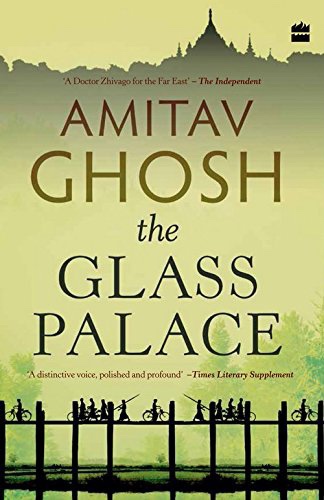
Amitav Ghosh, “The Glass Palace” (2000) – I haven’t looked far enough to say anything too definitive about it, but from where I sit, Indian writer Amitav Ghosh runs somewhere near the lead of the pack of contemporary literary writers in terms of talent and relevance. I’ve only read his historical fiction, but my understanding is he has also written nonfiction about climate change, which could be interesting and would certainly be a credit to his relevance, given how lackadaisical the literary response to climate change has been thus far. His historical fiction is quite good. The Ibex Trilogy, dealing with the period surrounding the Opium Wars, topped my best-of-fiction-reading list a few years ago. A lot of writers (well, a lot of publishers on behalf of a lot of writers) claim to tackle the interconnectedness that goes under the name “globalization,” but Ghosh actually does it, with verve, historical understanding, and a lack of pretense.

Among other things, Ghosh’s historical vision helps show us a basic fact about “globalization” that it seems younger people grasp more intuitively than those of us who remember the nineteen-nineties: that there’s nothing all that new about it. Global patterns of trade, migration, war, imperialism, communication, etc. have been critical to how life is lived at the very least since the circumnavigation of the globe five centuries ago, if not well before, depending on your definition of “global.” So, in the Ibex trilogy, we see globalization, nineteenth-century style, at the hands of capitalists and the British Empire destroying whole populations to make money off the opium trade. In “The Glass Palace,” we get a broader sweep of South Asian history, from the British invasion of Burma in the 1880s to World War II to a coda near the time Ghosh was writing.

That broad sweep means you don’t get the sort of finely-grained character work that characterizes much of literary fiction, but Ghosh gets his points across about most of his characters. We begin with Rajkumar, a Bengali boy who flees plague and washes up in Burma. He works and builds a fortune in the teak wood trade, a tough business involving elephants and transporting two-ton logs down rapid jungle rivers. He’s fixated on Dolly, a servant to the Burmese royal family, which was deposed when the British decided they wanted that teak trade all for themselves and added Burma to the empire. The British exile the royal family to a small town in India, but after Raj makes his fortune, he dresses up all nice, heads to India, and courts Dolly. At first she’s like “this is weird” but various characters interfere and she winds up returning to Burma with him, just as Raj expands into the rubber business, where there’s some real damn money.

Reviewers focus a lot on the Raj-Dolly relationship, and I think that’s because we get to know them before the deluge of other characters come in. Various relatives and children marry people and while most of them “make sense” there’s still a lot to keep track of as they make their way through Asia’s late nineteenth/early twentieth century. Raj makes a shit ton of money in rubber and establishes sons and in-laws in plantations in Malaya. Burma and Malaya both had an odd ethnicized division of labor, encouraged by the British playing their usual divide-and-conquer games. Indians, like most of the characters in the book, do most of the interfacing with imperial-backed capitalism. This means both that a few Indians like Raj make a lot of money, and many Indians toil in the plantations. “Natives” — Burmans, Malays, the assorted smaller ethnic groups those two used to lord it over before the a British came along — basically sit on the sidelines of capitalism. I get the impression this is because the British liked them doing their “traditional” thing and thought they were ill-suited for industrial labor (and plantations might be outdoors, but they involve producing commodities on industrial scale, with industrial labor discipline).

This inevitably leads the characters into the politics of the era in Asia. In typical depressing human fashion, the Burmans blame their downfall not on the British, who orchestrated it, but on the Indians, who the British employed as instruments in it. Meanwhile, more and more Indians are wondering why they play the roles the British scripted for them, and what an independent future might look like. These questions cause tensions and blow-ups in the extended clan. Raj just wants to make money, chill with Dolly, and secure his sons in business, and doesn’t take kindly when Dolly’s friend Uma starts asking tough questions about imperialism (and Raj’s questionable lord-of-the-manor pleasures). Uma charts a path across the Indian independence movement, from the militant (indeed, soldier-based, on the idea that they needed to convert the British-controlled Indian Army to make progress) Ghadar to the nonviolent Congress. Raj’s… nephew? I think? Arjun, meanwhile, joins that Indian Army in the thirties, as part of the first set of Indian commissioned officers. He’s proud at first, and takes well to British-style regimental life (bacon, beef, and all!).

But one cool thing about Ghosh- he doesn’t stint from portraying the ways things completely outside of anyone’s control direct people’s lives. Sometimes that uncontrollable love or whatever, so far, so literary, but more often, it’s economic and political forces. Two things spell doom for this rich clan’s various arrangements: the price of rubber, and Japanese imperialism. They’re almost entirely off-scene, but their power directs the action of the second half of the book. When rubber prices collapse during the Depression, the family’s fortunes tumble with them, and all those lovingly-described classic cars with maker names I never heard of seem like white elephants, even as they roll along on plantation rubber. Meanwhile, the Japanese smash the pretenses of British rule in Asia, seizing “impregnable” Singapore et al. Ghosh, and most of his characters, are under no illusions about the nature of Japanese conquest — one character shoots herself rather than be taken alive, and the Indians who abandon the British army for militancy become rapidly alienated with their Japanese patrons — but I couldn’t help but enjoy the British get theirs. Of course, again, it’s mostly Indians who suffer- even bluff Arjun has to think about what an Indian nation without an outside overlord might look like. He doesn’t know. Do any of us?

This is a pretty great book. That’s not to say it’s flawless. One flaw is personal for me- stories of “I was in love since childhood and made that love mine” weird me right the fuck out. I’m not talking high school sweethearts getting married, I’m talking like “we were destined to be together since pre-pubescence.” Admittedly, Raj and Dolly are roughly the same age, and Raj doesn’t consummate the relationship until they’re in their twenties, but still. Like I said, the characters sometimes get hard to keep track of, and I think it would’ve been better if Ghosh had ended the story with WWII, and not had a coda that hailed Aung San Suu Kyi as savior of Burma. Admittedly, it was 2000, and old Aung looked a lot better then, before she got into office and showed her clay feet, in the Rohingya crisis and elsewhere (not that I support the generals locking her up again). A work doesn’t need to be flawless to be great though, or worth reading for anyone interested in what literature can look like right now. ****’

Review- Ghosh, “The Glass Palace”

Review- McBride, “The Good Lord Bird”

James McBride, “The Good Lord Bird” (2013) (narrated by Michael Boatman) – People don’t really know what to make of John Brown. I can’t claim to be a John Brown scholar but I have read a fair amount about him and people really don’t know how to paint a full, communicable picture, and sometimes it seems that the closer a given writer gets, the more the real man and his real story eludes them. It also sometimes seems that writers contemporary with Brown, both enemies and friends, maybe get somewhat closer. That’s not linear- writers in the late nineteenth century seem just as lost as writers in the late twentieth. It seems to me that whatever sets of filters come down to make Brown opaque came down not that long after his death, and stayed there (or got thicker). I’m tempted to place the date at 1877, the year the US abandoned Reconstruction and well into the decades-long global freakout about revolution that came about as a result of the Paris Commune, but that’s not really something I can prove at present.

In any event, the combination of factors that go into John Brown’s story — race, slavery, militancy, strategy, psychology, religion, to say nothing of the chasm of the years and the many succeeding historiographical paradigms between now and 1859 — make it hard, really hard, to tell his story in a way that feels adequate. And each angle of his story, every aspect that makes it relevant today, also provides opportunities for people, honestly or not, to drive the story into one or another pitfall, slot it nearly somewhere it doesn’t belong but which pleases the teller. The guy who first got me into John Brown in a serious way is a crank, an anti-masker libertarian (opinion varies on the question of whether he was always that absurd or if he got worse over the years). He’s a somewhat more needlessly ideologically elaborate version of the Republicans who try to claim Brown as theirs. That’s a straightforward misprision- they only get weirder and more tedious from there.

I don’t say this often, but arguably, the contemporary American leftist attitude towards John Brown — admiration, of a type rarely extended to white men of his time, and not looking at him too hard — might actually be a decent default setting for contemporary people with things to do. Especially because this lack of digging usually means that said leftists won’t slavishly follow Brown’s failures; he’s a symbol, not the man with the plan ala Marx, Lenin, Trotsky, etc. The reasonings behind the attitude of the contemporary left towards John Brown might range from the respectable (they admire Brown’s courage) to the eye-roll worthy (he’s someone a variety of black figures, including Malcolm X, have given white people “permission” to admire- he has yet to be “canceled” in any meaningful sense), but there it is.

Still and all- people will look closer, and I’d say it’s a good thing to do so. This review is part of that. And novelists have taken a crack at it, too, not just historians. I tried reading Russell Banks’s “Cloudsplitter” and didn’t like it. Too much modern psychologizing, too slow. Even then, near the beginning of my historical education, I could see there was something just “off” about trying to wedge John Brown into contemporary standards. I don’t think we should abandon our standards while looking into the past, excuse slavers and tyrants and fuck-ups with “well, they were men of their times.” But the opposite doesn’t work either. As per usual, we are forced to think more, think better (or, you know, find another hobby).

“The Good Lord Bird,” by novelist and memoirist James McBride, takes a novel approach to John Brown, at least novel as far as I know in “serious letters”: violent slapstick comedy. This is the story of a boy known variously as Henry, Henrietta, and perhaps most often in the story, Onion. Enslaved in Kansas Territory and working in a tavern with his drunken slave father (his mother isn’t in the picture, and it’s implied that she’s white- McBride first came on the literary scene writing about his own mixed background, son of a black father and a white Jewish mother), Onion gets swept up in the fighting in “Bleeding Kansas” and freed/kidnapped by none other than John Brown. Somehow, Brown gets the impression that Onion is a girl, and for a variety of silly reasons, Onion keeps up the charade for most of the book.

The story is narrated by Onion many decades after John Brown’s death, with a “found footage” backstory to the manuscript I rather like. You’re never sure how truthful he is, and I’m uncertain whether McBride has everyone — Onion, Brown, Brown’s men, Frederick Douglass, JEB Stuart — speak in the same informal English because that’s how Onion would have recounted it, or under the idea everyone would have spoken like that (maybe they would have- I don’t know nineteenth century speech patterns).

In any event, Onion gets brought into John Brown’s band of antislavery militants and has to survive the maelstrom of Bleeding Kansas. Bleeding Kansas compounds our John Brown confusions, because Americans, historically, haven’t been great at looking at the realities of “unconventional”/“informal”/“irregular”/guerrilla/insurgency (the profusion of terms isn’t a good sign for clarity) war in the face. Bleeding Kansas looked more like Syria during its civil war than what we think of when we think of the American Civil War, with its uniformed armies fighting each other in open battle. Bleeding Kansas was ambush, massacre, pillaging, avoiding battle and striking at enemy civilians. It’s one possibility of what the whole north-south border could have looked like if the South had come closer to winning the Civil War… McBride’s tone, both comic and horrified, actually works pretty well for the situation. Onion keeps trying to get back (what he has to get back to — he was enslaved, and his father died in the raid that freed him — is questionable, but he’s twelve and far from home) and keeps getting into situations with angry, armed, often drunk (except John Brown- no booze for him) white people, scared and confused and trigger happy.

The relationship between Onion and John Brown makes up the emotional core of the book, and was the thing that gave me the most ups and downs in terms of what I thought of the whole project as I read it. There’s a section where Onion is separated from Brown and his band, lives as a slave for a hotelier, witnesses an abortive slave rising, etc., but that part felt almost wedged in to make the timeline work- it was the time between the Pottawatomie massacre and Brown’s decision to make his final raid. Onion’s time with Brown both gives him the chance to be eyewitness to history and to develop the relationship. As you can imagine, writing the relationship between a white historical figure and a young black boy (dressing up as a girl), set in the mid-nineteenth century, in the second decade of the twenty-first with all the weirdness about representation and literal-mindedness in literature that time entails, makes this a charged endeavor.

This is my own peculiar perspective, but as I came to listen to the book, I came to see Onion as, essentially, a contemporary subject, looking at and trying to grasp a profoundly non-contemporary subject, John Brown. That is to say, Onion is a lot like us, and like McBride, in terms of where we stand next to the figure of Brown. Onion is interested in the sort of things that we today often assume most people are interested in, as a baseline that people might somewhat deviate from but usually not abandon entirely: Onion wants fun, generally understood as relaxed and luxurious living with plenty of booze, he wants sex and love (confused, as it often is, especially in the minds of adolescents), he wants freedom for himself, and, relevant but generally less important than the other things, he wants to belong. That last does the most to propel him into action and keeps him around Brown, but his fecklessness and cowardice continually screw the pooch (and arguably alter history). The narrator is quite open about his fecklessness with the advantage of years, and Onion is only somewhat less open about it on the ground.

I’ll go out on a limb: this is the contemporary subject, as understood as the reader of contemporary literary novels. Feckless, cowardly, self-aware, looking for something bigger and better but unsure where to find it and skeptical of all comers. John Brown… is not. He was none of those things and is not the contemporary subject. In many ways, the admiration the left has for him is admiration for the qualities that render him alien, that, when we look a little deeper than “a white guy who actually meant it” — and he did, far more than Lincoln or Grant or any of the others — cause us to reach for terms like “religious fanatic” or “clinically insane.” And McBride dwells on both- John Brown’s praying spells, his evidently being off his rocker in numerous ways. Onion sees “the old man” as crazy and often wants to get away from him. He doesn’t, but often wants to. I would further put it to the reader that our construction of the “human” and the “normal” are as restrictive, if not more so, than many previous regimes, and surely more opaque, this despite the inclusiveness we all pat ourselves on the back for.

The worst moments of the book, for me, are the moments when I think McBride will take an easy way out. I’m actually continually surprised that John Brown hasn’t been “cancelled” as a “white savior.” It really wouldn’t fit — among other things, unlike Lincoln, Brown really did believe in social equality, lived with black people, gave them real positions of authority in his militia based on merit — but when has that ever stopped anyone? McBride, or anyway his narrator, depicts Brown, for much of the book, as blind- blind to Onion’s real identity as a boy, blind to the problems with his plan, blind to the realities of race. That’s in keeping with the slapstick/satire thing McBride is doing. I came to think, at certain points in the book, that maybe he wasn’t trying to “cancel” Brown — Onion never once doubts Brown’s sincerity — but that he was trying to deflate Brown. Just another guy with ideas, the classic foil of the feckless individual subject. Among other things, McBride does seem bound and determined to deflate Frederick Douglass, who he depicts as a lech and a hypocrite. My understanding is that Douglass didn’t actually treat women that well. But it seemed a bit much, and worse, a signal of intent towards Brown. “Weren’t those people in the past stupid? Isn’t greatness a joke?”

But it wasn’t that way, and I’m glad I stuck with “The Good Lord Bird” until the end, with its depiction of the Harper’s Ferry raid. It doesn’t get sloppy or sentimental. John Brown doesn’t suddenly become what a contemporary subject could see as a hero- flawless, a deus ex machina. In a lot of ways, that would have been worse than just deflating him. I am uninterested in uncomplicated, unearned heroism. Let’s put it this way- both Brown and Onion become tragic in intertwined ways, and in Brown’s case, it leads to something like apotheosis. Maybe Brown didn’t want to die, maybe he thought his plan could work (McBride presents it as obviously foolish- I’m not sure it was, but it’s also worth noting that calculuses of success and failure, and the tools used to pursue them, were radically different at the time). But he accepts his death- interestingly, accepts it at the moment when Douglass backs out of the plan. When he does, the truth — including the truth that Brown isn’t blind, that he sees a lot more than young Onion gave him credit for — emerges. Brown and his men are there to die and by dying, kill slavery, not all at once, but to set the events in motion. Even Onion’s failures — and one of the reasons Brown fails and dies, in this telling, is Onion’s fecklessness — ultimately contribute to this apotheosis.

Death is unavoidable, and the use of death as a solvent for truth is a deep and old enough trope that it finds its way even into our trite pop culture. In some ways, the idea that Brown died for what he believed in is what unites him with the contemporary subject- the latter can still admire the former, even if he can’t follow (Onion, after all, lives to tell the tale as an old man). Arguably, McBride didn’t understand Brown better than anyone else for most of the book. Among other things, comedy is a great excuse-maker- “I’m just trying to be funny, not trying to interrogate the way our present construction of sanity and, indeed, the human subject itself, impedes our understanding of John Brown and of the nineteenth century more generally!” And it is funny, and in the end, McBride does touch something outside of the cyclical self with with we all appear stuck. That’s something. ****’

Review- McBride, “The Good Lord Bird”

Review- Achebe, “Arrow of God”

Chinua Achebe, “Arrow of God” (1964) – This is the end of what they used to call Chinua Achebe’s “African Trilogy.” This isn’t really an adequate descriptor of the three books (“Things Fall Apart,” “No Longer At Ease,” and “Arrow of God”); they take place in a specific part of Africa (Nigeria, and mostly the Igbo parts in the southeast), Achebe wrote more books set in Africa, it’s not like there aren’t other African trilogies, etc. What “The African Trilogy” stands as an adequate descriptor for is the way in which Achebe, and his first three novels in particular, broke through to white readers in a way that African literature never had before the early nineteen-sixties.

It also helps that Achebe had real talent. He’s equally at home in describing Igbo village life, British colonial administration, and the people whose lives occurred uncomfortably between the two. “Arrow of God” might be my favorite of the trilogy. Here he tells the story of Ezeulu, high priest of the main god of an Igbo village during the period between the world wars. Ezeulu is in the familiar “African Trilogy” position, trapped between village life and “modernity” as represented by the British. But Achebe also resists facile dichotomies. Like any great tragedy, Ezeulu also makes his own bed with his pride and conviction that he can control events.

Being my kind of nerd, I really love Achebe’s depictions of Igbo society. Never didactic, he throws you into the deep end of Igbo complexities. The British never liked the Igbo (save for some missionaries who liked their relative openness to Christianity) in no small part because Igbo culture resisted the sort of informational/governmental grid any colonizer needs to throw over the people it oppresses. The British felt (rightly or wrongly) they “had a handle” on the Muslim societies in the north of Nigeria, or for that matter, the Zulus or the Afrikaaners they fought in South Africa. They might fight, but the British understood fighting. They really couldn’t wrap their minds around the way Igbo did hierarchy. It’s not to say they didn’t have hierarchy- they had plenty, and Ezeulu was near the top, locally. But these hierarchies were flexible and overlapping and could be dissolved and reformed relatively easily, and with seemingly very little loss of authenticity to the hierarchies thus transformed.

Case in point in this book- Ezeulu’s god, Ulu. As far as I can tell from this book and a few others, in Igbo tradition, the Igbo raise their own gods. Sometimes, they memorialize (or catalyze?) important events- a war, a famine, the life of someone important. Ulu is the civic god of the village federation where Ezeulu lives, a sometimes-uneasy alliance got together to ward off attacks from another village and sealed by the raising of the god Ulu. Ezeulu is in charge of the rites that affirm this god and lives in a big compound with his two wives and many children who he terrorizes with his outsized personality.

That the Igbo could raise new gods to honor events within historical memory mystified the British some, but could be filed under various racist rubrics. What really threw the colonial overlords was Igbo governance. Not only was there no central leadership to the ethnicity as a whole, but even most of the villages didn’t have a single recognized leader. “What are Africans without a chief?” you can almost hear them crying out, and so under once-legendary colonial administrator Frederick Lugard, the British simply found important (or just self-important) men in each Igbo village and appointed a chief, someone they could talk to and channel orders through. Predictably, this didn’t work well. Among other things, the Igbo were as flexible in terms of village structure as they were in religion, and formed and reformed villages and confederations as suited their needs, with the British always trying to catch up.

None of this is to imply the Igbo were some anarchist society, except maybe in the sense “anarchist” sometimes translates out to “lots and lots of meetings.” The villages, confederations, clans, religious societies et al of Igboland are forever disputing internally and externally, in the telling of historians, ethnographers, and writers like Achebe. If the British were less racist, they’d probably see the Igbo way of doing things as not too dissimilar from their favorites, the ancient Greeks. There’s a great emphasis on performing public good for public glory to accrue to one’s village, one’s lineage, oneself. War, wealth, and worship are the main ways to do that.

Ezeulu competes in this world of rivalries in a haughty and sometimes off-handed fashion. He’s already pretty high up when the book starts. But his unyielding stubbornness and conviction that old ways are best doesn’t help him. Rivals in the village get it to go to war over Ezeulu’s objections, and when the British put a stop to it, these rivals make Ezeulu out to be a stooge for the whites. His kids are scattered in different directions, some dissolute on palm wine, some looking for other ways out, some just scared. He sends one son to learn the ways of the British, including Christianity, but the son gets in too deep and causes some major problems. The British offer Ezeulu one of their made-up chiefdoms and he scores some points back home by refusing it, but by then, it’s too late. He tried to regain control over the villages by delaying a key harvest festival, but that only makes things worse. No one is going back to the old ways.

All of this is related in fine, crisp prose. Achebe weaves together Igbo dialect, rich in allusion and aphorisms, with the modernist prose that probably helped him get through the door of the Anglo critical establishment. I’m curious to read his subsequent books, including the one that got him in trouble with the Nigerian government and began his long exile, and his work on the Biafra War, which saw that government (with the help of the British) brutalize the Igbo people. ****’

Review- Achebe, “Arrow of God”

Review- Moshfegh, “My Year of Rest and Relaxation”

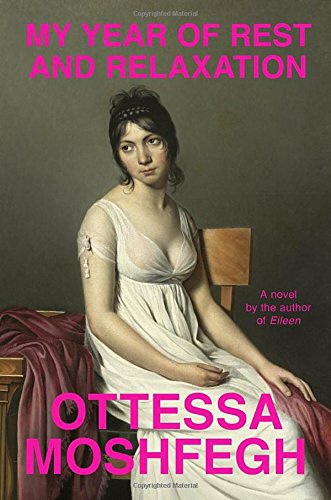
Ottessa Moshfegh, “My Year of Rest and Relaxation” (2018) (narrated by Julia Whelan) – I don’t know, man. I tried. I really do try with these works of recent literature, especially those written by women. It used to feel kind of good, thinking I was above contemporary literature- now the sheer lack of interest to be found there gets me down. It doesn’t help when it makes me think I’m just not capable of relating to the experiences of people different from myself, even if I know that’s a way publishers guilt people into buying their books…

A gloomy start to this review, I suppose, but this one wasn’t all bad, not as bad as some other recent examples of capital-L Literature I could cite. For one thing, Moshfegh’s prose isn’t bad. A little typical at times- a lot of lists of three items separated by “ands,” but hell, it’s only three, compared to the great galloping mock-heroic and-lists we’re used to seeing that’s downright restrained. And for once, a somewhat interesting concept: a young woman in turn-of-the-millennium New York tries to zonk herself out for a year, on the idea she’ll come out the other side better off.

The unnamed narrator is a woman in her twenties living in the fancy Upper East Side. She has an art history degree, conventional beauty, inheritance money, and an annoying best friend named Reva who’s enough of a “Jewish American Princess” stereotype to be borderline antisemitic. Her parents are dead upper middle class jerks (probably not actually rich enough to have left her enough money to live in the LES, but who cares, it’s the early aughts). Mossfegh depicts her as having taste. She certainly sees through the pretensions of the art world when she works for a gallery downtown, in what are probably the book’s best passages. For the most part, though, all her sensitivity gets her is an increased sense of disdain for everything and everyone around her. No wonder she wants to xanax herself into sleep for a year, though the assumption that that will help somehow is at least as delusional (or anyway should be seen as such) as Reva’s crash diets to attract a man’s attention.

Look… I’m persnickety enough to by now be a little bit sick of the “I’m so tired of hearing about privileged people in literature!” thing. It’s not like writing about the underprivileged is some magic ticket to good writing (and how many of these same people gatekeep people away from writing about people other than themselves?). But… there’s a reason, above and beyond political bullshit and posturing, for why that critique rings out so often. I’m reminded of Tocqueville talking about how what pissed the sans-culottes in the French Revolution more than anything wasn’t the power of the nobility, which had been declining for years, but the perks and privileges and swanning around the nobles still did, even as they were completely useless even in their own terms. The ultimate perk of the world elite at this moment is for their individual pain to matter. That they continue flaunting this perk as they do nothing — show that they’re capable of doing nothing — while the world burns…

I mean, I get it. I get that rich and beautiful people get depressed and that depression sucks no matter who it happens to. I’ve known enough rich kids to know their lives aren’t all great. I’m not a preacher looking for a moral, a charitable foundation looking to means test those I’d dole out my reading fee-fees to, or a consumer looking for stronger jerks on my tear ducts. What I am is a reader looking for something interesting. This has a reasonably interesting premise- world-despising privileged lady tries to blot out world. I can get down with that. But it becomes a lot less so when you realize the shape of its arc: family-inherited trauma to extreme behavior turns to crescendo to bliss-out.

Spoiler alert- the narrator’s quack psychiatrist (the voice actress makes her sound a good amount like Dr. Melfi from The Sopranos) gives our heroine a made-up drug that takes away time in neat three day black out chunks. After some neat planning, the heroine takes enough of these to black out several months without dying or doing anything that fucks her up too bad. Then she feels fine, enjoying the little things, except a little sad that Reva dies in 9/11. Maybe the point is that the rich and the pretty always bounce back? Reasonable enough, I suppose, but it still feels like something of a waste.

I wonder if what’s really going on here isn’t a certain finickiness. The narrator does gross things — pukes, blacks out, lets various bad men grope and have sex with her — and is generally “unlikable” in a respectable rebuke of the reader-whine you hear so often about “likable” characters. But maybe I’m just missing something here- I think blotting out life, I think three things. I think suicide, I think the Internet/video games, and I think opiates. The narrator does consider suicide at various points, but only if her restoration-through-sleep plan doesn’t work. The Internet (and the really addictive online gameplay it allows) was much less of a thing when this book was set. But for all the narrator’s outrageous drug abuse, Moshfegh is very leery about opiates, having the narrator only pop one or two “stray” vicodins. That’s interesting to me. The woman wouldn’t need all of her complicated prescription cocktails if she got Doctor Feelgood to give her oxys. It’s almost as though that’s too dirty, though, or would make this an “addiction” book (it’s not as though the drugs she does take are so “clean” or non-addictive)… you get the feeling that Moshfegh avoids them, and suicide. This book dips a toe in the sort of world-abasement that even the New Yorker crowd can get down with, all things considered, but steering clear of the stuff that’d really scare them… anyway.

I’m probably making this book sound worse than it is. It beats Sheila Heti, Moshfegh’s cousin in high pointlessness (another problem with both books- they expect me to care about visual arts, when the visual arts have been instructing me not to care about the visual arts since before I’ve been born). It beats Bret Easton Ellis, creator of the narrator’s sibling in New York-based rich kid madness, Patrick Bateman. Moshfegh doesn’t try our patience with lousy writing and stupid tricks like Heti or Ellis, which is a shame, as all of them wind up in the same netherzone. ***

Review- Moshfegh, “My Year of Rest and Relaxation”

Review- Serge, “The Case of Comrade Tulayev”

Victor Serge, “The Case of Comrade Tulayev” (1949) (translated from the French by Willard Trask) – Is Victor Serge the great Trotskyite writer? He certainly is pretty great, I guess I’m just curious if there’s some other big time Trotskyite novelist I’m not thinking of? Either way, Serge lived an adventurous life — raised by anti-Czarist Russian emigres in Belgium, bummed around the anarchist scene as a youth, went to Russia to help with the Revolution, fell in with Trotsky, prison, exile, narrowly avoided being killed by both Stalin and Hitler’s people — and began writing novels towards the end of it, after the Stalinist communist presses blackballed him from publishing essays. He never went right, never turned his coat, so novels became what he could get out. It sucked for him but it turned out to be pretty good for literature.

“The Case of Comrade Tulayev” finds the titular comrade, a big man in the Soviet government, shot dead on the streets of Moscow one snowy evening. We know who did it from the beginning- a rando with a gun and fleeting inspiration. But how random can it be in the midst of Stalin’s great terror? The machinery of repression goes into motion and numerous people are sucked in. The first half or so or the book introduces characters that get brought in as suspicious. Most of them were already marked, one way or another. There’s Erchov, the head of the secret service, marked for his failure to protect Tulayev and because secret service chiefs, coordinators of so much terror, only have so much shelf life. Rublev the historian is a leftover old Bolshevik, yet to be cleaned up by Stalin’s jealousies and ripe for cutting down. Makeyev, a regional governor, got too big for his britches and his wife, enraged by his infidelities, turned him in. Kondratiev returned from overseeing the Stalinist repression of rival left forces on the Republican side of the Spanish civil war only to find himself suspect.

Their various fates have little to do with their personalities or qualities, and of course nothing to do with innocence or guilt. There’s some reasonably interesting twists and turns as you try to figure out what will happen with this one or that one. The investigators are not notably competent at their jobs, even the job of backbiting and fucking people over, so things don’t go well for them, either. The person of Stalin, referred to as “the Chief,” occasionally intervenes, to condemn or save as was his wont. A kind of demoniac perversity seems to rule the day in what’s supposed to be a realm of human reason. A character tries to speak up in such a way that Stalin will kill him, and it backfires; a veteran apparatchik is done in by the momentary idealism of a family member. We see Tulayev’s killer in the end- he escapes consequences, but is stuck with the system. He moves and starts over again every few years, and it seems to work ok for him- wonder how viable that was in the Soviet system in real life?

You see this elsewhere in Serge’s take on the Soviet Union, this perversity- the stores full of fake goods, the peasants moved to incredible deeds by falsehoods or failing to do what they need to faced with facts, the whole self-aware machinery of lying, obedience, and repression. Many of the characters had been involved with the initial Bolshevik revolution, which also threw at them massive difficulties and betrayals, but none of them seem to regret it (as Serge didn’t, in life). The perversity of the revolutionary life — the sheer dogged stubbornness of the world’s flaws and failures, dotted with just enough sublime success to bait the trap, to keep you going — shaded into the perversity of the counterrevolution of Stalinism. I think that, more than any mystical tendency for revolutionists to turn against each other, makes up the continuum between revolutions and their failure: it’s fucking hard to change things, to keep at it year after year and failure after failure. Serge, I think, understood that, and not for nothing is he the great — Trotskyite — novelist, in that he kept going and never stopped trying to improve (and never stopped criticizing). That critical eye can make for good writing, sometimes. ****’

Review- Serge, “The Case of Comrade Tulayev”

Review- Knausgaard, “A Death in the Family”

Karl Ove Knausgaard, “A Death in the Family” (2009) (translated from the Norwegian by Don Bartlett) (narrated by Edoardo Ballerini) – It must be a real bonanza for small-language translators when a Karl Ove Knausgaard or a Halldor Laxness or an Ismail Kadare comes along, huh? Like all the Norwegian or Icelandic or Albanian translators coming out of the woodwork, getting their big moment…

Anyway, this is the first in a six-novel series where the author, an artsy Norwegian Gen Xer, relates his life in excruciating detail. The series gets a lot of Proust comparisons. I never got into Proust, I should probably try again. I didn’t get into Knausgaard either. I listened to it because every third audiobook I do, I try to listen to “important” “contemporary” literature. I remember when everyone was talking this guy up, and even the official dumb guy in the most prominent “dirtbag left” podcast talks about reading him, so, I figured I’d give it a try.

In the Proustian mode, Knausgaard’s autobiographical novel goes back and forth in time, following eccentric paths of association. For the most part, the first half of this book depicts Knausgaard’s childhood, roughly from age eight to age sixteen. The second half concerns what happens when his dad dies when the author is about thirty and just getting started in his literary career. The dad looms over a lot of the book- he’s a jerk, emotionally abusive, degenerates into alcoholism. But nothing can overshadow the great big I of Knausgaard himself. It’s Karl Ove, his feelings, his inner experiences, his minutely detailed recalling of his experiences: weather, clothes, the little mundane movements of people he converses with, that’s the attraction.

Ego can be a good thing for writers. Arguably, it’s a necessary thing, even for non-memoirists, the idea that your words are worth reading. But here’s the thing: Norwegians might be the most humorless people in the western world. In twenty-two hours of listening, I caught one (1) joke, and it was about Chekhov. Literature doesn’t need to be a laugh-a-minute to be legitimate. But A. Come on and B. Let’s talk tragedy. I know it has different meanings for different people. I’m somewhat old school in that I prefer the oldest meaning I know about- irresolvable conflict, brought on by what’s best in the conflicting bodies. You can argue Knausgaard’s series (called “My Struggle” because he’s a cute little prick, in spite of his perpetual long face) is about the greatest tragedy of all, in that sense, the tragedy of lived existence and its inevitable disappointments, culminating in death.

It was an interesting play, on the part of one faction of modernist writers, to roll the dice and try to sell normal life as tragic. Sometimes it pays off, artistically speaking, sometimes it doesn’t. It’s surely not what the Greeks had in mind, and another strain of modernism, following Nietzsche, went quite the other way in terms of their attitudes towards normal life, with, errr, interesting results. Of course, Knausgaard is a twenty-first century man (and a Gen Xer, if that means much in Norway), so awareness of his own consciousness, posturing and tragedy-seeking, is very much part of his deal.

What does it all add up to? One of my least favorite things in any kind of cultural production is the equation of “tragic” with “sad.” I know some people who do that and I don’t criticize them — they’re on their own journey — but I do not like it, especially from people who should know better. To be fair, Knausgaard is far too canny for that. But he basically only goes one notch above and makes an easy equation between “tragic” and “boring.” He makes pretty clear that this isn’t an abuse memoir. The point isn’t “my dad was an abusive prick and so I can’t enjoy life.” It’s just, “I can’t enjoy life, also, my dad is a prick” (I don’t think he uses the word “abusive” in relation to his father).

Basically, this is a long way around the barn of saying this book was boring. The language was nice. It probably would have bored me more in the hands of a less talented prose stylist. Not to get political, but contemporary Scandinavians are possibly the most comfortable, coddled group of people in human history. I know the Nordics are no utopia — have read enough Swedish crime novels to take that on board — and I know comfort is no guarantee of happiness, but you need to do more than Knausgaard does to make boredom interesting. It is possible. To me, this doesn’t manage it. I may look up the second book one of these days, but I’ve decided against going through the whole series sequentially in my audiobook-literature listening slot. You know, for those of you hanging on my reading selection news. **’

Review- Knausgaard, “A Death in the Family”

Review- Robinson, “Housekeeping”

Marilynne Robinson, “Housekeeping” (1980) – This novel answers a question I didn’t know I had, lingering in my mind: “what would a serious literary novel look like if it were written by someone who could check all of these boxes at once: white, American, sincerely believing Protestant, writing after the 1960s?” I think some part of me, before looking in to Marilynne Robinson, basically assumed no one fit the bill. Serious WASP novelist, pre-sixties? Plenty. Serious contemporary PoC American Protestantism? Sure. Contemporary white American Protestants that don’t really believe it but like the community and do-gooding? Still kicking, here in Boston, original HQ of the kind of thing, especially, and probably some of them write novels. Serious contemporary American Protestants?Well, yes, though recent events call into question the sincerity of their belief versus their tribal affiliations… In any event, they don’t write “serious” novels (I’m racking my brain to think of them writing good “unserious,” i.e. genre, novels either… James Ellroy, I guess, but he’s the definition of a “special case”). They don’t do rigorous abstract thought. That’s why the right fills its jurist and serious functionary seats with Jews, Catholics, Mormons, and if the Trump movement continues, whackjobs from the Internet.

Look, I know, I get it. I shouldn’t focus on that. I should focus on the unpretentious spare beauty of the language, the meticulous but unostentatious concern for the worlds made by women, and the simple-yet-thorough humanity of the characters. Well, among other things, those attributes are probably among the reasons why I never thought to read any Marilynne Robinson before now. It’s not that I’m against them. It’s just that those things are prized by creative writing students. I have taken one writing course in my life and it was spring semester, 2005. Robinson doesn’t seem to get involved in controversies or other stuff that might grab a non-writing-student’s attention (well, she gets praised by Oprah, but that’s not a good vector for my attention either). She’s respected in such a way that she never became a punching bag, ala Jonathan Franzen or (her former student) David Foster Wallace, so I didn’t get to know about her that way. I knew her name for a while, and would see her stuff in bookstores. I knew people in writing circles who talked her up, big time. Eventually I edited a review of her latest book for San Antonio Review, and figured maybe I should have a look. Here we are.

“Housekeeping” is the story of a kid named Ruth, living some time in the mid-twentieth century in a town called Fingerbone somewhere in the mountain west. One day, her mother drops her and her older sister Lucille off at Grandma’s house and drives her car off of a cliff into the deep mountain lake nearby. Previously, this lake had claimed a whole train full of people, including grandpa, slipping off the railroad bridge into the deep. It’s a scary lake. Grandma is old, tired, strong, respectable, and befuddled by life, what with its lake-taken loved ones and sudden responsibilities for children. She dies and some eccentric great aunts take over the house. Also thrown by their new responsibilities, the great aunts fly the coop when the girls’ aunt Sylvia returns to Fingerbone to take over the titular task of keeping house with the kids. Sylvia is an eccentric who lived for years as a drifter. She does whacky stuff like eat dinner in the dark and collect random shit. Ruth is basically down but as Lucille grows older and gets into adolescence, she is not. By and by, the law takes an interest in the supposed neglect of Ruth, and Ruth and Sylvia flee into the night.

Robinson’s prose is, indeed, quite fine. I especially enjoyed a passage where Ruth talks about the sort of not-asleep not-awake state you can get into if you stare into deep dark long enough. Robinson is good with sensate stuff like that. There’s a little bit of “the ands” — unnecessary usage of the conjunction “and” in lists instead of commas to, I don’t know, give emphasis or something, you see it all the time and it bugs me — but for all I know, she invented that tic and passed it down to her workshop epigones. She makes differences in terms of house cleaning and the like between the women who make up the story stand out and not in some obvious symbolic way. As for the simple humanity bit… well, I guess that’s where we get back to how I began. Her version of humanity is hard for me to recognize. Not that that makes it wrong, or false, or that I’m going to start bitching about how I “can’t relate to the characters,” that obnoxious cliche of readers who treat literature like a consumer experience. I felt I could relate to the characters.

Where I had trouble was connecting to the philosophical stuff Robinson put in Ruth’s mouth. I’ll give just one example- she has Ruth say “[F]or need can blossom into all the compensation it requires. To crave and to have are as like as a thing and it’s shadow.” And a bunch more in that vein- no more feel the need for someone to touch your hair as to feel it. In what world is that the case? Whose experience is that? Is that what it’s like to be one of the serene middle aged ladies at a UU church? I’m not trying to be rude or dismissive here. That’s just utterly foreign to me- not just to me, but to more or less everything I’ve read. It’s actually kind of wild. But it also makes me arch an eyebrow. What the hell is literature for in a world where desire and satisfaction are the same? What’s the point? A bit like asking what’s the point of being good if our fates are predestined, like Robinson’s homeboy (not being flip here, she has written extensively praising) John Calvin…

How much did any of the doings in the book interest me? How much do straying bourgeois wives interest me? Not much but I enjoyed “Madame Bovary.” “Housekeeping” held some interest for me but less- Flaubert is pointed, mean, and Robinson isn’t, not here anyway. So I amused myself in two ways. First, I played “find the contemporary workshop lit tropes.” Robinson reigned over the Iowa Writers’ Workshop for some time, and stuff from here crops up in “that kind” of fiction over and over again, from the NYT bestsellers list to your writer friends google docs. Siblings with a spooky bond? Check. The woods as source of meaning, Walden redux? Check. The “ands?” Check.

Second, I cooked up a scenario where Robinson is a satrap. I’ve noticed that in the publishing world, sometimes an author is basically crowned king of their community, the spokesman (gendered term used advisedly) who’s on call to represent their ethnos and advance their protégés, stymie rivals, etc. Junot Diaz was that guy for Dominican and to an extent Latino writers; Sherman Alexie played that role for Native American literature for a while. I think of these as “satraps,” the term for governors of what used to be independent kingdoms absorbed by the Persian empire. Both Diaz and Alexie ran afoul of abuse scandals clearly abetted by being treated like little dependent kings and both probably held back the literature of their respective communities (Diaz was quite spiteful towards Carmen Maria Machado, a much more talented writer). I think the white publishing industry would have loved for Ta-Nehisi Coates to be their African-American satrap, but he doesn’t seem interested and that literary space is (and always has been) too big and diverse to manage that way. I found myself thinking, what if there’s hundreds of good white Protestant writers — they’d have to be evangelicals, there’s not enough juice in “mainline” Protestantism anymore — and we just put Robinson out there as their symbolic figurehead so we don’t have to confront their energy, like how Diaz’s literary machismo was probably threatened by Machado’s perspective? Is Marilynne Robinson fake news?? Well, no, that’s silly. She’s just a decent writer I don’t relate to much. Don’t worry- I’ll give “Gilead” a try, one of these days. ***’

Review- Robinson, “Housekeeping”

Review- Zola, “L’Assommoir”

Émile Zola, “L’Assommoir” (1877) (translated from the French by Margaret Mauldon) – My understanding is that “L’Assommoir” was Zola’s breakthrough, as far as selling the series of which it is the seventh volume, the Rougon-Macquart novels, to the public. He was popular, but this one was a real hit. Whether this is down to the French public finally getting behind Zola’s experiment in extended-form literary naturalism, prising what he saw as the hereditary and environmental factors determining human existence out of the web of mystification around it, or just that people like depictions of low life and few had been served up to them like this before, is for wiser commentators than me to say.

“L’Assommoir” tells the story of one Gervaise (yes, it took a while for me to stop seeing her as Ricky Gervaise in a dress), a low-ranking member of one of the titular families (the Macquarts, for anyone keeping score) of the series. She starts out poor, working as a laundress in a north Paris slum, with two little kids from a dude, Lantier, to whom she wasn’t married and who ditches her early on. Life in the slum is crowded, dirty, and violent, not just physically but emotionally. Everyone is in everyone’s business. It’s the worst of both worlds in terms of people engaging in disapproved behavior — drinking, illicit sex, petty crime — but everyone still being highly moralistic about it all. Like I’ve said before, poverty and trauma don’t, on their own, ennoble- they fuck you up. People in “L’Assommoir” are pretty badly fucked up.

Towards the middle of the book, things look up for Gervaise. She gets married to a roofer, Coupeau, and makes/borrows enough money to open a laundry shop of her own. Zola understood himself as a naturalist, not a sentimentalist ala Dickens. There is, supposedly, a logic to what happens. It’s too much to say it’s the opposite of Dickens, that morality doesn’t enter into it, it definitely does, but in some weird late-nineteenth-century way I don’t fully grasp. So when the downfall starts, there seems to be multiple reasons. One is that Coupeau falls off a roof, hurts himself, and finds out he prefers chilling (and, eventually, drinking a lot even by prevailing standards) to working. If that were all, it would imply that Zola was making a commentary on bad luck. But there’s more to it. Gervaise can’t stop herself from “greed,” which in Zola’s usage means it’s old sense- she wants to eat a lot, and good food too. She also wants to laze and gossip with her workers rather than really attend to the neighborhood’s dirty laundry, and she likes throwing parties, even with her in-laws who hate her.

So as you can see, there’s a weird mix of dynamics going on in this Petrie dish Zola set up. Things get weirder when Lantier re-enters the picture, with mysterious money, political opinions (opposed to the Emperor, but not in an especially helpful way), and good lines of shit. Zola depicts Lantier as a sort of boarder-parasite (not a few social scientists from this period described the horrors that come in the wake of having to take on boarders, especially men) who men and women both find irresistible. He takes back up with Gervaise and also starts borrowing money from her. Coupeau doesn’t care, but he doesn’t care about much by that point besides going down to L’Assommoir, the lowest dive in the neighborhood, and swilling rotgut. Eventually, between Coupeau’s drinking, Gervaise’s laziness and gluttony, Lantier’s depredations, and factors like the utter lack of care options for elders or children, Gervaise is pretty badly fucked. Zola strings this out for hundreds of pages, not sparing details: humiliations at hands of vicious in-laws and former enemies, madness, free-falling standards of appearance and hygiene, eventual demise.

What to make of all this? Well, it held my interest pretty well, more than in-jokes about Second Empire politics or weird Genesis-allegories like you got in earlier installments of the series. Zola claimed this was “the first novel about working people that does not lie” and it scandalized many readers for its (relatively) frank references to sex and low life. The French is, supposedly, in the slum argot of the time, not just the characters’ dialogue and thoughts but much of the omniscient narration as well. The introduction warns this makes “L’Assommoir” notoriously difficult to translate. The translator of this edition made the interesting choice to basically turn it into cockney, which took me out of it some. I’m not sure what a better choice would be, but constantly hearing things described as “not half” this or that, “bleedin’” as a modifier, etc., felt wrong.

I’m also not sure what Zola meant me to carry away from the book. I should reign in my habit of compulsively politically classifying literary writers, but I guess I’d slot in Zola as a left-Republican (in the French sense, though American Republicans were a bit closer to that sense circa 1877). He’s sympathetic to the poor but also thinks they by and large do it to themselves. Character, as transmitted by heredity and shaped by environment, will out. Gervaise and Coupeau’s kid, Nana, subject of a later novel, is the result of slum breeding and slum environment, neither of which can result in anything good as far as Zola is concerned. Workers’s self-assertion in the world of “L’Assommoir” is usually either empty boastfulness, as in the case of the slacker Coupeau, or a grifter’s cover, like with Lantier. Meritocracy and striving don’t do much either. Would Gervaise had made it with a better husband? Zola definitely gets across that women are screwed way worse than men in the slums, structurally screwed. Well- it seems a thing with French social novelists they don’t do much with solutions. A lot of French social theorists used to, at the time, and their solutions were novelistic enough (see Comte, Fourier). This was a pretty good book in any event. If you’re not a weird Rougon-Macquart completist like me, there’s worse places to jump in, despite the translation issues. ****

Review- Zola, “L’Assommoir”

Review- Gyasi, “Homegoing”

Yaa Gyasi, “Homegoing” (2016) (narrated by Dominic Hoffman) – Historical fiction, as a category, eludes me somewhat. A friend defined it for me reasonably well, but I confess that I had been drinking and most of what I remember was that it’s fiction set before living memory but still within historical time i.e. not in a mythical undated past. I feel like there’s more to it than that, a certain relationship to the past, but I never solidified my thoughts on this; maybe it is just as my friend (who reads more historical fiction than I do, I’m pretty sure) has it and that’s it.

For instance- “Homegoing,” which made quite a splash when it came out in 2016, first novel by a writer in her mid-twenties… is it historical fiction? It does, indeed, take place in the past, ranging from the eighteenth century to close to the present day. It’s also definitely literary fiction. I suppose genre boundaries are generally looser these days, but all the same I can’t shake the idea that real, on-the-button historical fiction is… more romantic? More detail focused, really embedding you in the past? More populist? I don’t know.

Anyway! “Homegoing” is a story of two lineages. They are descended from half-sisters on the eighteenth century Gold Coast, in today’s Ghana. Effia, raised among the Fante people, marries a British officer overseeing the slave trade; Esi, raised semi-illegitimately among the Asante, winds up enslaved, sold out of the fortress that Effia’s husband oversees. We then follow the two half-sister’s descendants, Effia’s in Ghana, Esi’s in the United States, through two centuries or so of history.

Critics have described “Homegoing” as closer to a collection of short stories than a novel, and there’s something to that. Not only do the chapters focus on separate individuals as we follow the lines through the generations, they’re usually cut off from whoever became before. The previous generation in any given story is usually dead, sold away, missing, otherwise absent from the action with few exceptions, where the previous generational character is old and beaten down by life. The traumas of slavery, colonialism, Jim Crow will tend to do that. The lines come together in the end, thanks to the magic of university education in the late twentieth century. There’s no happily-ever-after promised for the last two of their respective lines but they do gain a certain degree of self-knowledge… that feels like a common trope in contemporary literature but I wouldn’t stake too much on it.

Truth be told, the characters started to run together some as Gyasi hit various historical beats. More than individuals, there was “the post-Reconstruction guy,” “the lady around when they introduce cacao production in Ghana,” “the college kids,” etc. That could be part of the point- history and it’s long-neglected, now-attention-grabbing personal-level cousin, intergenerational trauma, determines these characters more than interiority. It also could be that such a work is less suited for listening to as an audiobook, though the voice actor, Dominic Hoffman, does a decent job (note- I’m no judge of African accents so don’t get mad if you listen and don’t like his).

Trauma and history interact to make character- self-knowledge, and knowledge of one’s lineage, maybe provides a key to a meaningful life; as far as I can tell, these are the points of the book. It’s kind of similar to “Roots,” in a way, though the feel is entirely different. “Roots” came out of the black pride moment (written by a Republican who was, arguably, trying to corral black pride to an at least moderately conservative end); “Homegoing” comes out of contemporary social justice and fiction workshop milieus. Gyasi’s prose is finer than Haley’s, by a wide margin; Haley’s prose was generally more vigorous than Gyasi’s.

Trauma, history, lineage-knowledge as self-knowledge… white people tried this script, in the twentieth century, sometimes with real pathos (Jewish writers coming to terms with the Holocaust), sometimes more with bathos (“white ethnic” stuff amongst gentiles, and not a few Jews too). I think it is different from PoC writers, frankly, I’m not about to call them bathetic unless they go really overboard, but we’ll just say it has little to do with my idea of history. As far as I’m concerned — and I know this puts me at odds with leftists of more of a socialist stripe, as well as lineage-knowledge-power types who tend to be more left-liberal — I don’t believe there is a redemptive arc in history. I don’t believe it in personal history and I don’t believe it in global history and I don’t believe it for any history in between. Even if we achieve global or galactic utopia, that won’t have any bearing on what happened before. Each moment of the past has its own validity, its own goodness or badness not transfigurable into something else by the future…

Well! We’ve gotten off the beaten path and it wouldn’t surprise me if Gyasi more or less agrees but still sees power and healing in ancestry stories. And why not! She hasn’t got my long line of potato-diggers and pogrom-dodgers and, eventually, settlers of stolen land and wage-slaves to look back on. I’m just relating why this maybe didn’t move me more. It wasn’t bad but I didn’t get that much into it.

I will say, I have some interest in the increasing intellectual/cultural prominence of immigrants from Africa and their children (presumably, soon enough, grandchildren et al) in American life. Yaa Gyasi is one such, the daughter of academics who came to the US from Ghana, and who has lived on both sides of the pond. Two funny tells of the “West African moment,” beyond the Nigerian and Ghanaian et al names you see on bestseller lists and TV. I used to listen to a podcast hosted by black men who made much of the supposedly privileged status of immigrant Africans and how they supposedly don’t play well with “American descendants of slaves,” which apparently is a buzz-phrase with online black reactionaries now? Also, the fell Amy Chua, jurist, pop-sociologist, possible procurer for Brett Kavanaugh, named Nigerian-Americans as one of six or so, like, “power-ethnicities” to look out for in the next few generations. Interesting portents! ***

Review- Gyasi, “Homegoing”

Review- Wilde, “Salomé” and “The Importance of Being Earnest”

Oscar Wilde, “Salomé” (1894) and “The Importance of Being Earnest” (1895) – Oscar Wilde! I’ve known about him forever but this is my first time reading him. I got a book of his plays at a used place when I was briefly dating a woman who liked his work. One of the Melendy Avenue Review Citizens (become a Citizen, come on, it’s cool) indicated he wanted me to read Wilde so I’d reveal details of said relationship. There’s not a lot to reveal. We had fun for about two months and then something stupid and shitty happened and we both said and did dumb shit and then it was over and we haven’t spoken for years. The end.

I’m not sure Wilde is really relevant there, except maybe in being a libertine, which I guess the lady in question also was, but not really more than most people our age. Being a libertine was riskier in Victorian days- Wilde went to jail for a couple of years for sodomy, which ruined his health and probably prematurely ended his life. He had fun encounters with censors, too, including having “Salomé” banned from the London stage because it depicted biblical characters. But he was a rich, educated, Anglo-Irish libertine, and you could say he got the last laugh as he’s still beloved to this day.

I get the idea people probably love the image of Wilde more than they do his actual written work, but the latter holds up ok too. “The Importance of Being Earnest” is an amusing farce wherein two cynical dudes get with two idealistic-but-wily ladies, both of whom really want to be with men named Ernest because of the romantical sound of the name? And so they need to both be Ernest and a little bit earnest, despite being cynical and owning each other all the time with witty ripostes and generally not taking things seriously, and despite neither having been bestowed with the handle in question. One of the characters also discovers his paternity! Normally, a cynic getting all misty-eyed about love and paternity after however long acting above it all makes me mad, but it’s hard to do with Wilde, I guess because of his writing chops and the fact it was all so long ago. I will say the tropes — contrasts between London and country behavior, dronish young men, dreamy young women, battleaxe aunts, confusion and duplicity leading to love — were done better by Wodehouse in my opinion, but would there be a Wodehouse without a Wilde? That’s for historians of British comedy to say, I guess.

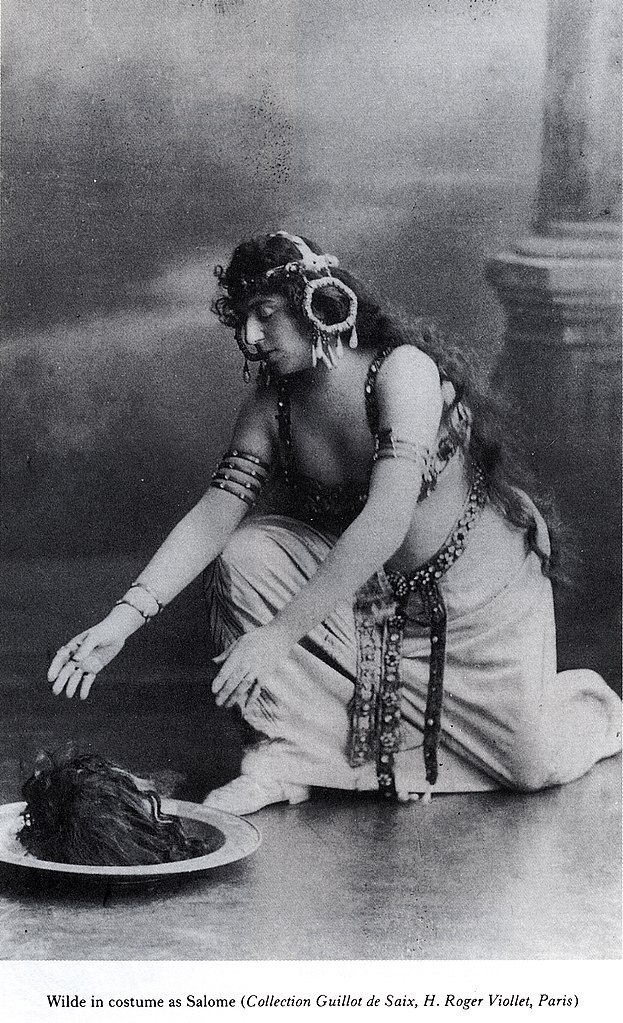
After finishing “The Importance of Being Earnest” I gave “Salomé” a try as a dessert. It’s a one-act fever dream about Christianity and paganism in the key of Orientalism. I don’t mean this to make it “problematic” though I guess it is, if you care- I mean to indicate that it partakes of a tradition of immoralists like Wilde looking to a fabulous (in many senses of the word) East. Say what you want about Orientalism as a topos but it was meant to entertain, provide a sensuousness conspicuously lacking in the coal-damp European modernity that developed alongside it. Salomé is sex as a certain kind of Victorian understood it, in all of its naivete and knowingness. Chivalry destroys itself for her, venality in the form of her mother and step-father try to contain her whilst despoiling her, pedants ignore her to fight each other, above all the crude misogynist prophet John the Baptist, representative of what’s coming next (SOME motherfuckers are going to be vexed to nightmare by the rocking of a cradle, to quote the most abused poem in the English language, by Wilde’s fellow Anglo-Irish weirdo lit guy), defies her, spits on her, gets got by her (well, her slaves, but on her command), and ultimately has the last grim, tight-lipped non-laugh at her expense. It’s weird. Part of me wants to do a table read of it over Discord or something but, as they say, it is “problematic.” But short! DM me? ****

Review- Wilde, “Salomé” and “The Importance of Being Earnest”