Review- Ngugi, “Devil On The Cross”

Ngugi wa Thiong’o, “Devil On The Cross” (1980) (translated from the Gikuyu by the author) – Neither my phone nor google docs allows me to make the diacritical marks above the vowels in Ngugi’s name, or in the name of the Gikuyu language (moreover, wikipedia only refers to “Gikuyu” as “Kikuyu” with no diacritical marks, whereas the copy of the book I have does not)… a point Ngugi, largely responsible for the movement of African literature into native African vernacular languages, would surely appreciate ruefully. And these were no minor linguistic points for Ngugi- he wrote “Devil On The Cross” on toilet paper in his jail cell, where he landed sans trial for plays criticizing the dictatorship of Daniel arap Moi over Kenya. Part of his criticism was that Kenya and other postcolonial African countries sold themselves to the West, including using the erstwhile colonizers’ languages as marks of status (though he was also critical of hypocritical deployment of African-ness by dictators and their lackeys).

“Devil On The Cross” is largely an allegory for the corruption of post-independence Kenya and what Ngugi thought could help. Kenya became independent after a long counterinsurgency war pitting the British Empire against a rag-tag group of rebels, the Mau Mau. The Mau Mau were closer to a religious movement than the sort of Marxist-derived insurgencies we associate with decolonization. They slaughtered a handful of British settlers (who squatted on the best lands, once held by the Kikuyu people) in bloody (and feverishly publicized by the British) ways. The British and their native allies came down hard, killing tens of thousands and routing the whole Kikuyu population and millions of others through a system of concentration camps (less than twenty years after a British judge sat in judgment at Nuremberg, “he repeated tiredly”). Even still, the British knew they couldn’t hold on forever: the point of their counterinsurgency, not unlike the similarly bloody, protracted, and forced-resettlement-based war in Malaya, was to force the process of independence into a mold that suited British interests. The British found conservative Kenyan partners with whom to do business, post-independence, rather than handing the country over to the Mau Mau freedom fighters. Kenya continued to be an outpost of European-friendly capitalism into the late seventies and beyond, when Ngugi was writing.

We encounter the allegory for this situation largely through the person of Jacinta Wariinga, a young woman who’s forced out of her secretarial job because she won’t sleep with her boss, and so takes a matatu bus away from Nairobi to her village. On this bus ride, she meets a variety of allegorical figures representing various social types: the worker, the peasant, the student, the nascent capitalist. Over the course of the ride, they all find out that they have been invited, by various parties, to attend a festival celebrating Modern Theft and Robbery in Kenya, where a King of Thieves and Robbers for the country is to be crowned by an international committee.

Much of the middle portion of the book is taken up by a description of this robber’s feast. Various Kenyan capitalists get up on the stage to describe the various ways they rook their countrymen — land schemes, schooling scams, etc. — brag about their cars and women, detail their collaborations running from working for foreign corporations to exploit the country to previously working for the British during the counterinsurgency, talking shit about each other, etc. Wariinga finds out that she’s connected to several of the passengers on the matatu in ways she couldn’t have predicted. The passengers react to the feast in several ways. Some try to join, and find they are too small-time or possessed of patriotic notions of only allowing Kenyans to rob Kenyans (allegorical representation of African capitalism). The peasant lady tries to get the police to come, but of course the police side with the ruling class.

Finally, the worker leads an uprising to chase the thieves and robbers out. It’s a sort of false climax to the book. Ngugi, influenced by Marx and Fanon, believes that only the African working class can overthrow the neocolonial regimes imposed on places like Kenya, preferably with help from peasants, students, etc., all of whom are in the allegorical mob. But in the end, they only can do so much. They chase the thieves and robbers out, but they all get away. Wariinga winds up in a couple with the allegorical student, which goes well for a while… but love can only do so much in the face of necolonial capitalism, and she winds up having to break free to an uncertain future in the actual climax.

“Devil On The Cross” fairly hits you on the head with its symbolism, but subtlety isn’t always strength, especially when dealing with an anguishing situation like that of post-independence Kenya. The language is interesting, interspersed with songs, bits of fable, and the occasional speech on the destiny of the African working class. Ngugi’s despair and wild hope for his country and the world comes through loud and clear. ****’

Review- Ngugi, “Devil On The Cross”

Review- Thackeray, “Vanity Fair”

William Makepeace Thackeray, “Vanity Fair” (1848) – Thackeray was, by most accounts, a prime bastard; those of Irish descent will never forgive him for his pro-genocide comments during the Great Famine. Great satirists generally are. The idea that satire only “counts” or is valid or funny if it solely “punches up” is a very recent idea and completely anachronistic as far as the history of the genre goes from Juvenal, another asshole and bigot, on down. Satire is supposed to be a mirror to society, and is as moral as mirrors ever are.

In that tradition of satire, Thackeray ranks high in the English pantheon, largely on the strength of “Vanity Fair.” One of the ultimate asshole power moves great satirists get away with isn’t casual bigotry or “punching down;” its having their cake and eating it too. Thackeray not only accomplished the satirist trick of ogling immorality whilst impugning it. He also played with the forms and conventions of literature between his time and the pre-Victorian period about which he writes. Moreover, convention and morality tie in with each other, then and now, so playing with one is playing with the other.

“Vanity Fair” has been subtitled “a novel without heroes,” and that’s an example of Thackeray’s spiteful playfulness, in this case seemingly targeted at his readership. There’s an obvious hero, as in protagonist: young amoral social climber Becky Sharp. There’s no novel without her. But according to the codes of Victorian propriety that Thackeray both upholds and critiques (the former more substantially), such a character, who uses charm and sex to climb the social ladder, cannot be a hero. But all the same, the readers are clearly there for her, not for her opposite number and frenemy Amelia Sedley, a simp and social faller. They’re definitely not there for any of the male characters, who are all comparative dullards, good, bad, and indifferent.

Becky Sharp establishes her bad girl cred right out of being a scholarship student at finishing school, where she throws a book by established moral authority Samuel Johnson out of a carriage window. Thackeray continually challenges his readers to judge Becky- does she truly do anything that awful? Is she really worse than those around her, from the simpering Amelia to the other social climbers to the horny, drunk, amoral lords on top of everything already? In part, this is answered by the title and theme of “vanity fair,” borrowed from Protestant preaching: where all is worldly, all is vanity, and who can especially blame (or praise) anyone within it? It’s also, I think at least, answered by the historical frame- Thackeray plays with the idea that morals were just worse in that pre-Victorian period, and invites his readers to the sort of self-congratulation that only reaffirms Thackeray’s diagnosis of universal vanity.

I, for one, don’t especially care whether Becky is good or bad, and see her only real crime as being bad to her kid. But Thackeray, with his contrast between Victorian family-centric morality and Georgian neglect and cruelty, may have coopted me into applying a possibly anachronistic judgment there. Altogether, I enjoyed the panoramic portrait of a scrambling, living society. His England (and Europe) are living, breathing places, more diverse than we’re used to thinking (and proof that including diversity — in this case, both wealthy and poor black characters and the presence of British imperialism in India — is any sign of authorial virtue). I loved the depiction of the ways in which imperialism and war abetted or foreclosed on the social climbing of the characters. The book is funny along with everything else. All told, a deserved classic. *****

Review- Thackeray, “Vanity Fair”

Review- Whitehead, “The Underground Railroad”

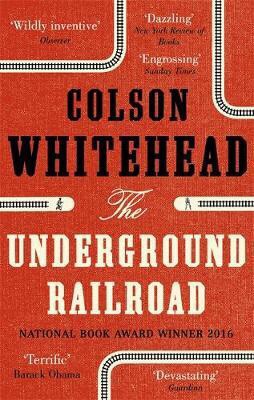
Colson Whitehead, “The Underground Railroad” (2016) (narrated by Bahni Turpin) – My campaign to read (or listen to, more often) the “great American novel” contenders of the last few years continues apace with this, voted best novel of the 2010s by at least one critical outlet (which seemed to only consider English language works, eliminating competition from Elena Ferrante, among others). This is a lightly magical realist fictional slave escape narrative. Cora flees her Georgia plantation and is dogged both by pursuing slave-catchers and by prevailing conditions in the places to which she tries to escape.

Wikipedia calls this “alternate history” and I suppose it is, in a sense, though not in the “Man In The High Castle”/Harry Turtledove sense that term usually denotes. Different racial regimes prevail in the different states Cora goes to, each distinct and discrete from the others. In South Carolina, white-managed “racial uplift” prevails, complete with medicalized terror against the quasi-free blacks. Fleeing that state ahead of the slave-catchers, Cora finds herself in North Carolina, which decided to go in for the elimination of slavery… and the genocidal destruction of its black population. Tennessee is, for some reason, burnt to a crisp. Indiana is peaceable at first but the free black population there is eventually terrorized into dispersal, too.

If there’s a logic between which state gets what fate, it’s an inner logic. I was expecting something like Orson Scott Card’s exaggeration of old regional traits and tropes that he used in the Alvin Maker books, a stupid notion on my part, I now see. What does the fictionalization of the historical conditions of the antebellum US offer? Well, one thing that leaps to mind is that it runs us through a (attenuated) catalogue of options available for black people in the US both before and after emancipation. Unlike a conventional slave escape narrative, there’s no real escape- only descent into a variety of states of insecurity and un-freedom. Also, unlike figures like Frederick Douglass or Olaudah Equiano (but like, say, Ta-Nehisi Coates), Cora is essentially an atheist. In this context, that means she flirts with cosmic pessimism- but in the end, keeps running. The ending is a happy-ish one, but muddled.

Whitehead appears to be in agreement with similarly lauded literary figure Coates about the intractability and overwhelming existential power of white anti-black racism. It’s hard to quibble much with that, all things considered, though I think in the end it’s imperative to push back against its implications. Among other things, it leads to the individualism we see in this novel. Like in a horror movie, sooner or later everyone Cora cares about, her team so to speak (fellow escapees, people who help her), are dead, and Cora alone has to mount her final escape. She creates her own Underground Railroad in lieu of the collective effort that failed her. This winds up not just dismissing any white agency in undoing racism (well-meaning whites are universally depicted as incompetent), which is an understandable enough pessimism, but any collective agency, including black collective agency. There’s no such thing as society, only men and women and their trauma. For a book notionally about the massive, multiracial liberatory undertaking that was the Underground Railroad, this is an odd way to go.

How much does all of that matter in judging this book? Some, I’d say. It flows reasonably well as prose. Whitehead handles perspective shifts, from Cora to various others, deftly. Character work does what it’s meant to do, I think. But if you’re going to have a magical realist epic about national themes, you need to have a vision. If nothing else, any magical realist element in any work demands a justification for its flights of fancy. I think Whitehead did half a job with that. He produces a decent pocket-sized selection of American racial hells. I wonder, in the hands of a more imaginative writer, what more might have done with it, and in the hands of a writer with more of a vision, what alternatives to chosen ones running like hell away might have come up. But I guess that’s where the zeitgeist is at, or anyway was in 2016. We’ll see how far the current moment can push it in a more useful direction, and what sort of literature it might produce. ***’

Review- Whitehead, “The Underground Railroad”

Review- Spark, “The Prime of Miss Jean Brodie”

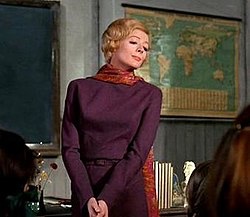
Muriel Spark, “The Prime of Miss Jean Brodie” (1961) – This was a fun little novel. Taking place mostly in 1930s Edinburgh, we follow the lives of six young pupils of one Jean Brodie, an unconventional schoolteacher who, we are told often enough, is in her prime for the course of the novel’s action. She picks favorites; she eschews the typical curricula in favor of “truth and beauty” and the occasional nod at interwar fascism. She has an unfulfilled love affair with the art teacher and a fulfilled one with the music teacher. She has a lot going on.

Spark masterfully warps the narrative, taking us forward into the future when the girls are grown and back into the past again with flawless aplomb and great gusto. Notionally, what’s “at stake” is who “betrayed” Jean Brodie, that is, narced her out to the school administration and got her early-retired. But this is solved relatively early in the book and the rest of it goes to show the logic behind it. Spark observes the manners of middle-class Edinburgh pointedly and poignantly, and while I don’t know what it’s like to be an eleven year old girl, I do know what it’s like to be eleven, and I don’t think Spark forgot either.

I’m not entirely sure what “The Prime of Miss Jean Brodie” is “about,” or if it needs to be “about” anything. If I had to put a spin on it, it would be about how adults project onto children, including the supposedly sensitive and intelligent adults, and what sort of trouble and loss of perspective that leads to. The last revealed actions of Jean Brodie are genuinely terrible, leading to trauma and death, and come from blurring the lines between herself and her students. But it’s all dealt with with a consummately light and deft touch. Highly recommended for those in to the art of fiction for its own sake. *****

Review- Spark, “The Prime of Miss Jean Brodie”

Review- Nguyen, “The Sympathizer”

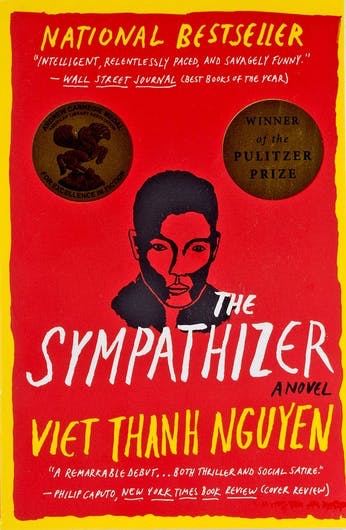
Viet Thanh Nguyen, “The Sympathizer” (2015) (narrated by Francois Chau) – This novel was quite interesting at times in spite of itself. The story of an unnamed ex-captain in the South Vietnamese national police, it’s mostly told in the form of a confession to an unknown commissar holding the narrator prisoner after the war is over. The narrator had been a mole for the National Liberation Front, and remained in that role even after the fall of Saigon and his evacuation, along with his commanding officer, to Southern California.

True to the title, the narrator is a sympathizer- always seeing things from multiple sides. He’s part of a trio of best friends with Bon, a sincere South Vietnamese nationalist killer, and Man, a fellow communist spy and the narrator’s handler. While he ultimately opposes the US intervention in Vietnam and wants a communist government, the narrator knows and likes Americans, even studying American Studies (which Nguyen teaches) when sent to American university. He’s half-Vietnamese, half-French, product of an illicit relationship between a French priest and a Vietnamese teenager.

He is, in short, both a classic and a very contemporary kind of subject. I try not to make everything an ideological critique, but some works call out for it. This is the great Vietnam novel of representation-minded 21st century liberalism- arguably, the great novel of that strain thus far, period. This isn’t the liberalism of JFK, which got the US into Vietnam in the first place. This is a liberalism of ambiguity and failure, but also of boundless room for individualistic variation, in short, the liberalism with which we now live.

This probably makes “The Sympathizer” sound worse than it is to most of my readership. But Nguyen is a capable writer (if a little much with the similes sometimes), and the representationist predilections only come out in the book about halfway through. The initial parts of the book depicting the fall of Saigon are great, as are his depictions of refugee life in Southern California, with its generals running liquor stores and skullduggery among politicians and wannabe liberators.

The representation-liberalism stuff really comes in when the narrator is hired as a consultant on a “Platoon” type movie directed by someone only called The Auteur. There, we are treated to the narrator’s long struggle to get some kind of meaningful Vietnamese or at least Asian representation in an exploitative film, and it goes so badly he’s almost blown up on set. This, and the narrator’s further negotiations with identity and love life around the same time, is less interesting to me than the other earlier parts of the story. But it clearly provides some of the emotional juice for the author and I suspect much of the readership I saw with this book on the train a few years back. It wasn’t bad- just next to the epochal struggle of the Vietnam War, it’s hard to care about some shitty ‘nam flick.

The end was also less compelling than the beginning. I’ll avoid spoilers though I don’t really have to, as the big reveal in the end is pretty obvious. The narrator and Bon go back to Vietnam as part of some hopeless Bay of Pigs-style scheme, and get captured. There’s then an extended, chapters-long torture and interrogation sequence, reminiscent of Orwell’s in “1984,” complete with speeches about the meaning of man and reflections on the inevitability of revolutions turning to inward-facing violence and corruption, etc. In the end, not unlike Winston Smith, the narrator comes to an exhausted, lighthearted, nihilistic epiphany. Human folly is ultimately about human folly with no point to it. The end.

I don’t know. Maybe this is just the red in me, but I think the revolution in Vietnam had a pretty distinct point- the will of the Vietnamese people to be governed according to their own lights. Or maybe it’s the negative in me- it’s worth it not to be ruled by assholes, and if a new set of assholes comes in, well, you revolt against them too. Use your limited time in this earth to make assholes uncomfortable- guess that’s my motto. It strikes me of as good of one as “nothing,” which the narrator winds up screaming as the big lesson he learned. Either way, this is a very interesting piece of work, for good and for… not even ill, just “less good.” ****

Review- Nguyen, “The Sympathizer”

Review- Morrison, “Song of Solomon”

Toni Morrison, “Song of Solomon” (1977) – There’s a clade of writers whose work I respect but do not, generally, enjoy- Faulkner and Garcia Marquez are the top of that marquis. Then there’s writers I both enjoy and respect but don’t have a ton to say about, and Toni Morrison would probably be near the top there. “Song of Solomon” is in the running for the best fiction I’ve read this year, as “Beloved” was a few years ago when I read it, but I don’t have a whole big thing of commentary on it. The story of Macon “Milkman” Dead as he grows up in mid-twentieth century Michigan, “Song of Solomon” expands leisurely, but never slowly, on a world of black people extending outward from Milkman’s family tree. His family is something of a mess- an unwanted child saved by his mother and his aunt Pilate, born from a union made for dynastic convenience among petty black wealth in their small rustbelt city, two sisters too educated into precious black bourgeois conventions to do anything, family secrets extending back to rural Virginia from which they hailed.

Milkman is an everyman in the best sense, which is to say he’s relatable while being somewhat feckless, selfish, and altogether human (another Berard Complete protagonist in literary fiction to go with Naipaul’s Mr. Biswas- fully realized without being tedious in the usual manner of bourgeois fiction). He floats through life, largely on the both reproductive and emotional labor of women relatives (mother, sisters, aunt, cousin-lover), until his thirties when he tries to find both gold and home by retracing the steps his family took backwards from the Great Migration. At the edges, he encounters traces of the mythical/countercultural past that Ishmael Reed (Reed and Morrison knew and read each other) conjured in his work, underground or renegade existences of outsiders on the perimeter of American life, living more authentically than their neighbors or descendants, magically so even. Morrison keeps this elusive, allusive, on the edges of Milkman’s perception, in a way I found compelling.

What else to say? “Song of Solomon” is beautifully and dynamically written throughout. The existence of a vengeful black counter-terrorist secret society threatens to take it into realms of speculative fiction that might not work, but it does work, in the end. I wonder to what extent the book reflects its time, when the retreat from black power and the civil rights movement was in the air but hadn’t yet reached the counterrevolutionary depths it would with the Reagan years. There’s a melancholy to the work, a desire for escape and an inability to find it, this side of fantasy… I don’t know enough to say. It’s good! *****

Review- Morrison, “Song of Solomon”

Review- Naipaul, “The Return of Eva Perón”

V.S. Naipaul, “The Return of Eva Perón” (1981) – Naipaul covers Argentina, the Congo (Zaire at the time), and his home country of Trinidad in this series of essays published over the course of the nineteen-seventies. These places find him in fine literary form, though if I were an Argentine, especially, I wouldn’t appreciate the depiction. You don’t send Naipaul out, especially to the developing world, to paint a pretty picture. Argentina and Zaire, in Naipaul’s tellings, are lands of delusion covering over fundamental inadequacies. In Argentina, the delusion is longer-running, having gone since the early nineteenth century; in Zaire, it’s largely an invention of Mobutu, uncrowned king and dictator, and his cronies. Argentina tried to convince itself it was Europe (aided by the wholesale slaughter of its native population and denial of existence of black Argentines), Zaire pretended to be an “authentic” African state forging its own path into the future when all either were doing, according to Naipaul, were fleecing each other and degenerating. Peron, husband and wife (wives), are what Argentina deserved, and peculiarly enough the closest to a revolution it would ever get. Zaire gets more of a Conrad treatment which was less interesting than the other essays, and there’s also an essay on Conrad I skimmed because I don’t know the author well and am not wild about him in any event.

The Trinidad case is interesting because it’s about another Trinidadian who made it big in England, like Naipaul did: Michael de Freitas, aka Michael X, British/Trinidadian Black Power leader and multiple murderer, who made a brief splash in mid-60’s England by posturing as a black power leader and getting people to go along with it, though not enough to substantiate an actual movement. Michael X was a part-black, part-Portuguese Trinidadian, which translated in England as just black. Naipaul comes from the island’s Indian community. I’ve heard it suggested that this essay, larded in contempt and with a palpable sense of doom, is Naipaul’s revenge for having been a dorky Asian swot surrounded by bigger, meaner black kids who essentially inherited the country out from under the Asians when the British moved out. It’s a nasty reading but Naipaul was a nasty guy. I could also see it as contrasting the fame Michael X briefly accrued from credulous white lefties, including John Lennon, eager to believe any black man with a grudge was a true revolutionary, with Naipaul’s own process of shucking and jiving Tory-ish for his own right-wing white patrons, which of course goes unmentioned, as it always does in Naipaul (did Naipaul have any rock star fans? Ray Davies, perhaps?). Either way, it’s a squirm-inducing homecoming for the eventual Nobel laureate, as his black other half winds up on the gallows for murdering several of his followers, dismembering two with a machete. All told, quality essays, though one questions some of his more severe judgments as coming from a place of Tory swot-ishness. ****’

Review- Naipaul, “The Return of Eva Perón”

Review- Jackson, “We Have Always Lived in the Castle”

Shirley Jackson, “We Have Always Lived in the Castle” (1962) – They’re creepy and they’re kooky/they’re altogether (something?)/nuh-na-na-na-na-na-nah/The Blackwood family!

Listen: a goth, I am not. In fact, I used to be pretty anti-goth before I learned to just let people enjoy things without my interference (to be fair, I was outnumbered by goths and pro-goths who hadn’t gotten that memo yet, either). To a certain extent, it’s the narcissism of small differences, different shades of interest in the tragic- my emphasis on conflict and the agon, theirs on the outcome, the beauty of the dead and damaged… or in less exalted terms, I like wars and they like murders… or that all could be bullshit. Either way, like I said in my Mishima review last time, I’m altogether not much of an aesthete, so the goth (or punk, or really most subcultures) way wasn’t for me.

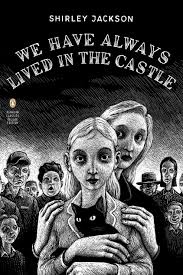
So what do I get out of gothic literature? And does Shirley Jackson’s oeuvre really count? I think the answers to those questions are “not as much as other people” and “yeah, basically, at least this book does.” In “We Have Always Lived in the Castle,” we are taken into the mind of Mary Katherine Blackwood, from a family of creepy murdered people the only survivors of which are her cohabitants sister Constance and uncle Julian. They live in a creepy old house in creepy old small town Vermont. Mary, or Merricat as she is known, lives her life according to the sort of rules and rituals made up by someone who stopped growing up at around twelve, or around the time most of her family was poisoned to death by… somebody. She buries things in the yard and nails other things to trees for their magical, protective properties. She’s into mushrooms, especially deadly ones, and her cat Jonah. Her sister consumes herself with cooking and other domestic tasks, and Uncle Julian obsessively documents the day in which his family was poisoned and he himself rendered invalid. It’s a gothic scene, I think we can all admit.

Her post-murders applecart is upset by the intrusion of her materialistic cousin Charles. Charles wants the family money, and is quite willing to turn Constance against Merricat to get it. He’s no match for her, though, and her means of removing him leads to what was for me the most interesting part of the book, a conflagration at their house followed up by a mob attack on the family- the Blackwoods had become fell legend for the small-minded Yankees they lived amongst and the fire became a bacchanalia for their greed and violence. Between the villagers and cousin Charles, you can’t help preferring the Blackwoods for who they are, creepy and potentially murderous though they are. Presumably, this was the effect towards which Jackson aimed.

All told, I could get why this is such a well-loved novel by so many people I know. It was definitely meticulously put together, and I’m interested in having more looks at Shirley Jackson’s work, especially her short fiction. That said, it’s not especially calculated to grab me. The stakes — the maintenance of Merricat’s way of life and the mystery of who murdered her family — didn’t interest me that much, for reasons not really the author’s fault. I wouldn’t say I related to Charlie or the villagers as opposed to the Blackwoods. Maybe I most related to Uncle Julian, who wanted to be fed, watered, and left alone to his historical researches… or maybe I just relate to the world outside the suffocations of the gothic, even if I can appreciate the intricacy and skill of its structures. ***

Review- Jackson, “We Have Always Lived in the Castle”

Review- Mishima, “The Sailor Who Fell From Grace With the Sea”

Yukio Mishima, “The Sailor Who Fell From Grace With the Sea” (1963) (translated from the Japanese by John Nathan) – I’m pretty opposite-day from Yukio Mishima. White, straight, fat, socialist, given to thinking in moral-cum-political terms versus Asian, gay, jacked, fascist, given to thinking in aesthetics and gestures. He’s an icon of world literature where I’m a lowly scribbler, but then again I haven’t bungled any auto-disembowelments in my life, so that’s something.

All that is to say I read Mishima in many respects to get into an alien mindset. It’s not a race or nationality thing, either, I don’t think- there are plenty of other Asian writers I can relate to just fine. I think it comes down to the role that aesthetics play in our respective lives. I’ll be the first to admit I’m aesthetically impoverished. I think I get how to avoid embarrassment under lax standards of judgment — whether the sartorial standards of schlubby intellectual-political types or the prose standards of genre fiction and criticism — and that’s about it. For Mishima, and for a lot of other writers and I think at least a few people in my life, aesthetics are a whole independent realm of experience and judgment, free (or, at any rate, detached) from the bits of the world that make more sense to me, the world of material and lexicographical conflict and compromise.

So sometimes I struggle with writers like Mishima. Certainly, I think little of his interventions in my world, the world of politics, where he embraced extreme right-wing Japanese imperialism… but then again, how much that was a political intervention versus an aesthetic one is open to debate (and so is the question of whether that matters, at bottom, or where the bottom is, etc etc). But I do try to understand literature on its own terms, and even an aesthetic goldfish like me can see something in Mishima’s writings, even in translation.

Out of the Mishimas I’ve read, this one is probably the most straightforward in terms of laying out what it’s about. Noburu is a thirteen-year-old boy in then-contemporary Japan. Raised by a widowed mother, he’s part of a gang of adolescents furious in their hatred of the adult world of compromise and sentimentality in favor of teenaged nihilism and transgression. One of the few things this gang can be said to approve of is the sea, so when Noburu’s mom gets together with a sailor, Noburu is tentatively pleased. A sailor represents connection with the high aesthetic ideal of the sea, of storms and death, of women left behind, etc. etc. Mishima’s not so didactic as to lay out a system of aesthetics, of what counts as worthy and what doesn’t- one of my problems with aesthetic types more generally is they don’t come clear about these things. But we do know the sea is cool and sailors are all right.

They’re all right, that is, until the sailor tries to be that worst of all adult things- a father. From where I sit he tried to be a pretty good one- if anything, a little too lax and understanding when he discovered Noburu had been spying on him and the mom having sex. But that, if anything, makes things worse from the point of view of Noburu and the gang. The last scenes are of the gang luring the sailor out to a cave where they plan on poisoning and dismembering him, which they had already practiced in a grueling earlier sequence involving a kitten. The sailor keeps joking and telling stories, trying to ingratiate himself with the boys and making them all the surer they’ll do the deed in the end.

This is a short book and wastes nothing in presenting a hermetic world of the boy Noburu, pierced by a fleeting glimpse into the adventure of the unknown and moments of transgression. I think of the cliches of amazon-review criticism- no likeable characters. That’s true enough, though even a goody-goody like me can recognize some of the thought process behind the adolescent nihilists. In all, this is an aesthetically sound, interesting, and at times disturbing artifact of the sort of mind I can only as yet grasp from a distance. ****’

Review- Mishima, “The Sailor Who Fell From Grace With the Sea”

2019 Birthday Lecture: The Countercultural Vision of History

Ishmael Reed is back in the news these days. The writer, now eighty-one years old, got national attention for his latest play, The Haunting of Lin-Manuel Miranda. Most of the headlines of pieces on the play are some variation of “Ishmael Reed Does Not Like Hamilton,” and indeed he does not. He sees the hit musical as whitewashing the Hamilton family’s involvement with slavery and the generally elitist politics of its subjects. Reed’s play is about the ghosts of the family’s slaves, as well as displaced Native Americans and indentured servants, coming to haunt Lin-Manuel Miranda, who whimpers piteously that he was basing it all off Ron Chernow. In interviews, Reed claims that Chernow, not Miranda, is the real target of the play. The Haunting sounds basically on the historiographical money, though perhaps a little dry.


The news pieces on Reed’s blast at Hamilton struck a chord with online people who associate the musical with gormless liberalism- some of you probably shared articles on it somewhere I could see them. Vice ran a video piece that followed Reed as he saw the play for the first time (he had previously only read the script), and he presents a likably irascible figure. Beyond that, though, Reed is in the position many of us know well, shooting rubber-bands at a cultural juggernaut. Thus far, Lin-Manuel Miranda and his people have not deigned to notice the play about his haunting, and Hamilton continues to be a big smash success.
Had Miranda wanted to take the offensive against Reed — and I’m not saying he should have, either morally or strategically — the materials are there. Ishmael Reed has had a long and let’s just say colorful career. In the sixties and seventies, he was a major literary star: one of his poems was the last in a volume of the Norton Anthology of English Poetry, literally the show-stopper of the canon. He’s been feted by critics across the spectrum from Amiri Baraka to Harold Bloom, the latter of whom included Reed’s novel Mumbo Jumbo in his list of five-hundred canonical works in the western canon. It looked, for a while, like Ishmael Reed might be the future of American literature.


Then, the seventies happened. Reed was always pugnacious and individualistic, a hard combo in the cliquey world of literature at any time, but harder still in the heightened ideological atmosphere of the 1970s. He wasn’t a movement guy- Amiri Baraka might have praised him, but Reed had little but scorn for black nationalists, either in terms of their literature or their politics, and he received at least one public death threat for writings satirizing militancy. He had his own ideas.


Things really started to sour after he got into an acrimonious public feud with Alice Walker, author of The Color Purple. A recurring pattern in Reed’s public beefs is that he starts out with a reasonable criticism. In this case, Reed began publicly wondering why it was black men were so often depicted as incestous sexual monsters in the works of supposedly progressive writers. He gets in trouble with his conclusions- black women writers were in league with white men to bring down black men, all part of some literary-sexual conspiracy. Feminism, to Reed, was the political expression of a lynch mob mentality directed at all men but at black men in particular. He says stuff like that in his essays — still does, sometimes, though he tones down the conspiratorial aspects — and has his characters say this in The Last Days of Louisiana Red, where I first encountered this tendency in a chapter-length rant by the main character. It was a weird thing to stumble upon, to say the least.


Other writers reacted to Reed accordingly, drawing a kind of cordon sanitaire around him. This in turn led Reed to becoming increasingly bitter and small, and it showed in his books. Where once he wrote sprawling works packed with symbolism and crackling with strange energies, his books from the 1980s onward lose a lot of their creativity. They engage with a world derived from bad op-ed writing rather than one created from myth and poetry, and they always involve a Reed-substitute character giving the comeuppance to some deserving representative of the establishment, often enough including feminists. I’m not going to do Lin-Manuel Miranda’s publicity hacks’ jobs for them, but there’s definitely enough pull-quotes about Reed’s feelings on feminists, women, and gays to go around.


If not to pillory Reed — if not to pull the old switcheroo, making you see the harsh truth behind a figure you might have briefly liked, clicking on some of those anti-Hamilton pieces — why else am I bringing him up? Well, there’s a few reasons. For one, I don’t think it’s that simple of a story. Reed’s a complicated figure. It would be a lot simpler if he had never created anything worth our time, but that’s simply not the case. His work from the 1960s and early 1970s is first rate, innovative, performing a high-wire act of drawing both from the highest and lowest ends of culture. Even in his lesser later works, you still see flashes of what made him great in between the silliness and superciliousness. In short, he’s not an ordinary troll, or anyway that’s not all he is. He’s also someone who partook in the construction of a particular vision of America’s past, present, and future, and I think the liabilities in that vision help explain his troll turns.


Most of the ideas of the American past that we now receive come to us from a breaking point: the breaking of the American establishment consensus idea of what American history was (and hence what American society is). Expressed by the historians of the mid-20th century, this held that American history was characterized by a consensus on the worthiness of liberalism, democracy, free (but sometimes regulated) markets, orderly progress, etc. When conflicts arose, like the US Civil War, they were over defining these concepts. In this, they argued, America was — is — exceptional.


That’s a ruthless simplification but I have a lot to get to. The point is, starting in the 1960s, there arose challenges to this consensus school, and different conceptions of the American past gobbled like so many hungry, hungry hippos over the minds of the American people. Even conceptions of the American past that partook of many of the ideas of the Consensus school were incapable of putting it back together just as it had been. Liberal believers in progress had to make previously marginalized voices part of the story (this is more or less the stream Hamilton comes from); conservative believers in American exceptionalism had to explain away the parts of American history that seemed a lot like the grubby histories of every other country in the world, and of course there were other, rival conceptions that undercut all of these assumptions.


It’s not just historians who create our concepts of the past. It wasn’t in the days of the consensus and it isn’t in our day or any time in between. In a sense, everyone who thinks or talks about the past, no matter how vague a notion they have of it, contributes to the creation of shared views of the past. This is true of actors with no intention of making a statement about the past- people looking to write a novel, say, or produce a TV show, or get elected to office, or make their kids grateful for some treat, etc. Conceptions of the past created largely by non-historians are important, but much vaguer than those professionally crafted… so you’ll just have to bear with me.


One of the actors on the spot for the collapse of the consensus narrative of American historiography was the counterculture. Here, I want to define my terms, mostly negatively. When I talk about the counterculture I am not talking about the New Left, as defined by groups like Students for a Democratic Society, the Black Panthers, the anti-Vietnam War protests, and so on. I’m referring instead to those who put emphasis on “dropping out” of a mainstream society they defined as being stricken by a variety of largely psychological or spiritual ailments- boredom, hypocrisy, malaise, etc. Rather than tackle these problems or source them to a political or social structure that created them, the counterculture sought to escape them. They did this physically by establishing communes and spiritually by various “mind expansion” techniques- drugs, eastern spirituality, rock music, so on and so on.


Of course, the New Left was on site to help redefine American history, too, and was in many respects better equipped to do so. And they did- a lot of contemporary American historians from that generation were involved in the New Left in some way, and they pioneered a historiography that stressed conflict, discontinuity, and non-exceptionalism in the American past. But that’s not what I’m talking about. I want to talk about the countercultural conception of the American past.


In keeping with the differences between the counterculture and the New Left more generally, there was some overlap between their historical understandings but many important differences, most of them involving emphasis on the political. If the New Left’s vision of American history has helped shape academic ideas of the American past, this is because it had a thesis about the sorts of things historians study, expressed the way they express things- articles, pamphlets, books, conference arguments. The countercultural idea of the American past was expressed indirectly, by inference, mostly (but not exclusively) in works of art- novels, poetry, film, etc. The counterculture’s idea of history is affective and reticular. Affective in the sense of privileging structures of feelings and expression over structures of politics, economics, etc. Reticular in the sense of being a reticule, or, in plain English, a “grab bag”- instead of neatly laid out narratives, it has a basic shape and concepts bump up against each other and form connections within the basic shape. This makes it harder to pin down, but by no means makes it less important.


Let’s get into specifics. Probably the easiest way to illustrate what I’m talking about is to talk about one of the ur-images of American history: the frontier. To the consensus historians, the frontier was one of the things that made America exceptional, that guaranteed that old aristocratic hierarchies from Europe couldn’t reproduce themselves, that guaranteed democracy- this is the Turner thesis, named after Frederick Jackson Turner, one of the great grandaddies of the American historical profession, who first advanced the idea in the 1890s. To the New Left, the frontier was sometimes a promise — consider how many of them came to political awareness under the influence of John Kennedy, who called for a “New Frontier” — but mainly a site of conflict, brutal conflict, between Native Americans and whites, between the US and other countries, between social classes, so on and so on.
The frontier is also a key concept for the countercultural understanding of the American past. The consensus school enshrined the frontier for what it created- modern American society. The counterculture held up the frontier as being what modern American society lacked- what it lost, in fact. You can argue, in many respects, that the lost frontier — the ejection from the garden, the creation of mainstream society with all of its repressiveness — is the reticule, the grab bag in which the parts of the counterculture concept of American history coexist outside of much in the way of linear order or structural hierarchy.


Once you know to look for it, you see it all over, from the counterculture’s fetishization of Native Americans to the writings of the Diggers and others to the emphasis on small-scale technologies, from the acid blotter to the personal computer, as tools of liberation one can take with them out to a frontier- as opposed to the big technologies, factories and room-sized computers and the like, favored by mainstream society at the time. They don’t call it “the Electronic Frontier Foundation” idly. Escape and transformation are key counterculture themes- for the American branch of it, anyway, it’s almost inevitable that they’d reach for the frontier as a key metaphor, as a space to escape to and in which to transform.
This trope produces some very strange visions of what went on in the American past. In many ways, it’s one of the more natural things you can imagine- a group of people projecting themselves into the past, locating an honorable lineage for themselves. This takes some strange shapes in the case of the countercultural past. A good resource for this is a book called “Gone to Croatan,” an edited volume put out by the anarchist press Autonomedia in the early 1990s. The essays are all about pre-20th century “dropout” cultures- various communalists, runaway slave communities, whites who ran off to join the Native Americans, etc. Taken together the essays in the volume produce a number of impressions: first, the sheer fecklessness of comparing the impulse to “drop out” of stultifying midcentury conformism with running away from one’s masters or facing genocidal violence; but second, the sort of affective, reticular approach to history I’m talking about. What binds the subjects of Gone to Croatan together is less any structural relationship or shared frame of reference but more the sort of mood or attitude that they conjure up in the reader, or, anyway, the intended anarchist reader of the early 1990s.


A lot of Gone to Croatan is taken up by an earlier effort that shows a strange intersection between academic history and countercultural historical vision. This is the strange story of the Ishmaels- not to be confused with the Ishamel, Ishmael Reed, we started with and to whom we will return. The Ishmaels were a poor family in and around Indianapolis in the nineteenth and twentieth centuries. Numerous and impoverished, they were a target for the active eugenics movement in the State of Indiana, and made the subject of a once-famous ethnographical study that labeled them “the Tribe of Ishmael.” Oscar McCullough, the sociologist who “discovered” the Ishmaels, was something of an amateur orientalist on top of everything else and threw in various references to exoticize and other-ise this family, which soon suffered under Indiana’s eugenic sterilization regime.


Fast forward to the 1970s, and the Ishmaels are discovered by yet another supposed do-gooder, Hugo Leaming. Leaming was a grad student at the University of Illinois. He found McCullough’s research, took some giant leaps of logic on his own, and concluded that the Ishmaels were in fact a tribe- a part of an underground of tri-racial — that is, part white, part black, part Native American — society of secret Muslims that existed on the frontier before the forces of the Man — people like McCullough — shut them out. He further speculated that the Ishmaels and others from this posited Islamic subculture helped found groups like the Nation of Islam and the Moorish Science Temple, which were gaining substantial attention at the time.


A good book on this is over in the “Ds” on my bookshelves, “Inventing America’s Worst Family” by Nathaniel Deutsch. It showed that both McCullough and Leaming were wrong, and there was little to separate the Ishmaels — a common enough name in Wales — from other poor white families who found their way to Indianapolis and other cities around that time. In fact, he tracked down the Ishmael family’s own genealogy websites, and found bemusement and consternation at the range of mixed messages their family history had been made to tenuously support.


Lost tribes surviving — thriving, even — on the margins of society, staying under the radar of officialdom, living a truer and more authentic life than those accepting the rules of mainstream society, rebelling by their very existence- you can see how that would appeal. More than that, the countercultural vision of the American past was participatory. You could participate in finding these lost groups and reviving them, like Leaming and other participants in Croatan. You could emulate them in your own life. If the book was published in the 90s, it has the stamp of the 70s and 80s on it as well, the decades when participatory history, with its reenacting and craze for genealogy, first got underway.


This is where history gets conflated with art, and this is where we return to literature and to the work of Ishmael Reed. Reed’s called his approach to literature “neo-hoodooism,” in reference to the version of voodoo originated in New Orleans in the nineteenth century. Like the Afro-Carribbean religions, Reed’s vision is syncretic, black themes changed by the experience of the New World and intermixing with other traditions. His novels (especially his earlier, better ones) are less driven by plot or character in the traditional western literary sense and are more like “conjurings” in this hoodoo sense, sacred dramas that instantiate a vision of the world and a prophecy of the future.


This merges most clearly with the historical vision of the counterculture in his 1969 novel Yellow Back Radio Broke-Down. In it, a society of children living in the wilderness and dressing as Native Americans are destroyed by the forces of land speculation, who create a town inhabited by figures representing the other evils of mainstream society- racism, organized religion, and so on. The only survivor is the Loop Garou Kid, a black cowboy and conjurer who joins other outsider-types in raining surreal destruction upon the town created in this act of slaughter. It’s at once an allegory for the destruction of a frontier seen as a space of freedom from mainstream society and a prophecy of that society’s destruction and the frontier’s rebirth.
Reed’s historical vision is on display in other works, most notably Mumbo Jumbo, about a sort of jazz-brain-virus that threatens to loosen up society in the 1920s, and Flight to Canada, a similarly surreal novel about the underground railroad, but I won’t go too deeply into them. What all of them have in common is the vision of both a prior existence and a rebirth of a spiritually authentic, liberated, non-Judeo-Christian polyculture in America. The very form of his novels — surreal, discursive, self-referential, partaking more of spoken language than canonical literary form — merges with its content and themes in this case. Even if you don’t believe a word of it, historically or aesthetically, his early novels are significant achievements.


At much the same time Reed was accomplishing these things, he was squabbling with the black freedom movement, praising capitalism and dictators like Papa Doc, and eventually coming to his big blow-up with feminism. The connective thread of his more recent forays into the public are defending any black men who find themselves in controversy — including Barack Obama along with Mike Tyson, Clarence Thomas, and OJ Simpson — from foes he inevitably compares to Nazis, be they feminists or actual white supremacists. Reed isn’t the only example of a right-wing strain in the counterculture. There’s the history of libertarianism, which we don’t need to rehearse here. There’s also a weird strain of Confederate apologia running through the countercultural idea of history, from Howard Zinn’s equivocating about who was right in the Civil War to the image of the Confederate as the great symbolic rebel against mainstream society in hippie writer Richard Brautigan’s The Confederate General from Big Sur. If it turns out the losers of the American past were all heroic underdogs, and the Confederates lost… most Confederate nostalgia can be traced to resistance to the black freedom struggle but it’s been at least abetted by the romanticization of rebellion qua rebellion that the counterculture helped promote.


What to make of all this? The space of freedom imagined in the countercultural vision of the past is not a space of responsibility, and what all of the structural critiques we see in the aftermath of the 1960s have in common is a call to take responsibility for imbalance of power and the iniquities thereby created. Even using the phrase “space of responsibility”” brings Reed’s literary villains, like Drag Gibson, the land speculator in Yellow Back, or the Knights Templar from Mumbo Jumbo, to mind. The countercultural vision is a picture of freedom as escape- not just from specific oppressions, mainly not even that, but from the very existence of the sorts of structure that could be used to any purpose, oppressive, liberatory, or otherwise. In short, it’s taking for the hills, fleeing for Croatoan, making like Christian in The Pilgrim’s Progress — or Siddhartha, for that matter — and leaving it all behind, even if “it all” includes a family and responsibility. Wherever responsibility rubbed up against this particular form of freedom in Reed’s work, responsibility lost out- and those who would be on that losing side often viciously satirized.


Along with everything else, Reed was one of the early backers of multiculturalism, calling for ethnic studies departments in universities, publishing authors from all sorts of backgrounds (including some of the first collections of Asian-American literature in the US), suggesting a bewildering array of ethnic literature from obscure slave narratives to assorted white-ethnic works as replacements for the conventional canon of American literature.


Taken together, I think Reed and the countercultural vision of the American past represents an early draft on the concept of multiculturalism. It partook both of the wide visionary nature and the fecklessness of movement culture of the 1960s and 1970s. Participants, from Ishmael Reed to cranky facebook boomers, not only see an attempt to correct its fecklessness as an imposition, but seem to interpret it as a threat to the whole project. Responsibility is just bringing back the structures that they sought to escape in the first place. The point of the polyculture, in this early draft of multiculturalism, is that it’s free and fun (well, for somebody, anyway), not necessarily that it’s just. I’m not certain anyone involved would see the distinction. As with so many baby boomer projects, we are getting stuck with the bill for fixing the situation.


I came to this subject because of my interest in how non-historians create involved visions of the past. This can tell you a lot not just how people see history but how they go about constructing their worlds more generally, what make up their patterns of thought. There must have been a feeling of exhilaration, the sense of rediscovering a better, freer history, which can point to a better future… the rebels of the sixties sought to awaken society from the somnolence of the Cold War consumer society, but many of them sought to escape into another dream. These were dreamers who resented being woken up.

2019 Birthday Lecture: The Countercultural Vision of History