Review – Ellroy, “Widespread Panic”

James Ellroy, “Widespread Panic” (2021) – James Ellroy returns to his bread and butter in this story of blackmail and obsession in fifties LA. You can argue he’s never left his bread and butter, but his most recent series, which he interrupted with this book, is a little off the beaten path. “Perfidia” and “This Storm” take place during WWII, involve more geopolitical intrigue, an effort at a sort of Balzacian encapsulation of the whole time and place of wartime Southern California, and also get into the strange and unlikely master plots that animated arguably his single greatest novel, “Blood’s A Rover” (don’t go off and read BAR if you want to start reading Ellroy, read the beginning of its series, “American Tabloid,” first)… but can’t quite nail it like that book could.

I’m still along for the ride wherever Ellroy, to my mind the great living American crime writer, wants to go… but it was nice to reunite with the more mundane LA scumminess that’s his old go-to. Our narrator this time is Freddy Otash, a (version of) a real life Hollywood private dick, supposedly one of the bases for Jack Nicholson’s character in “Chinatown.” As in real life, Otash in “Widespread Panic” is an ex-LAPD cop who works for “Confidential” magazine in the 1950s. “Confidential” turned the scandal rag into an art form and an ideological statement, and is among the main influences on Ellroy’s famous telegraphic/bebop-inflected writing style. Otash has the run of fifties Hollywood, gathering gossip on the stars for “Confidential,” arranging blackmail and shakedowns using the information he finds, threatening or just mauling anyone who threatens the business, etc.

If you’re looking for tightly-plotted detective work ala Ray Chandler or whoever, you won’t find it here. The plots here are mostly forgettable. Otash gets tangled up with figures ranging from JFK to James Dean. Importantly to Ellroy’s whole thing, he also gets tangled up with a variety of women- a floozie actress who leaves him for one of the bad guys, a giant college basketball player who flirts with him but refuses to have sex with him, an ex-communist with a deadly grudge, and one of Ellroy’s classic good hardass Midwestern women who have to make it in this awful town types.

The women are important thusly: in Ellroyland, like I discussed in my Jacobin piece on him long ago, romantic love for women constitutes the highest good a man can reach for, and what distinguishes good men from bad. Otash feels himself superior to the main villains in this novel, the minor actor Steve Cochran and Nick Ray, the guy who directed “Rebel Without A Cause,” despite the fact that, from most readers’ perspective, they’re a lot alike. They’re depicted as violent men who are obsessed with control and with voyeurism. They obsess over women and pursue them both openly and on the sly- they are stalkers. Otash is friends with James Dean for much of the book, but loses him to Nick Ray’s evil cadre surrounding the “Rebel Without A Cause” production. Ellroy puts a lot of weight on a scene where Otash finds the “Rebel” crew — Dean, Ray, Sal Mineo, etc. — do a frat-style “raid” on a sorority house. It’s a little more violent than what Animal House would get up to, but mostly involves yelling at women and stealing their underwear. Bad behavior, no doubt, Otash is right to be disgusted… but he does the same shit! He routinely breaks in places and does weird voyeuristic shit! All Ellroy protagonists do, and Ellroy used to himself! He’s a weird dude!

How, then, does Ellroy cop a judgmental attitude towards his villains? It comes down to a few differences that would register to most of the people reading this as aesthetic more than anything, but which for Ellroy make up the heart of his romantic-noir ethics. It’s in the way you go about things, and what backstops what you do. If you love the right kind of woman — a hard, difficult, protagonistic woman who is just off on her own weird trajectory — then you are among the blessed. Steve Cochran and Nick Ray just run around fucking whatever, which Ellroy protagonists also do, but you know, they either stop when they meet The One (or A One, anyway) or view all future assignations through the lens of one of the Divine Women.

I found myself wondering what the relationship between Ellroy’s protagonist-thugs, the divine (whether expressed as a woman or more conventionally), and rebellion as I read this curious book. Like “Confidential,” Ellroy does not love or necessarily even respect duly appointed authority, but he tends to despise those who rebel against it. Ellroy protagonists, Otash included, routinely rip off their (invariably crooked and thuggish) bosses in police departments or wherever else… but they don’t make a principle out of it. Rebellion as a principle is verboten in Ellroy. Much of the early part of “Widespread Panic” concerns Hollywood communists. They’ve already been raked over the coals by HUAC, and can’t really do much, but Otash and Ellroy still give them some juice. The runaround he gets into with them, politics aside, is a little… it’s fine, but not as good as the other parts.

Considerably more compelling in this vein of rebellion is Otash’s disgust for the (somewhat anachronistically early- the main action of the book ends in 1956) emerging counterculture. He doesn’t hate gay men, like his erstwhile pal James Dean, or drug abusers (Otash pops benzies like they’re going out of style). But he does hate people who go around acting like they can upset the applecart, morally or culturally speaking. Part of that might be good business- a blackmailer has much less to do in a morally permissive society. But beyond that, it seems to me that maybe Ellroy thinks copping an attitude of rebellion — whether it’s riding motorcycles too fast and making “blue movies” or following the Moscow line — means abandoning the straight and narrow, not defined by staying away from booze, drugs, sex, violence, and betrayal — that’s boring — but defined by certain patterns of devotion, like those Ellroy’s protagonists have for the divine women.

Satan was the first rebel, after all, and whatever else you want to say about the politics of Ellroy’s takes, there’s few better at getting across the airheaded but vicariously vicious posturing of rich, decadent types who think they’re above morality or respect, let alone devotion. This comes out in Ellroy’s treatment of the case of Caryl Chessman, a convicted (and confessed) rapist who became a Hollywood cause celebre. I’m also opposed to the death penalty, but Ellroy made opposition to gassing (they used gas in California back then, creepily enough) the guy seem like pure envy- they love Chessman, these Hollywood liberals, Nick Ray included, because they want to be bad like him, because they lack the sort of moral rectitude that differentiates an Ellroy protagonist… even when said protagonist is also a murderer and a creep. That Otash tells this all from Purgatory, where telling his stories brings him closer to salvation… well, it’s a weird and thought-provoking book, and I’d say upper-mid-tier Ellroy, which at this point means top-tier of contemporary fiction. ****’
Review – Ellroy, “Widespread Panic”

Review- de Gobineau, “Essay on the Inequality of Human Races”

Arthur de Gobineau, “Essay on the Inequality of the Human Races” (1855) (translated from the French by Adrian Collins) – French right-wingers are generally more interesting than right-wingers from the Anglosphere, I’ve found. Something about that always-the-bridesmaid-never-the-bride thing- they never really wound up in charge, the only time they came close was Vichy, a parody of French nationalism installed by their worst enemies… and the worst part was, by that time, that parody probably was the best they could do. Among other things, French right-wing thought is interesting because it’s diverse, which means it never coalesced around one movement or figurehead, not even Papa Petain.

So the work of the Comte de Gobineau, one of the fathers of “scientific” racism, is better than it has any right to be… but still not “good.” An aristocrat who was buddies and pen pals with that other big French aristocratic intellectual name of his era, Alexis de Tocqueville (your original liberal-chud pairing, like how some left-libs pat the likes of Dreher or whoever on the head now sometimes?), the Gobineaus were pretty big losers during the Revolution. Not big enough, if you ask me, but apparently Mama Gobineau started defrauding people to keep little Artie in book money, and you gotta figure that “defraud” might be a euphemism for selling what she had to sell, so…

He’s pissed! He’s pissed at society for being insufficiently deferential to its betters, and pissed at all the theories that imply either equality of peoples, or that inequality is the product of environment, ideas, or any of that (needless to say, the idea that hierarchy might not be the best way to order our comparative understandings of society doesn’t enter into his head, or, to be fair, most nineteenth century heads). He has a good old time showing the many inconsistencies in various theories of history from Herodotus to Rousseau to contemporaries like Guizot. They had a lot of them, as theories of history, and especially theories of history before people really knew how to do archival research, often do. This is the best part of the book.

But then he goes into his big theory of history. It’s all blood, people! Good blood, bad blood (you know I’ve had my share/my woman left home with a brown-eyed man/and I actually really care a lot because his brown eyes are a sign of racial impurity etc etc). All of civilization comes from a small coterie of people with good blood, and most of that good blood comes from “Aryans,” that horrible conceptual gift the advance of linguistics accidentally gave to the world. Why, then, do “civilizations rise and fall,” as one of the central question of nineteenth century thought somewhat unhelpfully put it? Because good blood mingled with the bad blood it conquered! Thereby diluting the bloodlines, thereby leading to the decline of civilization. Gobineau also makes entirely clear he’s talking about France- the nobles, his people, had Germanic Aryan blood, the peasants had Celtic blood, and those peasants only got the better of the nobles because the nobles mixed blood and became degenerate.

This is stupid, and has about the kind of “evidence” behind it as you’d expect, but the kind of stupid that proves, for lack of a better word, “catchy” with some kind of people. It doesn’t convince so much as it burrows a groove in the head of those who want such a groove there. It has embedded in numerous projects into which stupid people with mental energy to spare can invest themselves. They can try to chart where exactly the blood went wrong, or try to explain China, Japan, the Mayans, or whichever non-whites they find impressive as being, somehow, Aryan. They can try to come up with schemes to preserve that blood, which almost always involve shedding somebody else’s.

Interestingly, Gobineau didn’t have an issue with the Jews. He sees them as a strong race, as possibly Aryan even! There’s no big puppet master behind decline, in Gobineau’s book- just horny aristocratic conquerors and hustling low-borns. It makes you wonder why, if they’re such hot shit, the master races can’t maintain, but that’s sort of part of what makes French reaction both smarter and less able to take power than the versions you see in the Anglosphere and in Germany. The latter often say they have a tragic sensibility, but with one or two exceptions, they don’t. Gobineau’s work is spiky with hatred — for black people, for the masses in general, and especially for intellectuals who think the masses are anything other than dross — but it’s also basically resigned to the inevitable tragedy that is life. It’s a stupid, needlessly cruel, and ultimately self-flattering version of tragedy, but at least connects up to it, somewhere, and French reactionary thought from Maistre to Celine to Faye does a lot with that, or anyway, more than other (one is tempted to say “more Aryan,” from the ironically-named Rosenberg to Breivik) do.

Of course, a Hitler is always in the wings to gussy it up and give violent racists something to do other than ponder the tragedies of decline and horniness, and that’s how you get the inevitable blood-farces of reaction. C’est la vie, as Gobineau might sigh to his pen pal Tocqueville. *’

Review- de Gobineau, “Essay on the Inequality of Human Races”

Review – Foucault, “The Birth of the Clinic”

Michel Foucault, “The Birth of the Clinic: An Archaeology of Medical Perception” (1963) (translated from the French by Alan Sheridan) – I think this is the only one of Foucault’s monographs I had yet to read? I haven’t read the second through fourth volumes of “History of Sexuality” (I get the impression few do), or all of the extant translated College de France lectures, if those count. It might seem like a big investment in the guy! He was a name to conjure with when I was in school, even if people who even claimed to understand what he was saying were few and far between in history programs. This always surprised me. The reason I’ve read his books is simple- I find them interesting. Sometimes they’re obscurely-written (apparently there’s circumstantial evidence that Foucault deliberately made the language harder in order to fit in with French academia) and sometimes I disagree with them. But I never invested the old guy — or any of the other old guys, or gals, or new ones either — with magic. Like Zaphod Beeblebrox, “Foucault is just this guy, you know?” I find reading goes better when you’re aware of big reps but don’t take them on board.

Having now read this one, I see it mostly as a rehearsal for his next book, “The Order of Things.” Like that one, “The Birth of the Clinic” traces a change in the order of knowledge and practices — one is tempted to say “praxis” but the bald old point-monger always avoided Marxist language, even when he was supposed to be in Marxist formations — that occurred between the ends of the seventeenth and eighteenth centuries. In “The Order of Things” he discusses such changes in a number of fields, in “The Birth of the Clinic” he focuses on medicine (European medicine, to be precise- one thing about Foucault is he stayed in his Eurocentric lane). I don’t remember all the details of the intellectual (another word Foucault avoided- wouldn’t want to come off as a “mere” intellectual historian, heavens to Betsy, no!) transitions he detailed in “The Order of Things” but from what I recall, a lot of them were pretty similar to those in “The Birth of the Clinic.” They’re not so much down to “advances” as shifts in how to organize data (another word he’d never use). Firmly early modern doctors tended to ascribe/describe in somewhat earthier, wide-ranging tones, and work with bewildering ranges of variables and what they could mean; those further down the on-ramp to what we would call “modernity” tended to be more stripped down and given to isolating variables, etc., though honestly even late eighteenth century medicine sounds pretty baroque and weird to my ears.

Truth be told I had less interest in this one both because it wasn’t as thoroughly fleshed out as “The Order of Things” and because I’m less interested in the subject matter, weird old medicine that didn’t work, than I am in rhetoric and other topics Foucault discussed later. I will say Foucault’s a clever spark, and I think encouraged his reputation as a shifty pseudo-magical genius, using techniques any stage magician would know- in this instance, framing. The book stops before the germ theory of disease takes hold, and before vaccinations really get going, either. If he did that, he really would be telling a story, unavoidably, of discovery and medical progress. He cuts the story off before anybody fucking knew anything, so of course, he doesn’t talk about objective truth, and the people who get real mad when the humanities people don’t give the science folks their gold stars do their thing, all good for the Foucault brand.

I don’t think that’s all Foucault was doing here, or even most of it, and I’m sure he had valid reasons to tell this story the way he did. But the “legend of Foucault,” if you will, that obtains even (arguably exclusively) with educated people is that he’s a subjectivist weirdo who doesn’t even think medicine is objective. Of course, other people (often devotees of other aspects of Saint Foucault) debunk that idea as a misreading of the man, at tedious length, but the guy himself just gave that nice toothy smile and stayed noncommittal. It doesn’t really worry me either way. ****

Review – Foucault, “The Birth of the Clinic”

Review – Osman, “The Invention of Brownstone Brooklyn”

Suleiman Osman, “The Invention of Brownstone Brooklyn: Gentrification and the Search for Authenticity in Postwar New York” (2011) (read by Marc Cashman) – Woof! I needed that week off from reviewing. I do love criticism but I also love “me time.”

I got this book originally during a book-buying spree while studying for my comprehensive exams. The idea is you read, or anyway prepare to answer questions about, as many of the major books in your field as you can convince your examiners you looked at. I did pretty good! But never got to this one. I figured I’d give it a listen in my “nonfiction reviews” slot. It’s something of a minor standard, it appears, in the academic history of gentrification.

Historian Suleiman Osman begins the story of gentrification in Brooklyn well before naive “common sense” understandings of these things, in the seventies or nineties. The story here begins in the immediate postwar period, when middle-class New Yorkers, including recently demobilized troops, started looking at Brooklyn as an alternative to expensive Manhattan living. Osman gives us a capsule residential history of the borough, from farm town to poorly-planned real estate speculation to almost-rival, a sort of Oakland to Manhattan’s San Francisco… these new middle class people postwar inserted themselves into the multi-layered history of Brooklyn, and came to use that history for their ends.

These ends were both self-expressive and monetary, as middle-class ends so often are. Brooklyn presented, if not a blank canvas — they didn’t want that — then at least a palimpsest that people looking for a certain kind of “urban experience” could work with. These were people who specifically did not want to live in the utopian (utopia means “no place” in Greek) suburbs or high rises, both of which were designed to warehouse people like them in comfort. They wanted somewhere with a sense of history and, for lack of a better term, that slippery concept of “authenticity.” All because we can’t pin it down, doesn’t mean the feelings surrounding it aren’t real (even if the term is dubious). Symbolic of all this were the brownstone buildings of South Brooklyn. To the Brooklyn settlers, they represented nineteenth century grace and elegance (even if, in fact, they were often cheaply built by low-balling speculative builders), and refurbishing them — often after they had been converted to serve as low-cost rooming houses for decades — gave the settlers a sense of both sweat equity in the neighborhoods and a metaphor- they were going to fix the mistakes of previous generations (you know, with their pesky need to live cheap) and renew an urban dream.

“Inventing Brownstone Brooklyn” lingers mostly on Brooklyn Heights, arguably the beachhead of the gentrification invasion, and on surrounding areas (it doesn’t touch much north of there, like Williamsburg, the gentrification epicenter when I lived there, or Greenpoint, directly north- not a lot of brownstones, for what that’s worth). Osman talks about the different ways gentrifiers understood themselves, and boy, they wrote a lot- pamphlets, novels, memoirs, articles in magazines. They were the ones who were going to make the new urbanism, most notably that version preached by Jane Jacobs in a few chapters of her “The Death and Life of Great American Cities,” (few read that book all the way through, and no one reads her other stuff) a reality. They stood down a number of plans by Robert Moses and other villains in the Jacobs-ite rogues gallery to build superblock construction in Brooklyn Heights. It turned out it was useful to have white middle class people, many of them journalists, architects, and especially lawyers, when you wanted to defend your neighborhood from city hall.

Osman makes much of the confluence of visions between the early gentrifiers and at least some of the people they settled amongst, usually some mixture of working class “white ethnics,” black peoples, and Puerto Ricans. They could work together to save neighborhoods, sometimes, or get improvements. Some of the gentrifiers meant that sixties business. But others either didn’t, or meant it in the bad way. They “meant it” as in they opposed “big government” and “red tape” and anyone getting in the way of their self-fulfillment (which, curiously, usually seemed to coincide with their real estate portfolios). In the end, “saving” a neighborhood from Robert Moses usually meant a stay of execution. Moses wanted to plow highways through neighborhoods and raise brownstones to build superblocks because he thought you needed those to maintain an industrial city (factories need trucks, trucks need big roads). Gentrification went hand in hand with financialization and the service economy, which implied a different spatial order. Neither were great for the working class of late twentieth century Brooklyn.

In keeping with work inflected by “the new cultural history,” Osman soft-pedals the economic factors, especially early in the book. Sure, the settlers of south Brooklyn wanted a good deal, but they also wanted to find themselves, find community, etc etc. He even points out how banks and insurance companies wouldn’t service owner-renovators of brownstones in a lot of neighborhoods, seeing them and the neighborhoods more generally as bad risks! But, even Osman has to admit, eventually, the money was the determinative thing. It didn’t take long for banks and real estate companies to notice what was happening in Brooklyn. These companies seized on the gentrifiers as proof of concept for expanding into “dilapidated” urban real estate. Hell, even a lot of the cultural stuff worked for them, decades before anyone knew what a latte was- the early settlers, looking for “neighborhood” feel where parts of 1960s Brooklyn only offered block or parish or ethnic feel they couldn’t directly accessed, often went deep into the archives of New York history to find some, any, old-timey name to give their neighborhood. This is where “Cobble Hill,” “Carroll Gardens,” “Boerum Hill” (which is flat) come from. Once given a name, these areas could become commodities. Maybe that’s not what the original gentrifiers had in mind (though Osman looked for some who minded and only found a few), but that’s their ultimate importance. ****’

Review – Osman, “The Invention of Brownstone Brooklyn”

Review – Stephenson, “Termination Shock”

Neal Stephenson, “Termination Shock” (2021) – I recently had the inspiration to google “Neal Stephenson net worth.” The internet seems to know what every even mildly famous (Stephenson once said he was probably about as famous as the mayor of Des Moines- figure maybe we could bump him up to, I dunno, El Paso mayor status now?) is worth, or at least gives a confident-sounding answer. The answer the Internet gave for Neal Stephenson is eighty-five million dollars. That’s a lot! It makes sense, given that he’s been a bestselling writer for a while, but more so because he is a friend of — and his work is an inspiration to — tech billionaires, including the current biggest of all, Jeff Bezos. Something tells me those nerds probably let slip a few tips to the old beard-monger (he’s not that old or that beardy these days, granted) when they’re in their cups, geeking out with the dude who wrote “Snow Crash.”

I’m a materialist, so I’ll just say it: I think Stephenson’s proximity to/immersion in the world of rich tech people has dulled his imagination, blunted his literary ambitions, and (along with what I can only imagine is soft-touch editing) encouraged several of his bad traits as a writer. I’m a dialectical materialist, of sorts, so, naturally, I will complicate this assertion. I don’t think money necessarily leads to bad art. I do think that the mental/cultural/aesthetic space of contemporary rich people ala Bezos is so profoundly anodyne that spending enough time in it will, almost invariably, infect a person with its banality. Moreover, depicting the anodyne space of “bizjets” (as Stephenson invariably calls private jets at this point), high-end hotels, conferences, etc in a way that doesn’t numb the mind… well, my favorite filmmaker, Michael Mann, has to expend all his talent to make settings like that compelling, and he only has to do it over the course of a two hour movie, with frequent dips into more interesting environments (“The Insider” is one of his harder movies to watch in part because of this issue).

Neal Stephenson is, in fact, a major talent, though I wouldn’t say a prose stylist in the way Mann is a cinematic artist. His talent is a cobble of ideas, capable genre chops, ambition, and flaws. You know what doesn’t have cobbles, or if they do, they’ve been artfully arranged by mercenary art school grads for maximum soullessness? The world of billionaires. And that is the world where we live in for most of “Termination Shock,” Stephenson’s go at a climate change novel.

The idea here is that in the near future, a Texas billionaire (who, god help me, I can’t help but imagine as Rod Strickland, Hank’s boss on “King of the Hill”) starts shooting sulfur into the atmosphere to abate climate change. He invites the Queen of the Netherlands — Stephenson likes to introduce her in any given section with her fusillade of names, but mostly, she goes by Saskia — and elites from other low-lying areas to look at his Big Gun for shooting sulfur-shells into the atmosphere and help advance his plans. This puts Saskia, here depicted as just a sensible, self-aware lady trying her best, into a whole political thing. Meanwhile, Canadian Sikh action-guy Laks (Stephenson is a words and ideas guy who loves action-guys, more later) goes to the Punjab to connect with his roots through learning advanced Sikh stick-fighting, and winds up in some weird fighting with the Chinese in the Himalayas. Then these things get connected!

I’m aware of where criticisms of Stephenson usually land- on the politics of his ideas and postures, and sometimes, as an afterthought, on his prose. I’ve been doing this long enough that I accept that his politics won’t be like mine, and I more or less accept his prose, too. The big red flag for most people will, naturally enough, be geoengineering (trying schemes to reverse climate change). I am not a scientist or engineer. Here’s what I know: most people I know with an opinion on geoengineering are firmly against it, and that includes a substantial subset made up of every actual scientist I know and have heard opine on the subject (a substantial minority of science-enthusiast friends are pro-geoengineering); that our system, and especially the individual billionaires involved, probably shouldn’t be in charge of anything more important and dangerous than a pair of soft shoes. So, basically, not too dissimilar to nuclear power, except I could see a situation where nuclear power was key to the future, and even Stephenson seems to only see geoengineering as a temporary measure…

Anyway! Stephenson clearly —likes— geoengineering schemes- why wouldn’t he? He likes big, ambitious technoscientific schemes. But you might be surprised how little he dwells on opposition to geoengineering, especially for a dude who in other novels makes his dislike for critics of ideas he sees as important through turning them into truly obnoxious villains. True, his characters invokes “the Greens” as an ever-present force blocking progress, but that’s mild stuff, for Neal. The politics he’s concerned with is great power stuff and in the end, he treats them all alike- looking out for their interests (except the US, which he treats as something of a basket case that can’t really act in its own interest- fair enough). There’s some China-baiting but by the time the book reaches a denouement, the Chinese are not the problem. By the end of the book, he’s making a decent point, even, not about geoengineering so much as maybe, even if we “need” billionaires and terrible governments to do big important projects, they should also not cowboy around doing whatever without talking to each other. I think most of can agree that communication is good (the most communication I want to make with a billionaire is “hand it over and get in line for your turnips with everyone else” but, you know).

So, no, it’s not the politics that makes this probably the worst Stephenson novel. Rather, the politics is infected by the same anodyne, under-thought but over-elaborated, quality that makes the plot, writing, and characterization bad. Basically, it’s a very dull seven hundred pages. It’s a thriller — Stephenson has clearly long loved airport thrillers ala Grisham but has only indulged in writing them the last decade or so — that seldom thrills. That sucks, because Stephenson has packed big books before with stuff. If it wasn’t discussion of ideas, it was fun incident. But, god help me, the world Saskia inhabits just can’t be interesting no matter how hard Stephenson tries (I don’t know how hard he’s trying). Witnessing the aftermath of climate catastrophes (like a pretty horrifying-sounding beachside mass-drowning in sea foam) having a love life, getting ratfucked by the Chinese and their deepfake schemes, could be interesting, but aren’t. They’re written like so many depictions of flying around in “bizjets” and attending conferences. It is almost determinedly boring, like he’s trying to prove some kind of point.

What of characters not trapped in the “air-conditioned nightmare” of beige rich life? What about Laks the Sikh stick-fighter? Well, it’s a little more interesting. It sounds absurd at first, that India and China would restrict their wrangling over deglaciated Himalayan real estate along their 1962 ceasefire line by having “volunteers” fight with sticks, rocks, and fists. Stephenson waxes thoughtful on the long history of “performative war,” which wasn’t particularly persuasive on why someone wouldn’t just use a knife or a gun, and why the invariable casualties (rocks can also kill you!) wouldn’t produce the sort of outrage that would escalate the situation… but it is true that not everyone uses every weapon they have. Stephenson relies on the example of nuclear weapons- I thought more about fascist versus antifascist confrontations. Who knows what will happen post-Rittenhouse verdict — and if the fascist right thinks they’d have more than a momentary advantage if things went to the gun, they are wrong, guns are plentiful in this country and they can’t organize for shit — but for now, there are practices that contain the escalation of the violence.

So, in principle, the “Line of Actual Control” storyline passes the sniff test, and the action was more interesting than Saskia flying (herself- you see, she trained as a pilot, so she’s not just some useless scion of unearned wealth, oh, no!) around. But let’s talk about the non-grossly-wealthy characters in “Termination Shock.” These are mostly Laks, who briefly becomes a social media celebrity for leading a crew of Indian stick fighters against Chinese opposite numbers, and Rufus. Rufus is the inevitable standin most Stephenson novels have for the wisdom of the American heartland. This time, the stand-in is, like Nas, “all races combined into one man” instead of being just a white guy, but mostly Stephenson identifies him as a Comanche. He gets involved in the action by rescuing Saskia and the Dutch royal crew from thirty to forty feral pigs when they visit Texas at the start of the book.

Here’s the thing- Rufus’s story, about how he got obsessed with feral pigs after one ate his kid, how he developed state of the art feral pig hunting techniques, how he read Moby-Dick after someone compared him to Captain Ahab, etc etc… it’s both the best part of the book, action wise (and comes to a halt once the Texan geoengineering billionaire hires him to attend to the dry fart of the plot), and the prime symptom of the patronizing ventriloquism Stephenson has long done with working-class characters, and which has gotten worse as time has went on and as Stephenson moves in more rarified social circles. Rufus is a noble savage in a peculiarly old-school mode, not so much Tanto as the sort of Native American imagined by Enlightenment types- simple, noble, formal, thoughtful, rational even if attached to strange cultural norms. He is contrasted to ignoble savages, like (white American) people who try to fight Laks for being Sikh, and, implicitly, the white heartland Americans who have let Stephenson down by supporting Trump and otherwise seceding from consensus reality. As for Laks, he’s Stephenson trying to write his way into the head of a good-hearted, smart but not especially verbal, athletic/mechanically-inclined guy. You get these a lot in Stephenson novels, but they’re usually side characters, and so you don’t see the strings quite as much. Let’s just say Stephenson’s loquacity as a writer and the supposed strong silent types he writes make for some odd contrasts.

One thing you can say for Stephenson’s working class puppets- in the end (and the back quarter is much better than the preceding parts), everyone is a puppet, blown along by forces greater than themselves, even queens and billionaires and people trying to make new countries out of geoengineering-happy low-lying rich countries (and a few impoverished Pacific Island countries fronting for them). Climate change, capitalism, and great power conflicts are so big no one can entirely manage it, even the billionaires or powers like India and China. That’s true enough. But between the lack of much to say about this state of affairs, and the hundreds of pages he makes you spend in beige billionaire hell…between both Stephenson and Kim Stanley Robinson writing climate change novels that are, above all else, failures to imagine radically different ways of arranging things (even when both have imagined precisely that in other works!), it’s not an encouraging picture. **

Review – Stephenson, “Termination Shock”

Review – Cusk, “Outline”

Rachel Cusk, “Outline” (2014) (narrated by Kate Reading) – Other than some stuff I read as part of my efforts to understand the far right, this highly-acclaimed literary novel was probably the least pleasant reading (in this case, listening, but there was nothing wrong with the reader or the audiobook production) experience I had this year. That’s not to say it’s the worst book I read this year (barring chud bullshit), though it is pretty bad. There were just a number of features in this one that made it particularly hard to put up with for its quite limited duration.

One feature is good press. I get that publishers had almost no reason not to praise anything they release in anything less than fulsome terms. I also get that critics, when they like something, also, increasingly, have no reason (other than a professional pride they haven’t seem to got) not to do the same. But there’s praise and praise. Fellow crappy contemporary scribblers Lauren Oyler and Charles Yu are praised in terms that are probably honestly meant but, if you squint, you can see them as being a bit backhanded- they express “their times” or “the experience of being” X, Y, or Z (for Oyler, a woman, notionally smart, or a millennial, for Yu, being Asian-American). Rachel Cusk, on the other hand, gets critics to call her no less than a major force shaping and advancing literature today. While her work is also definitely seen as expressing the experience of being a woman, she is also depicted as making major formal contributions to contemporary literature, in a way critics depict few writers.

Well… they’re not wrong. “Outline” condenses much of what makes contemporary literature distinctive into a product of peculiar purity. The novel consists of an unnamed narrator — a successful female British writer, like Cusk herself — relating stories told to her by assorted interlocutors, mostly in travels to Greece and around London. There isn’t a plot. The language isn’t awful but does not shine. And every single interlocutor — I basically refuse to call them characters — speaks in the same voice, that is, the narrator’s voice. They all relate their life stories — and they’re mostly Greek magnates of one degree or another or Anglo writing pedants — in the language and tone of Cusk herself. You can only tell when one is speaking as opposed to the narrator because of the accents the reader puts on!

Honestly, I can somewhat admire the chutzpah. Bret Easton Ellis and similar writers might have explored nihilistic self-absorption, but they were simple-minded enough to think that meant you just present an inner-monologue of a self-insert narrator. How much more self-indulgent is it to take the stories of others, quite dissimilar from the self, and just… rewrite them to sound like you! If it were Cusk just trying to report what people said, she would, accidentally if nothing else, slip into language other than what passes for high-toned contemporary English. But nope! Even when presented as quotes (as opposed to the narrator relating an interlocutor’s story), they sound exactly like her! It was excruciatingly boring — the only thing that could have saved these miserable stories of divorce and upper class anxiety would have been interesting language which Cusk either cannot or will not use — and when combined with both the knowledge that is considered cutting-edge writing, and the sort of dim knowledge that, yep, you know what, the critics are right, or half-right, it’s not brilliant like they say but they’re right that it is the distillation of contemporary literary fiction… yeah, it was a tough listen.

I don’t expect to read a lot of defenses of Cusk here — not unlike my other major category of unpleasant reads, the words of fascists, I read these shitty literary books so you don’t have to — but I figure if I did, what I’d hear is that this is what it’s like to be a woman. You have men just pouring out personal stories to you, on planes and in dinners, and it’s actually a work of subversion to regurgitate them all in your own voice. Well, maybe! That doesn’t make for a good novel. If that interpretation is correct, that just makes “Outline” similar to a lot of modern art- a joke, a stunt, a dumb point that would warrant, maybe, an essay, not a whole novel, written and read because no one involved has anything to really say but still fells compelled to self-expression. Extra half star for stones, though. *’

Review – Cusk, “Outline”

Review – Corey, “Leviathan Falls”

James S.A. Corey, “Leviathan Falls” (2021) (read by Jefferson Mays) – Well, at long last, here we are! At the end of The Expanse! What a long, strange trip it’s been… well, a long trip, anyway. As you know, I’m behind on reviews and trying to catch up. That is a problem, because this book is deeply unremarkable and I remember little about it. And it’s sad, because I do think the Coreys (it’s a house name for two guys) tried to do something ambitious here. Humanity, in its hour of need, “groks a rock” (a giant alien data storage device) and learns the history of the universe! In honestly pretty bad pseudo-dreamlike prose. Jellyfish-neuron-people figured out space, also figured out how to use alternate-universe-energy, built gates between stars, and then got iced by the alternate-universe beings. Now those alternate universe beings are mad that humans are using the juice again. Also, the (former, sort of) dictator of humanity decides to try to hive mind us up, like the jellyfish folk, on the idea we’d be both more able to cope with the universe, and happier.

It’s not terrible but not great, not so much bad in and of itself and more dispiriting that this is the best we can do. Among other things, I’m not saying that the Coreys need to hop on “team hive mind” but pretty much everyone right away rejects it, even after former-dictator guy tries the soft sell (he soon goes hard, natch). Certainly the characters do, because, after all, they are Characters, with Feelings and Development and Subplots, so no go. But wouldn’t the extras maybe kinda like being part of a larger whole and forgetting their egos? I’m pretty egotistical and even I can see the appeal. Arguably the most dispiriting part was when characters, in their internal monologues, would list off the things humanity would “lose” if we became an all-powerful, strife-free hive mind. If I remember right, these things we stood to lose include “prayers,” “jokes,” “first dates,” etc. There they go, tempting us with a good time!

Eventually, perspective dullard Jim Holden apotheosizes and saves the galaxy, but at a cost. Heart o’ gold zombified thug Amos gets to live on and on, various other characters that I guess I’m supposed to have feelings about, after spending thousands of pages with them, go their various ways. Fine, fine. I guess this is what people want. I’m just kind of baffled. It all seems… mismatched. The ambitions of space, the familiarity of every dynamic they threw up there, the sheer size of the work and how little gets done with it. I guess people want… same-same, repeated at nauseum, and in settings you’d think would reward creativity? That last part… is it spite? Probably not. People just like variety, is probably the simpler answer. I don’t know. The end. ***

Review – Corey, “Leviathan Falls”

Review – Waite, “Vanguard of Nazism”

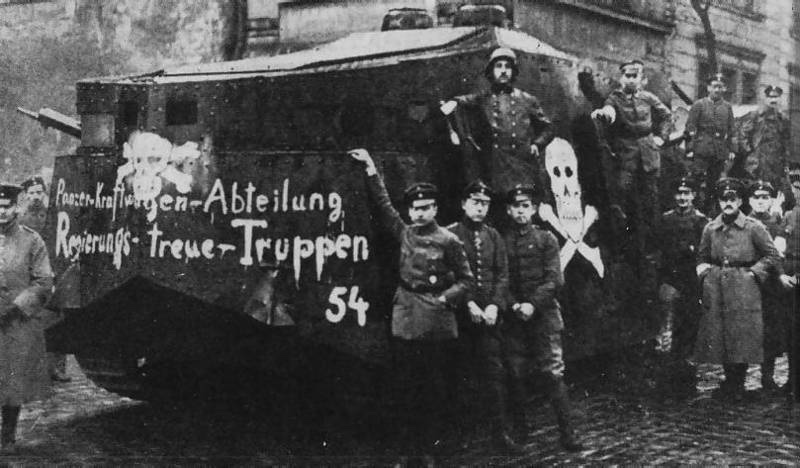
Robert Waite, “Vanguard of Nazism: the Free Corps Movement in Germany 1918-1923” (1969) – This one is an early stab at the history of the Freikorps, the right-wing paramilitary formations that arose in Germany after its defeat in World War One. As the title indicates, the Nazis recognized the Freikorps as crucial forebears (didn’t stop them from killing numerous Freikorps big shots in the Night of the Long Knives, but that’s fascism for you) in important regards, both practical and inspirational. The whole gist of Nazism — basically, mass violence to instantiate imagined past glories that the previous, duly constituted protectors of the values of bygone days were supposedly too ineffectual to regain — was indeed prefigured by the Freikorps.

In the book’s best chapters, Waite — a WWII veteran, longtime beloved teacher at Williams College, and guy who eventually tried to psychoanalyze Hitler decades after Hitler’s death — traces how the Freikorps ethos came directly from elite formations in the WWI-era German army. Units of “stormtroopers” deployed to stealthily and violently overtake enemy trenches developed their own culture, separate from the German army traditions of obedience to duly appointed authority, rational planning, strict hierarchy, etc. It’d be wrong to say the stormtroopers, and the Freikorps after them, exactly subverted these ideas- they just reapplied, and in some circumstances super-charged them, to fit the extreme circumstances of the trenches (or, later, collapsed post-defeat Germany). So they were still quite obedient and hierarchical, just to the baddest dudes in their little group, not to graybeards on the general staff, eager to fight but for “the German spirit” and increasingly for the sake of the violence and not (just) because they were told, etc. The similarities between the culture of these elite troops and those of certain other elite military formations (who also failed to win their war despite their big reputations) suggest themselves readily.

So far, so cultural, and it’s worth noting that other factors, like the pan-Germanist movement, helped prepare German right-wingers for the idea that while hierarchy is always a great good, extant hierarchy might not be the most legitimate. When Waite gets into the Freikorps’ practical effects, stuff gets interesting in a different way. Put bluntly (and I finished this a while ago and am trying to clear a backlog so blunt it shall be), Waite is a Cold War liberal and a guy who believes in totalitarianism School notions, so tries to thread the needle between “the Freikorps are obviously bad” and “well, SOMEONE had to restore order in Berlin!” You can tell he has a certain affection for Gustav Noske, the Social Democrat who first called on the Freikorps, in many respects created them along with the Army generals (though I’d bet something like them would come about anyway) and sicced them on the SPD’s rivals to their left. Waite seems to see Noske, a former army sergeant himself with, errr, a substantial respect for order, as a tragic figure. If only he’d have had the foresight to reign them in somehow! Isn’t it sad how they clubbed Rosa Luxemburg to death! But, you know, there was looting, and you just can’t have that, and they did a general strike after the Freikorps tried to overthrow the SDP’s asses, that was cool, right? He cites the memoirs of Freikorps leaders sometimes as sole sources when talking about revolutionary conduct, like revolutionary sailors supposedly taking random women and children hostage when faced with the army in Berlin. It gets pretty bad in some places.

I’m used to the way a certain kind of liberal — Peter Gay did this too — lionized the Weimar Republic, the “good Germany,” the experimental Germany, trapped between Nazis and Communists, etc. The KPD made plenty of mistakes (that tends to happen when you systematically murder the best leaders in a group) but the equivalency is just wrong and I don’t think I need to belabor that point here. At least those old liberals felt the need to show their work more than contemporary ones do, and maybe meant their hemming and hawing more, meant their disgust with the right, than a lot of liberals do now when they tut tut before handing arms to the Right Sector or shaking hands with whichever ghoulish politician. So you get chapter and verse, as best as you were going to get with the available sources not so long after it happened (about the distance the late seventies is to us now), about the many, many extralegal murders the Freikorps did. When they stormed cities held by workers and soldiers councils, they just massacred people, hundreds of people per city. In cities without ongoing uprisings, they routinely murdered union organizers, politicians, and poor random people who “knew too much” throughout the years Waite covers. Nobody did anything. Almost none of them went to jail, and fewer still for serious time. The SDP, who had militia of its own, never really took the fight to the right, and by the time the KPD got big enough, the Freikorps had metastasized into the Nazi Party, a mass movement with support from elites. It’s grim.

“The Proud Boys and the Oathkeepers, they’re no Freikorps!” I can hear some of you say. Well, take what comfort in that you can. They clearly want to be- they dream what the Freikorps did. If you told a German of 1913 vintage that clubs of demobilized soldiers and their college student groupies were going to kill thousands of civilians in Germany proper in a few years, they wouldn’t believe it, either. All it took was the right crisis. I intend to keep our local fascists in a place where they can’t take best advantage of the crises we know are coming down the pike. Let’s keep them wannabes. ****

Review – Waite, “Vanguard of Nazism”

Review – Leach, “Land of Desire”

William Leach, “Land of Desire: Merchants, Power, and the Rise of a New American Culture” (1993) – Stores are weird! I’ve seen medievalists shake their heads at the internal economy of Dungeons and Dragons, where a medieval society has set prices in what amounts to a stable, global currency and you can just go to a sword store and buy numerous kinds of sword (or a magic store and buy magic!), which isn’t at all what went down in pretty much any society until quite recently. Means of production go a long way towards determining means of exchange.

The means of exchange my generation and that of my parents (to a lesser extent my grandparents – maybe to an even lesser extent the generations after mine?) take for granted came about due to peculiar social and cultural circumstances in the nineteenth century. It is these circumstances that American history/American studies guy William Leach interrogates in this book I was supposed to read for a long ago comprehensive exam. Coming at us from the early nineteen nineties, it also partakes of some odd historical politics of consumerism and independence.

The story goes, Leach tells us, is that most Americans up until the 1880s or so made a lot of their own stuff, and the stuff they bought they usually bought from speciality stores. One exception was the “dry goods” store, but those were generally small and local. Most of the people who wore clothes made outside of the house were either quite rich, who got tailored clothes, or the very poor (including slaves), who got cheap mass-produced stuff. Similarly, the idea of buying a toy would seem odd to most Americans, according to Leach- you just made kids dolls or whatever with what was around.

But America’s booming industrial economy raised the specter of “overconsumption.” Industrial giants were frightened they were making too much stuff, too cheaply, and didn’t have enough buyers. As Leach points out, this fear didn’t make a lot of sense, as many consumer markets only came into being once producers realized there was such a market — there was no toy glut, for instance, they weren’t making that many toys because there wasn’t a market — but it’s evident that’s what a lot of businessmen worried about. In classic cultural history fashion, Leach is more interested in the affective life than the economic realities of his subjects, and it turns out, these dudes had big dreams.

John Wanamaker is probably the closest thing the book has to a main character, and he was an odd duck. He genuinely believed that the right kind of merchandising technique — a combination of mise-en-scene and sheer abundance, more or less — would not just make him a retailing success, but would prove socially and even spiritually redemptive. If he made his stores sufficiently beautiful, shoppers (and employees!) would be uplifted to dream of better things, to realize the true oneness of everyone under a beneficent God, etc etc. Rather than the dusty, dimly-lit dry goods store, you would get a gleaming, glittering, brightly-lit utopia where you could get everything you needed, or wanted- the department store.

Other department store moguls, like prime bastard Marshall Fields, didn’t have such airy notions, but they knew good business when they saw it. People liked light and air in their stores, and they liked one stop shopping. Boston’s own Filene’s pioneered having literal multiple levels for multiple classes, including “Filene’s Basement” for the hoi polloi (which became its own spinoff store, which outlasted the death of the original Filene’s by five years). It was a genuinely new form of privatized public space, and it used to include all kinds of amenities, including musical productions, what amounted to daycares, and multiple restaurants (like the cheap department store lunch counters that became the site of some civil rights protests). This was in marked distinction to the first draft of the department store, which began like so many novelties of modern history in France- French department stores were for the elite. The American department store brought an elite experience into reach for millions.

Were people spiritually uplifted by all this, like Wanamaker thought? It’s hard to say, exactly, but I’d actually say the Simpsons provides us with a better word: Americans were “embiggened” by the department store. Probably more than anything save the introduction of motion pictures, department stores altered the visual sense of Americans and eventually people throughout the world in the late nineteenth and early twentieth centuries. So many of the features we take for granted in indoor public spaces have been standardized from the department store model. Most of those things — the lighting, the cleaning, the sonic environment, the relationships between staff and customer, the standardization/customization dichotomy — either only existed for the wealthy or didn’t exist before the department store put them all together. Let’s put it this way- it makes sense, in more than a simple cause-effect way, that our version of celebrating the birth of Christ is largely the product of early twentieth century department stores, from the fusillade of gifts to the centrality of Santa.

As far as Leach’s take on all this, it’s mixed. He’s best when he’s not prescriptive. Getting into the weeds of the odd visions of people like Wanamaker and L. Frank Baum (who produced department store displays before he wrote his stories of the consumer utopia of Oz), he’s quite good, and helps you see that while their visions were strange, the shift they took part in was so fundamental it would be hard to be entirely normal about it. But between the rising anti-consumerism in nineties culture and the hangover of republicanism studies in the eighties, Leach foists some odd value judgments.

Where did the independent yeoman of yesteryear go, Leach lamentingly wonders? He went shopping at Macy’s and that was the last we heard of him! He could have kept his independence if only he made his kids play with corn husks instead of plastic! I’m of a few minds here. On the one hand, many of our consumer practices are environmentally unsustainable. On the other, I think nothing is too good for the working class, that consumption can be fun (if possible to undertake joylessly) along with being inevitable, and can make some private luxuries available to all, especially if we make communal luxuries too. In the last analysis, I’m not sure it’s good history, on top of everything else, to lament department stores as killing independent producers. Capitalism did that. The people going to these stores worked in large capitalist enterprises and couldn’t just make their own shit, certainly not as good shit as factories could. I actually think that degree of specialization isn’t necessarily a problem, whatever classical republican economic ideology might say. The problem is who controls the work, and who gets the fruits. Once we have a means of production that settles that the right way, then we can make means of exchange that work for all of us, too. ****

Review – Leach, “Land of Desire”

Review – Rhys, “Good Morning, Midnight”

Jean Rhys, “Good Morning, Midnight” (1939) – There were a lot of ways for your twentieth century to suck. While lacking a certain “genocide” quality, one pretty bad one was to be a talented woman in one of the roughly umpteen “epoch-making” art/culture scenes of the century of my birth. Seemingly all of them, whatever their political pretenses, were real boys clubs, and the only women they wanted around weren’t there for their direct artistic contributions. These scenes tended to be both profoundly socially incestuous while also full of strangers whose best motives were gawking and whose worst were bad indeed Throw pretense, money, drugs, and other twentieth century party favors like intense ideological posturing into the mix along with the misogyny and fame, and it’s not a fun scene.

Jean Rhys did not have a fun twentieth century. She came from a white creole family on the tiny Caribbean island of Dominica, and crossed the Atlantic for education, socializing, and art. Her father died when she was young and she may have made her living as essentially a high class escort — the lines could be blurry (still can, I imagine) — until she had a stroke of luck, of sorts. She started writing and her stories started garnering praise from big shots like Ford Maddox Ford. This was at the height of the Jazz Age, and she lived it up while she could in London and Paris. But she was always a little too stringent for the fizzy/tragic Fitzgerald-esque party, it seems. She didn’t do gazing out at the lights, she did gazing into the black. Her characters didn’t lose themselves- they knew just where they were, and it sucked. She never pretended that money, status, and pain weren’t basic realities of life as she knew it.

This did not endear her or ensure her popularity with readers looking for the usual Jazz Age tropes. She was managing a living with her second husband, looking back at the bad (or anyway, worse- I get she wasn’t happily married exactly) old days when the money started to run out, when she was writing “Good Morning, Midnight” – and, in a struck of bad geopolitical luck, the war hit and no one wanted to read about sad decaying women in a Paris that would soon have bigger problems.

That sucks, because it, and everything I’ve read of her describing life in London and Paris in the interwar period, is great. It’s raw and affecting. The narrator is stuck, stuck by her failed marriages, her inability to do much, the positions both mainstream society and the bohemian fringe assign to women. One of the worst places to be, as far as relatively lucky nationalities like Anglos (not poor inhabitants of the real killing fields in Eurasia, say) at that time was in the declining middle class. You didn’t have any real ability to work for money — you often effectively couldn’t — but you didn’t have enough money to go on, especially if you were on the outs with family.

The narrator has burned every bridge, or someone burned it for her. Every cheap boarding house or dress shop in Paris reminds her of another failure. She meets people, including men who at least pretend to want to help her, but can never know their real motives, and worst of all, she’s starting not to care. She mulls over drinking herself to death, or just making life as tiny as possible — stay in her room, live off of coffee, bread, and regret — not so much as an economizing measure as just to live in accordance with her inner self. It’s a brutal read, but I love it because it seems real in ways that flashier depictions of inner failing and falling don’t. Rhys eventually won international recognition when she was in her sixties for “Wide Sargasso Sea,” a retelling of Jane Eyre from the perspective of the madwoman in the attic (another white creole from the Caribbean who had a miserable time in England). When interviewed about her newfound success, she dismissed it as too little, too late. Ouch. *****

Review – Rhys, “Good Morning, Midnight”