China Miéville, “Embassytown” (2011) – I’m probably going to do a video on this! With a special guest star, as part of a new thing I’m doing. But I still figured I’d give a review.
China Miéville seems like a pretty cool type, genuinely committed to both genre fiction and to revolutionary socialism. In “Embassytown,” he does more or less straight up scifi! Though of course, Miéville seems the type to dislike having the phrase “straight up” ascribed to his writings, and there’s more than a little horror in here as well. In humanity’s future amongst the far-flung stars, there’s a settlement called Embassytown! It’s a little human spot on a planet dominated by a species they call the Ariekei, or the Hosts. In classic Miéville style, the author enumerates their many gross-sounding features but does not give a clear picture of what they look like. Roughly deer-like moss-bugs with coral extrusions that hold their eyes, multiple pairs of wings that are actually ears and/or arms, two mouths, various slimes, you get the picture. The Ariekei and the humans live more or less peaceably, with the humans sticking to the town with its breathable air and trading stuff back and forth, mostly goods the Ariekei biologically engineer.
The Ariekei speak a language, or rather, Language. It has two important features: first, they talk it out of both mouths at the same time, with said mouths each making different noises to make one word, and second, they can’t lie. Speech is thought for them, and vice versa, and they can only think/speak stuff that actually is. They have no word for “that,” for instance, just ways to specify what thing they are talking about. This creates communications problems! They couldn’t communicate with humans at all until the human started breeding people as twins of such a high empathy that they basically think the same thoughts? Or something? And can speak sufficiently in tandem to speak Language. Then, the Ariekei can understand. These twin pairs are called Ambassadors, and they and their handlers more or less run the human show on Embassytown, though a vaguely Hanseatic-themed human confederation technically has it as a colony.
Woof! All this happened in the past of the novel. In the present day, Avice is a child of human settlers who grows up on Embassytown and goes on to become an “Immerser,” which is to say, she can navigate the eerie nether space that is Miéville’s way of getting around the light barrier. She comes back with a linguist husband named Scile (who she doesn’t sleep with?) who is intrigued, naturally, by Language. Avice is also a simile in Language. In order to do similes, the Ariekei need for the thing they’re invoking to actually happen. So, using a human intermediary, they draft the child Avice to do a thing. She didn’t like it, which probably has to do with why she went out to space. But she returns to Embassytown just in time for a power play- the metropole sends a new type of Ambassador. They’re not twins! Just two guys! But it turns out that their Language is such hot shit that the Ariekei get addicted to it! Fuck!
I’m being a little facetious in my descriptions, as I seemingly can’t help but be with Miéville’s flashily “subversive” cleverness, but it’s a cool idea and it works well. It also ends a long middle period where the book wanders a little, as Avice slowly describes herself getting enmeshed in weird power/Language politics, with Ariekei who try to learn to lie, with other simile-children, with her husband and his increasingly unfortunate ideas about it all. But shit kicks off once the Ariekei get a load of EzRa (the Ambassadors all have names that are names that are also combos of names or at least nicknames- CalVin, DalTon, MagDa, etc). They quickly need to hear EzRa (who I don’t imagine as my friend Ezra, he’s a lot cooler) to function. And then they build up tolerance. And then EzRa refuses to fully cooperate with the other humans, because they’re fucked up and like being, as Miéville puts it, a “god-drug.” Then the Ariekei technology, seemingly all congealed out of bio-soup similar to that which the Ariekei come, get addicted to EzRa, and build up tolerances, and stop functioning, etc.
Soon shit starts to be some weird space-alien-drug-language-zombie-apocalypse situation! It’s pretty cool. You can’t ding Miéville for invention. The day gets saved, sort of, by some inter-species communication and language stuff. I’m not going to get too much into it, both to avoid spoilers, and because I want to get into the questions I’ve got with my friend on video! Stay tuned! ****’
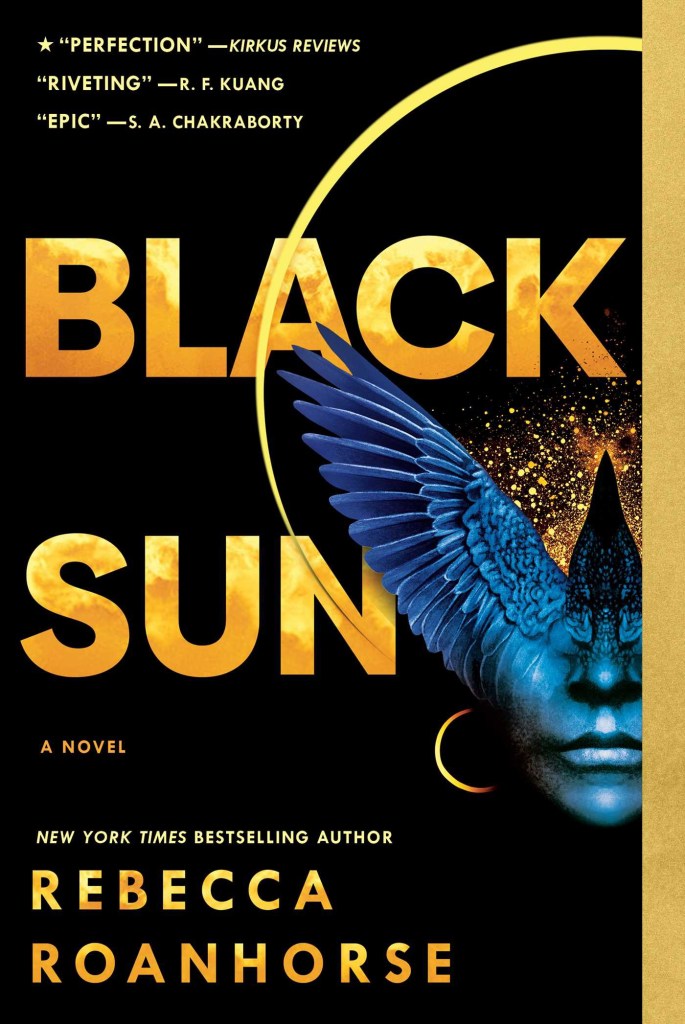
Rebecca Roanhorse, “Black Sun” (2020) (read by several actors) – I didn’t especially like this novel, one of the most hyped and praised fantasy works of the last few years, but more than even most books, it’s impossible to separate my reaction to it from broader context. “Black Sun,” like many speculative fiction novels in the last five to ten years, is meant to be a great victory for inclusion and new perspectives in its genre. Set in a secondary world based on Mesoamerican and Southwestern Native American history and mythology and written by a black woman who claims membership in one of the Navajo nations (according to Wikipedia, said nation disputes this claim), it promises a new departure in fantasy. No more “white farm boys going on quests,” as Roanhorse put it in one interview, no more whiteness-as-default. This was going to be something new.
Well… it isn’t. It just isn’t. It’s the same old fantasy crap with vaguely Mesoamerican trappings, and really, not that much of that. Special child of destiny, blah blah, Han Solo-style outcast rogue, etc etc, the world is on the precipice of dangerous transformation, yadda yadda yadda. And you know… that’s fine, I guess. I don’t love it, I don’t hate it. I like to paraphrase Adam Clayton Powell’s reaction to the Mafia hijacking of the illegal lottery in his district: “I am against the numbers in any form, but until the numbers aren’t played in Harlem, I want the black man to have the same chance to profit from it as the Italian,” or words to that effect. As long as anodyne same-same bullshit is what we’re doing, women, people of color, queer people, marginalized people of all kinds, deserve the same chance to write banal fantasy novels as anyone else, and throw in the same bowdlerized versions of what they think of as their culture as any white guy doing his Wagneresque nonsense.
But like… what a wasted opportunity! A Mesoamerican-based fantasy novel that actually tried something ambitious could kick ass! Hell, there probably are some… they’re probably out of print and don’t have social-media-active authors and/or fans to do shitty publishers’ promo departments’ work for them… but I do think it’s worth thinking about, with this explosion of interest in diverse representation in media, and at least some understanding of the histories and patterns of thought of historical cultures, why we get stuff like “Black Sun” instead of the more interesting works we should be able to expect.
Let’s start with what is missing in “Black Sun.” The plot is hackneyed and poorly-paced, the language dull, and the imagery not especially creative, but those problems are surmountable (though in descending order). What’s really missing is any sense of difference in the world. The characters act, talk, and think like genre stereotypes, though admittedly genre stereotypes of our time rather than the ones from days of yore by which we’re supposedly inundated. There is no indication that this culture, based, supposedly, on entirely different roots than European culture, produces different thought, or social structure, or really anything, even aesthetics. Roanhorse depicts the characters as dressing a bit different than standard Renn Faire garb, but you’d figure the one thing the author of this sort of work would nail down would be that the world would —look— different, and she doesn’t manage that. I thought the whole basis of this stuff was a sort of bourgeois liberal variety of ethnic essentialism, a kind of Twitter-bound Herder’s sense that every group has a unique way of thinking and seeing the world based on culture, environment, heredity, etc., but you don’t see any of that here, and you don’t see it in works that play similar roles but with different ethnicities represented, either- in or out of genre fiction. It’s maddening!
Some of the problems are not unique to the failures of the liberal representationalist model in genre fiction, but are broader problems, especially in SFF. There’s a lot of worldbuilding and it’s not done especially gracefully, and again, Roanhorse has the opportunity to make a world that seems really different — that has a different lived-in experience than however many Middle Earths and Westeroses — and whiffs it. The world isn’t the most laboriously built-out one you see these days, to Roanhorse’s credit, but it possesses the schematism that characterizes a lot of contemporary SFF worldbuilding. What I mean by that is you wind up in a world that may have secrets, but is otherwise ordered in rather rigid categories, worlds that could very easily be summed up in charts. You have these nations (that should be a worldbuilding gimme- it should not be new news to people who went through liberal education recently that the nation state should not be taken for granted!), you have these factions, these gods, and this type of person is characterized by X, Y, and Z, while the other type of person from whatever faction can be characterized by A, B, and C, on and on.
Tolkien’s worlds weren’t like that- Gygax, Arneson, et al had to do a lot of work to rationalize his world (and Moorcock’s, and Vance’s, and who knows how many others) into playable schema. To say there’s been a dialectic between games and SFF writing might have been accurate in their day- at this point, the overlap is nearly comprehensive and defines SFF writing more than it does games. This isn’t a problem in and of itself- some good fiction has been inspired by games. But it can be a problem when the schematic categories of gaming come to define, in an insufficient critical way, worldbuilding, and in some cases character work and other aspects of writing. It doesn’t help matters that some of the most successful franchises of all time are heavily schematic: Harry Potter and it’s houses, Game of Thrones and it’s factions, on and on. It doesn’t help that such categorizations loan themselves readily to the kind of fandom identifications that help drive sales (you have to figure the recent craze for astrology plays into this dynamic too- “I’m a Taurus Ravenclaw etc etc!”), – and to the sorts of stories — star cross’d love across the ill-delineated faction lines being most prominent — that people want to read (over and over again). I don’t know if whole online communities are going to start delineating themselves by Roanhorse’s four castes of the academy of the holy city or whatever just yet. I can’t say whether Roanhorse wanted that to happen when she wrote the book, or that it matters- because that’s the thing with tropes and cliches, it’s not some conspiracy. It’s just the path of least resistance.
It seems that a community of fiesty critics and writers have arisen that share some of my issues with contemporary SFF, and they have recently taken to describing the dominant strain in it these days as “squeecore.” These critics name the following as the traits of squeecore: a shallow emotional range that mostly does either maudlin or glib; heroes who feel like adolescents even when they aren’t; genre send-ups that were stale twenty years ago; aversion to the dark or strange; influences from anime and video games; humor “stuck in the aughts”; superficial dedication to diversity and other liberal values, generally affirmed by the triumph of the hero. The original promulgators of this critique were maddeningly unspecific about who they had in mind, and mostly only named big figures well outside of striking range (like Joss Whedon).
I think the concept is a valuable contribution to the critical discourse, but could use some work. There’s a certain “opposite day” tendency in the criticism that sees qualities lacking in squeecore — mainly darkness and sexiness — as the sine qua non of quality genre fiction and as lacking in the unfortunate SFF of today. I don’t think that’s quite right. Maybe it’s not the quality of darkness and sexiness they want, but you can’t say that “Black Sun” doesn’t do dark, or sex. It’s just anodyne, predictable, and even if the situations — the inevitable world-doom/structural oppression combo the heroes will fix however many bloated books in because hashtag-love-wins; the sexual politics ported in straight from contemporary Twitter — weren’t so hackneyed, the writing is not up to the task. Dark and sex won’t fix the problem, and really I think few aesthetic fixes will. But maybe I think that because my aesthetic sense is limited. My solutions are pretty limited, as well- learn more, I guess? Challenge yourself? A ruthless criticism of everything existing? Maybe that would help me critique contemporary literature more effectively but something tells me it is, to borrow a phrase from one of my critical masters, shooting nerf darts at a T-Rex.
Because why should Rebecca Roanhorse or her many, many readers care? Why should they challenge themselves? Why should they be more critical? They’d clearly rather not. It won’t win you any popularity contests- you’ll still deal with the same chuds who hate anything thoughtful, even anodyne liberalism and boring writing, plus all the anodyne liberals and boring writers will hate you, too. And it’s not like Roanhorse wrote a bad book, just a mediocre one. And the world’s burning and emerging fascism etc etc. I get that. I will say that I think many of the same faculties that could maybe get us out of the whole “burning world” business with something like civilization intact are the same that maybe might get us a better literature, genre and otherwise. Similarly, I think that a lack of imagination, of criticality, and of ability to take on a range of difficult emotions and ideas, and the complacent belief that because you’re not awful then you must be good enough, really isn’t helping, anywhere. **’
Heather Ann Thompson, “Blood in the Water: The Attica Prison Uprising of 1971 and Its Aftermath” (2016) (read by Erin Burnett) – The Attica uprising is another one of those historical things I’ve known about and been interested in forever but can’t put my finger on when I learned about it. It might have been when, during an attempt at becoming a “film buff” in my late teens, I watched “Dog Day Afternoon” and got to the famous scene when Al Pacino riles the onlookers to his bank siege with a chant of “Attica! Attica!” and then I went and looked it up? It might also have been before that- it feels like it was always in the background, an artifact of a strange but not entirely disappeared time.
Seeing as the first group of people who got to tell a public story about Attica — the officialdom of the state of New York, led by then-Governor Nelson Rockefeller — lied about the situation from stem to stern, historian Heather Ann Thompson had her work cut out for her in writing the first major academic history of the uprising and its aftermath. This is, in some respects, an old school social history, an excavation of the history of the downtrodden made possible by intensive spadework through old, and in this case long-suppressed, sources. Among other things, Thompson’s access to long-hidden or censored state records allows her to show that the state, from Rockefeller on down, purposefully lied about what happened at Attica for decades.
Attica Correctional Facility is way out in the depths of western New York. Life was bad there. The prisoners were mostly black and Puerto Rican from the city, while the officials and guards were almost all white and rural. More than the harshness of conditions — shitty food, overcrowded cells, hard labor (to the great profit of the State of New York) — there was an inconsistent, martinet quality to life at Attica that wore on the men. It was impossible to follow all of the many rules, seemingly inspired by encrusted layers of discredited penological theories. So the men were routinely given beatings or isolation by guards who made clear their racist contempt for their charges, generally for minor or even unavoidable infractions of petty rules. This has an echo in the petty stupid charges that landed a lot of young people in the hellhole of Attica in the first place- joyriding, minor theft, above all violation of parole, and something tells me parole violations were as impossible to avoid in the slums as infractions are in the prisons.
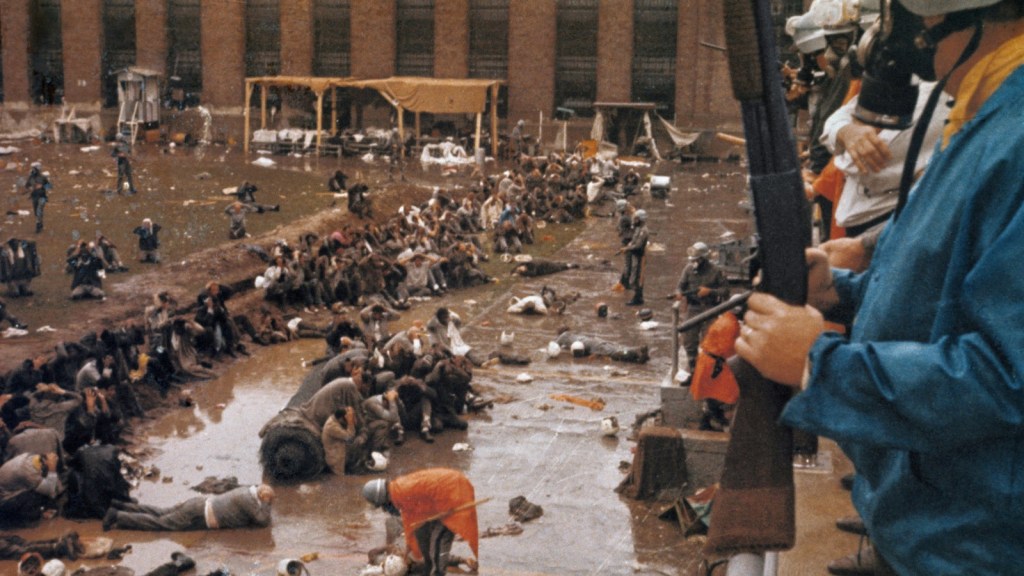
Thompson does not believe that prisoners planned the Attica Uprising, which began on September 9th 1971, ahead of time. Basically, a guard started beating a prisoner while lining a group of them up to go to a meal or exercise, I can’t remember which. The guards had already taken away a number of prisoners for severe beatings as retribution for complaining about conditions in the nights previous, and something snapped. The men attacked. They seized control of the central yard of the prison and several cell blocks. A guard would later die of injuries incurred during this initial attack. The prisoners took forty-two guards and prison officials hostage.
After an initial period of chaos, both sides of the conflict found leaders, or anyway, spokespeople. The prisoners established a rough sort of democracy, led by a council of respected men, many of them drawn from the radical milieu in the New York prison system: Black Panthers, Young Lords, various black Muslim groups, a few white radicals like “mad bomber” Sam Melville. As for the state, you could almost see it as this symbolic tableau- notionally “well-meaning” vaguely-liberal officials, like state prisons commissioner Russell Oswald, trying to manage the situation while a small army of frothing mad prison guards, state policemen, and sheriff’s deputies roiled in the background, demanding blood.
You can guess who won out in the end, both between the prisoners and the state and between the state officials who wanted, at least a little, to avoid a bloodbath and the reactionary mass of gun-thugs beneath them. For three days, the prisoners tried to negotiate with the state. The state sent observers, mostly journalists and politicians, to discuss matters and to report on conditions inside the yard. The observers got a mixed picture. Someone — Thompson isn’t clear on who, and doesn’t seem interested in finding out — killed three inmates during the time between the Attica rebels taking control of the yard and when law enforcement took it back. Moreover, the demands that the prisoners came up with included some that were basically politically impossible, like a plane to a “non-imperialist” country (one wonders how their lives would have gone had they somehow made it to Cuba or Algeria). But the observers were also surprised and heartened to find the prisoners on good order, taking care of each other and taking very good care of the hostages (indeed, showing more care than the state showed, either before — like when the rebels tried and failed to get the state to take a head injury of a guard seriously and he died — during or after the retaking). Most of the demands, as Commissioner Oswald readily admitted, were reasonable: better food, better pay for their labor, more education, not throwing any mail in Spanish in the trash, etc.
Any situation like this has numerous factors that go into its outcome, but I think we can say that the end was “overdetermined.” Thompson raises hopes — that at certain points communication really happens between the different sides, that this or that interlocutor will come and fix things — only to dash them against walls made of institutional indifference, miscommunication, and bad luck. Pretty much no one comes out looking good, even if the Attica rebels come out looking better than the picture of savage criminality the state would try to etch into history. It’s hard to do direct democracy, and the rebels made some mistakes with it, but given the strains… Black Panther leader Bobby Seale looks pretty bad, too, briefly coming in and harming negotiations by making miscommunications, refusing to clear them up, and then begging off by saying that his party wouldn’t authorize him to do anymore.
But no one looks worse than the New York State Police and the man who sicced them on Attica, Governor Nelson Rockefeller. Rockefeller comes off as something like the deus absconditus of gnostic myth, the lousy god who set up bad situations and then disappears, aloof off in the celestial aether. His own people, like Commissioner Oswald, begged Rockefeller to come to Attica. No one thought he’d talk to the rebels directly, but at least they could have taken the negotiations more seriously. But Rockefeller refused, and left the worst possible people — State Police commanders and his personal fixers — making calls. Ultimately, Rockefeller had his eye on the White House and didn’t want to look “weak in crime” if he was going against his old foe, Tricky Dick.
Almost worse, to me, was Commissioner Oswald. I don’t expect any better from a Rockefeller, even if liberals long for the day of supposedly-sensible “Rockefeller Republicans.” But you can see in real time Oswald going from patronizing, but seemingly sincere, reformer to angry martinet, irked enough by the men he thought should be under his control displaying their agency past what Oswald thought the limits should be that he ultimately signed off on a massacre. Maybe he thought the cops and guards flocking to Attica to get their piece of prisoner flesh would off him if he held off much longer- certainly they were putting pressure on the situation. Rumors circulated that the rebels in the yard were setting up gallows and bombs, that they castrated guard hostages, on and on. All bullshit of course… and in the end, Oswald served his function, as he probably always would have.
The state, as Thompson told it, had effectively regained control of the yard just after a National Guard helicopter dumped something like CS gas all over the area. No one was resisting at that point, just blindly scrabbling around. The cops and guards who rushed in had no training for this situation and inappropriate equipment- shitty gas masks and goggles, shotguns loaded with buckshot, hunting rifles. Of course, the assumption behind that sort of thing is that the sort of “best practices” used by contemporary militarized and lawsuit-leery cops are what they’d want in any event. But the guards, state cops, and sheriff’s deputies who stormed Attica went in wanting to kill. They liked what buckshot did to the bodies of prisoners. That they — and they alone — killed nine hostages with their gunfire does not seem to have bothered them, at the time or after. They were too busy, first executing several prisoners, including leaders Sam Melville and 21-year-old Black Panther L.D. Barkley, as well as torturing the surviving rebels, and then beginning their campaign of lies and cover-ups. By the time it was all over, forty-three people were dead, thirty-nine of them killed by gunfire from the forces of the state. No hostages were killed or seriously harmed by their prisoner rebel captors.
Nelson Rockefeller went on a press conference and said the prisoners had cut throats of and castrated hostages. The state smeared its own employees, medical examiners, when these examiners pointed out that medically, this did not happen. But, in certain respects, it was an atrocity-coverup combo whose time had come. This was just as the conservative reaction to sixties/seventies militancy started gaining steam. It was probably also the moment in American history where sympathy for mostly black and brown prison rebels would have been highest — witness the multiethnic crowd who responded positively to Al Pacino’s “Attica!” chant — but that left was fragmenting under the pressure of state suppression and the challenges inherent to what they, we, do. The state’s story could become enough of an official story for the state’s purposes.
Like I said, Thompson does this book old-school social history style, so it’s granular and sticks close to evidence. This pays a lot of dividends in the first half of the book, which traces the roots and the story of the uprising. It begins to become a diminishing returns situation in the back half, which covers the efforts of Attica survivors — prisoners and hostages both — to get some justice. The fact that this took up half of the book kind of shows the problem. Thompson does a fine job illuminating the legal back and forth that dragged on into the first decade of the twenty-first century, but it simply isn’t as interesting as the uprising, and there’s less to learn for it. The state obstructs justice, realistically if not according to the letter of the law, when money and reputation are on the line- this could have been gotten across more briefly. I think it would have been interesting to have seen more about how the uprising influenced the broader movement for prisoners rights, and, god help me, the culture at large. Most of the time I root for social history over cultural history when they compete nowadays, but Thompson could have used a skosh of the cultural approach in this one. Still, this is a very good and exhaustive book on an event that still resonates today. ****’
Clarice Lispector, “The Complete Stories” (2018) (translated from the Portuguese by Katrina Dodson) – I think I get it. This isn’t really “for me.” Clarice Lispector is hot new shit in certain literary circles, despite (?) having been dead since 1977. Born into a Jewish family in the Ukraine, Lispector’s family made the smart move of getting the hell out of there before the wheels came completely off, and Clarice was raised a middle-class Brazilian. She became a literary success early on, and a social one too, moving in Brazilian high society and marrying a diplomat. The biographical details are mainly relevant insofar as they inform the glamour that has wrapped around Lispector’s name, first in her native Brazil, and then in anglophone literary circles as her work came to be translated. I’m trying to find a generous way to say it, but basically, I think there’s a lot of hype here. Divide Latin American literary hype — breathy, exotic, not your granddad’s dour (or sappy) northern hemisphere literature — by the sort of hype that surrounded the recently-deceased Joan Didion (harshly “literary,” and a beautiful elegant woman readers can project themselves on to) and you’re more or less there.
Well, I read Lispector’s short stories, supposedly her most accessible works- apparently she really gets into some modernist weeds in her novels. They weren’t bad, necessarily… or maybe they were and I’m just trying to be “nice.” They were mostly tales either of cities being weird and surreal, or women dealing with bad men, or both. The language is supposed to be “lush” but I can’t say I experienced it that way. The stories are more notable for what they lack- no moral or “point,” especially not a political one, and you have to imagine contemporary literary readers breathing a sigh of relief on that score. Not much in the way of character, often anonymous men and women described by surface characteristics and behaviors. You can’t really get avant garde points with a focus on character, anyway, or plot, which the stories don’t really have either.
What do they have? Well, a vague air of tropical decadence- cf my notes about “Latin American literary hype,” anglophone and Western European readers have been looking to Latin American writers for that at least since “The Boom” in the mid-twentieth century. It’s ushered great writers onto the global literary scene, this literary escapism. Who knows, maybe Lispector is one and I’m too much of a literal-minded lunkhead to enjoy! Kinda sucks that the best they can find to renew that source of interest in world letters has been dead longer than the people “discovering” her have been alive, but thems the breaks, I guess. I was never that much of a stickler for “show don’t tell” but Lispector does a lot of telling about people’s inner states. There isn’t much here that sustains my interest, I’ll admit.
Shot in the dark- as Dril put it, “this whole thing smacks of gender!” Not in the sense that Lispector’s work is where it is because she’s a woman or something stupid like that. I mean in the sense that many of these stories comment on gender relations in a groove well worn by millennial thought on the subject. The bad men with whom Lispector’s protagonists deal aren’t dissimulators or opportunists like many abusers. They advertise themselves as the nihilists they are, the protagonists find themselves irresistibly drawn into their orbit, and are usually changed in some way- and callooh, callay, a miracle! In the differently-moraled global south they don’t jump immediately to “the woman gets murdered” to send the point about bad men home. In fact, they seem empowered by the experience, to use a term Lispector would probably stick her arm in a bear trap rather than use. Not by sticking with the bad man, oh no. Just in general. They’re badder and vaguely witchier.
From the cheap seats of cis manhood, it appears the great comic theme of millennial women’s writing — and men, especially straight men, keep saying things but have less and less to say that transcends the level of overly-elaborated grunting, so most writing these days is done by women — is that you can be gay! The comedy of errors that is compulsory heterosexuality straightens, if you will, itself out and everyone can go off and be happy. The central tragic theme of millennial women’s writing is that most of the time, they either love, or have loved, or will love, a man or men, alas. Lispector stories show the shiftiness of loving men, but, like certain genres less of literature (though it’s there) and more of music and social media aesthetics, depicts a ability one might have to have one’s cake and eat it too by emerging from the tragedy of dealing with our dumb male asses stronger and more independent. Well! I’ve heard worse visions. ***
Carrie Tirado Bramen, “American Niceness: A Cultural History” (2017) – Americans… mean, mean, mean, or… nice?! Well, opinions have differed! And in keeping the modalities of the “new” (well, “new” as in “closer to Foucault than Burckhardt,” not “new” as in… Olivia Rodrigo? She’s a new singer people like, right??) cultural history, historian Carrie Bramen does not come down on one side of the “are Americans nice?” question. That’s not the point. The point of this book is to interrogate how Americans have deployed the concept of “nice” over the course of the nineteenth century, the era in which that overused word took on something like it’s contemporary meaning.
It would also be easy enough to write a history of how niceness, the most banal of positive descriptors, had been used to paper over social conflicts. Arguably, that was a major thrust of bourgeois thought and activity, in the nineteenth century and continuing on to today- the idea that the problem isn’t who has power, but who is nice to whom (see arguments over “civility” in the last few years). There’s a material element to that, too; niceness culture grew more powerful as standards of living rose. “Nice” as in manners is one thing, “nice” as in “nice kitchens, bathrooms, indoor heating arrangements” actually does change lives. You can see why people could kind of drift into thinking that a system that produced all that had to be ok, if people would only behave in accordance with our newly-nice surroundings.
Well, now I’m reporting my own ideas and not Bramen’s. Bramen’s work on niceness is a little more abstract. She has chapters themed around a few contested ideas of niceness. Native Americans- cruel, or nice (see the concept of “Indian giving”)? The smile of the slave- proof of docility, and if so, what does docility mean? Or was it all a ruse to hide their potential for violence? Different people argued different things, mobilizing the tropes of niceness for their own ends. Some cultural historians really can’t get over the way tropes can mean different things to different people. Admittedly, so much cultural analysis is so thoroughly one-dimensional — this trope means this and only this — that you can see why they’d want to nail the point home.
Probably the most interesting throughline has to do with gender and the valuations given to different kinds of rhetoric. Niceness was and is a thoroughly feminized concept. Much of what we’re looking at in this book takes place before the great big gender freakout of the late nineteenth century, when men throughout the white world decided they’d been emasculated and needed to embrace the macho and eschew the ladylike. What we’re looking at is high nineteenth century “separate spheres” ideology. It wasn’t exactly “woke” but it wasn’t as deeply misogynistic as what came after. The sphere of women was, in many respects, understood as key to “civilization,” the source of both progress and power (whereas after the freakout, femininity came to be understood as corrosive to civilization). What you see in a lot of “American Niceness” is the application of niceness as a feminine, civilizing virtue to various groups and concepts, usually by women (Harriet Beecher Stowe is the closest to a main character in this book) but not always. Probably the most interesting chapter to me was the “nice Jesus,” and all the dimensions of that.
Bramen eventually gets into post-freakout territory with the effort to make America’s empire in the Philippines seem “nice,” which it did mainly through two classic American means: sending schoolteachers (a feminized profession) to fan out across the archipelago to teach American-style niceness, and the emphasis a lot of (generally male) American propagandists played on the ingenuousness and self-effacement of American imperialism as compared to the British or German models. Bramen talks some about the relationship between niceness and violence in America, the way that the former apologizes for and covers up the latter, but I think the conclusions she draws here are generally more tentative and not as strongly followed-up-on as other ideas she has. All in all, a decent showing and showcase for both the strengths and weaknesses of the contemporary cultural history model. ****
J.M. Coetzee, “Disgrace” (1999) – This is my first go at one of the living Anglo Nobel Prize winners in literature. Coetzee had moved to Australia by the time the Swedes bestowed the big medal on him, but lived most of his life in his native South Africa, and life in that country seems to be the subject of most of his literary work. A sensitive soul (you’d figure more writers would be, but they’re not), the contradictions and tensions of his homeland press themselves, along with other dilemmas that haunt writerly types, upon his consciousness and that’s how we get this novel.
The main character, David Lurie, is a mediocre man convinced that greatness, at least by association, is his due. A professor at a university in Cape Town, he lectures indifferent students, writes books about poetry which nobody reads, and carries on affairs. His inner space, as related by third person narration, is the endless self-justifying monologue of the overeducated, but not necessarily that bright, man with the usual banal urges for sex, power, and sexualized power. Most of this comes via bowdlerized applications of the ideas and life events of the romantic poets, especially Byron, to his own seedy situations. Eventually, he sleeps with one student too many, and gets the boot. Having no one else in his life, he heads to rural East Cape, where the adult daughter of one of his failed marriages lives on a small farm.
David loves his daughter, Lucy, but doesn’t understand her and is a little bored with her (not unlike how Byron grew bored of one of his own daughters, produced by one of his affairs, and packed her off to a nunnery to die of malaria). We only have David’s judgments to go on, but it seems she’s something of a hippie, a back to the land type, and I don’t know a lot about the course of the counterculture in South Africa. She grows flowers, goes to market, sells them. She partners with African farmers nearby and volunteers to raise and kennel dogs. Apparently roving stray dogs is, or was, a problem in East Cape?
It doesn’t seem too bad, but the air of dread Coetzee continuously conjures doesn’t allow for an idyll. A small gang attacks the farm, steals a bunch of stuff, and rapes Lucy. The attackers are black, and David is convinced that they had help from one of Lucy’s African neighbors. Lucy provides just enough assistance to authorities to make an insurance claim and then clams up, doesn’t make rape charges, doesn’t inform the police when one of the attackers shows up at her neighbor Petrus’s housewarming party. She has decided to blank the whole thing. She won’t change, she won’t move away to somewhere safer, and all of that means working hand in glove with neighbors who tacitly (perhaps actively) helped her rapists.
David decides this is her form of reparations, her way of adjusting to post-apartheid South Africa and expiating her guilt (this is before “privilege” talk became common). Lucy isn’t saying- she knows the old bastard won’t listen or get it anyway. David, with nothing else to do, winds up staying in the little town as well, strumming a toy banjo as he tries to summon up an aria for an opera about one of Byron’s lovers and helping an animal shelter dispose of dead dogs.
Bleak stuff! Some of the critical comments on the back talk about Coetzee “weaving light into the darkness” or words to that effect. I think they’re either wrong or just talking about the prose. Everything is pretty wretched. All the characters are tragic, not just in the debased sense of “quite sad” but in terms of existing in boxes of misery they helped create for themselves. This aspect is amplified by the ways in which David views things from a (self-serving version of) romantic ideology which, if it ever fit any time, does not fit nineteen-nineties South Africa. Even when he makes something like an understandable call it’s for dumb reasons that make you hate him again. When a commission at his university comes together to investigate his harassing a student (and maybe sweep it under the rug), he immediately admits to what he did and accepts the consequences… because of some nonsense about the priority of eros or whatever. Coetzee underscores the uselessness of everything that the academic/intellectual tradition brings to most situations.
Coetzee was vocally anti-apartheid, at least according to online sources, but not especially political- this scans, according to the bleak vision of life presented here. He’s gotten in some trouble with political figures in South Africa who like to paint him as an out-of-touch white man slandering post-apartheid black self-assertion as sexual violation. Well, white self-assertion in the person of David Lurie doesn’t look too great, either, and reaches well into sexual assault territory as well. I do think Coetzee chooses to twist knives sometimes (though, in keeping with highbrow literature, he doesn’t get especially graphic) to get his points across. It’s hard to say what would produce a better situation in his home country (Coetzee has said he moved to Australia in part because of the crime situation in South Africa) and it’s made harder by the way people, mostly on the right but in other political directions too, turn what happens there into a referendum on black-white racial politics more generally. One wants to rattle off the usual solutions, and they’d probably help more than most things. But “Disgrace” hits, at least in part, because of how unflinchingly it looks at the types of inhumanity that seem ineradicable, maybe inseparable from humanity itself. ****’
Gail Bederman, “Manliness and Civilization: A Cultural History of Race and Gender in the United States, 1880-1917” (1996) – This is a good work of history that makes good points, but like some other recent(ish) historical works — thinking Herf’s “Reactionary Modernism” here — suffers somewhat from its own success, read twenty-five years after its release. It has somewhat an inversion of Herf’s problem: his book’s title became almost a cliche, but the arguments within it are varied enough to reach beyond the cliche. Bederman’s work constitutes a substantial pick-blow in the excavation of the sheer weirdness of the white world between 1870 and the outbreak of WWI. None of her phrases or ideas became cliches, and “Manliness and Civilization” still represents vital work, but the text itself tends towards a repetitive thesis-heavy show-and-tell. It probably doesn’t help that Bederman was publishing a decade or so after Herf, which is to say, a decade further into academia’s slide into caution and irrelevance. This was probably Bederman’s dissertation and those are generally cautious and schematic.
Wow! I’m making “Manliness and Civilization” sound bad, and also not saying what it’s about. It’s not bad! It’s good. And it’s about the extended freakout around race and gender that overtook the white bourgeoisie throughout the world in the last third of the nineteenth century, and running into the early twentieth. White men were in decline, people started thinking. They were under siege, supposedly, from the “lower races,” the lower classes, women, and most of all, their own comfort and prosperity. No more could manliness be understood as the sort of relatively sober-sided dispensation of responsibility. No, it had to get aggressive. It had to get primal! It had to rebuke femininity and softness and be outwardly aggressive. In many ways, we live with the masculinity we inherited from this period- it probably helps that mass culture as we know it came about during its high tide. The specifics fade in and out, or soft pedaled and hard-sold depending on circumstances, but the core is still there.
The great thought-worlds of the bourgeoisie draw strength from interactivity and choice-opportunities. I wouldn’t call the big bourgeois freakout “great” as in “good” but it was “great” as in “important and generative.” There was no one set way to participate in the freakout, to combine and recombine the elements. With education and platform, you could do what you wanted with them. Bederman discusses how four important cultural figures played with the central lineaments of the freakout.
Black journalist Ida B. Wells used racialized ideas of civilization to combat lynching. How can white men claim to have a monopoly on civilization (as they now did- earlier variants of civilization-thought were usually also racist but more involved) when they did such notably uncivilized things to black people? Psychologist Stanley Hall got in trouble for telling Chicago schoolteachers they had to let their boy children act like “savages,” on the basis of some needlessly complicated bullshit about how boys act out the racial past of their various races, and if they don’t, they get “neurasthenia” i.e. sad, soft, and potentially gay? Charlotte Perkins Gilman, author of high school classic “The Yellow Wallpaper,” was apparently a racist psycho who thought that she had to stay unmarried so she could focus on uplifting the race, and that the problem with sexism is that it didn’t let women like her advance the white race? And of course, there’s Teddy Roosevelt, who LARPed his idea of white manhood all the way from a sickly boyhood to a belligerent presidency.
These are all interesting and compelling stories. This would probably get a higher rating if Bederman allowed their stories to breathe a little more away from the schemas she cautiously laid out in the introduction (which is mainly about boxer Jack Johnson, who became an obsessive focus for many of these questions- could have used more on him, his case is fascinating). Race, gender, and ideas of “civilization,” the three frames and by god each section will laboriously bring in all three, cite the relevant authorities, tie in with earlier examples, and then say that all that was said, no matter what it does to the flow of the book. Class gets wedged in there with the slightly panicked air of someone who forgot to add the bay leaf to the roast (can you tell this a feeling I have experienced, because I have?). And I’m like… just let loose, Professor Bederman! I believe in you! Hell, I’m probably a victim of having thought too much (and I bet too loosely- I am no expert on the period) about this freakout. If I had read it back during comps when I was supposed to… still. A good and important book! ****
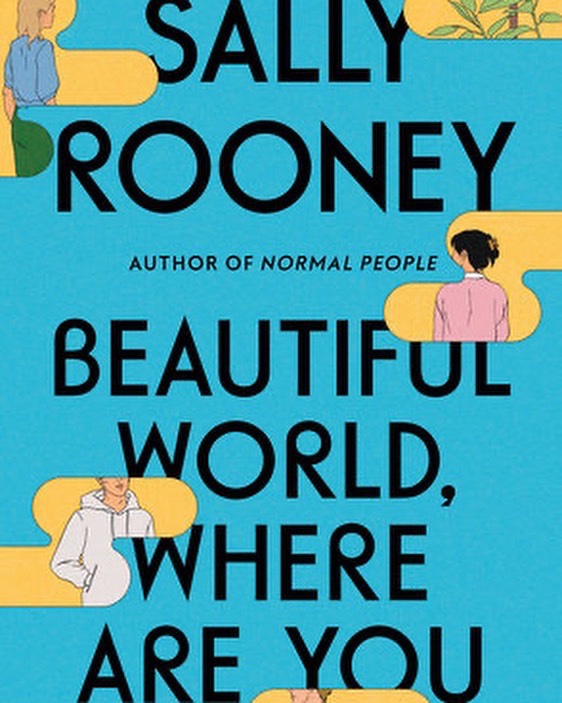
Sally Rooney, “Beautiful World, Where Are You?” (2021) (read by Aoife McMahon) – What does Sally Rooney, the great hope of Millennial letters, have for us this time? Well, once again, a story of two contemporary young Irish people having a mostly bad time. And once again, it’s pretty good. Does it live up to the hype (that Rooney makes plain in this book she wishes she didn’t have surrounding her)? Who’s to say?
As people have pointed out, this one is a little more directly autobiographical, as one of the two main characters, Alice, is a successful novelist, with many identifiers connecting her to Rooney herself. There’s also been speculation on some critics’ part that making Alice so baldly similar to herself was Rooney’s way of maliciously complying with critics who insist most of her female leads are self-portraits. The other main character, Eileen, is not a successful novelist, but toils away at a Dublin literary magazine. They write each other long emails about all kinds of stuff. I used to do similar email chains with people! Maybe, some day, again.
They both have men in their lives, and the men and their reactions to them and the men’s reactions to their reactions cause a lot of grief. Alice moves to the countryside after a nervous breakdown and starts hanging out with Felix, a working class guy. Eileen, for her part, is just one lover to Simon, a childhood friend who is very attractive and has lots of lovers, but both clearly want something more but various things keep them from getting it.
I gotta hand it to Rooney- she really does nail a lot of the neuroticism, here defined as psychological inability to get what one wants, that defines a lot of millennial life, among really verbal people. Felix isn’t as formally educated as the other three but he’s smart and online a lot, so approaches things in somewhat similar ways. All of them somehow manage to think themselves into misery and inability to reach for things, mostly meaningful, honest contact with others. Alice and Felix circle each other like new cats, each convinced the one looks down on the other (and like cats, both are right). Eileen invests tremendous meaning into her relationship with Simon, to such an extent she scares herself into acting indifferent, which then “let’s” Simon go date much younger beautiful women, despite the fact it doesn’t make him happy and a real relationship to someone who knows him well might. What a set of predicaments! They’re not the most exciting or original emplotments in the world. But there is a reality to them I recognize in the people I know, complete with self-aware self-hatred of these predicaments, and how it doesn’t help). Like a lot of stuff I both read and encounter in the emotional life of my age group, there’s a there-but-for-the-grace-of-God (well, really, medicine and “finding my people” early and holding on to them)-go-I quality. It’s tough out there.
Rooney arranges some decent set-pieces- bad parties, bad parties where some good stuff happens, travel. There’s some good will they or won’t they. It’s less will they or won’t they bang — they all have sex, that part is understood — but will they or won’t they make an actual effort to be with someone who makes them happy? For a little while, I was wondering if Felix was a hustler, looking to get money out of Alice, maybe Rooney being a little self-consciously outrageous by summoning up the shade of the class-inappropriate lover. But no, nothing like that. The book was sufficiently interesting and well-written, in a spare and matter-of-fact sort of way, that I wasn’t disappointed that Rooney missed the turn-off into Crime Fiction Land.
Alice and Eileen email back and forth about the Bronze Age Collapse, and how it resembles our times, and how irresponsible it is for them — and for culture — to obsess over individual feelings and relationships when the world is at stake. One of them reads something other than the Wikipedia article on said collapse, and finds that a lot of people in the Eastern Mediterranean probably barely knew it when the palaces who took some taxes from them collapsed, or were occupied by new Sea People or whatever. They went on living their lives. The four protagonists more or less figure their shit out. She doesn’t come out and say it, but each relationship has one person with a lot of money (Simon comes from money), so, that helps with the whole moving-on-in-life thing. Anyway! This book was pretty decent. I don’t think Rooney has to save literature, or be the great leftie millennial writer. She can just keep doing what she’s doing as far as this rando is concerned. ****’
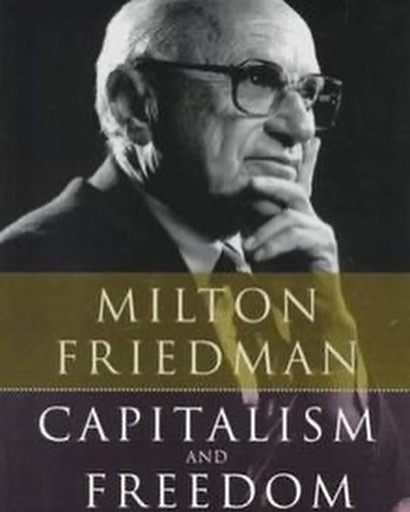
Milton Friedman, “Capitalism and Freedom” (1962) – What’s worse- the pedant or the spin doctor? The bitter pill or the shitty candy coating? That’s what I found myself thinking reading this, probably the last libertarian book I’ll read for “general education” (as opposed to “get a load of this fucking freak”) purposes for some time, and comparing it to others I’ve read recently. Von Mises and von Hayek (I like to add the “vons” – let’s make sure everyone knows their class status), especially the former, wrote dense, stormy tracts. Von Mises especially insisted that all forms of knowledge other than that based on his “praxology” were suspect. They were going to tear down knowledge and build it back up from scratch on the basis of first principles. People say stuff like “you have to admire their ambition,” and you don’t, really, but it’s clear why people say stuff like that.
Milton Friedman had more or less the same social goals as von Mises or von Hayek- win the class war for the bourgeoisie, first by beating back the Keynesian alliance between (collaborationist) labor/left leadership and government institutions, then by making sure bourgeois interests would stay on top of what was left after that. But Friedman went about it in a different way. He didn’t assail the knowledge-order around him so much as try to correct it in his direction. He mastered a peculiarly American rhetorical mode where disaster — in his case, Soviet-style totalitarianism, economic collapse, or nuclear war — is always around the corner but the sun still shines through the discourse of the speaker (the master of this, of course, was Ronald Reagan). There’s no “praxology” here, just good old American common sense! Or, rather, what most American nonfiction book buyers want- nonsense dressed up as common sense, with just enough truth to sugar the pill and the little thrill of the counterintuitive. There’s a reason “Freakonomics” came out of the same profession as “Capitalism and Freedom.”
Thinking about the rhetoric of this book is a lot more interesting than thinking about the content. Business is freedom, government isn’t, blah blah. I try to make a good faith effort to project myself to the early sixties. The left as we know it — opposed to capitalism, and the government that serves it even if it also demands concessions from said government — is basically dead, even deader than it is now. People believe in a sort of militarized, big government Keynesianism in a way that’s hard to conceptualize today. The economic tide was rising and… no, still don’t really get it. I still can’t get how you could look at capitalist practices, except if you’re on top of or deeply sheltered from them, and say, “yeah, this is freedom. If I don’t like my job I can just quit! And not have any money until I find some other bullshit employer I also hate!!” “Hey, I can choose fifty bajillion types of toothpaste, and of the sodas that necessitates it’s urgent use! Get out of the way of my joyful choices, bureaucrats!” I guess, for a higher percentage of readers, the other half of the story — “but I can’t afford decent healthcare or housing” — wasn’t there, but like… it was also wasn’t for a lot of people outside of either the middle class or the really privileged sectors of the working class we’ve let stand in for “The Working Class” in that period (and, for all too many, our own).
And that kind of gets down to the nub, doesn’t it? Friedman was relatively sunny about it. People opposed to the free market solutions are just confused, that’s all. If they could just see their best interests clearly they’d be “classical liberals” like him, and that’s why he’s writing this book. That in and of itself is a measure of difference between him and von Mises and the von Hayek of “The Constitution of Liberty” (the old Austrian word-monger went more pop in “The Road to Serfdom”). The real old school Austrians aimed at the elite notionally smart enough to understand them. Anyone confused, especially if they weren’t devoted to their idea of greatness, wasn’t worth their time. Their real heirs would be people like Murray Rothbard and the Internet anarcho-capitalist those who came after them, squalidly looking for a vanguard of freedom to take them past the goal post and ending with “the red pill.” Friedman watered down the product by offering it to a broad educated public, but it got better results. It played better with American suckers.
But Friedman gets caught in the same place they all do, and why so many libertarians, once the bills started coming due circa 2008 or so, downed that red pill and became open, committed racists and fascists (the better ones fled into our increasingly weak-tea liberalism). A lot of people are distinctly unenthusiastic for “freedom” as they conceive of it, and many of them are people of color or otherwise marginalized. Friedman swears up and down that the free market is actually better for black people and everyone else than they sort of infringements on said markets they call for through movements like the civil rights movement then reaching a crescendo in the South. Segregation is irrational because it cuts off customers from segregated businesses, he insists. Strike down segregation laws but don’t “force” integration and let the market deal with it! Soon enough everyone can sit at the lunch counter.
But that doesn’t work. First, because you’d still have armed agents of the state hauling people out of public establishments because they’re the wrong race and that’s fucked up and wrong no matter how you look at it. Second, because it does what all free market thought does and ignores history except as a series of just-so stories (did you know that oppressed minorities like Quakers and Jews did better from markets than they did from nasty old politics?!). You can say all ideologies read history selectively and you’d be right, but libertarianism more than any other ignores power differentials — pretty much every single power differential other than who happens to hold public office and what they can do that non-officeholders can’t — and how they shape history, and the present. There’s a history in the South whereby the whites hoarded not just political office but also money and power. The struggle against de jure segregation in public accommodations was an attack on an instantiation of this system, one that struck at the dignity of black people and that everybody — everybody except utter ding dongs like Friedman, that is — could see was wrong. That was not the core of the system, and most civil rights campaigners knew it, and knew they had many more battles ahead of them.
That Friedman couldn’t countenance even that first battle… well, people talk about how nice and positive and non-bigoted in person he was. I can even believe it. But fast forward a few decades and you basically have to believe in some deficiencies of race in order to hold on to a belief in the free market. This is less in the face of long-standing wealth and income differentials based on race, though that’s part of it, and more on a simpler basis. Most people of color still don’t want what libertarians are selling, and neither do most working or poor people. Most people might like the stuff about decriminalizing certain behaviors or not getting in wars, but they still see politics, broadly speaking as a struggle over power, as necessary and even vital. And so, naturally, there has to be something wrong with most people. We wind up back with the more open elitism of von Mises. And there’s something more wrong with any given group the more it rejects the basis premises of the “free market,” therefore, there’s something very wrong indeed with most marginalized peoples. Most of the dysfunctions of libertarianism as a movement that we’ve seen since the Obama election, I think, stem from this dynamic.
Friedman says little of this, though the “market-based solution” to segregation would be enough to get him “cancelled” in most circles today. He, probably genuinely enough, saw it as a solution less to segregation and more to his real bete noir, disorder, or rather, two birds that could be killed with one stone. That runs like a thread through “Capitalism and Freedom,” and through most of libertarianism- fear of disorder, fear of disruption. I am well aware they like to present themselves as freewheeling, thriving on chaos, using “disrupt” as the most sacred verb in the dictionary. But try delaying their sushi delivery an hour and then tell them someone “disrupted” DoorDash with an brief work stoppage, and see how much they like disruption then. White people were really, really scared of the sit-ins and marches, as scared as they were of riots. In many respects, Friedman was assuring the “white moderate” King wrote derisively of to relax- once we get rid of those pesky laws (both segregation and labor) everything will work out. And Friedman would be dead by the time the jig was well and truly up and the libertarians dropped the mask. Lucky to the end, the wily little Econ-gnome. *
V.S. Naipaul, “Miguel Street” (1959) – This is one of Naipaul’s earlier novels, depicting life on the titular slum street in Port of Spain, capital of his native Trinidad. Slum life depictions can get real dicey, real fast, between catastrophizing and sentimentalizing and tortured oscillations between the two. Naipaul, even that early in his career, craftily avoids both. In what I suspect is a riposte to left-leaning “social” writers, he makes an apostrophe early on against those who depicts areas like Miguel Street as “just slums,” just poverty and degradation, but he doesn’t make the lives of its inhabitants out to be constant sunshine and roses. It is a fairly typical Naipaul world, perhaps a little more honest than most in that few really pretend to believe the lies everyone tells, more for amusement than for anything else. People are self-serving, but insufficiently consistent to be called truly selfish much of the time. They pursue drives that make sense in context but probably aren’t “the right play” according to someone sitting in an easy chair in London or America. They’re human, but not in the grottily sentimental way of most humanists (or the equally silly nihilistic way of most anti-humanists).
Most of “Miguel Street” is made up of little vignettes about specific inhabitants. Most of them are about dreams they have to put away, or that blow up in their faces- in the case of a man who dreams of making a living making fireworks displays, literally. They dream of glory, borrowed from afar- boxing championships, American wives, lotteries, passing exams and going away to London (which the viewpoint character, like Naipaul himself, eventually does). When the dreams collapse, as they generally do, they find themselves back with the gang on Miguel Street, not starving or in fear but poor and not doing much, or else they disappear to another island to work in obscurity. Even Hat, who serves as the voice of the neighborhood and something of a Greek chorus, commenting on all of the stories, has his moment where he comes close to going mad when he feels he’s being cheated at gambling, winds up going to jail, and when he’s gone the narrator knows it’s time to make his way out.
Here’s something I found interesting: there’s not a lot of talk about race. Trinidad is a racially divided society. Naipaul is descended from Indians brought to the islands to provide labor post-abolition, most of the rest of the population is descended from black slaves, and there’s a small remainder of white (sometimes “off-white,” like Portuguese or Middle Eastern) people with disproportionate control over resources. Other inhabitants of Miguel Street are referred to as Indian or black or Portuguese or whatever when it’s important to the story- but a lot of the time, it’s not. I’m used to narrators in slum stories informing the reader of the race of every introduced character, unless it’s assumed that most people in a given space they’re describing are one race or another. They do this because it’s central to the dynamics of the interactions. Hell, I’m reading one memoirs set in Chicago in the thirties where the narrator reports the skin shade of every black person who he comes across- and it’s germane to the story, not (or not just) a private fixation of the author. I wonder, was Trinidad just less race-obsessed than the US? I do know Naipaul deeply resented the black power movement that came to Trinidad in the sixties. Anyway! This is a good little book, well worth reading. ****’







 Too Much Berard