James S.A. Corey, “Leviathan Falls” (2021) (read by Jefferson Mays) – Well, at long last, here we are! At the end of The Expanse! What a long, strange trip it’s been… well, a long trip, anyway. As you know, I’m behind on reviews and trying to catch up. That is a problem, because this book is deeply unremarkable and I remember little about it. And it’s sad, because I do think the Coreys (it’s a house name for two guys) tried to do something ambitious here. Humanity, in its hour of need, “groks a rock” (a giant alien data storage device) and learns the history of the universe! In honestly pretty bad pseudo-dreamlike prose. Jellyfish-neuron-people figured out space, also figured out how to use alternate-universe-energy, built gates between stars, and then got iced by the alternate-universe beings. Now those alternate universe beings are mad that humans are using the juice again. Also, the (former, sort of) dictator of humanity decides to try to hive mind us up, like the jellyfish folk, on the idea we’d be both more able to cope with the universe, and happier.
It’s not terrible but not great, not so much bad in and of itself and more dispiriting that this is the best we can do. Among other things, I’m not saying that the Coreys need to hop on “team hive mind” but pretty much everyone right away rejects it, even after former-dictator guy tries the soft sell (he soon goes hard, natch). Certainly the characters do, because, after all, they are Characters, with Feelings and Development and Subplots, so no go. But wouldn’t the extras maybe kinda like being part of a larger whole and forgetting their egos? I’m pretty egotistical and even I can see the appeal. Arguably the most dispiriting part was when characters, in their internal monologues, would list off the things humanity would “lose” if we became an all-powerful, strife-free hive mind. If I remember right, these things we stood to lose include “prayers,” “jokes,” “first dates,” etc. There they go, tempting us with a good time!
Eventually, perspective dullard Jim Holden apotheosizes and saves the galaxy, but at a cost. Heart o’ gold zombified thug Amos gets to live on and on, various other characters that I guess I’m supposed to have feelings about, after spending thousands of pages with them, go their various ways. Fine, fine. I guess this is what people want. I’m just kind of baffled. It all seems… mismatched. The ambitions of space, the familiarity of every dynamic they threw up there, the sheer size of the work and how little gets done with it. I guess people want… same-same, repeated at nauseum, and in settings you’d think would reward creativity? That last part… is it spite? Probably not. People just like variety, is probably the simpler answer. I don’t know. The end. ***
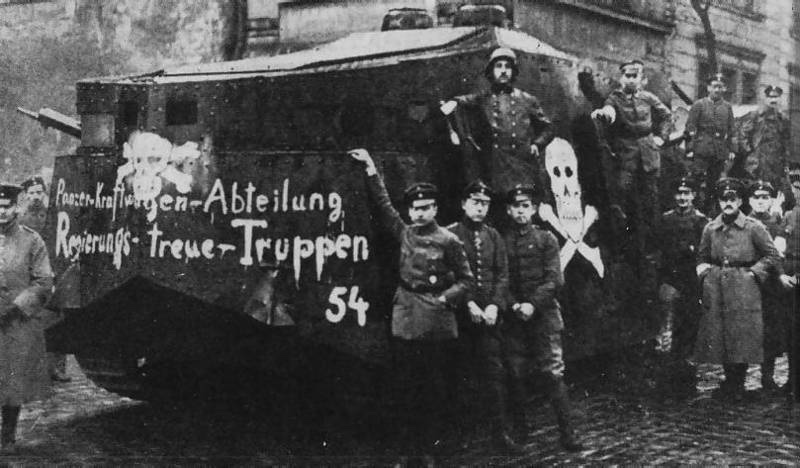
Robert Waite, “Vanguard of Nazism: the Free Corps Movement in Germany 1918-1923” (1969) – This one is an early stab at the history of the Freikorps, the right-wing paramilitary formations that arose in Germany after its defeat in World War One. As the title indicates, the Nazis recognized the Freikorps as crucial forebears (didn’t stop them from killing numerous Freikorps big shots in the Night of the Long Knives, but that’s fascism for you) in important regards, both practical and inspirational. The whole gist of Nazism — basically, mass violence to instantiate imagined past glories that the previous, duly constituted protectors of the values of bygone days were supposedly too ineffectual to regain — was indeed prefigured by the Freikorps.
In the book’s best chapters, Waite — a WWII veteran, longtime beloved teacher at Williams College, and guy who eventually tried to psychoanalyze Hitler decades after Hitler’s death — traces how the Freikorps ethos came directly from elite formations in the WWI-era German army. Units of “stormtroopers” deployed to stealthily and violently overtake enemy trenches developed their own culture, separate from the German army traditions of obedience to duly appointed authority, rational planning, strict hierarchy, etc. It’d be wrong to say the stormtroopers, and the Freikorps after them, exactly subverted these ideas- they just reapplied, and in some circumstances super-charged them, to fit the extreme circumstances of the trenches (or, later, collapsed post-defeat Germany). So they were still quite obedient and hierarchical, just to the baddest dudes in their little group, not to graybeards on the general staff, eager to fight but for “the German spirit” and increasingly for the sake of the violence and not (just) because they were told, etc. The similarities between the culture of these elite troops and those of certain other elite military formations (who also failed to win their war despite their big reputations) suggest themselves readily.
So far, so cultural, and it’s worth noting that other factors, like the pan-Germanist movement, helped prepare German right-wingers for the idea that while hierarchy is always a great good, extant hierarchy might not be the most legitimate. When Waite gets into the Freikorps’ practical effects, stuff gets interesting in a different way. Put bluntly (and I finished this a while ago and am trying to clear a backlog so blunt it shall be), Waite is a Cold War liberal and a guy who believes in totalitarianism School notions, so tries to thread the needle between “the Freikorps are obviously bad” and “well, SOMEONE had to restore order in Berlin!” You can tell he has a certain affection for Gustav Noske, the Social Democrat who first called on the Freikorps, in many respects created them along with the Army generals (though I’d bet something like them would come about anyway) and sicced them on the SPD’s rivals to their left. Waite seems to see Noske, a former army sergeant himself with, errr, a substantial respect for order, as a tragic figure. If only he’d have had the foresight to reign them in somehow! Isn’t it sad how they clubbed Rosa Luxemburg to death! But, you know, there was looting, and you just can’t have that, and they did a general strike after the Freikorps tried to overthrow the SDP’s asses, that was cool, right? He cites the memoirs of Freikorps leaders sometimes as sole sources when talking about revolutionary conduct, like revolutionary sailors supposedly taking random women and children hostage when faced with the army in Berlin. It gets pretty bad in some places.
I’m used to the way a certain kind of liberal — Peter Gay did this too — lionized the Weimar Republic, the “good Germany,” the experimental Germany, trapped between Nazis and Communists, etc. The KPD made plenty of mistakes (that tends to happen when you systematically murder the best leaders in a group) but the equivalency is just wrong and I don’t think I need to belabor that point here. At least those old liberals felt the need to show their work more than contemporary ones do, and maybe meant their hemming and hawing more, meant their disgust with the right, than a lot of liberals do now when they tut tut before handing arms to the Right Sector or shaking hands with whichever ghoulish politician. So you get chapter and verse, as best as you were going to get with the available sources not so long after it happened (about the distance the late seventies is to us now), about the many, many extralegal murders the Freikorps did. When they stormed cities held by workers and soldiers councils, they just massacred people, hundreds of people per city. In cities without ongoing uprisings, they routinely murdered union organizers, politicians, and poor random people who “knew too much” throughout the years Waite covers. Nobody did anything. Almost none of them went to jail, and fewer still for serious time. The SDP, who had militia of its own, never really took the fight to the right, and by the time the KPD got big enough, the Freikorps had metastasized into the Nazi Party, a mass movement with support from elites. It’s grim.
“The Proud Boys and the Oathkeepers, they’re no Freikorps!” I can hear some of you say. Well, take what comfort in that you can. They clearly want to be- they dream what the Freikorps did. If you told a German of 1913 vintage that clubs of demobilized soldiers and their college student groupies were going to kill thousands of civilians in Germany proper in a few years, they wouldn’t believe it, either. All it took was the right crisis. I intend to keep our local fascists in a place where they can’t take best advantage of the crises we know are coming down the pike. Let’s keep them wannabes. ****
William Leach, “Land of Desire: Merchants, Power, and the Rise of a New American Culture” (1993) – Stores are weird! I’ve seen medievalists shake their heads at the internal economy of Dungeons and Dragons, where a medieval society has set prices in what amounts to a stable, global currency and you can just go to a sword store and buy numerous kinds of sword (or a magic store and buy magic!), which isn’t at all what went down in pretty much any society until quite recently. Means of production go a long way towards determining means of exchange.
The means of exchange my generation and that of my parents (to a lesser extent my grandparents – maybe to an even lesser extent the generations after mine?) take for granted came about due to peculiar social and cultural circumstances in the nineteenth century. It is these circumstances that American history/American studies guy William Leach interrogates in this book I was supposed to read for a long ago comprehensive exam. Coming at us from the early nineteen nineties, it also partakes of some odd historical politics of consumerism and independence.
The story goes, Leach tells us, is that most Americans up until the 1880s or so made a lot of their own stuff, and the stuff they bought they usually bought from speciality stores. One exception was the “dry goods” store, but those were generally small and local. Most of the people who wore clothes made outside of the house were either quite rich, who got tailored clothes, or the very poor (including slaves), who got cheap mass-produced stuff. Similarly, the idea of buying a toy would seem odd to most Americans, according to Leach- you just made kids dolls or whatever with what was around.
But America’s booming industrial economy raised the specter of “overconsumption.” Industrial giants were frightened they were making too much stuff, too cheaply, and didn’t have enough buyers. As Leach points out, this fear didn’t make a lot of sense, as many consumer markets only came into being once producers realized there was such a market — there was no toy glut, for instance, they weren’t making that many toys because there wasn’t a market — but it’s evident that’s what a lot of businessmen worried about. In classic cultural history fashion, Leach is more interested in the affective life than the economic realities of his subjects, and it turns out, these dudes had big dreams.
John Wanamaker is probably the closest thing the book has to a main character, and he was an odd duck. He genuinely believed that the right kind of merchandising technique — a combination of mise-en-scene and sheer abundance, more or less — would not just make him a retailing success, but would prove socially and even spiritually redemptive. If he made his stores sufficiently beautiful, shoppers (and employees!) would be uplifted to dream of better things, to realize the true oneness of everyone under a beneficent God, etc etc. Rather than the dusty, dimly-lit dry goods store, you would get a gleaming, glittering, brightly-lit utopia where you could get everything you needed, or wanted- the department store.
Other department store moguls, like prime bastard Marshall Fields, didn’t have such airy notions, but they knew good business when they saw it. People liked light and air in their stores, and they liked one stop shopping. Boston’s own Filene’s pioneered having literal multiple levels for multiple classes, including “Filene’s Basement” for the hoi polloi (which became its own spinoff store, which outlasted the death of the original Filene’s by five years). It was a genuinely new form of privatized public space, and it used to include all kinds of amenities, including musical productions, what amounted to daycares, and multiple restaurants (like the cheap department store lunch counters that became the site of some civil rights protests). This was in marked distinction to the first draft of the department store, which began like so many novelties of modern history in France- French department stores were for the elite. The American department store brought an elite experience into reach for millions.
Were people spiritually uplifted by all this, like Wanamaker thought? It’s hard to say, exactly, but I’d actually say the Simpsons provides us with a better word: Americans were “embiggened” by the department store. Probably more than anything save the introduction of motion pictures, department stores altered the visual sense of Americans and eventually people throughout the world in the late nineteenth and early twentieth centuries. So many of the features we take for granted in indoor public spaces have been standardized from the department store model. Most of those things — the lighting, the cleaning, the sonic environment, the relationships between staff and customer, the standardization/customization dichotomy — either only existed for the wealthy or didn’t exist before the department store put them all together. Let’s put it this way- it makes sense, in more than a simple cause-effect way, that our version of celebrating the birth of Christ is largely the product of early twentieth century department stores, from the fusillade of gifts to the centrality of Santa.
As far as Leach’s take on all this, it’s mixed. He’s best when he’s not prescriptive. Getting into the weeds of the odd visions of people like Wanamaker and L. Frank Baum (who produced department store displays before he wrote his stories of the consumer utopia of Oz), he’s quite good, and helps you see that while their visions were strange, the shift they took part in was so fundamental it would be hard to be entirely normal about it. But between the rising anti-consumerism in nineties culture and the hangover of republicanism studies in the eighties, Leach foists some odd value judgments.
Where did the independent yeoman of yesteryear go, Leach lamentingly wonders? He went shopping at Macy’s and that was the last we heard of him! He could have kept his independence if only he made his kids play with corn husks instead of plastic! I’m of a few minds here. On the one hand, many of our consumer practices are environmentally unsustainable. On the other, I think nothing is too good for the working class, that consumption can be fun (if possible to undertake joylessly) along with being inevitable, and can make some private luxuries available to all, especially if we make communal luxuries too. In the last analysis, I’m not sure it’s good history, on top of everything else, to lament department stores as killing independent producers. Capitalism did that. The people going to these stores worked in large capitalist enterprises and couldn’t just make their own shit, certainly not as good shit as factories could. I actually think that degree of specialization isn’t necessarily a problem, whatever classical republican economic ideology might say. The problem is who controls the work, and who gets the fruits. Once we have a means of production that settles that the right way, then we can make means of exchange that work for all of us, too. ****
Jean Rhys, “Good Morning, Midnight” (1939) – There were a lot of ways for your twentieth century to suck. While lacking a certain “genocide” quality, one pretty bad one was to be a talented woman in one of the roughly umpteen “epoch-making” art/culture scenes of the century of my birth. Seemingly all of them, whatever their political pretenses, were real boys clubs, and the only women they wanted around weren’t there for their direct artistic contributions. These scenes tended to be both profoundly socially incestuous while also full of strangers whose best motives were gawking and whose worst were bad indeed Throw pretense, money, drugs, and other twentieth century party favors like intense ideological posturing into the mix along with the misogyny and fame, and it’s not a fun scene.
Jean Rhys did not have a fun twentieth century. She came from a white creole family on the tiny Caribbean island of Dominica, and crossed the Atlantic for education, socializing, and art. Her father died when she was young and she may have made her living as essentially a high class escort — the lines could be blurry (still can, I imagine) — until she had a stroke of luck, of sorts. She started writing and her stories started garnering praise from big shots like Ford Maddox Ford. This was at the height of the Jazz Age, and she lived it up while she could in London and Paris. But she was always a little too stringent for the fizzy/tragic Fitzgerald-esque party, it seems. She didn’t do gazing out at the lights, she did gazing into the black. Her characters didn’t lose themselves- they knew just where they were, and it sucked. She never pretended that money, status, and pain weren’t basic realities of life as she knew it.
This did not endear her or ensure her popularity with readers looking for the usual Jazz Age tropes. She was managing a living with her second husband, looking back at the bad (or anyway, worse- I get she wasn’t happily married exactly) old days when the money started to run out, when she was writing “Good Morning, Midnight” – and, in a struck of bad geopolitical luck, the war hit and no one wanted to read about sad decaying women in a Paris that would soon have bigger problems.
That sucks, because it, and everything I’ve read of her describing life in London and Paris in the interwar period, is great. It’s raw and affecting. The narrator is stuck, stuck by her failed marriages, her inability to do much, the positions both mainstream society and the bohemian fringe assign to women. One of the worst places to be, as far as relatively lucky nationalities like Anglos (not poor inhabitants of the real killing fields in Eurasia, say) at that time was in the declining middle class. You didn’t have any real ability to work for money — you often effectively couldn’t — but you didn’t have enough money to go on, especially if you were on the outs with family.
The narrator has burned every bridge, or someone burned it for her. Every cheap boarding house or dress shop in Paris reminds her of another failure. She meets people, including men who at least pretend to want to help her, but can never know their real motives, and worst of all, she’s starting not to care. She mulls over drinking herself to death, or just making life as tiny as possible — stay in her room, live off of coffee, bread, and regret — not so much as an economizing measure as just to live in accordance with her inner self. It’s a brutal read, but I love it because it seems real in ways that flashier depictions of inner failing and falling don’t. Rhys eventually won international recognition when she was in her sixties for “Wide Sargasso Sea,” a retelling of Jane Eyre from the perspective of the madwoman in the attic (another white creole from the Caribbean who had a miserable time in England). When interviewed about her newfound success, she dismissed it as too little, too late. Ouch. *****
Zachary Carter, “The Price of Peace: Money, Democracy, and the Life of John Maynard Keynes” (2020) (read by Robert Petkoff) – I’ll admit: I’m behind on reviews. I listened to this a little while ago. And all I want to type is the name “KEYNES!” to the same cadence as the word “SHOTS!” in that one tens song where they just shout the word “SHOTS!” a lot. Admittedly, if one major economist of the twentieth century could be said to have engaged in “party rocking” it would probably be John Maynard Keynes. As journalist Zach Carter, author of this highly-regarded new book on the man and his ideas tells us, Keynes was a social butterfly who hung out with people thought of as cool, in his day, and got laid a lot with men and married one of the great ballerinas of his time. But, still, you all probably expect more content from me, and I hate to let people down.
Among other interesting innovations, Carter eschews the standard biography format. You don’t get a long section about Keynes’s childhood or education, or other bits of “setup” like you see in a lot of big, whang-dang-doodle biogs. Instead, we start with Keynes “folding his long legs” into a friend’s motorcycle’s sidecar and toodling off for London, leaving placid academic Cambridge for the hurly burly of WWI London. Someone needed to manage the empire’s economic situation in it’s time of need, and that would be a six foot seven queer math major, our Maynard. Also, the last third or so of the book takes place after Keynes died, in 1946 (at a relatively young 62). It discusses the future of Keynes’s ideas, their ascendancy, their modification — Carter would insist their corruption — their fall, their possible resurrection.
This is a rich and very well-written work aimed towards an educated general audience (I think of it as the NPR/Twitter demographic). We get into the ins and outs of Keynes’s career, which took him to the Versailles Conference, attempts to work at the Exchequer and manage the Depression, further work during the war, the Bretton Woods conference which laid the groundwork for the postwar global economic order, his personal life, encounters with figures as diverse as Virginia Woolf and Winston Churchill, on and on. Keynes had a really interesting life, on top of whatever else can be said about him. It’s hard to imagine contemporary big time academics matching it… if nothing else, they’re expected to work a lot harder at much dumber tasks than Keynes or academics of his generation (and Keynes was a hard worker) were…
Insofar as there’s a takeaway point beyond “this guy had a cool life,” it’s one I actually agree with, and which has been a minor hobby horse of mine for some time, even if I disagree with some of the valuations Carter has put on the point. Keynes, Carter argues, updated liberalism for the twentieth century. This is relevant in large part because Keynes’s opponents, led by Friedrich von Hayek (a contemporary of Keynes, whose attacks against his work Keynes treated with a patronizing — and often hilarious — encouragement, real “A for effort, Freddie” stuff), have tried to seize the mantle of “classical liberalism” against anything that smacked of Keynes. Anything that expands “government” can’t be liberalism because (insert what’s often a misreading of Mill, Locke, Adam Smith, whoever here), the “classical liberal” argument goes. This was always a stupid argument. In many respects, it reflects the Marx-envy of free market fanatics. They always wanted a Marx for their side, and have enlisted a roll call of figures, each less fitting or just more pathetic than the last — Smith, von Mises, von Hayek, Ayn Rand — to be that figure. But there just isn’t a prophet figure like that for them, and there isn’t a central set of canonical texts like there is in Marxism (you’d figure they’d appreciate that, “free thinkers” that they’re supposed to be!).
In fact, the closest to a Marx figure in liberalism is… John Maynard Keynes! This gets to the dumber, more relevant part of why the idea that “classical liberalism” really exists in a different ideological formation than postwar liberalism was always a sham. The point of liberalism was never small government or big government. It was always about eliding the basic, elemental conflict between redistributing power down the social scale towards the people who make society work, or keeping it where it is/retrenching it in the hands of ever smaller and more arbitrary elites. Law, markets, education, culture, numerous mixes and combinations of these and other things, liberals have proposed all of these as alternate axes and bases of politics than the basic struggle for power. Keynes, and his equivalents in liberal politics such as Franklin Delano Roosevelt and Lyndon Baines Johnson, thought that you could elide the power struggle through, basically, beating socialism at its own mass-appeal game. Keynes saw that the productive capacities of capitalism could make a decent life for everyone, and thought that fiscal policy could guarantee that life, thereby defusing social conflict and finally short-circuiting the struggle for power.
I’m a socialist and a Marxist. I believe that the history of humanity is the history of class struggle (some other stuff, too), and I want the working class to win, and I work towards that in my way. So it’s with that in mind when I say that the Keynesian vision is a tempting one… but maybe not as tempting as some would make out. Maybe it’s just the fighter in me, but I have noticed the political deactivation that the Keynesian future promises. We’ll all have so much leisure and time for art (Keynes was a great art lover, and envisioned everyone doing community theater, which is cute) we’ll just let the experts carry on with things! I don’t like that. Carter makes clear that Keynes saw most form of political agitation — from the October Revolution to his friend, writer Lytton Strachey, handing him a letter protesting Keynes’s involvement in WWI and stalking out of a dinner date — as essentially tragic, to say nothing of low-class. I will never believe that political struggle will ever stop, as long as we’re recognizably human (zap me up into the post-human energy hive mind, if it comes to that!), and wouldn’t want it to. “It’s all in the game,” as a beloved figure of early twenty-first century fiction put it.
Carter also makes clear that Keynes’s ideas never had a golden age. There was never a point where governments used countercyclical fiscal policy via investment in public goods to create a stable economic system for the benefit of a broad public. There was never enough money put into the New Deal or the Great Society for it to do that. The massive amounts of money poured into WWII sparked the recovery from the Depression and proved Keynes’s point about deficit spending. But that out terrible ideas into the heads of the politicians around, and we can call that “military Keynesianism.” Pour money into the military and boost employment and public purchasing power that way! No empowering the working class (even by accident, by giving them more leisure time by, say, cutting work time), less vulnerable to red-baiting (the American Keynesians were mercilessly hounded by McCarthyites until nerds like Paul Samuelson promised they’d be apolitical good boys), lots of shiny guns. This was a parody of what Keynes, a man who hated war, had in mind. But with its cowed working class, crucial role for (similarly cowed, but in a different way) experts, and attempt to evade, rather than crush, entrenched powers of wealth and bigotry, it was a parody as faithful to the spirit of the original as anything Weird Al ever produced.
Keynes supposedly “came back” in 2008 after the financial crisis but we all, Carter included, knew what that meant in that soppy cardboard political context- giveaways for the rich. The world might have, sort of, gotten one of Keynes’s basic points — “the market isn’t self-regulating any more than ‘nature’ is, stupid!” — but the political power to do something useful about that observation wasn’t there. It’s not just a matter of Keynes’s old enemies, the Austrian school types who insist on the self-regulation of markets, having seized much of the intellectual high ground. It’s that Keynesianism was always ambivalent about the forces — including a real, fighting left — that made it possible to even get a sham version of it like military Keynesianism going in the first place.
Basically, if you want to get what Keynes promised, you need to fight for what Marx wanted, and if you’re doing that, why not just take the whole fucking pie? Especially when you know, now, given the history (they should have known in the twentieth century, too- they were powerful but often foolish, where we’re all too wise and weak), that the right will wait as long as they have to to take the power back if you don’t break the base of their power, no matter what concessions you make to their little fee-fees? I think Carter would answer “so you don’t get mass atrocities ala Stalin,” more or less, and also a more robust idea of freedom and possibility than obtained in places like the USSR, even post-Stalin. I hear that, though it’s not like followers of Keynes-era liberalism, like LBJ or Richard “we are all Keynesians now” Nixon were strangers to mass death… well, that’s not the “real” Keynesianism, but the military mutation, Carter might say in an unguarded moment (he strikes me as much too slick to write something so gormless if he had time to think)… but then what’s the “real” socialism, etc etc.
Anyway! This was a pretty good book. Sometimes it rubbed me the wrong way in terms of petting expertise-driven liberalism and pooh-poohing radical politics, but I guess I’m sensitive. “The price of peace” is an interesting title, especially given how so many, especially but not exclusively on the right, think “paying for peace” equals appeasement equals Nazis equals bad. It could very well be even if leftists wanted to pay “the price of peace” (and it looks like we are more willing to play these games, and basically have been since the seventies or earlier), the right may very well not let us. Who’s to say? Along with whatever else it is, this book, like the tv show “Mad Men,” is also an elegy for a lost moment of mid-century ambition and cool, warts and all (Keynes had plenty, including that non-obsessive, partial, but nasty strain of upper class British antisemitism). Just how lost is it? I tend to think deeply lost, but who does that stop? *
Zachary Carter, “The Price of Peace: Money, Democracy, and the Life of John Maynard Keynes” (2020) (read by Robert Petkoff) – I’ll admit: I’m behind on reviews. I listened to this a little while ago. And all I want to type is the name “KEYNES!” to the same cadence as the word “SHOTS!” in that one tens song where they just shout the word “SHOTS!” a lot. Admittedly, if one major economist of the twentieth century could be said to have engaged in “party rocking” it would probably be John Maynard Keynes. As journalist Zach Carter, author of this highly-regarded new book on the man and his ideas tells us, Keynes was a social butterfly who hung out with people thought of as cool, in his day, and got laid a lot with men and married one of the great ballerinas of his time. But, still, you all probably expect more content from me, and I hate to let people down.
Among other interesting innovations, Carter eschews the standard biography format. You don’t get a long section about Keynes’s childhood or education, or other bits of “setup” like you see in a lot of big, whang-dang-doodle biogs. Instead, we start with Keynes “folding his long legs” into a friend’s motorcycle’s sidecar and toodling off for London, leaving placid academic Cambridge for the hurly burly of WWI London. Someone needed to manage the empire’s economic situation in it’s time of need, and that would be a six foot seven queer math major, our Maynard. Also, the last third or so of the book takes place after Keynes died, in 1946 (at a relatively young 62). It discusses the future of Keynes’s ideas, their ascendancy, their modification — Carter would insist their corruption — their fall, their possible resurrection.
This is a rich and very well-written work aimed towards an educated general audience (I think of it as the NPR/Twitter demographic). We get into the ins and outs of Keynes’s career, which took him to the Versailles Conference, attempts to work at the Exchequer and manage the Depression, further work during the war, the Bretton Woods conference which laid the groundwork for the postwar global economic order, his personal life, encounters with figures as diverse as Virginia Woolf and Winston Churchill, on and on. Keynes had a really interesting life, on top of whatever else can be said about him. It’s hard to imagine contemporary big time academics matching it… if nothing else, they’re expected to work a lot harder at much dumber tasks than Keynes or academics of his generation (and Keynes was a hard worker) were…
Insofar as there’s a takeaway point beyond “this guy had a cool life,” it’s one I actually agree with, and which has been a minor hobby horse of mine for some time, even if I disagree with some of the valuations Carter has put on the point. Keynes, Carter argues, updated liberalism for the twentieth century. This is relevant in large part because Keynes’s opponents, led by Friedrich von Hayek (a contemporary of Keynes, whose attacks against his work Keynes treated with a patronizing — and often hilarious — encouragement, real “A for effort, Freddie” stuff), have tried to seize the mantle of “classical liberalism” against anything that smacked of Keynes. Anything that expands “government” can’t be liberalism because (insert what’s often a misreading of Mill, Locke, Adam Smith, whoever here), the “classical liberal” argument goes. This was always a stupid argument. In many respects, it reflects the Marx-envy of free market fanatics. They always wanted a Marx for their side, and have enlisted a roll call of figures, each less fitting or just more pathetic than the last — Smith, von Mises, von Hayek, Ayn Rand — to be that figure. But there just isn’t a prophet figure like that for them, and there isn’t a central set of canonical texts like there is in Marxism (you’d figure they’d appreciate that, “free thinkers” that they’re supposed to be!).
In fact, the closest to a Marx figure in liberalism is… John Maynard Keynes! This gets to the dumber, more relevant part of why the idea that “classical liberalism” really exists in a different ideological formation than postwar liberalism was always a sham. The point of liberalism was never small government or big government. It was always about eliding the basic, elemental conflict between redistributing power down the social scale towards the people who make society work, or keeping it where it is/retrenching it in the hands of ever smaller and more arbitrary elites. Law, markets, education, culture, numerous mixes and combinations of these and other things, liberals have proposed all of these as alternate axes and bases of politics than the basic struggle for power. Keynes, and his equivalents in liberal politics such as Franklin Delano Roosevelt and Lyndon Baines Johnson, thought that you could elide the power struggle through, basically, beating socialism at its own mass-appeal game. Keynes saw that the productive capacities of capitalism could make a decent life for everyone, and thought that fiscal policy could guarantee that life, thereby defusing social conflict and finally short-circuiting the struggle for power.
I’m a socialist and a Marxist. I believe that the history of humanity is the history of class struggle (some other stuff, too), and I want the working class to win, and I work towards that in my way. So it’s with that in mind when I say that the Keynesian vision is a tempting one… but maybe not as tempting as some would make out. Maybe it’s just the fighter in me, but I have noticed the political deactivation that the Keynesian future promises. We’ll all have so much leisure and time for art (Keynes was a great art lover, and envisioned everyone doing community theater, which is cute) we’ll just let the experts carry on with things! I don’t like that. Carter makes clear that Keynes saw most form of political agitation — from the October Revolution to his friend, writer Lytton Strachey, handing him a letter protesting Keynes’s involvement in WWI and stalking out of a dinner date — as essentially tragic, to say nothing of low-class. I will never believe that political struggle will ever stop, as long as we’re recognizably human (zap me up into the post-human energy hive mind, if it comes to that!), and wouldn’t want it to. “It’s all in the game,” as a beloved figure of early twenty-first century fiction put it.
Carter also makes clear that Keynes’s ideas never had a golden age. There was never a point where governments used countercyclical fiscal policy via investment in public goods to create a stable economic system for the benefit of a broad public. There was never enough money put into the New Deal or the Great Society for it to do that. The massive amounts of money poured into WWII sparked the recovery from the Depression and proved Keynes’s point about deficit spending. But that out terrible ideas into the heads of the politicians around, and we can call that “military Keynesianism.” Pour money into the military and boost employment and public purchasing power that way! No empowering the working class (even by accident, by giving them more leisure time by, say, cutting work time), less vulnerable to red-baiting (the American Keynesians were mercilessly hounded by McCarthyites until nerds like Paul Samuelson promised they’d be apolitical good boys), lots of shiny guns. This was a parody of what Keynes, a man who hated war, had in mind. But with its cowed working class, crucial role for (similarly cowed, but in a different way) experts, and attempt to evade, rather than crush, entrenched powers of wealth and bigotry, it was a parody as faithful to the spirit of the original as anything Weird Al ever produced.
Keynes supposedly “came back” in 2008 after the financial crisis but we all, Carter included, knew what that meant in that soppy cardboard political context- giveaways for the rich. The world might have, sort of, gotten one of Keynes’s basic points — “the market isn’t self-regulating any more than ‘nature’ is, stupid!” — but the political power to do something useful about that observation wasn’t there. It’s not just a matter of Keynes’s old enemies, the Austrian school types who insist on the self-regulation of markets, having seized much of the intellectual high ground. It’s that Keynesianism was always ambivalent about the forces — including a real, fighting left — that made it possible to even get a sham version of it like military Keynesianism going in the first place.
Basically, if you want to get what Keynes promised, you need to fight for what Marx wanted, and if you’re doing that, why not just take the whole fucking pie? Especially when you know, now, given the history (they should have known in the twentieth century, too- they were powerful but often foolish, where we’re all too wise and weak), that the right will wait as long as they have to to take the power back if you don’t break the base of their power, no matter what concessions you make to their little fee-fees? I think Carter would answer “so you don’t get mass atrocities ala Stalin,” more or less, and also a more robust idea of freedom and possibility than obtained in places like the USSR, even post-Stalin. I hear that, though it’s not like followers of Keynes-era liberalism, like LBJ or Richard “we are all Keynesians now” Nixon were strangers to mass death… well, that’s not the “real” Keynesianism, but the military mutation, Carter might say in an unguarded moment (he strikes me as much too slick to write something so gormless if he had time to think)… but then what’s the “real” socialism, etc etc.
Anyway! This was a pretty good book. Sometimes it rubbed me the wrong way in terms of petting expertise-driven liberalism and pooh-poohing radical politics, but I guess I’m sensitive. “The price of peace” is an interesting title, especially given how so many, especially but not exclusively on the right, think “paying for peace” equals appeasement equals Nazis equals bad. It could very well be even if leftists wanted to pay “the price of peace” (and it looks like we are more willing to play these games, and basically have been since the seventies or earlier), the right may very well not let us. Who’s to say? Along with whatever else it is, this book, like the tv show “Mad Men,” is also an elegy for a lost moment of mid-century ambition and cool, warts and all (Keynes had plenty, including that non-obsessive, partial, but nasty strain of upper class British antisemitism). Just how lost is it? I tend to think deeply lost, but who does that stop? *
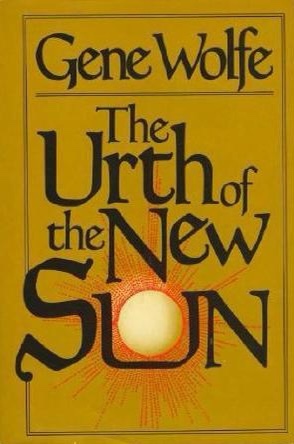
Gene Wolfe, “The Urth of the New Sun” (1987) – Gene Wolfe wrote “The Book of the New Sun,” a quartet of novels (that can — I would say should — be read as one) that ranks among my favorite works, and probably the hardest to describe among literary favorites of mine. It is the story of Severian, an orphan raised by a guild of torturers and executioners in some far future Urth (the spelling turns out to have more meaning than flavor- maybe? See below) where the sun is guttering out. Severian has a perfect memory, clinical depression, a way with the ladies, a destiny, and arguably the greatest prose stylist in scifi/fantasy history behind him. The story is told in past tense- Severian is using his perfect memory to recall his youth, his adventures, and his ascension to the role of “Autarch,” emperor/representative of Urth, and due to scifi shenanigans he has more than one consciousness in him. The story goes back and forth across space and time, and if you get lost, it’s in the best possible way.
Wolfe — an unassuming man, for all of his talents, who died a few years back, not a strutting fool and/or a gormless nerd like so many big name scifi/fantasy writers — decided his follow-up would be… a follow-up. “The Urth of the New Sun” follows Severian in his ascendance past the Earth (or Urth?). This is an interesting decision for Wolfe to make. We leave the New Sun books as Severian the Autarch learns that being Autarch is basically about answering for Urth at some sort of divine/alien space/time tribunal. He gets on a spaceship and goes, the end, more or less. Do we really need a tale of Severian on the spaceship?
Well, having read it, I’d now say “no,” we don’t need as, it turns out, the world needed (but probably doesn’t deserve) The Book of the New Sun. Among other things, Wolfe can’t quite manage the creative farrago he did in the original series, strategically revealing what was going on behind all the weirdness, keeping other things concealed, switching out truths for lies and vice-versa until you barely cared anymore and just went with the story. This one does something like that but less so- the flipped cards stay flipped (“floop the pig!” as they’d say on a show that I think might have drawn some inspiration from Wolfe), confusing aspects stay confused, it is less elegant.
But it’s still pretty good. Wolfe’s prose style — dense and allusive but always flowing and alluring, not unlike a lava flow, how beautiful and crushing it is — carries the reader along. It might have helped had I read this closer to when I read the New Sun books, as there’s a lot of call-backs, but it’s hard to forget Thecla, Jonah, the Green Man, and the rest (some of Severian’s lovers — Severian being a lady’s man on top of everything else isn’t as cheesy as it sounds but is the closest to cheesy Wolfe gets here — are a bit interchangeable, tragic women of power usually)… Just sometimes hard to forget where Wolfe left off with them.
Especially because his spaceship, in keeping with relativity (or some other science stuff, who’s to say really), is also a timeship! And kind of a… temporal realm ship? There’s some Kabalistic metaphors here, where Severian and company, after some spaceship stuff, wind up higher up the Sepiroth, the Tree of Existence, snd then have to go back home. Among other things, this probably confirms what some of the old Wolfe-heads say- Urth ain’t Earth, but it’s close (and possibly upside-down- there’s reasonably good hints that the city where Severian is born is meant to be alternate dimension far future Buenos Aires, but the Plata/Gyoll flows the wrong ways, the jungles and mountains are on the “wrong” direction, etc).
In the end, Severian does the thing. You kind of know he will. The suspense of that was never the point, though seeing what Wolfe could yank out of his bag of tricks to complicate matters is part of what you’re plonking down time and money to see. There’s some time travel (including retconning/retroactively-establishing stuff in the prior books), some Christian symbolism (Wolfe was a devout Catholic, but I question how the claims made that his works are directly devotional), and then Severian finally gets to get a rest. Wolfe wrote two more series, the Book of the Long Sun and the Book of the Short Sun, in the same, err, multiverse? I’ll get to those, at some point, but I think this is a good, if perhaps more protracted than necessary, stopping point for Severian’s story. ****
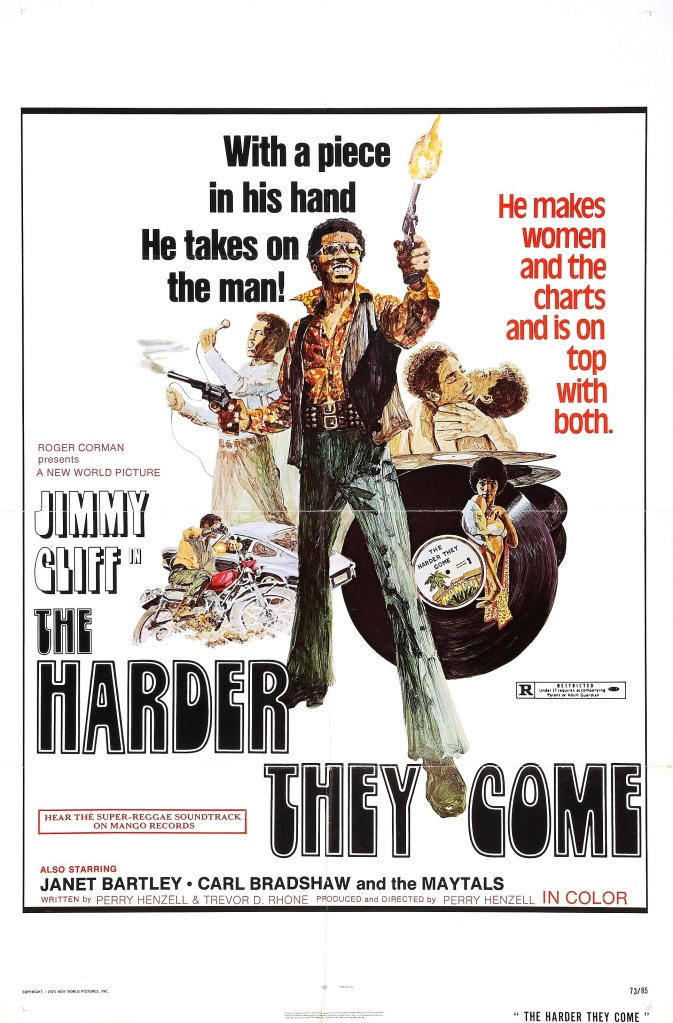
Michael Thelwell, “The Harder They Come” (1980) – A movie novelization praised by Chinua Achebe and Harold Bloom! Well, it makes sense. “The Harder They Come” is an awesome movie (watch it with subtitles), a classic tale of overcoming odds and dying to become a legend, and which helped introduce reggae to global audiences. Michael Thelwell is one of the original Black Studies guys, a civil rights movement veteran, and a friend/editor of Achebe. And as Thelwell points out in his introduction, he does not slavishly follow the plot of the film- among other things, the film runs at a brisk 109 minutes so it’d probably make for a short novel.
Thelwell starts us out in rural Jamaica in the mid-twentieth century. Ivanhoe Martin is a young boy who acquires the nickname “Rhygin” for his “raging” lust for life. He’s always willing to go farther than the other kids- work harder, swim further, jump off higher cliffs into deeper water. His grandmother wants him to follow in her footsteps, farming the green hillside land in a community descended from Maroon slave rebels. But you can’t keep them down on the farm once they’ve heard rocksteady, one of reggae’s progenitors. As a teenager, Ivan moved to Kingston, the big city, and encounters many classic “country bumpkin” pitfalls before starting to lead a dual life- good churchgoing boy, helping repair things around a Baptist compound by day, and “rude boy” by night, running the streets with a gang and watching endless westerns in the movie houses.
Ivan is what I’d (modestly) call “Berard-complete” – a fleshed out character (it was a real risk, too, to turn him into a kind of black Horatio Alger character, but Thelwell knew better) who also isn’t tediously psychologized. His knocks don’t all go into making him a better, stronger person. In particular, Thelwell presents the brutalities of all levels of Jamaican poverty — from wandering the streets of the rich neighborhoods begging for work only to be treated like pests, to the numerous ways the poor rip each other off just to survive, to Ivan getting ripped off by record producers after almost reaching his music stardom dreams recording the titular song — utterly unromantically. It doesn’t make you better. It just sucks.
Eventually, Ivan is hit hard enough he snaps. He cuts up a cruel overseer, gets whipped (Jamaica still used caning as a punishment at the time), and becomes a weed dealer. He gets in with some Rastafarians. The Rastas are a sort of otherworldly presence in the book. Ivan and his friends witness an attempt by Rastas to “take over” Kingston (this happened in real life). Rastas show up at odd points to show a way that black men can be true to themselves in the world. Ivan never becomes one — he loves the flash of the world too much — but they’re an important presence in the book. Eventually, the big fish Ivan works for betrays him and tries to have him killed. This allows Ivan to fully become Rhygin, as he goes on a massive crime spree that makes him a folk hero (and launches his record to the top of the charts). In the end, he’s gunned down by the cops on a beach, calling on them to “send out one man who can draw” so he can fight and die like his cowboy heroes.
It’s an interesting book, written partially in Jamaican patois (with helpful glossary). Thelwell makes good use of the contrasts of types of life- the simple rural life in the villages (which Ivan can’t return to, due to devastating changes while he’s away), life among the “sufferers” of Kingston, glimpses at the nice life lived by exploiters, the mystic experience of the Rastas. One thing I found interesting was the way in which Ivan, in the end, overcame by turning away from his humanity, in large part symbolized by women, especially his girlfriend Elsa who escaped the Baptist compound to be with him. It’s ambiguous whether Elsa betrays him to the police or not- it was either her, or the Rasta partner last seen being tortured by the cops. In any event, turning away from womanhood, with its softness and potential treachery, to finally become the “star-bwai” gunslinger… that seems to be a theme in a fair amount of lore, not unique to Jamaica but pretty common, in my experience, in Jamaican narratives, including reggae lyrics. In Rasta myth (and to a degree, practice) you don’t usually become a gunslinger star, but women very much belong in a separate, subordinate place while men take the “chalice” (weed pipe) and “reason” with each other. Remnant of colonialism, maybe, I’m no expert. Either way, an interesting book. ****’
Issa Shivji, “Class Struggle in Tanzania” (1976) – I picked this one up at a sale at the Brookline Public Library. Who was reading Marxist analyses of Tanzania from the seventies in Brookline, I wonder?
In any event, I have it, and read it. 1976 was an interesting moment in Tanzania. By then, it was almost ten years past the Arusha Declaration, where charismatic leader Julius Nyerere declared that Tanzania was going to build “African Socialism,” based on village cooperation, nationalizing foreign-owned business (much of which dated to the colonial era), and forging the country’s own path in the Cold War. Probably the best known artifact of this era were the “ujamaa villages,” planned cooperative villages where socialism, African style, would supposedly be grown from the ground up.
What did Marxist Issa Shivji think of all this? Not necessarily what one would think, in a number of directions. Shivji taught in Tanzanian universities, and belonged to the prominent Asian minority you see in much of coastal East Africa. He writes in the classic inter-Marxist mode- this is when Marxist and Marx-influenced thinkers were taking the “international development” world by storm, in that brief period between America’s defeat in Vietnam and when neoliberalism really started to hit in the eighties. He understands the books — Marx, Engels, Lenin, Mao — and how they apply to the ground better than his interlocutors and he wants to prove it.
Socialism can work in Tanzania, will come to Tanzania, Shivji argues, but it isn’t there as a result of Arusha. Ujamaa is ultimately a conceit of the “bureaucratic bourgeoisie” based in Nyerere’s regime, who defeated the old commercial bourgeoisie (basically, the guys selling sisal and cotton abroad) for power with the help of the emerging working class and the peasants. It’s not an adaptation of socialism- there doesn’t need to be “African socialism” because as far as Shivji is concerned, that’s a patronizing workaround; Africans, like everyone else, can have, will have, deserve to have, socialism, no modifiers necessary. Things don’t look exactly like Russia in 1917, China in 1949, Cuba in 1959, Shivji grants, and we shouldn’t expect it to, but a working class is emerging into class consciousness and will soon get what it is due.
It’s interesting what’s not in this book. I don’t mean this as a dig, really, but you can see it as an artifact of the era just before concern for “human rights” took over the thinking-about-developing-countries realm. Nyerere was far from the worst violator of human rights around, but he did force people off the land into his Ujamaa villages. He controlled the press tightly, and waged periodic campaigns against such “non-Tanzanian” cultural practices as soul music and homosexuality. He also had almost nothing to say about periodic attacks on the Asian community he comes from. You could see this as being beyond Shivji’s strict brief (and this is a short book), but you’d figure the forced migrations would enter into the status of the working class and peasantry… in any event, Shivji’s tradition as he understood it took other stuff more into account. In ten years time, Nyerere (who probably comes up more in this review than he does in the book- it is centered on the reality of class, not the actions of important individuals) would be gone, the dream of Ujamaa and numerous other decolonization-era visions for what Africa could be would fade, replaced by a terrible cycle of exploitation and war. If Marxism provides the blocks with which to rebuild, one has to assume people will have to reach for more elementary ones still than the ones Shivji presents, given the stark realities. We’ll see, I guess. ****
Charles Yu, “Interior Chinatown” (2020) (read by Joel De La Fuente) – Another way in which white Americans have been absurdly lucky: many of the “white ethnic” groups came to social acceptance at a time when literature was taken halfway seriously. The most dramatic case in point is the rise of Jewish talent in American literature after World War II (by this time most white American Catholic ethnic communities, after flirting with social realism when that was cool in the thirties ala James Farrell, deracinated all their writers when they produced them at all). Guys like Philip Roth and Saul Bellow came to prominence in an era when you could become famous by writing serious, ambitious literature, and I say this as a guy who doesn’t like Bellow and runs hot and cold on Roth. They could say what they had to say about being an American Jew — it was a lot — and say a lot of other stuff in many different ways, to say nothing of saying it all in a context of broad-based economic prosperity.
None of that holds anymore, and it sucks pretty hard, I’d imagine, for people from ethnic communities that produce a lot of people in a class position to break into literary fame, and for readers more generally. There’s a Tantalus element to the situation. Everyone, notionally, who reads anything other than what Fox News shills at them to fill out cheap ad time, wants to hear about difference from diverse voices. Our universities duly stamp out many many ambitious young scribblers from more and more communities, mostly communities of color (you could argue recent immigrants from Eastern Europe count too, and there are weird quasi-ethnic elements of how literature receives poor whites from some parts of the country). Like Roth’s New York area Jews before them, these writers and their communities have had to make difficult adjustments to American life and constantly second-guess what their (valid, impressive) success means in the face of both racism and life’s general absurdity. All the tools are there in abundance like never before, from word processors and the Internet to every kind of inspiration, every source of color, available at the touch of a button.
All this has been a decent spur to the creation of books- but not, necessarily, to the creation of quality literature, of an exploration of contemporary life and its contexts or of artfulness or experiment in literature, and certainly not the two combined. Newly intellectually prominent ethnic communities are faced with a situation that does not reward literary quality or risk-taking. Publishers are cautious in a way they weren’t during an era of cheap paperbacks and a public that saw the consumption of difficult and/or daring artistic production as a marker of class status. Neither of those were necessarily noble (well, cheap paperbacks are, in my opinion), and the stuff that came out of it wasn’t always great. But it was different. It’s ironic that writers today can now be lumped into the category of “content providers” when, in fact, the actual content of their works is of decreasing relevance. What matters is what boxes they can tick off for the company producing them and the readers consuming them. This does not for quality literature make- you get a lot of secular sermons, a lot of try-hard bullshit, and a lot of not-try-hard-enough bullshit, too. A lot of the better fiction writing that pertains to ethnicity comes from writers immersed in genre, like Carmen Maria Machado and Stephen Graham Jones.
Maybe it’s the Marxist in me, but I have to think the class positions involved have something to do with it, too. Roth, Bellow, Vonnegut (not a Jew, but with German roots when that meant something), none of them were exactly poor or working class. But class divisions, especially within expanding postwar universities, were less salient (especially among white people- more of their/our infernal luck) than they are today. Look up the biographies of contemporary literary lions who write about their ethnic experiences and they’re pretty impressive- fancy schools, often fancy jobs they did before writing, prizes of all kinds. That these are in no way representative of their communities as a whole — couldn’t possibly be, Harvard doesn’t have enough dorm space for it — is part of the problem. That being a winner from a marginalized (but, key, internally stratified) group now means something different than it did in the mid-twentieth century seems to be part of the problem.
All of which is a very long way of getting to a profoundly mediocre — I’d go ahead and say bad — book that has gotten a lot of good press, Charles Yu’s “Interior Chinatown.” How much of this is marketing, how much any of it will last beyond a season, it’s hard to say, but this has been hailed as a definitive statement in the literature of one of the largest (and most diverse- more on that anon) groups I’m talking about, Asian-Americans. Yu is very much in the category of ultra-impressive resumes you get on writers these days, and worked in a white-shoe law firm before deciding to write full time (he’s not a bad looking guy, either, another recent development in authors- they tend to have it going on, physically, these days). Big, or anyway highly credentialed and talked up, talent, community that wants to be heard, surely he has something to say?
Well… yes and no. Let’s get a description out of the way first, which among other things gets into Yu’s forms, which to the extent there’s a selling point here beyond “big Asian-American literary statement,” is it. This is the story of a guy who goes through most of the book being called Generic Asian Man. He’s called this because the novel takes the form of a screenplay! All the world’s a stage, or anyway, a production set for a hacky police procedural. The main character is forced to play Generic Asian Man over and over again in role after role. Yu is not shy about making this the central problem of Asian-Americans, especially Asian-American men (women are “The Girl With the Almond Eyes” until they become “Old Asian Woman”). He does that thing you get in metafictions where the whole thing is an obvious metaphor, but the author escapes from the obloquy assigned to allegory (never got why allegory gets such a bad wrap, and from Tolkien too!) by keeping it vague as to whether the action in the novel is meant to be taken at all literally. But in any event, we see some of his life as he gets the chance to play an important side-character in a hacky cop show called “Black and White” (can you guess the races of the protagonists?), marries and screws up his marriage, but also has various surreal encounters culminating in being arrested for some sort of Generic crime and having to defend his Asian-Americanness in court, or something.
If there is a central problem in contemporary anglophone literature (and peeking over the Anglo fence to figures like Michel Houellebecq and Karl Ove Knausgaard, I’m not sure it’s much better in other languages), it’s an utter inability to commit to anything worth committing to- and this includes committing to the bit. It’s funny- comedians can do it, in some cases to the point of monstrosity. But with all the political and social change we’ve seen since the return of history circa 2001-2008, and with seemingly good intentions on the part of so many expensively educated people, literature can’t seem to nail commitment.
So, “Interior Chinatown” does not commit to the “all the world’s a stage” bit. It is, in fact, highly self-serious (for all of its jokes, few of which land) and ends in a long long sermon (there’s a kung fu fight after the sermon, which is both Yu’s best joke and a transparent toss to whoever has to make a movie out of this lame book). Some of the better sections of the book, in fact, describe Generic Asian Man’s parents’ lives, back in that generally-more-literary midcentury period. Yu unrepentantly milks the experience of midcentury Asians for pathos in what is, let’s recall, the story of a contemporary Generic man (who… may or may not work fairly successfully in show business? I guess Yu was trying to say he does, this might not have been the best choice for audiobook), despite the profound differences in situation between him and them.
What would a story of Generic Asian Man trying to become his beau ideal — Kung Fu Guy! the best Hollywood offers Asians! — look like if it committed to the bit? What would it be without the descent into family story, the stuff about divorce, and the speechifying about why Asians aren’t considered real Americans in the end? Well, it would be… a light novel! Perhaps not unlike that other Asian publishing phenomenon, “Crazy Rich Asians,” in that regard- self-aware, more formally experimental (though not in a way a sitcom couldn’t reproduce, and has), but mostly farcical. Yu isn’t quite funny enough to pull that sort of thing off, but light novels are quite honorable- arguably, that’s what P.G. Wodehouse, one of the all time greats of English language literature, produced.
The problem here isn’t Yu’s descents into pathos on their own, or even the ineptitude with which he shifts into these descents (though the latter is a problem). There’s some serious, serious lumping involved, on axes of class — Yu the white shoe lawyer/bestselling author speaking for a community whose working class majority faces much bigger problems than getting cast in cool roles — and origin — something tells me him claiming to speak for literally every American with roots in Asia, including casually throwing in South Asians and Middle Easterners into the malaise he fights, flies more with white readers than anyone else — but you could still make a decent novel with ideological holes. Hell, a lot of great novels are, like, eighty percent ideological holes!
I guess what makes this novel lousy is a gestalt of all of these problems and a general lack of funniness in the supposedly funny bits or interest in the bits that aren’t supposed to be funny. Maybe it’s also disappointment. There was a point, a sort of first draft of multiculturalism, where it seemed like diversity might actually improve American literature on some axis other than bare representation (which is an improvement! If dull writing is going to be a thing, people of color deserve the same chance to be rewarded for being dull as us whites!). Ishmael Reed, for instance, went out of his way to promote writing from outside establishment circles on every ethnic and class basis he could. He did this because he thought it would transform American literature in terms of form and content beyond the representational benefits- he could be cruelly cutting towards writers of color who he thought carried establishment writers, and he made a lot of enemies that way. Enemies or no, he was pretty successful, helping launch the careers of writers who did pretty well… for a while. But you can’t waltz into Harvard Books and grab a copy of a Shawn Wong novel (I’m sure the employees would order you one that’d be there in a week or two, but you know what I mean). Reed won in that he survives at all- he lost, in that the culture went in an altogether different direction. “The armies of this age are weak,” to quote another guy who literature also didn’t follow, but could have, to our benefit.
We’ve lost so much in the last few decades that we’ve lost the dream that we can get something other than sitcom material or rich kid masturbation in serious literature. That one of the central dreams we lost is also the name of a godawful sitcom that people pat on the head for formal experimentation that would have seemed crusty in Reed’s heyday — “Community” — is just an ironic insult to add to our injury. It’s pointless to pick on Yu in particular for these problems. “Chinatown Interior” is a symptom, not the disease itself, and there’s way worse out there. But I read it and it sucked and here I am. I’m not in charge of what any community, certainly not the Asian-American community, should like or want, but, from the cheap seats, it deserves better than this. **






 Too Much Berard