Review- Jacobs, “Rogue Diplomats”

Seth Jacobs, “Rogue Diplomats: The Proud Tradition of Disobedience in American Foreign Policy” (2020) – My advisor wrote this! Seth is a good guy and was a good advisor to me during my time at Boston College. He’s also a good diplomatic historian and writer. I remember when he started this project- after years of teaching US Foreign Policy courses, he noticed how often American foreign policy seemed to pivot on American diplomats saying “yolo” and defying instructions from Washington… and most of the time, making better (in an American nationalist realpolitik sense) deals than if they hadn’t.

The story starts early, when communications took a long time, enabling diplomats to get away with more than they might. At the negotiations that ended the American Revolutionary War, John Jay (the least “sexy” of the writers of the Federalist Papers) decided to blow off provisions that American negotiators stick closely to the positions of their French patrons. He saw he could play the British and the French off each other. He got a lot more out of Britain than a nascent ex-colony that only barely beat its mother country in a protracted war could have expected, most importantly a western border that went out to the Mississippi River. The French only wanted their American buddy to go to the Alleghenies, but were faced with a fait accompli.

Similarly, wordy political appointee Nicholas Trist accompanied the American army conquering Mexico when the US jumped that country in the 1840s. He got a lot of confused messages from back home- President Polk, another creature of hacky politics, was trying and failing to balance various factions and their demands to variously seize part of Mexico, seize all of Mexico, or seize none of Mexico. Trist, on site and seeing just how unstable the wartime Mexican government was, and how intransigent the Mexican people would become if more of them were occupied, wrote and signed the Treaty of Guadalupe Hidalgo, taking Texas, California etc but not dismembering Mexico to such an extent that the US would be forced, with its relatively small and unprofessional army, to occupy the whole country. Everyone congratulated him but Polk, an asshole in more ways than one, still ruined Trist’s career for his disobedience.

But it’s not all comms troubles making for ambassadorial disobedience, though, Jacobs persuasively insists. Even when something like modern communications technologies come on line, American diplomats still disobeyed. I will say, though, I noticed the disobedience became more “elided orders and went off-message” than straight-up “signed a treaty against orders” disobedience. Walter Hines Page, US ambassador to Britain under the Wilson administration, went whole-hog on US support for Britain during WWI in ways that could be understood as compromising US neutrality. On the other side of the coin, Joseph Kennedy emphasized American neutrality in the lead up to its entry into WWII above and beyond what FDR had in mind while he held “Embassy London,” descending into out and out apology for Nazi Germany. It looks like Henry Cabot Lodge probably didn’t have direct orders to greenlight South Vietnamese dictator Ngo Dinh Diem (and his family) when he did in 1963, to clear the way for a more competent (and compliant) ruler- he just interpreted vague documents about encouraging Ngo to go away, made contact with the generals, and the rest was history.

All of these stories are told in engaging style, and I read enough diplomatic history under Seth’s direction to know you can’t take that for granted. More than anecdotes, Jacobs points out the ways in which this record of disobedience at key points illuminates a uniquely American style of politics. The US didn’t have a formal civil service for decades after most important European countries adopted one. It was routine for American presidents to give away ambassador posts as patronage appointments (and still is). Important posts might get somebody more competent… or might just get a higher bidder. Among other effects, this guaranteed that many American diplomats in important spots were independently wealthy, not reliant on a civil service salary (among other things, that didn’t — still doesn’t — cover the budget for all the socializing you’re meant to do as a diplomat, which is wild to me). They were self-assured men, often “aristocrats” (Joe Kennedy was an arriviste, even if he probably had more cash than all the others combined), confident of their ability to make independent judgments in matters of state independent of “superiors,” no matter said superiors ability to win elections. Sometimes, it paid off.

Jacobs also depicts all of these rogue diplomats as winners, for American policy aims if not in their personal lives, with the exception of Joe Kennedy. I’m ambivalent about this. Seth understood my politics were more radical than his and never dinged me for it- he’s a fair, broad-minded guy. I get that from a realpolitik perspective, stealing a third of Mexico probably “made sense.” I get from both that perspective and from a more liberal, “let’s try to ameliorate things” perspective, stopping Mexico from collapsing completely after we dismembered it was probably a “good” thing for Nicholas Trist to do. But it still leaves a weird taste in my mouth, praising anyone involved with the American side of the Mexican war.

As far as American involvement in WWI goes… that’s a weird one, even from a realpolitik perspective, and it’s made foggier by the fact that the American historical profession as we know it in many respects emerged out an act of parricide- routing old-school “progressive” historians, many of whom were as suspicious of the American founding fathers as they were of America going “over there” in 1917 (or abolitionism, or, as in the case of at least one prominent historian from that cohort, the Holocaust- skepticism can become a disease), from the profession and trashing their legacy in grad seminars across the land. Jacobs follows that rebuke and agrees that America should have intervened in WWI. You all know me, revolutionary defeatism and all that, but just taking the “American perspective,” I guess I’m on the fence, but come down to sort-of agreeing in an attenuated way. I think German brutality in WWI was inexcusable, but also circumstantial, not an essential part of the Kaiserine regime (above and beyond the “normal” cruelty of imperialist powers). British were no strangers to brutality, as their effort to starve Germany shoes, and I think the big surprise was that the Germans were willing to directly kill (as opposed to genteelly starve) “civilian” white people, Belgians and ocean liner passengers. I’m not sure Germany was a direct threat to America, beyond its shipping, at the time. What it was, especially after years of terrible war making everyone involved more extreme, was a threat to an Anglo-centric world order America was set to inherit from the British. Who the hell knows what would have happened if the Germans had won? Whereas we know what happens if the British won- by and by, we’d inherit more and more of their mantle. Duck soup- in that way, Page knew what he was doing.

Lastly, Vietnam… well, from both an American realpolitik and a revolutionary perspective, we never should have been there. Jacobs argues, against some historians (and many counterinsurgency boosters- a lot of latter day counterinsurgents like Ngo, an opinion not shared by contemporary counterinsurgents like Roger Hillman), that getting rid of Ngo extended America’s play in Vietnam. Maybe, but is that a good thing, for anyone? I guess according to Lodge and his bosses in the Kennedy White House, it would be, unless we buy the Oliver Stone theory that JFK was looking to get out (he wasn’t).

Anyway! This was a fun and interesting book with good insights into American diplomatic history. I’d recommend it even to people to whom the phrase “diplomatic history” doesn’t seem to promise good times, because of the quality of the writing and the intrigue of the stories. I like to think I’d say that even if I didn’t like and respect Seth Jacobs as a teacher, scholar, and all around good guy. ****’

Review- Jacobs, “Rogue Diplomats”

Review- McBride, “The Good Lord Bird”

James McBride, “The Good Lord Bird” (2013) (narrated by Michael Boatman) – People don’t really know what to make of John Brown. I can’t claim to be a John Brown scholar but I have read a fair amount about him and people really don’t know how to paint a full, communicable picture, and sometimes it seems that the closer a given writer gets, the more the real man and his real story eludes them. It also sometimes seems that writers contemporary with Brown, both enemies and friends, maybe get somewhat closer. That’s not linear- writers in the late nineteenth century seem just as lost as writers in the late twentieth. It seems to me that whatever sets of filters come down to make Brown opaque came down not that long after his death, and stayed there (or got thicker). I’m tempted to place the date at 1877, the year the US abandoned Reconstruction and well into the decades-long global freakout about revolution that came about as a result of the Paris Commune, but that’s not really something I can prove at present.

In any event, the combination of factors that go into John Brown’s story — race, slavery, militancy, strategy, psychology, religion, to say nothing of the chasm of the years and the many succeeding historiographical paradigms between now and 1859 — make it hard, really hard, to tell his story in a way that feels adequate. And each angle of his story, every aspect that makes it relevant today, also provides opportunities for people, honestly or not, to drive the story into one or another pitfall, slot it nearly somewhere it doesn’t belong but which pleases the teller. The guy who first got me into John Brown in a serious way is a crank, an anti-masker libertarian (opinion varies on the question of whether he was always that absurd or if he got worse over the years). He’s a somewhat more needlessly ideologically elaborate version of the Republicans who try to claim Brown as theirs. That’s a straightforward misprision- they only get weirder and more tedious from there.

I don’t say this often, but arguably, the contemporary American leftist attitude towards John Brown — admiration, of a type rarely extended to white men of his time, and not looking at him too hard — might actually be a decent default setting for contemporary people with things to do. Especially because this lack of digging usually means that said leftists won’t slavishly follow Brown’s failures; he’s a symbol, not the man with the plan ala Marx, Lenin, Trotsky, etc. The reasonings behind the attitude of the contemporary left towards John Brown might range from the respectable (they admire Brown’s courage) to the eye-roll worthy (he’s someone a variety of black figures, including Malcolm X, have given white people “permission” to admire- he has yet to be “canceled” in any meaningful sense), but there it is.

Still and all- people will look closer, and I’d say it’s a good thing to do so. This review is part of that. And novelists have taken a crack at it, too, not just historians. I tried reading Russell Banks’s “Cloudsplitter” and didn’t like it. Too much modern psychologizing, too slow. Even then, near the beginning of my historical education, I could see there was something just “off” about trying to wedge John Brown into contemporary standards. I don’t think we should abandon our standards while looking into the past, excuse slavers and tyrants and fuck-ups with “well, they were men of their times.” But the opposite doesn’t work either. As per usual, we are forced to think more, think better (or, you know, find another hobby).

“The Good Lord Bird,” by novelist and memoirist James McBride, takes a novel approach to John Brown, at least novel as far as I know in “serious letters”: violent slapstick comedy. This is the story of a boy known variously as Henry, Henrietta, and perhaps most often in the story, Onion. Enslaved in Kansas Territory and working in a tavern with his drunken slave father (his mother isn’t in the picture, and it’s implied that she’s white- McBride first came on the literary scene writing about his own mixed background, son of a black father and a white Jewish mother), Onion gets swept up in the fighting in “Bleeding Kansas” and freed/kidnapped by none other than John Brown. Somehow, Brown gets the impression that Onion is a girl, and for a variety of silly reasons, Onion keeps up the charade for most of the book.

The story is narrated by Onion many decades after John Brown’s death, with a “found footage” backstory to the manuscript I rather like. You’re never sure how truthful he is, and I’m uncertain whether McBride has everyone — Onion, Brown, Brown’s men, Frederick Douglass, JEB Stuart — speak in the same informal English because that’s how Onion would have recounted it, or under the idea everyone would have spoken like that (maybe they would have- I don’t know nineteenth century speech patterns).

In any event, Onion gets brought into John Brown’s band of antislavery militants and has to survive the maelstrom of Bleeding Kansas. Bleeding Kansas compounds our John Brown confusions, because Americans, historically, haven’t been great at looking at the realities of “unconventional”/“informal”/“irregular”/guerrilla/insurgency (the profusion of terms isn’t a good sign for clarity) war in the face. Bleeding Kansas looked more like Syria during its civil war than what we think of when we think of the American Civil War, with its uniformed armies fighting each other in open battle. Bleeding Kansas was ambush, massacre, pillaging, avoiding battle and striking at enemy civilians. It’s one possibility of what the whole north-south border could have looked like if the South had come closer to winning the Civil War… McBride’s tone, both comic and horrified, actually works pretty well for the situation. Onion keeps trying to get back (what he has to get back to — he was enslaved, and his father died in the raid that freed him — is questionable, but he’s twelve and far from home) and keeps getting into situations with angry, armed, often drunk (except John Brown- no booze for him) white people, scared and confused and trigger happy.

The relationship between Onion and John Brown makes up the emotional core of the book, and was the thing that gave me the most ups and downs in terms of what I thought of the whole project as I read it. There’s a section where Onion is separated from Brown and his band, lives as a slave for a hotelier, witnesses an abortive slave rising, etc., but that part felt almost wedged in to make the timeline work- it was the time between the Pottawatomie massacre and Brown’s decision to make his final raid. Onion’s time with Brown both gives him the chance to be eyewitness to history and to develop the relationship. As you can imagine, writing the relationship between a white historical figure and a young black boy (dressing up as a girl), set in the mid-nineteenth century, in the second decade of the twenty-first with all the weirdness about representation and literal-mindedness in literature that time entails, makes this a charged endeavor.

This is my own peculiar perspective, but as I came to listen to the book, I came to see Onion as, essentially, a contemporary subject, looking at and trying to grasp a profoundly non-contemporary subject, John Brown. That is to say, Onion is a lot like us, and like McBride, in terms of where we stand next to the figure of Brown. Onion is interested in the sort of things that we today often assume most people are interested in, as a baseline that people might somewhat deviate from but usually not abandon entirely: Onion wants fun, generally understood as relaxed and luxurious living with plenty of booze, he wants sex and love (confused, as it often is, especially in the minds of adolescents), he wants freedom for himself, and, relevant but generally less important than the other things, he wants to belong. That last does the most to propel him into action and keeps him around Brown, but his fecklessness and cowardice continually screw the pooch (and arguably alter history). The narrator is quite open about his fecklessness with the advantage of years, and Onion is only somewhat less open about it on the ground.

I’ll go out on a limb: this is the contemporary subject, as understood as the reader of contemporary literary novels. Feckless, cowardly, self-aware, looking for something bigger and better but unsure where to find it and skeptical of all comers. John Brown… is not. He was none of those things and is not the contemporary subject. In many ways, the admiration the left has for him is admiration for the qualities that render him alien, that, when we look a little deeper than “a white guy who actually meant it” — and he did, far more than Lincoln or Grant or any of the others — cause us to reach for terms like “religious fanatic” or “clinically insane.” And McBride dwells on both- John Brown’s praying spells, his evidently being off his rocker in numerous ways. Onion sees “the old man” as crazy and often wants to get away from him. He doesn’t, but often wants to. I would further put it to the reader that our construction of the “human” and the “normal” are as restrictive, if not more so, than many previous regimes, and surely more opaque, this despite the inclusiveness we all pat ourselves on the back for.

The worst moments of the book, for me, are the moments when I think McBride will take an easy way out. I’m actually continually surprised that John Brown hasn’t been “cancelled” as a “white savior.” It really wouldn’t fit — among other things, unlike Lincoln, Brown really did believe in social equality, lived with black people, gave them real positions of authority in his militia based on merit — but when has that ever stopped anyone? McBride, or anyway his narrator, depicts Brown, for much of the book, as blind- blind to Onion’s real identity as a boy, blind to the problems with his plan, blind to the realities of race. That’s in keeping with the slapstick/satire thing McBride is doing. I came to think, at certain points in the book, that maybe he wasn’t trying to “cancel” Brown — Onion never once doubts Brown’s sincerity — but that he was trying to deflate Brown. Just another guy with ideas, the classic foil of the feckless individual subject. Among other things, McBride does seem bound and determined to deflate Frederick Douglass, who he depicts as a lech and a hypocrite. My understanding is that Douglass didn’t actually treat women that well. But it seemed a bit much, and worse, a signal of intent towards Brown. “Weren’t those people in the past stupid? Isn’t greatness a joke?”

But it wasn’t that way, and I’m glad I stuck with “The Good Lord Bird” until the end, with its depiction of the Harper’s Ferry raid. It doesn’t get sloppy or sentimental. John Brown doesn’t suddenly become what a contemporary subject could see as a hero- flawless, a deus ex machina. In a lot of ways, that would have been worse than just deflating him. I am uninterested in uncomplicated, unearned heroism. Let’s put it this way- both Brown and Onion become tragic in intertwined ways, and in Brown’s case, it leads to something like apotheosis. Maybe Brown didn’t want to die, maybe he thought his plan could work (McBride presents it as obviously foolish- I’m not sure it was, but it’s also worth noting that calculuses of success and failure, and the tools used to pursue them, were radically different at the time). But he accepts his death- interestingly, accepts it at the moment when Douglass backs out of the plan. When he does, the truth — including the truth that Brown isn’t blind, that he sees a lot more than young Onion gave him credit for — emerges. Brown and his men are there to die and by dying, kill slavery, not all at once, but to set the events in motion. Even Onion’s failures — and one of the reasons Brown fails and dies, in this telling, is Onion’s fecklessness — ultimately contribute to this apotheosis.

Death is unavoidable, and the use of death as a solvent for truth is a deep and old enough trope that it finds its way even into our trite pop culture. In some ways, the idea that Brown died for what he believed in is what unites him with the contemporary subject- the latter can still admire the former, even if he can’t follow (Onion, after all, lives to tell the tale as an old man). Arguably, McBride didn’t understand Brown better than anyone else for most of the book. Among other things, comedy is a great excuse-maker- “I’m just trying to be funny, not trying to interrogate the way our present construction of sanity and, indeed, the human subject itself, impedes our understanding of John Brown and of the nineteenth century more generally!” And it is funny, and in the end, McBride does touch something outside of the cyclical self with with we all appear stuck. That’s something. ****’

Review- McBride, “The Good Lord Bird”

Review- Lewis, “Public Entrepreneurship”

Eugene Lewis, “Public Entrepreneurship: Toward a Theory of Bureaucratic Political Power” (1980) – I have a feeling the Citizenry (become a Citizen of my newsletter, it is rad) voted for me to read this book out of two motivations: a minority are genuinely interested in how bureaucracy works, and a majority who thought it would be funny to make me read and review something with a title that sounds this boring. Joke’s on them! I love this shit. I tracked down this book and bought the cheapest but still rather dear copy I could find with some stimmy money. I had known about it for at least a decade, after seeing it in some “works cited” of interesting books.

I probably would not have noticed this in “works cited” were it not for the second subtitle (I basically refuse to have second subtitles in the headlines of my reviews, nonfiction authors should count themselves lucky to have subtitles, let alone fiction writers getting subtitles!): “The Organizational Lives of Hyman Rickover, J. Edgar Hoover, and Robert Moses.” What a trio! Hard charging bureaucrats who gave precisely no fucks and ran important parts of American state power at roughly the same time, Rickover was the “father of the nuclear navy,” Hoover ran the closest thing to a nationwide secret police force America ever saw, and Moses was “master builder” of New York, basically in charge of the city and state’s public infrastructure for decades. They weren’t the gray, colorless figures we associate with master bureaucrats. They weren’t exactly flamboyant like the politicians they coexisted with, like Roosevelt or Johnson, either. They were their own thing- the titular public entrepreneur.

This book belongs to what you’d call “historical sociology,” that odd by-blow of two fields you’d figure would maybe have more in common but reached a real nadir of mutual misunderstanding not long after this work was published. I’ve read some good historical sociology (like this book) but it’s not a good way to rocket up the field in either history or sociology, specializing in it. Essentially, what Eugene Lewis (a political scientist, according to his short, eccentric, one suspects self-written Wikipedia page) tries to do here is use historical examples to prove a social scientific point. He doesn’t do primary research (a big history no-no) and he doesn’t do anything quantitative or any fieldwork (a substantial social sciences no-no). Mostly, he talks about the careers of the three men, based on secondary sources (including Robert Caro’s legendary biography of Moses, “The Power Broker”), and fits them into a definition of public entrepreneurship. Public entrepreneurs both fit (uncomfortably) into their organizational molds and break them wide open, they expand their domains, they present a face of apolitical technical competence, they get old and stumble on new political realities, etc etc.

I shouldn’t give such short shrift to Lewis’s theory here, but A. it’s not why I read the book and B. it didn’t go anywhere. My understanding is that “Public Entrepreneurship” is respected in its field but that field isn’t huge and this didn’t spark a big, long-lasting conversation. It also came at an interesting time- 1980, just as neoliberalism was coming down the pike and bureaucracy went from being seen as a necessary evil to… well, here the story is funny. Neoliberalism is a famously slippery term, and people tend to associate it with a rebellion against bureaucracy and rules-bound organizations in favor for “thriving on chaos” in the marketplace, but recent research and arguments have gotten across the point that neoliberalism in fact thrives on, proliferates, rules and bureaucracy. But in any event, those bureaucracies wouldn’t look that much like those of the heyday of the mid-twentieth century. A “theory of bureaucratic power” that made a Weber-inflected take on those bureaucracies in 1980… that’s just bad timing.

But really, I mostly just found the descriptions and comparisons of how the three principals worked interesting and written in quite lively style, remarkable for social science. All three were tough- interestingly, the one from the actual military, Rickover, while a hardass when it came to his agenda, was probably the least of a son of a bitch of the three (then again, he probably wouldn’t have hesitated to flip that nuclear switch if the order came down, so…). Moses routinely destroyed neighborhoods to build highways, and Hoover, arguably, would be the one man to erase from American history if you only got one (I’m aware other people did worse stuff- but most of them would have been replaced by equally bad, roughly equally competent people, not the case with Hoover in my opinion). While Lewis makes notes of things like the lives destroyed during the red scare, he is ultimately more interested in bureaucratic form, how the three men managed new technologies and techniques and played politics, all while appearing apolitical. In many ways, that is the most appropriate portrait of these three men and others of their type, and I’d argue the type is worth understanding. The siren call of “just getting shit done”… not always enough to get an elected politician over the line, but it can provide a basis for power that slips the bonds of what is usually associated with bureaucracy (i.e. the notional source of the apolitical nature of the bureaucratic entrepreneur). Lewis admits his book is more of a jumping off point than a set of definitive answers- alas, I don’t know what jumped off from it.

One thing I found myself wondering- is this sort of power exclusive to liberal capitalist states? Would other bureaucratic setups nurture similar people under similar dynamics? It would seem they could- surely clever people played communist and fascist bureaucracies pretty well. I guess I’m wondering A. would such power dynamics inevitably exist in any system with bureaucracy, and could (should?) they be prevented and B. could you have, if not socialist, then social democratic public entrepreneurs within a capitalist system? Frankly, I have my doubts, though I have fewer doubts about the technical feasibility — some AOC devotee landing in charge of Head Start or something and cancelling their opponents on Twitter until they ran all of the country’s pre-K or some such — then whether it’d actually be helpful to socialism. I don’t hate bureaucracy but it’s not my preferred way to play the game. In this case, I very much am asking for some friends who I could see seizing upon such an arrangement were it possible… people love some sewer socialism… maybe my navy-man alter-ego in a work of fiction (who would no doubt greatly admire Rickover!)… anyway. An interesting and evocative book. ****’

Review- Lewis, “Public Entrepreneurship”

Extramural Writing: Beyond Belief Amongst the Millennials

I wrote a piece for Full Stop, which is rapidly becoming my favorite outlet for which to write. It started as a review of Tara Isabella Burton’s new book on millennial spirituality and religious practice, “Strange Rites.” It’s a provocative book, well worth reading, and summoned strange thoughts in me when juxtaposed with some of the other stuff I study, especially the contemporary right. Put it all together and you get this piece. Enjoy.

Extramural Writing: Beyond Belief Amongst the Millennials

Review- Corey, “Cibola Burn”

James S.A. Corey, “Cibola Burn” (2014) (narrated by Jefferson Mays) – Back to the Expanse! This time the drama takes place on a planet on the other side of an ancient alien wormhole. But humanity doesn’t leave the cynical maneuverings that characterize the Coreys’ (its two guys, James Corey is a nom de plume) gritty workaday space solar system as established in the previous four volumes. Some squatters, survivor of the collapse of a colony on Ganymede that we saw a book or two back, went through the wormhole first and settled a seemingly earth-like planet. Alas, according to the rules, an Earth-based megacorp has dibs. They can’t even agree what to call it! The megacorp wants to call it New Terra, the squatters call it Ilus. In any event, they start fighting. Who’s called in to mediate but Jim Holden, space-dad and classic perspective-dullard, the protagonist who has less character than all the others but whose dogged insistence on heroic goals drives the story forward?

This one is pretty fun, taking as its motto the old writing workshop advice, “chase your characters up a tree, and once they’re there, throw rocks at them.” The corporate security people and the settlers do tit-for-tat terror on each other. The settlers are desperate for a place to live, and the leader of the corporate team is depicted as a kind of Colonel Kurtz psychopath, except speaking in corporate tough talk rather than whatever Brando was doing, so Holden can’t get them to knock it off. In the midst of all this, the planet turns out to be less a planet and more a planet-sized factory made by the same long-dead intergalactic alien civilization that made the wormholes… complete with defensive systems. These systems go off one by one, creating additional headaches for Holden et al at an agreeably frantic pace.

The other perspective characters include Elvi, a naive corporate scientist with a big-girl crush on Holden, Havelock, a corporate security guy, and Basia, an accidental (he only wanted to do property damage!) settler terrorist. I guess talking about them is as good a place as any to talk about this book and colonialism. Various people have told me the show is a good, “subversive” take on the difficulties of colonialism. I haven’t seen the show — I want to get through the books first — but that’s not really how I see this book. The actual issues of colonialism aren’t really here, because there is no indigenous culture (unless you could the long-dead builders of the planet). There is some racism on the part of the corporate security people, who are mostly from cushy, established Earth, and the squatters, who are hardscrabble Asteroid Belt types, but that’s about it. If anything, there’s more of your classic inter-settler squabbling, like Elvi the scientist earning the ire of the settlers for trying to get them to do less mining (and pooping) so she can do more science on a fresh, untainted biosphere. The violence of both sides is understood as being about greed, sociopathy, and in-group loyalty, the kind of thing basically-good people like Basia and Havelock can transcend, not really about power and who wields it for whose benefit.

There’s still enough of the Coreys’s master, George R.R. Martin, here to make any politics beyond “people are generally bad, except for your (often chosen) family, who you should be good to and open to expanding” supremely unlikely.But that’s ok, as far as I’m concerned, because it’s fine for a scifi adventure to be a scifi adventure without a scathing political critique behind it. It’s almost heartwarming, seeing the authors gesture at a broader point but landing on the usual bromides about family and empathy… anyway, I actually think the Coreys best Martin in terms of delivering on promises, and I’m not just talking about that last ASoIaF book we’re not getting. I mean resolving plots in a satisfactory number in an acceptable span of verbiage, balanced worldbuilding — the concept of the Expanse is about as thin, conceptually, as that of Westeros, but the Coreys haven’t built as much on such shaky foundations as Martin has — and not automatically going for the most cynical/grimdark resolution every time and calling it “tragedy.” Elvi gets over Holden and it’s fine- in Westeros, presumably she’d die horribly. Havelock learns some lessons without getting tortured. Even Holden’s girlfriend, Naomi, a cardboard Strong Female in most instances, shows some vulnerability in a human kind of way. All in all, not bad. ****’

Review- Corey, “Cibola Burn”

Review link- The Everyday, Between Revolution and Reaction

I published this piece in LARB almost two months ago but forgot to update here! It’s a review of Marc Stears’ “Out of the Ordinary,” which purports that a focus on “ordinary life” on the part of a group of British writers and artists (including George Orwell and Dylan Thomas) helped create a humane, effective center-left in Britain in the mid-twentieth century. I don’t “buy” it but it was an interesting and thought-provoking book. Also, Stears wrote a nice tweet about my review! In contrast to my rep in some quarters as an unforgiving ideological warrior, I do like to clasp hands across divides. It just turns out some divides are hard or impossible or not worth crossing. Anyway! Here’s the link. Enjoy!

Review link- The Everyday, Between Revolution and Reaction

Review- Chamberlin, “The Cold War’s Killing Fields”

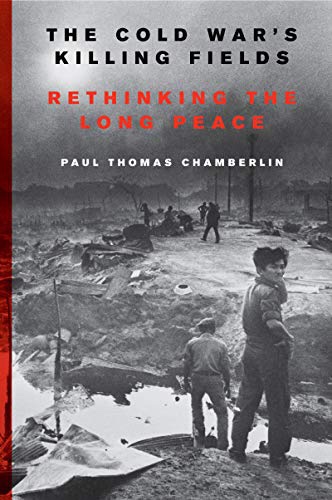
Paul Thomas Chamberlin, “The Cold War’s Killing Fields: Rethinking the Long Peace” (2018) – The “new global history” makes its way from the archive-heavy “groundbreaking” texts that get a scholar through the door, to the more approachable, secondary-source-using works that help a professor get tenure (and if they’re lucky and have a good contract, textbook buys). Chamberlin did the former with his book “The Global Offensive,” about the PLO’s international campaigns, and is now doing this latter with a broad-scope look at the Cold War in Asia. It makes sense the Cold War is such a locus for global history, given that it took place around the world, and the archives are mostly intact, and in a variety of languages for all these scholars to show off their chops. It’s been a good time for Cold War scholars.

Chamberlin takes aim, though in a curiously unaggressive way, at two shibboleths of recent twentieth-century historiography. One is right there in the subtitle: “the long peace,” the idea that the Cold War constituted a peculiar time where conventional wars between great powers ceased, in marked contrast to the first half of the century. This was most strongly promulgated by the dean of Cold War historians, John Lewis Gaddis, though Gaddis, in this as in other instances, was always more of an affirmer of consensus establishment ideas than he was an innovator. It’s easy to see the Cold War as peaceful from Yale. It’s a lot harder from pretty much anywhere in the parts of the world that Chamberlin writes about and refers to as “bloodlands,” making another nod at another Yale historian with substantial crossover appeal, Tim Snyder (Chamberlin went from a job at the University of Kentucky to one at Columbia over the course of researching this book, for those playing the home game). Snyder’s “Bloodlands” was an interesting and frustrating book, understanding the regions between a Germany and Russia through a lens inflected both by an understanding of the central importance of mass violence and a certain liberal totalitarianism-school dingbattery that only got worse once Snyder got Resistance-brain after the Trump election.

Chamberlin reassures us he’s not having a go at Gaddis and I don’t recall him mentioning Snyder by name but there’s enough of interest here to retain us without academic backbiting. The central idea should be obvious to anybody: maybe we avoided the big nuclear blowout everyone was afraid of, but a lot of countries suffered terribly due to the Cold War. Particularly given the coincidence of the Cold War occurring during the collapse of the European empires, the conflicts that would have accompanied decolonization in any event became supercharged and freighted with meaning as the Cold War superpowers forced each conflict into the framework of bilateral — or at best, US vs USSR vs China trilateral — conflict. The Cold War’s gravitational pull — and especially the sheer determination on the part of the American side to assimilate seemingly every political event between 1947 and maybe 1980, if not well after, into an us vs them framework, and the money and force they’d throw into the project — drew in wars that had little to do with decolonization as well, particularly in the Middle East.

While some of this dynamic played out in Africa and Latin America, Chamberlin chooses to focus his efforts on Asia. This makes sense, as many of the worst conflicts occurred there, and enough of them happened that you get a solid arc of conflicts from the end of WWII right up to the nineties. Most of the book is made up of respectable capsule histories of Cold War conflicts running in an arc from Korea all the way to Lebanon. Chamberlin artfully balances concision and completeness, overarching theses and the details of the individual conflicts. It wouldn’t make a half-bad textbook with which to teach the Cold War.

The historical narratives Chamberlin threads through these conflicts include atrocious conduct towards civilians as well as the eventual downfall of both revolutionary Third World communism and of secular nationalism in much of the arc of conflict he describes. Most of the wars in Cold War Asia were civil wars, and one thing that has become increasingly clear in history is that civil wars are a special kind of hell (you have to wonder how much the fact that the US Civil War was understood as “chivalrous,” alongside the way the English kind of throw their civil war down the memory hole, contributed to the delay of that realization in anglophone history). These invariably become wars against suspect populations. In Korea, massacring suspect civilians was de rigueur when either side, the American-backed South or the communist North, seized an area, or retreated from it. Massacre was also common on the invariable “both sides” in Vietnam, to the point where many were surprised that after the communist revolutionaries final victory, their revenge kill count was “only” in the five or six figures. On and on.

“Both sides” doesn’t really cover it, though, because one side was typically a good deal stronger than the other, and that was the side that was backed by the United States. The Soviets and Chinese did not distinguish themselves with their regard for human life during interventions in Afghanistan, Korea, and Vietnam. But it’s clear, from this book and from the Cold War scholarship in general, that both material and ideological factors rendered American-backed parties in these wars both deadlier and more willing to use that deadliness indiscriminately. You want to see disregard for human life, have a gander at the conversations between Nixon and Kissinger about what their friend, the Pakistani military under Yahya Khan, was doing in Bangladesh in 1971, or the approving CIA memos of the mob slayings of hundreds of thousands of purported communists in Indonesia in 1965. You didn’t need to be a sociopath like Kissinger, though- just accepting of the Cold War establishment party line and not thinking too much, like most Americans involved in destroying Korea and Vietnam, in large part from tens of thousands of feet in the air or from an office somewhere, killing between one and three million in both places, mostly civilians. Even the (arguably) grisliest set of episodes in the book, the killing fields of Cambodia under the Khmer Rouge, took place with tacit American (and Chinese) approval, to “counter” in some backwards way, the (Russian-backed) North Vietnamese.

The international left won some pretty substantial victories in Asia during this period, mainly in creating and maintaining a communist regime in China and the victory over American imperialism in Vietnam. But it took a beating in doing so. Brutalized societies do not for utopias make. In many respects, our caricatures of Communist regimes as brutal and deprived gain their truth from the fact that all of them — not just the ones in the Asian bloodlands, either — went from long-oppressed, typically impoverished autocracies to war-torn messes to just left to their own devices. There’s limits to how much failure and oppression that excuses, but the point is that deprivation and violence, often enough inflicted by overweening foreigners (who think they’re doing you a favor in the bargain!), tend to elevate harsh, hasty decisions and those who are comfortable implementing them. The rest is history.

It’s questionable how much that factored in to the ways in which the third wave of Asian Cold War conflicts in the Middle East (after a first wave in Northeast Asia and a second in Southeast Asia) turned away from communism and towards ethnic conflict and religion, especially militant Islamism. It certainly didn’t help, in terms of confusing local socialist forces (do we favor China or Russia, etc?) or inculcating paranoia and divisiveness in, say, the Afghan left. Egypt and Arab nationalism is somewhat outside of the scope, or anyway the framing Chamberlin gave it, and while he doesn’t underplay the American hand in encouraging Islamist forces, he doesn’t quite nail how destroyed the Middle East left was by direct suppression, not just discouragement at how communism seemed hard and treacherous.

This brings me to one of the odder things about the book- what he counts and what he doesn’t as part of his “bloodlands.” Snyder was odd about this too, including relatively quiet Estonia but not bloodied Yugoslavia, but he had a thesis, double-occupation, Nazi-Soviet totalitarian interplay, to advance. I don’t really see what Chamberlin’s thesis would lose by including the Hukbalahap rebellion in the Philippines in the late forties and early fifties, or the “Malay Emergency” that ran from 1948 to 1962. I guess every pedant will find a gored ox in any book of this kind, and the book doesn’t suffer too much from their exclusion. It probably doesn’t help that neither war is that well sourced or widely written about, as I have reason to know. In fact, the main people who write about them are self-dealing counterinsurgents crowing about them as success for their model of war. Beyond them it’s tricky to find stuff. The British aren’t eager to talk about Malaya because of their usual impulse to hide their dirt; Americans aren’t eager to talk about the Philippines because it’s a confusing by-blow that doesn’t demand anything of them (not unlike Liberia in that respect). For instance, I can’t find a good casualty count for the Huk War. Details are a little better with the Emergency but not much. It could be they simply weren’t bloody enough for Chamberlin’s definitions? But among other things, they encouraged the western side in the Cold War to take a hard line in Asia…

Anyway, this is a pretty admirable work of history. It’s interesting to see the “bloodland” thing taken out of the context of totalitarianism arguments, most of which implicitly back Anglo-American power, if not all of its uses (often, totalitarianism-minders want that power to be used more aggressively, like North Korea hawks). It’s conceivable that this book is an instance in a kind of positional warfare on the part of soft-left (here meaning actual leftists who are cautious about revolution, not liberals) academics to use widely accepted notions — like that it’s bad to kill millions of people — to criticize the Cold War state and its inheritors, most of the states currently extant and the neoliberal capitalism that dominates most of them. That’s cool- I can’t help but imagine the slashing attack an Eric Hobsbawm or a Walter Rodney would make of the same material, but sometimes expanding the trench lines works too. ****’

Review- Chamberlin, “The Cold War’s Killing Fields”

Review- Davis, “High Weirdness”

Erik Davis, “High Weirdness: Drugs, Esoterica, and Visionary Experience in the Seventies” (2019) (narrated by the author) – Reading (well, listening to) this book, appropriately enough given its content and tone, was an experience. Historian of religions Erik Davis landed this book right into two registers that produce very different emotional responses for me. One register is that of chewy, involved, critical intellectual history, a happy place for me, somewhere I feel both welcomed and challenged. The other register is that of mysticism, spirituality, and the particular chip on the shoulder of intellectuals who study esoteric subjects, a much more fraught and murky intellectual/emotional space for me. It is impossible to disentangle these strands in “High Weirdness” and pointless to try. In the end, the challenges involved in taking this book in have helped make it, for me, one of the best books I’ve read this year.

I locate an echo of my ambivalence in the three subjects around whom Davis structured his narrative: hallucinogen evangelist Terence McKenna, journalist and novelist Robert Anton Wilson, and scifi master Philip K. Dick. Before listening to this book, my feelings were reverence for Dick, distaste for Wilson, and for the most part a lack of interest in McKenna. In many respects, I took opposite paths between Dick and Wilson. Wilson’s “Illuminatus!” trilogy was passed around by the hippie/nerdy boys (gendered pronoun used advisedly) of my very hippie/nerd-heavy school. I got my hands on it at fourteen, enjoyed the first fifty or a hundred pages of historical references and sex, and then lost it. I picked it up again in my late twenties, and was distinctly unimpressed by the history, the sex, the libertarian politics, the prose style, and the general “ain’t I a stinker?!” tone of the work. I read Dick’s “The Man in the High Castle” as an alternate history obsessed teenager. I liked it but didn’t really “get it” until I got into PKD more generally in college and reread it. As for McKenna, I only knew about him because a psytrance act I liked (don’t at me, they had some groove to them) sampled his lectures.

Did I change my mind about any of these impressions? Not really- maybe I’m a little more sympathetic to Wilson, learning about assorted personal tragedies of his, but that’s not enough to make me read more of him. But in many respects the men themselves are beside the point except as ideal types of “the psychonaut.” The word itself takes me back to attic rooms with boys tolerant of, but not always enthused by, my uptight company, shoving Chinese research chemicals from the internet up their noses while I sat by and prattled (knowingly) of tabletop role playing games and (utterly ignorantly) of girls… boys who are now men, many of them husbands, fathers, homeowners, and I’m very pleased to say some of them are still friends (it probably helps I got a bit less uptight). Anyway! Davis is a historian, methodologist, and champion of “the weird,” as both a topic of study and as a way of approaching the world. As I was in those attic rooms, I am ambivalent. Unlike my time in the attics, I am going to make a good faith effort to understand.

This is made difficult by a few things. In many respects, I came to what intellectual maturity I possess through interaction with the special bugbear of countercultural psychonautry- materialist critical analysis. Hippies need squares, and one suspects that goes both ways. Hippies and communists actually just don’t get on very well if they take each other’s premises even marginally seriously. They are incommensurate. I identify as a democratic socialist more than a communist, and my friends, then and now, interested in psychedelia identify even less with hippie-ness, but you get the idea. In college, I put down my few feelers to what Davis calls “consciousness culture” in no small part by reading The Baffler, which took great delight in skewering the conjunction between counterculture and capitalism that loomed so large during the first internet boom. I wasn’t a punk, and if anything, I’d rather listen to the 13th Floor Elevators than to Minor Threat any day, but many of my teachers were punk. Be fast, be mean, hit vulnerable spots… among other things, it seemed a better set of principles for someone escaping nerdery (let’s throw another subculture in the mix!) in my circumstances than “tune in, turn on, drop out.”

And then there’s the chip on the shoulder that students of esoterica who get as far as Davis has gotten — well-known journalist, history PhD — in “straight” intellectual life. I get it… kind of. Academia can, indeed, be stultifying. Studying stuff off the beaten path can get you frozen out, especially considering grim economic realities (though esoterica can also be flashy enough to attract grant money and undergrad eyeballs, it’s worth noting). But there is a distinctly passive-aggressive hippie-macho quality to the way psychedelic advocates express the chip on their shoulders, and Davis is no exception. He broadly implies that academics don’t engage more with the esoteric, the “weird,” and the psychedelic because they are afraid of having their minds blown, that they have to stay within the rules of consensus reality because they’re too chicken to venture outside.

Well… lord knows academics are often cowardly enough. But I’ve also known a lot of people who would do god knows what with their bodies and cerebellums but are terrified of critical thought or honest self-examination. They’ll brave the ayahuasca jungle but not the therapist’s couch, take aboard criticism from fellow impaired miscreants before listening to an editor. Moreover, speaking as a materialist, what’s more comforting- the idea that there is a big magical universe that takes human consciousness as a key element, or the idea that there is nothing other than the material, that there’s no magic, that when we die we rot, and human consciousness was probably an evolutionary adaptation to make us better hunter-gatherers? I could just as easily say psychonauts, heads, and freaks are the cowards, retreating up their own assholes, refusing the trek into the desert of the real. That’s certainly something like what The Baffler would have said back in its glory days, if they could stop laughing at what they saw as countercultural clownishness long enough.

It’d probably be pretty good if I got into what’s actually in this book, huh? Because it’s good. It’s really good. Even the parts where I was ambivalent made me happy because they made me think. Davis dealt not just with three “psychonauts,” but their most outre flights of fancy, on their own terms but in a way that made them relevant even to my materialist ass. It would have been easy to focus on “Illuminatus!” and “The Man in the High Castle,” and Davis does discuss them, but as a prelude to jumping into the deep ends with his subjects: the McKenna brothers’ efforts to build a… psychedelic musical computer/philosopher’s stone? in the Colombian jungle, Wilson’s entry into (and out of) a paranoid “Chapel Perilous,” and Dick’s “2-3-74” experience, which dominated the last part of his life and helped produce the Valis series as well as his impenetrable Exegesis. Davis’s own exegeses of these are bravura performances of insight, sensitivity, and erudition, borrowing from vast arrays of historical and theoretical literature. This is already a long review so I’m not going into detail, but take it from an only intermittently-sympathetic interlocutor, they are quite good.

But there is a certain extent to which these exegeses, for me, were more like (noble, accomplished) work-showing for the larger contextual points Davis makes in “High Weirdness.” As far as the exegeses themselves are concerned, they serve as proof of concept for Davis’s takes on how to approach “the weird.” Neither confirming nor denying whether his psychonaut’s experiences were “real,” applying Bruno LaTour’s actor-network theory where objects are constituent, active parts in the construction of truth, borrowings from Derrida, there’s a lot going on here. Some of it is genuinely innovative- some of it reminds me of that other habit of esoteric academics, using “what do you mean by REAL?!?”-type rhetoric to keep alive the idea (often a childlike hope- not that of the six year old desiring magic power, but the twelve year old who doesn’t want to put his magic kit away) that the supernatural is real… more the former, really, I guess I’m just sensitive to the latter, especially from a guy who likes to take his shots at the intellectual courage of materialists… really, I’d say methodologically, Davis is at his best in incorporating “trash culture” and subculture histories into serious intellectual history, but that could just be reflective of my particular interests.

Historically, Davis makes some provocative claims for his subject. McKenna, Wilson, and Dick were proud freaks, outsiders… but their thoughts and actions weren’t so far outside of the mainstream as that might imply, especially not in the seventies. I have some disagreements with Davis, here, though probably more about emphasis (and arguably misprision) than fact. Davis wants to upend the seventies-as-decline narrative, one of the few things both the left and the right can agree on. All three of his subjects were involved, to one degree or another, with the sixties movements, and according to many readings, their retreat from politics and entry into paranoid delusion (if we choose to look at their experiences that way) goes along with the decline-into-individualist-malaise theme of a lot of seventies historiography. I basically agree with this notion, but also think it is ripe for some productive disagreement. If nothing else, the psychonauts didn’t (always) understand the situation as a decline, especially not the comparatively hearty Terence McKenna and the increasingly smug right-libertarian Robert Anton Wilson… the depressive (and actually brilliant, as opposed to half-smart like Wilson or just sort of questionably relevant like McKenna) Philip Dick had a tougher time. A lot of people thought they were going in the right direction. I might disagree (so might PKD!) but it’s worth understanding their perspective.

Davis takes us home towards the end of the book with a discussion of “the network society,” a concept that starts taking on valence more in the seventies and which the three subjects prefigured, and especially McKenna participated in. Whatever credulity Davis might display towards the claims and especially the premises of psychedelia, he is no naïf about the magic of networks, showing how from the beginning, whatever supposedly liberatory, freaky-Deleuzian (to bring in another theorist he name-checks) quality networks might have had, they were also systems of deception, fuckery, and control- and it was impossible to disentangle the two. This he displays in the case of hippie, early network enthusiast, and murderer Ira Einhorn’s both digital and social network of futurists and freaks. I know a thing or two about how cold the countercultural imagination can be, from that same school often described as a “hippie” school. When I enrolled in the late nineties, this school openly advertised itself as being the school for the network society, but there wasn’t much peace and love there. The founders were libertarians, ruthless Zionists, pigheaded supporters of the Iraq War, and one of them even made the local news for how much money he donated to Trump’s reelection campaign. In a gesture at contemporary relevance that I don’t think Davis necessarily needed to justify his work, he ties in the altright, “meme magic” etc., in an impassioned call to understand “the weird” before it destroys us.

Well… as it happens, I know a thing or two about fighting fascists and cut my teeth in fighting the “altright” variant. We beat the altright by dragging them away from fora and memes and into the real. We challenged them to come fight on the streets, with the means of politics, violent and otherwise. They tried, and we beat them so hard that no one calls themselves “altright” anymore. There are plenty of Nazis, but that specific strategy is played out, dead, because of us and what we did, in reality, relying on masses, weight, truth. If you ask me, that points to a good way to study the weird- not necessarily with an eye towards beating it (though learning to break anything down is often quite instructive), but by relating what it says about itself to assorted tests of consensus reality. You don’t need to be “reductive” to do that. You don’t need to grade the weird like so many undergrad essays. Just throw it around and see how it reacts. If these ideas are so interesting and important, they should survive.

Along with “psychonaut,” Davis uses an interesting word, mainly for Dick- “hermenaut” (not sure of the spelling because audiobook), navigator of the word and the methods of reading. Maybe it was my odd sensitivities, but it seems like Davis had an odd relationship with Dick. It turns out that Davis knew Terence McKenna “Bob” Wilson- Dick died when Davis was fifteen, and they did not meet. Davis knew of Dick’s work and helped edit the Exegesis, and maybe this herculean task introduced a certain frustration with the great man that Davis doesn’t have for his old, now dead, friends McKenna or Wilson. It got borderline disrespectful, from where I sat- more emphasis on Dick’s romantic failings, the phrase “mendacious imagination” came up… but “hermenaut” is interesting. It’s worth noting Dick had given up on psychedelics, mostly, by the time he had his vision in 1974. He still did plenty of drugs, especially the proletarian uppers needed to keep him writing. All three subjects were voracious readers but Dick had a reading (and writing) habit that put the other two to shame. There’s a reason (beyond academic appreciation, which Dick has more than the other two) for the Borges comparisons.

Forgive me for another reference to my youth. At my weird hippie-nerd high school, I was known for my refusal to use drugs, and a boy I knew who was quite enthusiastic for them asked me how I intended to expand my mind. As far as he was concerned, the options were either psychedelic drugs or decades of meditation- I didn’t want to do either, so what was I going to do? “I’m going to expand my mind by reading,” I told him. I don’t relate this story to “own” the boy. I don’t actually stand with the Baffler crowd in dismissing other ways of learning and other existential concerns out of hand, though I may not have much time for them myself and utterly refuse to be shamed for that. But I’ve chosen to explore the noosphere — the realm of human thought, which Davis refers to once or twice but wasn’t really part of his or his subjects approach — instead of whatever dimension the psychonaut chooses. Truth be told, I think it’s been good for me, and has actually granted some of the benefits, like enhanced connection with others, that more esoteric strains of consciousness promise. Dick’s hermenaut imagination helped raise him from his “tomb world” of depression and paranoia (funny how the whole range of “spiritual” thought avoids the realities of clinical depression like it’s a damn leper, like it doesn’t disprove the idea of a good universal consciousness…). I think that way of doing things has helped me, too. And that’s part of why, despite my ambivalence, despite occasionally rolling my eyes, I can only feel gratitude to Erik Davis for producing this work. *****

Review- Davis, “High Weirdness”

Review- Branch, “At Canaan’s Edge”

Taylor Branch, “At Canaan’s Edge: America in the King Years, 1965-1968” (2006) – “Non-violence is a tactic” is a phrase I’ve heard intoned many times over the last few years. Left unsaid but implied by context is the fact that non-violence is not the only tactic. People who say the line usually also include the implication that non-violence is not a strategy, a goal, or a politics. Like a lot of intoned phrases, “non-violence is a tactic” tries to foreclose on an argument ahead of time, because in a key moment in American life, non-violence was more than a tactic. It was a strategy, a goal, a politics, a tactic, a discipline, and, in language that has now become hackneyed but still retains some of its power, a dream.

“At Canaan’s Edge” is the last in a trilogy of books by journalist Taylor Branch covering the civil rights movement, largely through examining the life of Martin Luther King, Jr. These are big, long books written for an educated but popular audience. As such, they are relatively thesis-light and narrative-heavy. But coming to the end of King’s life, and with it, Branch heavily implies, the end of the “civil rights” portion of the black freedom struggle in the twentieth century, the theses become more pronounced.

The theses are not the strong points of the “America in the King Years” series. Branch identifies with the civil rights movement in a way it’s tempting to attribute to his being white, liberal, and well-off. His version of King is not the nice Santa Claus figure embraced by conservatives and by many liberals alike. Among other things, Branch, writing a substantial biography, does not steer away from King’s increasingly vociferous criticism of capitalism towards the end of his life, or the way white liberals from LBJ on down turned on King as King made his opposition to the Vietnam War clear or as the movement set its sights on de facto segregation in the north. But even in the late date of 2006 (the first volume of the trilogy came out in 1988), and even with caveats about the warm personal relationship between King and figures like Stokely Carmichael, Branch still holds to the old idea that the rise of the concept of black power did much to end the civil rights movement that a reader of the series had, by then, invested a good two thousand five hundred pages reading about.

Ultimately, Branch charts the declension narrative of civil rights going into 1968 “more in sadness than in anger,” as the saying goes. Carmichael and the rest, veterans of hard work and harrowing persecution in the struggle in the Deep South, had good reason to embrace black power and more robust self-defense. Struggle, in general and in the peculiar pitch of non-violence, wears people down, King included. Just, for reasons Branch doesn’t make clear, King could stand it longer than the others, could keep the non-violent faith, commitment to multiracial alliances, and a form of patriotism that even his closest allies could not. Then he was murdered, and that was that.

The stuff one comes to this kind of book for — narrative history — satisfies more than the theses do. Branch tells the stories well and in a lot of detail. If there’s an issue here, it’s that Branch gets a little too ambitious and gives us a lot of what’s going on in Vietnam along with the black freedom stuff. I get it- it was all part of the largest gestalt, and Vietnam helped drive King’s allies in the White House, President Johnson included, away. But we didn’t need all of the details of strategy meetings with the national security council for that. I think Branch wanted to make Johnson out as a tragic figure. I can even buy it, a little- Johnson probably would have preferred not to have inherited the Vietnam mess, and focus on his poverty programs. But ultimately, a man killing hundreds of thousands to stay in power… not that tragic. More just bad. And it slowed the book down.

Still and all, this trilogy was well worth reading. Like I said before, I probably knew more about black power movements than I did about civil rights. It’s almost as though universities assume that you get so much of (a bastardized version of) King and civil rights from elementary school onwards that it’d be redundant to teach it seriously in history classes.

What, beyond firming up the details instead of it just being a blur of compelling black and white images, did I get from reading these books? Well, I do think non-violence is best understood as a tactic, or really more of a strategy. Moreover, I think in many cases fighting is appropriate and justified. I certainly think the parody of King’s strategy that’s invoked by the media and on-the-ground peace police at street actions isn’t worth much. But I don’t think it makes sense to let the matter rest there. Reading these books, it is impossible to accept the picture of naivety, passivity, or even cowardice that leftists sometimes allow to develop of the civil rights movement, a kind of negative of the (frankly, often patronizing, naive, overly-sunny) picture of black power militancy we have created. Whatever their mistakes and flaws, these were serious people with a serious strategy, aware of alternatives, who made their choices with their eyes open. You don’t need to believe in non-violence in any capacity, and you certainly don’t need to accept Branch’s occasional dip into patriotic bathos, where he insists King was doing no more nor less than the Founding Fathers, to accept that.

Practically speaking, I think the main takeaway from King, the SCLC, and the “civil rights” side of the (debatable, heuristic) “civil rights-black power” dyad isn’t the power of non-violence but the power of discipline. The sort of non-violence King used took immense discipline, and no amount of militant sneering can efface that. That discipline meant endless work on recruiting, educating, organizing, and mobilizing many many often previously-unpolitical people. The movement’s inheritors kept the fire but did not, generally, keep the discipline, as though by coming out from behind the shadow of “Lawd” (as some SNCC hands called him behind his back) King, they could relax, let out long-suppressed breath. Sometimes it seems that they thought that dispensing with non-violence meant dispensing with any discipline beyond (often arbitrary) chains of command and adherence to lines. That didn’t answer, couldn’t answer, to the strains. I think we need to learn that discipline again, even if we don’t accept all of the premises King, Branch, or anyone else added to it. ****’

Review- Branch, “At Canaan’s Edge”