Review- Rushdie, “Midnight’s Children”

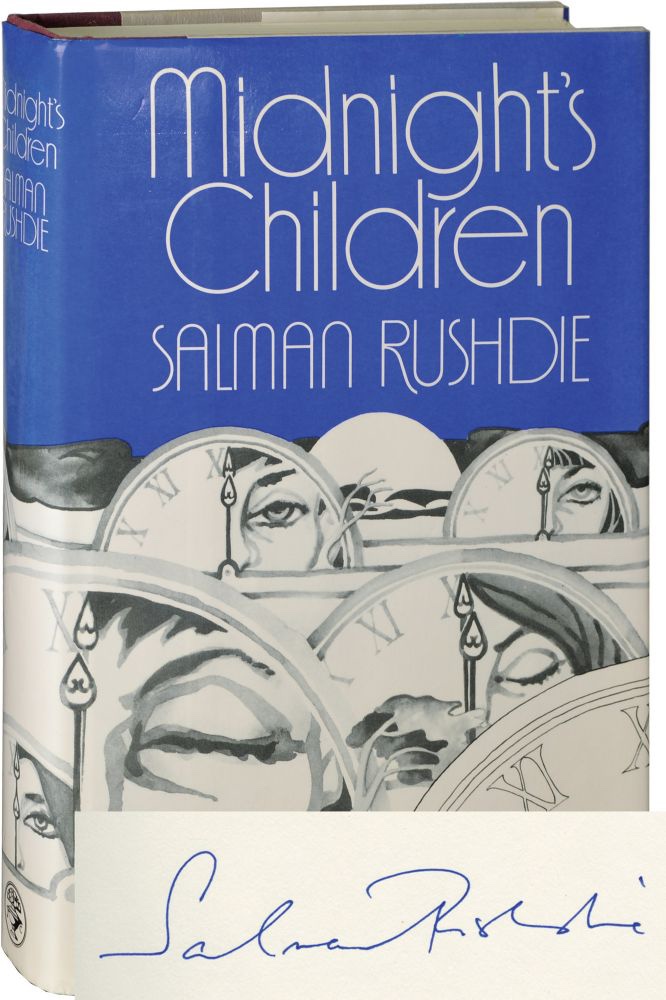
Salman Rushdie, “Midnight’s Children” (1981) – “And good luck with ‘Midnight’s Children,’ heaven knows no one’s ever finished it,” Mark tells another character on one episode of “Peep Show.” Well, I did finish it, though it took a while. What did I get out of it? That, perhaps, is the sort of question that a Rushdie novel seeks to subvert the basis of (conveniently enough, the cynical part of me adds). Should literature be the kind of thing one “gets something out of” or should it be an experience in and of itself? “Midnight’s Children” belongs to the latter category, which is to say that the novel itself is an interesting experience, and also a way of saying that the ending is not noteworthy.

“Midnight’s Children” is the story of Saleem Sinai… or IS it? Is it not the story of post-independence India? Because, you see, Saleem and independent India are born at the very same time, the stroke of midnight on that fateful night in 1947 (also the year Rushdie was born, but not the date). Baby Saleem gets a letter from Nehru marking the occasion and everything. But Saleem (the narrator along with being the main character) doesn’t tell the story beginning with himself. He talks about his grandparents, how they met, his parents, assorted symbolisms and portents in his background, a family habit for being there at key moments in India’s history. The stories are told from the point of view of an older Saleem writing his memoirs and reading them to a paramour, with a lot of asides, glimpses forward and back, etc.

Saleem is very much a literary figure of his or, rather, Rushdie’s time, resembling viewpoint characters found in other magical realist novels like those of Gabriel Garcia Marquez, as well as quasi-fantastic literary recent-historical novels like those of Saul Bellow and E.L. Doctorow. He’s precocious, opinionated, destiny-crossed, bodily-marked (he has a big nose), voyeuristic, and horny. I guess in most of these respects he’s a reflection of the author and the anticipated reader- it’d hardly do to have an incurious unopinionated viewpoint character, unless you were trying something unusual.

He also has a super-power, though it seems to come and go somewhat arbitrarily. He can read minds and have others read his. Through his super-power, he comes to find out that hundreds of children all around India have super-powers, too, and all were born in the midnight hour of India’s birth, just as he was (hence the title of the book). He summons them all to nightly congresses in his mind (which now seem like nothing so much as so many meetings on Zoom, but of course Rushdie couldn’t have known about Zoom or the pandemic which forced its use back then). They don’t come to much — too many kids, too many ideas, too poorly organized — though Saleem does meet his archnemesis, the violent boy Shiva, born at the same time as him, whose super-power is to kill people with his oversized knees? Honestly, not the best or scariest power out there.

Saleem and Shiva share a secret, Saleem wittingly and Shiva unwillingly, related to their respective births and the families they belong to. There’s a lot of switching in this book, family-switching, name-changing, conversions, and Saleem goes back and forth between India and Pakistan as well. Relatedly, you get a lot about the malleability of identity and identifiers like family, religion, nationality. In one of those have-it-both-ways-and-neither-way things you get with a certain kind of literature, Rushdie both plays to the mystification of India in the western mind and critiques it- westerners are both wrong to see India as mystical and ineffable and also wrong to try to understand it rationally on their own terms. Well, it’s a big, old country. Who’s to say there’s a right way to approach it?

One way in which Rushdie is pretty conventional is in his treatment of women. Saleem claims to have been made and unmade by women every step of the way, from before his birth to his finding his super-power to falling in love with his (sort-of-not-really) sister to his misadventure in the Bangladesh War of Independence and on and on. Horniness and sentimentality combine to make seemingly all women alluring mysteries to Saleem. Is this how Rushdie sees things, or just his viewpoint character/avatar for exploring India’s identity? In the end, Saleem is nearly completely undone by the scariest Indian woman of all, Indira Gandhi. Rushdie abandons most of his literary ambiguity here and seems just shit-scared of that particular woman.

I’m probably not selling anyone on this book, but my tone is such in part because I’ve been sleep-deprived for a little while due to what appear to be medical issues, so I’m having trouble mustering up enthusiasm. But I kept reading the nearly 650 pages not out of stubbornness but out of genuine interest. Rushdie is a capable enough prose stylist, even when winking to assorted now somewhat played-out theoretical concerns, that he carries the reader along. It’s a lively book, which is in interesting contrast to the way it’s sort of a monument of world literature, something to be name-checked rather than really engaged with- “lively” isn’t the word you’d usually ascribe to monuments. Another contradiction for the road, I guess. ****’

Review- Rushdie, “Midnight’s Children”

Review- Machado, “In the Dream House”

Carmen Maria Machado, “In the Dream House” (2019) (narrated by the author) – Much of the time, great works come like bolts out of the blue, with no really visible antecedents: “Astral Weeks,” like I talked about last week, DuBois’s “Black Reconstruction.” Other times, they grow out of unlikely hummus. “In the Dream House” belongs, to my mind anyway, to the second category: it is the millennial confessional essay, not a form I generally respond well to, raised to something both beyond and in keeping with the boundaries of the form.

This is an account of Machado’s emotionally abusive relationship with an unnamed woman, written in scores of tiny chapters, some only a sentence or so long. Machado processes what happens to her through the lens of criticism. Each chapter examines her relationship through a genre or trope, all harkening back to a central trope of the “dream house,” the spaces of her relationship, physically split between old houses in midwestern college towns, Iowa City and Bloomington, Indiana and figuratively inhabiting the utopian dream of lesbian relationships- all the good parts of love, none of the bullshit men bring with them.

How much detail of the abuse does it make sense to go into? In one harrowing chapter (there are many), Machado details how she had a sick desire for her abuse to have been more physical, with bruises she could point to. As it stood, the emotional abuse she sustained, the constant undermining of her sense of self and nurturance of a sick kind of dependence on another’s caprice, was bad enough for this reader. Machado manages emotional space in this work like the best prizefighters manage space in the ring. The examination of her relationship through genre and trope would seem to keep the whole thing at least an arm’s length. But, and perhaps this is my own methods of emotional distancing talking, I found the mechanism supremely relatable and capable of delivering devastating emotional payloads. The distancing, and Machado’s honesty about it, is its own form of closeness.

Me and my war and fighting metaphors… In the introduction, Machado writes, “if you need this book, it is for you.” Well, I don’t know if I need this book, or if it is “for me” in the sense that phrase is generally meant these days. Machado was born within a year of me, we are both nerds whose main medium is the English language… and there the resemblances leave off. Beyond the obvious demographic differences, romantic relationships have played a pretty small role in my life. My boundaries are high, and perhaps I’ve traded some degree of interpersonal connection to avoid what seems to me dramatics and irrational behavior. That’s about as confessional as I feel like getting. One of the points of literature is to nurture empathy. Sometimes, this project turns inward, curdles. Sometimes, I resist literature having a point, in part for the same reasons I avoid some kinds of personal connection- a disinclination to having others meddle in my head. All that said, I am glad I opened myself to Machado’s writing to the extent I did. *****

Review- Machado, “In the Dream House”

Review- Vachss, “Flood”

Andrew Vachss, “Flood” (1985) (narrated by Christopher Lane) – This crime novel, published in the year of my birth, catalogs many of the going fears of the time, most of which bled into my early childhood. The first of what seems to be a long series of novels starring Burke, an ex-con private eye who specializes in shaking down the “freaks” of his native New York City and protecting children, “Flood” capitalizes on the panic over organized child sexual abuse then raging unchecked. Vachss himself, according to wikipedia and his introduction to the novel, at any rate, considers himself first and foremost a protector of children. He apparently has a law practice that only takes on juvenile clients, and once ran a juvenile prison (honestly, seems to contradict the whole “child protector” thing right there, but what do I know?). Eye-patched and given to eccentric statements, like how his “personal religion is revenge,” he cuts a vaguely Moshe Dayan-ish figure.

I listened to this book in part out of general interest in crime fiction, and in part out of an interest in fictional depictions of this era of moral panic. My birthday lecture this year is in part on Dennis Lehane, another crime writer who draws from the well of corrupted childhood innocence. Cards on the table: “childhood innocence” talk from adults, especially adult men, creeps me out. I am indeed aware there are those who prey on children- growing up when and where I did, this is unavoidable. I’m also aware that these are crimes of power imbalance, and posturing as a protector of the weak is a good way to ensure that the power imbalance stays where it is, regardless of good intentions on the part of the “protector”. I also know that in the vast majority of instances, the power imbalances that generate child abuse come from socially-enshrined institutions, the kind you’re not supposed to question, like that of the Catholic Church or, most pertinent of all, the heteronormative patriarchical family. The local fascists like to posture about how opposed they are to pedophilia, as though such a stance makes them brave. They still support Trump and never touch the Church. I’ll believe a social worker or a survivor when they talk about this shit, not a rando vigilante wannabe.

Vachss (and Lehane, for anyone keeping score) acknowledge this power dynamic, partially. Child abuse exists in the sanctified spaces in the world of Vachss because, well, it exists everywhere, kind of rendering the point moot. Still and all, the “freak” Burke hunts in this book finds his victims via, where else, day-care centers, in this instance day-care centers run by liberal churches who buy a freak’s fake traumatized Vietnam vet schtick. He’s hired by the titular Flood, a hot young lady who wants to do a karate duel with the bad guy (who calls himself “The Cobra”). It’s that kind of a book.

Much of the book is a tour through the slime-pits of Burke’s New York. Vachss enumerates in loving detail Burke’s scams, security arrangements, and network of allies. We don’t know what Burke went to jail for but we do know he sees himself as being above both the square society of “citizens” and the “freaks” of the city- he sees himself as a meta-predator, preying on those who prey on others. Though to be honest, when he’s drumming up business for shyster lawyers or running his other penny-ante scams, he seems more like a scavenger than anything else, and Vachss’s descriptions of his security systems get tiresome too. For those playing the game of trying to dope out an ideology here, Vachss is complicated, though I wouldn’t say “complex” in the sense of “nuanced.” He’s disgusted by the society of freaks, but right-wingers are freaks just as much as anyone else in his book. Scamming the mercenary pipeline to Rhodesia winds up being a key part of how Burke finds his man, and Burke is pals with Puerto Rican militants and a trans woman who’s relatively sensitively portrayed, given the era and the context.. Moreover, there’s little appeal to lost innocence on a societal level- Burke and Vachss don’t look back to the fifties or whenever. Ultimately, in a fallen world, there is no society, only men and women and their — in this instance, chosen, like Burke’s posse — families, to borrow a phrase from a contemporary figure. Crime fiction doesn’t generally set out to solve the structural woes of the world, but the way they choose to portray these structures can tell you something.

How to rate this book? It was certainly an interesting glimpse into a time and place. Vachss’s work might form a building block going forward in thinking about the era, and I do plan on reading and writing more concertedly about the late twentieth century. I also found it markedly unpleasant to listen to. Vachss himself would presumably put this down to my incapacity to deal with the reality of the streets, but if I may speak for myself in this hypothetical conversation, I don’t think that’s it. For one thing, I’m not sure how real any of this is, between the karate duels and the friend of Burke’s who invented a laser as a kid and the open-air child slave and pornography markets. For another, it just ticked a lot of boxes of unpleasantness for me and I think for many readers orthogonal to the premise of child abuse existing, starting with the creepy protector-of-the-youth bullshit you need to accept as the price of entry, and including the choice of the voice actor to do ludicrous dehumanizing Asian and black dialect voices (his Hispanic voices were relatively restrained- thank god for small favors I suppose). In the last analysis I rate these books based on whether I liked them, like goodreads says (this all started with goodreads, for better or for worse), and in the end I would not say I “liked” this weird, scuzzy book. **

Review- Vachss, “Flood”

Review- Walsh, “Astral Weeks”

Ryan Walsh, “Astral Weeks: A Secret History of 1968” (2018) – Van Morrison’s second solo album, “Astral Weeks,” seems to come out of nowhere. Those accustomed to the overplay of “Brown Eyed Girl” on oldies radio and assuming that’s what Morrison is all about — even if they like that version — are in for a surprise if they turn on “Astral Weeks.” Better essayists than me, most notably rock critic legend Lester Bangs, have already expanded at length on the album’s musical qualities, with a lot of words like “transcendent” thrown around. It really is worth your while to give it a listen.

One of the things that provokes discussion about the album is the contrast between the art and the artist. It’s not that anyone’s surprised that Van Morrison could create something like that on a talent level- from his early work with Them, everyone knew Morrison had talent. The contrast is between the emotional range of the album and that presented by Van Morrison the person, and much of his subsequent work. In short, “Astral Weeks” is a deeply felt, empathetic piece of work, and Van Morrison was and is… a piece of work. He himself has spent the last fifty years insisting “Astral Weeks” isn’t representative of his work or personal in any way. He’s something of a sour old man and always was, even when he was making brilliant music in his early twenties. This wasn’t rock and roll grandiosity, great talent and great failings (and great stories); he was just a low-grade, petty prick to everyone around him. You don’t need to believe great souls make great art but… the going theory seems to be that Morrison got in touch with something around the time he made “Astral Weeks.” Some of the magic lasted into subsequent albums, but it was mostly gone with a few years, and he never touched anything like it again, and it burnt something out of him.

Musician and music journalist Ryan Walsh puts forward the novel idea that there could be a Boston connection to that “something” Morrison touched in this book. It’s notionally about the album, but really it’s an attempt to summon a gestalt. Boston isn’t commonly thought of as one of the epicenters of “the sixties” as a phenomenon, but Walsh makes the argument here that maybe it should?

There’s a few different strains of narrative he follows and tries to string together. Van Morrison was indeed in Boston in 1968, Cambridge more precisely, trying to get out of a bad record contract, playing gigs, and writing the material that would go into “Astral Weeks.” He was attracted in part by the Cambridge folk revival scene, which was in collapse by then and an erstwhile member of which, Mel Lyman, was setting up a folk-music-labor-and-sex cult in Roxbury, the Fort Hill Community (or Lyman Family). This all sort of came together around the creation of the Family-backed Boston Tea Party, a concert venue which became a favorite for the Velvet Underground among others. There was a lot of psychedelic stuff going on, from Timothy Leary’s early experiments at Harvard to trippy public tv on WGBH to the countercultural press — like the Fort Hill Community’s magazine “Avatar” — pushing the envelope and getting in free speech fights. There was also the more earth-bound concerns of the time, and Walsh retells the story of how the Boston mayor’s office got James Brown to play a special concert to help keep the kids occupied and not rioting after the MLK assassination.

A reader expecting solely a deep dive into Van Morrison’s world and process might be disappointed by how much of the book isn’t really about him, but Walsh does get the goods in terms of tracking down his collaborators. He also paints a vivid picture of Boston’s music scene at the time, when record company people tried and crashingly failed to promote a “Boston Sound” as a geographical counterpoint to a San Francisco seen as fading out. He gets seemingly every old Boston rock hand talking. One person Walsh doesn’t talk to is Morrison himself. I have it on reasonably good information from a friend of the author that Walsh didn’t even bother to try, knowing that “Van the Man” has driven numerous other rock journalists, like his biographer Clinton Heylin, to distraction and hostility with his evasions and crabbiness.

How successfully does Walsh summon his Boston 1968 gestalt? Does it get across the emotional overtones he wants it to? He’s reasonably successful, I’d say. You don’t get quite the sense of cosmic connection out of the coincidences and crossed paths Walsh documents that you do out of “Astral Weeks,” but it’s harder to do that kind of thing with prose nonfiction. I’m not sure I buy the notion of “Astral Weeks” as a “Boston album.” Yes, Morrison developed the songs in Boston. But he recorded them in New York, with the vital backup of New York jazz session musicians. More importantly, the songs themselves reflect Morrison’s youth in Belfast. “Astral Weeks” has been called the last culturally significant portrait of Belfast before the Troubles. But this, thankfully, is not a thesis heavy book. Mostly, you just sort of take in the gestalt, and Walsh’s efforts to reconstruct it. ****’

Review- Walsh, “Astral Weeks”

Review- Winship, “Hot Protestants”

Michael Winship, “Hot Protestants: A History of Puritanism in England and America” (2019) (narrated by Paul Boehmer) – I listened to this book less out of interest in the Puritans themselves and more out of interest in where the historiography on them has gone lately. Michael Winship is a professor who has been widely published in Puritan history and this appears to be his attempt at a book for a wider audience, so it’s probably not the best way to get at the cutting edge of the questions involved, if there still is one. But at the same time, mid-twentieth century and earlier writers on Puritans, who I’ve read more of, directed themselves or at least tried to at a mass audience while maintaining high academic standards, getting reviews in newspapers and the like and not just academic journals. This led to such amusing remarks as a newspaper reviewer warning readers that Perry Miller’s “The New England Mind” “requires cooperation from the reader.” Indeed!

The early American Studies scholars wrote for a broad educated audience because they had what amounted to a civilizing mission in mind: show the American people the greatness of their own culture (as defined by the canonizing project the American Studies scholars themselves undertook) and simultaneously steer them away from political radicalism. Perry Miller’s Puritans were meant to be not ancestors to Americans, as earlier scholars held them — if nothing else, in an increasingly diverse America, that wouldn’t fly — but as progenitors of their political and social project. Scholars like Miller were too sophisticated to make this claim in any easy, straightforward way, and given to an ironic, sometimes tragic outlook on life and the achievability of great dreams, so a one-to-one Puritans-to-contemporary-Americans thing wasn’t what they went for, at least outside of what might get taught to primary school children. Even if you disagree with their take on the Puritans or others they construed as constitutive of the American cultural canon (I often do) or with their larger pedagogical project (which I’m definitely not on board with- not that any of my teachers were, either, by the time I came of age), works like “The New England Mind” endure as scholarship for a reason.

Again, “Hot Protestants” from the title on down is meant for popular consumption, in this age where scholars seem convinced that no one wants their most advanced work, unfortunately. So I don’t know what Winship’s larger project might be. In the world of “Hot Protestants,” it appears to be “humanizing” the Puritans, as well as deprovincializing them, re-rendering them into the trans-Atlantic actors they were. The narrative often moves forward through representative stories of given Puritan experiences to illustrate changes in the relationship between Puritanism and the established Church of England, in New England’s ecclesiastical governance policies, and so on. There’s less emphasis on theology here than I am used to seeing in work on Puritans, and more on what today would be called the “wedge issues” which so violently rent society in Britain in the seventeenth century: regulations on amusements, specific forms of ritual, church governance, and so on. Perhaps Winship felt that this would hold a modern reader’s attention more than the points of theology which so moved the Puritans- he is probably right, if so.

Winship is less thesis-heavy than Miller and his ilk. This is probably good as far as accurately conveying information about the Puritans goes; Winship takes a swipe at Miller specifically for blowing John Winthrop’s “City on a Hill” speech out of proportion and decontextualizing it until it became a cliche of twentieth-century American rhetoric. But it raises some questions as to what the stakes are for “Hot Protestants.” The stakes for Miller and the American Studies cohort were high- arguably as high as that of the Cold War they imagined themselves helping to fight. “Hot Protestants” is no defense of Puritanism, even if contextualizing them in any meaningful way helps show them as something other than the simple tyrannical martinets they’re often portrayed as being. Implicitly, the book might be able to sustain a reading as a warning of the dangers of ideological purity, which Puritans (both of Presbyterian and Congregationalist stripe), Anglicans, and everyone in between pursued violently and at great cost to New England and especially English society.

Still… not to harp on the comparison, but I did read Miller recently, and he made the Puritans seem both alien and kin to the society in which I live, in a number of illustrative ways. There was a power and subtlety in “The New England Mind” which “Hot Protestants” simply doesn’t have. It’s admirable to try to make the strange familiar, as Winship tries to do. I think it’s another thing entirely, an uncanny and wonderful thing, to suspend the reader between the strange and the familiar, to make the reader dig a little deeper into the structure of what they find familiar and see that it’s pretty strange, too. I guess to put it more simply, Winship familiarizes the strange but does not make familiar strange, in this book anyway. Doing both is more interesting, to me, anyway. ***’

Review- Winship, “Hot Protestants”

Review- McCurry, “Masters of Small Worlds”

Stephanie McCurry, “Masters of Small Worlds: Yeoman Households, Gender Relations, and the Political Culture of the Antebellum South Carolina Low Country” (1995) – Historian Stephanie McCurry gets down to social history cases in the antebellum Low Country of South Carolina, arguably the harshest and most alien American social environment this side of Massachusetts at the height of the Puritan theocracy. Over half of the population were enslaved Africans, reaching seventy percent of the population in some places. This skewed the already warped Southern social fabric. Here, instead of a non-slaveholding white majority like you saw in many southern states, even the “small” “yeoman” farmers owned upwards of ten slaves. McCurry doesn’t discuss landless white agricultural workers in this work, which suggests they were only present in very small numbers, unlike in the rest of the country.

No, the Low Country was something of a propertarian dream (as, indeed, the antebellum south is generally for a clade of right-wing libertarians). The small farmers, caught between the system of massive cotton and rice plantations run by ultra-wealthy elite planters and the abyss, more or less, found a place in the system based on what they had: ownership and mastery over a small amount of land, a small number of slaves, most importantly over their families and especially wives and daughters. Ownership, mastery, and their inevitable counterpart, submission, became the master metaphors of the Low Country, governing everything from how the people related to the Almighty in the evangelical churches to how electoral politics functioned.

McCurry tries to address the paradox between the universal white manhood suffrage South Carolina embraced and the aristocratic control exercised by Low Country planters. There could be no republican governance without a subject working class- the “mudsill” of civilization, as they called it. By being routinely recognized as not part of this mudsill, as (lesser) masters in their own right, the yeomen were essentially flattered into taking part in an otherwise deeply undemocratic system where the planters held the balance of power through gerrymandering, property requirements on offices, and so on. This is a good enough answer, and an explication of the “psychic wage” theory of white supremacy. I do wonder, though- elites everywhere would give a lot for the kind of control the antebellum planter elite had in South Carolina. Why did it work out so diabolically well for them there and not elsewhere? Is it just happenstance, or a founder effect from the Barbadian planters that settled the country in the late seventeenth century? Or are the differences exaggerated? Either way, this is good spadework done on a difficult and counterintuitive subject. ****

Review- McCurry, “Masters of Small Worlds”

Review- Cherryh, “Merchanter’s Luck”

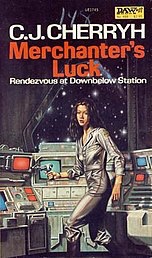
C.J. Cherryh, “Merchanter’s Luck” (1982) – I very much enjoyed the first of C.J. Cherryh’s “Alliance-Union” series, “Downbelow Station,” a fast-paced and agreeably overstuffed scifi novel set on a trading station on a remote planet. “Merchanter’s Luck,” the next book in the series, has some of its interstellar-workaday charm, not unlike that found in the universe of the “Alien” movies. But I’ll be damned if it doesn’t drown the reader in technobabble and the particularities of gray-market interstellar trade. Sandor, the protagonist, runs a sort of tramp-steamer in space, the “Lucy,” which does various low-grade contract-shenanigan deals, staying one step ahead of the law. As far as I can tell, the plot is he falls in love with Allison, from the “Dublin Again,” a respectable family generation ship (in scenes with the family, one is tempted to cry out, “MICKS… IN… SPAAAAAACE”) that does big-time interstellar trade. He follows her spaceship on a risky “jump” to another star system, which causes attention to fall on his shady business. For some reason — love? Impressed with his dedication? — Allison convinces her bosses/grandparents to more-or-less buy “Lucy” and let her and some cousins help run the ship with Sandor and do some interstellar trade on their account. They then get entangled in some business between space-pirates and space-pirate-hunters. There’s something about a “Union” and an “Alliance,” two unhelpfully generic names for rival space empires. The characters learn to respect each other. And there’s a lot, a LOT, about the logistics of space travel. But unlike in the writings of, say, Neal Stephenson, there’s no geek-out attempt to explain these logistics. The characters just think and talk about them and expect you, the reader, to follow along with the jargon. It gets baffling and boring. I still like the overall gestalt of Cherryh’s space stories so I’m rating this higher than I might, but I hope the sequels give the readers a little more to work with. ***

Review- Cherryh, “Merchanter’s Luck”

Review- Waugh, “Vile Bodies”

Evelyn Waugh, “Vile Bodies” (1930) – The Jazz Age, a time period reading Americans instinctively think of as “Great Gatsby” territory, gets the Waugh treatment in this, his second novel. Waugh came out the gate an extraordinarily assured and controlled writer — “Decline and Fall,” his first book, is well worth reading — and while he anchors “Vile Bodies” in pathos (helped by a bit of future prognosticating), it lacks the occasional dip into the bathetic Fitzgerald was known to take, or that his fans have read into him if we’re feeling charitable.

A couple, Adam Symes and Nina Blount, stand as centerpiece of this brief but panoramic view of Jazz Age London society. They get engaged and disengaged as Adam’s fortunes go on a madcap up-and-down run over a period of weeks: getting his manuscript (Adam is a “bright young thing” writer), winning bets, losing checks, gaining and losing newspaper employment, etc. Waugh accompanies this central theme with further illustrations of a society out of kilter, unmoored from traditional verities (he wasn’t lachrymose about the loss- yet). The constant in and out of parties that wander from place to place, a well done (if slightly heavy-handed) public motor race gone out of control, and the occasional brief speech from a savvy Jesuit (this is around the time Waugh converted to Catholicism) underscore the theme of post- (or inter-, anyway) war moral chaos. “Vile Bodies” nails a mixture of humor (Waugh was a cutting humorist, which did not mix with his, err, unfortunate racial opinions well, but it doesn’t come up much here) and angst where the two relieve and enhance each other.

In the end, it’s all pointless, as Waugh prognosticates another, even more destructive war than World War One on the horizon (I don’t think you needed to be a Nostradamus to do that, but it works for Waugh’s purposes). One wonders how long and fervently Waugh hoped for the war he eventually participated in, World War Two, and wrote about extensively… though his war novels never reached the acclaim of his earlier work or of “Brideshead Revisited.” You could call this a search-for-meaning novel, but really, Adam doesn’t want meaning as much as he wants a break on the financial-cum-nuptial front- he’s a reflection of his times, including his time’s self-reflexiveness, not a rebel against it. Those times were well made for Waugh’s critical literary eye. ****’

Review- Waugh, “Vile Bodies”

Review- Mahajan, “The Association of Small Bombs”

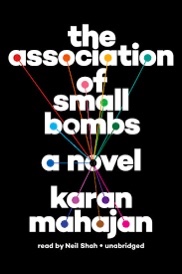
Karan Mahajan, “The Association of Small Bombs” (2016) (narrated by Neil Shah) – To paraphrase Adam Clayton Powell: “I am against the dismal novel of bourgeois angst. But until the dismal novel of bourgeois angst is done away with, I believe the Indian bourgeoisie deserves the same chance to be minutely depicted as the Anglo-American bourgeoisie.” Divorce, the classic subject matter of such novels, now has competition from terrorism, the departure point for “The Association of Small Bombs.” We get to see how a “small” bombing in a Delhi market scarred the lives of a survivor named Mansoor, some of his friends, and the parents of two child victims of the bomb.

I guess I shouldn’t have started on such a down note, this book isn’t great but it isn’t terrible. Predictably, but also aptly, enough the bomb becomes a metaphor for the forces fracturing the marriage of the Khuranas (the couple whose kids were killed), stunting Mansoor’s life, etc. Paul Auster’s problem was a lack of good verbs; Mahajan’s tic is odd adjectives and descriptive language, a less damning flaw but still notable. The worst one that comes to mind is describing a computer keyboard as being made up of “plateaus and inclines” when I think you’ll find your keyboard is actually pretty flat and regular, etc. There’s some interesting interactions between young people over Islam and porn (the two forces battling for the soul of the internet, one says) and a pretty good scene where the dad Khurana tries to show his bratty sons (before they get killed) how the other half in Delhi lives, but the poor aren’t being squalid enough to get his point across. There’s a lot of less interesting stuff about marriage and real estate.

Probably the most interesting part for me wasn’t the Khuranas’ bad marriage and apartment deals but Mansoor and his friend Ayub. They meet in activist circles, trying to resist the Indian police’s unfair treatment of Muslims (including people involved in the bombing that injured Mansoor years earlier). Here, Mahajan takes his place in the long litany of bourgeois writers who depict politics of any stripe, from Gandhian pacifist protest to Salafist terror, as motivated by an individual’s ennui, boredom, and status-seeking, and not by anything like ideas or a genuine desire to see the world different. This facilitates the slide of Ayub from one of those poles to the other- a girl in his activist group breaks up with him, so he joins the Kashmir separatist terrorists. There’s a little more to it than that — Mahajan is nothing if not interested in observing the psychology of his characters — but that’s basically Ayub’s story, which sucks Mansoor in and ends the book. All told, an Indian-American (Mahajan was born and currently lives in the US but was raised in Delhi, I understand) entry into the mold of bourgeois literature, for better and for worse. ***

Review- Mahajan, “The Association of Small Bombs”