Review- Ellroy, “This Storm”

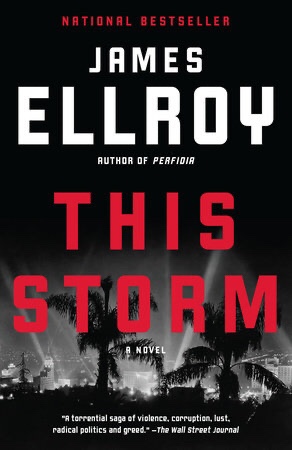
James Ellroy, “This Storm” (2019) – How to even describe a late-stage Ellroy novel? Nearly six hundred pages of cop-fantasy fugue gets at the gestalt. Ellroy described his early method as transcribing the crime fantasies he came up with while bumming around LA, frequently homeless and high on shoplifted cough suppressant. His later method, as far as his very few interviews let us see, is to hole up in his house sans internet or tv, marinade his brain with old LA newspapers and jazz and classical records, and let his imagination, full as ever of wild schemes, outre ultra-violence and chintz, spool out into a book every few years. Nice work if you can get it, I suppose, though he had to go through hell to get there, what with his mother being murdered when he was a kid and him being raised essentially feral…

Anyway, “This Storm.” Title taken from a line in an Auden poem. Set in LA and Baja California in 1942, second part of a planned quartet of wartime LA crime novels. Ellroy’s trademark telegraphic/police report style enhances the effect of a constant drip of incident, new (sometimes new old- these books link up with his previous books and share characters) characters, layers upon layers… a group of characters, mostly the shady, violent cops Ellroy loves, stumble upon a massive conspiracy involving a gold heist and some kind of totalitarian left-right alliance to sabotage America, during and after the war. As a historian, it’s deeply amusing to me to see Ellroy, a smart guy and lover of history but not a theorist, walk backwards from his kiddie-crime-book inspired rogues gallery of commies and Nazis into something like the classical totalitarianism school concept of mid twentieth century history.

Different characters want different things but most of them want some combo of gold and a “clean solve” to a baffling triple murder connected with the gold. The most interesting is Dudley Smith, as close to a classic Ellroy ubermensch as any Catholic (he’s ever so Irish, y’see) will be (Ellroy might be the last mainline Protestantism snob alive), is seduced by the right side of the right-left gold alliance. This comes in the form of the Sinarquistas, a sort of Mexican fascist movement that actually existed. While Smith and other Ellroy fascists have some right-wing values — order, for sure, and hierarchy — for them, it’s mostly fetishistic, a matter of the look and the violence (this is presumably what attracted Ellroy to the Nazi right as a teen). Communists, in Ellroy’s telling (at least this time around- he was a little more sympathetic towards the end of the Underworld USA trilogy, which I wrote about in Jacobin many moons ago), are a little more self-righteous but much the same- in it for the excitement and the opportunity to lord it over others.

Not to get persnickety with what is, after all, a crime novel and not a political treatise, but it’s not like Ellroy’s USA exactly has some grand point to it other than murder, sleaze, and chintz. One of Ellroy’s great strengths is that he doesn’t even pretend there’s anything at the bottom of it. He continually has his characters refer to it as “this white man’s country.” It’s not subtle and he doesn’t really try to justify it. In the end, he makes clear the totalitarians are just crooks with an added layer of ideological excitement going for them, so… not sure what it all adds up to, but as Ellroy will be the first to tell you, he’s not a political animal these days and he won’t talk about Trump. So there.

There’s a lot else going on, too. There’s divided loyalties, between characters who are sometimes too generic, types, strongarm cops and strong-willed arriviste women. There’s a depiction of a gay Japanese-American dealing with the internment of his community on top of all the crime mess, the sensitivity of which belies Ellroy’s usual provocativeness. And there’s Ellroy’s invocation of nighttime LA which really makes me want to go get a drink at a Chinese restaurant at 1 in the morning, which between living in greater Boston and living under covid doesn’t look too likely…

At this point, one doesn’t read an Ellroy novel for the plot. Starting with the end of the Underworld USA trilogy, they got too big, too fantastic, hallucinogenic even, which I saw as a fitting end to the trilogy but now just appears to be the man’s MO. But the immersion into Ellroy’s nighttime, nightmare world of blackmail, violence, chintz, the fetishitic invocation of the objects and rituals attached to them… for those who have come with Ellroy this far, “This Storm” is worth it. To those beginning the journey, I say go to “American Tabloid” and start from there. Don’t say I didn’t warn you. ****

Review- Ellroy, “This Storm”

Review- Ngugi, “Devil On The Cross”

Ngugi wa Thiong’o, “Devil On The Cross” (1980) (translated from the Gikuyu by the author) – Neither my phone nor google docs allows me to make the diacritical marks above the vowels in Ngugi’s name, or in the name of the Gikuyu language (moreover, wikipedia only refers to “Gikuyu” as “Kikuyu” with no diacritical marks, whereas the copy of the book I have does not)… a point Ngugi, largely responsible for the movement of African literature into native African vernacular languages, would surely appreciate ruefully. And these were no minor linguistic points for Ngugi- he wrote “Devil On The Cross” on toilet paper in his jail cell, where he landed sans trial for plays criticizing the dictatorship of Daniel arap Moi over Kenya. Part of his criticism was that Kenya and other postcolonial African countries sold themselves to the West, including using the erstwhile colonizers’ languages as marks of status (though he was also critical of hypocritical deployment of African-ness by dictators and their lackeys).

“Devil On The Cross” is largely an allegory for the corruption of post-independence Kenya and what Ngugi thought could help. Kenya became independent after a long counterinsurgency war pitting the British Empire against a rag-tag group of rebels, the Mau Mau. The Mau Mau were closer to a religious movement than the sort of Marxist-derived insurgencies we associate with decolonization. They slaughtered a handful of British settlers (who squatted on the best lands, once held by the Kikuyu people) in bloody (and feverishly publicized by the British) ways. The British and their native allies came down hard, killing tens of thousands and routing the whole Kikuyu population and millions of others through a system of concentration camps (less than twenty years after a British judge sat in judgment at Nuremberg, “he repeated tiredly”). Even still, the British knew they couldn’t hold on forever: the point of their counterinsurgency, not unlike the similarly bloody, protracted, and forced-resettlement-based war in Malaya, was to force the process of independence into a mold that suited British interests. The British found conservative Kenyan partners with whom to do business, post-independence, rather than handing the country over to the Mau Mau freedom fighters. Kenya continued to be an outpost of European-friendly capitalism into the late seventies and beyond, when Ngugi was writing.

We encounter the allegory for this situation largely through the person of Jacinta Wariinga, a young woman who’s forced out of her secretarial job because she won’t sleep with her boss, and so takes a matatu bus away from Nairobi to her village. On this bus ride, she meets a variety of allegorical figures representing various social types: the worker, the peasant, the student, the nascent capitalist. Over the course of the ride, they all find out that they have been invited, by various parties, to attend a festival celebrating Modern Theft and Robbery in Kenya, where a King of Thieves and Robbers for the country is to be crowned by an international committee.

Much of the middle portion of the book is taken up by a description of this robber’s feast. Various Kenyan capitalists get up on the stage to describe the various ways they rook their countrymen — land schemes, schooling scams, etc. — brag about their cars and women, detail their collaborations running from working for foreign corporations to exploit the country to previously working for the British during the counterinsurgency, talking shit about each other, etc. Wariinga finds out that she’s connected to several of the passengers on the matatu in ways she couldn’t have predicted. The passengers react to the feast in several ways. Some try to join, and find they are too small-time or possessed of patriotic notions of only allowing Kenyans to rob Kenyans (allegorical representation of African capitalism). The peasant lady tries to get the police to come, but of course the police side with the ruling class.

Finally, the worker leads an uprising to chase the thieves and robbers out. It’s a sort of false climax to the book. Ngugi, influenced by Marx and Fanon, believes that only the African working class can overthrow the neocolonial regimes imposed on places like Kenya, preferably with help from peasants, students, etc., all of whom are in the allegorical mob. But in the end, they only can do so much. They chase the thieves and robbers out, but they all get away. Wariinga winds up in a couple with the allegorical student, which goes well for a while… but love can only do so much in the face of necolonial capitalism, and she winds up having to break free to an uncertain future in the actual climax.

“Devil On The Cross” fairly hits you on the head with its symbolism, but subtlety isn’t always strength, especially when dealing with an anguishing situation like that of post-independence Kenya. The language is interesting, interspersed with songs, bits of fable, and the occasional speech on the destiny of the African working class. Ngugi’s despair and wild hope for his country and the world comes through loud and clear. ****’

Review- Ngugi, “Devil On The Cross”

Review- Tooze, “Crashed”

Adam Tooze, “Crashed: How a Decade of Financial Crises Changed the World” (2018) (narrated by Simon Vance) – I graduated from college in 2008, straight into my first grad school program at the New School, so I was insulated (somewhat) from the big financial crash that happened right as my cohort was entering the world. I remember being mostly bemused. A finance guy I am not. I can just about see the sense in commodity futures, which, perhaps not coincidentally, is the most financially complex I’ve seen science fiction get. But anything beyond that strikes me as so much confidence gamesmanship, somewhere between a busybox for people who like really boring games and a black box idol that we occasionally make sacrifices to as though Target wouldn’t have flaming hot cheetos if we didn’t. Adam Tooze, an economic historian, does his best to make things clear as he discusses the crash and its attendant fall-outs, but there’s limits to how much it penetrated my thick, hairy skull.

As far as I can tell from both this book and other sources, at some point in the nineteen-seventies the powers that be gave financial institutions permission to go even more hog wild in terms of making up various money-magic techniques than they had previously been. This resulted in things like mortgage-backed securities and credit default swaps and whatever the fuck else. The credit rating agencies colluded in making these seem sounder than they were. It seemed to me like a big game of musical chairs, except the governments of the world and especially the US made sure everyone who paid enough money got a seat no matter how badly they bungled whilst the music played. The big losers appeared to be countries like Greece and Ireland, caught up in the game without the resources to back it up, but punished by hypocritical countries like Germany and the US, who encouraged them to this model of capitalism in the first place. If you ever thought Europe was so much more enlightened than the US, their treatment of the financial crash really gives the lie to that point. China comes out looking relatively sane.

Insecurity, opacity, and a clear bias in favor of the already rich and powerful helped produce the various backlashes we’ve seen in the last few years, from Syriza on the left to Trump and Brexit on the right. How much is this just capitalism doing what capitalism does? I tend to think that’s exactly what it is, though Tooze, a self-described “left-liberal,” is as such a little more cagey. This book doesn’t come to any mind-blowing conclusions (unless it does in the bits describing the actual financial shenanigans I don’t find easy to follow), but it’s a worthwhile sally into the history of the near past. I also enjoyed the reading by Simon Vance, whose accent (which sounded vaguely Scottish to me but apparently he was born in England? Who knows) put fun spins names like Angela Merkel. ****

Review- Tooze, “Crashed”

Review- Miller, “The New England Mind”

Perry Miller, “The New England Mind” Vols I and II (1939-1953) – Someone on Perry Miller’s Wikipedia entry dug up a quote from an obscure essay about another topic altogether to claim that “the dark conflicts of the Puritan mind eroded his own mental stability.” Miller drank himself to death in 1963, not yet sixty years old, and the event was hailed as a major loss to American intellectual history. He produced many books but “The New England Mind,” his two volume work on the intellectual world of the Puritan settlers, probably stands as his magnum opus.

Miller’s work here has the thoroughgoingness of the Puritan, and his radicality, in the sense of getting to the root of things. He spends hundreds of pages on foundation work, most notably in the first volume, where he excavates the logical, scholastic framework of the thinking of the first generation of Puritan leaders in New England. We hear a lot about the medieval scholastic tradition, with which the Puritans tinkered but did not dispense with until everyone else did, and a whole lot about Peter Ramus, the French Huguenot logician who sought to displace Aristotle as king shit logician man. As you might be able to tell from my levity, these chapters took some digesting on my part, but the spadework was spectacular.

The picture of the Puritans that emerges from the first volume is that of a deeply dour kind of cosmic optimist. They finagled their way out of the terrible strictures of Calvinism through the establishment of the Covenant of Grace. This was the idea that God, despite being empowered to and justified in arbitrarily damning and saving whoever He pleases, condescends to make a pact with his believers in the same way men of business (as so many Puritans were) make pacts amongst themselves. Faith would bring salvation, not just for individuals but for the community — the new “city upon the hill” of New England — as a whole. The terms of the pact were to be regulated by the (Congregational) church- you couldn’t just go off and make the deal on your own. This way, Miller tells us, the Puritans navigated between the Scylla of Arminianism (the idea that good works could bring about salvation, more or less, a Calvinist no-no) and the Charybdis of Antinomianism, the idea that salvation was entirely interior, an inner light that redeemed the person totally without need of structures.

My image of the Puritan covenant-based social/theological/intellectual order as depicted by Miller is that of a powerful but delicate engine, capable of great feats of world-building but needing constant tinkering to keep from going off kilter. This helps explain why the Puritan fathers came down so hard on antinomians like Anne Hutchinson, who they saw as threatening the colony with spiritual and hence general anarchy (which some scholars of Puritanism, like Edmund Morgan, came to see as essentially correct in a way Miller avoids). Covenant theology ran into a generational problem- what happens when the children of “saints” i.e. full church members don’t have the right kind of conversion experience, the right kind of faith to become full church members themselves? This was tied in to the question of infant baptism, a serious issue in seventeenth century Protestantism.

Miller leads off the second book with the New England solution to this issue, the Half-Way Covenant. This allowed people to baptize their kids as partial members of the church but not recipients of the full communion. As the name implies, this didn’t really satisfy anybody. People either wanted to stick with the old system, babies be damned (literally?) or, as eventually came to pass on the Connecticut Valley frontier, simply let all adults who professed faith and weren’t notorious sinners take communion. Above and beyond the deeply felt theological issues here, there were political issues at work. The church was the center of the New England town (hence those pretty, plain white frame churches around so many New England town greens), everyone paid to maintain it and magistrates enforced its rules, even once the British government twisted the arms of Massachusetts and Connecticut to allow other sects to worship. At first, the likes of John Winthrop, Increase Mather, and other big names in Puritanism were perfectly fine with a minority of “saints” lording it over everyone else in town. Time eroded that system and their confidence.

Miller might have been the origin of the idea of the Half-Way Covenant as the beginning of the decline of Puritanism… and the beginning of New England looking like America, as he conceived it. The rest of Volume II is a long series of defeats for Puritan orthodoxy, but it’s not as simple as that. In many respects, these defeats — ranging from the loss of control over social hierarchies as capitalism developed to introductions of new models of physics — were encouraged by the beliefs of the Puritan fathers themselves, no strangers to deal-making or broad liberal educations that eventually led to acceptance of a recognizably “modern” economics and science. Miller, while protective of the Puritan genius from its many irreverent critics, doesn’t see the declension away from Puritanism as a bad or good thing in and of itself. It’s part of the construction of an American way that would include Puritan ideas in its DNA but would be its own thing.

For a long time, many Americans saw the Puritans as father figures. For the “filiopietistic” strand of American historiography in the nineteenth century, this meant enshrining them as demigods of wisdom. For the irreverent writers of the early twentieth century, ranging from progressive historians to H.L. Mencken, the Puritans were bad dads- “abusive” wasn’t the language they would’ve used, but certainly to be looked at with scorn. For Miller and the other American Studies writers in midcentury, they had a complex, conflicted — dare I say psychoanalytic — approach to the Puritans-as-father, an appreciation but also an ironic distance (which makes sense- this was the first generation of American university scholars to involve many Jews and other non-WASPs) that seems distant from our own sensibility… but made for some great scholarship. Thick, dense, at times exhausting along with being exhaustive (it reminded me of Pocock’s “The Machiavellian Moment,” both for good and for I’ll), “The New England Mind,” like the achievements of the Puritans, is an impressive piece of work from a perspective that can only now be approached from outside. *****

Review- Miller, “The New England Mind”

Review- Thackeray, “Vanity Fair”

William Makepeace Thackeray, “Vanity Fair” (1848) – Thackeray was, by most accounts, a prime bastard; those of Irish descent will never forgive him for his pro-genocide comments during the Great Famine. Great satirists generally are. The idea that satire only “counts” or is valid or funny if it solely “punches up” is a very recent idea and completely anachronistic as far as the history of the genre goes from Juvenal, another asshole and bigot, on down. Satire is supposed to be a mirror to society, and is as moral as mirrors ever are.

In that tradition of satire, Thackeray ranks high in the English pantheon, largely on the strength of “Vanity Fair.” One of the ultimate asshole power moves great satirists get away with isn’t casual bigotry or “punching down;” its having their cake and eating it too. Thackeray not only accomplished the satirist trick of ogling immorality whilst impugning it. He also played with the forms and conventions of literature between his time and the pre-Victorian period about which he writes. Moreover, convention and morality tie in with each other, then and now, so playing with one is playing with the other.

“Vanity Fair” has been subtitled “a novel without heroes,” and that’s an example of Thackeray’s spiteful playfulness, in this case seemingly targeted at his readership. There’s an obvious hero, as in protagonist: young amoral social climber Becky Sharp. There’s no novel without her. But according to the codes of Victorian propriety that Thackeray both upholds and critiques (the former more substantially), such a character, who uses charm and sex to climb the social ladder, cannot be a hero. But all the same, the readers are clearly there for her, not for her opposite number and frenemy Amelia Sedley, a simp and social faller. They’re definitely not there for any of the male characters, who are all comparative dullards, good, bad, and indifferent.

Becky Sharp establishes her bad girl cred right out of being a scholarship student at finishing school, where she throws a book by established moral authority Samuel Johnson out of a carriage window. Thackeray continually challenges his readers to judge Becky- does she truly do anything that awful? Is she really worse than those around her, from the simpering Amelia to the other social climbers to the horny, drunk, amoral lords on top of everything already? In part, this is answered by the title and theme of “vanity fair,” borrowed from Protestant preaching: where all is worldly, all is vanity, and who can especially blame (or praise) anyone within it? It’s also, I think at least, answered by the historical frame- Thackeray plays with the idea that morals were just worse in that pre-Victorian period, and invites his readers to the sort of self-congratulation that only reaffirms Thackeray’s diagnosis of universal vanity.

I, for one, don’t especially care whether Becky is good or bad, and see her only real crime as being bad to her kid. But Thackeray, with his contrast between Victorian family-centric morality and Georgian neglect and cruelty, may have coopted me into applying a possibly anachronistic judgment there. Altogether, I enjoyed the panoramic portrait of a scrambling, living society. His England (and Europe) are living, breathing places, more diverse than we’re used to thinking (and proof that including diversity — in this case, both wealthy and poor black characters and the presence of British imperialism in India — is any sign of authorial virtue). I loved the depiction of the ways in which imperialism and war abetted or foreclosed on the social climbing of the characters. The book is funny along with everything else. All told, a deserved classic. *****

Review- Thackeray, “Vanity Fair”

Review- Le Guin, “The Lathe of Heaven”

Ursula K. Le Guin, “The Lathe of Heaven” (1971) – George Orr dreams effectively- that is to say, some of his dreams come true, shifting reality behind them. That’s the premise of this Hugo Award winner from scifi legend Ursula K. Le Guin. Orr doesn’t want to do this anymore, and his attempts to self-medicate his dreams away lead to him being put in the care of psychiatrist Dr. Haber, who sees the potentialities of Orr’s ability when combined with Haber’s hypnosis chops. Haber soon has Orr dreaming up all kinds of things to improve their lot and that of humanity, generally leading to unintended consequences. Dreaming away overpopulation (this is the seventies, when people were worried about that) leads to a great plague obliterating much of humanity. Dreaming away war between nations leads to war between planets, and dreaming away racism leads to everyone being the same gray color (something tells me people would still develop something like racism, but hey, it’s a scifi novel). Orr, something of a natural Taoist, wants to stop getting in the way of the Way of things; Haber, almost a parody of the sort of scifi ubermensch Le Guin and the rest of the New Wave in scifi were trying to get away from (and their authors), insists on their (mostly his) ability to change the world for the better. Eventually, Haber’s faustian power grab does himself in and nearly destroys consensual reality while they’re at it. Short, effective, and moving, this one earns its place in the canon of speculative fiction. *****

Review- Le Guin, “The Lathe of Heaven”

Review- Whitehead, “The Underground Railroad”

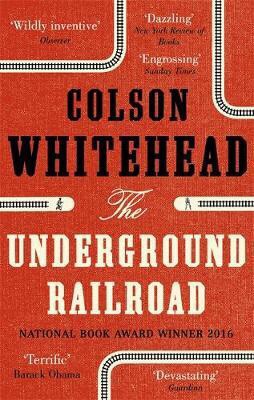
Colson Whitehead, “The Underground Railroad” (2016) (narrated by Bahni Turpin) – My campaign to read (or listen to, more often) the “great American novel” contenders of the last few years continues apace with this, voted best novel of the 2010s by at least one critical outlet (which seemed to only consider English language works, eliminating competition from Elena Ferrante, among others). This is a lightly magical realist fictional slave escape narrative. Cora flees her Georgia plantation and is dogged both by pursuing slave-catchers and by prevailing conditions in the places to which she tries to escape.

Wikipedia calls this “alternate history” and I suppose it is, in a sense, though not in the “Man In The High Castle”/Harry Turtledove sense that term usually denotes. Different racial regimes prevail in the different states Cora goes to, each distinct and discrete from the others. In South Carolina, white-managed “racial uplift” prevails, complete with medicalized terror against the quasi-free blacks. Fleeing that state ahead of the slave-catchers, Cora finds herself in North Carolina, which decided to go in for the elimination of slavery… and the genocidal destruction of its black population. Tennessee is, for some reason, burnt to a crisp. Indiana is peaceable at first but the free black population there is eventually terrorized into dispersal, too.

If there’s a logic between which state gets what fate, it’s an inner logic. I was expecting something like Orson Scott Card’s exaggeration of old regional traits and tropes that he used in the Alvin Maker books, a stupid notion on my part, I now see. What does the fictionalization of the historical conditions of the antebellum US offer? Well, one thing that leaps to mind is that it runs us through a (attenuated) catalogue of options available for black people in the US both before and after emancipation. Unlike a conventional slave escape narrative, there’s no real escape- only descent into a variety of states of insecurity and un-freedom. Also, unlike figures like Frederick Douglass or Olaudah Equiano (but like, say, Ta-Nehisi Coates), Cora is essentially an atheist. In this context, that means she flirts with cosmic pessimism- but in the end, keeps running. The ending is a happy-ish one, but muddled.

Whitehead appears to be in agreement with similarly lauded literary figure Coates about the intractability and overwhelming existential power of white anti-black racism. It’s hard to quibble much with that, all things considered, though I think in the end it’s imperative to push back against its implications. Among other things, it leads to the individualism we see in this novel. Like in a horror movie, sooner or later everyone Cora cares about, her team so to speak (fellow escapees, people who help her), are dead, and Cora alone has to mount her final escape. She creates her own Underground Railroad in lieu of the collective effort that failed her. This winds up not just dismissing any white agency in undoing racism (well-meaning whites are universally depicted as incompetent), which is an understandable enough pessimism, but any collective agency, including black collective agency. There’s no such thing as society, only men and women and their trauma. For a book notionally about the massive, multiracial liberatory undertaking that was the Underground Railroad, this is an odd way to go.

How much does all of that matter in judging this book? Some, I’d say. It flows reasonably well as prose. Whitehead handles perspective shifts, from Cora to various others, deftly. Character work does what it’s meant to do, I think. But if you’re going to have a magical realist epic about national themes, you need to have a vision. If nothing else, any magical realist element in any work demands a justification for its flights of fancy. I think Whitehead did half a job with that. He produces a decent pocket-sized selection of American racial hells. I wonder, in the hands of a more imaginative writer, what more might have done with it, and in the hands of a writer with more of a vision, what alternatives to chosen ones running like hell away might have come up. But I guess that’s where the zeitgeist is at, or anyway was in 2016. We’ll see how far the current moment can push it in a more useful direction, and what sort of literature it might produce. ***’

Review- Whitehead, “The Underground Railroad”

Review- de Camp, “Lovecraft”

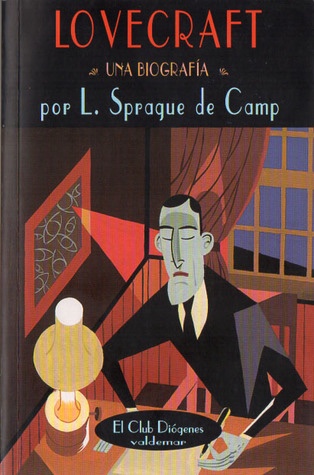
L. Sprague de Camp, “H.P. Lovecraft: A Biography” (1975) – Horror writer icon H.P. Lovecraft was obscure in his life, but is well-known today, and arguably products of his fruitful imagination outpace his name in recognition- he could hardly have foreseen the image of his terrible elder god Cthulhu becoming chibi-fied into dolls, for instance, or for his references to become so common in gaming culture. Perhaps, as a lifelong pessimist, he could have seen coming the way his name has become synonymous with racism in speculative fiction and nerd culture more generally. Ironically, if he didn’t become so well-loved by a fervent cult in the mid-twentieth century, no one would have published his voluminous correspondence, which contains much stronger and more persistent racist content than do his stories (which could be pretty racist but not much more than was common in pulps at the time).

I’m reading Lovecraft for my upcoming birthday lecture, which juxtaposes the writer with crime writer Dennis Lehane and discusses both as promulgators of a genre vision of New England. Truth be told, chain-reading Lovecraft stories gets pretty old, pretty quickly- he’s best taken one at a time. I also “knew” about him and his various reputations, good, bad and indifferent, from my previous immersion in nerd culture, so who knows how I would have taken to him without that background. This birthday lecture is why I sought out this biography, which was also recommended by a correspondent of mine (alas, Lehane is still among the living and has not been biographized outside of brief journalistic profiles, to the best of my knowledge).

If the first iteration of the Lovecraft myth was of a lone genius scribbling away his tales of cosmic horror unacknowledged in Providence, L. Sprague de Camp, a man of the golden age of science fiction, seems to be the author of the second iteration of the myth- Lovecraft, tragic victim of what made him great. Apparently, August Derleth, first and most dedicated votary of the first iteration of the Lovecraft cult, dropped dead before he could write this biography, and the contract passed to de Camp. De Camp makes heavy use of Lovecraft’s thousands of surviving letters and is able to follow the author’s career month by month, giving his opinions of the various projects Lovecraft pursued and generally giving a thoroughgoing picture… if one with a distinct framing.

De Camp’s writing is sprightly, irreverent, lightly swaggering in that way of scifi writers of his time. He was a man of the world, author of nearly a hundred books, and a major critical figure in scifi/weird-fiction circles (he also wrote a biography of Lovecraft’s friend Robert E. Howard, of “Conan the Barbarian” fame). In short, he was as different from Lovecraft as it was possible for another white, basically conservative, male speculative fiction fan of his time to be. And seeing as that was largely the ambit in which de Camp (and Lovecraft) walked in and wrote for, de Camp makes much of the implied difference.

De Camp doesn’t downplay what many modern readers will want to know about, Lovecraft’s bigotry, except by way of comparison with the amount of attention de Camp dedicates to Lovecraft’s distinctly type-B personality and unprofessional working habits and demeanor. Lovecraft’s dread of rejection, refusal to “lower” himself to self-promotion, blown opportunities for advancement, inability to type even, come in for de Camp’s disapproving notice. Lovecraft’s bigotry gets tied up in this- de Camp depicts his “ethnocentrism” (a term he seems to prefer to “racism” for some tired midcentury reason) as one of his many impractical attachments to outmoded ways of thinking and doing things, that kept him in Providence, cozened by older female relations, unable to keep the good wife he won in the person of Sonia Greene, and generally failing to be the sort of ubermensch de Camp saw himself and his fellow scifi golden agers — an impressive bunch, if with impressive failings — to be.

One of the more relatable things about Lovecraft, to me, is his disdain for life, from his horror at biological fact to his preference for the dreamed over the real. His participation in “amateur journalism,” which de Camp lightly chides as a waste of time, reminds me of the people I know who’ve gotten really into blogs and/or forum cultures, complete with wrangling and factionalization. I think Lovecraft resounds as much with nerds to this day in part because he was one of them, and one who transcended without selling out… by the expedient of dying before he could and having his devotees popularize his work.

But make no mistake- he was racist as fuck. De Camp keeps promising what amounts to a “face turn” in later life. He did marry a Jew, after all, though he kept making anti-semitic remarks during and after his marriage. He got less bad about white ethnics in his later years, even making a mob of Italians (led by a priest, natch) save the day in one of his better late stories. One of the reasons de Camp prefers charges of “ethnocentrism” to “racism,” it seems, is that Lovecraft had a great pride in his notional “aryan” ancestors, which he dampened some later on. To broaden out into the ways his worldview affected his work, later stories like “At the Mountains of Madness” show a certain sympathy with the alien other that rivals his earlier outbursts of horror at difference for their emotional charge. But he was still writing shit about black people basically until the end, died believing Mussolini was pretty good (and FDR, too, for what it’s worth), and really didn’t change that much. You get the impression de Camp wished Lovecraft would stop being racist in the same way he wished he would buck up and learn to type- because it was embarrassing.

How much does Lovecraft’s bigotry matter? Well, I think for the fandom culture it matters somewhat what they name their prizes et al for, in terms of being welcoming to the people Lovecraft scorned. I don’t bother with the old get-out of “separating art from artist;” I believe can and should appreciate and enjoy the works of artists of all kinds with their eyes open. It’s just a fact that a lot of innovative artists were lousy people and/or had rotten politics. If you understand art as something other than a set of interchangeable entertainment products, which I do but which it appears a troubling number of popular critics do not, you can’t just swap them out for nicer people and have yourself a nice, clean culture. If nothing else, the repressed has a way of returning… as it happens, I’m not sure if Lovecraft was that much of a genius in and of himself. But in some respects the proof is in the pudding: we’re still talking about him, he helped define the genre of horror, and Cthulhu isn’t going to leave our collective imagination any time soon. We’re into at least a third iteration of the Lovecraft myth — Lovecraft as monster — and arguably a fourth — Lovecraft as figure less than the sum of his works — and who knows where it’s going to go from there. There’s limits to how much I care — I’m only a horror guy incidentally, for projects such as this year’s birthday lecture — but it’s an interesting process to watch. ****

Review- de Camp, “Lovecraft”

Review- Wu, “The Color of Success”

Ellen Wu, “The Color of Success: Asian Americans and the Origins of the Model Minority” (2014) (narrated by Emily Zeller) – Growing up in very white surroundings in suburban Massachusetts, I got the model minority stereotype of Asian-Americans from both sides: from the right, either resentful of Asian-American success or wondering why black and Hispanic people couldn’t be more like Asians, and from liberals, who cited Asians as exemplars of successful diversity. Of course, minus some of the right’s (seemingly fading?) resentment, the two ideas rest on a lot of the same assumptions. Historian Ellen Wu attempts to get to the historical origin of the stereotype in this work of cultural history.

Wu chose to narrow her focus to Japanese and Chinese Americans, which makes a certain degree of sense on a number of levels. One is contrast- from having been treated quite similarly under the late-nineteenth/early-twentieth century restriction regime, the two groups experienced the sea change of the Second World War drastically differently. Japanese Americans were, of course, rounded up and interned into what we only hesitate to call “concentration camps” because we (imprecisely) call Nazi extermination camps the same thing. Chinese Americans, on the other hand, were all of a sudden white America’s little buddies, allies in the war, and Congress revoked Chinese exclusion in 1943. Both suffered reversals, as Japanese Americans came to be associated with the heroic war record of Nissei combat units and the Chinese American community split over the results of the Chinese Revolution. In both cases and for well after World War II, American foreign relations played a major role in shaping the construction of an Asian American racial identity.

As the Cold War set in, American race relations became a foreign policy issue. The US’s massive race problems, especially their formal legal instantiations, posed a problem for American policymakers attempting to extend leadership in the decolonizing and developing world. This both opened opportunities and imposed limits on the black civil rights struggle, as historians have noted, and Wu points out it did much the same for Asian American efforts at full citizenship. On the one hand, especially when paired with martial patriotism, domestic anticommunism (pro-nationalist elements fairly firmly quashed pro-communist elements in most Chinese American communities), and thoroughgoing respectability politics, Cold War geopolitics opened doors for Asian Americans. The Hawaii statehood debate shows this- objected to for decades on the basis of Hawaii’s Asian population, it was in the late 1950s as concerns over American relations with the Pacific that consensus came around Hawaii’s admittance. On the other hand, this straitjacketed Asian American communities into a particular mold: ultrapatriotic, uncomplaining, devoted to the “American Way” as then understood, and as Wu puts it, “definitively not black.” This is when the comparisons between black and Asian communities by whites began, and not coincidentally, when the Model Minority stereotype really came into its own.

Wu emphasizes both Asian participation and opposition to this race-making process. Early chapters take the reader back to the forties, when far from being America’s richest ethnic group and a model of assimilationist success, Japanese American communities were mostly poor, farm or slum dwelling, and Japanese teens joined Mexican and black kids in “zoot suiting,” wearing outlandish clothes and refusing adult respectability. Numerous Japanese Americans, understandably enough, wanted nothing to do with the American war effort after having been interned, and the Japanese American community groups took an authoritarian stance towards their charges in encouraging them to enlist and otherwise conform. Even as the path to Asian assimilation became clearer, many Asians resisted the bargain, insisting on solidarity with the black freedom struggle and on pointing to the social contradictions within their own communities that community leaders covered up with feel-good model minority stories. This is a conflict that goes on to this day, as Wu and some of my Asian comrades would remind us and as both the model minority (especially as a parenting style) and the “Yellow Peril” from a resurgent China gain in cachet.

This is my first time listening to a history book that didn’t have at least one eye on a mass market, like Tim Snyder did with “Black Earth,” though clearly this one had enough crossover appeal to attract Audible’s attention. While I did miss being able to check endnotes, it was still a pretty good experience, testament to solid writing chops on Wu’s part. It’s a little “dissertation-y;” I would have liked to have seen more about what the model minority experience meant once embraced by the national consciousness, especially as, in the epilogue, Wu points to its adaptivity- starting as a product of Cold War liberalism, but adapting to the conservatism of the Reagan years and the War on Terror. But you can see why Wu would want to reign it in and stick to the origins of the stereotype, as promised. ****

Review- Wu, “The Color of Success”

Review- Gay, “Weimar Culture”

Peter Gay, “Weimar Culture: The Outsider as Insider” (1968) – Peter Gay promoted a psychoanalytic history that I look at with mixed feelings, but he had a good eye for where to deploy his method. He wrote five volumes on the “inner experience” of bourgeois civilization during the Victorian period, which was Freud’s whole thing, and he wrote this book on Weimar Germany, a time and place caught up in psychodrama if ever there was one. He knew better than to try to analyze individual actors- it’s more he applied the ideas to a “spirit of the age,” which sounds gauzy because it is, but works better than one might think (especially given his aforementioned canniness about subjects). In a sense, Gay was the last of the old-school cultural historians ala Burckhardt or Huizinga, interrogating times and places and their “spirits” via their cultural artifacts, before the newer cultural history in its Foucault-inflected sense arose in subsequent decades.

For what it is, “Weimar Culture” is excellent, and I would argue transcends both psychoanalytic history and old-school cultural history to deserve its place as an enduring classic. Gay goes beyond stereotypes of decadence and cabarets (though giving them their due) to play on a few themes as he delineates what was distinct about the culture of those brief Weimar years from the rest of German history. As the subtitle promises, there’s the idea of the “outsider as insider,” the “revolt of the son” in the arts and in politics that challenged prevailing bourgeois norms, and the eventual “revenge of the father,” a return to a spurious version of “order” under the Nazis. Gay incorporates numerous instances of the “Weimar spirit” from the liberals and social democrats who attempted to practice a new (and precarious, and in the end failed) type of German politics, to the Bauhaus and expressionists in painting and film, to the more-than-once-cited legs of Marlene Dietrich (a psychoanalyst might have fun with Gay for that) into his schema in what is a short (fewer than 200 pages) book.

Probably my favorite part of the book is his discussion of the politics of poetics in Weimar, where poets and writers played an uncharacteristically outsized role in the definition of political space and action within it. This is exemplified in all of its glory and ineptitude by the person of Stefan George and his circle. In better times, George would just have been a popular poet surrounded by his groupie dudes and having a good old time. But times being what they were in the Weimar era, the George Circle and its concept of a “Secret Germany,” both beneath and far above the hoi polloi hue and cry of republican politics, became an important feature undermining the stability of democracy. Figures like Thomas Mann, his less-known brother Heinrich, Rainer Maria Rilke, and others take center stage in turn as they attempt to come to grips with the time… as the time soon enough came to grip them. All in all, a historical masterpiece, even if it’s far from a methodology I would pursue. *****

Review- Gay, “Weimar Culture”