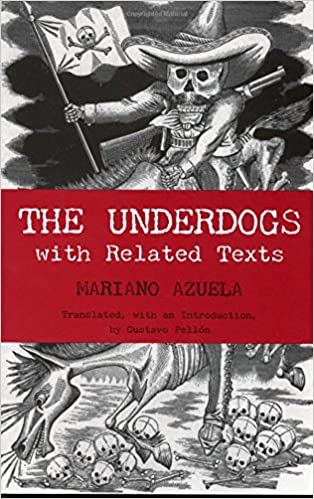
Mariano Azuela, “The Underdogs” (1915) (translated from the Spanish by Frederick Fornoff) – We get a worm’s eye view of the Mexican Revolution in this novel, which as far as I can tell is considered the great novel of that war. Indigenous Mexican peasant Demetrio takes to the hills with some friends after federales burn his house. Azuela doesn’t explain the whys and wherefores- that’s just what the war causes men to do. The politics of the war impede on its logic only from high above. Demetrio and his friends know they hate the federales, the rich, and the reactionaries, and the three tend to meld together. They win some fights and soon enough become a sort of military unit, promoting Demetrio to their leader with self-declared ranks and joining up with other revolutionaries.
They’re all fighting the murderous Victoriano Huerta government, but really the war, Azuela takes pains to note, has its own logic. Demetrio and company “live off the land-” that is, by looting, rich people where they can, anyone else in a pinch. Drunkenness, concubinage, random violence and general disorder become the order of the day, in a way reminiscent of such wars from the Thirty Years War onward. This is contrasted to the high-sounding rhetoric of Luis, a city-slicker “curro” who joins Demetrio’s unit, from whom the sort of patriotic revolutionary speeches contrast to his behavior tolerating and reluctantly participating in the abuses of the revolutionary forces.
Talent will take you far in such a chaotic situation, and Demetrio winds up a general in Pancho Villa’s army. But those who know the conflict or just know about romantic rebels like Villa realize he’s doomed. After taking part in the overthrow of Huerta, Villa loses the great battle of Celaya to his erstwhile allies, which Demetrio only finds out about from some refugees he might otherwise rob. Demetrio’s men go down fighting against a better organized and equipped force. The end, no moral! My edition is a critical edition with a bunch of essays, one of which compares “The Underdogs” to epic literature, and I think that’s right- Demetrio has the gigantism and ineptitude of epic heroes, and the war is largely it’s own point, as they tend to be in epics. It was interesting to read such a modern epic about a war largely neglected in the States. ****’
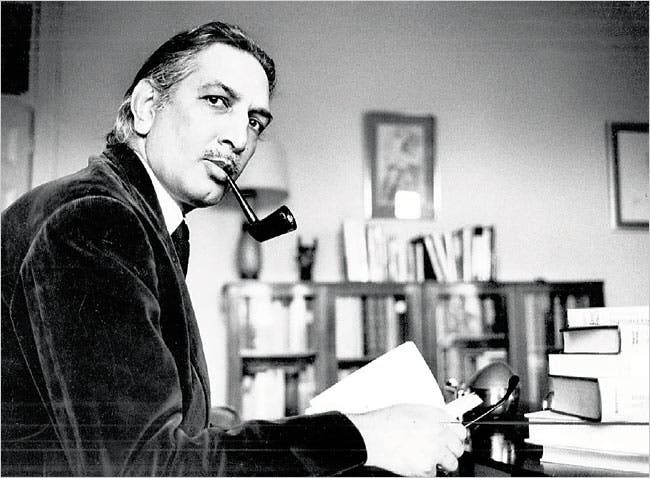
Linda Hopkins, “False Self: The Life of Masud Khan” (2006) – Masud Khan was a controversial British psychoanalyst. Born and raised in the British Raj in what would become Pakistan, he came to Britain as a young man and immediately got involved in the postwar psychoanalysis boom. From the beginning of his career to its ignominious end, he was both lauded and condemned for his high profile and unconventional style. Linda Hopkins, a psychoanalyst herself, tries to avoid both in this interesting biography, opting instead for an attempt at a deep, compassionate understanding of a profoundly difficult man.
Psychology is a subject that has interested me at various points but it’s subtleties typically escape me. I find it hard to concentrate on them. I find it easy to concentrate on history, however, including my own, so I’ll say Masud Khan reminds me of a number of people I’ve met during my long sojourn in alternative education and grad school after that: charismatic rich kids who make big gestures and have a tendency to lie. Khan came from a rich landowning family in Punjab and took British psychoanalytic circles by storm when he came to Britain and took part in the postwar analysis boom. Handsome and quick-witted, he quickly became a big figure, analyst to numerous stars (Hopkins won’t say who but I believe her), dinner party lion, hobknobber with celebrity, holder of important psychoanalytic institutional posts, heir apparent to the great (supposedly, I don’t know much about him) Donald Winnicott.
Hopkins has us exhilarate with the good years and reel with the bad. By the late sixties Khan’s penchant for lies (seemingly pathological ones, at least in that they seemed not to serve a practical purpose, but I’m no psychologist), drink, and other women (despite being married to the prima ballerina of the Royal Ballet) caught up with him. He broke many of the rules of psychoanalysis, most notably socializing with — and sleeping with — patients. He did this for years and no one in British psychoanalysis did anything about it. Hopkins doesn’t make clear why- Khan did have some “lucky” timing, in between it being the sixties and seventies and his getting cancer at a key moment when the authorities were going to censor him. He recovered and went right back at it.
What finally killed his reputation was his last book, where he, among other problematic things, went on extended screeds against the Jews (despite having several of the proverbial good Jewish friends). Hopkins doesn’t quite bracket this off — she presents enough of a balanced picture to be realistic — but does suggest we put this, and his other misbehaviors, in the balance with the good Khan did. This is supplied by numerous interviews with patients who claim he helped them, and his many contributions to psychoanalysis. Hopkins doesn’t go into detail about the latter, and as someone who benefits from having psychological concepts explained to him as though he’s five, this wasn’t a helpful omission for me. As for the interviews, they appear to be roughly even between those who claimed he helped and those who claimed he didn’t, or that he hurt them- maybe there were more of the former but the latter made more of an impression.
Hopkins looks back more in sadness than in anger. This makes for good biography. The impression I was left with of Khan is mixed. On the one hand, I’m not immune from being charmed, including by the vaguely sociopathic when they take an interest in me. On the other, I scorn abuse of power, which is what sleeping with your patients is. Obviously antisemitism is wrong, though Hopkins argues was more of a symptom of his possible bipolar status than a real ideological stance- but charmers like Khan live and die by inconsistency, and I scorn that, too. He was consistent in his hatred of fat people, too, so overall my conclusion is that he could’ve used a swift ass-kicking, as an adult. But that wouldn’t make very good biography, and “False Self” is pretty good biography. ****’
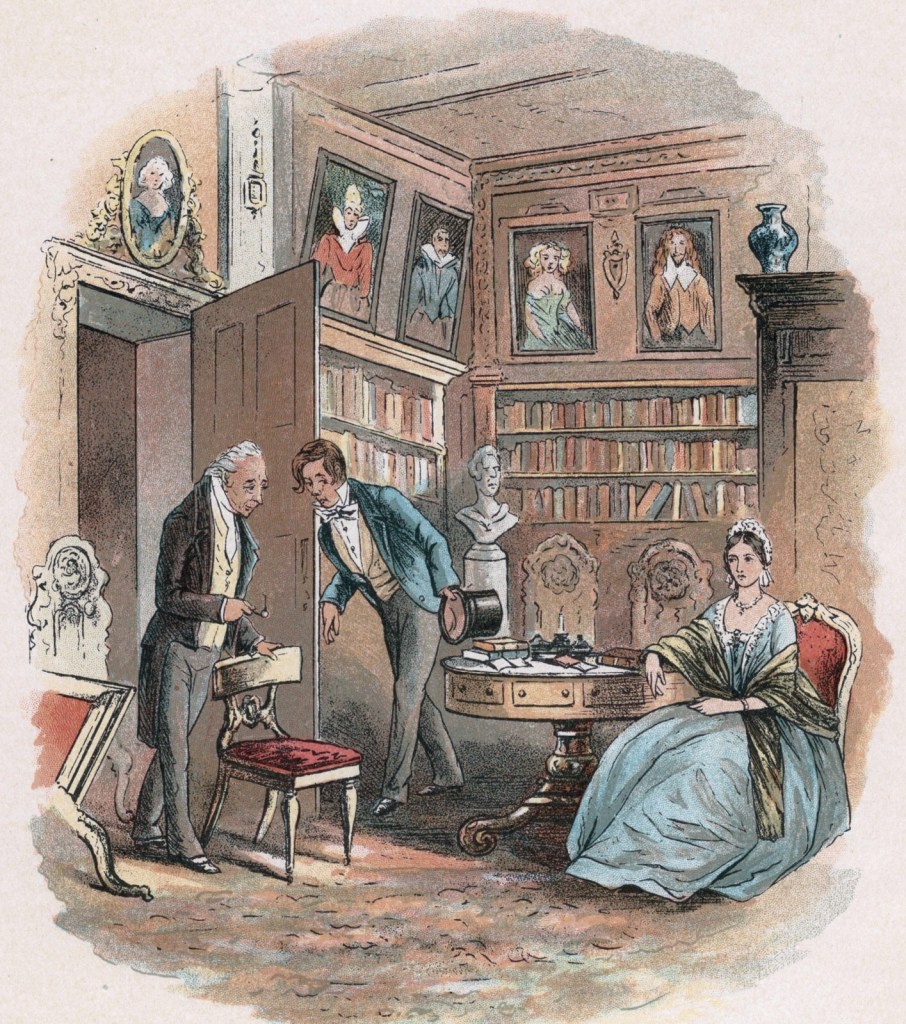
Charles Dickens, “Bleak House” (1853) – I think my issue with Dickens is that I go in expecting Anthony Trollope but sentimental. I failed to recognize that Dickens is a lot more stylistically complex. This isn’t always a good thing, and with my acknowledgment that there’s more going on in Dickens on a literary level, I prefer Trollope’s clarity and sophistication of social observation.
All that said, “Bleak House” was a pretty good read, with the usual Victorian literary caveats of it being extremely long, filigreed, and full of subplots. Like a soap opera, it’s hard to say what the main plot is, though there is a main character in the part of ingenue Emma Sunmerfield. She acts so little for herself that it’s hard to say her plot is THE plot, but she does sort of tie it all together. “It all” includes an interminable, generations-consuming lawsuit, the mysteries of various births (including Emma’s own), a murder or two, some guy spontaneously combusting, and, of course, marriages.
I’m not about to recite the whole plot of this eight-hundo pager. Dickens isn’t shy about metaphor- the London fog swirling around the courts district, the contrast between the childlike selfish aristocrat Skimpole and the street child Jo, and of course the nasty do-gooders, all compassion for far-off problems but living in homes of squalor both physically and emotionally. All told, it’s pretty good Dickens, as far as Dickens goes. I should probably go back and give “A Tale of Two Cities” another shot. ****
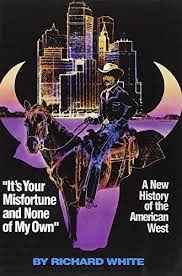
Richard White, “‘It’s Your Misfortune and None of My Own:’ A New History of the American West” (1991) –This is a pretty textbook-ish account of the territory between the Missouri River and the Pacific Ocean from European contact to the Reagan administration. White’s main thesis is that the mythology of the West — of self-made men making their own individualistic stamp on the vast landscape — is challenged to the point of irrelevance by the array of federal interventions that made the West what it is. These range from the federal army destroying independent Native American power to distributing land to people and railroads (mostly railroads) to, after the frontier period, investing massive amounts of money into water and power infrastructure in the West, following it up with federal investment in military and commercial ventures in the same area. This is one of those theses that have become common sense in American history, at least in part due to White’s intervention thirty years ago- I don’t know enough about the historiography of the West to say how they’ve diverted from White since, but I imagine it has.
Probably most interesting to me is the repeated clashes between those who dream of the West as a blank canvas on which to paint their designs and the reality of the place, both ecological and human. From private empire-builders like James Wilkinson and magnates like John Sutter to farmers convinced that “rain follows the plough” into plains and deserts to boomtown boosters of various descriptions, White describes a range of dreamers foiled by reality, though not without cost to people, especially Native peoples and the Hispanic populations of the pre-American-rule West. There’s a lot here about the tortured twists and turns of American Native policy, which makes for informative but infuriating reading. He also describes a fair amount of class conflict, though ultimately gives short shrift to radicals ranging from the IWW to the American Indian Movement and the Black Panthers. I guess he’s right in that they didn’t alter the structure of forces in the West, and were less politically successful than the similarly western-concentrated New Right. I guess the material reality they ran against was the brutality of a capitalist state. Is that as inevitable a part of Western reality as aridity and distance? Who knows, let’s hope not. ****
Timothy Snyder, “Black Earth: The Holocaust as History and Warning” (narrated by Mark Bramhall) (2016) – What a weird book! Snyder, who is at this point a full-on hashtag-resistance intellectual, was never a stranger to controversy or to portentiousness, and cuts a broader public figure than most historians. I remember being introduced as a historian in a wedding conversation with one of the literate burghers of my hometown, and the name and title the fellow dropped to make conversation with me was Tim Snyder’s “Bloodlands.” From the killing fields to Snyder’s (impressive, by any measure) archival depths to a comfortable suburban Massachusetts living room…
Anyway, “Black Earth” continues some of the conversation begun in “Bloodlands” (with all of its flaws) and takes it still further. We return to the zones of “double occupation” (that is, lands that both the Nazis and the Soviets occupied, sometimes trading back and forth multiple times), the site of most of the Holocaust and, Snyder avows, the geospatial inspiration and permission for it. At the center of “Black Earth” are Snyder’s sweeping claims about Nazism, the Holocaust, and the state. Forget about the image of the bureaucrat rubber-stamping the camps into being, Snyder tells us. Nazism is actually a negation of the state (here, he’s echoing Hannah Arendt, with her claims that Nazism represented an eclipse of nationalism). Hitler sought to destroy states, and succeeded in doing so in Austria, Czechoslovakia, the Baltic states, and especially Poland (though not, notably enough, Germany), and was abetted by the Soviet Union in the zones of double occupation. These stateless zones then became sites where anything was possible, and that thing became the Holocaust. The state, far from the agent of genocide, is the only real protection against it, Snyder tells us.
The weak points here are many, and resemble those in “Bloodlands,” to an extent. First, Snyder’s characteristic exclusions when he’s trying to make a point: Yugoslavia, despite its massive death rate in the war, can’t be a “bloodland” because it wasn’t double-occupied; its contributions to the Holocaust get similarly short shrift in “Black Earth.” Needless to say, the many genocides perpetrated by states — like those undertaken by colonial regimes, such as the destruction of the Native Americans — aren’t mentioned. The Nazis did indeed destroy states in Eastern Europe. But the maintenance of a state is no guarantee for survival like he makes out, as the fate of the Dutch Jews or the targets of genocide by the Croatian Ustashe demonstrate. Snyder knows this but basically waves it off. The Ustashe were a state that wasn’t really a state, the Netherlands had a state but not really (but the French didn’t?), etc. etc.
This goes along with Snyder’s strange dismissal of the prevalence of prewar antisemitism and its importance to the Holocaust, placing everything on Nazism and especially the person and ideology of Hitler (Himmler comes in as second banana, and Carl Schmitt, who there’s no evidence ever wrote a thing Hitler read, comes up too). There’s some interesting stuff here on Hitler’s use and abuse of biological metaphors, his insistence on a life of struggle and violent competition (he was far from alone in this, as a perusal of Theodore Roosevelt’s writings will show), the way he depicted Jews as “super” natural, i.e. using ideas to circumvent the way of nature. But then, to use internet lingo, Snyder “capes” for interwar Poland, admitting it was antisemitic but showing how its antisemitism drove the Polish government to support the hardest core Zionists they could find, on the idea that that way they’d be rid of their Jews. The opposite of a Holocaust, you see! Or maybe you don’t, seeing as mass involuntary population transfers inevitably lead to mass death in any instance, even the Revisionist Zionist-Polish Nationalist (or contemporary Likudnik-Christian Zionist) fever dream. The stuff about the connection was pretty interesting to read, but does not bear anything like the analytical weight Snyder places on it.
Let’s meet Snyder half-way and say that state destruction did occur and was important, and antisemitism on its own doesn’t lead to genocide, but don’t buy state destruction or Hitler’s “biological anarchism”(!) as explanations. How then, a Snyder fan might ask (I wonder if that other Snyder, Zack, has read “Bloodlands” like the hometown burgher…), do I explain the different outcomes faced in different countries during the war? Well, the massive fucking land war might have something to do with it. The Nazis and the Soviets fighting for national survival in the biggest war the planet has ever known, and everywhere this happened, the Nazis introducing their war against Judeo-Bolshevism, until the latter essentially took over the war as the Nazis began to lose. This has the added benefit of including Yugoslavia, where the partisan fighting was especially fierce, and why in the western occupied areas anti-semitic genocidal violence picked up as the war got closer, as when the Italian Republic of Salo actually started taking Italy’s racial laws seriously. It’s a commonplace that the war and the genocide went together. That commonplace is good enough for me, but it doesn’t have the tendentious energy that Snyder wants to deliver.
One gets the impression from reading a lot of the reviews that not everyone read it all the way through, that they felt they got enough of the book by looking at the beginning chapters and the conclusion. They may even be right, in a lazy kind of way. The middle of the book is more or less a recitation of the history of the Holocaust from the perspective of Snyder’s preoccupations, familiar facts to anyone who knows the history with some added editorial baggage. But it made me wonder- could the whole thing have worked without the one state Hitler didn’t destroy or even really try to, the German state? Someone had to recruit and pay the Einsatzgruppe. Someone had to keep the home front going. And is it really the destruction of the state if you impose dictatorship on an area after wiping out its government? It’s the destruction of a nation-state, sure. But there does seem to be somebody with a monopoly on the means of the use of force. It doesn’t add up.
What it all doesn’t add up to is found in the conclusion, a true monument to a particular kind of conservative-liberal febrility that Snyder has continued to pursue in his work on contemporary political life. Like the rest of the book, the problem isn’t that Snyder lacks intellectual firepower- just that he has seemingly no conception of what a real target would be. So we’re treated to a discursus on the Green Revolution, which replaced Hitler’s preoccupation with the struggle for survival with plentiful cheap food (true), how food might be getting scarcer again (true-ish), and how China, Russia, and “the Middle East” could take up Hitler’s strategy of making scapegoats for ecological change and seek out new realms (Africa, for instance) for biopolitically-driven conquest. Quick, someone’s going to get genocidally, globally violent rather than face climate change, who is it? If you answer anyone other than America you’re a rube. That’s not to exclude others, but we’ve already done it by tearing apart the Middle East in part to secure an energy supply. How are you going to talk about water wars in the Middle East, as Snyder does, while neglecting Israel’s control over Palestine’s water? Talk about a stateless, vulnerable people! The real subject of climate-driven violence (one Arendt wouldn’t have neglected, say what you will about her) are the refugees it is generating, and we get very little from Snyder about that. But nope, Snyder only has eyes for states and ideologies.
We need to see the Holocaust as about ecologically-ideologically-driven state destruction, Snyder tells us, to avoid doing it again. The “left” and the right both blame the state from their various perches (“postmodernism” gets thrown around as a bad guy here) for misinterpreting the Holocaust and not getting the importance of states. We’re in grave danger, Snyder tells us, of failing to learn our lessons. I actually tend to think that’s true, even as I disagree with ehat exactly the lesson is. But again, not due to a left-right conspiracy to induce anarchy, but due to a much simpler explanation- distance in time from the events, and the Holocaust’s cooptation by Hollywood and American ideology into something bad people did because they were bad. That said, aren’t there a million other models for how states — or non-states — could engage in future atrocity? Don’t some of them seem closer than Snyder’s version of the Holocaust, or anyone else’s? I’m in favor of learning from the Holocaust. I’m also in favor of seeing it in the light of a long history of genocide and atrocity, especially against colonized and indigenous peoples, that seem to offer more immediate lessons than the very peculiar circumstances of 1930s-1940s Europe. **’
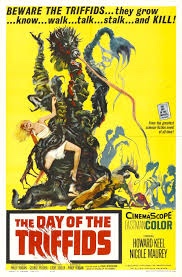
John Wyndham, “The Day of the Triffids” (1951) – I’ve heard this called the grand-daddy of post-apocalyptic fiction. On the one hand, this sounds wrong — I feel like there are earlier examples, like “The War of the Worlds” — but on the other hand feels right in a genre relevance sense. The apocalypse, unlike most, is a two-parter. First, a species of carnivorous plant called the triffids appear. This isn’t much of a problem at first, because people can control them, despite their deadly poisonous stingers and increasingly apparent ability to communicate with one another. Then one day, a mysterious shower of comets — or something that look like comets — blind the vast majority of people on Earth (one wonders if Jose Saramago read this one).
Biologist Bill is one of the lucky ones with sight- he was in the hospital with a triffid sting to the eyes and hence couldn’t see the comet shower. By the time he’s able to get up and out of the hospital, civilization is already collapsing. Wyndham effectively describes the pathos of roving gangs of blind people attempting to loot to survive, the sighted either lording it over the blind as kings, trying and failing to help them, or trying to secede from the rest of the species.
If “Day of the Triffids” created post-apocalyptic conventions, it did a very good job, as it all colors within the lines: Bill rescues a sighted girl and they promptly fall in love; they entertain but reject various humanitarian theories of how to deal with the crisis as doomed, through no fault of themselves, of course, they’re still the good guys; they meet up with a group of like-minded survivors led by someone making philosophical/sociological points that all lead to “free love;” Bill and Josella get separated and Bill undertakes all kinds of adventures getting her back.
It’s all well done. The triffids are genuinely creepy, even if a lot of surviving in the early parts of the book is more about avoiding disease and hunger than avoiding them. The anti-humanitarian lessons are contrived but not forced, in a literary sense. The characters are well-realized, especially for midcentury science fiction that doesn’t make a display of literary qualities. It’s worth reading both from a history-of-genre perspective and on its own merits. ****’
Thomas Biebricher, “The Political Theory of Neoliberalism” (2018) – German scholar Thomas Biebricher lays out the “neoliberal problematic” in this work of intellectual history and political theory, both abstract and applied. In the first two thirds of the book, he discusses six neoliberal thinkers, three German (Röpke, Eucken, and Rüstow), two American (Friedman and Buchanan) and one Anglo-Austrian (Hayek). He positions them in various configurations depending on their ideas on the state, on democracy, on science, etc., rather than discussing each in turn. It produces the impression of a sort of quadrille (sextille?) as they line up differently on the various issues. There’s a general trend line, though, between the German ordoliberals and the Anglo-American libertarian types. All of them placed a lot of chips on constitutional design in order to encase the market order away from political influence. But where the ordoliberals trusted centralizing institutions to do this, the libertarians (my distinction- Biebricher doesn’t make it) were more skeptical and believed in distributing power to bodies like states. The ordoliberals were worried (like Hannah Arendt!) about “mass man,” and wanted to find ways to de-massify by emphasizing institutions like churches and associations, where the Anglo-Americans didn’t go in as much for that kind of thing. In general, it leaves with the impression that the ordoliberals are understudied in English. I also wonder what this would have looked like if Von Mises and Rothbard were added to the mix, but Biebricher and other recent scholars of neoliberalism like Quinn Slobodian and Melinda. Cooper emphasize neoliberal approaches to government so strongly one wonders if those closer to anarcho-capitalism would count.
I don’t want to go into all the different ways the varying thinkers contrast each other, both because it’s a lot and because I read it a while ago (i.e. pre-pandemic), but there’s a lot of food for thought there. Biebricher then tries to apply what he’s laid out in the first two thirds to the crisis of the Eurozone, which to tell the truth I had a hard time following because fiscal politics just makes my eyes glaze over. Not a very responsible position, I know, but not a voluntary one either. All in all, a worthy addition to the literature on neoliberalism. ****’
Arlie Russell Hochschild, “Strangers in Their Own Land: Anger and Mourning on the American Right” (narrated by Suzanne Toren) (2016) – Sociologist Arlie Russell Hochschild would, presumably, object to me categorizing her book along with others in the “Cletus Safari” genre, where educated types go out into the hollers and trailer parks (but seldom the McMansions) to figure out what those dang flyover people are thinking, what they could possibly want. And in some respects, she’d be right to object- she did spend several years with Tea Partiers in Louisiana, after all, and clearly does her level best to write of them sensitively. She makes a game effort to “scale the empathy wall,” as she put it, between her Berkeley-bound blue state self and her informants, and claims to have befriended several. I tend to believe it.
Still and all… there’s no rule saying Cletus Safari can’t be undertaken in earnest. What makes it Cletus Safari isn’t exploitativeness (though that’s inevitable in any researcher-informant relationship, no matter how respectful) but the relationship between researcher and informant as envisioned by the researcher. Acting as though the people of Middle America are this riddle that needs deep (or shallow, as the case more generally is with journalistic safaris) application of the tools that urban sophistication can provide in order to get what’s going on with them- that’s the essence of Cletus Safari.
Leftists get “the white working class” or “middle America” or whatever plenty wrong plenty of the time when they try to explain it, too, but Cletus Safari is a peculiar product of deep-freeze liberal, or even liberal-conservative as with J.D. Vance or Charles Murray, mindset. There’s just something about it: the individual, armed only with their advanced degrees, research assistants, and gosh darn broad-mindedness, getting down to cases with the canaille — and y’know what? LEARNING something about THEMSELVES in the process! — that just screams “domestic Peace Corps,” or “domestic counterinsurgency” for that matter (it might be a matter of time before the genre gets folded into the latter…).
I’m getting away with myself, here. My point is that Hochschild doesn’t need to be stupid or a bad writer or sociologist — she is none of those things — to produce Cletus Safari. She just needs liberal brain, which she has in spades. At its core, liberalism is about short-circuiting power conflicts through appeal to some sort of underlying harmony of interests and channeling the energy of power conflict into other streams of “progress,” economic, technological, political, whatever flavor. One such short-circuiting and channelling produced the discourse of “big government versus small government” or “government versus market.” It’s a way of not asking the question even a baby radical would ask- “whose government?”
Hochschild takes the terms of the debate over “government” at face value as presented in contemporary American political media. The image of the liberal professor arrogantly lording their perspective over others is wrong, or at least is in this case- this particular liberal professor has been captured by her sources, at least to the extent where she uncritically accepts a “big government versus small government” framing as though it means anything in and of itself. This is the heart of “The Great Paradox,” as she calls it- the fact that the people most in need of “government” by virtue of the economic screwed-ness of their communities are the most likely to want to gut it, to vote for people who refuse to help them and often make matters worse. Why, oh why, do they do this to themselves, the liberals cry out to know?
Thomas Frank often gets lumped in here and it’s called the “What’s The Matter With Kansas” question, but people (Hochschild included) get Frank wrong- Frank made it abundantly clear to anyone who actually read the book that Kansas was largely the doing of the Democratic Party, which abandoned whatever pretense it once had of looking out for the working class and/or the little guy. If you’re going to get screwed either way, might as well vote for the guys who at least throw you the bone of cultural solidarity and make liberal elites amusingly angry. There’s limits of how long I’ll go to the mat for the honor of Tom Frank, but he deserves more credit than he gets for “What’s the Matter With Kansas” from people who should know better.
Anyway, this book. Hochschild wants to explain What’s the Matter with Louisiana, a state in need of more and better governance if ever there was one, considering it is sinking into the Gulf of Mexico in no small part because of its main export, oil. The people she talks to, white inhabitants of the area around Lake Charles (which is half black but she doesn’t talk to many of them), are prey to one ludicrous petrochemical-linked natural disaster after another, from the BP oil spill to a massive sinkhole that consumes many of their homes caused by irresponsible chemical storage practices. Some of them grant that maybe the government should do more to fix this or that given individual problem (though they rightly point out the state authorities in Louisiana are in the oil industry’s pocket). But in general, they eschew “big government” and hail the oil industry as a great friend of Louisiana.
So she talks to a range of Lake Charles Tea Partiers. A lot of the book is her collecting quotes and anecdotes. From them, Hochschild excavates their “deep story,” a narrative construct that structures all their other ideas. This “deep story” is basically the idea that there’s an orderly line for the American dream, and that Tea Partiers (that is, older white people) are being cut in line by minorities, and moreover, the minorities are being praised and the Tea Party base scorned for their respective actions. Hochschild proudly reports that all of her informants related to the deep story when Hochschild explained it to them.
If I were one of Hochschild’s informants, I would jump at this story, too, because it’s a lot nicer than the simpler explanation: spite. Their lives suck (most people’s lives suck), despite their privileges, and they want to take it out on someone, so they take it out on others. No government could be too big for the task- Hochschild doesn’t record any answers to questions about police violence, but her informants are certainly in favor of big government capable of regulating your uterus, of closing the borders violently, of waging permanent wars in the Middle East. Why wouldn’t they be willing to spite themselves in the bargain, if it’s people like Hochschild who get hurt worse (or more performatively) by things like environmental degradation? Among other things, they’re old. They’ll be gone soon. To paraphrase a Zionist slander of the Palestinians, these people hate liberals more than they love their children.
I don’t know, man. I’m not trying to condemn this book entirely, out of hand. I get that Hochschild put a lot of work in. I get that she couldn’t just go out there and come back with “these people are spiteful” as the answer. Among other reasons, spite isn’t the only thing they’ve got- they also share their sweet tea and pictures of grandchildren with her. But a more complex view of the person than contemporary liberal brain (as distinguished from liberalism at its best, which can do more with complexity) allows shows that spite and at least superficial kindness to strangers (who you know are observing and reporting), basic niceness, can coexist. How personally mean were the bulwarks of any broad-based repressive system? I don’t think spite fails to exist in “blue” areas, and an ethnography of, say, the burghers of Newton/Wellesley (or my own dear hometown of Foxborough) would show that much nicer- maybe a tad more rational in their spite. But between liberalism and some very basic cooptation by her subjects, Hochschild whiffed it on this one. **’
Chimamanda Ngozi Adichie, “Americanah” (2013) – Beyonce’s favorite feminist wrote this novel roughly around the time Beyonce made her famous, or at least famous for a writer. Chimamanda Ngozi Adichie was reasonably prominent before then, a MacArthur genius fellow and all that, but it was the world’s biggest pop star taking a bunch of her words out of context and putting them in a music video that made her the figure she is today, about which position I understand (from her wikipedia article) Adichie herself is ambivalent. Understandable!
Beyonce-meme-ification or no, “Americanah” stands on its own merits, but is definitely a book by a prominent TED talker. The story of one Ifemelu, a Nigerian middle class girl who moves to the States for school, “Americanah” is part immigrant story, part love story, and part vehicle for the author’s observations and opinions about race, gender, the differences between America and Africa, etc. One of Adichie’s TED talks is about the importance of representation of varying viewpoints in media- to the extent anyone really founds any of the discourse of twitter and tumblr, she played a role in founding representationalism discourse as it exists today. One way this plays out interestingly is that beyond writing as a black African woman, Adiche writes as a specifically middle-class Nigerian- no starvation or war crimes for her, and she comments wryly on the white Americans she meets who expect such. Ifemelu’s briefly poorer in America than she is in Nigeria, but the book doesn’t dwell on that for more than a chapter or so. She winds up a young urban professional with a successful blog laying the cards on the table about race in America from a non-American black perspective.
The blog is interesting in that its observations are picayune even for a 2013 woke blog. Adichie’s observations of Ifemelu’s environment are inevitably more interesting and better-written than anything the character produces for the blog. Is this accidental, or is Adichie trying to say something about the blogging/social media milieu of the time? In general I’d say Adichie is a better novelist than an essayist, though I get the feeling as an essayist (based on Ifemelu’s blog and Adichie’s TED talks) she is pitching at a much more basic audience. She even depicts Ifemelu as dumbing down her material, especially her paid talks to workshops, for mostly white audiences. It’s interesting to consider if Adichie is doing the same thing.
As far as the novel goes, it’s not half bad. The characters are pretty well fleshed out. Incident in the novel is uneven, given how much of it is the opportunity to do observational bits, and at least one incident that should be harrowing (a teenager’s attempted suicide) kind of comes out of and goes nowhere. She has a good eye for the details of American life that blips sometimes but is generally reliable. There’s a central romance between Ifemelu and her high school boyfriend Obinze that’s made easier to believe in by how many obstructions it finds, and how ambivalent one feels about its final consummation. All in all, a decent read. ***’
Phil Neel, “Hinterland: America’s New Landscape of Class and Conflict” (2018) – This is a very interesting and provocative look at the contemporary geography of class conflict from someone steeped in insurrectionism. Forget the “brain-hub,” “creative class” cities, Neel tells us- the most interesting spaces, both from an intellectual and an insurrectionist standpoint, contemporary capitalism has created are the hinterlands. Neel divides them into far — rural and exurban — and near hinterlands, the latter of which are the interstitial spaces within urban areas into which capitalism shoves both infrastructure and poverty.
The far hinterlands are, well, not “familiar” but are at least examined in many a post-2016 work. Neel is a native of rural northern California (the “State of Jefferson”), but doesn’t truck with the native tale-bearer/interpreter role that J.D. Vance has taken on. Neel does, however, borrow from Vance’s fellow militant liberal, counterinsurgent David Kilcullen, in arguing that in in the void left by the economy and increasingly by government in rural western areas, whoever evinces “strength and stability” will attract a following. In some places, Neel notes, militia groups like the Three Percenters and the Oathkeepers present more of that strength and stability than does the local government, and certainly more than any left-leaning formation. Ironically, most militia types can no more claim to be the salt of the earth hinterland types than most liberals, being largely well-heeled exurb dwellers, but could potentially attract a following.
I found the discussion of the near hinterlands most interesting. Geographers have long observed that the inner ring suburbs of many cities, originally all-white, are rapidly diversifying and becoming poorer as black and Latino residents flee the inner cities. Ferguson, Missouri is a good example of this outside of St. Louis. At the same time, the infrastructural supports of capitalism extend outward spatially into these same areas- the warehouses, the trucking depots, server farms, etc. This activates Neel’s insurrectionist imagination. He had a rioting bust from Occupy Seattle and is in general dismissive of most other leftist strains (sometimes eye-rollingly so, as when he puts too much analytical weight on identity politics as a failing of the contemporary left). He was on the ground in Ferguson, too, one of the much-maligned “outside agitators,” but there wasn’t much need for outside agitation. The people of Ferguson were pissed, and their situation isn’t all that different from the other near hinterlands- poverty, insecurity, racism, a state absent in terms of dealing with needs but omnipresent in terms of doling out fees and police violence. Ferguson, Neel notes, was the first major suburban uprising, and the geography was totally different than that of traditional urban uprisings, much less dense and more spread out, darker, both in the sense of fewer streetlights and just a general sense where the cops didn’t know what was going on.
Where does this leave us? Neel theorizes about the “historical party” of revolution, the implicit mass ready for what might come, and “overcoming the riot” – going from rioting (or occupying) to a more sustained revolutionary action. He wonders where the “ultras” of the American near hinterland scene may be, alluding to the soccer hooligans who did so much to bolster crowd resistance against regime forces in Egypt, Ukraine, and elsewhere. He calls for an “oath of water”: where the reactionary militias have an “oath of blood” to a community defined by exclusion, the advancers of revolution need an oath to the flood, the overcoming of all boundaries (I wonder if Neel has read Klaus Theweleit?). His prose flows beautifully and his observations are sharp. I can’t say I agree with everything here — Neel would probably find me a softie, with my book review and noise demos and tendency to stay put in dear old Massachusetts — but this is a fascinating, compelling read. *****






 Too Much Berard