Review- Hristov, “Blood and Capital”

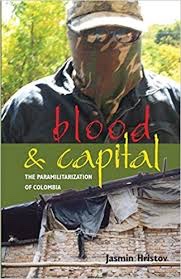
Jasmin Hristov, “Blood and Capital: the Paramilitarization of Colombia” (2009) – Canadian sociologist Jasmin Hristov casts a critical eye on the war and peace process in Colombia. The decades-long war supposedly ended with the victory of the Colombian government (aided significantly by the United States) over both the far left guerrillas of FARC and the ELN and the right-wing paramilitaries of the UAC. Both groups formally surrendered and disarmed, AUC in 2006 and FARC in 2017.

Hristov argues that the paramilitaries won the war, effectively, by “paramilitarizing” the Colombian state. Despite their formal antagonism — the AUC was always illegal and part of the US State Department terrorist list along with FARC — the Colombian government frequently worked hand in glove with the paramilitaries, before, during, and after the time the AUC formally existed. Much of the book is made up of lists of deeds undertaken jointly by the Colombian military and one or another right-wing paramilitary group, of arms and intelligence funneled to paras, blind eyes turned towards their atrocities, and joint operations. Hristov wisely does not place as much emphasis on the AUC as an organization as the peace process did- it was always a coalition and never a central command for all paramilitaries in the country. Its inheritor groups continue to this day, exporting drugs, intimidating labor and social movements, killing to protect their rackets.

In most insurgency wars, there’s something like a ten-to-one ratio between kills made by counterinsurgents and those made by insurgents. This is why you still get whiners claiming that the US “won” the Vietnam War- we surely killed many more people, by a chasmic margin, much good it did us or anybody else. But in the FARC war, the titular FARC inflicted twelve percent of the casualties, and the armed forces of the Colombian government inflicted eight. The rest, eighty percent, were killed by right-wing paramilitaries. These wars generally make mock of the distinction between civilian and military, but the paramilitaries in particular ignored the distinction. They terrorized communities seen as in league with the guerrillas, which often meant nothing more than that the village organized peasant groups or labor unions. The paras are also notorious for “limpieza social,” bloody social cleansing of the poor, sex workers, LGBT people, and so on.

Hristov is a Marxist and she makes clear the class lines of the war. The paramilitaries are the armed forces of the (primarily rural) Colombian elite. Isn’t a certain other body also the armed forces of the elite… oh yeah, the government! So ultimately, six of one, half a dozen of another. Why, then, did the paras form? In part, it’s counterinsurgency strategy gone feral- the establishment of local anti-guerrilla patrols was a part of counterinsurgency from its beginnings in the late fifties/early sixties. As Hristov points out, at first it was the government creating paras and the elites supporting- later on, as the war heated up, the roles were reversed, with elites creating paramilitary bodies with tacit or overt government support. The paras, she holds, could get their hands dirty in a way the government was reluctant to do. The rest is history.

My one main quibble with Hristov is that she takes a rather either/or attitude regarding criminality and ideology- if you’re a criminal, you’re not an ideologue (and presumably vice-versa), and the paras are definitely criminals looking to protect ongoing criminal enterprises like drug exportation and land clearances, so, their ideology is bunk. I’m not so sure I agree, in general and certainly in the case of the more ideologically-inclined paras like the AUC- maybe she’s right about the inheritor groups. Colombia has a long history of patriarchal rural conservatism that goes berserk when challenged, and it’s far from the only place that fits that description. The particular kinds of violence and the rhetoric around them strike a chord familiar from the history of paramilitarism and vigilantism from Northern Ireland to Michigan in the Black Legion days. The righting of the world, the restoration of the natural hierarchical order, through spectacular violence is an ideology in and of itself, at least as common on the right as the notion of the existential necessity of armed revolution is on the left. Crime fits in- when the right people do it for the right reasons, it stops being crime, in this view of the world, and becomes a sacrifice made by superior men. In general, though, this is a fine and useful book about a conflict whose lineaments should be of broad interest to those interested in social conflict. ****’
Review- Hristov, “Blood and Capital”

Review- Ligotti, “The Conspiracy Against the Human Race”

Thomas Ligotti, “The Conspiracy Against the Human Race: A Contrivance of Horror” (2010) – Cosmic pessimism! The belief that existence is fundamentally worse than non-existence, generally coupled with the idea that consciousness in specific was a dramatic evolutionary mistake. As Thomas Ligotti, renowned horror writer points out in this dip into the nonfictional (or anyway philosophical), not a popular position. I remember when “True Detective” Season 1 came out and Matthew McConaughey’s cosmic pessimism (influenced, the showrunner admits, by Ligotti) provoked much eye-rolling from people who, as I recall, were mostly unified by their belief in a better future. These ranged from “hopepunk” Whedon-loving liberals to youthful revolutionaries somewhere on the post-Lenin evolutionary tree- cosmic pessimism was a big no no to them and a wide range in between.

I don’t know, man. I’m pretty lucky. Born white, male, middle-class (if downwardly mobile), American, to loving parents, in the late twentieth century, I’ve been dealt a hand so high in the top percentages of hands dealt that I don’t know how many zeroes would go to the right of the decimal point. And still… I can see cosmic pessimism’s point. Certainly enough to avoid hand-waving it away as though I’m above it. At the end of the day I do what I can to make the world better (or foil those who’d make it worse) but I’m not convinced of the ultimate existential validity of what I do- who can be? Recent events, between climate change, reversion to fascist barbarism, and now pandemics, give the pessimist position more of a hearing than you’d get even ten years before. Longer-term secular trends, like the uncovering of just how prevalent mental illnesses like depression are, help too.

I don’t think I’m going to resolve the cosmic pessimism/cosmic optimism question on my moribund blog or facebook wall. Instead of basing my review on how much I agree or disagree with cosmic pessimist Ligotti, but on how much I got out of the book. This alone makes me a dodger of the grim truths of reality in the cosmic pessimist book, but I never expected any thanks for flak-catching for Rust Kohle anyway. The book is honestly something of a mess. On a sentence level, Ligotti is clearly a very capable writer. I’d be interested in reading his fiction. But I had a hard time getting through the book, and not because it depressed me. It kind of bored me- which is precisely what a hope-clinging millennial would say in dismissal (that way millennials often say “boring” when they mean “offends me but without officially crossing established offense-lines), but I don’t mean it like that. I just mean philosophical speculation and neuroscience bore me and that’s a lot of what’s in this book. It doesn’t seem well-organized to me, though maybe there’s an organizing scheme I just didn’t get. I’ve read much juicier anti-life material, by John Dolan, say, and Schopenhauer (who gets name-checked but then moved on from for reasons I didn’t quite get). According to its own terms, pessimism has the entire vista of nature and human behavior to choose from to illustrate its points, but there’s very little in the way of illustration, here. All in all, more of a puzzling, sedate kind of book than one that grabbed me, one way or another. **’

Review- Ligotti, “The Conspiracy Against the Human Race”

Review- Lippmann, “Public Opinion”

Walter Lippmann, “Public Opinion” (1922) – Walter Lippmann created the op-ed writer as we know him. He was a sort of proto-Tom Friedman: newspaper columnist, author of bestselling nonfiction books, influencer of politicians. Though usually, a “proto” is supposed to be less than the later version, and Lippmann wasn’t as embarassingly silly, stupid, and bad at writing as Tom Friedman. Friedman describes forces beyond his (extremely limited) comprehension; Lippmann made a play, a not entirely unsuccessful one, at both portraying world-changing forces and shaping them himself.

In “Public Opinion,” Lippmann is coming from his experience working for the State Department during World War One, having taken part in what could be called the information side of the war (and just as importantly, the postwar peacemaking). The world, he announces, has become complicated, vastly complicated, so complicated no one can really understand it. At best, they understand a “pseudo-environment” composed of stereotypes (he was the first to use the word as it’s currently used). This is a problem, because human action still affects the real environment, not just people’s pseudo-environments.

Lippmann was writing for a general, if educated, readership and so takes his time laying all of this out, with examples (many of them drawn from the war or the peace process) and considering the case in it’s different facets, etc. Then he eases in to his attack on democracy, or, anyway, democratic theory. Democratic theory, he states, is based on the idea that everyone has access to the knowledge they need to make decisions. If this was ever true, Lippmann averrs, it’s definitely untrue now in our increasingly complex world. Lippmann depicts democratic theorists as hand-waving issues of complexity away by relying on “the human heart” to make the right decisions. I think Lippmann is about a quarter right here, both in terms of his depiction of democratic theory (resting largely on the American Founding Fathers, not the most notably democratic bunch) and his assessment of the knowledge problem. Democrats/republicans weren’t as unaware of the issue as Lippmann depicts; they went a long way towards trying to solve the problem through universal public education. For another thing, the republican notion of relying on virtue — or “the human heart” as Lippmann derisively puts it — didn’t come out of pre-modern somnolence, it came out of turbulence and chaos in places and times like Renaissance Italy, Civil War-era England, Revolution-era America. The idea, greatly simplified, was that fate and chance throw up all kinds of shit at you, and you’re better off having the inner resources to cope rather than try to have unique tools to meet every unpredictable situation. And these thinkers, from Machiavelli on down, knew that virtue could be a slender reed against the storms of chance and complexity.

But consider the other options! For Lippmann, the answer to the problems of governance in the midst of complexity lay in the creation of official fact-finding bureaux manned by the best experts and the “manufacture of consent” (a phrase he coined). You need the right people with the right amount of power, and they need to use modern media techniques to put them over to the people (Lippmann was a critic of democracy but knew it was here to stay). Where to find these people, Lippmann doesn’t say- he seems to assume the reader knows, and that the answer would be “people like Lippmann and his Harvard friends.” So, essentially, rule by universities, like a certain portion of the right’s nightmares. You don’t need to buy in to alt-right talk of a sinister university-based “Cathedral” to see the problems here. For one thing, nowhere in his system does Lippmann actually say that education is the way out of the pseudo-environment trap. If it was, the answer would be (and has been taken to be by generations of liberals) enhanced universal education. But if that’s not it — if even the educated operate according to stereotype and pseudo-environment — then who educates the educators? Where do the experts come from? How can we assess their expertise?

Like his spawn on contemporary op-ed pages, Lippmann was more of a condenser and expresser of elite opinion than he was a creative thinker (though again, he was much more creatively capable and competent at expression than his descendants). He leaves these massive lacunae in his work, but one gets the idea that’s almost intentional. Making too specific of a sketch of the expert-ocracy wouldn’t give his friends in government space to work. In many respects, Lippmann’s expert boards exist in the federal government today, just with less power than Lippmann would have given them. They are, like every other expression of power, public and private, ultimately dependent on political will and guided by political considerations. As it turns out, power isn’t reducible to expertise, though there’s always a buyer for people who promise ways to bypass the human element of power relations. Lippmann is an important part of a long liberal tradition promising to steer elites between the Scylla of popular uprising and the Charybdis of authoritarianism through the application of superior technique/knowledge. Sometimes, this even works, though it’s hard to see how today. ***

Review- Lippmann, “Public Opinion”

Review- Le Bon, “The Crowd”

Gustave Le Bon, “The Crowd: A Study of the Popular Mind” (1895) (translated from the French by unknown) – Crowds act differently from individuals… is this a controversial statement? I’d be willing to entertain a challenge to the premise but from where I sit currently it seems pretty indisputable that something or other happens to people when they get in a united group. I’ve experienced it myself; though I don’t think my crowd-self and my alone-self are all that different, I do feel differently in a crowd than when I am alone.

In the midst of the great global freakout about the lower orders of society that arose in the late nineteenth century, French psychologist Gustave Le Bon decided to figure out what made crowds distinctive. Le Bon was a conservative social critic along with being a doctor and psychologist, and this is more of a work of social criticism (though “scientifically” based, in its own terms) rather than a work of science. Le Bon conducted no study of anything other than his own observations of crowds in Paris (including during the Commune) and reading about them in history. This isn’t all that different from a lot of social science at the time.

Like many figures of the big reactionary freakout of the late nineteenth/early twentieth century, Le Bon was fixated on concepts of degeneration. In his view, the crowd is a degenerate, a throwback to “primitive” man (or contemporary woman- women being less advanced than men in his hierarchy). It is less intelligent, less capable of using reason, more emotional, more volatile. Le Bon stresses this can sometimes be used for good — that a crowd is braver than an individual, like “primitives” supposedly were braver than “civilized” men — but in general, crowds were inimical to civilizing influences. He claimed it took decades for ideas to seep into the head of the crowd, which I guess is one way of explaining how the French crowds of the revolutionary period got quite excited about elaborate Enlightenment theory, the kind of thing you wouldn’t expect a “primitive” body to get.

Le Bon claims various things, like the race of a crowd (Latins being more hot-blooded than Anglos and other stereotypes) or what it was assembled for, can influence how a crowd behaves. Leaders can influence crowds, at least temporarily, through the right kind of words and symbols (simple, repetitive ones). But by and large, crowds and their traits are a constant throughout history, in Le Bon’s telling, only now we can’t control them, due to democracy, and things look due to get worse, due to socialism. One of his more interesting claims is that if democracy had existed before the industrial revolution, the latter would never have gotten off the ground- crowd democracy wouldn’t allow it.

Le Bon didn’t really offer any ways out. Various of his readers, which definitely included the fascists and might have included Lenin (I’ve seen the latter claimed but never verified), could argue they were regenerating civilization by creating and embodying ideals that could channel people to more constructive ends. Liberal and conservative critics took Le Bon and his ideas seriously in the early twentieth century, and arguably won out in the battle over “the crowd” by a strategy of neutralization. From the noble goals of education reformers (Le Bon pooh-poohed education as an influence, a major oversight on his part) to the grubbier ends of marketers, a lot of public discourse in the liberal democracies over the last century has been about individuating subjects, preventing them from becoming the sort of crowd Le Bon and his readers envisioned. Sometimes, this backfires- see any Black Friday. But by and large, capitalism has succeeded in short-circuiting the crowd by appealing to the individual, though it had to survive two world wars motivated by crowd psychology (if you buy that kind of thing) to do it. Civilization saved, I guess? That’s certainly what a Walter Lippmann (who I will be reading in this space) would say. I’m less sure. I think we might need our ability to crowd up back… and we might just be getting it. Time will tell. **

Review- Le Bon, “The Crowd”

Review- Mason, “Siege”

James Mason, “Siege” (1992) – This, apparently, is what the kids on the far-right are reading these days. There’s even nice little photos of James Mason with members of Atomwaffen Division, where Mason’s is the only face not blocked out. Despite endorsing aleatoric violence and terror as the only way forward for the white race (and hence, in his view, humanity), Mason has lived all these years quietly in Colorado… for my money, drawing a federal payroll for information on the idiots who come to kiss his ring, but I’m a cynic.

“Siege” was the name of Mason’s nazi magazine, which he started in the early eighties after nearly twenty years on the nazi right. He bounced from George Lincoln Rockwell’s American Nazi Party to the National Socialist Liberation Front (it was the sixties, everyone had a liberation front) to remaining aloof from organization altogether. Many of us know the type from the left- the guy (usually a guy) just too damn smart and right about things to play ball with anyone else, and with just enough validity to his critiques of the (generally dysfunctional) movement institutions to make his stance make sense.

“Siege” took a line against mass strategy — efforts on the parts of Nazis and others on the far-right to engage a broader public — and in favor of armed struggle, but of a different kind than that in which other, actual, liberation fronts engaged. Those were generally born out of mass strategy, after all. Mason so despaired of the white masses that he believed the system needed to collapse to wake them up- or not, as the case may be, but either way, the government, economy, society as a whole needed to go up in smoke. To this end, he lauded serial and spree killers (as long as they were white) and took up a relationship with Charles Manson, on the idea that “helter skelter” was in fact coming and should come, and that Manson had done a noble thing trying to bring it about.

In most respects, the inception and reception histories of “Siege” are more interesting than the content. The content is repetitive- disses of other movement figures (though seldom by name), calls to get your shit together to be effective agents of chaos, lauding violence, rinse, repeat. What’s more, it’s not especially well-edited, and this is where we get into inception/reception history. “Siege” became a book in the first place due to the efforts of one Michael Moynihan. Moynihan is probably best known for his book “Lords of Chaos,” on the satanist/nazi Norwegian black metal scene (next up in this reading slot, as it happens). Moynihan befriended Mason and followed in many of his beliefs, including veneration for Charles Manson, and took up, edited, and released a book of pieces from “Siege” into the form we have it in today. For his part, Moynihan these days claims not to be a Nazi or far-right (part of this is lies, part is sleight of hand: Mason and other Nazis often pooh-pooh “the right wing” in the same way Communists and Socialists do with mere “liberals” or “progressives”), despite his extensive record in the space where music, occultism, and Nazism meet up. He had a lot of fans who should have known better and was published by Feral House, which features both in fond memories of nineties alternative culture and in the somewhat fevered imaginations of the dreaded “red-brown alliance,” where Nazis and Communists come together to haunt all our dreams…

There is a very eighties/nineties edgelord aspect to the whole Mason situation. He throws around hippie rhetoric about “the pig system” and so on. He blames TV for a lot and holds the supposed object of his efforts, the common white man, in pretty low esteem. Being impressed by Manson, claiming to be above right and left… you can see how his schtick would appeal to a certain kind of Gen-Xer. And we all know how those kinds of Gen-Xer/late-20th century alternative culture types like to wriggle out of their embarrassing phases in the eighties/nineties/oughts/last week, as though they never had any commitments and their words had/have no weight at all… a dispiriting tableau all around, and one we’re not shot of yet.

Anyway, to an extent I guess I read these things so you don’t have to, and with “Siege” you really don’t have to. It’s repetitive and poorly edited. Mason’s probably smarter than Moynihan and could’ve collected his own pieces, you’d figure, but c’est la vie. It’s not the worst writing on the far right- I’d still go with a tie between “Moldbug” Yarvin and Ayn Rand there. But it’s by a violence-worshipping dirthead, for violence-worshipping dirtheads, and knowing it’s out there and doing what Mason presumably wanted it to do is enough for the right-thinking population. *’

Review- Mason, “Siege”

Review- Carlyle, “On Heroes, Hero-Worship, and Heroism in History”

Thomas Carlyle, “On Hero-Worship, Heroes, and Heroism in History” (1840) – There’s nothing quite like “sage literature” to bring out the flippant in me, and Thomas Carlyle was one of the great sages of the Victorian period. “Great” in the sense of major: his hatred of Jews, disdain for black people, and sheer priggishness prevent him from being “great” in the sense of “good.” So I want to start this in jest: talking about the Spanish title of the work, “Los Heros,” and how much more appealing it is than the English original; quoting Sam Elliott in “The Big Lebowski”- “…what’s a hero? But sometimes, there’s a man. And I’m talkin’ about the Dude here. Sometimes, there’s a man, well, he’s the man for his time and place.”

Sam Elliott’s not that far off from Carlyle’s definition, but of course, being a Victorian sage, Carlyle can’t help but ladle morality all over what’s otherwise a pretty succinct value-neutral definition of a hero. More than someone about whom it can be said “he fits right in there,” the Carlylian hero is the driving force of history; it’s from Carlyle the concept of the “great man theory of history” comes. Heroes set the pattern for other men (gendered pronoun used advisedly- Carlyle doesn’t get near what women might or might not contribute to his schema). They both express the great truth of a given era and shape that truth themselves. They’re transcendent and immanent at the same time. They are the enemies of disorder. Where the sincere beliefs of a supremely capable man meet up with the right context, there we see the truly great men of history, in Carlyle’s telling- though he tends to downplay the “context” bit.

Who are the examples of heroes? Well, Odin, the Norse God, for one, who Carlyle claims was probably at one point a man. The Prophet Muhammad comes next. Luther and Knox get the laurels from this post-puritan Scot. A lot of the examples, surprisingly to me, were men of letters: Dante, Shakespeare, Samuel Johnson, Robert Burns, Rousseau. Finally, we get military men such as Cromwell and Napoleon, the latter proclaimed “our last great man” at the end of the series (these were originally lectures).

Carlyle was equal parts Puritan and Romantic. The Romantic comes out in his finding the definition of heroism in men who operated at cross-purposes: a pagan God, the founder of Islam, a Catholic poet, two Protestant preachers, and Jean-Jacques Rousseau walk into a bar… but this works because Carlyle’s program isn’t any given ideology going in his time but his own crystalizing ideas of heroism as a force in and of itself, independent of program. Indeed, he disagrees strongly with Rousseau’s program, sees him as a progenitor of the horrors of the French Revolution, but he’s still a hero, especially for what Carlyle sees as an eighteenth century cursed by reasonableness and “formula,” an unheroic age.

If the job of the hero is to shape history, the job of everyone else is to recognize, worship, and obey heroes. This is part of where Carlyle as progenitor of fascism comes from. I think this is somewhat overblown from a historical perspective, though it doesn’t help that Goebbels was reading Carlyle’s biography of Frederick the Great to Hitler in the last days in the bunker. Rather, I think Carlyle was a precursor to and major influence on the irrationalist trends that blossomed in the general bourgeois freakout of the late nineteenth and early twentieth centuries, that created the gestalt out of which fascism came. So, a progenitor at second hand, along with a great many figures we’d hesitate to call fascist.

Still and all, a stark vision, where the historical job of the French Revolution was not to liberate anyone but to strike down false forms and “formulas,” ossified deposits of previous orders, allowing for new waves of heroes to arise and instantiate a new order. What Carlyle sees as good about Napoleon was his exemplifying the power of the “career open to the talents.” One gets the feeling that if Carlyle wrote twenty years later he’d have another chapter, the Industrialist as Hero. Not for nothing does “Moldbug” Yarvin, with his desire for a tech-CEO-God-king-manager-to-complain-to, claim Carlyle as a major influence (though that fucking STEM nerd doesn’t get history well enough to understand that Carlyle was also at heart a Puritan, Yarvin’s bete noir).

Obviously, I disagree with pretty much all of this. I don’t want to get into a whole “thing” about the role of the individual in history- it’s a tedious, often fatuous question. We’ll just leave it to say that all of the careers of Carlyle’s heroes can be understood as expressions of larger forces at work through individuals. Maybe this makes me one of the accursed “skeptics,” thinking along the grain of the valets to whom no man is a hero; Carlyle has a lot to say against the type. I don’t know about all that. I think individuals make their impact in some sort of harmonious relationship with larger forces, not that they’re irrelevant. But they also breathe, eat, shit, and die like other people. As De Gaulle, who presumably would have made the roster, put it, “the graveyards are full of indispensable men.” Moreover, a hero is a thin reed, to which what happened to England after Carlyle’s favorite, Cromwell, died, can attest. The collective can and has acted on the historical stage to move things in one direction or another — even Carlyle gives this backhanded creedence through reference to “ages of heroes” — and you’re better off uplifting and empowering that than relying on individual dudes, no matter how impressive. Still, this was an interesting work, and Carlyle has a strong, compelling voice, if not one I especially like. One of the more worthwhile books I’ve read in my recent explorations in reactionary writings. ***’

Review- Carlyle, “On Heroes, Hero-Worship, and Heroism in History”

Review- Yarvin, “A Gentle Introduction to Unqualified Reservations” and Land, “The Dark Enlightenment”

Curtis “Mencius Moldbug” Yarvin, “A Gentle Introduction to Unqualified Reservations” (2009) and Nick Land, “The Dark Enlightenment” (2013) – For my sins, I’ve committed to reading the major figures on the contemporary far right. Being me, I made the decision to read the “neoreactionary”/”Dark Enlightenment” writers well after their sell-by date. The far-right kids these days seem to be all about the aleatoric terror espoused in Mason’s “Siege” (which I will also review, so, uh, look forward to that) rather than trying to anoint a CEO-king for America or some secessionist seasteading anarcho-monarchist-capitalist utopia.

In particular, “Moldbug” Yarvin’s late-oughts internet snark has aged poorly. Someone told this dork he was funny, and Yarvin, with characteristic critical acuity, bought it. So you can’t even get your reaction straight. It needs to be hedged in by paragraphs of “ironic” observations, attempting to counter the objections the reader (imagined as an NPR-listening liberal) brings to the table, faux-erudite asides, etc. Another way “Gentle Introduction” has aged poorly is that he brought it out just before actual class politics started to make a comeback in the US, with Occupy (which presumably set off all his neuroses about “disorder”) coming soon on its heels. So he thinks he’s really blowing minds when he insists that the American Revolution wasn’t good, which is just laughable to anyone who’s spent one July on leftbook. He keeps using these exaggerated, supposedly funny medical metaphors for what his “red pill” is doing to you, the reader. It’s like nothing so much as a pseudo-intellectual version of a carnival barker outside of an especially un-scary haunted house attraction.

“But the irony is what separates the new alt-right from traditional fuddy-duddy conservatives!” I remember hearing and at least a few of you might be thinking. No, that’s just marketing. When you get into the stuff Yarvin cares about, he gets very persnickety and pedantic, and the stuff he chooses for that is telling. He was at the time a global warming denier another way this aged poorly even in its own terms- the cool thing for right-wingers now is to admit it’s happening and so we need to kill the brown people and the poors. He comes out of the Austrian reactionary economic camp, and so has a lot to say about inflation and money. And he is shit scared of black people, in that self-scaring way of online conservatives who convince themselves that they’re going to be killed on the way to the Times Square M&M Store, which would be funny if the outcomes didn’t tend towards the tragic.

What emerges from all this isn’t something new, different, or scary. These are all pretty base conservative pedantries and fears. The cutesy writing bullshit is meant to distract you from how banal his thoughts are. What are his recommendations or searing insights? Well, he continually insists that everything to the left of Hitler, more or less, is descended from seventeenth century Puritanism, which isn’t even an original way to be wrong. He goes on to mix the metaphor by referring to its modern-day descendants as “The Cathedral,” which by definition Puritans would have an antagonistic relationship towards, but actual history isn’t this asshole’s strong suit. Being impressed by the resemblance between politics and religion is an undergrad thing. Yarvin’s solution, a pseudo-monarchy of capitalist leaders, isn’t original either. He calls himself a Sith Lord but really, he just wants there to be a manager for him to complain to, presumably, as my roommate put it, to stop girls from laughing at his weird dick. Protecting capital by sealing it off from democratic pressure is the long-term project of the neoliberal right, and it’s a sign of creative decline and poor education that rich idiots like Peter Thiel look to this Yarvin guy for ways to accomplish it. Dogshit. *

Along with Peter Thiel, Yarvin managed to impress Nick Land, at one point a scholar on the frontiers of “cyberculture theory” or something like that. I’ve never gotten what Marshall McLuhan was banging on about, let alone “cyberculture” people, but people I respect seem impressed with Land’s earlier work (which I might look into at some point). Somewhere along the line, Land went crazy, moved to China, and became an anti-black racist, not necessarily in that exact order. His extended essay “The Dark Enlightenment” reframes and extends several of Yarvin and cohort’s arguments.

Land is certainly a better writer than Yarvin, though that’s mostly in the negative sense of not larding himself down with specious humor. He adds an accelerationist edge to neoreaction by joining it more forcefully than Yarvin does with out of control expansion of technology and capitalism (Land doesn’t comment on Yarvin’s climate denialism, but one gets the idea he doesn’t agree with it). Only authoritarian capitalism can meet the challenges of the future, Land tells us, and the only way to do that is through exit, secession, the thing for which the neoreactionaries provide part of the key.

The other part of the key is racism- the most interesting part of either work is Land’s extended meditation on “the Cracker Factory,” a misapplied version of Grady McWhiney and Forrest McDonald’s Celtic Thesis on the origins of southern white culture. The Cracker Factory is sort of the opposite of the Cathedral: where the Cathedral manufactures politically correct sheep and their masters, the Cracker Factory churns out violent, tribal, but existentially sound men and women who, Land implies, could be the muscle behind some of the neoreactionaries’ secessionist fantasies. Rich man’s war, poor man’s fight, the farce version! He has something of a point there, though, that there’s a social system that manufactures the potential right-wing killers of the future- he just gets which one it is wrong. It’s in the suburbs and exurbs, not the hollers and trailer parks.

In general, Land tracks Yarvin in being redundant. The sort of obfuscatory cultural theory Land used to produce was inimical enough to actual progress to begin with, without being openly racist and antidemocratic, just as there are plenty of xenophobic pedants of Yarvin’s stripe. These people are only a threat insofar as they whisper in the ears of the stupid and powerful among the tech elite and potentially help shape the ways in which said elites look to deal with us regular people. Only time will tell how much it amounts to. *’

Review- Yarvin, “A Gentle Introduction to Unqualified Reservations” and Land, “The Dark Enlightenment”

Review- Vinge, “A Fire Upon the Deep”

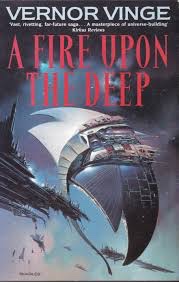
Vernor Vinge, “A Fire Upon the Deep” (1992) – Hard(ish) scifi space opera “goes to the dogs” in this one! Ha, ha, not figuratively, but in the sense two human children wind up in the clutches of rival factions of medieval dog-like pack-mind aliens. The action in “A Fire Upon the Deep” is split between Johanna and Jefri, last survivors of a human colony that gets eaten by a super-advanced malignant AI, and a crew of spacers hired by a human from the same society, Ravna, who goes looking for the ship they were on. The ship had to bail on dog-alien planet and, of course, also contains a way of defeating the Blight, as the evil AI is known.

This is a big (600 pages or so) book with a wide sweep. We go from hyper-advanced space colonies to dog-alien castles and encounter a number of interesting Vinge concepts along the way. Perhaps the most important are the “Zones of Thought.” As it turns out, Earth is in the Slow Zone- the closer to the galactic core you get, the slower the speed of light is, and in turn the slower do neurons fire and advanced tech becomes impossible even if it could be designed. The advanced space civilizations exist in the Beyond, where faster-than-light travel is possible, and the Transcend, inhabited by god-like energy beings. You have to be careful not to get caught in the “Slow Zone” nearer the galactic core, or in a zone storm, where your tech stops working. Vinge also tells us what the space internet looks like- a lot like usenet newsgroups from the nineties, an interesting take from the pre-social media days. The pack minds of the “Tines,” as the humans come to call the dog-aliens, are fleshed out, with gestalt personalities, telepathic communications (and confusions if packs get too close), and multi-generational layering. This is echoed in the shared mind of one of the human shipmates, who was reanimated by a Transcend god-thing that the Blight kills, and is left with some of the god’s abilities and personalities along with his reanimated baggage. Heady stuff! Vinge takes his time with all this, too, which turns out for the best even if it makes the book a little long and slightly confusing in some places.

Vinge sets up multiple ticking clocks, from the threat of the Blight, to the race between Ravna’s crew and the Blight’s fleet to seize the spaceship with the anti-Blight weapon, to the impending rumble between rival groups of Tine eugenicists (one mean, one less mean) that endangers the human children they’ve taken in. The clocks are always ticking but he still takes the time to throw in other complications: betrayals, horrifying discoveries about perfectly nice plant-people, the imperial ambitions of cute butterfly-aliens, the humans helping the Tines up the tech tree, etc. Vinge throws in a lot and most of it is good. One thing you don’t get a ton of is the libertarian posturing I’m told Vinge indulges in (he’s won the libertarian “Prometheus” scifi award multiple times), and that I can do without. All told, a decent, if perhaps overstuffed, scifi adventure with a lot of neat concepts. ****

Review- Vinge, “A Fire Upon the Deep”

Review- Sundiata, “Brothers and Strangers”

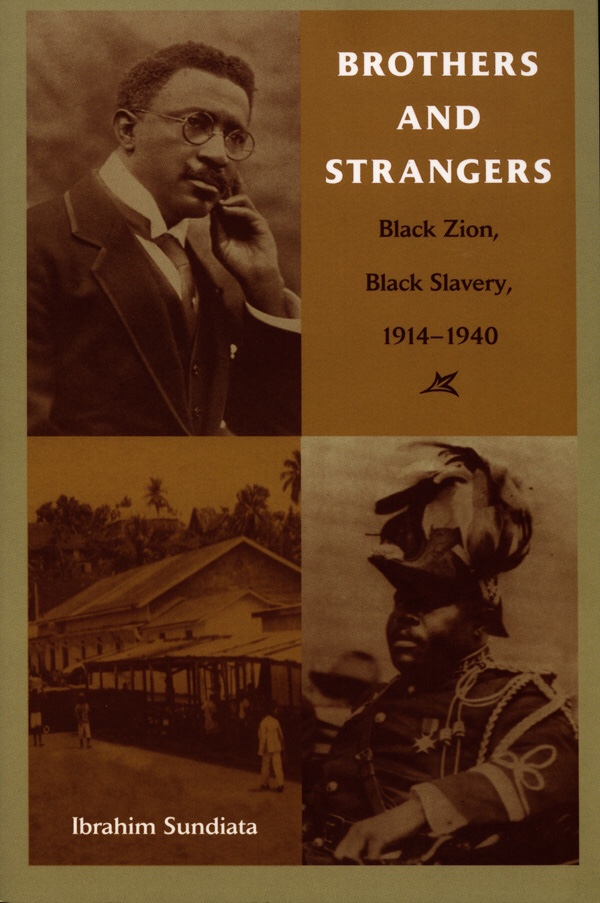
Ibrahim Sundiata, “Brothers and Strangers: Black Zion, Black Slavery 1914-1940” (2004) – I’m fascinated by Liberia and I’m not quite sure why. Perhaps it’s a reflection of my fascination with America, Liberia being America’s barely-acknowledged by-blow, in certain respects. A few thousand ex-slaves and free black people were dumped on a shore in West Africa, on the idea that while slavery was either wrong or just not long for this world, black people needed a place to go, as they couldn’t mix with whites… If you ever wondered what sort of thoughts were going on with the people ideologically between the abolitionists and the ardent slaveholders, where the mythical “reasonable middle” was, that was more or less it. It was big in the Upper South, where the largest populations of free blacks were (there’s still a Maryland County in Liberia to this day). And then they were just… left there.

The story in “Brothers and Strangers” takes place around the centennial of Liberia’s settlement. The US had long since disclaimed responsibility for Liberia, though it was associated closely enough with the country that the other imperialist powers in West Africa wouldn’t swallow it up. The Americo-Liberians (as the descendants of the settlers came to be called) formed a tiny elite, five figures worth of people or so, ruling over a small but incredibly diverse body of tribes in their notional national territory. The Americo-Liberians, sadly, reproduced much of the social order they had left behind, complete with vast inequality and an elite that ran plantations based on semi-enslaved local labor. The governing elite also ran up massive debts, mostly to Britain, but to France and the US as well.

Liberia came to the attention of the world due to these debts, and due to their technically joining the Entente during WWI, placing them in the League of Nations. This coincided with the rise of Pan-Africanism as an ideology in the Black Atlantic, from Jamaica to New York and Britain. The increasingly combustible racial situation in the United States and elsewhere encouraged black people to reconsider emigrationism. Pan-Africanism and emigrationism had a peculiar relationship with imperialism. On the one hand, they were opposed to European imperialism in Africa and the West Indies, and were often on the cutting edge of movements protesting white abuses. On the other, they were inspired by imperialist ideas of civilizational uplift and racial solidarity. Africa needed the African diaspora, as far as many Pan-Africanists were concerned, to settle the continent and bring it to it’s true destiny, etc. etc.

The big figure in Pan-Africanism at the time was, of course, Marcus Garvey, leader of the United Negro Improvement Association and a big “Back to Africa” proponent. The Jamaican Garvey looked to Liberia as a logical place to begin a resettlement effort. It should have been a win-win, or anyway a reaffirmation of what Liberia was supposed to be about: a haven for black people, a republic where their voices and talents mattered. Garvey could provide fresh blood and all manner of skilled workers and settlers, Liberia could provide the footprint on the continent.

Alas, the oligarchy in Monrovia had other ideas. To put it bluntly, which Sundiata does a few times, the Americo-Liberians by and large wanted Pan-African money but not Pan-Africans. After encouraging Garvey for a little while, when it looked like he could provide capital, the Liberian government began stonewalling him. Garvey grew suspicious and hostile towards the Liberians, and UNIA became a voice, often a lonely one, for the oppressed native populations of Liberia after the Americo-Liberians spurned them.

Garvey’s arch-rival, W.E.B. DuBois, maintained that American blacks should continue to support Liberia. This became increasingly important as Liberia’s debt crisis worsened. A scandal over labor importation compounded the crisis: Liberian elites were found to be making money by shipping laborers, sometimes at gunpoint, to plantations in neighboring colonial regimes, where they were treated brutally. To complicate matters still further, the Firestone rubber company took over a vast swath of Liberia for rubber planting. The lifeline this extended rapidly became a noose around Liberia’s neck, as the Firestones (father and son) demanded an ever-increasing slice of Liberia’s GDP as “loan” servicing, all while exacerbating the country’s problem with forced labor and generally acting like a miniature imperial in their own right. It began to look like some larger power — the US, Britain, and/or the League of Nations — might take a hand. Sundiata gets into the diplomatic nitty-gritty of what happened across the twenties and thirties, as the Americo-Liberian elite hustled for its life, and won, with at least some help from the African-Americans they generally held at arm’s length. Black pressure on the State Department wasn’t a major force, Sundiata tells us, but given how no one (other than at times Harvey Firestone, Senior or Junior) really wanted the hot potato of the Liberian mess, it was enough. To a certain extent, Liberia was saved by the bell; FDR came in just as the Firestones were ramping up their demands for gunboat diplomacy, and tamped down on that kind of thing. Meanwhile, the League of Nations was a few years away from getting owned by the future Axis powers so they weren’t going to do anything, either.

Was this for the best for Liberia? Probably- it was already a situation of internal imperialism, the Americo-Liberians suppressing the natives. More imperialism is never the solution. But, as Sundiata points out, Liberian history is a brutal, gratuitously cruel lesson in the distance between outsiders conception of Africa and realities on the ground. The original white backers of colonization expected a stable missionary base in Africa and a solution to America’s race problem, and got a black republic instead. The Pan-Africanists envisioned solidarity between black people on the basis of race, and got the cruel realities of class and ethnic division. Various white do-gooders in the early twentieth century expected a pliable regime they could walk over, and got bogged down in the realities of resistance and bureaucratic inertia. Now, when I bring up Liberia, people respond referring to the Vice documentary about how fucked up the civil wars in the 1990s and 2000s were. Is there a lesson here? Ibrahim Sundiata admirably refuses to sermonize and draw some big moral, other than the usual academic thing about how we need a more nuanced understanding of things, and that the Liberians and other peoples of Africa need to work out their own respective destinies. That seems to be a decent place to leave it. ****’

Review- Sundiata, “Brothers and Strangers”

Review- Miéville, “Kraken”

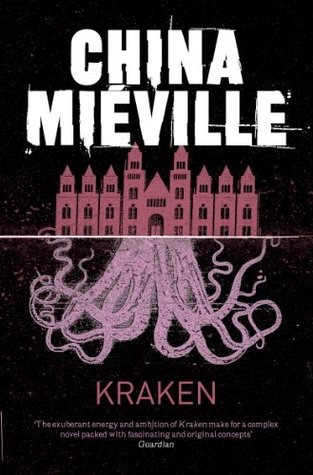
China Miéville, Kraken (2010) – Gotta say… I was always a whale guy in the squid-whale dichotomy. I know, I know, the cool kids are all about cephalopods these days, but that just makes me back my mammal friends all the more. And there’s no “Moby-Dick” about squid. Miéville’s “The Kraken” ain’t it, either.

To be fair, I doubt it’s trying to be, and what it amounts to is something pretty decent. As the back copy will tell you, somebody steals a dead giant squid (and its tank) from a London museum, which sends its caretaker Billy into a world of competing cults, magical weirdos, magic cops, and assorted terrors. The big dead squid has big juju and it’s own cult of squid-worshippers, and so magical London — which is less officially hidden than generally ignored — is all in an uproar over what to do about it.

Most reviews don’t go much past the back copy, and I think there’s two reasons for that. For one, spoilers- there’s a big twist in the end and no one wants to give it away. Second, and I think more importantly, the plot swirls maniacally and is littered with all kinds of stuff China Miéville thought was cool. There are at least five agendas to attend to, including that of Billy, the closest thing to a central viewpoint character, and each of these agendas have assorted arcane obstacles and helpers, all of which require explanation.

What does some of this include? Well: a gang boss who is a sentient tattoo on someone’s back and who makes people-machine hybrids; another gang boss who’s a dead magician; some magic cops, one of which is based on Amy Winehouse, who summon cop-ghosts from old police procedurals; magic Nazis; an ancient Egyptian demiurge of trade unionism who can embody himself in statues (and action figures); a cockney embodiment of evil; an iPod that’s bad at music but good at magical protection; several apocalypses; chronically depressed teleporters; “Londonmancers” who manipulate the city in various ways; were-squid . And I’m leaving stuff out.

When the plot comes together, it ultimately works, especially knowing Miéville’s body of work and his commitments (he’s a big leftie and former ISO member, for those playing the home game). It’s a long, confusing, but mostly fun ride getting there. It all depends on what proportion of and which of the things Miéville throws against the wall make your eyes roll. Without getting into spoilers, the magic in “The Kraken” relies on metaphors, and so the denizens of magical London take metaphor extremely seriously, to the point of silliness at times. But for the most part, Miéville’s storytelling and vast powers of invention prove winning. ****

Review- Miéville, “Kraken”