Review – Mishima, “The Decay of the Angel”

Yukio Mishima, “The Decay of the Angel” (translated from the Japanese by Edward Seidensticker) (1971) – Mishima — forty five years old and a highly respected and popular, if somewhat controversial, writer at the time — finished the manuscript of “The Decay of the Angel,” the final book in the “Sea of Fertility” tetralogy, and then went off to die. With a small handful of followers, he walked on to a Japanese Self-Defense Force base and took the commanding officer — with whom he had a friendly relationship, previously — hostage with samurai swords. They forced him to call the troops to assemble, and there, Mishima harangued them, demanding that they follow him in restoring Japan’s imperial glory. They all laughed at him. Mishima then disembowled himself.

There’s a big “spoiler” at the end of “The Decay of the Angel” that I won’t reveal. What I will say is, it provides a certain degree of credence to the argument that Mishima’s final gesture was more an act of depression and self-loathing than of hateful nationalistic fervor. I say “a certain amount,” and moreover, don’t see the two as necessarily mutually exclusive. People want to see Mishima as a tragic figure as opposed to a fascist, much like they wanted to see Heidegger as a sage rather than a Nazi, and have been revising their apologies downwards ever since. There’s any number of ways to express loathing for self and world that don’t involve embracing fascism.

If anything, Mishima was something of an expert on loathing by the time his life was over, Many registers of disgust with the world characterize the “Sea of Fertility” series and its last volume especially. Viewpoint character Honda is now an old man. He lives with an old lesbian who trolls him all the time. They stumble upon one last reincarnation of Honda’s friend from adolescence, who has been reincarnation roughly every twenty years (because they keep dying young)- a teenage lighthouse keeper named Tōru. Honda adopts him, which apparently you can just do with random youths in 1960s Japan, and sets about trying to help the boy live past twenty, which none of the previous incarnations have yet managed.

I know I should say more about, like, Mishima’s aesthetic and philosophical meditations in this, his final work, but I can’t help but focus on how often Honda just gets owned in this book. Tōru is an asshole, basically a feral human, and makes Honda’s life hell. He steals Honda’s money. He makes fun of Honda all the time. He sabotages Honda’s efforts to teach him how to get along in society. He cruelly persecutes various women who like him. He outs Honda as a voyeur, ruining his reputation at the end of the life. He is, in general, a dick. And moreover, various clues start to lead Honda to believe that maybe he got mixed up about the whole reincarnation business.

More than the particulars of reincarnation, I think the story is about beauty, decay, and the point of existence. What both drove Mishima to fascism and also limited his effective expression of the ideology was the same thing that drove his creative efforts and his life generally- an amoral aesthetic vision where beauty is the only thing that matters, and it’s defined by youth, purity, and violence. In this volume, Mishima rubs our nose in both ends of what sucks about that. It sucks to get old, because old = decay and ugliness in his world, and there’s no values that can redeem your old stinky ugly hide. It also sucks to be, or be around, beautiful youth, because they’re amoral, stupid pricks who will suck you dry.

So what are you left with? Along with whatever else both the book and its aftermath were, they were also manifestations of Mishima’s panic of growing old. He was never particularly emotionally stable to begin with — artists, you know? — and, like the Japanese imperialists he idolized, he was willing to go that extra mile to make a point… the extra mile usually meaning spilling blood, though at least in this case it was only his own. One wonders if he would have been pleased with his posthumous reputation. He seems like a hard guy to keep happy but objectively speaking he seems to have done pretty well dead.

Still and all… one wonders if this would have come off as this sad tragedy to so many people if it had been undertaken by someone from the part of humanity who actually has good reasons to obsess over aesthetic judgment of their bodies, i.e., a woman. If a literary woman in her forties had an extended freakout about the decay of her body, ending in tetralogies, hostage taking, and suicide, well- probably some people would see that as tragic and symbolic but I tend to think more people would find it pathetic and funny.

But expecting fairness from literature is a bit like expecting justice from the weather. Mishima might have been the last one who could really put over the modernist literary enfant terrible thing in a way that didn’t come off as cheap trolling to cover up a lack of talent (cf Bret Easton Ellis). We tend to equate “saying something” in literature with some didactic “message” — Mishima had something to say but more faith in the aesthetic whole than its educational payload. ****
Review – Mishima, “The Decay of the Angel”

Review- Vance, “Star King” and “The Killing Machine”

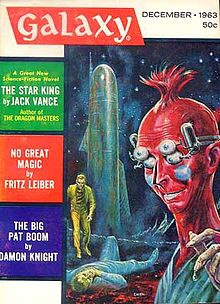
Jack Vance, “Star King” and “The Killing Machine” (1964) – I read these two on two flights back and forth cross-country. At about 160 fast-paced pages, they worked out pretty well for that time slot. They’re the first two volumes in the Demon Princes series, named after the gang of five space pirates who destroyed the village and killed the family of Kirth Gessen (related to that n+1 guy, one wonders?) who, naturally, vows revenge, one novel per Demon Prince.

The setting is classic Vance- far future, interplanetary, but comparatively low tech (there’s hand-wavey faster than light travel, but everyone still deals in cash), and a crazy quilt of planets with radically different cultures and environments. One of the conceits is that anyone with a spaceship can lift off and find an inhabitable planet, so every oddball sect or separatist group settles its own world, and stuff gets weird out there after a few thousand years.

Into this welter goes Kirth, his life given relatively straightforward meaning and rationality by his quest for revenge. The Demon Princes themselves belong to a kind of competitor species to humanity, asexual amphibians characterized by an innate drive to imitate and eventually excel the most sophisticated species they can find- which, this being midcentury sci-fi, soon comes to mean humans. They even adapted themselves to look like us. Apparently, most people aren’t that worried about it, but these Demon Princes guys decided to pursue sneaky lives of spectacular crime.

This means along with sci-fi with a certain western element (the revenge quest, frequent visits to the untamed frontiers where all the weirdest planets are), there’s a certain detective story element to each of the books, as Kirth needs to poke through clues to figure out who each of the Demon Princes are. In the first one, he finds that his quarry is hiding among academic administrators(!), and uses the promise of rights to a lucrative planet, along with some good old-fashioned goon suborning, to winkle him out. In the other, the bad guy is hiding on a planet stuck in the Middle Ages, so Kirth needs to do some knight and princess biz.

The set ups are fun and the books are quick. They give plenty of range for Vance’s worldbuilding and his baroquely courteous but sinister dialogue- like Wodehouse’s evil twin. A particular favorite, after he gets a story out of an old flunky of one of his quarries who belongs to a cult that eats rotten food and is on his way out the door: “Gersen said thoughtfully, ‘I shall now take all your money, and throw your vile food into the sea.’” The Demon Princes, naturally, rant like Bond villains on acid when caught, and their henchmen are pretty good, too.

Hard boiled heroes of the Chandler or Hammett mold are often somewhere between standing aloof from the sordid worlds they deal with and being their apex predators. Something similar can be said for many of Vance’s heroes, including Mirth. One interesting difference- Vance’s sci-fi/fantasy worlds are rendered sordid by the forces of time, decay, and petty narcissism, especially the narcissism of difference, than by exploitation as in the noir. Vance wasn’t a comrade and tended to see people as amusing, amoral beings who do a variety of fun tricks.

As the story develops it becomes clear that the Demon Princes were undone by the constant striving after greatness that their species is prone to- they can’t just enjoy life, they need to be constantly chasing more, and in their case, it’s more refined wickedness. The bad guy in the second book, the titular Killing Machine, seeks out a medieval world because he has some long-winded theory about producing the perfect kind of fear. Kirth is a relatively straightforward type, but of course, he’s aware his whole life, too, is dedicated to killing, and what happens if it’s ever over? Presumably, we’ll learn more about that in subsequent volumes. ****’

Review- Vance, “Star King” and “The Killing Machine”

Review – Mishima, “The Temple of Dawn”

Yukio Mishima, “The Temple of Dawn” (translated from the Japanese by E. Dale Saunders and Cecilia Segawa Seigle) (1970) – Ok! Book three of Mishima’s final tetralogy. Gotta say… this one is kind of slow. There’s a lot of travelogue stuff — Mishima was a big traveler — about Thailand and India which is decently written but doesn’t interest me that much. There’s several essay-length disquisitions about different ideas of reincarnation. Moreover, the book in general is about decay. In keeping with the larger thesis of the “Sea of Fertility” books, very few things can transcend the earthly tendency to decay- mostly, beautiful dead youths. This one emphasizes the decay state that beautiful death needs to transcend, so… a little slow.

It’s 1940, Japan is on the verge of war, and viewpoint character Honda Shigekuni is in Thailand. In full middle age by this point, and a successful corporate lawyer, Honda’s doing deals when he realizes that an eight year old Thai princess, Ying Chan, is the reincarnation of his high school friend Kiyoaki, who had been reincarnated in the previous book in the form of Isao, an ultranationalist high school student. This little girl who had never left Thailand keeps babbling about how she should be back in Japan, knows stuff only Kiyoaki or Isao would know, etc. Of course, being surrounded by minders and eight, there’s not much that can come of it, plus the war happens.

Fast forward to the postwar years. Honda does well from the occupation, but feels serious weltschmerz hanging out with the other Japanese elites who have done the same. He gets into voyeurism. He befriends some writers who are probably analogues to Japanese writers Mishima wants to say something unpleasant about. Ying Chan, now in her late teens, shows up in the circles Honda spends time in, and he gets all weird about her. He wants Ying Chan to sleep with his neighbor, for reasons I honestly can’t remember. It’s like that Gombrowicz novel “Pornografia,” where two old litterateurs try to get an attractive young couple to get together in the ruins of wartime Poland. What’s with that time period that weird old literary leches were trying to get attractive young people to bang, as though they wouldn’t anyway? Maybe it’s easy to believe in the end of all that when it seemed like the world was ending. Well, it works out for Honda, but spoiler alert: the princess dies, or else there wouldn’t be a third reincarnation of Kiyoaki for the last book.

I’m basically glad I’ve read these, even if this one is less rewarding. I’m starting to think maybe I should’ve started my Mishima reading with more popular fare like “The Sailor Who Fell Out of Grace With the Sea” but there’s always time for that. I suppose I’m interested in his big statement, and this book’s sequel is the literal last thing he ever wrote before meeting his self-imposed violent end, so… we’ll see. ***’

Review – Mishima, “The Temple of Dawn”

Review – Dick, “The World Jones Made”

Philip K. Dick, “The World Jones Made” (1956) – Philip K. Dick! This is the 23rd PKD novel I’ve read and there’s still plenty to go. On the one hand, that sort of productivity is an accomplishment in its own right. On the other hand, the production schedule he was on — 44 novels and 141 short stories in 30 years — almost certainly helped shorten his life. The whole noble-downtrodden-genre fiction vs bad-snooty-literary fiction thing has gotten pretty tired in recent years as geek culture — much of it as pretentious, formulaic, and just generally lame as any product of the high culture bad ol’ days — has swallowed the planet. Still… you can’t help but think about how literary writers with barely a fraction of Dick’s talent or work ethic lived much cushier and longer lives. I guess there’s some compensation in that PKD lives on not just as a writer but as a legend, where his literary contemporaries are, at best, whited sepulchers foisted on poor unsuspecting English students…

Anyway! “The World Jones Made” is classic Dick, a little before he hit his best period in the early-to-mid 1960s. In the beginnings of his sci-fi career, Dick cranked out novels and stories of post-nuclear wastelands. These weren’t the kind of fun lawless zones of Mad Max. These were the sort of dour postwar scenarios imagined by the likes of Herman Kahn and other nuclear strategists- buckled down, regimented, productivity-driven, stolidly trying to ignore the horrors of environmental destruction and mutation. Dick could turn the crank and produce one of these horrifying worlds as a setting, and then drop in something odd, something philosophical and uncanny.

In “The World Jones Made,” there’s two such somethings. In something of an aside that joins the main plot in the end, we read of the tiny lives of humanoid creatures genetically engineered to live on Venus, with the usual angst about being created beings. But the major premise of the story is the titular Jones, a small time carnival sideshow who turns out to be able to predict the future perfectly- but only one year at a time. The post-war world had been ruled over by a global regime espousing “relativism” — the war having been caused by political and religious fanatics, the world government locks up anyone who declares their opinions to be fact, unless the holder of the opinion can prove it. Well, Jones can, and a movement rapidly springs up around him which overturns the regime. Dick thought hard, if not necessarily in a professional academic vein, about Nazism, and there are shades of that here… and shades of them overthrowing a global-oriented “relativist” elite that can’t see it coming. Maybe Jones wasn’t the only one who could see the future…

But, there’s some disadvantages to seeing one year and one year only into the future. For one thing, Jones can’t change anything. He, and everyone else, is locked in. This makes him a miserable, sour fatalist, along with whatever else. Within a year of his death, Jones starts seeing — experiencing — his own decay, and no one does the horror of decay like PKD. Moreover, Jones can’t deliver on any of his promises to his adoring crowds… and he knows it. The best he can do is wreck the previous system, seemingly more out of spite than any other reason.

Most of the viewpoint characters other than Jones are standard early-Dick protagonists, nondescript cops or investigators with considerably more interesting women in their lives providing a certain degree of uncertainty (PKD was married five times). How Jones’s precognition fails — how he gets killed — isn’t made that clear. Writing his way out of his own premises was never PKD’s strong suit.

What PKD was nearly uniquely gifted at, and what assures his place in the pantheon of great sci-fi, was constructing worlds of dread and fascination. Some people ding his prose style and character work, not without reason. But the things he wanted to get across — on the positive side possibility, on the other hand the lived experience of fear, decay, being trapped, living paradoxes — he gets across as well as any writer, and he does so in fine form here. His stories make us ask questions about our own experiences, and without the pretense or hippy-dippy rigamarole that “questioning reality” literature usually implies. *****

Review – Dick, “The World Jones Made”

Review- Parsons, “Ku-Klux”

Elaine Frantz Parsons, “Ku-Klux: The Birth of the Klan during Reconstruction” (2015) – This is a very strong, subtle, and frightening work of cultural history. “Ku-Klux” is a history of an organization that has been defined in no small part by the specters and myths it generates. Parsons manages a very intricate task in reading the very real, material violence the Klan afflicted (and it’s material consequences) in relation to the Klan as an idea, a set of narratives and images deployed by a number of different actors to various ends (note- Parsons uses “Ku-Klux” instead of “Klan,” in keeping with practice during the nineteenth century- I’m using “Klan” out of convenience).

It’s important to note that Parsons is writing specifically about the Reconstruction-era Klan, or the “First Klan” as it’s sometimes called. Much of our imagery of the Klan comes from the “Second” (1920s) or “Third” (civil rights era) Klans. The early klan was much more loosely organized, and did not have a standardized appearance- the uniform white sheets and hoods. Instead, local klan groups self-organized, and dressed in a bewildering variety of costumes, from pretty basic hoods to what were basically clown costumes to full-on drag. Basically, Halloween- like those creepy old Halloween pictures.

And that might be the central point Parsons gets across- the early Klan very cleverly manipulated the line between serious and playful and between truth and myth. The bizarre costuming and other ritual aspects of the early Klan served a number of purposes, and weren’t as good at anonymizing their members as you may think. What they did do was create a space where the normal rules, not just of law and morality but of reality in general, didn’t apply. The message was clear- any attempt to challenge white dominance would not only lead to violence, but to a nightmarish overturning of order in general. It wasn’t enough to beat, maim, rape, and kill- the Klan also forced its victims into sadistic fantasy tableaux of white dominance.

Parsons also makes clear the ways in which politicians and publics in the north helped constitute the Klan as a concept- and in a way that helped make the Klan’s efforts successful. From the start, the Klan borrowed from northern commercial culture, most notably taking elements of gothic fiction and minstrel shows to structure their statements and rituals. Northern politicians and newspapers eagerly followed stories of Klan atrocities, especially when they could use them to argue for increased Republican power over the South. But as time wore on, several elements of the Klan’s cultural operations began to warp the story in directions favorable to them. Democrats and rival Republican factions began casting doubt on Klan stories- and one of the ways in which their outlandish ritual character helped the Klan was in sowing that seed of doubt.

Worst of all, Republican politicians waving the bloody shirt insisted on the image of pitiful black victims, and often literally shushed black survivors who attempted to tell their stories of resistance, even just to the point of refusing to play along with the Klan’s ritual grotesquerie. Along with amplifying the Klan’s cultural power by making resistance seem impossible, it eventually created a picture of the South where blacks were, always and inevitably, simple victims of the violence that’s just generated, like maggots from old meat, by white revanchism- and that there’s nothing anyone, certainly not northern politicians, could do to help. This dovetailed nicely with the declining Republican interest in the Reconstruction project, and helped make itself a self-fulfilling prophecy.

Historical analogy is a tricky game in any event. It’s made worse by the blindness to the many-fold axes of comparison that our language (and, one suspects, popular culture) encourages. So, the very first thing anyone goes to to dismiss an analogy that makes them uncomfortable are differences in size and scale- thing A can’t be like thing B because B effected more people, lasted longer, etc. And there’s often good reason to do this- think about the reductio ad hitlerum arguments that fly all over the place… though now that it’s the right that cries genocide much of the time, I guess we might rename it reductio ad stalinum (or maoum).

But… especially for a book published and 2015, and presumably conceived and written years before, there’s a lot here that illuminates dynamics in the contemporary far right. I know that will be enough of a stretch for some people, but if I really wanted to stretch, I’d say something like: the Klan is a notch in the belt of a specifically Anglo-Protestant modality of irregular war, attuned to the lifeways of the people pursuing it in the same way the Mongols’ way of war was essentially their way of surviving on the steppe, militarized.

But we’ll stick with the shorter stretch for now. The most obvious is the Klan’s use of performance, irony, and the prevailing pop culture narratives of the day, and the way that finds echoes in the contemporary altright. This practice creates multiple faces for different audiences, making it hard to get a grip on the phenomenon as a whole, and more than that works to confuse people and lead them to believe the rules aren’t working anymore- witness the altright belief in “meme magic.” And in a sense, it does work- not for their maximalist goals, which are absurd, but for making the society that much more violent and paranoid and making it harder to make any real social progress.

A related unfortunate parallel is the way portions of the commentariat who really should know better can’t seem to get their heads around the fact that people can be silly and ironic and also deadly earnest and violent. I wonder where that comes from. Did they not go to high school? Hell, I didn’t go to real high school and even I know that!

On a somewhat more positive note, there were people with power at the time who took the Klan seriously. Parsons tells the story of a Major Lewis Merrill, a Union army intelligence man who did the obvious things in his area of operations in South Carolina. He formed relationships with and gained the trust of the part of the community that he could work with (i.e., the black people), created a network of informants, arrested the Klan leaders they accurately fingered (it’s a myth that people didn’t know who was leading these things- these are small communities), and supported efforts to build a political base for a non-white-supremacist system. Remarkable how these things work with a clear head, some solid working partnerships, and a little elbow grease. *****

Review- Parsons, “Ku-Klux”

Review- Bolaño, “The Return”

Roberto Bolaño, “The Return” (2001) (translated from the Spanish by Chris Andrews) – I haven’t got a ton to say about Bolaño that doesn’t reproduce the usual cliches. Symbolic figure of Latin American literature in the wrecked shambles of both the Boom and the dreams of twentieth century Latin America, check. Career tragically foreshortened and not even by something glamorous, check. Nihilism and with it enough dead women and sex workers to be suspect by today’s prevailing moral codes in literary circles, check. Most of all, the paradox of literature- utterly incapable of making the world a better place, in Bolaño’s telling, but also as essential as air to life as he knows it. Check.

The stories in “The Return” are Bolaño in fine form. If the magical realism promulgated by the Boom writers sought to weave dream logic into everyday life, Bolaño’s major theme is the nightmare logic that is already there. Bolaño’s Latin America was the Latin America of the narco wars, of structural adjustment, and most of all, of Pinochet and the other dictators who killed, at least for a generation, whatever fleeting hopes the continent had previously had for forging their own path forward. Violence permeates his surreal moments the way wonder permeated magical realism.

Bolaño doesn’t see incipient fascism as lurking under a mask of normality. In his stories, normality and fascism constitute each other; at its most remote, fascism is the norms — masculine norms above all, but norms of family, religion, nation, culture in general — militarized and let loose to rule by terror. The violence of a fascist cop shades into the violence of the soccer hooligans which shades into the violence of cartel enforcers which shades into the violence of exile and malaise, of cramped lives dependent on precarious employment and even more precarious literary patronage. All of which is expressed in large part through violence against women. Moreover, fascism (in a phenomenological sense if not a strict political one) lives in the decision to see all this as normal, fine, even as it produces spectacular, surreal, and horrifying results.

The collection’s best stories, in my opinion, are: “Detectives,” a dialogue between two cops who, we find out, went to high school with a “Belano” and jailed him after the coup- this based on a strongly-disputed part of Bolaño’s origin story, where he went to Chile as a young man to assist the revolution, only to be jailed and released to leave Chile for good; and “The Prefiguration of Lalo Cura,” the closest you’re going to get to an epic in short story form. There was a podcast called “Tales of Serious Literature,” which doesn’t seem to be running anymore, which had a good episode on the story. I don’t think I can say much that the host (who had a perfect, deeply amusing pedant voice, and a real love of literature) couldn’t.

Some of the stories about layabouts and their paranoid women troubles were kind of drags. Bolaño’s not the worst depressive writer when it comes to women but that’s not saying much. Misanthropy all too often shades into misogyny, though I get that he was trying to depict a milieu more than his own life. Some people see Bolaño as wallowing in paranoia and filth. I wouldn’t say he’s a sunny writer, but in continuing to create remarkable artifacts with literature — a tool he constantly harps is, at the very least, deeply compromised in the face of the world’s brutality — I think he actually affirms life more than a lot of cheery material does. ****’

Review- Bolaño, “The Return”

Review- Mounk, “The People Versus Democracy”

Yascha Mounk, “The People Versus Democracy: Why Our Freedom Is in Danger and How to Save It” (2018) –


(Note: I initially wrote this for a little magazine, but since then pretty definitive pieces on the book and it’s genre appeared in n+1 and in Dissent. Both are well worth reading and say much of what ought to be said. But I do try to post a review of every book I read, and I did read this book, so I thought I’d post this here.)


Harvard-based German political scientist Yascha Mounk is one of the latest to step up to the plate to explain the decline of the liberal political order, the necessity of reviving it to more or less pre-2016 status, and how we can get there. Younger than many in the same ideological cohort and less tied to wildly unpopular neoliberal institutions and policies, he’s got the marketing game down pretty good too- The People Versus Democracy is the sort of thing bound to get a Vice interviewer excited. The book is schematic and breakable down by bullet points, well-suited to an audience used to getting their public intellectuals via TED talks.

The title is something of a stumper. We’re more used to hearing arguments about freedom versus democracy, or merit versus democracy– fear of the masses taking down the big important people, from people representing (or fancying themselves to represent) the latter. What does the people versus democracy mean?

What Mounk means when he talks about the “people versus democracy” is “the people versus liberalism.” Mounk allows that there is such a thing as illiberal democracy, where elected strongmen abuse the rights of minorities and trample due process. This is one of the primary things he fears from Trump, Modi, Orban (who boasts of the “illiberal democracy” he has made of Hungary), etc. But as far as he is concerned, the only true democracy is liberal democracy, and that is what he is worried about “the people” undoing.

Political thinkers of his generation and that preceding him (barring a few unserious radicals), Mounk tells us, assumed liberalism and democracy naturally go together. This is what the “End of History” moment in the late 1980s meant. But we are now witnessing the “deconsolidation” of liberalism from democracy. Democratic publics are turning against liberalism, with its provisions of equal justice under the law and checks on executive power, both in the new democracies that liberals had such high hopes for post-1989 (mostly in Central Europe) and in liberal democratic states of older vintage: Brexit Britain, AfD Germany, LePen’s France, Trump’s America.

Unlike libertarian figures like Jason Brenner and their proposals for bringing back property (or better yet, IQ-based) restrictions on voting, Mounk sees democracy as something like an equal partner to liberalism in the “liberal democracy” formation. This gives him some additional context that many of the liberal doomsayers lack. He grants that if liberal democracy has become unpopular among worryingly large swaths of contemporary electorates, it is due in no small part to the elites in liberal societies hollowing out the substantive meaning of their democracies. Judges and unelected bureaucrats unilaterally makes rules that affect millions and the wealthy buy access to power, Mounk explains. This results in a situation of “rights without democracy,” the equal and opposite of the illiberal democracy scenario. It’s hardly surprising that people prefer the latter, if those are their choices.

What has brought us to this state of affairs? Mounk identifies three factors behind the disaggregation of democracy and liberalism: social media; economic stagnation; and the rise to importance of “identity.” Stagnation makes people mad; social media lets their anger circulate widely, quickly; “identity” gives them someone to be mad about.

Mounk’s history of the late twentieth century puts the dysfunction of liberal social science bereft of political economy or class analysis in stark relief. In his telling, social media and the economic restructurings that led to secular stagnation in the developed world are the results of the genies of technological and economic progress, respectively. The identity politics thing is the result of immigration, with an assist from liberal college professors who say mean stuff about the Enlightenment. Why these things have taken on the importance that they have – and they all are important, even if they are framed unhelpfully – and why the political system of liberal democracy is unable to cope with them, are not answers Mounk answers or really addresses.

Mounk can talk about an economy. He cannot talk about capitalism, a system of organizing production; which is to say, a system of power. We hear a lot about the impositions on freedom made by illiberal democrats such as Orban and Duterte. We hear a little about the inroads liberalism has made on democracy through wealth concentration. We hear nothing about how freedom and democracy are made into abstractions by the reality of class power in a capitalist society. Liberalism, at its most ambitious, builds out the degrees of freedom and democracy possible without defeating capitalism: the government can’t imprison you for dissident speech but your boss can make you ask to go to the bathroom; you can vote for someone to vote on laws but not for who runs your workplace. This is a massive, almost juvenile reduction of a complex set of dynamics, that doesn’t even get into how race and gender interact with capitalism to produce even grosser unfreedoms and inequalities. But it is pitched at the writing and analysis level of The People Versus Democracy, and Mounk does not engage any critique like that, even to dismiss it. The closest he comes is comparing Jill Stein and Naomi Klein to Donald Trump and Steve Bannon as purveyors of “easy answers.”

Mounk comes perilously close to something like class consciousness when discussing the influence of wealth on policymakers in formally democratic countries. Less than a matter of open bribery (though that happens plenty), he argues, it’s a matter of “milieu.” Rich and powerful people spend their time with and get to know other rich and powerful people, and come to identify with them and their interests, and this identification shapes policy.

Alas, Mounk does not follow up on this insight. Like others on the left-er side of liberal, he acknowledges that income inequality is an issue, in terms of people’s quality of life and their willingness to engage in the sort of politics he understands as acceptable. But also typical of liberals, he does not, cannot, understand inequality as part and parcel of a structural relationship between a class that owns and rules and another class that works and obeys. A liberal democracy is already a hollowed-out democracy. It isn’t simply hollow for the poor, because they cannot participate as much as the rich (though that’s certainly part of it); it is hollow because the most pressing questions of social power are bracketed away. It’s little wonder that people would disengage, even if many of the replacement outlets for their political energy are ghastly and will only make matters worse.

Nowhere in The People Versus Democracy is the dysfunction of liberalism’s inability to confront capitalism as a system more on display than in Mounk’s proposed remedies. His economic prescriptions are about what one would expect from, say, a centrist Democrat running in a district where Bernie polled well: make the rich pay their fair share, retool welfare for the twenty-first century, etc… mostly unobjectionable, if tepid. We also hear about the need to “domestic nationalism” and “renew civic faith.” For the most part, these are as platitudinous as they sound- people should try to reach across divides, promote civics education, maybe get Zuckerberg to tone down the fake news algorithms, etc.

It’s where those phrases aren’t platitudes where the piece runs into real trouble, and reveals just how much the strain of avoiding a critique of capitalism can warp a thought process. Liberalism needs nationalism because liberal leaders, hands tied by devotion to capitalism, cannot offer their people anything more substantive with which to secure their loyalty. And “domesticate” it all you like, but nationalism has something of a habit of going feral, as we are currently seeing the world over. The “civic faith” chapter takes a bizarre stroll into political correctness-baiting. Here, Mounk pulls from some anecdotes of his time around universities to argue that we aren’t civically engaged in large part because of professors traducing the Enlightenment and the Founding Fathers. This is the sort of inflation of the power of obscure academics (and ignoring other, larger factors) that characterizes Fox News, not serious scholarship. It’s unlikely anyone is going to wave Mounk’s chapter on their way to harassing an adjunct out of a job, especially when there’s so much stronger stuff available in that vein. But it goes to show that even intelligent, up-and-coming liberal commentators will veer erratically into profoundly unlikely territory to avoid confronting the power of capitalism.

The people aren’t opposed to democracy. Capitalism is. *’

Review- Mounk, “The People Versus Democracy”

Review- Fleming, “Casino Royale” (1953)

casino royale

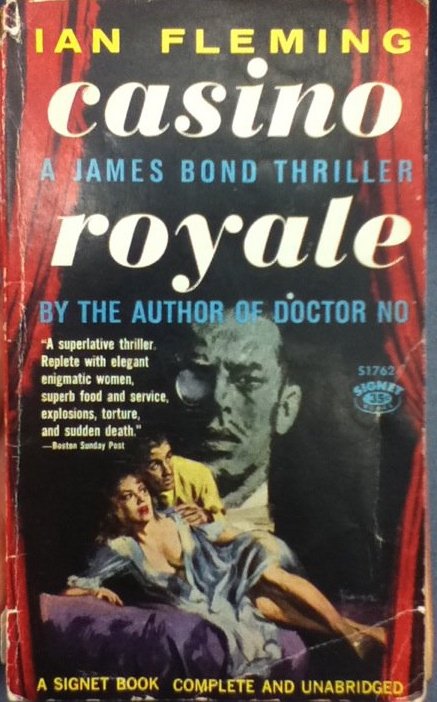
Ian Fleming, Casino Royale (1953) – Bond was never my favorite spy. He’s probably the first I heard of, but I never really got into him, either sincerely or for camp reasons. As alluded to in an earlier review, I’m a Bourne guy, despite my acknowledgment of its overly-earnest quality. But when the first Bond novel came up on a library free pile, I figured I’d give it a try. Among other things, I’m interested in how the installments came to be such an established, almost ritualized formula.

When people talk about the pleasures of “genre” narratives rather than “literary” fiction or “art” films, one of the things they go to is plot. Genre focuses on tight plots that deliver the goods in fine prescribed formula, rather than futzing around with experiments. Of course, the way genre fiction tends to sprawl sometimes, especially lately thanks to your George R.R. Martins, Robert Jordans, Steig Larssons et al, so “tight genre plots” aren’t all they used to be.

But I gotta say… the plot in “Casino Royale” was “tight” to the point of being nonexistent. A Soviet agent, Le Chiffre, ripped off his operating funds (for his evil Communist labor union!) and is trying to get it back by gambling. MI-6 sends James Bond over to rook him at cards, preventing Le Chiffre from making good. The stupid thing is… Bond beats Le Chiffre (at baccarat- the filmmakers changed it to poker, and for good reason, baccarat sounds boring), Le Chiffre and his goons kidnap and torture Bond, and then… the Soviets just come and kill Le Chiffre anyway, and let Bond go. The end. MI-6 could just have waited for the Soviets to clean up their own mess.

So, presumably, the plot isn’t the point. The point is to inhabit Bond’s world. Though, being the beginning of the series, it’s much less elaborate than it eventually becomes. The SMERSH network of which Le Chiffre is part is borderline scifi in its omnipresence, but none of the scifi gadgets or anything are in play yet. Bond isn’t jetting around the world- all the action takes place in one faded resort town in the south of France. He only sleeps with one woman, who of course turns out to be both a useless impediment AND a spy and who kills herself out of guilt after she falls in love with Bond.

I didn’t think it was anything special but you can tell why readers would like it. It’s short and moves along quickly. For readers in post-imperial Britain just emerging from wartime austerity, a character who affirms traditional British values, lives it up, and asserts British geopolitical relevance while doing so must have been appealing. And Fleming does develop a distinctive narrative voice for Bond. It’s an adaptation of older British spy protagonists like John Buchan’s Richard Hannay: upper-crust British gentleman as ubermensch. He’s “over” as in superior to almost everything and just sort of bored and blase. He’s demonstrably cultured (at least in a consumer sense- clothes, cars, food and wine) but also something like Nietzsche’s “blond beast”- brutal, violent, rapacious, lordly. That parallels the other cheap pathos-generating technique you get in this kind of narrative- Bond thinks feelings don’t matter, but inevitably, in every story, he has feelings of some kind… and they matter a lot because the feelings of a guy who normally doesn’t have them are worth more on the pathos exchange. I’ve often thought a lot of pop works on those sort of emotional antinomies.

At this early stage, it seems like Fleming is wavering between embracing Bond-as-we-know-him and experimenting with a more noir sensibility, where the whole enterprise is seen as dirty and morally compromised. You get the idea that maybe we’re not supposed to really like Bond. But in between bouts of post-genital-torture freshman philosophizing in his hospital bed and quickly falling in and out of love with the lady spy, Bond entertains and rejects both moral relativism and romantic love. I’m not going to run out and buy the next installment, but if turns up on a library pile, I’ll probably pick it up, if nothing else to trace the developments. **’


Review- Fleming, “Casino Royale” (1953)

Review- Mishra, “Age of Anger”

ageofanger

Pankaj Mishra, “Age of Anger: A History of the Present” (2017) – One thing you can say about Pankaj Mishra- he has good taste in enemies. Niall Ferguson tried to sue him; more recently, mainly due to his inability to parse the multiple meanings of the word “romance,” Jordan Peterson declared his interest in physically fighting him. It’s no coincidence that two of Mishra’s signal public beefs have been with the leading (pseudo-)intellectual defender of the British Empire, and a guy who would’ve been a very common type of white-settler Dominion jingoist dullard had he been born a few decades earlier.
If he had to pick an occupation to put on his tax return, more than historian, or essayist, or novelist, Mishra could put down “critic of empire.” He’s an inheritor of decades of anti-colonial and postcolonial thought generated by the first few generations of intellectuals to emerge from, to borrow the title of another of his books, the ruins of empire. So Mishra takes on the time-honored role of ruffler of metropole-pedant feathers, and he’s pretty good at it. He’s also a popularizer, which means a couple of things. He places the thought generated by earlier grapples with empire in a more contemporary context. He is also something of a bowdlerizer… though truth be told, if you’ve ever read some of these postcolonial theorists, you’d have to admit they could use some “reductionism” into an idiom people can actually read.
You see both the merits and the flaws in his approach in “Age of Anger,” where he attempts to explain our current moment of mass populist/reactionary/nihilist rage through reference to earlier periods of angst over modernity. In Mishra’s view, modern history is defined by a few dynamics that went into motion in the 18th century. Arguments between Voltaire and Rousseau prefigure the general arguments about whether Enlightenment modernity is worth it or not, if the benefit of the narrow few who appreciate Enlightenment thought really is everyone’s benefit. The harsh adjustment of Germany, Italy, Russia, Japan, and India to 19th-century industrial modernity — the death of God, the rise of nationalism, class conflict, et al — prefigures the crises occurring throughout Africa and Asia today. The McVeighs and Al-Awlakis of today’s worlds are essentially copies of the Emile Henrys and Underground Men of Dostoevsky’s time.
The flaws are obvious enough. Mishra is an arch-lumper, and I say this as a guy who tends to lump rather than split himself. He slides between the mid-19th century and the early-21st in the space of a paragraph. His evidence is almost entirely cultural, and more broad (admirably broad) than deep in that vein. Complex situations with significant material factors become duels between different modes of feeling and thought, especially Voltaire’s bien-pensant liberalism and Rousseau’s ressentiment, appearing again and again in different guises. It’s all the eternal return of the demons modernity suppresses, spurred on by the inequalities and general angst modernity produces.
Most cultural and intellectual histories are much, much more careful than this- they restrict themselves to what they can prove, which typically involves painstakingly putting together archival evidence and finely-grained readings of context. This is to avoid doing an injustice of the specificities of historical situations, and to avoid the sort of overgeneralization that tends to undermine a thesis. You can see why this is important, reading this. Especially when the best he can come up with for what to do about the way modernity seems to just generate rage and alienation is to go “:shruggy emoticon: modernity, huh? Whaddaya gonna do??”
But the book also has substantial merits, also clear after reading so many delicate, finely-wrought, and quite slow cultural and intellectual histories. Mishra’s a good prose stylist. He does fine work popularizing the findings of historians who have traced some very peculiar circuits of radicalism in the nineteenth century, between anarchism, nationalism, socialism, and proto-fascism, and shouts the historians out in a solid bibliographical essay. He has a long chapter on the experience of German romantic nationalism that serves as a very competent gloss, the kind of thing it could make sense to assign to undergrads in a core course to get the basic lineaments across (and in which to look for holes).
Moreover, his basic point — that maladjustment to modernity isn’t a problem of specific cultures, but is inherent to the project of modernity as a whole — is well-taken. The issue is, what then? It’s pointless to try to tell someone how to write a book differently. But I think an approach that injected some materialism into the subject would have had to have reckoned with the ways the material accomplishments of modernity really have changed humanity’s potential, and like any potential, it can be used for better or for worse. To paraphrase a certain birthday boy, critics of modernity have described and furrowed their brow at the modern world- the point is to change it into what it can and should be. ***’
Review- Mishra, “Age of Anger”

Review- Thompson, “The Grifters”

Jim Thompson, “The Grifters” (1963) – Gotta say… for a book about grifters, there’s precious little grifting in this one. Jim Thompson was the standard bearer for pulp hardboiled crime fiction in the 1950s and 1960s, picking up where Chandler and Hammett left off (and sharing the latter’s Popular Front sympathies- I’m not sure how he avoided the blacklist, possibly through avoiding writing for pictures?). Among other things, he carried forward the existentialism-inflected psychological bent of earlier hardboiled writers. I’d argue it goes a little too much in the psychological direction in this one.

It makes sense- these sort of noir stories were always more about the people than the crimes. And the particular grifts in this book are almost shockingly banal and small time; stuff like rolling loaded dice for drinks and asking for change for twenties and then pocketing both the twenty and the change. Not exactly interesting crimes here. So I guess from that perspective it makes sense that the book focuses largely on the tangled inner lives of short-con grifter Roy Dillon, his mother Lilly, and his lover Moira.

The problem is, at the end of the day, the inner life stuff is pretty midcentury paint by numbers. A lot of pop-Freud (you can guess what Roy’s relationship with his hustler mom is like), a lot of what we’d now call “generational trauma” but what at the time they’d call something like “bad home environment” leading to antisocial behavior, a little bit of the holocaust kind of wedged in and then left alone. Thompson’s clever enough to play a little with the Code-era combination of leering fascination with squalor and edifying excuses for gawking that both writers and readers indulged. But it’s still feels rote at times.

It’s a brisk 189 pages and Thompson is a good enough prose stylist to keep you reading. Some of the stuff about the milieu — the community of short-con operators, with its oral traditions and fleeting (and inevitably betrayed) connections — and its connections to square society are interesting. But more should have happened. I wasn’t ready to start doodling bongs in the margins, but it could’ve used a little more action. ***’

Review- Thompson, “The Grifters”