François-René de Chateaubriand, “The Genius of Christianity” (1801) (translated from the French by Charles White) – This is, arguably, one of my “less essential” readings on the right. No one’s going around making Chateaubriand memes these days. But I had heard of him, and knew he was important at one point, and I’m going to have to get to grips with the whole religious-conservative thing one of these days. Classic me, I jump to this instead of just choking down some Rushdoony, or better yet, just YouTubing megachurch seminars or something… like trying to figure out the “altright” from essays and novels instead of memes and YouTube comments…
Anyway! I do think this was educational and worth reading. Chateaubriand came from an aristocratic family that escaped the guillotine. Young Franky-Rennie took the obligatory Enlightenment-leaning young aristo trip to the nascent United States to see what the noble savages were up to. At one point, the two epic poems he wrote inspired by having a look at the deep woods from out of his carriage were included in “The Genius of Christianity,” but the fussy American (one suspects Irish-) Catholic editors of this English translation decided to leave those out of the translation I read.
Either way, between the revolution and whatever else, Chateaubriand left the Enlightenment behind and embraced the Catholicism of his birth. Being young, inspired, and something of a hustler, he saw what a lot of his peers failed to see- you gotta propagandize. The old church really didn’t, not in Europe anyway, not after the wars of religion burned out over a century before. They were around and hegemonic and had been for a long time. What did they need clever essays in vernacular languages for? “To counter Voltaire and co,” Chateaubriand would say. It probably all seems a little pointless now, but this was then. You needed that little slice of the population that read clever essays, or anyway, enough of them to make the machines of modernizing society work.
The main thing about Chateaubriand is he’s not too clever. There were other, cleverer lights on the emerging anti-revolutionary right circa the turn of the nineteenth century. Many of them, including the brilliant and sinister Joseph de Maistre, also defended mother church. But Maistre, with his rhapsodies for the hangman as the holy spirit in the earthly trilogy of throne, altar, and gallows, is not for mass consumption, even educated mass consumption. Chateaubriand was no theologian (though he read, or at least skimmed, many), no Jesuit logician. What Chateaubriand seems to have been was a bridge figure between the French counter-enlightenment, Catholicism, and romanticism. A three way bridge, like the Triboro!
So Chateaubriand barely concerns himself with proving Christianity true. He mostly talks about it as beautiful, mysterious, and of course he doesn’t use the word but comes close to the concept, cool. Atheism and deism are for nerds, Catholicism has rad buildings, historicity, etc. He provides the sort of skein of rationale that a literate audience that doesn’t want to think of itself as stupid, but still wants to believe whatever it wants uncritically, like to have, and then gets on with the business of talking about how beautiful and life-affirming the whole Christian deal is. You might think “hey, that sounds like tradcaths!” Meaning online reactionary Catholic converts. Sure- they’re definitely more in it for the aesthetic than anything else. But Chateaubriand, while he gets his licks in at the lumieres, isn’t as resentful and scared as they are (is anyone?). If anything, the whole thing reminded me more of people closer to the left that I know, who agree with Chateaubriand that Catholicism is pretty and that maybe something is missing in their lives without it, or some equivalent. Chateaubriand hadn’t really figured out the irony-kitsch thing, but, hey, progress matches on, I suppose. ***
The fatuous, in-app-purchase-requiring 4x game of the contemporary nationalist imagination
Yoram Hazony, “The Virtue of Nationalism” (2018) – I should probably stop reading books on the idea that the contemporary twerp-right is reading them, all on a throwaway line in a half-remembered article in the Atlantic or the New Republic or somewhere, shouldn’t I? I doubt this Hazony guy is really hot stuff on the right, at least the part of it I should pay attention to. Whatever nonsense is in here, Hazony is too moderate, too polisci, and let’s not forget too Jewish for an increasingly bloodthirsty and openly antisemitic right. The kid name-checking him in that article probably just liked the title. I’ve seen a lot of that. You can’t tell me all these idiots on goodreads, or the morons on the other side of the line when we deal with local Nazis, have actually read Evola’s “Revolt Against the Modern World.” They just like the title, and stick with it despite Evola having written numerous books that are also fascist nonsense but are pitched more at their level. This is not a thoughtful time on the right.
Anyway- Hazony plays the usual polisci calvinball of making up whatever categories he wants and foisting them on the entirety of history to make some dumb presentist point. There’s three ways of arranging sovereignty, he informs us: “tribes and clans,” where no one has loyalty beyond an immediate in-group and it’s a war of all against all; nation-states, little culturally-bound units with discrete borders and governments; and empires, which swallow up nationalities and subject all to the rule of some overarching sovereign. The real choice in front of us, Hazony informs us, is between nationalism and imperialism, these days, the imperialism of super-national bodies and ideologies: the EU, global liberalism, Islam, Marxism comes in but more as an example from the past.
Well, this is obviously stupid, and moreover, Hazony seems to get that, does so much hand-waving he could probably fly from his home in Israel to Brussels to tell the eurocrats how naughty they are. One big hand wave is that you only get nation-state status if you’re “strong enough.” Ahh! Well, ok then. That sorts that. He hand-waves the imperialism practiced by more or less every nation-state on earth, sometime in its history and usually in its present. That’s different, and basically ok (“hear that, Palestinians!!”). You get to do that when you’re a political scientist! There’s a huffing and puffing appeal to the “common sense” of people who have grown up with national sovereignty as a basic principle, and pretty gratuitously whacky claims, like that the Old Testament enshrines the nation-state form specifically.
What all this adds up to is one of two things: I think Hazony might have meant it as an appeal to the center; or, part of an intellectual fig leaf for the right, like that boy in the article would have in mind. But the center is shrinking and paralyzed, and increasingly, the right, from the “national conservatives” to open Nazis to Zionism, dispenses with fig leaves altogether. Among other things, they can’t make up their mind between Hazony’s three categories. They say they like nationalism, and some of them do, but seemingly on the basis that nation-states are the playable factions of the 4x or miniature battle game they think life either is or should be. But many of those same people clearly prefer tribal/clan models, or imperial models, or… it’s almost like sovereignty isn’t a “solved problem” with discrete categories but rather a set of techniques and priorities!
I give Hazony a little credit, but just a little, because sovereignty really isn’t a solved problem. Every now and again, a leftist looking to make a point, and they can come from the heights of the academy or the dregs of the Internet, crops up to crow about our lack of grounds on this issue, like a fat house cat bringing you a rubber band it caught but generally not cute. Well, they’re not wrong, though their solutions, which usually amount to “embrace nationalism, it’s fine,” generally are. At the same time, slapping one category on top of another like a trump — “class beats nationality, haha!” — clearly doesn’t do either. We might want it to be that way but in practice it doesn’t work. Hazony won’t help anyone clarify anything. But, unlike a lot of my readings on the right, especially contemporary ones, he’s at least in the neighborhood of an actual question, and in this category, I take the consolations I can get. **
Eric Voegelin, “The New Science of Politics” (1952) – When I was a teenager, I sometimes carpooled to school with a boy from the next town over. His father, a minister and learned man with a deep rumbling voice, found out I was interested in politics and asked me questions about it. One was “…do you seek to… immanentize the eschaton?” I did not know what “immanentize” or “eschaton” meant, and the dad informed me it meant something like bringing about the end of time and the kingdom of Heaven on earth. I don’t know what I told him. Eventually, through reading about the history of conservatism, I found out that that “immanentize the eschaton” line, usually preceded by the words “don’t” or “don’t try to,” was a minor slogan of the American conservative movement popularized by William Buckley and adapted from the works of German refugee scholar Eric Voegelin. It was a cutesy way of getting across the point that efforts to bring about utopia lead to worse situations than before (and therefore, don’t inconvenience the wealthy and powerful). Apparently, there were bumper stickers with the slogan on it.
Voegelin may have inspired a bumper sticker slogan but he fell into obscurity after his death in 1985, especially compared to similar figures like his fellow emigre Leo Strauss. Voegelin has a fervent but small cult following, a little think tank somewhere where foundation money keeps a few pedants going, but nothing like what the Straussians had in terms of access to power, or to go a bit further afield in the movement, the Objectivists or even anarcho-capitalists ala Rothbard. He hasn’t become a meme, either, like assorted right-leaning thinkers like Julius Evola or Emil Cioran, unless the boomer, pre-Internet version of a meme — recalled slogans from yesteryear imparted on a captive (but willing enough!) audience of teenagers — counts.
This is too bad, because as far as I’m concerned, Voegelin had more on the ball than any of them, with the possible exception of Strauss- and unlike Strauss, Voegelin did not play. He laid his cards — his erudite, well-written (in a chunky, Teutonic way), deeply whack cards — on the table for all to see. It probably didn’t help his cult grow, compared to Strauss’s self-flattering mystery cult. But it made for an interesting read.
Voegelin was a totalitarianism theorist, but not like Arendt or any of the others I know. For one thing, he was stringent enough to attract gestapo attention even though he wasn’t a Jew or a leftist, which took some doing and promoted his move to the US. You can characterize Arendt and other totalitarianism thinkers by their philosophical reaches, their rummaging in the past for tools, metaphors, and explanatory schema (which all seems a little gratuitous to materialist me, but when done well makes for some toothsome reading). But I can’t think of any who reached as far back, with so rigorous a set of rummaging tactics, brushed up against and sometimes made good use of critical ideas we lose at our peril, and came back from this journey into the past with such a honkingly absurd but internally self-consistent set of schema as Voegelin does in “The New Science of Politics,” a set of lectures meant to be a prologue to the sprawling philosophical history of politics that he never finished.
It’s like this: forget power conflicts, or rather, forget their material dimensions, Voegelin tells us. All that does — Voegelin doesn’t say it but it’s what happens, in this and in idealist political thought more generally — is separate the wheat from the chaff, the rich powerful activist countries that matter and the rest who don’t (you gotta figure one of the reasons “traditionalists” — and Voegelin is related to big-T Traditionalism in some important ways — hate contemporary life is because a lot of rich countries can’t be bothered to play classical power politics anymore… though post-Ukraine invasion, who knows?). Politics is actually about representation. He doesn’t mean that as in “what should go along with taxation” or “brown faces in high places,” but an altogether more metaphysical representation, the instantiation of capital-T Truth, in some vaguely Platonist way, on earth. Representation, undertaken correctly, assures order, which in this sense basically means an alignment of the human and something like the divine. Voegelin doesn’t insist, explicitly, on a Catholic reading of the universe to agree with his system, but does see the Christian-classical synthesis of the high Middle Ages as the height of “philosophical anthropology,” the proper understanding of man in the cosmos.
“Order” is an interesting and fraught problem. I organize- I know getting people to do stuff, even stuff they want to do, in an efficient manner, takes coordination. But even a relatively type-A type like me gets that some kind of order generates itself without some mandate from the nous if there’s enough earthly motivation. Why isn’t that good enough, at least as a basis upon which to improve? Especially for self-proclaimed “conservatives”? (It clearly is for many!)
For conservative politicians, “order” generally means keeping the poor and whoever the local downtrodden ethnicities are around in a subordinate place. Simple! It becomes complicated when someone tries to make a transcendent order of that, which right-leaning intellectuals seemingly can’t stop themselves from attempting. I run into this with the fashy teens I try to get information out of after they ineptly troll some of my goodreads reviews. No matter how much they claim to venerate the pre-modern past, they always punt to evo-psych explanations: “traditional” oppressive order is good because we evolved with it, it’s old (it’s usually not that old but w/e) so that proves it’s stability, and with the era of accelerating disaster in which we live… it runs into the usual problems even taking as read the anachronism and factual errors involved. If it’s so natural and self-evidently good, why do you need oppressive structures to instantiate and maintain it? And you get the usual answer- because Those People are evil and want to destroy it, and we all know who Those People turn out to be.
Well, if Voegelin was an anti-semite, it doesn’t turn up here, though he’s notably uninterested in Jewish concepts of the relationship between divine mandate and worldly order, to which I understand Jewish thinkers have given a lot of sophisticated thought. Voegelin makes throwaway references to Jewish and Islamic ideas of representation to prove his concept is global and perennial, but the big show goes from Athens to Augustus to Augustine to Aquinas. They didn’t get it right right away. That’s one of the interesting things about Voegelin- his Truth is transcendent, but the ways people interact with it change according to circumstance, and he understands some of those changes as valid, necessary even. Let’s not make too much of it — they’re necessary to unfold god’s plan or something — but still. You got to something like an ideal representation of a divine order that is the most important fact of the universe, a critical element of which was that unknowability-but-demand-making combo that makes monotheism so spicy, in the Middle Ages, where Emperor represented political order and Pope represented spiritual order.
I didn’t agree with Voegelin by the point, maybe three fifths into the lectures, where he was making this point, but I was impressed with his erudition, his writing, and the sophisticated way he laid out the various elements of the system of order as he understood it. There were some farrago elements from the beginning, the nose-in-the-air way intellectuals of his kind, like his friend (and to my mind, substantial intellectual inferior) von Hayek, dismissed materialism based on straw-manning no one would accept for their own beliefs. More than — or along with being — a farrago, a dodge away from unacceptable ideas, it also got deeply derpy with Voegelin’s — and here, it’s good to GIS him, his beady eyes and big forehead behind his spectacles — insistence that all social science, including any history that partook of positivism, is wrong on its face because of its lack of “theory” i.e. value statements… but I’m used to that. And then came the turn. The turn wasn’t enough to ruin the experience of the book, not hardly. But it was enough to transform my enjoyment of it from intellectual appreciation to something like high camp.
It’s the gnostics, folks! It’s not the Jews, or whoever else, who brought the snake into the garden of the high Middle Ages, who play that role that all conservative world-building needs, but the ding-dang gnostics! Just when you thought it was safe, that pesky Joachim of Fiore has his vision and all of a sudden they’re immanentizing the eschaton all over the place! All modern political philosophy other than reactionary conservatism and, Voegelin grudgingly allows, some forms of very conservative classical liberalism, are just Gnosticism warmed over. Communism, socialism, most types of liberalism, fascism, nazism- all just Gnosticism, and all lead inevitably to totalitarianism, the erasure of all individuality and freedom in the great blaze of that immenatinized eschaton.
You can see it coming, if you read the text. For someone breezing over hundreds of years of history in a set of lectures for an American collegiate audience, Voegelin writes carefully, but not ploddingly, covering his bases, when he talks about ancient and medieval philosophy. But things get awful hurried and poorly-documented when he gets to his gnostic conspiracy theory. He can’t help it (well, maybe he could, if he threw his thesis overboard). There aren’t a lot of actual records of what the gnostics — and contemporary scholars often hate the word, because it implies a much more unitary movement than what record there is would suggest — actually believed or did. Most of what we “know” about Gnosticism comes from the records of the inquisitors who hounded them to destruction and burned their texts. Poor Voegelin- at the time he was writing in the early fifties, archaeologists were just piecing together the Nag Hammadi archive, the major source of stuff actually written by gnostics — about fifty texts in all — that we have. Voegelin wasn’t in the archaeology mafia, and translations wouldn’t appear until the sixties. Another way Strauss was lucky- he stuck to canon. Voegelin was more adventurous and it cost him.
But he did it to himself. Stuck-up German that he was, he should’ve known better than to just sort of slide a few half-apocryphal historical guesswork suggestion gnostic transmission from their utter destruction before the Late Antique period was out and into the 1200s, when Joachim of Fiore was doing his thing, let alone to Voltaire, Marx, and Hitler, into such a key place in his edifice. Amateur hour! The stupid thing is, he probably could have had his cake if he didn’t insist on eating it. He could’ve said the Enlightenment thinkers walked backwards into Gnosticism, reconstructing the creed (or Voegelin’s version of it) out of their interests, desires, and found intellectual parts. I’ve seen other right-wing theoreticians of history, lesser lights than Voegelin but perhaps more savvy, do stuff like that. The gnostics make great villains. You can argue that the Church instantiated their version of who the gnostics were, complete with weird rituals and underground dwellings, quite deep into the western idea of villainy, nestled comfortably next to stereotypes about Jews. John Whitbourn, who I’ve owned an email to for about eighteen months, made good use of gnostic villains in his anarcho-Jacobite fantasy stories. They’re a chestnut, and it’s easy enough to grow their ideas out of whatever soil you want to use for planting- intellectual pride, depression, decadence, neuroticism, whatever.
But no, that won’t do, not for Voegelin. Because ideas matter, dammit! And not in some positivist, pragmatic sense, some John Dewey feel-goodery where you pick what ideas “work!” They matter because they’re metaphysical concepts that we need to instantiate on earth to keep the darkness at bay, to make the world make sense. It’s touching, really, that Voegelin would want to extend this metaphysicality to his enemies, who he also regards as intellectually inferior (well, until you realize there’s really only one solution for dealing with them…). But it leads him to some excruciating readings of history and theory. I’m a lumper, rather than a splitter, in history- I like bigger categories than some people find legitimate. But everything from this Joachim guy to Keynes being a gnostic… when we barely know what they actually believed… and that it’s an actual intellectual lineage, a conscious project, like Catholic scholasticism! And he means it! That’s too much, man. He just gets himself deeper in the mire the further he goes until he sounds like Glenn Beck with a thesaurus.
It’s funny but it’s also sad, and gets crooked as you figure it would. Voegelin was giving these talks at the behest of some conservative foundation trying to bolster the Cold War on campuses. John Whitbourn, the anarcho-Jacobite Catholic fantasist, would probably agree with Voegelin’s condemnation of the Puritans as the first truly modern gnostic totalitarian movement. But Whitbourn had the balls to include all of Protestantism in the condemnation, Luther right next to Cotton Mather. If Puritanism was a rebellion against the divine settlement of Catholicism, it had a starting point: the Reformation, on which good Catholic traditionalist, but better Americanized Cold War conservative Voegelin, does not lay a glove, and doesn’t even mention. Shameful! If you’re going to go down this crazy road, go all the way! Similarly, at the very end, Voegelin cops out when granting that the American Revolution and even the English Civil War — where, mind you, the Puritans executed a sitting king! — were ok, for reasons too boring to get into but translate to “conservative cold warrior Americans sign my checks, and while they’re fine digging at Puritans — Mencken did that after all — they won’t tolerate smacking down the founding fathers or parliamentarian oligarchy.” Lame.
Well, campy conspiracy and lame-puts towards the end and all, I got a lot more enjoyment out of this than any right-wing material I’ve read recently. I don’t plan on chasing down any more Voegelin, and certainly not his little cadre of sad followers trying to pipe up with their imitation of the master’s erudition in the sea of bullshit on the right-wing internet. But this one was definitely well worth reading, in many of the veins in which my readings on the right work. *****
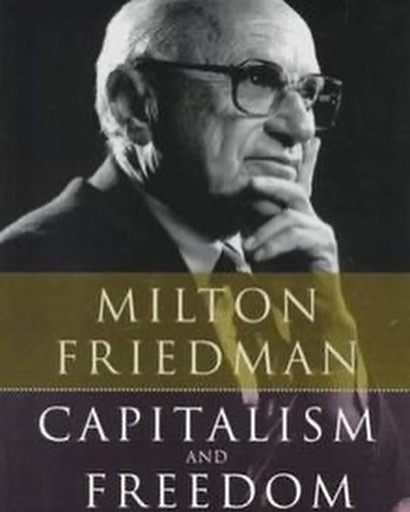
Milton Friedman, “Capitalism and Freedom” (1962) – What’s worse- the pedant or the spin doctor? The bitter pill or the shitty candy coating? That’s what I found myself thinking reading this, probably the last libertarian book I’ll read for “general education” (as opposed to “get a load of this fucking freak”) purposes for some time, and comparing it to others I’ve read recently. Von Mises and von Hayek (I like to add the “vons” – let’s make sure everyone knows their class status), especially the former, wrote dense, stormy tracts. Von Mises especially insisted that all forms of knowledge other than that based on his “praxology” were suspect. They were going to tear down knowledge and build it back up from scratch on the basis of first principles. People say stuff like “you have to admire their ambition,” and you don’t, really, but it’s clear why people say stuff like that.
Milton Friedman had more or less the same social goals as von Mises or von Hayek- win the class war for the bourgeoisie, first by beating back the Keynesian alliance between (collaborationist) labor/left leadership and government institutions, then by making sure bourgeois interests would stay on top of what was left after that. But Friedman went about it in a different way. He didn’t assail the knowledge-order around him so much as try to correct it in his direction. He mastered a peculiarly American rhetorical mode where disaster — in his case, Soviet-style totalitarianism, economic collapse, or nuclear war — is always around the corner but the sun still shines through the discourse of the speaker (the master of this, of course, was Ronald Reagan). There’s no “praxology” here, just good old American common sense! Or, rather, what most American nonfiction book buyers want- nonsense dressed up as common sense, with just enough truth to sugar the pill and the little thrill of the counterintuitive. There’s a reason “Freakonomics” came out of the same profession as “Capitalism and Freedom.”
Thinking about the rhetoric of this book is a lot more interesting than thinking about the content. Business is freedom, government isn’t, blah blah. I try to make a good faith effort to project myself to the early sixties. The left as we know it — opposed to capitalism, and the government that serves it even if it also demands concessions from said government — is basically dead, even deader than it is now. People believe in a sort of militarized, big government Keynesianism in a way that’s hard to conceptualize today. The economic tide was rising and… no, still don’t really get it. I still can’t get how you could look at capitalist practices, except if you’re on top of or deeply sheltered from them, and say, “yeah, this is freedom. If I don’t like my job I can just quit! And not have any money until I find some other bullshit employer I also hate!!” “Hey, I can choose fifty bajillion types of toothpaste, and of the sodas that necessitates it’s urgent use! Get out of the way of my joyful choices, bureaucrats!” I guess, for a higher percentage of readers, the other half of the story — “but I can’t afford decent healthcare or housing” — wasn’t there, but like… it was also wasn’t for a lot of people outside of either the middle class or the really privileged sectors of the working class we’ve let stand in for “The Working Class” in that period (and, for all too many, our own).
And that kind of gets down to the nub, doesn’t it? Friedman was relatively sunny about it. People opposed to the free market solutions are just confused, that’s all. If they could just see their best interests clearly they’d be “classical liberals” like him, and that’s why he’s writing this book. That in and of itself is a measure of difference between him and von Mises and the von Hayek of “The Constitution of Liberty” (the old Austrian word-monger went more pop in “The Road to Serfdom”). The real old school Austrians aimed at the elite notionally smart enough to understand them. Anyone confused, especially if they weren’t devoted to their idea of greatness, wasn’t worth their time. Their real heirs would be people like Murray Rothbard and the Internet anarcho-capitalist those who came after them, squalidly looking for a vanguard of freedom to take them past the goal post and ending with “the red pill.” Friedman watered down the product by offering it to a broad educated public, but it got better results. It played better with American suckers.
But Friedman gets caught in the same place they all do, and why so many libertarians, once the bills started coming due circa 2008 or so, downed that red pill and became open, committed racists and fascists (the better ones fled into our increasingly weak-tea liberalism). A lot of people are distinctly unenthusiastic for “freedom” as they conceive of it, and many of them are people of color or otherwise marginalized. Friedman swears up and down that the free market is actually better for black people and everyone else than they sort of infringements on said markets they call for through movements like the civil rights movement then reaching a crescendo in the South. Segregation is irrational because it cuts off customers from segregated businesses, he insists. Strike down segregation laws but don’t “force” integration and let the market deal with it! Soon enough everyone can sit at the lunch counter.
But that doesn’t work. First, because you’d still have armed agents of the state hauling people out of public establishments because they’re the wrong race and that’s fucked up and wrong no matter how you look at it. Second, because it does what all free market thought does and ignores history except as a series of just-so stories (did you know that oppressed minorities like Quakers and Jews did better from markets than they did from nasty old politics?!). You can say all ideologies read history selectively and you’d be right, but libertarianism more than any other ignores power differentials — pretty much every single power differential other than who happens to hold public office and what they can do that non-officeholders can’t — and how they shape history, and the present. There’s a history in the South whereby the whites hoarded not just political office but also money and power. The struggle against de jure segregation in public accommodations was an attack on an instantiation of this system, one that struck at the dignity of black people and that everybody — everybody except utter ding dongs like Friedman, that is — could see was wrong. That was not the core of the system, and most civil rights campaigners knew it, and knew they had many more battles ahead of them.
That Friedman couldn’t countenance even that first battle… well, people talk about how nice and positive and non-bigoted in person he was. I can even believe it. But fast forward a few decades and you basically have to believe in some deficiencies of race in order to hold on to a belief in the free market. This is less in the face of long-standing wealth and income differentials based on race, though that’s part of it, and more on a simpler basis. Most people of color still don’t want what libertarians are selling, and neither do most working or poor people. Most people might like the stuff about decriminalizing certain behaviors or not getting in wars, but they still see politics, broadly speaking as a struggle over power, as necessary and even vital. And so, naturally, there has to be something wrong with most people. We wind up back with the more open elitism of von Mises. And there’s something more wrong with any given group the more it rejects the basis premises of the “free market,” therefore, there’s something very wrong indeed with most marginalized peoples. Most of the dysfunctions of libertarianism as a movement that we’ve seen since the Obama election, I think, stem from this dynamic.
Friedman says little of this, though the “market-based solution” to segregation would be enough to get him “cancelled” in most circles today. He, probably genuinely enough, saw it as a solution less to segregation and more to his real bete noir, disorder, or rather, two birds that could be killed with one stone. That runs like a thread through “Capitalism and Freedom,” and through most of libertarianism- fear of disorder, fear of disruption. I am well aware they like to present themselves as freewheeling, thriving on chaos, using “disrupt” as the most sacred verb in the dictionary. But try delaying their sushi delivery an hour and then tell them someone “disrupted” DoorDash with an brief work stoppage, and see how much they like disruption then. White people were really, really scared of the sit-ins and marches, as scared as they were of riots. In many respects, Friedman was assuring the “white moderate” King wrote derisively of to relax- once we get rid of those pesky laws (both segregation and labor) everything will work out. And Friedman would be dead by the time the jig was well and truly up and the libertarians dropped the mask. Lucky to the end, the wily little Econ-gnome. *
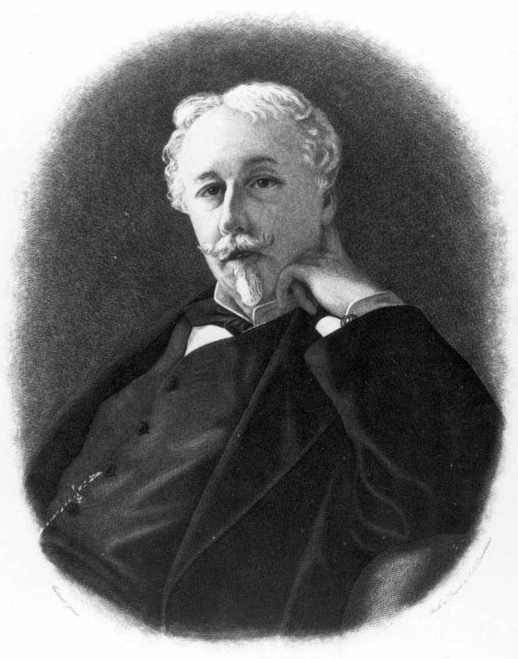
Arthur de Gobineau, “Essay on the Inequality of the Human Races” (1855) (translated from the French by Adrian Collins) – French right-wingers are generally more interesting than right-wingers from the Anglosphere, I’ve found. Something about that always-the-bridesmaid-never-the-bride thing- they never really wound up in charge, the only time they came close was Vichy, a parody of French nationalism installed by their worst enemies… and the worst part was, by that time, that parody probably was the best they could do. Among other things, French right-wing thought is interesting because it’s diverse, which means it never coalesced around one movement or figurehead, not even Papa Petain.
So the work of the Comte de Gobineau, one of the fathers of “scientific” racism, is better than it has any right to be… but still not “good.” An aristocrat who was buddies and pen pals with that other big French aristocratic intellectual name of his era, Alexis de Tocqueville (your original liberal-chud pairing, like how some left-libs pat the likes of Dreher or whoever on the head now sometimes?), the Gobineaus were pretty big losers during the Revolution. Not big enough, if you ask me, but apparently Mama Gobineau started defrauding people to keep little Artie in book money, and you gotta figure that “defraud” might be a euphemism for selling what she had to sell, so…
He’s pissed! He’s pissed at society for being insufficiently deferential to its betters, and pissed at all the theories that imply either equality of peoples, or that inequality is the product of environment, ideas, or any of that (needless to say, the idea that hierarchy might not be the best way to order our comparative understandings of society doesn’t enter into his head, or, to be fair, most nineteenth century heads). He has a good old time showing the many inconsistencies in various theories of history from Herodotus to Rousseau to contemporaries like Guizot. They had a lot of them, as theories of history, and especially theories of history before people really knew how to do archival research, often do. This is the best part of the book.
But then he goes into his big theory of history. It’s all blood, people! Good blood, bad blood (you know I’ve had my share/my woman left home with a brown-eyed man/and I actually really care a lot because his brown eyes are a sign of racial impurity etc etc). All of civilization comes from a small coterie of people with good blood, and most of that good blood comes from “Aryans,” that horrible conceptual gift the advance of linguistics accidentally gave to the world. Why, then, do “civilizations rise and fall,” as one of the central question of nineteenth century thought somewhat unhelpfully put it? Because good blood mingled with the bad blood it conquered! Thereby diluting the bloodlines, thereby leading to the decline of civilization. Gobineau also makes entirely clear he’s talking about France- the nobles, his people, had Germanic Aryan blood, the peasants had Celtic blood, and those peasants only got the better of the nobles because the nobles mixed blood and became degenerate.
This is stupid, and has about the kind of “evidence” behind it as you’d expect, but the kind of stupid that proves, for lack of a better word, “catchy” with some kind of people. It doesn’t convince so much as it burrows a groove in the head of those who want such a groove there. It has embedded in numerous projects into which stupid people with mental energy to spare can invest themselves. They can try to chart where exactly the blood went wrong, or try to explain China, Japan, the Mayans, or whichever non-whites they find impressive as being, somehow, Aryan. They can try to come up with schemes to preserve that blood, which almost always involve shedding somebody else’s.
Interestingly, Gobineau didn’t have an issue with the Jews. He sees them as a strong race, as possibly Aryan even! There’s no big puppet master behind decline, in Gobineau’s book- just horny aristocratic conquerors and hustling low-borns. It makes you wonder why, if they’re such hot shit, the master races can’t maintain, but that’s sort of part of what makes French reaction both smarter and less able to take power than the versions you see in the Anglosphere and in Germany. The latter often say they have a tragic sensibility, but with one or two exceptions, they don’t. Gobineau’s work is spiky with hatred — for black people, for the masses in general, and especially for intellectuals who think the masses are anything other than dross — but it’s also basically resigned to the inevitable tragedy that is life. It’s a stupid, needlessly cruel, and ultimately self-flattering version of tragedy, but at least connects up to it, somewhere, and French reactionary thought from Maistre to Celine to Faye does a lot with that, or anyway, more than other (one is tempted to say “more Aryan,” from the ironically-named Rosenberg to Breivik) do.
Of course, a Hitler is always in the wings to gussy it up and give violent racists something to do other than ponder the tragedies of decline and horniness, and that’s how you get the inevitable blood-farces of reaction. C’est la vie, as Gobineau might sigh to his pen pal Tocqueville. *’
Figured the real pig poop balls might get me in trouble with platforms and besides, this asshole deserves the real version of nothing except a boot in the ass
Christoper Caldwell, “The Age of Entitlement: America Since the Sixties” (2020) – It’s getting on towards the end of the year, and so I find myself thinking about the best and worst books I’ve read lately. Since I’ve instantiated “readings on the right” as a slot in my book rotation system, I can rely on it (and the random crap I read for birthday lectures) to fill up my “worst of” list. I don’t feel great about that, as it makes me look like I have an ideological litmus test for quality, which I don’t. It is what it is, as people now say, and I can console myself with the several literary libs who have also made this year’s shitlist so far.
But the bottom three — the ones that have earned my “half-star” rating, for those playing the home game — are all shining examples of contemporary right-wing brain rot, the sort of thing that really makes you (or, well, me) wish we could restrict their (ab)use of the English language for the aesthetic good of society. And they’re three quite different examples, which pleases me as much as I’m going to get pleasure from dogshit like this. Michael Mahoney, you may remember, is a boy nazi who has tried his hand at avant-garde literature and produced nothing but bloviation and commentary on lifestyle choices. I guess in this triptych he’d represent the contemporary right trying to be cool and cutting edge. Andy Ngo produced his pants-wetting “journalistic” account of the dangers of antifa, a laughably cack-handed and incompetent work. There’s the right as brave, honest truth-tellers, above ideology.
And then we come to Chris Caldwell, a journalist of sorts and a Claremont center hack (Claremont is a California school/tax-dodge whose lit review came to some prominence on the strength of having a sufficiently undiscriminating digestive tract to swallow Trumpism without the show of gagging other right wing rags made). Here we have the contemporary right trying to be intellectually relevant. One thing you can say for Caldwell is that he’s not trying to get intellectual relevance by aping anyone on the post-Buckley tree of conservative intellectuals. He’s too coy to come out and say “Trump is great” (his coyness is one of his nauseating qualities) – but he has to be able to express enthusiasm for Trump, his program, and what he represents. And he has to do so in a way that doesn’t come out of the box compromised by what a certain portion of Trump’s base — and something tells me this guy has browsed 4chan and congratulated himself for his edgy currentness in so doing — would call “countersignaling.”
And so, “Age of Entitlement.” I suppose I could, if I wanted to, applaud the ambition of this book, an attempt to read the whole period from the passage of the Civil Rights Act in 1964 to the beginning of the Trump campaign in 2015 from a Trumpian (but coy and faux-reluctant) lens. But what distinguishes sweeping, ambitious historical readings from your uncle bitching on Facebook about kids these days? Well, a carefully constructed argument based in sources and a publisher’s imprimatur, generally. Caldwell has the latter, alas.
The thesis here is pretty simple: the Civil Rights movement, and it’s legal denouement in the Civil Rights Act and associated laws, upended the United States Constitution and ushered in a radical new understanding of governance in the US (file under “things conservatives believe that would rule if they were true”). Instead of a nation of laws and limited government, we became a nation of judicial fiat and big government. Rather than limiting behavior, civil rights laws made affirmative guarantees and empowered the federal government to make those guarantees real. It started with guarantees to black people but extended to women, other people of color, gay people, etc. This in turn can be understood as an instantiation of a class revolution- the dread Professional Managerial Class doing in their betters, lording it over the poor working stiffs and making them take sensitivity trainings in the bargain. By the end of the book he’s calling white men “second-class citizens.”
Christopher Caldwell’s Wikipedia entry refers to him as a “journalist.” Journalists can and have produced fine works of history. Journalists, the good ones anyway, have a respect for sources. But Caldwell does not. Most of his sources appear to be anecdotes from journalistic profile pieces. He repeats the kind of ludicrous claims that have become stock-in-trade for idiots, cutouts where knowledge would be, like that one that claims that every dollar any American governing body has spent on anything other than the military between (whichever year, usually sometime around when “those people” started “acting up” in a way the cracker in question started noticing) and (now) equals spending on “welfare” or “social justice,” therefore constituting “the most expensive failed social experiment in history” or whatever. Like the “100 million dead from communism” number, it’s a ridiculous claim, and unlike the communism one, doesn’t paper over anything real, just a category error. But who cares? It’s a meme. It’s all memes- one way in which Caldwell really has been “red-pilled” since his Weekly Standard days. That’s the quality of argument here.
I was curious what would happen when this ding dong got to Reagan and neoliberalism. How was he going to frame a story of expanding government power through decades of rule by politicians of both parties slashing the welfare state and denouncing “government as we know it?” Well, that was my turn for a category error. Because I have a class analysis, I understand what Reagan and Clinton did as part of a class war, a highly successful one- retrenching the scraps of power previous generations of workers wrested from the bourgeoisie. But this guy is actually dumb enough to be paid to write about politics and still think “government” exists in an existentially discrete category, subject to binary switches you can toggle- “small-good; big-bad.” And, of course, he’s both a right-winger and a member in good standing of the upper classes (even as he plays populist at times), so he doesn’t give a shit or notice what happens to poor or working people under these conditions. The government in some sense stayed the same size or got bigger (mostly due to police and military power but ok), gays got more accepted, immigration continued, the news was bad, Reagan or no Reagan. I shouldn’t have expected different.
Of course, if you think of “government” as a thing in and of itself, a building downtown sending out orders and goons according to its own logic, the “second class citizen” business as applied to privileged people the law attempts to blunt the privilege of — white men, usually — makes more sense. This is as good a reason as any to not make that category error, and one of the reasons why the Republican Party and the conservative movement could so easily get swallowed by someone who would say the quiet parts loud. The list of things you need to think in order to wedge such an understanding into the other accoutrements surrounding it — from the expansive power all of these people, libertarians included, want to give the cops, to the long long history of government action specifically propping up white supremacy up to and including literally conquering a continent and handing government land to white squatters and railroads, to a completely fictitious “freedom of association” Caldwell somehow finds in the Constitution — is… long. Arguably, that list is coextensive with white American culture (as opposed to other cultures to which white Americans can and sometimes do belong). Many of its greatest proponents think it’s not long for this earth. Let’s hope they’re right, for once. ‘
Marion Rodgers, “Mencken: the American Iconoclast” (2005) – “Send a maniac to catch a maniac,” as the phrase went in one of my favorite childhood movies, “Demolition Man” (which I think still holds up quite well). The writer to “catch” Henry Louis Mencken in biography form, by that standard, would have to be a prose wizard and critical to the point of scabrousness. Alas, in this biography, the task is taken up by a journeyman writer whose attitude towards her subject is mostly one of hero worship.
Do people still think much about Mencken? An article recently said Matt Taibbi thinks of himself as a Mencken figure, which is a complicated claim I’m just going to leave alone. I thought about him well before I read much of him because his name was ubiquitous if you read much about American culture from a period roughly between 1920 and 1945 or so. It’s not an exaggeration to say that every American writer who came of age in that period wrote in Mencken’s shadow. From his perch at The American Mercury and The Smart Set, Mencken propelled American literary modernism into the spotlight through his criticism and curation. He was one of the most famous men in America during the Jazz Age, and young intellectuals the country over aped his hard-drinking, cigar-chomping style. He was also a working journalist and was famous for reporting on presidential campaigns and on the “Scopes Monkey Trial.” His linguistic work, “The American Language,” is highly respected.
It’s hard to explain much about Mencken’s career without going into detail about his politics, which is a problem because a lot of the contexts of what mattered to him were different back then. In fact, you could argue that as his context converged more with one we could recognize, the more he kicked against it, and the further he fell from his twenties heights.
H.L. Mencken is at one and the same time a very contemporary figure, and one not necessarily easy to place given contemporary ideas about writing and politics. He was, in many respects, the original talented edgelord, laying the pattern for media iconoclasts from his day to the time of Parker and Stone. He was the guy who always one step ahead in terms of wit, who didn’t care when you did (and sometimes, just to show you up, cared when you didn’t, or didn’t expect him to), the “equal opportunity asshole,” the guy you couldn’t help laughing at or otherwise enjoying his work. Many of the same hot button issues Mencken leaned on are similarly deployed by edgy types today, from the hypocrisy of religion to the fecklessness of politicians to the importance of free speech.
That last might give us an entry point into the ways in which Mencken eludes us. Rodgers depicts Mencken as a man whose first and last priority was always free speech. She opens with a scene of him baiting a Boston blue nose into having him arrested for selling a copy of the American Mercury, which the Watch and Ward Society had had banned (this was the time when “banned in Boston” was a known phrase), getting the case dismissed, and stopping by Harvard for rousing applause. Mencken was, in fact, critical in opening both cultural and legal doors that allowed literary modernism to flourish in the United States. But it’s worth noting that the sensibilities offended were usually those around the use of working-class language like “damn,” allusion to the existence of sex workers, or depictions of such lascivious acts as kissing.
The point being, if you showed Mencken an episode of South Park without context, I think it quite likely he would agree with his Boston antagonist that it was filth and should be banned post-haste. This is a guy who broke up with a movie starlet at least in part because she made jokes about Johan Strauss’s waltzes. In this way, he’s both utterly unlike the “free speech purists” (outside of some chan-bound fantasists no one believes in literally free speech but you know what I mean), and strangely parallel. They get weirdly easily offended, too, a lot of the time. A lot of the time, what they’re about is more the promulgation of quality, as understood by themselves and as done over the objections of busybodies, rabble, and losers, than they are about anyone else’s freedom.
Mencken’s contemporary quality and his distance from our time come together in his reaction to Franklin Delano Roosevelt. Mencken hated FDR since he came onto national political scene in 1920, seeing him as a silver-tongued mountebank (a favorite Mencken insult, “mountebank”). When FDR became President and started implementing the New Deal, Mencken grew increasingly angry, and grandiose, paranoid, in his anger. FDR spelled an end to American liberties, with his throwing money at the poors and his management of the press. On the one hand, this was, more or less, ideologically consistent for Mencken- he was always an elitist and always despised the poor. On the other, FDR was actually known as a relative fiscal conservative going into his term of office (Rodgers neglects to mention this), but Mencken still hated him and had for over a decade.
I think it’s actually easy to see why Mencken hated FDR so much, so consistently, for so long, even as FDR was key to ending the Prohibition law Mencken hated so. FDR beat Mencken. FDR beat Mencken at his own game, communicating in American English via mass media, and shifted the cultural ground under Mencken’s feet. Mencken couldn’t adjust to post-1929-crash reality, and FDR steered many aspects of that reality. FDR even beat Mencken at ridicule, owning him in speeches, and all Mencken could do was fume and fulminate, getting less and less funny with each column inch he took up screaming after the president. Whatever abrogations of due process FDR undertook in his time, he didn’t need secret police to beat his most determined opponent in the press- just his own wit and popular goodwill. That must have gutted Mencken, to the extent he understood it. It revealed a deeper weakness- Mencken always did best against weak opposition. He was a front-runner, great at turning his nose up at the “boobs” but unable to do much against anyone who could match wits with him or see something he couldn’t.
From there, it was downhill for Mencken. He was materially secure, more or less, but increasingly culturally irrelevant, somewhere between an honored relic and a cautionary tale. Among other issues, he was part of a whole generation of people whose justifiable skepticism regarding American intervention in World War One led to some horrifying judgment calls as its sequel came around. Mencken, ever the Germanophile and mindful of how exaggerated (some) anti-German propaganda in the Great War was, systematically downplayed the dangers of fascism and of Hitler in particular. Whenever there was a choice between sympathizing with inconvenienced Germans and with existentially endangered Jews, he always chose the former, and didn’t shy away from stereotype and crude language in so doing- why would the guy who called his critical collection “Prejudices”? By the time he died in the fifties, it made sense that a scabrously racist gang of paleocons had taken his name for one of their societies.
Well! I guess I should talk about Rodgers’ book rather than giving you this report on the guy, huh? Most of what I’ve written here I knew before I listened to this biography. Of course, I learned a fair amount in listening… but a lot of that was minutiae. This wound up raising questions for me that I found more diverting than the book as it wore on. How do you generate good questions in a biographical project? It’s so easy to fall into the trap of taking a side in some notional Egyptian afterlife courtroom, waiting to see if the alligator eats the subject’s heart. This leads biographers to array their investigations around the established controversies — in this case, “how much of a racist, antisemitic prick was Mencken, all told?” mostly — and neglect more interesting approaches.
The upshot of this is that as Rodgers went on into the period of Mencken’s life defined by public controversies, especially ones where he both loses and looks bad by contemporary lights, the more analytical energy she spends trying to justify him. This sucks, because not only are some of her calls pretty bad, but when she lets the thing breathe a little it isn’t half bad. You can see this in the early parts of the biography, where Mencken’s boyhood Baltimore comes to life, and the Edwardian (they often say “Victorian” but that’s basically wrong) context in which Mencken grew up and which shaped so many of his ideas comes across clearly. Among other things, the German-American milieu of Mencken’s youth (I forget whether Mencken’s parents or grandparents were the immigrants) comes in loud and clear, the combination of respectability and skepticism and the quiet certainty that they were, in fact, superior in terms of culture to American-Americans.
Basically, think of this book as having three stages (it has like seven “parts” but ignore that). Mencken’s youth is the best part, basically up until the end of World War One. Along with fun descriptive bits, it seemed to be setting up a clash between Mencken’s Edwardian, vaguely-German-American-nationalist idea of what an advanced man should be like, and the realities of modernity as revealed by the war. We get a little bit about this in the second part, Mencken’s salad days in the twenties. We see some of how the literary critical sausage gets made, Mencken’s negotiation with the “tribal twenties” — despite believing black people to be essentially inferior to whites, he published many more black writers than any other white editor, respecting talent where he found it — but we also start getting a lot of “hot goss” about Mencken’s love life. It was intermittently interesting — and Rodgers seems more indignant at the way the bachelor playboy Mencken dealt with some of his women than how he borderline denied the Holocaust — but not a good sign, how much it dominated the book. Then you get the end, with Rodgers scraping the bottom of the evidentiary barrel to make her man look good in his decline. By this time, analysis of anything interesting has gone out the window in favor of lawyering up- admitting what she has to admit, but giving “context” to excuse him.
The context I’d be interested in is that of historical change, and not just “a lot of people didn’t believe atrocity stories from Nazi Germany that people now know are true.” A real historical contextual understanding of someone like Mencken wouldn’t be a defense, or a takedown. He’s interesting enough, and important enough to American letters, to contextualize for its own sake. I wonder where Rodgers is at these days- I think she teaches somewhere, used to contribute to Reason, and you can see this as an addition to an aughts-era libertarian canon of saints. What it all would have meant, to her or to anyone, after libertarianism took its big fall against Trump, is a question you can’t glean an answer to from this book, alas. Will anyone with a critical acuity anywhere near matching Mencken’s — and despite some holes in his abilities, when he was good, he was phenomenal — ever take on the project of bringing him and his times truly to life, or will it all be fans and/or detractors from here on out, until people finally forget him? ***
Ludwig von Mises, “Human Action: A Treatise on Economics” (1949) – Part of me thought, as I read this, “ok, this is the real shit” — not as in “this has a bearing on reality” (quite the opposite), but, “this is the mack daddy, this is the guy the libertarians are all trying and failing to be.” Von Mises came out of Dolfuss’s clerical fascist Vienna post-Anschluss (he worked for Dolfuss, but as a Jew, by blood if not by conviction, Nazism was a bridge too far). He had the haughtiness of European high culture, the world-building faustian self-belief and system-building ambitions of the great age of secular lawgivers that ran from Rousseau’s time to Freud’s. I had a vision of him as the pit bull of libertarianism, with people like Rothbard and Nozick as so many yapping terriers making noise from behind him.
Well, yes and no. He certainly had more going for him than either libertarian philosopher, or any of the others who came in his wake. But it wasn’t necessarily brains or even originality that he had. It was the sort of Yiddishism an assimilé Viennese Jew smiling and nodding for the likes of Dolfuss would avoid like botulism: chutzpah. And really, that’s a charitable reading. We associate chutzpah with underdogs. That’s never what he was, never how he’d even want to be seen (if this offends libertarians the way some of my reviews offend fascists, I’m sure they’ll try to get across the idea he was an underdog in the face of liberal statism blah blah etc etc fuck off).
But that’s basically what he had. He had… maybe “the face” is the right term… to just declare vast bodies of knowledge and many perspectives taken by numerous thoughtful people just verboten to human consideration. “Human Action” is about how anything other than the most intentionally naive positivism is flatly wrong, useless, and morally suspect. He calls this “praxeology,” “the study of human action.” Intent doesn’t matter, he smugly declares, not just as a consequentialist — that would make some sense — but out of a smug assumption of something like perfect, or at least sufficient, knowledge. In one of the great whoppers of supposedly educated writing — the sort of thing the worst positive thinker or evangelist you could imagine would probably demur from saying so baldly — declares that human action, it’s success and failure, actually creates happiness or sadness! You’re happy if you achieve your aims. The end!!
Quite apart from whatever else it is, von Mises and his followers (for those playing the home game, of the two lesser libertarians I mentioned, Rothbard really was a hype man for von Mises and believed in this praxeology shit, where Nozick had some other dumb philosophical basis) basically see this stuff as taking irony and tragedy out of the box of life. Things work rationally. Not being able to see things rationally is the closest thing to a tragedy you’ll ever get- not for those who so see things, but because those people keep rational people from thriving (there’s reasons von Mises warmly praised Ayn Rand before some stupid quarrel split them up). That’s it. Any intellectual construct that acknowledges that sometimes, the best laid plans don’t work out and maybe collective action differs in some important way from individual action — everything from Marxism to the most anodyne progressive liberalism to, von Mises hastily adds, burnishing his antifascist credentials for the big jump to America, racism — is intellectually bankrupt and oppressive to even be around. There’s a reason anarchocapitalism is, at best, a hop or two from mass slaughters ala Parkland- there are the main characters (you, and people you think about) and everyone else is a malignant sheep whose lives aren’t really lives.
What’s left of the European tradition — what von Mises supposedly brings to the table — if you take tragedy and irony out of it? If everything is a just-so story where the heroes just need to realize their heroism/rationality? Well, not much. Just the face, like I said, more or less, the chutzpah, the ability to get over with those rubes who want pedigreed ideas but not the existential bummers that often come with them (i.e. Americans with money), to write nearly nine hundred pages of this garbage and not get laughed off as a crank. *
Michel Houellebecq, “Serotonin” (2019) (translated from the French by Shaun Whiteside) – I have a little test I like to subject contemporary literature to; I call it The Hook Test. I take a novel about the muddle of contemporary identity — who are we? what does contemporary society/technology etc mean for our senses of self? Is sincerity and/or happiness possible or even desirable, and under what conditions? on and on — and I read it, and then I ask myself: “did this novel say anything about its subject that noted nineties band Blues Traveler didn’t say better, more succinctly and with more effective imagery in their 1994 hit ‘Hook’? Is there any way in which this novel (usually at least a hundred pages and several hours worth of reading time) is actually superior to the three-minute pop song by a band I can tolerate but do not love? Did the expensively-educated litterateur have anything to offer next to the New School dropout and libertarian who makes irresponsible decisions about crossbows, besides, of course, the class cachet of being seen with a literary novel?”
As you can probably tell, I find most contemporary literary writers fail that test. Jonathan Franzen, Sheila Heti, Lauren Oyler, Karl-Ove Knausgaard, Tao LinJeffrey Eugenides, Otessa Moshfegh, Bret Easton Ellis, Teju Cole- not one of them beats that fat dude from the nineties, as far as I’m concerned, not in substance and frankly not in style, either, though jam bands really aren’t my thing. I am more impressed with what Blues Traveler did than with that list, and you have to figure it includes some future Nobel laureates. I don’t think Blues Traveler said anything really profound in “Hook.” They just illuminated some aspects of contemporary life (and what does it say that we’re still dealing with the same bullshit, in more or less the same frames just with more bandwidth, as a pop song from 1994?) in a reasonably succinct, witty way, and showed some chops in doing so- not anyone could have played that song the same way. People paid a lot of money and given a lot of respect — to say nothing of space, hundreds of pages versus a few minutes — to say something about the same subjects that kind of lame band took on fail to do that.
Interestingly, I can think of one contemporary writer who has both passed and failed The Hook Test: Michel Houellebecq. He passed it with “The Elementary Particles” and “The Possibility of an Island.” From where I sit, he barely cleared the bar with “The Map and the Territory.” But to the extent “Submission” was about contemporary identity and not just a thought experiment/sexual fantasy, it fails the test. And his latest, “Serotonin,” undoubtedly enters into the same space as “Hook” and it fails next to it big time, as ignominiously as Knausgaard or Cole (if not as crashingly bad as Franzen or Oyler).
This sucks, for a few reasons. It sucks because “Serotonin” was not an enjoyable read, obviously. It sucks because Houellebecq can do better, or could, anyway, almost twenty years ago now. It also sucks because Houellebecq was, arguably, the last of the great right-wing writers. There used to be a lot of them- you really can’t appreciate any aspect of modern culture, including both popular and “literary” writing, without at least respecting what artists from the right brought to the table (or, for that matter, artists who cheered on the depredations of any communist tyrant you care to name). I did a whole YouTube video about it! And named Houellebecq as one of three remaining good right-wing fiction writers, and the only one who came from “literary” fiction (though his best work uses a lot of scifi elements). I guess there isn’t really much reason to lament the breed going extinct, except that it’s a bad weather sign for where both literature and the right are going. But I still find it a bummer in and of itself.
That said, it’s worth noting here that the critics are all wrong to say that “Serotonin” is some big deal political novel, a cri de coeur from the euroskeptic right. The book mostly deals with the inner life of Florent-Claude, a sad agriculture bureaucrat. And by inner life, I mostly mean how he’s lonely and horny and nothing makes him happy. Florent-Claude’s love and sex life are considerably more exciting than one would think, from that description- I wonder if that’s down to national differences, no one would write an American sad sack lamenting his life with a sexy younger (Asian, because why not) girlfriend, or the many passionate and highly erotic love affairs he had before then, if they really wanted to get quotidian desperation across. All that’s a problem for rock stars and, I guess, Frenchmen.
Florent-Claude ghosts the sexy Asian lady, tries some antidepressants, and wanders around France trying to find people from his past. He finds an old friend from agricultural college who’s descended from the Norman aristocracy and who’s trying to make a go of it farming his ancestral land. This is where the politics supposedly enters into things. Global competition and EU rules — which Florent-Claude helped implement in his capacity as a bureaucrat — are strangling the traditional agricultural class of France. These same forces created the anodyne world in which Florent-Claude cannot help but feel inauthentic and unhappy. You can’t lead a simple life in a nice rural space with its own peculiar cheeses and stuff anymore!
That’s a big part of it, for the French, and the differences between the French vision of a disappearing good life and the American provided most of the interest that Houellebecq failed to give this book. The big thing with the French is local peculiarity. This mostly comes out in consumables- unique cheeses and wines and stuff for each region or even each town. You need a highly sensitive sensibility to care about that stuff, to be able to tell the difference between “traditionally” made cheeses and ones that cut corners. When Americans talk about “local tradition” they usually mean “will the federal government make us stop treating people like animals.” The good life as understood by Americans accepts — demands — a much greater degree of homogeneity, less sensibility. Arguably, America won the Cold War with the promise of refrigerators and dishwashers, the same in millions of identical, but gleaming clean, kitchens on tv (well, death squads too, can’t forget the death squads). Some people — parts of our own bourgeoisie, too — try to figure out how to have all that nice stuff plus, like, bespoke local dairy products. It’s a balancing act and takes a lot of resources, and it’s no guarantee small producers will win out.
Anyway, Florent-Claude hangs out in rural Normandy, accidentally happens upon a German pedophile, and witnesses his Norman friend and some of their friends do a last stand for protectionism of their dairy products, which culminates in some gun violence. F-C then encounters an ex with a kid, has a big sad, keeps taking antidepressants, throws a rhetorical bone to Jesus who he doesn’t believe in (maybe Houellebecq will pull a Huysmans — we know he’s a fan — and go super-Catholic?), considers suicide, then that’s it, book over. People were like “omfg he predicted the gilles jaunes!” “Serotonin” was written before those started but published after. I don’t know, I was under the impression the French did a lot of protests like that? Some critic somewhere said something like “Steve Bannon could have written this book.” Maybe- you’d figure in speech, at least, Bannon would have gotten to the political juice earlier, not maundered about women and impotence so much, but he’s also dumb and a middle aged man, so who knows?
It increasingly seems like Houellebecq could pass the Hook Test, back when he could, by an old litfic technique- lean on genre. “The Elementary Particles” and “The Possibility of an Island” both had strong scifi elements. There was all the same alienation from contemporary society, the “decline of the west” stuff, the provocations and casual sexism, but there was also more stuff to pay attention to. I didn’t want to believe this would happen, but at this point, Houellebecq really does read like a grayer-toned and smarter version of the authenticity-ponderers that are his anglophone contemporaries. Why shouldn’t he? It’s not like he gives a shit- presumably he just writes for money and/or some little attention-high, that’s the vision of the world he promulgates in his books, anyway. This is less of a waste of time than a lot of other contemporary litfic. Houellebecq is intermittently capable of honesty and close observation, more than the Hetis and Eugenideses of the world. But the fact I’d even put him in that space is a bad sign. That’s what makes this book hard to read at times, not the same provocations Houellebecq’s been doing since people thought John Edwards might be President someday. **’





 Too Much Berard