Review- Yarvin, “A Gentle Introduction to Unqualified Reservations” and Land, “The Dark Enlightenment”

Curtis “Mencius Moldbug” Yarvin, “A Gentle Introduction to Unqualified Reservations” (2009) and Nick Land, “The Dark Enlightenment” (2013) – For my sins, I’ve committed to reading the major figures on the contemporary far right. Being me, I made the decision to read the “neoreactionary”/”Dark Enlightenment” writers well after their sell-by date. The far-right kids these days seem to be all about the aleatoric terror espoused in Mason’s “Siege” (which I will also review, so, uh, look forward to that) rather than trying to anoint a CEO-king for America or some secessionist seasteading anarcho-monarchist-capitalist utopia.

In particular, “Moldbug” Yarvin’s late-oughts internet snark has aged poorly. Someone told this dork he was funny, and Yarvin, with characteristic critical acuity, bought it. So you can’t even get your reaction straight. It needs to be hedged in by paragraphs of “ironic” observations, attempting to counter the objections the reader (imagined as an NPR-listening liberal) brings to the table, faux-erudite asides, etc. Another way “Gentle Introduction” has aged poorly is that he brought it out just before actual class politics started to make a comeback in the US, with Occupy (which presumably set off all his neuroses about “disorder”) coming soon on its heels. So he thinks he’s really blowing minds when he insists that the American Revolution wasn’t good, which is just laughable to anyone who’s spent one July on leftbook. He keeps using these exaggerated, supposedly funny medical metaphors for what his “red pill” is doing to you, the reader. It’s like nothing so much as a pseudo-intellectual version of a carnival barker outside of an especially un-scary haunted house attraction.

“But the irony is what separates the new alt-right from traditional fuddy-duddy conservatives!” I remember hearing and at least a few of you might be thinking. No, that’s just marketing. When you get into the stuff Yarvin cares about, he gets very persnickety and pedantic, and the stuff he chooses for that is telling. He was at the time a global warming denier another way this aged poorly even in its own terms- the cool thing for right-wingers now is to admit it’s happening and so we need to kill the brown people and the poors. He comes out of the Austrian reactionary economic camp, and so has a lot to say about inflation and money. And he is shit scared of black people, in that self-scaring way of online conservatives who convince themselves that they’re going to be killed on the way to the Times Square M&M Store, which would be funny if the outcomes didn’t tend towards the tragic.

What emerges from all this isn’t something new, different, or scary. These are all pretty base conservative pedantries and fears. The cutesy writing bullshit is meant to distract you from how banal his thoughts are. What are his recommendations or searing insights? Well, he continually insists that everything to the left of Hitler, more or less, is descended from seventeenth century Puritanism, which isn’t even an original way to be wrong. He goes on to mix the metaphor by referring to its modern-day descendants as “The Cathedral,” which by definition Puritans would have an antagonistic relationship towards, but actual history isn’t this asshole’s strong suit. Being impressed by the resemblance between politics and religion is an undergrad thing. Yarvin’s solution, a pseudo-monarchy of capitalist leaders, isn’t original either. He calls himself a Sith Lord but really, he just wants there to be a manager for him to complain to, presumably, as my roommate put it, to stop girls from laughing at his weird dick. Protecting capital by sealing it off from democratic pressure is the long-term project of the neoliberal right, and it’s a sign of creative decline and poor education that rich idiots like Peter Thiel look to this Yarvin guy for ways to accomplish it. Dogshit. *

Along with Peter Thiel, Yarvin managed to impress Nick Land, at one point a scholar on the frontiers of “cyberculture theory” or something like that. I’ve never gotten what Marshall McLuhan was banging on about, let alone “cyberculture” people, but people I respect seem impressed with Land’s earlier work (which I might look into at some point). Somewhere along the line, Land went crazy, moved to China, and became an anti-black racist, not necessarily in that exact order. His extended essay “The Dark Enlightenment” reframes and extends several of Yarvin and cohort’s arguments.

Land is certainly a better writer than Yarvin, though that’s mostly in the negative sense of not larding himself down with specious humor. He adds an accelerationist edge to neoreaction by joining it more forcefully than Yarvin does with out of control expansion of technology and capitalism (Land doesn’t comment on Yarvin’s climate denialism, but one gets the idea he doesn’t agree with it). Only authoritarian capitalism can meet the challenges of the future, Land tells us, and the only way to do that is through exit, secession, the thing for which the neoreactionaries provide part of the key.

The other part of the key is racism- the most interesting part of either work is Land’s extended meditation on “the Cracker Factory,” a misapplied version of Grady McWhiney and Forrest McDonald’s Celtic Thesis on the origins of southern white culture. The Cracker Factory is sort of the opposite of the Cathedral: where the Cathedral manufactures politically correct sheep and their masters, the Cracker Factory churns out violent, tribal, but existentially sound men and women who, Land implies, could be the muscle behind some of the neoreactionaries’ secessionist fantasies. Rich man’s war, poor man’s fight, the farce version! He has something of a point there, though, that there’s a social system that manufactures the potential right-wing killers of the future- he just gets which one it is wrong. It’s in the suburbs and exurbs, not the hollers and trailer parks.

In general, Land tracks Yarvin in being redundant. The sort of obfuscatory cultural theory Land used to produce was inimical enough to actual progress to begin with, without being openly racist and antidemocratic, just as there are plenty of xenophobic pedants of Yarvin’s stripe. These people are only a threat insofar as they whisper in the ears of the stupid and powerful among the tech elite and potentially help shape the ways in which said elites look to deal with us regular people. Only time will tell how much it amounts to. *’

Review- Yarvin, “A Gentle Introduction to Unqualified Reservations” and Land, “The Dark Enlightenment”

Review- Ellroy, “Clandestine” and le Carré, “The Spy Who Came In from the Cold”

AUDIOBOOK ROUNDUP: AESTHETICS OF ANTICOMMUNISM AND COUNTERREVOLUTION EDITION

James Ellroy, “Clandestine” (1982) (narrated by William Roberts)

John le Carré, “The Spy Who Came In From The Cold” (1963) (narrated by Michael Jayston)

We’ll start with Ellroy’s “Clandestine,” his second novel, despite the fact that it’s twenty years younger than le Carre’s work- I read “Clandestine” first and it’s set earlier. This was the beginning of Ellroy’s dip into his mythic realm, the noir Los Angeles of the 1950s, the world about which he spent his wayward youth wandering around the city fantasizing. Eventually, Ellroy’s dream-nightmare-LA would be the scene for the epic “L.A. Confidential” quartet; extrapolated to embrace the US, the gestalt he formed would be the basis for his greatest work, the “Underworld USA” trilogy.

But “Clandestine” is his first swing at it, and it shows. His main character is Frank Underhill, the sort of SoCal ubermensch Ellroy wrote (and sometimes writes) when he was projecting the man he wanted to be, not the man he was as he wrote later. Underhill is tall, handsome, athletic, a super-cop and a scratch golfer to boot. He’s a cop because he gets to experience something called “the wonder” (I wonder if it’s capitalized in print- I plan on ordering a hard copy for my library so I guess we’ll find out). He’s an appropriately meat-headed expounder of what “the wonder” is and we never quite get at it, despite Underhill waxing rhapsodic about it multiple times. As far as I can tell, “the wonder” is voyeuristic rubber-necking along the disasters that people’s lives become, the cheapness of life and death, the small pseudo-poignant details which tend to dissolve into death-kitsch; the sort of thing you get to see a lot of as a cop or other first responder. In later works, Ellroy gave up on characters telling “the wonder” and simply showed them basking in it. That’s an improvement.

Voyeurism and schlock are important parts of the Ellroy gestalt. Belonging is another key part- being one of the few that get to peek behind the curtain and act on what they find there. There’s someone killing women in LA and Underhill is brought in to a special LAPD unit led by Irish psycho Dudley Smith, who turns up frequently in Ellroy’s later work. Smith’s unit is essentially a death squad. Underhill has reservations about this but goes along with it anyway through the middle of the book, by far it’s strongest part. Ellroy tries to be whimsical in the first part, with poetry-spouting cops and cute dogs (punctuated by the killing of some Mexicans). That all goes out the window once Underhill gets in with Smith and tortures a confession out of an innocent man who goes on to kill himself before the evidence can clear him. Underhill tries to keep his distance and even double-crosses Smith, but not before taking a fascinated ride through the great domestic war of midcentury America, where crime, vice, simple nonconformity, and communist subversion are understood to constitute each other. Underhill gets to be one of the men engaging in the terror campaign this entails, while keeping some part of himself above it- Ellroy does better than that when we return to the domestic counterrevolution in “Underworld USA.” There, there’s escape, but no getting above the terror whilst keeping a foot in it.

The last part of the book is more interesting from a biographical perspective than anything else, now that Ellroy has written some fascinating and wrenching autobiographical works. Ellroy’s mother was murdered — a case still unsolved — and he was raised by a negligent father. Spoiler alert: a character seemingly based on Ellroy’s dad is the mastermind behind the women murders, which involves a whole convoluted plot with drug dealing, secret gay pacts, Nietzscheian delusions, etc. He kills someone a lot like Ellroy’s mother, and there’s a whole section where Underhill goes to Wisconsin (where Ellroy’s mother was from) and tracks down a whole massive crime epic story about the woman victim and her family. Moreover, they had a kid who sounds a lot like young Ellroy: obsessed with crime, unable to get along with other kids (and a genius, natch). It’s a lot!

In theory, Underhill and the other cops are part of the thin blue line between civilization and savagery. The thesis of the midcentury counterrevolution is that crime and subversion go hand in hand. Maybe Dudley Smith believes that (though it’s also a convenient thing for a sadist to believe), but I’m not sure Underhill does, or Ellroy. That’s just jive for public consumption. The real point is for power to reproduce itself, to continue the cyclical world of violence and chintz that makes up “the wonder,” which in turn justifies the violence (and chintz) of men like Ellroy’s cops. This is the joy of the domestic counterrevolution, and I think one reason why Ellroy is an important artist is that he brings that home better than anyone. He hadn’t quite nailed the delivery yet in “Clandestine,” but he would in time. ***’

What to say about “The Spy Who Came In from the Cold”? It’s a masterpiece for a reason. It hit me right in that Michael Mann sweet spot: the meticulous attention to details in the depiction of tradecraft, the masculine pathos, the deft scene-setting. And it’s paced better than anything Mann has ever done except, perhaps, “Thief.”

I’ve chosen to write about these two works together not just because I listened to them close to each other but because they have themes in common. Anticommunism is at the center of the world of le Carré’s work just as anti-subversion/crime is in Ellroy’s. But in both of them (or at least in this one of le Carré’s books- I haven’t read any others but will) the ideology is in most respects besides the point. Where Ellroy’s men find themselves in the battle to keep the domestic population in line, le Carré’s spies reach existential epiphany on the foreign fronts of the Cold War. Not for nothing is one of the main LAPD stations called “ramparts” and not for nothing is the then newly-built Berlin Wall one of the main symbols in “The Spy Who Came In from the Cold.” The ramparts don’t just separate Us from Them- in these novels, that’s not even the main purpose. The act of manning the ramparts separates those who see from those who can’t.

It might seem the more appropriate pairing with Ellroy’s crime fiction is the other side of the spy-fiction spectrum, James Bond. Sex, violence, and over-the-top schlock are what Bond is all about, after all. Well, A. I’m not sure that’s the case with the early novels and I intend to read them in order and B. I think the contrast with le Carré is more interesting. Both Ellroy and le Carré are interested in the introspections of the hard men who watch the ramparts in a way Ian Fleming doesn’t seem to care about. More than that, between them, Ellroy and le Carré span a near-comprehensive array of the affective appeal of the right side of the Cold War, in the Anglo genre world at least.

Le Carré is proper and sparse where Ellroy is over-the-top and leering. This extends to story form, as well. “Clandestine” involves stories within stories and sprawls all over the map, and so do many of Ellroy’s later works. “The Spy Who Came In from the Cold” is a story as well contained as the Soviet Union turned out to be in Eastern Europe. Le Carré sketches in his characters with a few telling details where Ellroy concocts vast fictional biographies.

Enough comparison! What is “The Spy Who Came In from the Cold” about? It’s a simple story. British intelligence wants to eliminate a dangerous leader in the East German counterintelligence apparatus. They get their former Berlin station chief, Leamas, to pretend to defect. They don’t do it with any phony damascene road conversion to Khrushchev-era communism. They have Leamas pretend to dissipate into drink and disrepair, complete with short prison stint. Le Carré goes through the whole routine of vetting and bringing in a new defector asset, and before you know it Leamas is face to face with East German intelligence… and finding out the mission isn’t all it seems. There’s some great back and forth between Leamas and his communist opposite numbers, a lot of subtle spycraft, it’s great fun.

It says something about how good this is that I don’t want to spoil this book that’ll soon be old enough to collect social security. And the plot, while supremely well-constructed and enjoyable, is somewhat beside the point for this essay. The spies in this care about communism or anticommunism about as much as Ellroy’s cops- more a matter of instinctive reflex and team loyalty than anything else, and le Carré makes it clear that goes on both sides of the iron curtain. Believers — like Leamas’s British communist girlfriend — are just dupes, pawns in waiting.

It’s too much to say le Carré’s spies believe in the game, but it’s something like that. More than what they believe, they get to be Tragic Men, men defined by being forced into choices that ordinary men never have to think about. No day job, excitement, and the opportunity to wax tragic, significant- that’s as appealing in its own way as Ellroy’s cop power trips. Higher-toned, perhaps- that’s a market niche all its own. *****

Conservative/reactionary/counterrevolutionary, take your pick, politics wouldn’t work if they didn’t speak to people somewhere deep. Conservative genre fiction — and my understanding is le Carré isn’t a raving Tory but I think his fiction leans right, so to speak — is part of the worldbuilding project of the global right, and a guide to the affective pressure points that make the whole thing tick. Probably, I should read the other half — romance fiction — to really get a comprehensive vision, but hey- one thing at a time.

Review- Ellroy, “Clandestine” and le Carré, “The Spy Who Came In from the Cold”

Review- Whitbourn, “The Two Confessions”

John Whitbourn, “The Two Confessions” (2013) – Dipping once again into the works of “counter-reformation green anarcho-jacobite” fantasy writer John Whitbourn brought me to this, the final installment of the series his first novel, “A Dangerous Energy,” began. The world is one where magic is real and largely controlled by the Catholic Church, which in turn controls vast swathes of the planet, keeping it at a pre-industrial level of technology even into the 1990s. This world’s Britain is staunchly Catholic, ruled by the Stuarts, not at all a United Kingdom, and generally not a great advertisement for what the counter-reformation, magic, or the Jacobites do for a country. Life is squalid, limited, and dark- for characters in Whitbourn’s stories, shading towards pitch black.

Our protagonist, Samuel Trevan, is an orphan turned proto-industrialist struck down by the Church’s strict laws against over-exploiting labor (in one of this alternate universe’s more extreme points of departure, the Church doesn’t generally side with employers). He was going to make a fortune manufacturing rifled muskets (because that’s where they’re at, technologically) and then marry the upper-class girl of his dreams, but no such luck once the Church gets done with him.

Now expendable, Trevan is employed by some of the realm’s deep state fixers to fix a case of spooky mines in rural Devonshire. Trevan wants money, his handlers want discreet elimination of a problem down there. And what a problem it turns out to be- demi-devils, part human part demon, but even worse- heretics! Specifically, Bogomils- for those not versed in heresiology, these were the predecessors to the more famous Cathars, and were dualists who believed the material world was somewhere between irrelevant dross and actively evil. Our word “bugger” comes from “Bogomil” because of their supposed sexual practices (to help reduce reproduction). These Bogomils are in touch with some cask-strength Lovecraftian elder god type thing and aren’t shy about sacrificing people (in a nicely nasty touch, the Bogomils’ friends, those dastardly Unitarians, are too squeamish for it and leave before the rituals get spicy).

Trevan’s whole crew gets sacrificed, but then Trevan is saved by… not quite a deus ex machina. Is there a Latin word for elves? Either way, elves exist in this world, magical and aloof from humanity but not above messing with it (in a way that reminds me of archons from the lore of the dreaded Gnostics). This is where things get fuzzy. The elves say they save Trevan because he’s a massive threat to them. The industrial revolution he could usher in would destroy elfdom- even his touch or proximity is toxic to the fae folk. So they take him, give him all the money he wants, let him marry the girl, and try to hide him. If they’re so indifferent to humanity, why don’t they kill him, or let the Bogomils sacrifice him?

Eventually, Trevan gets doxxed and the Bogomils show up, but not to sacrifice him: to try to recruit him. They want the industrial revolution, for reasons obscure but in tune with Whitbourn’s general vibe- in his world, heresy and “progress” go hand in hand. They harass Trevan so bad he eventually has to hide in a monastery, which is where the novel ends. The end, no moral!

Well, some moral. Whitbourn is as much a horror writer as a fantasy writer, so there’s limits to how sunshine-y his worlds would be in any event, but from a “deep green” perspective the world is probably better off, and some of the filigree in the worldbuilding makes clear settler colonialism didn’t get far, either. More than anything, man is small and mostly knows his place. Whereas, Whitbourn’s antiheroes and villains are small, battened by forces beyond their comprehension, but entertain delusions about steering their own ship… that is to say, they’re moderns. And in Whitbourn’s world, the moderns lose.

They have to, because this is essentially cosmic horror — horror about the universe’s essential cruelty and pointlessness — but with precisely one out: a remote but all-powerful God who, for mysterious reasons, chooses to communicate with man through the Catholic Church. That’s where reactionaries fall apart- man is small and irretrievably corrupt, therefore let’s pick a few of them (or just one!) and give them all the power. In Whitbourn’s world, those people have the direct line to the one bare trickle of cosmic hope, so I guess it makes sense they call the shots. Still and all though- the world as Whitbourn shows it is dark, cramped, and dirty (the writing displays horniness that borders towards the cringeworthy). The Bogomils have some good points about the grossness of the world, even if, in the fine old reactionary genre formula, the more ideas they have the more awful their behavior.

Anyway… a lot going on here. I may have gotten into Whitbourn out of ideological curiosity but I’ve stuck with it because he writes genre fiction with verve and heart (and a high work rate- he has dozens of other books). This one had a pretty good dungeon-crawl and some sinister yokels, even if it also had inexplicable plot points and slow bits. It’s all part of the unique package Whitbourn delivers. And he (or someone pretending to be him for some weird reason) has commented on my blog! I emailed him about doing an interview. Fingers crossed! ****

Review- Whitbourn, “The Two Confessions”

Review- Washington, “Up From Slavery”

Booker T. Washington, “Up From Slavery” (1903) – I picked this up at a library sale because it’s historically important, and Modern Library ranked it #3 on its list of great nonfiction works of the 20th century- the highest black writer, ranked above works by W.E.B. Du Bois, Malcolm X, Richard Wright, and so on. To be fair it is a pretty conservative list, with “The Education of Henry Adams” topping it. But still, a big claim.

It’s not my place to adjudicate political fights within communities not my own. I will say that Washington has not gained in popularity since the 1960s, where the introducer to my copy discusses him as someone worth reading basically out of opposition. I’m told there’s an edition with an introduction by Ishmael Reed, a politically protean and contrarian figure, which I’d like to read. His rival, Du Bois, is name checked with more and more frequency, from where I’m sitting, and Washington primarily exists as a foil to him and the black freedom struggle.

Washington doesn’t do himself many favors in this book. His writing working class black people speaking in minstrel dialect would be enough to cost him legitimacy if he wrote even a few decades later. “Up From Slavery,” which is largely repackaged from his speeches, contains a kernel of an interesting story- Washington was indeed born a slave and wound up a quasi-official spokesman for his community, running a sort of millet system out of his school, the Tuskegee Institute.

But you don’t really learn much about how this happened. As far as Washington is concerned, it happened because he wanted it, he worked for it, and some white people were nice to him. That’s it. It gets more interesting when Washington spitefully depicts — often enough imagines — the dreadful fates of black people who pursue other values, like formal education, political power, and simple human enjoyment. Respectability and work — whatever work the white man deigns to give him — is the black man’s only way forward. Washington believes this to the point of intentionally degrading black political efforts during Reconstruction, bragging about seeing former black politicians reduced to servile work and drunkenness. It’s fucked up. Apparently, he took that attitude to Tuskegee, to the point where he scolded some of his own professors for carrying books around.

It’s possible to spare a little sympathy for the impossible position figures like Washington were in after the failure of Reconstruction. I wasn’t kidding in comparing his situation to the millet system- a minority at the mercy of a capricious and violent ruling majority, he tried, like the Armenian leadership before the Ottomans turned to genocide, to make himself and his community into whatever shape wouldn’t call down heat. Of course, it didn’t work, not for the Armenians or the German Jews or Iraqi Shia or American black people. How to rate something like this? A historical document written in fairly pompous late 19th century oratorical style, about disputes in a community not my own but touching on historical questions which effect us all… well, I base these ratings in the last case off of enjoyment, and this was a grim read. **

Review- Washington, “Up From Slavery”

Review – Whitbourn, “To Build Jerusalem”

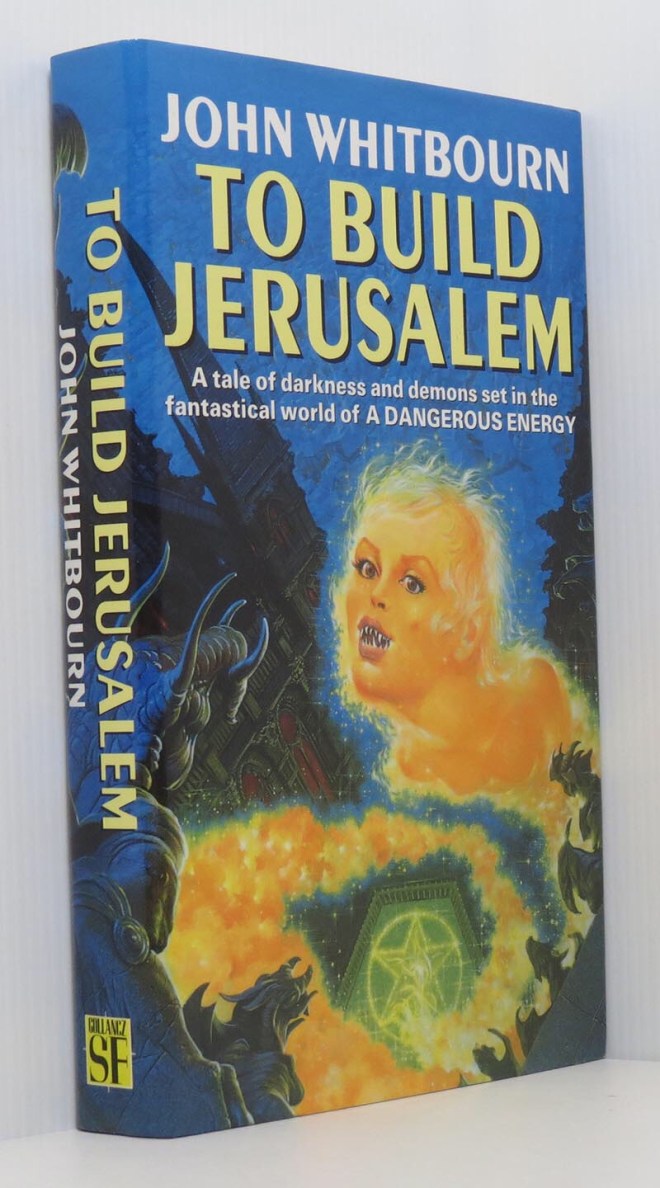
John Whitbourn, “To Build Jerusalem” (1995) – An alternative title for this one could be “Fear of a Protestant Planet.” English fantasy writer Whitbourn once described himself as a “Green Counter-Reformation Anarcho-Jacobite” (you can see why I made a point of tracking his books down). This was back in the eighties or nineties, before we would automatically assume such a person is just trying to find a way to avoid self-describing as fascist. Whitbourn’s ideas frame the worlds he writes, and they’re animated by a pulpy horror/fantasy sensibility with substantial Lovecraftian overtones.

This one in particular takes place in a world where the Reformation failed, the Catholic Church runs things in a manner reminiscent of the Emperor in Dune, and magic exists, mostly wielded by priests. Like I said when I reviewed the first book set in this world, “A Dangerous Energy,” if Whitbourn is trying to convince people that the world would be better without the Reformation, he’s found a funny way of doing it. The world is dark, cramped, and run by tyrants. It’s the late twentieth century and much of the world is unmapped and they’re just figuring out trains. To the extent Whitbourn can be said to pitch it as a “good” world, you could argue it’s more orderly- people know their place in the world and stick to it. Not my thing, but ok.

But Whitbourn is pleasingly non-didactic, and the actual point of the world seems to be that it’s a good jumping off point for horror and adventure. The main character is an enforcer for the Church, a sort of Catholic janissary named Adam. He’s sent to England because there’s a disturbance in the force- some kind of entity in the sphere of magic that is making the spells not work good. Wizards often summon demons, but it turns out, the demons they summon are small-fry compared to a big (and very horny) demon from a realm of evil beyond even the evil-realm the wizards can access. The many layers of unknowable and unholy power that exist beyond our ken are reinforcement for the idea that we need a stable order watched over by a perennial source of spiritual power…

Spoiler alert- the demon lord (never named) manifested itself to the Gideonites, the underground remnants of Protestantism in England. They bargained with it to kidnap the King and the papal legate and do a bunch of other mayhem. Whitbourn depicts the Gideonites as similar to (a conservative picture of) militant leftist movements in our timeline (including references to “democratic centralism” lol). Their overweening pride and desperation over being owned by the Church and its armies all the time leads them to believe they can use this demon-lord to bring about the End Times and hit the reset button on the whole thing. Not only that- but they’re getting into enclosure! The venal lords of England, never really faithful enough, start doing capitalism against the wishes of the church, kicking good pious peasants off the land and raising sheep for money. Both the demon’s antics and enclosure are treated as equally heinous, offenses against the sacred order of things.

The book’s a lot of fun. Naturally, our Leninist-Puritans can’t control the demon-lord, who does all kinds of nasty things. Adam develops a fun Holmes-Watson thing with a provincial English yeoman-soldier. Whitbourn throws in a lot of fun details and a real sense of place, namely Surrey and Sussex- apparently he has whole collections of macabre tales about them. The ending was kind of a cop-out. There’s some fun battles in the demon-lord’s own dimension, but they end with a literal deus ex machina (or deus ex coelum). It’s consistent with Whitbourn’s beliefs and with his vision of our world at the mercy of extra-dimensional powers above and below… but it kind of took the wind out of the book’s sails. Still, definitely worth checking out. Also, someone claiming to be Whitbourn commented on my review of his earlier volume. If you’re reading this, Mr. Whitbourn, thanks for getting in touch, and I hope your straits aren’t actually dire! I did go out and buy this book, and encourage others to do so if they like quality weird history/fantasy/horror fiction. Maybe we can do an interview? Let me know! ****’

Review – Whitbourn, “To Build Jerusalem”

Review – Sedgwick, “Against the Modern World”

Mark Sedgwick, “Against the Modern World: Traditionalism and the Secret Intellectual History of the Twentieth Century” (2004) – Historians of esoteric or occult thought generally go around with a chip on their shoulder about the way their field is ignored and, allegedly, ridiculed by historians writ large. There’s some truth to it, and some make a good case for the importance of their field to intellectual history writ large- Earl Fontainelle on his very enjoyable podcast, “The SHWEP” (Secret History of Western Esotericism Podcast), for instance. But in some cases the desire to prove that esoteric thought was important, relevant, and like other intellectual movements, with lineages and everything, overwhelms whatever other analytical point a given work might try to make.

In some cases, it looks like a case of a historian being captured by their sources- they begin to sound like the sort of people who insist, not so much that magic is real, but that keep an open mind, and in other cases like the squabbling of the sort of real world occultists they write about, forever going back and forth on who has the legit secret knowledge, etc. They get cute about whether they themselves believe in it or not, as though their personal belief in magic is actually what people care about. Sometimes it’s like “Masters of Atlantis” but not funny.

Historian Mark Sedgwick’s book on the traditionalists is more in the latter camp. Traditionalism is an esoteric philosophy that, as Sedgwick contends, traveled far, especially (well, almost exclusively) in elite circles in the early twentieth century. The basic idea of Traditionalism is this: there is a set of unified spiritual truths that everyone once knew about and that held society — in some far distant prehistoric time — in perfect harmony. Something happened and now we have modernity, which isn’t perfect, unified, or spiritual. Bits of the tradition are scattered amongst the world’s religions and spiritual movements. A spiritual elite should piece together the Tradition for themselves and… well, most of the time, the next step is form clubs and bicker with each other about who’s being properly traditional, but at least some thought about trying to spread the message more broadly. Some of these ideas went into New Age spirituality, though major Traditionalist figures like Guenon, Coomaraswamy or Evola would doubtless sneer mightily at New Agers over… whatever differences they have.

If I already didn’t know about Traditionalism at least a little from prior research, this book would have been borderline incomprehensible. Sedgwick doles out definitions of what they actually believe almost grudgingly. He does very little analysis of the many texts the Traditionalists produced. The bulk of the book is made up of talking about the Traditionalists, how they knew each other, their connections to other belief systems (particularly Sufism, of which Sedgwick is a scholar), etc. etc. This is of little intrinsic interest, especially considering the big claims Sedgwick makes early on of Traditionalism forming a key part of twentieth century intellectual life as proven by the big names who got into it… but the big names basically aren’t there. He goes out of his way to say Carl Jung wasn’t one, appearances to the contrary. That’s about as big as we get, unless Mircea Eliade is an especially big deal to you.

The frustrating thing is, as a peculiar ideology for elites with at least some pull, I could buy an argument for saying that Traditionalism might have had some importance, in much the same way similarly elitist (and basically nonsensical) ideologies like Objectivism have. Sedgwick barely makes it. The closest he comes is the way figures like Eliade and Coomaraswamy helped popularize the idea that all religions have a core of truth (which is the Tradition handed down from olden days) and all are worth studying. That’s interesting, but he doesn’t develop it much.

Similarly, Traditionalism’s connections with fascism and the European far right, as exemplified by the person of Julius Evola, who was in the news recently because Steve Bannon thought to name drop him (if he’s actually gotten through a volume of the Baron’s fatuous oeuvre, I’ll give him… I don’t know, a penny and a shot of Scope to quell the shakes? I’m not giving that guy shit). Sedgwick does the annoying thing New Age people (including Evola’s English translators) do where they try to take Evola’s snobbish disdain for the plebian Mussolini as a sign he wasn’t a fascist. No- if anything, he was just even more violently attached to hierarchy, and put Traditionalism together with racial hierarchies in the most obvious combination since plastic explosives and roofing nails. Sedgwick can’t quite stay away from the story of how Evola-inspired neofascists contributed more than their fair share to the Years of Lead in 1970s Italy- after all, there’s that delicious line about the cops finding an Evola volume in your flat being more damning than if they found C4. But again- it’s stories, anecdotes, connections, no real analysis of the ideas or how they interacted. It’s a shame because Traditionalism and other marginal ideas of that kind have more to tell us if we trace their dynamics than if we try to insist they’re not marginal, or anything else they manifestly are. **

Review – Sedgwick, “Against the Modern World”

Review- Kruse, “White Flight”

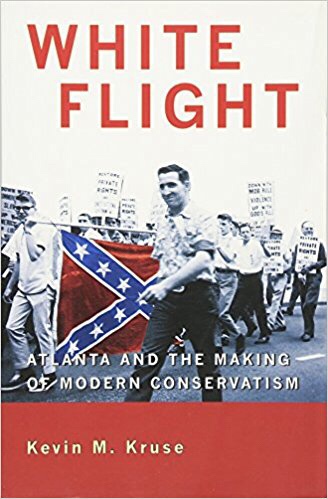
Kevin Kruse, “White Flight: Atlanta and the Making of Modern Conservatism” (2005) – This book is part of a wave of pretty solid social/cultural histories that used local studies to examine national historical trends, many of them published by Princeton University Press in the 2000s. Kevin Kruse looks at Atlanta in the mid-twentieth century and the ways it dealt with race, specifically as it pertained to desegregation and class. For decades, Atlanta had prided itself on being forward-thinking and racially moderate- the “town too busy to hate.” That all went out the window once it became clear that black people weren’t going to be content to be second-class citizens, disallowed from public services and spaces. “White Flight” traces the patterns and broad historical effects of the temper tantrum the white population of Atlanta threw in response.

Kruse goes through a number of the efforts white Atlantans tried to bolster and reinscribe formal racial separation in the period from the 1940s and the 1960s. Open racial terrorism, including bombings, came into play most often as black families attempted to buy homes in white neighborhoods. Neighborhood-based public resources such as schools, parks, pools, and busses were generally abandoned by whites — and therefore underfunded — rather than allowed use by integrated publics. Most of this affected working-class white Atlantans; even middle-class black families couldn’t afford (and certainly couldn’t secure loans) to buy in middle-class neighborhoods. Things finally reached the upper classes of white Atlanta when the sit-ins at restaurants and stores began to challenge the merchant elite of the city for control of their space, and when demands came to desegregate spaces where they congregated, like golf courses. Then they lost their sense of noblesse and began flipping out, too. And in Kruse’s telling, they all acted en bloc, only disagreeing on whether intransigence or flight was the proper response to desegregation- nobody thought about trying to make it work, nobody white anyway. Flight won out.

In the end, none of the formally, legally racialized bulwarks of the segregation order remained standing in the late 20th century. What we have instead is a racial order kept in place by control of capital, which in turn commands space (in the form of real estate) and force (governments, taxes, borders, cops). The new suburbs that whites fled into, not just in Atlanta but all over the US, grew into cut-off enclaves- at one point, Metropolitan Atlanta had 56 separate municipalities in it, each with its own taxes, zoning code, schools, etc. Using notionally color-blind language about “small government” and “local control,” these suburbs can replicate something like the experience of segregation for the white people who live in them.

There is a caveat there, though, two things that changed in substituting informal suburban segregation for the older formal, urban version. First, people were enjoined to avoid open expressions of vulgar race hate in public and in the legally binding rules. Second, and more consequentially, white Atlantans in the segregation era enjoyed well-funded public spaces and goods. Post-white flight, suburbanites came to abjure the idea of the public altogether. In some instances, the public schools, behind the walls of exclusive zip codes, continued to have some esteem (see also, suburban Massachusetts). But for the most part, public transit, public housing, public leisure- all of these were replaced by private equivalents. Many of the principles we associate with suburban design and governance were there before white flight, but white flight codified it, standardized it, and put a ton of money and political will behind it. This privatization eventually came to be a matter of principle, as expressed by politicians from these rapidly expanding suburbs, and none more openly than Newt Gingrich, who represented the Atlanta suburbs.

In Kruse’s telling, the real secession wasn’t the southern states from the northern- it was the white suburbs created out of the flight from desegregation seceding from the rest of society, despite being entirely dependent on urban cores and the federal government for their very existence. Consciously or not, their leaders succeeded where earlier reactionaries failed, and actually found a way to give a substantial portion of the population just enough property to feel like they’re in the master class- and just enough anxiety to be willing to fight to protect it, and to consider any other system not just wrong, but dangerous. Moreover, by helping destroy the cities in the mid-20th century, they also spiked the most viable alternative to that way of life. They even went so far as to rebuild some cities on a sort of privatopia-lite model and let their bored spawn go live in them!

In the end, soft segregationists called liberalism’s bluff. Liberals weren’t going to allow formal segregation anymore by the mid-20th century. This was in part due to values, but liberals had the political capital and the will to go along with it in large part due to the Cold War- segregation being a bad look when wooing developing world allies. But liberals also weren’t willing to challenge capitalism, and the smarter, later generations of segregationists knew it. Crying about the big mean gummint making you serve milkshakes to black customers was for small-timers. The real action, and the real money, was in remaking segregation with the tools — capital, and the way it can command institutions and populations — at hand. *****

Review- Kruse, “White Flight”

Review- Fleming, “Casino Royale” (1953)

casino royale

Ian Fleming, Casino Royale (1953) – Bond was never my favorite spy. He’s probably the first I heard of, but I never really got into him, either sincerely or for camp reasons. As alluded to in an earlier review, I’m a Bourne guy, despite my acknowledgment of its overly-earnest quality. But when the first Bond novel came up on a library free pile, I figured I’d give it a try. Among other things, I’m interested in how the installments came to be such an established, almost ritualized formula.

When people talk about the pleasures of “genre” narratives rather than “literary” fiction or “art” films, one of the things they go to is plot. Genre focuses on tight plots that deliver the goods in fine prescribed formula, rather than futzing around with experiments. Of course, the way genre fiction tends to sprawl sometimes, especially lately thanks to your George R.R. Martins, Robert Jordans, Steig Larssons et al, so “tight genre plots” aren’t all they used to be.

But I gotta say… the plot in “Casino Royale” was “tight” to the point of being nonexistent. A Soviet agent, Le Chiffre, ripped off his operating funds (for his evil Communist labor union!) and is trying to get it back by gambling. MI-6 sends James Bond over to rook him at cards, preventing Le Chiffre from making good. The stupid thing is… Bond beats Le Chiffre (at baccarat- the filmmakers changed it to poker, and for good reason, baccarat sounds boring), Le Chiffre and his goons kidnap and torture Bond, and then… the Soviets just come and kill Le Chiffre anyway, and let Bond go. The end. MI-6 could just have waited for the Soviets to clean up their own mess.

So, presumably, the plot isn’t the point. The point is to inhabit Bond’s world. Though, being the beginning of the series, it’s much less elaborate than it eventually becomes. The SMERSH network of which Le Chiffre is part is borderline scifi in its omnipresence, but none of the scifi gadgets or anything are in play yet. Bond isn’t jetting around the world- all the action takes place in one faded resort town in the south of France. He only sleeps with one woman, who of course turns out to be both a useless impediment AND a spy and who kills herself out of guilt after she falls in love with Bond.

I didn’t think it was anything special but you can tell why readers would like it. It’s short and moves along quickly. For readers in post-imperial Britain just emerging from wartime austerity, a character who affirms traditional British values, lives it up, and asserts British geopolitical relevance while doing so must have been appealing. And Fleming does develop a distinctive narrative voice for Bond. It’s an adaptation of older British spy protagonists like John Buchan’s Richard Hannay: upper-crust British gentleman as ubermensch. He’s “over” as in superior to almost everything and just sort of bored and blase. He’s demonstrably cultured (at least in a consumer sense- clothes, cars, food and wine) but also something like Nietzsche’s “blond beast”- brutal, violent, rapacious, lordly. That parallels the other cheap pathos-generating technique you get in this kind of narrative- Bond thinks feelings don’t matter, but inevitably, in every story, he has feelings of some kind… and they matter a lot because the feelings of a guy who normally doesn’t have them are worth more on the pathos exchange. I’ve often thought a lot of pop works on those sort of emotional antinomies.

At this early stage, it seems like Fleming is wavering between embracing Bond-as-we-know-him and experimenting with a more noir sensibility, where the whole enterprise is seen as dirty and morally compromised. You get the idea that maybe we’re not supposed to really like Bond. But in between bouts of post-genital-torture freshman philosophizing in his hospital bed and quickly falling in and out of love with the lady spy, Bond entertains and rejects both moral relativism and romantic love. I’m not going to run out and buy the next installment, but if turns up on a library pile, I’ll probably pick it up, if nothing else to trace the developments. **’


Review- Fleming, “Casino Royale” (1953)

Review- Wolfe, “Radical Chic and Mau-Mauing the Flak Catchers”

radicalchic

Tom Wolfe, “Radical Chic and Mau-Mauing the Flak Catchers” (1970) – Like a lot of cultural movements of the second half of the twentieth century, “the New Journalism” or “gonzo journalism” did much to break up ossified patterns in a given field, raised up one or two genius figures… and for every genius, launched the careers of a half-dozen cheap hacks who could superficially copy them and who seemingly never, ever go away. So gonzo journalism gave us Hunter S. Thompson, one of the great American writers of his time. It also gave us Tom Wolfe, alas.

You start to sympathize more with literary traditionalists when you realize what letting people experiment means when undertaken by rubes. Thompson could make gonzo work because no matter how far he went out on a limb or how high he got on the job, he had real discipline and craft as a writer. Wolfe… does not. He apes some of the middling-unreadable aspects of modernist literature: lists, imagistic passages meant to be disorienting but mostly just boring, various distending techniques that don’t come across. But while his literary mugging frequently gets in the way, it never truly obscures his main point: name-dropping, talk about interior décor and clothes, posturing of the notables, and miscellaneous class-signifier bullshit. It was truly dispiriting reading his many lists of New York socialites in “Radical Chic;” I recognized few of the names (Leonard Bernstein; Barbara Walters) as crusty old-people favorites, but most of them meant nothing to me. Something tells me they didn’t mean all that much back then, either. But Wolfe is breathlessly taken with them, even as he despises them- kind of like Gollum. It’s even worse with the black radicals in both “Radical Chic” and “Flak Catchers.” Wolfe’s combination of contempt, stabs at hip (not unlike the white liberals he lampoons), and seething jealousy for their charisma comes through loud and clear, but precious little else about the people he’s talking about does.

Presented with two of the broadest targets someone looking to punch liberals could want – upper-crust types playing at radical, and a mutually-parasitic relationship between welfare recipients and social services bureaucrats – he doesn’t even really land that hard. I gotta say, I was expecting something more coruscating (should’ve known better- I tried reading “Bonfire of the Vanities”). “Radical Chic” is a bit better than “Mau Mauing the Flak Catchers” in this regard. If you want an instant low-grade nausea/headache, faithful reader, give Wolfe’s account of a shouted exchange between a Black Panther leader, Leonard Bernstein, Otto Preminger, and Barbara Walters at a party Bernstein threw for some Panther leaders a read. It’s about as bad as you’d expect. “Flak Catchers” is considerably less effective on this score, because it relies on the reader being stunned by the idea that mid-level bureaucrats – the titular “flak catchers” – exist to deal with annoyances their higher-ups want to avoid. Why is this considered a fresh observation? Why did it merit a whole essay, other than for the obvious reason of gawking at the multi-ethnic gangs of youth and their leaders flamboyantly hassling said flak-catchers?

The thing tying the two essays together… well, realistically, it’s Wolfe playing to the desire to gawk and to feel “in the know” on the part of white middle class audiences stuck with the expectation to be “progressive” but looking for the door. But thematically, it’s the kayfabe aspects of sixties radicalism. The “beautiful people” in Bernstein’s Upper East Side apartment don’t really know what the Panthers are about and don’t want to- they’re just a fashion accessory. The bureaucratic flak-catchers in the Great Society welfare program offices of San Francisco exist in tacit agreement with the radical hustlers getting gangs of “The Warriors”-dressed kids to yell at him and threaten riots- without both, nobody, bureaucrat or community organizer, gets their funding, according to the piece. It’s all kayfabe, all fake, all hustle.

There’s an element of truth to this. But the stupid thing is, Wolfe is on the same side of the hustle. He needs it to be a hustle or else he has nothing to write about. If there was anything going on – which he concedes there was with the Panthers, if nothing else their propensity to get assassinated by the police kind of implies they had some contact with reality – he wouldn’t know what to do with it, and clearly doesn’t with the Panthers. He can’t write about the reality of anything, like Thompson did, because he hasn’t got the insight, the talent, or the motivation. He can’t even get at the reality of a given hustle, what’s actually happening behind the posturing- one of Thompson’s specialties. Wolfe has the contemptuous sneer of someone who’s figured it all out without having figured anything out other than convincing other rubes he’s figured something out.

This goes a long way towards explaining Wolfe’s staying power. Bourgeois audiences needed the means to sneer away the upheaval of the 1960s. Simply proclaiming it immoral, anathema, might work for the masses of rubes but it won’t work for people who fancy themselves smart. That’s too panicky, low-class, and besides, they like some of the loosened lifestyle restrictions. So when someone comes along telling them the whole thing was really about something they know about – class signifiers, fashion, posturing – and on top of that, that’s what things in general are all about, no need to interrogate any further, obviously people are going to jump on it. Thompson is dead, in part, because his society drove itself into a ditch rather than learn any lessons from his times. Wolfe continues to swan around in his dumbass white suits because he helped people actively unlearn. *’

Review- Wolfe, “Radical Chic and Mau-Mauing the Flak Catchers”

Review- Miller, “Nut Country”

nutcountry

Edward H. Miller, “Nut Country: Right-Wing Dallas and the Birth of the Southern Strategy” (2016) – The flipping of the South from solidly Democrat territory to (somewhat less-) solidly Republican in the span of a decade or so is one of the few historical narratives you can expect, say, an average college undergrad or a comedian to know about. And they’ll have an explanation for it, too- either the democrats got less racist and/or the republicans got more, or shuffling their feet and muttering something about taxes, or whatever baroque fantasy more forthright conservatives would summon to explain matters in a way that elides the racial element.

But explanations like that, even if they’re broadly correct, don’t really explain how the change happened. Historical studies of specific times and places within the larger trend help fill that gap, and that’s what my BC colleague Ed (who very graciously sent me a free replacement of his book when my first one got straight up stolen from its packaging) sets out to do with “Nut Country.” The title is a quote from JFK, who referred to Dallas that way after receiving harsh treatment from the local right-wing establishment (only to get shot in the same city by — probably — a leftist).

Dallas brings together many of the elements that made the Southern Strategy that the Republican Party rode to several victories in the late twentieth century possible. It was a booming oil town that could diversify into other areas largely due to federal investment in the southwest, but run by rich men convinced of their self-sufficiency. You had the same dynamic of old-style Protestant religiosity and white supremacist racial attitudes meeting mass culture and suburbanization you see elsewhere. Miller also highlights a creative tension between “ultraconservatives” — John Birch Society types who saw Eisenhower as part of the communist conspiracy — and more moderate, businesslike conservatives. This is something that could have been developed more. It’s not clear where the dividing line is beyond rhetorical tone (especially as regards race) and figures oscillate between the two. This dynamic could use to be theorized more thoroughly.

But more than anything, Miller makes a strong case for Dallas as the patient zero of the southern strategy. It’s main vector was Bruce Alger, a congressman who switched from comparatively-suave country club Republican to frothing race-baiter who voted against federal milk money for schoolkids and back again as suited him. If you wonder how exactly the transition was made, “Nut Country” does a good job of showing it as a matter of trial and error. Alger tries being “moderate” on civil rights and is race-baited to defeat (by a democrat). He wins when he embraces the Dallas far-right and its combination of resistance to civil rights, Cold War paranoia, and opposition to social provision. But he, like many converts, takes it too far and comes off as, frankly, weird- too conspiratorial, too accusatory, too likely to kick off nuclear war, not unlike his pal Barry Goldwater. It was time for another pivot.

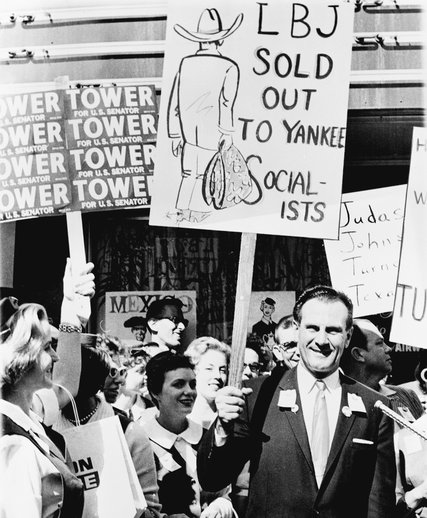
What Alger landed on — what the whole Republican Party landed on, Miller argues, from the example of Alger and other early Sun Belt Republicans — was a tone that could sell far-right politics to a mass audience. This tone was sunny (mostly), businesslike, and meritocratic. It adapted some of the language of civil rights — especially as regards equal access and due process — to protect racialized systems of privilege in housing, education, and much else. In many respects, this was an adaptation to the fait accompli of black voting and public accommodation access. The wagons needed to be recircled. I also think it was also an adaptation to national mass media- open racism or conspiratorial rhetoric didn’t play well on tv (for the moment), but appeals to “law and order” and “neighborhood schools” and “property values” did and do. This strategy, as Miller shows, wasn’t the result of a master plan from above (though it would eventually be applied that way by the national GOP). In fine free-market fashion, it was the result of entrepreneurial leaders adapting to local conditions… with healthy portions of money and fear to grease the skids some. ****’

Review- Miller, “Nut Country”