
Review – Gottfried, “After Liberalism”

Paul Gottfried, “After Liberalism: Mass Democracy in the Managerial State” (2001) – I am, once again, behind on reviews. I finished this a while ago. Paul Gottfried got my attention, and that of other antifascists, when journalists pointed to him as a substantial influence on Richard Spencer and the altright, including, possibly, coming up with the term “alternative right,” as in alternative to the neoconservative ascendancy that was just about to reach its peak around the time this book came out. It’s murky, how much Gottfried actually knew Spencer, but they traveled in similar paleoconservative circles before Spencer became briefly prominent. Gottfried has gone on record abjuring the altright, saying their project is not his.

Unlike most of these distancing maneuvers, this one comes off as reasonably legitimate. There are two main reasons for this. One is that Paul Gottfried is a Jew. There’s no shortage of right-wing Jews out there, and I’ll talk about the antisemitic cast of Gottfried’s main argument, but I don’t think Gottfried is the particular kind of craven that would cause a Jew to make common cause with Nazis, and he’s not the sort of Jew Nazis would necessarily let in (Spencer might, but he’s a fancylad with a following he can count on the fingers of his hands, at this point). The other, more substantive, reason is that Gottfried seems to come from the branch of paleoconservative that is deeply and sincerely opposed to the sort of mass political mobilization and rapid sweeping political changes that help distinguish fascism from more normative conservatism. 

Among other things, Gottfried sticks to something more closely resembling the historical and the empirical in this book than is common on the contemporary right (or, for that matter, among ideologues across the spectrum). As far as Gottfried is concerned, by the turn of the twenty-first century, the verdict was in, and the more pessimistic predictions of the founding fathers and assorted classical liberal figures were correct: let the mass of people participate in politics, and they will just vote rich people’s money into their pockets. Race enters into it less than one might think, except as something to potentially break the spell of welfarist lassitude- more anon. This is just democracy, Gottfried sighs, it’s the role of the statesman to see his way forward despite it. 

So, unlike fascists, Gottfried doesn’t really believe in the volk. There’s a little bit of that thing you see in right-wing writers ranging from Nock to Kirk to Rothbard, a certain nostalgia for simple folk and their (supposedly) unquestioned hierarchy, but like those three, that nostalgia is also a nostalgia for the (again, supposed) quietude of that past. But at the same time, Gottfried speaks well of populism. This is where Gottfried does, in fact, link up with fascism, and why Spencer et al would have found his work useful to them. 

What’s his motivation, you might wonder- if the volk aren’t noble, and in any event the damage is done, what is Gottfried bothering with? It’s because he hates the managerial elite who supposedly brought this state of affairs about. He spends almost half of the book trying to definitively delink the liberalism of most twentieth century figures from “classical liberalism,” and I tend to think that he did this less because it mattered so much — he resignedly calls the likes of John Dewey, Herbert Croly et al “liberals” in spite of all — but because it lets him obsessively pore over the rhetoric of the progressive movement, the new dealers, the great society types, and social liberals of his own time, and the awfulness and strangeness of their creed(s). The managerial elite overthrew the old capitalist elite, and with it the latter’s (notionally) purer liberalism. They bribe the volk with welfare and sap their values and vitality, in the name of their odd cosmopolitan value set, somewhere between antinomianism and Gnosticism. We know this story. 

What little hope Gottfried sees — and where he links up with fascism, where he really did influence or at least prefigure how the altright and numerous other far right formations today understand and pursue their project — is in hitting the managerial class where it is, supposedly, weak: culture. The cultural rules of the managerial elite become more important and more flagrantly arbitrary as their power grows, Gottfried argues. The real nature, the kind of Fabian/gnostic elitism of our educated credentialed elites, comes to the fore, and as Pat Buchanan showed, you could rally the good salt of the earth folks to object to…

The funny part is, the thing that impelled Gottfried to write this was the defeat of Bob Dole at the hands of Bill Clinton in 1996. Talk about distinctions with little difference! I guess Clinton was “more PMC,” to be reductive, a baby boomer, a philanderer, an erstwhile protester with an ambitious wife. What were the good right-populist folk supposed to be objecting to, then? What were the secretly radical managerial elite foisting on them? Meaningful advances even in bourgeois assimilationist gay rights, like marriage equality, were years away from being on the table, and the black freedom movement was an increasingly bitter (and bowdlerized) memory. The late nineties were not a time for the coddling of criminals, so we don’t get the kind of panic around that reactionaries made use of before and after. Gottfried grumbles some about how “government” never shrinks, employs too many people even as Clinton is gutting social services, but you can tell his heart is barely in it, compared to undoing the social and cultural power of the managerial elite.

No, it’s the usual peccadilloes that make it impossible to fully respect paleocons, even when they make a positive contrast with neocons in some areas. Gottfried is offended by the idea of civil rights, and raises the specter of hate crime laws. Beyond being wrong (and wrong-headed- “law and order” types should beg for hate crime legislation, especially if they’re also traditionalist conservatives ie people who want to legislate affect and feeling, but we know why they don’t), it’s honestly just kind of lame. What kind of pathos are we expected to take from business owners no longer being able to legally visit police and/or personal and/or mob violence on customers for being the wrong race? Why is that a “freedom” we should give a damn about, even in the most abstract way? 

Well, bigotry is certainly a part of it. I don’t know how personally bigoted Gottfried was or is (I believe he is still among the living). He doesn’t go on as much about the behavior of black people, sexual minorities, immigrants etc as you might expect. Bigotry, and the enforcement of a world defined by personal and sectarian ascriptions, was part of the power displaced by the professional managerial elite that serves as Gottfried’s great bugbear. The lord of the manor, or the planter, or the ward heeler, or whoever, should be allowed to enforce his bigotries and make use of the bigotries of his underlings to enforce his rule. Take that off the table, and you get the rationalism of the H.R. manager (which most often serves to sweep subtler, but ubiquitous and powerful, bigotries under the rug). The way to break the power of these managers is to mobilize these bigotries — often channeled against the openings that liberal managerial hypocrisy leaves wide open and unguarded — which are held to be the true feelings of “the people.” People power, if you will.

And this is where the antisemitism that Gottfried doesn’t deploy, but which is endemic to the far right and which his epigone Spencer has put so many chips on, comes in. You need to have a super-group to explain why the “naturally” superior, however defined — the aryans, the aristocracy, the landowner/industrialist/capitalist elite that the likes of Gottfried and Nock seemed to prefer — ever lost power. For most of them, it can’t be the real agency of the subordinate classes, otherwise they’d have to admit that the subordinate are powerful, capable of making their own decisions, and therefore do not deserve to be subordinate. There has to be some counter-elite. Because they are, in some sense, white, and because of longstanding prejudices and myths, Jews fit that role almost uniquely. Eric Voegelin, and a small school that follows him, puts Gnosticism in that same role. Gottfried comes close to that, not exactly summoning Basilides the False but basically making contemporary liberalism a sort of semi-esoteric cult, working in secret. But that’s usually several degrees too complex for people, especially because even a madman like Voegelin couldn’t bring himself to say that progressives were literally gnostics, with a lineage going back all the way. So, Jews it is, and even if it starts out targeting someone else, the Jews invariably get dragged in.

The version of this Trump, numerous right-populists the world over, and the altright has been pursuing is generally less well thought out than Gottfried’s version. You have to figure the old fucker probably furrowed a brow to see that one of the earlier instantiations of this dynamic involved a fight about video games and how many boyfriends a lady game designer had or did not have. But for all Gottfried’s erudition and delves into the history of liberal ideology, the whole edifice was always in the service of things just as stupid and small — petty bigotry, the personal domination of small-scale tyrants, silly grudges, pedantic rules-lawyering, the martinet’s dread of liberation — as “ethics in video game journalism.” As above, so below, or something. ***’

Review – Gottfried, “After Liberalism”

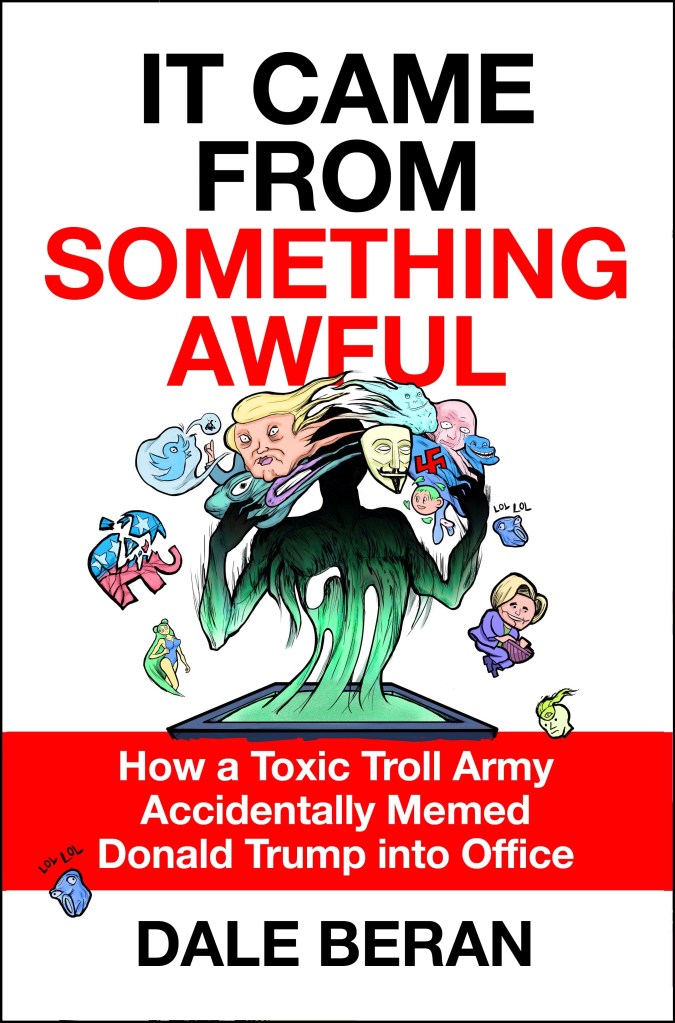
Review – Beran, “It Came From Something Awful”

Dale Beran, “It Came From Something Awful: How A Toxic Troll Army Accidentally Memed Donald Trump Into Office” (2019) – I’ve come to call it the Mark Fisher school of social criticism. Mark Fisher, for those of you unfamiliar, was a British cultural studies writer who wrote about contemporary culture, especially online culture. If you’ve heard the phrase “capitalist realism,” that’s one of his. His work has proven highly influential on many writers in the same areas, in terms of ideas, themes, and tone. I think it is fair to say, at this point, that he is the object of what could be called a cult (think more like the Marian cult or the cult around Foucault, not Heaven’s Gate). A lot of writers in the “online discourse hell” space hail Fisher as not just an influence, but as something of a prophet, a saint figure, complete with martyrdom at the hands of the force that Fisher understood as fundamental to contemporary life: the depression and malaise induced by late capitalist existence.

I don’t want to dismiss Fisher intellectually, and I don’t want to downplay people’s emotional attachment to a writer who they felt understood what they themselves were going through, and who died, leaving a lot of people feeling bereft. That said, the thought produced by Fisher’s epigones has a lot of severe weaknesses, and a meta-weakness- the cult of Fisher, for all of its wide-ranging criticality, does not do self-criticism very well beyond ritual invocation of its own fecklessness and inability to effect change. 

I’d like to say that this book encapsulates the Fisher school’s weaknesses and its strengths, but that’s only maybe a quarter true. It doesn’t have all the weaknesses of the Fisher school. “It Came From Something Awful” doesn’t have the wounded defensive quality Fisherite work often does, and doesn’t show the sympathy for the far right that often occasions displays of that defensiveness. Beran stumbles into other Fisher school mistakes, but not those, thankfully. The book’s strengths, on the other hand, are less that of Fisher and his epigones and more that of fairly solid, middle-of-the-road history or journalism: fine research, well-organized findings, the relating of an important and interesting story. I suppose where the Fisher school comes in at all is that the author’s embeddedness in some of its precepts undermines him, turns what could have been a great work into a decent one.

I avoided this book when it first came out for a stupid but honest reason: it’s title, subtitle, and cover all made it look deeply inane. But some commentators who I take reasonably seriously took this seriously, and for a while I was trying to keep up with altright-explainers, so I figured I’d give this late entry a try. 

Right off the bat, Beran distinguished himself from other writers on the subject (most notably Fisher-cultist turned “main reason people googled ‘social patriot’ circa 2019” Angela Nagle) by actually knowing what he was talking about. Talking to Nazis like Richard Spencer, or even the boot boys, is like looking at bugs in a terrarium. Actually going into their spaces, especially the fora, is more like levering open a rock and sticking your face into what’s underneath. Journalists and scholars don’t like it, and usually can’t tell when someone fakes it (the sheer lack of new information in “Kill All Normies” should have been a clue, but hey, it was 2017). But Beran not only did it- he had been doing it for a while, at least lightly. He was a habitue of the titular “Something Awful” and no stranger to the chans, especially in the early days. He actually talked to people involved, not just founder figures like “Lowtax” Kyanka, “Moot” Poole, and Fredrick Brennan, but everyday, anonymous users of the boards.

And it shows. Beran lays out a sensible, comprehensible history of anonymous forum culture. He starts with early, pre-web message boards like the Well — which tried allowing users to be anonymous, but quickly wrapped up that experiment — to the beginning of contemporary forum culture with Something Awful (I had friends who were big into it on the early aughts) to the terrible marriage of Japanese anime image boards and American entrepreneurial innovation we came to call the chans. 

In terms of interpretation of this story, Beran is on somewhat shakier ground, but makes some decent connections and points. His biggest point is about a conjuncture between the spread of forum culture and the death of counterculture. By the time the late nineties rolled around, every single counterculture since the Beats, including mutually antagonistic ones such as hippies and punks, and even those that eschewed the whole game, like grunge, had been co-opted, defanged, and commoditized by the overarching capitalist monoculture. Seemingly the only thing the culture industry could not sell, by the time Lowtax was starting Something Awful, was the rejected backwash of Gen X grunge ‘tude: cynicism, indifference, and a certain soupçon of fascination with gory death and sexual violation (it turns out that somebody could indeed sell those things, but I guess the fora habitues were past caring by then). 

I split the difference on this. It’s an unsubtle reading and ignores or misreads some important factors (I’m still rewriting my birthday lecture which covered some of this ground- patience!). But it’s not so wrong as to be unusable, and also probably represents something like the historical common sense of a lot of the people who helped make the forum culture, and at least part of the story as understood by many participants in it today (including, mutatis mutandis, the Fisher cult). 

One thing Beran gets, that a lot of writers both in and out of the internet-discourse fail to grasp, is that a lot can change in twenty years, and it’s not all meaningless signifier churn. At various points, the people on the boards bestirred themselves to do things other than swap funny or grotesque pictures, and abuse themselves and others. Anonymous grew out of 4chan, and while a lot of people pooh-pooh it now, whatever else it represented, it represented at least some people rejecting Gen Xer nihilism for some sort of collective, values-based project. And then, of course, various snitches snitched and it collapsed. A more organized movement probably would not have collapsed like that, but when you’re organized by whoever can talk the biggest on an IRC channel…

Into the gap left by both the decline of Anonymous and the collapse of the “hope and change” Obama dream — and I think a lot of us undersell exactly how high the hopes were for Obama because we don’t want to review how badly most of us, myself included, suckered — came the same sort of nihilism of the kind of people who, at the turn of the millennium, made mocking teenage suicides a sport… but changed. It got sharper and even meaner, weirdly more desperate, more violent. The rise of the incel culture seems to have been a leading indicator, that the nihilism was going to leave the realm of jokes and pranks and start getting bloody… and, for the product of groups of supposedly anything-goes jokesters, weirdly self-serious. I still sometimes try to imagine the reception on “the old internet” that I only watched from a distance to the idea that anyone was entitled to sex… well, between the rise of both internet porn and dating apps (the latter of which could be seen to quantitatively prove nerds’ inadequacy) and the egging on of cultural/political entrepreneurs like Milo Yiannopolous, Mike Cernovich, and eventually Trump’s man Steve Bannon, a new crew of culture industry vultures found ways not just to commodify a counterculture’s dissent, but to weaponize it. 

Here is where things start to fall apart in this book. First, so the blame doesn’t all go to the Fisher school, Beran relies way more on Hannah Arendt for his analysis of the right than makes sense. I tend to think this probably comes down to a mixture of simple… I don’t want to say ignorance, but maybe just unawareness of the way the study of fascism has gotten past/around the grand old lady, and the ways in which Arendt’s analysis actually coheres rather nicely with the hopelessness of the Fisher school. Even here, Beran isn’t completely off-base, and makes good use of some of Arendt’s ideas about déclassé upper class types allying with similarly deracinated lower orders to create fascist mobs, which suits the likes of Yiannopoulos and his gamer cohort to a T. But there’s some extreme flattening of historical patterns here that make it hard to see the differences between now and the periods Arendt writes about. I’m something of a lumper myself but it got a bit out of hand here.

This leads to the overarching weakness of the book, where it meets up with the weakness of the Fisher school of contemporary-awfulness analysis (and, in a weird way, Arendt). The Fisher school is so thoroughly invested in the all-encompassing awfulness of our lives under late capitalism that it can’t see anything else… including features of that awfulness that aren’t part of its pre-established menu of tropes and laments. Basically, they really, really don’t get offline. The further Beran gets from a screen (he laments “the screen” without getting into why it’s so much worse than “the page” or “the stage” or “the epic poem”) the less he knows what he’s talking about. Unlike some Fisher epigones, his hopelessness about/spite towards the left doesn’t lead him to hate on online libs/leftists to the detriment of his analysis. His chapters on tumblr are quite thoughtful. 

But leftist opposition to the altright, to Trump, and to other instantiations of the right-wing resurgence we’ve seen post-2008 didn’t come from, or even mainly from, tumblr teens and their concerns for personal validity. Hell, if you want to blame the internet for the many weaknesses of today’s left, tumblr wouldn’t be where I’d look- I’d look at Twitter, which Beran does little with, mostly treats as a neutral medium. Speaking from personal experience, I can tell you that not only is antifa not a group — and that “black bloc” isn’t one (from Philadelphia?? Beran claims) either — but that whatever concerns those of us who do antifascist direct action may share with the stereotypical tumblr-teen, they/we didn’t get into this because they/we were mad about racist Halloween costumes. To think this betrays the ways in which Beran — and here is where his weaknesses sync up most completely with the Fisher school — really cannot imagine a world apart not from the internet, but from his version of the internet, to the extent that even googling what black bloc does not seem to have occurred to him. 

Beran, unlike Nagle or some other Fisher acolytes, doesn’t add hatred and ax-grinding to the problems this intellectual inheritance brings with him. He does not seem to actively resent anyone who would actually try, however unlikely they are to succeed, to do something about our capitalist-depressive-realist state (and potentially show up the poster-philosophes in the bargain), which I’ve seen a lot of in online essays and comment sections. But the ways in which cynicism and the barest filigree of theory fill in for commitment to thoroughgoing understanding — which would imply much more work, in the archive and the long watch of thought, even if you don’t think it would also imply taking to the street, as I and my comrades do — did a lot to hamper his work. I’m probably making this sound worse than it is, but I think that’s because the good parts and the bad parts stand in the starkest contrast in this book. Moreover, the good parts are good in a simple way — they do the job — and the bad are better fodder for comment… perhaps reflective of the larger incentive structure motivating the fecklessness of the Fisher school. In any event, this book is better than many, for all of its flaws, but somewhat disappointing. ****

Review – Beran, “It Came From Something Awful”

Review – Thiel, “Zero to One”

I tried to get Dall-E to make the Angel of death greeting Peter Thiel, but this was the best it could do

Peter Thiel, “Zero to One: Notes on Startups, or How to Build the Future” (2014) – This is the last book I read of a series of seven unconventional right-wing books, books that in some sense were off the beaten path of conservatism, but reflected or were influential or parallel in some way… or anyway, a projected series. There doesn’t seem to be a good English translation of alleged Chinese state authoritarianism apologist Wang Huning out there, and the Unabomber Manifesto is really more of a pamphlet than a book, no more within my ambit of reviews than any single article.

I say all that to say this: Peter Thiel is probably the slimiest motherfucker out of those seven with which I started, which include a slavery apologist in the person of Thaddeus Russell and an actual murderer in the person of Ted Kaczynski. The depths to which Thiel would sink to accomplish his ends reach far below what a middling scribbler like Russell could manage, and his capacity for destruction is much more real than anything Kaczynski could have dreamt. And yet, I was probably the most on board with Thiel as I was with any of the writers I read in this series… for the first, maybe, quarter of “Zero to One,” his business manifesto, assembled out of notes his catamite and potential Arizona Senator Blake Masters took when Masters sat Thiel’s tech business class at Stanford. 

At this point, contrarianism-posturers – and there is arguably no bigger or more historically important claimant to the throne of contrarian-philosopher than Peter Thiel – have to overcome reflexive skepticism from anyone who has noticed how contrived their postures and goofy their claims often are. But Thiel did manage some actually good and, in some ways, genuinely contrarian, in a good way, points, early in the book. The big one is that competition is not the boon to innovation that people think it is. Market competition does not lead to the best products- it leads to the products that can beat others at market, which is not the same thing. “He overstates his case,” I thought, reading it, “I know a lot of nerds and that’s just how they talk,” I reasoned, going over his pro-monopoly arguments. Monopolies can focus on their task, not on competition, and therefore prevent themselves from either pursuing illusory goals or simply competing away their whole profit margin. “If he could get that profit in and of itself is in large part the problem, we’d really be getting somewhere!” I figured. 

ANNH! Buzzer noise, around a third or a quarter of the way in. It turns out that market competition is a bad way of assigning value not because of the warping effects of profit-taking, but because it involves the preferences of everybody, i.e., the stupid little people who don’t care enough about space travel and life extension technology. What you need are small, dedicated, elite bodies – like the founding core of a tech startup, Thiel tells us – willing to flout rules and conventions, truly “think different” (about things like “the diversity myth,” the title of another Thiel book, or obeying safety regulations), and achieve monopoly power. Only such people can get us out of our current demoralizing state, with ever-improving gadgetry and entertainment options, but basic needs failing to be met… that is, the basic needs of Peter Thiel. Peter Thiel needs space travel, because he’s a nerd, and he needs life extension, because he’s one of those chickenshit, profoundly hard to respect nerds who are terrified of natural death. What’s the matter, Pete? Death will eliminate the source of all your problems, the irritation you can’t be rid of despite your billions of dollars- it will eliminate you. Once it takes that turn, the book is useless, except as a guide to the thought of a man our society, in its wisdom, has imbued with absurd amounts of power and money. As far as I’m concerned, the closer the day he meets that big fear of his, the better. It certainly won’t leave the written word any poorer. *’

Review – Thiel, “Zero to One”

Review – Binet, “HHhH”

Haha hope you enjoyed your last Mercedes ride, my good bitch

Laurent Binet, “HHhH” (2010) (translated from the French by Sam Taylor) (read aloud by John Lee) – One thing about the Nazis, is most of them died like punks. Shooting themselves rather than facing justice, sniveling on their way to the gallows in Nuremberg or Jerusalem… Reinhard Heydrich, arguably the coldest, evilest, Nazi-est Nazi of the bunch, died ranting and raving in his hospital bed from a wound that shouldn’t have been fatal – the shitty sten gun they shot at him with didn’t work, he got horsehair upholstery lodged in himself from a mis-thrown grenade, it got infected because his doctors sucked. Fuck him.

Getting ahead of myself, here! This is a sort of meta-historical novel. French writer Laurent Binet talks about how he got fascinated with the assassination of Reinhard Heydrich, number two man in the SS, man who oversaw the planning of the Holocaust, overlord of what’s now Czechia when the Nazis seized it, one of the few Nazi leaders to even remotely resemble the “Blond Beast” Nietzschean ubermensch type. He got got by two soldiers, a Czech and a Slovak, dropped into the country by the British Special Operations Executive. After weeks on the lam, Jozef Gabcik and Jan Kubis were betrayed by a Czech resistance man, and hundreds of SS men tracked them down to a church basement. After a long siege where they shot several Nazis and refused to surrender, the two SOE men killed themselves. Among other acts of retaliation, the Nazis leveled the Czech town of Lidice and murdered all five hundred inhabitants. 

It’s a great story! I think Slayer might have written a song about it… both heroic and grim. Binet does not tell it as a straightforward, historical-fiction style narrative, and talks a lot about how he learned about the lives of the people involved, how we would like to present them, how facts compel him to present them, books he read while writing this book, how he felt insecure about Jonathan Littell’s “The Kindly Ones,” a novel of Nazism that won the Prix Goncourt while he was writing it (a novel in French written by an American, to boot!), etc etc. 

Meta stuff can go either way. I could see how one might not like it in this story. But I actually think it worked pretty well. “Showing his work” enhanced my appreciation for the story and its details. World War Two is such well-trodden territory, with so many layers of mythology drawn over it, that it can be hard to know what to think of it. Among other things, I see a trend where the smarter, more independent writers and critics kind of steer away from it. I get the impulse, but I think it’s good to not disengage… or maybe the little kid who loved WWII stuff in me simply hasn’t shut up yet. In any event! I thought this was pretty fun. ****’

Review – Binet, “HHhH”

Review – Gallagher, “The Nazis of Copley Square”

Charles Gallagher, “The Nazis of Copley Square: The Forgotten Story of the Christian Front” (2021) – A member of my dissertation committee wrote this! It’s a fascinating story along with one that illuminates various odd corners of history with academic chops, a rare combo. I know a fair amount about the history of fascism, and I knew very little about the Christian Front- and nobody knew some of the stuff Charlie, as I know him, uncovered before he published it.

The Christian Front was, basically, the street instantiation of the vision of American Catholic fascists like Charles Coughlin, a sort of radio-based catholic Glenn Beck figure for the thirties. Catholic meatheads flocked to Coughlin’s message and sought out conflict with the many enemy figures Coughlin pointed them to: communists (also a growing movement in the thirties), liberals, Jews. It was a weird moment in Catholic America, and here we’re mostly talking Irish Catholics though Italians, Poles etc come up sometimes too. Catholics were sort of outsider-insiders. They had been around for long enough, had dense enough populations especially in northern cities, and done enough of the assimilationist things — Charlie especially emphasizes Catholic participation in the American effort in the First World War — that they felt some ownership in Americanism. But this period saw the rise of an Americanism that was explicitly anti-Catholic and anti-immigrant, as exemplified by the resurgent KKK of the twenties, and a crippling economic depression. Perhaps it looked like they were, to borrow a line from a guy Christian Fronters wouldn’t have liked, assimilating into a burning house.

None of the Fronters say that- they’re all flag-waving Americans, even when they’re actively undermining American war efforts as some of them would go on to do. If nothing else, it’s hard to say what exactly an American Catholic anti-Americanism would look like… they’re hardly going to secede… in any event! The Christian Front became a thing on the scene, especially in New York and Boston, brawling with leftist groups, making speeches back when street corner speechifying was a big deal. There was already a custom of neighborhood conflict that you could paste an ideological skin on to. 

One thing about eras of ideological ferment — the thirties, the sixties, right now — is that they allow nerds, goons, and pedants to take the things they’d do normally and dream of expanding them in terms of scope and importance. The brawls between Irish and Jewish kids suddenly aren’t just scraps between poor ethnics stuffed like rats into overcrowded cities, but part of some global conflict between Christianity and judeo-bolshevism; your clique of nerds and weirdos that you met in college aren’t just free-standing public assholes but a revolutionary vanguard. You can see why Christian Front people would think they could get real big, real fast. They had a deep well of American hatred and ignorance to tap into, and the classic fash assurance that the cops and the military are with them. So when a few got too big for their britches and started stealing and training with National Guard weapons, they were as surprised as anyone when they got pinched by the FBI.

The prosecution of the New York Christian Fronters has two main points of interest. The first is how the American Catholic establishment, both the actual church itself and politicians aligned with it, moved heaven and earth to get across two things: the Christian Front was no real threat; and that they had nothing official to do with the Church. Both are funny claims, true in some ways, but more revealing of how people in power understood political violence in this period than anything else. 

The Christian Front was extremely unlikely to overthrow the American government, like Hoover’s FBI informants caught them saying they wanted to. That the FBI insisted on going after them for this — and not, say, for their many plans to indiscriminately attack Jewish targets, in the idea this would bring about a communist uprising that the Front would then help their pals in the police and the army repress — speaks to their priorities. Fascists are right that cops share a lot of their views (with soldiers, it usually depends on the makeup of the service in question). What they get caught up on is a powerful police service usually sees street fash as cats paws, at best, and have no intention of taking orders from them. Hoover’s FBI was quite strong- perhaps not as professional as it would eventually become, but Hoover felt no need to bend the knee to any would-be fuhrer. They don’t care that much if you bash up people they don’t like- they do care if you overstep, make more work for them. 

The “are they Catholic?” part also has interesting historical questions attached. Charlie is a Jesuit along with being a historian, and an expert on the history of American Catholicism. In the fine Jesuit tradition, he does not evade intellectual responsibility: the Fronters were deeply invested in two Catholic doctrines that are either unpopular or officially derogated now, but were big deals at the time. One is the idea of the “mystical body of Christ,” that all Catholics are part of one body, and an injury to one is an injury to all, and to God. The other is “Catholic action,” which held that even if lay Catholics doing good works in the world couldn’t formally lay claim to the mana of the apostolic succession like priests could, they could claim to be doing the church’s work and deserve some kind of institutional recognition as such. Sometimes, these ideas inspired charity or even solidarity. Other times, they inspired fascism. American Catholics couldn’t claim to be systematically oppressed by the time the thirties came around, but as part of a “mystical body” with Russian, Mexican, or Spanish Catholics catching hell from leftists, they could take “Catholic action” and lash out at the supposed oppressors, and this usually meant Jews. 

So, the church fathers and their political friends could tell the truth- no bishop made the New York Christian Front plan to bomb Jewish community centers. But they were wrong to say that the Front had nothing to do with Catholicism. The FBI flubbed the prosecution of the New York Front leaders, but they went relatively quiet after that. Much of the action, in the Front and in the book, shifted to Boston. In characteristic Boston fashion, the leader was less of a street orator and more of a pedant and a sneak. What Francis Moran’s plans lacked in outward violence compared to his New York comrades, they made up for in ambition and sly interweaving with existent community practices in the Boston area.

Francis Moran was a failed priest and failed businessman, a classic smart underachiever. If you think those sorts are bad now, throw in growing up in the urban overcrowding and sexual repression of the Catholic American milieu at the time and you’ve got Moran. He got into the Coughlin movement and found a talent for organizing and public speaking. He made the Christian Front into a local organizing force, getting at least implicit nods from big politicians like James Curley. He, like the New York Fronters, was lucky in his choice of prosecutors, bumbling Irish-American political cops who more than half agreed with him about Jews and leftists. 

The war was probably the worst thing to happen to all of these little fash chieftains, and before it happened, before even aligning with Hitler, they wanted to make sure no such thing happened. In fact, this was a substantial part of their appeal. It’s a historical tragedy that the American people almost learned a lesson from the First World War — don’t let the British gull you into winning their stupid imperialist wars for them — just in time for the one time in history when that lesson was, in fact, invalid. A lot of people were slow to pick up that Nazi Germany was a different beast than the Kaiserreich (and yes, I get the latter was no picnic either, I’m a socialist), didn’t want to believe it. And of course, plenty thought that the Nazi program sounded good. But once the war was on, it was pretty hard to sustain American patriotism — which all of the fash groups, then as now, lay at least some claim to — while supporting other fascists, to say nothing of the massive expansion of police power that came with.

One of Charlie’s big discoveries is that Moran was working with the Nazi consul in Boston, a creepy SS intellectual named Herbert Stoltz. There were limits to what Gallagher could find or what Moran could provide- it mostly looks like Stoltz cultivated Moran as a potentially useful asset to sow discord in an important population center, should the US go to war. It seems that both the FBI and antifascist researchers — led by an indefatigable Irish-American Catholic leftist, Frances Sweeney — had at least some evidence that this was the case, but were unable (or, perhaps, in the FBI’s case, unwilling) to bring Moran down, especially after the Boston cops muddied the waters. Moran might have passed on intelligence, but more than anything it looks like Stoltz valued Moran as a political actor, a counterweight to pressure for America to join the war on the British side, and to spread a mood of defeatism and general shittiness that would make America less effective if it did jump in. 

Charlie also discovered that the Nazis weren’t the only foreign intelligence agency active in Boston at the time. British intelligence also funded political groups to bring America into the war, precisely the sort of thing Moran and others crowed about. The British intelligence and foreign policy establishment were especially worried about Irish-Americans impeding the political campaign for intervention and possibly the war effort itself. They set up Irish American groups to try to counter groups like the Christian Front, with little success. Frances Sweeney got her start working for an MI-6-funded front group, though she continued pursuing Boston fascists well after the British got what they wanted, American involvement in the war, and gave up funding local antifascism. 

Likely Moran’s most lasting legacy — he left politics in the forties, never recanted, and lived out his days as a reference librarian at the Boston Public Library — was his work to radicalize the already extant antisemitism of the Boston Irish. This, more than anything involving the war, is what local antifascists like Frances Sweeney were fighting hard to abate. There was serious antisemitic violence in Boston in 1943, as mostly Irish-American gangs coordinated attacks on Jews and Jewish institutions, aided and abetted by the largely Irish Boston Police Department, and ignored by the largely Irish-American political leadership of the city. Evidence Charlie dug up, including statements Moran made to FBI and antifascist infiltrators, suggests that Moran worked hard from underground to encourage this violence to go from the endemic condition of urban life to serious, planned assaults. Things only cooled down once the national media started paying attention.

One of Moran’s last recorded political statements was that he thought the returning veterans of the war would join him in sorting out “the Jewish problem.” Perhaps this is why he felt comfortable taking the heat off the Boston burner after the riots in 1943. It didn’t quite work out that way for him. But in other respects, Moran accomplished a good amount of what he set out to. He helped sew antisemitism into the fabric of twentieth century Catholic life in the area, and helped make a pigheaded authoritarianism a prime expression of Boston Catholic identity, especially among the Irish. It might sound like the community didn’t need much help with that, and there’s truth to that crack. But the twentieth century put a lot of pressure on the circuit between bigotry, conservatism, and ethnic identity in the US, and things could have gone a different way. What Moran showed was that you could get away with a lot, as a white bigot, through sly cultivation of publicity and politicians, playing that half-blind wrestling ref that is mainstream liberalism for all that it’s worth. 

What this reminded me of was, in part, the fascists I fight here, but more the population base they seek to reach: those sullen pasty faces in the suburbs, the progeny of the mobs Moran once moved, feeling that glowering itch to stamp out anything or anyone who would make the world better than a bad night at one of their shitty sports bars. It’s up to us to disconnect the circuit between their resentments and the ability to harm others, once and for all. This book doesn’t show us how, or purports to, but it’s a fascinating read with some unfortunate contemporary resonances. *****

Review – Gallagher, “The Nazis of Copley Square”

Review – Bartov, “Hitler’s Army”

Omer Bartov, “Hitler’s Army: Soldiers, Nazis, and War in the Third Reich” (1992) – I’m old enough to remember when the “good Wehrmacht” myth still played with people who should know better. It was a Cold War myth, originally, a way to save face while rearming West Germany, but it got mixed up with all kinds of other ideas about war, memory, etc., that seem to make less and less sense the further we get from it. I imagine some chuds out there still hold to the myth, but you gotta figure they hold the harder the more we understand what the Wehrmacht actually was, both because they like to trigger libs (i.e. anyone who knows anything) and because they like what the Wehrmacht actually did, and pretending it was noble is a good way to have your cake and eat it too.

Because it’s pretty clear, now: the Wehrmacht was, as Omer Bartov put it, “Hitler’s army.” Bartov, an Israeli historian who’s currently at Brown, emerged from a variety of tedious fights in the history of the Third Reich — the debate of “intentionalism” (it was all Hitler’s idea) versus “structuralism” (it was all them reacting to/interacting with structures), the “Historikerstreit” where Nazi apologists like Ernst Nolte burnt their fingers by saying the quiet parts loud — waving a simple, undeniable thesis, backed by archival research and affirmed by where more abstract theorizing was going. Namely, if you hate your boss so much, you usually don’t fight the biggest war in human history and kill tens of millions of people when he tells you to, like the Wehrmacht did in Eastern Europe. The war against the Soviet Union was understood as something other than a normal war, even the wars the Nazis unleashed to swallow up countries like France. It was an ideological and racial crusade, extreme violence — even by the standards of an epoch of bloody wars — was always a part of it, and the Wehrmacht embraced it from the beginning.

There’s a lot of historiographical hedging here — Bartov beats the shit out of rival theories of what kept the Wehrmacht together, most of them obvious Cold War snowjobs, at somewhat tedious length — and the meat of the book comes towards the end. This is where you get the letters and the diaries, and the exposition of the totalizing world that the Nazis made in the killing zone in the East. By 1941, most of the men going into the Wehrmacht had lived under the Nazi regime most of their lives. Many of them had been through the Hitler Youth and they all mainlined propaganda. Above and beyond the specific politics, this propaganda insisted that fighting, suffering, obeying, and above all, killing, is what will make the Reich. In many respects, what Nazism aimed at was creating a sphere where that would be a reality, and they only came close in the East. However bad they were to the French or whoever, whatever they had in mind for the Atlantic powers once they got grips on them (rather unlikely), it was the East where the action was.

Probably the most compelling part to me was Bartov’s explications of a peculiar mental operation that a lot of German soldiers did. You can see this operation attested to over and over again in the literature, and you see other conquerors do it too- British, Americans, I don’t want to say it’s universal but it’s common. And that operation is, treating the human condition that these soldiers see as a result of their army’s actions as an indictment on the people they are conquering, and a justification for further violence.

Germans saw inhabitants of the Soviet Union after said inhabitants were subjected to extreme violence. The Soviets they encountered were scared, hungry, hurt, bewildered, dirty, and often far from home. People in that position don’t usually look or act their best. And it seems that more or less the official position of the Germans out there, as revealed in letters home as well as in official orders and dispatches, is that’s just how Slavs, Jews, Roma, etc. are. They don’t even really bother to say “well, we Germans wouldn’t be like that if we got invaded.” They didn’t seem to need that extra mental armature. They saw hungry, ragged wretches, who they had done most of the work to make wretched, and decided that what they saw meant that the people they were conquering were just wretches who deserve what they get (you’d figure the next step would then be “why are we bothering with them” but nobody seems to have gotten there, either, in any meaningful sense). We know what the consequences of that kind of dehumanization look like.

I’m used to stupidity and to cruelty, but that kind of motivated, but seemingly not quite intentional, divorce between cause and effect… That, I don’t really understand. I think it might be important to understand but ultimately not something you can think your way into. This mental habit was in no way confined to Germans between 1941 and 1945. I had to read “American Sniper” for a project a few years back, and that was Chris Kyle’s basic impression of Iraqis. That’s the logic behind the “shithole countries” remark. That’s how the British saw Indians, Africans, and often enough the Irish. That’s how a lot of American cops look at black, brown, and poor people.

It does seem that “official” first world culture encourages that little voice that says “they’re still people/how do you think they got so wretched, dummy?” And it seems that first world fascists can be reasonably defined as the kids who are mad that that voice got installed in their heads and want to kill it, and kill it in everyone else, joined sometimes by those who lack it entirely and are mad that people say they should have it. And, no, “leftists aren’t just as bad.” A lot of the worst leftists atrocities took place precisely when leftists didn’t do the thing they’re supposed to do, and think seriously about the lives of those in front of them. And it just doesn’t happen as often, or as severely, as crimes motivated by this sort of master-wretch dichotomy that seemingly defines the mental landscape of a lot of people in positions of relative power.

This attitude has to be institutional to get the sort of effect you saw on the eastern front, not just “bad apples” or just the SS. Ultimately, it was the logic behind the whole war. It’s one of, maybe the main, or the only, non-logic behind the concept of race in general. It defined the goals of the war in the east and its conduct. It’s why the Germans couldn’t try to move slow, couldn’t try to meaningfully ally with minority nationalities in the USSR or just Russians who hated Stalin and communism, even as, in many cases, such people greeted the Nazis, went to great lengths to join them. All that dried up pretty soon after the initial invasion, with the way the Germans treated the entire population of the USSR. Assholes like Bandera stuck with it out of a mixture of ideological fanaticism and the knowledge that there was no going back. The SS did some of their major killing actions because the Wehrmacht asked them to, after general Nazi policy so badly alienated the (previously grievously oppressed!) people of the USSR that they were willing to risk the worst retribution possible to strike back.

They were all in it together. The attempt on Hitler’s life by a small clique of Wehrmacht officers was a poorly-organized, half-hearted attempt for a few of them to save their own skins, get the Anglos on side to stop the Soviets from coming for them. The Soviets took terrible vengeance on Germany, but you’ll notice Germany still exists, which is more than would have happened to Russia or anywhere else east of Prussia had the Nazis won. Maybe because the logic of dehumanization was so prevalent in the power centers of the world no one really knew what to make of it when they saw what it all led to. Then the Cold War came along, so official historians and social scientists had a new script, and a new motivation to explain away what we saw, to redeem the Wehrmacht and so on. Well. Pretty much anyone who takes history seriously anymore gets that that’s bullshit, in no small part to Omer Bartov here, but who’s to say whether we’ve closed the barn door after the horse got out? ****’

Review – Bartov, “Hitler’s Army”

Review – Dugin, The Fourth Political Theory

“Russia can have a leeeetle fascism… as a treat”

Alexander Dugin, “The Fourth Political Theory” (2009) (translated from the Russian by, like, a dozen people, who cares) – Let’s get one thing straight from the start: Vladimir Putin needs a ponderous ex-punk ex-dissident “Traditionalist” to tell him to be a prick and invade places like he needs a hot shovel. A few years back, around the time of the Trump election, US media started noticing Alexander Dugin, and some floated the idea he was “Putin’s Brain.” This is typical American provincialism, applying our situation — in this case, an extremely narrow scenario, the fact that we had a president for eight years who was so stupid that people like Karl Rove and Paul Wolfowitz had to do his thinking for him — blithely to very different arrangements abroad. I’m no Russia expert, but it seems supremely unlikely that the ex-KGB siloviki and the gangster oligarchs that run the show over there really care that much about what any philosopher says. Things do have a tendency to get stupider and stupider in this timeline, so maybe more Russians who count are actually listening to people like Dugin. One thing this Ukraine situation has shown us is that the delusion some of us anti-imperialist leftists held, that powers like Russia, cruel though they may be, are at least smarter and more rational than the US, doesn’t hold up as well as we’d like, so that would fit. I’m aware that Russian state media has some kind of employment situation going with Dugin. It’s the job of major state cultural/intellectual apparatus to keep a variety of pedants and ideologues on staff in case they’re handy. We’re cheap. That doesn’t mean people like him (or me, lol) really decide anything.

Dugin has been on my radar for a long time. I had actually planned on running him in the election he swept for my next “reading on the right” well before the Ukraine crisis. If you read about contemporary fascism, traditionalism, or red-brown cross-over, his name comes up a lot. This, along with his association with Russia, a country that brings out the bullshit in Anglo-American writers, means there’s a lot of dumb agendas not so much surrounding Dugin, as much as surrounding the discourse around the topics that Dugin bridges. You can find waltzing pairs of bullshit slingers along every axis touching the man: those who think he’s Putin’s brain versus those who know he isn’t; those who sound the alarm on red-brown (that’s alliances between anticapitalist leftists and fascist right-wingers, for the uninitiated) coalitions versus those who insist any mention of that is crying wolf; those who want to defend the honor of the sort of occultism/traditionalism Dugin claims versus those who think it’s all fashy rot. I do think there are rights and wrongs, here. I also think that many involved on all sides over-generalize and press their arguments further than they will go, seemingly out of spite a lot of the time.

So, let’s go to the texts, shall we? I mean the text of Dugin’s writing, and the text of his life, most of which might as well be his writings because he’s the main source of information here. The story we’re told is that Dugin came from a family reasonably high-up in the Soviet hierarchy- his dad was a general. Dugin was a rebel- maybe this is just crossing the streams of things I’ve been thinking about recently, but he does seem a bit like a classic early-Gen-X type, a rebel of the kind that valued posturing and shock over anything else (the Soviet context was different enough from the Western to seriously complicate that read, I know). He got into rock music, satanism and other aspects of the occult, and Hitler. Supposedly, he found some Julius Evola in the Lenin Library in Moscow and that was all she wrote- he was now a Radical Traditionalist. I can basically rattle off my spiel explaining what Traditionalism is (and isn’t) from memory, since my 2018 birthday lecture, in my opinion my best one. I’m sick of doing it. Just know that when guys like Dugin say tradition, they mean initiatory occult knowledge, and know that like any magician, they rely on misprision and slips to get over with audiences. This includes the verbal slip between Tradition like they mean it and tradition like we mean it, the actual traditions of actual people. 

The biggest gap I see in Dugin’s biography is that between the fall of the Soviet Union and about 1997, when he wrote his book on “geopolitics.” That’s the book that got the west’s attention, after it was adopted by the Russian military colleges as a textbook. Where did he make enough money to sit around, write, and get involved with Eduard Limonov’s Nationalist Bolsheviks? The legacy of Limonov — people whose opinions I take seriously say he was a great writer, and I intend on reading him some day — and the NatBols motivates a lot of the bullshit slinging in this story. Here, I’m more interested in the context. The Soviet Union collapsed, the economy went into freefall, everyone was scrambling, and I wonder where Dugin (and to a lesser extent Limonov and other NatBols) found material support… really, more for my own picture than because I think such support would necessarily translate into allegiance. Nice complete picture, that’s what I’m about. 

Anyway- Dugin’s thoughts on geopolitics got people’s attention. If there is any parallel between Dugin and the neocons as implied by the “Putin’s brain” thesis, it is this: both were late twentieth century ideological entrepreneurs shilling some Risk-board nonsense to fill the hole where people like them thought a sense of national mission should be. They’re both parodies of an already degraded form of thought, the two classical schools of International Relations theory. Neoconservatism is a hyper-charged, violent Liberal Internationalism; Dugin’s Eurasianism, where he calls for Russia (and maybe China, if they’re on side) to lead a solid bloc in, you guessed it, Eurasia, is a parody of foreign policy Realism. 

Dugin, for his part, follows in the long… well, post-1945 long… tradition of fascist pedants magpie-picking from amongst the few fash left standing after the big blowout for ideological inspiration. The unlettered skinhead mooks did Hitler-manquery; the ones with that critical bit of grey matter go looking for somehow who didn’t shit the bed and die in 1945. That’s how Evola got a postwar rep- he was still alive, because nobody trusted him with anything important. That’s why you still see Strasserites, despite Strasser being as scabrously anti-semitic as the Fuhrer who offed him, because he, being dead, wasn’t so thoroughly associated with ignominous defeat. Figures like Mosely and Yawkey were, ironically, protected by the rules of liberal democracies, and they have their little followings. Dugin is an Evola disciple but for his geopolitics, he borrows heavily from Karl Haushofer, a German practitioner of the school of “geopolitics” that came about in the early twentieth century. Like a lot of haut-bourgeois thought, geopolitics is a way of thinking about something real — the way geography influences, sometimes determines, politics — without taking most of the realities on board. Geopolitics is high-flown, if taken seriously it’s high stakes, and just bullshit enough for someone to be able to say anything at all they want under its auspices (dialectics has sometimes played a similar role, if you think I can’t pick on Marxists too!). It’s perfect for an ideological hustler like Dugin.

Because that’s what the Fourth Political Theory is- a hustle. Dugin, above all else, is a performer. Take a look at his videos. Big old gray beard, English pronunciation and cadences somewhere between Zizek and a Bond villain. I could, potentially, see his geopolitical and “Eurasianist” stuff having something closer to meaningful content (that’s saying a lot, for a field and an ideology I hold in low regard). But what you see in this, his effort to encapsulate his broader political ideas, is a transparent snow job resting on sleight of arthritic hand. 

Dugin’s theory is the Fourth theory, you see, because there were already three: Liberalism, Communism, and Fascism. Fourth theory is none of the above, he’ll have you know, regardless of how Fascist it looks (or its fond words for the worst parts of the Communist legacy)! The three previous theories were all modern, in that they believed in progress. The Fourth theory is both pre- AND post-modern, and doesn’t! But it still partakes of a dialectic, because Liberalism’s victory ushered in postmodernism, which the Fourth theory would take advantage of to be Liberalism’s eventual gravedigger. Fourth theory is related to conservatism, Dugin tells us, especially traditionalism, your Evolas and your De Maistres (the latter not a formal Traditionalist but a believer in similar ideas). But it’s smarter, cooler, newer. 

Here’s a good tell: Dugin claims to have made a workable politics out of the thought of Heidegger. I’m actually of two minds about this. On the one hand, I actually rather appreciate the cheek of someone willing to take this awful wizard-gnome and his pronouncements as something so mundane as a political program. No seminar table intimidation for old Doogs! On the other, even I know claiming to wield “dasein” like a fucking… ruler, or wrench, or pointer, is definitely not what the old fucker had in mind and points to the larger incoherence of the whole project. The whole point of Heidegger is to be anti-programmatic. Dugin says he is too- he, like his co-thinker and fellow half-smart Eurotrash Guillaume Faye, insists he is ultimately a radical pragmatist, concerned with what works. Then goes on to make a program of it. To affirm a programmatic — which is not to say well-considered — list of goals, most of which conform to what his idea of what a Russian meathead wants out of life: more power for Russia, no gay pride parades, etc. 

You see the same thing with his definition of postmodern… and of most other things. More than anything I’ve read in theory, or heard from a professor, what the whole thing reminds me of is the calvinball discursive games assorted half-read kids (invariably boys) have tried to get me to play with them. “How do we know X ACTUALLY isn’t Y??” And, invariably, you could see what they were driving at. At the very least, they were trying to get social points over you, prove you wrong or insufficiently broad-minded somehow. Usually, they had some bigger point, at least bolstering some kind of ethos. Dugin is doing the same thing. He wants something just as slippery and open-ended as any college sophomore philosophy major. It’s just more violent (he soft-sells the violence and racism, but given how prominent a place “ethnocentrism” plays in his system…). 

Ultimately, stupid and pointless though this book was, it was a reasonably smart read to undertake. Coming in 2009, this is a pretty good sample of the kind of competitive scrabbling for position you saw various far-right ideological entrepreneurs engage in as it became good and clear that the End of History was ending. Dugin had some advantages and some disadvantages, and they tended to run along parallel lines. He’s clearly better-read than a lot of his rivals and co-thinkers. Richard Spencer always came off like a grad student who didn’t do the reading and was trying to get by in colloquium with bluster; Dugin did some of the reading but “realized” no one cared, it’s all just symbols and branding anyway. But, he’s also Russian, and so has a more limited audience… but, he’s Russian, so has a smaller pond to try to dominate. I kind of thought I’d rate this one higher, but the book gets repetitive and his act gets old. When I came to give a “bullshit” tag in my shelving system, I couldn’t actually make myself call it “fascist bullshit.” It is that. But more than that, it’s “post-bullshit,” my category for books that take the category confusions and other lacunae of theory to smuggle nonsense and, often enough, the lies of the powerful into print. I wouldn’t be surprised if Dugin’s patrons in the Russian ruling class reach more for ideological explanations ala this book as the Ukraine situation sucks more and more, for them and for the world. I’m not looking forward to it. *’

Review – Dugin, The Fourth Political Theory

Review – Kunzru, “Red Pill”

Hari Kunzru, “Red Pill” (2020) (narrated by the author) – Well, well! This one inspired many thoughts and feelings in me. More of them, written down, are derogatory-sounding than this book deserves. In that respect it reminds me of another, somewhat similar book, Ben Lerner’s “The Topeka School.” Maybe I don’t have it in me to straightforwardly praise contemporary literary fiction (maybe I just don’t have practice!). In particular, anything that treads the waters of “what the fuck is happening/rise of fascism” is going to bring up a lot of weird stuff for most anyone who reads them, especially if they don’t follow some predictable line (“love wins”).

I thought, maybe four fifths through listening to this book, that maybe Kunzru was verging towards a predictable line, after all. But I guess I should say what happens in this book a little before going into that! We’ve got an unnamed narrator, a South Asian British man living in Brooklyn, early middle age, wife and kid, a freelance writer of cultural criticism, maybe a cut above the NPR type, call it the N+1 type, and let’s go ahead and call our narrator “Hari.” Hari is feeling weltschmerz but wins a fellowship to do some study in Germany. Off he goes, promising his wife that he’ll return with a book manuscript on “the poetic I” and a head free of angst. 

Well, naturally, the fellowship is not all it seems. It was founded by some ex-Wehrmacht Christian Democrat industrialist with funny ideas, that entail Hari having to do a bunch of shit he’d rather not: work in an open plan office and eat meals with fellow fellows, most notably an obnoxious evopsych professor. I gotta say, it’s pretty funny that Hari’s nightmare is basically what office workers like me take for granted: a cubicle, supervision, meals eaten with people not your choosing (I will say my employer isn’t so bad about the latter). Does Kunzru get that? Probably, though whether he “groks” it… 

Anyway! Things get increasingly sinister. Among other things, the fellowship center is smack in the middle of the Berlin neighborhood of Wannsee. Wannsee, of course, is best known for the Wannsee Conference, called by Reinhard Heydrich to plan the logistics of the “final solution.” It was also a sort of fashionable vacation spot (back then, any crappy old lake — like the “see” in Wannsee — a short-ish distance from a city was a destination) for romantic poets like Heinrich von Kleist, a spicy type Hari is studying for his project. Von Kleist shot a lady friend and then himself around the lake. Bad vibes! Hari walks around and around the lake. It’s winter in Berlin. His book isn’t getting anywhere.

Where can Hari take refuge other than in streaming TV? He obsessively watches a cop show — I imagine it being a lot like “The Shield” except maybe with Dolph Lundgren in the main role — marked by extreme violence and occasional apostrophes to the viewership in the form of speeches Hari realizes are drawn from reactionary philosophers of the past: Emil Cioran, Joseph de Maistre, the like. It’s all stuff about how life is a pointless bloodbath, etc etc. 

Things really take a turn, as they so often do, when the internet goes down. Hari tries to get it fixed but the IT guy is probably in the altright and they’re probably also watching all the fellows when they sleep (or is Hari having a breakdown?). Plus also those dang German ordoliberals with their ironclad fellowship contract are probably cutting off his internet because they can see he’s not doing enough work! Fuck!! He’s gotta get to the bottom of this!

Hari does not for a good gentleman detective make. He tries to get one of the cleaning ladies to tell him stuff. She tells him a long story about how she was a punk in East Germany, was stalked and mind-fucked by a stasi officer into being an informant on the scene, and also had a very shitty post-reunification life, as did most of the people involved in her story. All that, and she doesn’t drop any useful hints! She just gets mad at Hari! Can it get any worse?

A cool black gay guy at the fellowship invites Hari out to a charity gala for refugees and things can, indeed, get worse. Hari, disgusted by the money and obviously fake concern on display, tries to help out a refugee and his daughter who he sees on the street and botches the approach. He goes back to the gala and meets Anton, the dude who makes the cop show, and asks him about all the weird quotes. 

Insofar as all the dread Kunzru builds up has a payoff, it is in the antagonism between Hari and Anton. Anton is a Nazi, or anyway, a nihilist who sees that the premises of Nazism and reactionary ideology more generally is the way towards his preferred social order- the strong ruling over the weak, and getting to caper and shout and be worshipped while doing so (you get the impression, in this book and elsewhere, that it’s the capering these people really want, and I guess a redefinition of “strength” and the ruling privileges that go with it towards parameters more amenable to themselves). And — and here it’s worth noting that while this book was published in 2020, it takes place in 2015 and 2016, the lead up to Trump’s win in the election — he owns Hari pretty good. Invites him out with his Nazi pals, makes fun of him, doesn’t leave many holes that someone of Hari’s intellectual background can exploit (I saw plenty — he’s a precious little fellow, Anton, with his undercut and his elaborate joke of going to a kebab place and not eating, and anything precious is delicate — but of course my circumstances are different). Then Anton and a Nazi friend show up at the fellowship center, do some Nazi troll shit, and get Hari booted! 

The dynamic, here, is that Hari is the sort of ineffectual left-leaning intellectual, pondering poetry in abstruse little journals, that right-wing man’s men who don’t care about anything, man, can walk right over. Well- that is, certainly, a thing in the world! One of the feelings I felt while reading this is a familiar one I’ve never put a name to (perhaps the Germans have a word). It’s a feeling of almost seeing my perspective in someone else, or my circumstances, but also missing it by a mile. I’m a leftist intellectual worried about a rising tide of reactionary violence as crises converge. But like… I also don’t fetishize my own helplessness, as Hari does, as a fair few leftists and liberals I know have, and do. I don’t “forget about” fascists, the way “sensible” liberals and moderates would have me do- there, Hari and I agree. But my version of living my values entails being able to do something about them in the world, as best one can.

The world — the pre-1945 world, the world of the Cold War, the prefiguring of the crises of the 21st century that the altright represents — crashes in on Hari, in a personal and offensive way. To Kunzru’s credit, he does not linger long on the Brooklyn world that tears like tissue paper once Hari is expected to work under normal circumstances and then meets a troll. He doesn’t wallow in its fecklessness, just let’s a few features — Hari’s wife’s work for the Hillary Clinton campaign, a few cultural markers, mostly Hari’s utter inability to cope — do the work for him. Interestingly, he doesn’t altogether crumble in the face of the world… or, well, maybe he does. In all likelihood he has a paranoid break with reality. He becomes obsessed with Anton, stalks his online circle (how many of which are just Anton-bots, replicating his posts?), and basically comes to conceive, saying outright at least once, that Anton is the Moriarty to Hari’s Holmes. He thinks Anton leaves breadcrumb clues to find Anton on an island off the coast of Scotland. Hari acts weird there, with a knife, and gets arrested. His wife and brother find him, put him on a plane back home, have him committed for a while, and then he returns home to a tentative, painful peace. Then Trump gets elected!

When I say that Hari doesn’t completely come undone, I mean that at least he does something. He doesn’t do something smart. But given that the failure mode that defined his existence so far was inaction, going to confront the symbol he created for the dread he felt — a dread I hold he is right to feel — seems… like a step in the right direction? I don’t know, isn’t facing fear a good thing? 

And that’s what I mean when I say, way back in the second paragraph of this review, that Kunzru seemed to veer towards a conventional conclusion about the conflicts that characterize our time. He doesn’t do a “love overcomes” thing. He comes close to doing a “paying attention and trying to fight emerging fascism will drive you mad, so, don’t” thing. As it happens, I think the last fifth or so of the book, where Trump wins the election and it becomes clear that the forces of conventional liberal reasoning — mostly represented by women who call Hari crazy, like his wife and his psychiatrist — can’t keep the wolf from the door, takes us away from this conclusion. Maybe it’s just me being politically happy with that, but I do think it shows some artistry on Kunzru’s part. Of course, a Brooklyn intellectual, confronted (away from home and what community he has and in a bad way emotionally) with fascism, would do some dumb bullshit like construe that the fascist set an elaborate online trap for him, and try to confront the fascist, in the trap, like a dumb movie. Hari’s subject is literally “the poetic I!” Individualism is his whole thing.

It’s not a just so story- Hari doesn’t, say, join any kind of community defense effort or something, which he dismisses with lines like “I was learning poetry when I should have (he doesn’t actually mean this) learned to field strip an AR-15” etc. He’s not any better off for his brush with fascism. That reads true, as well, and in keeping with the general sense of contemporary dread that Kunzru shares with Roberto Bolaño, Michel Houellebecq, and, well, the news and the internet. Nobody learns anything. Nobody’s capable of learning anything, and it’s too late if they are. 

Kunzru deserves to be in Bolaño’s company, and that of the early, compelling Houellebecq, in terms of crafting an intelligent, readable narrative that rings true to our times. It is a compelling listen/read. I’d even say Hari is “Berard Complete” – he feels real without being tediously fleshed out, or anyway, more than a first-person narrator of his kind would flesh himself out in the course of telling a harrowing personal tale. I guess, at some point, I would like a story, one that isn’t about superheroes or people who might as well be, who see that fighting people who would oppress you, while not easy on the soul, is possible, sometimes necessary, and maybe not even a road to automatic emotional ruin and distance from your loved ones. Just for variety! I understand it doesn’t make sense to ding an author for the story they didn’t write, and this book certainly held my interest and inspired respect for its craft more than most recent literary books do. So, I won’t ding it that half star I was considering for my horror movie fan-style frustration with the Haris of the world, yelling at the book, “just punch him, you asshole! It worked on Richard Spencer!” *****

Review – Kunzru, “Red Pill”

Review – Bronze Age Pervert, “Bronze Age Mindset”

Bronze Age Pervert, “Bronze Age Mindset” (2018) – I decided to take a look at this one because people on the contemporary far right talk about it a lot, including people close to Donald Trump, people with security clearances. “Gaze upon the terrible and stupid shit supposedly serious people are taking seriously.” Well, I had my little gaze, but I also do antifascism and watch street-level and internet fascists on my own. It might be important that the likes of Michael Anton (author of the “Flight 93 Election” essay) take “Bronze Age Pervert” seriously. But I have the inkling it’s less likely that BAP will directly advise on policy or something, and a lot more likely — in fact, is already a fait accompli — that BAP expresses a way of thinking that has already filtered outwards into the broad contemporary right.

For those of you unfamiliar, “Bronze Age Pervert” is a social media personality. He hollers about the corruption of our current age, harkens back to a period when men were men (there were a few such periods but as you’d guess, the Bronze Age is his favorite), and caterwauls about the relationship between physical strength/classical beauty and virtue. In 2018 he put out some of his stuff in ebook format. As far as where he fits in contemporary reactionary circles goes, his influence mostly runs in the “manosphere” and in “neoreactionary” circuits. Some even speculate that BAP is actually Curtis Yarvin, aka “Mencius Moldbug,” a neoreactionary writer I reviewed a while back. Whether he is or isn’t Yarvin, BAP fits in- while a screaming reactionary, he’s also pedantic and, like many in the manosphere, urges a peculiar vision of self-improvement over real-world political action. Scream online, whisper in the ear of the powerful (if you can get them- this isn’t 2017 anymore), and “cultivate yourself,” the main MO of this type.

A brief detour: what seems like a long time ago, when this book was likely being conceived and before she took her “heel turn,” Angela Nagle cut a reasonably high profile in the land of left-wing altright-explainers. We all should have seen how thin that pretense was (plenty of people did- but we all should have) between her needless cheap shots at tumblr teens, the distinct absence of the deep research into altright forums she claimed she did from her written work, and from the sort of pseudo-clever, Twitter-sound-bite quality of even her best points. One of those points was this: in no way did the altright, as we called it then, resemble patriarchy of yore. It was juvenile, vulgar, polymorphously perverse. Nagle would assure us that growing up in rural Ireland (another tell- for someone who hated identity politics, Nagle was not above making use of her Irishness for authenticity points) she knew from patriarchy, and it wasn’t that. As usual, even her relatively good points were more about scoring points against enemies on her left, in this case Internet feminists throwing charges of “patriarchy” around. Moreover, the point lands and then mires in the context of twenty-tens Internet debate like a two ton anchor in swampy bottom muck.

I say all that to say this: it should be a given that Internet misogynists (racists and other reactionaries too), even when they harken back to one or another period of the past as a golden age of gendered order, should not be expected to actually live up to even their own picture of said golden age, let alone what the time was “actually” like. It can be good for “owns.” The failure of people to live up to the standards they set themselves seldom fails to provide targets for criticism and abuse, and if the standards are ludicrous to begin with and they scream and abuse others for not accepting them, all the better. But there’s limits to that, too, and arguably that’s where books like “Bronze Age Mindset” come in.

The word “mindset” is a vague one. Most users of the word would be better served trying a variety of nouns ranging from “attitude” to “ideology.” BAP and those like him are a (likely accidental) exception. Vagueness serves them, and if you think the mind is a sort of simple input-output device you can “set” or program, then the word is perfectly cromulent. Set your mind on its course and let it fly! Don’t think too much about how you had to think — at least a little! — to get yourself on this set course. That should be your last thought! “You’ve been thinking thoughts your whole life!” As Super Hans put it in that one Peep Show episode where he and Jez join a cult. “Look where that got you!”

That’s roughly the sort of thing BAP would say, though he might use fewer conjunctions, to get across the idea he is a hulking caveman, or else throw in some dumb Internet-speak. That’s not to say he recommends something so simple as just not thinking. Oh no! He’s a Nietzschean, you see. He’s the real thinker! He sees past the skeins of lies put out by vampires who seek to prevent the true spiritual elite — who are also the intellectual elite, and the physical elite, the strongest and the prettiest — from living out their destiny. You can guess what ethnic group most of those vampires come from, though BAP has a lot more to say against the Chinese and Shia Muslims (not sure how that bee got in his bonnet but who cares) more than he does about Jews.

Biology is everything; history is mostly falsified and in fact men and monsters and weird gods coexisted, maybe (he strikes many more poses than he stakes claims, but says readers should look into hollow earth ideas). The real conflict is between those who’d “domesticate” people by getting them to live in cities, and then those who want to live wild and free with the strong taking what they want, as nature supposedly intends. The nonsense of it all is apparent and not really that necessary to rehearse here- science is true when he wants it to be but a tower of “bugmen” (domesticated people) lies when it says something he doesn’t like, history is mostly lies except the back third of the book is mostly tediously-retold stories of heroic men from history, most of whom came from at least partially agricultural/urban societies, blah blah.

Stupid to expect much sensible here. To the extent he has anything to say, it’s about the farce that is most of contemporary masculinity. He uses “gay” as a casual insult, but advances an interesting, sympathetic theory as to why boys turn out queer: they get a look at the parody of masculinity prevailing around them, abd don’t like it. Without any “real” masculinity to model themselves after, they become effeminate and hence gay and/or trans, etc. I reject a lot of the premises involved, but I do tend to think a lot of people, by no means men and boys only, have discovered themselves somewhere on the spectrum of queer because of just how awful and rotten conventional sex and gender roles are. But he doesn’t sustain any real train of even half-interesting thoughts — one wonders if he included that bit about gay boys to appeal to rich reactionary gays like Peter Theil — and like I said, spends a lot of the book telling “epic fuckwaffles”-toned versions of old stories about pirates and conquistadors and shit. He gets that contemporary Internet-based life is awful, but he doesn’t write like it.

Like I said, I think this book is less important for its potential to reach important shitheads — they’ll do awful and stupid things whether or not they read BAP or anyone else — and not really directly his impact on more everyday fash, either, at least not directly. I guess what I’d say is that BAP is an example of an emerging attitude towards truth on the part of some reactionary sections of our society.

In recent years, being wrong has not proven to be a problem for our elites. Everything from the Iraq War to the 2008 crash to the Clinton presidential campaign shows that they just don’t suffer meaningful consequences for fucking up, and often recieve greater rewards when they do. I’ve come to think that in lieu of any better explanations for the world around them, certain sectors of society have more or less decided that being factually right or wrong about things is for suckers, and even having a standing attitude towards the rightness or wrongness of most given ideas beyond personal convenience is just unnecessary. If they just carry on that way with enough conviction, then they, too, can be like our elites, consistently rewarded. They too can fail upward. That most of these same people claim to hate postmodernism, while adopting distinctly postmodern attitudes towards truth claims and towards the relationship between appearances and reality… well, that’s just the sort of factual reality they don’t have to care about.

I see this pretty frequently in street practice. Political types generally try to minimize their losses (it takes discipline to follow Amilcar Cabral’s motto, “mask no defeats”) but contemporary fascists really take it to a whole other level. What does it matter if they get infiltrated, routed, humiliated again and again as long as they can cut video for their few hundred followers on right-wing-only social media that makes them look (their peculiar version of) cool? Real world failure seldom embarrasses them. If you can really get them at their ethos, that embarrasses them, sometimes- a big manosphere figure got shamed, “cancelled” if you will, because someone dug up an essay on how he enjoyed his girlfriend having sex with other men, thereby making him a “cuck” (his outsized emotional reaction, directed at a player in the scene bigger than himself, didn’t help). But even that’s inconsistent. Reality as you and I understand it, with some relationship between cause and effect and everything that implies, is for bugmen. Supermen make their own reality, with kickass elves and magic and shit in it.

“They’re immune!” you might find yourself crying out. Well, they may be immune to facts and logic, but we already knew that, didn’t we? Immune to mockery most of the time too- well, we’ve seen that, too. Really, as unsettling as seeing people who really think the Earth is flat, or that there’s microchips in vaccines, or that physical strength is the same as personal virtue is, it’s probably a good thing. It’s good that we see what we’re dealing with. Think about eras when embarrassment actually did work, when people didn’t pipe up with their worst ideas because they were afraid of being mocked- the sixties and the nineties come to mind, that is, rising tides. Once they stop handing out shiny apples for being good rational types, it’s no surprise that people — many of them only a few generations removed from hex signs and tent revivals (or darker things yet) — decide they won’t play along.

Beyond showing the seriousness of our situation, there’s another… maybe not happy, but positive message here. People of this type lose to people who can see reality and drag the others into it. Sometimes, it’s even relatively easy- the original altright became a punchline because one dude decked Richard Spencer on TV, and because we dragged the rest of them off their forums and into real, public space, and made clear we wouldn’t put up with their shit. It’s unlikely that this form of reactionary post-truth, and others like it (QAnon probably most troubling of all) will be out to bed that easily. But if we can adhere to reality harder than they can adhere to fantasy, I think we can do what needs to be done. *’

Review – Bronze Age Pervert, “Bronze Age Mindset”

Review- de Gobineau, “Essay on the Inequality of Human Races”

Arthur de Gobineau, “Essay on the Inequality of the Human Races” (1855) (translated from the French by Adrian Collins) – French right-wingers are generally more interesting than right-wingers from the Anglosphere, I’ve found. Something about that always-the-bridesmaid-never-the-bride thing- they never really wound up in charge, the only time they came close was Vichy, a parody of French nationalism installed by their worst enemies… and the worst part was, by that time, that parody probably was the best they could do. Among other things, French right-wing thought is interesting because it’s diverse, which means it never coalesced around one movement or figurehead, not even Papa Petain.

So the work of the Comte de Gobineau, one of the fathers of “scientific” racism, is better than it has any right to be… but still not “good.” An aristocrat who was buddies and pen pals with that other big French aristocratic intellectual name of his era, Alexis de Tocqueville (your original liberal-chud pairing, like how some left-libs pat the likes of Dreher or whoever on the head now sometimes?), the Gobineaus were pretty big losers during the Revolution. Not big enough, if you ask me, but apparently Mama Gobineau started defrauding people to keep little Artie in book money, and you gotta figure that “defraud” might be a euphemism for selling what she had to sell, so…

He’s pissed! He’s pissed at society for being insufficiently deferential to its betters, and pissed at all the theories that imply either equality of peoples, or that inequality is the product of environment, ideas, or any of that (needless to say, the idea that hierarchy might not be the best way to order our comparative understandings of society doesn’t enter into his head, or, to be fair, most nineteenth century heads). He has a good old time showing the many inconsistencies in various theories of history from Herodotus to Rousseau to contemporaries like Guizot. They had a lot of them, as theories of history, and especially theories of history before people really knew how to do archival research, often do. This is the best part of the book.

But then he goes into his big theory of history. It’s all blood, people! Good blood, bad blood (you know I’ve had my share/my woman left home with a brown-eyed man/and I actually really care a lot because his brown eyes are a sign of racial impurity etc etc). All of civilization comes from a small coterie of people with good blood, and most of that good blood comes from “Aryans,” that horrible conceptual gift the advance of linguistics accidentally gave to the world. Why, then, do “civilizations rise and fall,” as one of the central question of nineteenth century thought somewhat unhelpfully put it? Because good blood mingled with the bad blood it conquered! Thereby diluting the bloodlines, thereby leading to the decline of civilization. Gobineau also makes entirely clear he’s talking about France- the nobles, his people, had Germanic Aryan blood, the peasants had Celtic blood, and those peasants only got the better of the nobles because the nobles mixed blood and became degenerate.

This is stupid, and has about the kind of “evidence” behind it as you’d expect, but the kind of stupid that proves, for lack of a better word, “catchy” with some kind of people. It doesn’t convince so much as it burrows a groove in the head of those who want such a groove there. It has embedded in numerous projects into which stupid people with mental energy to spare can invest themselves. They can try to chart where exactly the blood went wrong, or try to explain China, Japan, the Mayans, or whichever non-whites they find impressive as being, somehow, Aryan. They can try to come up with schemes to preserve that blood, which almost always involve shedding somebody else’s.

Interestingly, Gobineau didn’t have an issue with the Jews. He sees them as a strong race, as possibly Aryan even! There’s no big puppet master behind decline, in Gobineau’s book- just horny aristocratic conquerors and hustling low-borns. It makes you wonder why, if they’re such hot shit, the master races can’t maintain, but that’s sort of part of what makes French reaction both smarter and less able to take power than the versions you see in the Anglosphere and in Germany. The latter often say they have a tragic sensibility, but with one or two exceptions, they don’t. Gobineau’s work is spiky with hatred — for black people, for the masses in general, and especially for intellectuals who think the masses are anything other than dross — but it’s also basically resigned to the inevitable tragedy that is life. It’s a stupid, needlessly cruel, and ultimately self-flattering version of tragedy, but at least connects up to it, somewhere, and French reactionary thought from Maistre to Celine to Faye does a lot with that, or anyway, more than other (one is tempted to say “more Aryan,” from the ironically-named Rosenberg to Breivik) do.

Of course, a Hitler is always in the wings to gussy it up and give violent racists something to do other than ponder the tragedies of decline and horniness, and that’s how you get the inevitable blood-farces of reaction. C’est la vie, as Gobineau might sigh to his pen pal Tocqueville. *’

Review- de Gobineau, “Essay on the Inequality of Human Races”