Review – Waite, “Vanguard of Nazism”

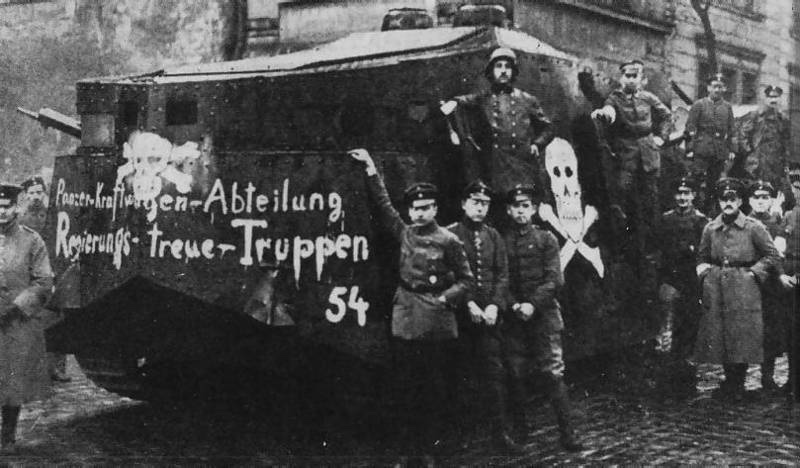
Robert Waite, “Vanguard of Nazism: the Free Corps Movement in Germany 1918-1923” (1969) – This one is an early stab at the history of the Freikorps, the right-wing paramilitary formations that arose in Germany after its defeat in World War One. As the title indicates, the Nazis recognized the Freikorps as crucial forebears (didn’t stop them from killing numerous Freikorps big shots in the Night of the Long Knives, but that’s fascism for you) in important regards, both practical and inspirational. The whole gist of Nazism — basically, mass violence to instantiate imagined past glories that the previous, duly constituted protectors of the values of bygone days were supposedly too ineffectual to regain — was indeed prefigured by the Freikorps.

In the book’s best chapters, Waite — a WWII veteran, longtime beloved teacher at Williams College, and guy who eventually tried to psychoanalyze Hitler decades after Hitler’s death — traces how the Freikorps ethos came directly from elite formations in the WWI-era German army. Units of “stormtroopers” deployed to stealthily and violently overtake enemy trenches developed their own culture, separate from the German army traditions of obedience to duly appointed authority, rational planning, strict hierarchy, etc. It’d be wrong to say the stormtroopers, and the Freikorps after them, exactly subverted these ideas- they just reapplied, and in some circumstances super-charged them, to fit the extreme circumstances of the trenches (or, later, collapsed post-defeat Germany). So they were still quite obedient and hierarchical, just to the baddest dudes in their little group, not to graybeards on the general staff, eager to fight but for “the German spirit” and increasingly for the sake of the violence and not (just) because they were told, etc. The similarities between the culture of these elite troops and those of certain other elite military formations (who also failed to win their war despite their big reputations) suggest themselves readily.

So far, so cultural, and it’s worth noting that other factors, like the pan-Germanist movement, helped prepare German right-wingers for the idea that while hierarchy is always a great good, extant hierarchy might not be the most legitimate. When Waite gets into the Freikorps’ practical effects, stuff gets interesting in a different way. Put bluntly (and I finished this a while ago and am trying to clear a backlog so blunt it shall be), Waite is a Cold War liberal and a guy who believes in totalitarianism School notions, so tries to thread the needle between “the Freikorps are obviously bad” and “well, SOMEONE had to restore order in Berlin!” You can tell he has a certain affection for Gustav Noske, the Social Democrat who first called on the Freikorps, in many respects created them along with the Army generals (though I’d bet something like them would come about anyway) and sicced them on the SPD’s rivals to their left. Waite seems to see Noske, a former army sergeant himself with, errr, a substantial respect for order, as a tragic figure. If only he’d have had the foresight to reign them in somehow! Isn’t it sad how they clubbed Rosa Luxemburg to death! But, you know, there was looting, and you just can’t have that, and they did a general strike after the Freikorps tried to overthrow the SDP’s asses, that was cool, right? He cites the memoirs of Freikorps leaders sometimes as sole sources when talking about revolutionary conduct, like revolutionary sailors supposedly taking random women and children hostage when faced with the army in Berlin. It gets pretty bad in some places.

I’m used to the way a certain kind of liberal — Peter Gay did this too — lionized the Weimar Republic, the “good Germany,” the experimental Germany, trapped between Nazis and Communists, etc. The KPD made plenty of mistakes (that tends to happen when you systematically murder the best leaders in a group) but the equivalency is just wrong and I don’t think I need to belabor that point here. At least those old liberals felt the need to show their work more than contemporary ones do, and maybe meant their hemming and hawing more, meant their disgust with the right, than a lot of liberals do now when they tut tut before handing arms to the Right Sector or shaking hands with whichever ghoulish politician. So you get chapter and verse, as best as you were going to get with the available sources not so long after it happened (about the distance the late seventies is to us now), about the many, many extralegal murders the Freikorps did. When they stormed cities held by workers and soldiers councils, they just massacred people, hundreds of people per city. In cities without ongoing uprisings, they routinely murdered union organizers, politicians, and poor random people who “knew too much” throughout the years Waite covers. Nobody did anything. Almost none of them went to jail, and fewer still for serious time. The SDP, who had militia of its own, never really took the fight to the right, and by the time the KPD got big enough, the Freikorps had metastasized into the Nazi Party, a mass movement with support from elites. It’s grim.

“The Proud Boys and the Oathkeepers, they’re no Freikorps!” I can hear some of you say. Well, take what comfort in that you can. They clearly want to be- they dream what the Freikorps did. If you told a German of 1913 vintage that clubs of demobilized soldiers and their college student groupies were going to kill thousands of civilians in Germany proper in a few years, they wouldn’t believe it, either. All it took was the right crisis. I intend to keep our local fascists in a place where they can’t take best advantage of the crises we know are coming down the pike. Let’s keep them wannabes. ****
Review – Waite, “Vanguard of Nazism”

Review – Allen, “The Nazi Seizure of Power”

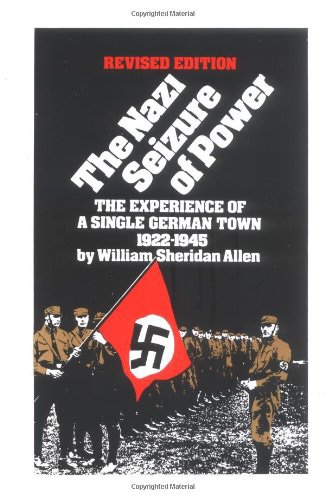
William Allen, “The Nazi Seizure of Power: The Experience of a Single Nazi Town, 1922-1945” (1965) – The town of Northeim is more or less smack dab in the middle of Germany, in what’s now Lower Saxony and what used to be the Kingdom of Hanover. Historian William Allen insisted that Northeim was not truly “average,” whatever that would mean for a town. But Northeim was typical enough for Allen to use it as the basis for this social history/historical sociology of Nazism, especially focused on how the Nazis took power. Apparently when this book was first published in the sixties, they gave it a fake name? But now it’s just Northeim.

With Teutonic thoroughness the inhabitants of Northeim kept meeting notes of their various parties and associations, newspaper archives, diaries and so on, for nosy Americans to eventually mine and figure out what’s wrong with them. At first, Northeim seemed about as good of a Weimar-era town as you were going to get. There was a little freikorps versus communist action early on after the war, but after that, things settled down. The working people — Northeim was a railroad town — supported the Social Democrats, the burgers supported various burger parties from weird Hanoverian particularists to the People’s Party. They didn’t get along, didn’t really interact, but the SPD was determined to make a go of this parliamentary governance thing and for the time being so were most of the others.

The Northeim Nazis, as Allen depicts them, possessed a deadly combination of traits that no one saw until it was too late: an ability to play to the deep loyalties of most Northeimers, especially religion and nationalism; and a complete dedication to winning power at almost any cost. Those two went together- Girmann, the local Nazi chief, despised religion but was perfectly happy courting the town’s influential Lutheran clergy… until he was in power and didn’t need them anymore. There was seemingly no limit, ideological or practical, that the Nazis set on themselves, in the way both the bourgeois parties and the Social Democrats did (the Communists enter into the story of Northeim too late and in too small numbers to really compete as they did in other parts of Germany). I do wonder if that would have applied to compromising the core of Nazism, antisemitism, but Northeim had few Jews and according to Allen, antisemitism was not a major part of their campaign to win the town over.

In Northeim, two forces could have stopped the Nazis. One was the petty bourgeoisie letting the Nazis in and giving them cover. The original leadership of the local Nazis consisted mostly of small business types, clerks, minor professionals and the like. The higher ranks of burgerdom in the town didn’t necessarily like the Nazis, but they didn’t hate them enough to expel them, giving them a foothold- and plenty of them liked the idea of a counter to “the reds.” That would be the other force that could have stopped the Nazis, the SPD. They had a well-organized militia in the town, the Reichsbanner, that successfully fought the Nazis several times in street battles. But they never got the call to arms to really go out and deal with the Nazis. That would have had to come from above. The national SPD, committed to parliamentary democracy as the way forward and terrified of more radical forces to their left and their right, wasn’t about to give the order. Redline after redline passed, until in 1933 it was too late.

The Depression opened the door to the Nazis, in Northeim as elsewhere in Germany, but not in the way one would think. The unemployed didn’t stream into the ranks of the Nazis- maybe a few did, but most either went Communist or just didn’t vote. The Depression didn’t gut local businesses, either- the railroad held on, and so did the businesses that serviced it. It was, again, the ordinary townsfolk of Northeim and especially the bourgeoisie (and farmers) who saw some unemployed people and strikes and decided that what was needed was order. Someone needed to bang heads and make things go right, and the Nazis promised to do that. Especially with the SPD chained to failed Weimar policies, including supporting borderline dictators like Schleicher and Hindenburg, the alternatives were dim, not like the local burgers were going to cross over to even “reds” as dim as the SPD at that time.

It turned out that the Northeimers liked the parts of Nazism that aped things that were popular everywhere, including New Deal America- public spending to put people back to work and slap up some fresh coats of paint. They could assent to the mass public rituals they were expected to participate in, and didn’t seem to much miss their free associational life. They grew tired of the Nazis, Allen shows in the short last part of the book, which covers the actual Nazi regime. They didn’t like being bullied by gangster-ish randos like Girmann, but by then it was too late, and the habit of obedience to those who summoned up the values of the fatherland smoothed the rest of the way to 1945. I wonder if any Northeimers were with the SS, and if their idea of Nazism, the war, and what it meant might be different. The East really was where Nazism expressed itself fully.

The decent people had to stop the Nazis, Allen declares at the end. True, I suppose, but what makes somebody “decent?” It seems that Allen mostly meant “willing to color inside the lines of bourgeois democracy.” Maybe if he meant “committed to … bourgeois democracy” it might make more sense, but that would be a much smaller number of Northeimers, including many allowed in all socially “decent” homes. It might basically have just been the SPD and a few nice liberals, and could they have stood against the reactionary elements of the area? I don’t think Allen set out to reinforce the class war elements of the rise of fascism, but he was an honest enough historian that he couldn’t help it. Moral of the story, you can’t trust the bourgeoisie to keep the Nazis at bay, and you probably can’t trust socialist parties participating in bourgeois democracy to do it either? Robust popular organs of self-defense, I guess, is what it comes down to, if you can’t prevent the conditions that give rise to Nazis- and robust popular organizations generally help prevent those conditions, too. ****’

Review – Allen, “The Nazi Seizure of Power”

Mahoney – “Gothic Violence”

I entered “dullard Bachelorette contestant” into GIS and got this

Michael Mahoney, “Gothic Violence” (2021) – In case you go looking for it, the author of this book goes by “Mike Ma,” and is a D-list fascist social media figure, a former running boy for Milo Yiannopolous (one only wonders what absurd abuses Yiannopolous would make a notionally straight dumbass go through to belong in his circles; and one is much more shaken by the knowledge that whatever Mahoney did for Yiannopolous, it was likely more honest and less demeaning than anything else Mahoney had ever done). I don’t play with these fascists and their nicknames- when I reviewed Mahoney’s last book, the worst book I read last year, I hadn’t bothered to google him. I saw Mahoney give his new novel five stars and beg for purchases of his self-published work and reviews to help further juice sales, but only by people who had read it, he insisted. Well, who am I to deny such a cri de couer? Especially when I can illegally download the book online (if Mahoney wants one red cent from me, he can come find me in Boston and have the “authentic experience” he is always whining about trying to get his thirteen-twenty-nine)?

At first, I was thinking this one might be better than “Harassment Architecture,” Mahoney’s prior and first literary effort. After all, “Gothic Violence” has a plot, which should be a marked improvement on its predecessor, which didn’t really have one. “Gothic Violence” follows a Mahoney-Marty-Stu narrator character who belongs to a group of Florida-based fascist surfers who use violence of various kinds to disrupt our corrupt social order. “Surf Nazis Must Conquer,” or, a callow brain-damaged Chuck Palahniuk’s take on “The Turner Diaries” – doesn’t sound good, sounds better than “Harassment Architecture.”

Well, Mahoney manages to disappoint even these low expectations. He can’t concentrate on a plot because he fancies he has important things to say. He thinks he’s an aesthete and a philosopher. So you get long (this isn’t a long book, but still) passages of undergrad writing workshop-style prose describing dreams and visions, interspersed with what there is of the plot and various manifesto-style passages about this or that thing that bothers him (his trans panic, a lot of stuff about lifting weights and drinking raw milk). It hasn’t got much more focus than “Harassment Architecture,” even with the notional inclusion of a plot.

Mahoney attracts attention for his prominence on “accelerationist” social media (“accelerationist” was a lefty thing, for a long time, still is in some quarters, but has mostly migrated to the fascist right- like “libertarian”). To the extent there’s a point to all this, it’s the destruction of our social order through violence and terror and the reemergence of “natural” “strong” men, our natural leaders, yadda yadda. Would these strong natural men have as much patience as Mahoney seems to expect they’d have for his shitty maunderings, or would they whack him with a stick to stop the noise? The idea that anyone even remotely close to an ubermensch, however defined, would want to bother with books like this isn’t the dumbest part of the “might makes right” apocalypse scenario, but it’s the part I thought about most often.

At the end, after his gang routs the system from Florida, the Mahoney-Marty-Stu wanders the beach and encounters a magical hangman who makes some dumb speeches, and then Mahoney makes his own little speech (he doesn’t indicate the hangman hangs around to listen- the closest to realism this book gets) about how whether damned or saved, he will never be ordinary (he says “average,” because he is stupid, a bad writer, a worse “traditionalist,” and can’t help but punt to rationalist-statistical language, even at the apotheosis of his transcendence- what he means is ordinary).

The only way in which any of this — this book, Mahoney’s performance of self, the whole tableau — could be regarded as anything other than ordinary is that it’s unusually shoddy, amateurish. Even then, it’s probably about ordinary for self-published work in that regard, too. He cribs flagrantly from a cheap list of recent literary figures — Palahniuk, Brett Easton Ellis, Tao Lin — that rank high among both the noxious cultural weeds (I have some time for Palahniuk but he probably hasn’t been good for literature) and the commonest role models for young men who fancy themselves literary. He can’t help but make fussy little points about lifestyle while he’s trying to pretend to be above it all. Completely predictable ones, too, for deeply insecure boys of his generation: lifting weights (why always lifting? Sheer muscle mass won’t help you that much), undercooked meat, old clothes, the usual mask-off context-collapse “I need to bolster my manhood and don’t care who notices how frantic and embarrassing my efforts in that direction are” stuff. Celebrity culture stuff, can’t keep himself from that, either- weirdly old, too, he was born in the nineties but obsesses over The Strokes, of all bands- are they retro, now?

Above all, you see the desperate desire for self-expression, the utter incapacity to get a point across, the dim quarter-awareness (less in the content than in the tone) of the bourgeois boy raised to believe that he has things to say that, in fact, he has nothing at all in his mind that’s worth the breath coming out his lungs, not that that’s going to stop him. That combination is as ordinary as grass, and has a banal origin: we didn’t tax his parents enough to force him to work for a living. Just another thing for us to fix- stick it on the list. ‘

Mahoney – “Gothic Violence”

Review- Neiwert, “Red Pill, Blue Pill”

David Neiwert, “Red Pill, Blue Pill: How to Counteract the Conspiracy Theories That Are Killing Us” (2020) – Dave Neiwert has a possibly unique reputation in antifascist circles- he’s a liberal, a “lib” who is skeptical of militant antifascism, but all the serious antifascists I know admit, without any grudging, that he knows his shit. He’s been following the far right for years, does good research, and doesn’t go beyond the research (for instance, into having a great many opinions about antifascism that he expounds upon, as many liberals do with less basis).

His new book is about conspiracy theories and there’s good reason why. It’s goddamned everywhere and anyone my age or older has had the creepy experience of watching conspiracy theory migrate from the drolly amusing margins of life to the center. It’s especially hard on liberals, who put so many chips on the idea that a rational, informed public can steer public life without much in the way of dangerous mucking about with power structures. The rise of Trump and QAnon is like a zombie movie turned real to them. Hell, I’ll admit, I’m not so far from liberalism — or maybe just the idea that the sort of irrationality and fanaticism you now see cropping up in the Trumpist/QAnon/antivaxx/CRT-panic formations is a “those people” thing, something for the South or abroad, not a thing that would affect New Englanders or people who remind me of New Englanders — to be unable to relate.

Among other things, Neiwert makes an interesting point- conspiracy believers have undertaken virtually every mass casualty attack in western countries for the last twenty years. Incels, “white replacement” Nazis, he doesn’t mention them but ISIS guys usually believe conspiracies, too. That’s a relevant fact, but Neiwert doesn’t push it too hard- after all, more and more people have been drawn into the world of conspiracy theory (not talking about thinking something is fishy with the Warren Report or that Epstein didn’t kill himself, but hardcore world-organizing conspiracy theory) and most of them don’t do any violence. We could also point out that when you leave the twenty-year cutoff, mass shootings seem orthogonal to conspiracy thinking- I’ve never heard that the Columbine killers or other school shooters of that era were particularly into conspiracies, for instance.

Mass shooters are the tip of the iceberg. Since conspiracy theory lurched towards the center of right-wing politics, conspiracy theory can do even greater damage when it winds up behind the wheel of policy. Immigration, climate change, the basic administration of justice and basic governing functioning… as the Republican Party enters into a dynamic where it needs to feed its conspiracy-mad base more and more red meat, who’s to say how much can get thrown into a cocked hat by conspiracy-inflected thinking?

And this is where Neiwert slips up, and where his liberalism, no impediment to seeing the problems of the right, trips him up. Advice on trying to deprogram your conspiracy-minded family and friends dominated the last part of the book. It’s fairly sensible stuff about being empathetic but firm, giving them alternative stuff to believe, dealing with underlying hurts, etc. You can see why people whose relatives have been stolen from them by Fox News and Infowars would want that advice. But it isn’t a meaningful political solution. Neiwert even grants that it’s dicey enough as an individual solution. But it seems to be what liberalism offers.

Not to be a broken record, but I’ll stake a claim: it’s about power. What will break the grip of conspiracy? Maybe stuffing every Fox News casualty’s mouth with gold could do it, reassure their anxieties, but A. certainly not for all of them and probably not for enough of them and B. The pricks they vote in won’t let us do that until we have enough power to actually overthrow them. Really, I think, especially given the linkages between conspiracism, authoritarian politics, and authoritarian cultural strains (there’s also an “authoritarian personality” supposedly, and I can believe it, but that’s not my field), there needs to be an alternative pole of power that can command allegiance, respect, or failing those, silence. It doesn’t have to be the silence of the censor: the sullen silence of knowing you’ll be laughed at for your challenge will do it, at least keep the conspiracists on the margins where they belong. And if you have that kind of power, you don’t need to worry that your whole setup can be knocked down by a senile ex-game show host and his febrile fans. That’s what we need- to the extent nice conversations with your chud relatives can help build that, good. To the extent they can’t, well, we know where to drive the old cart and plough. ****

Review- Neiwert, “Red Pill, Blue Pill”

Review- Jünger, “The Worker”

Ernst Jünger, “The Worker” (1932) (translated from the German by Bogdan Costea and Laurence Hemming) – I used to think I was clever, telling leftists how much they had to learn from reactionary sources. I don’t think I was wrong, really, but there’s definitely diminishing returns. I guess I just like sampling many kinds of ideas and writing and wanted a rationale to get friends on board. Maybe a better rationale is that if you expand your knowledge-base you get a broader and more flexible idea of how thought works. You see patterns you might otherwise miss. Dump a bunch of shit into the hopper and see what materializes.

Ernst Jünger typically yields fewer excuses for reading than other right-wing figures, because he’s been assimilated as a “literary” figure, largely on the strength of his First World War memoir/novel “Storm of Steel” and because his politics were pretty heterodox. But he was definitely “in the mix” of fractious ideological politics in the interwar period, hovering around the Conservative Revolutionary faction- antidemocratic German nationalists who were a bit too aristocratic and intellectual for the Nazis (who wound up stealing most of their thunder). Jünger wasn’t much of a joiner, it seems, though good biographical material on him isn’t easy to find in English. Not being a joiner is one of those things that might make it hard to get into print, but sometimes adds staying power to the works that do make it- and avoiding joining the Nazis, as Jünger did, was a pretty good move. They liked him (mostly), he didn’t like them, though was perfectly willing to cooperate with them when they were in power.

On the eve of the Nazi takeover, Jünger published an ideological/philosophical polemic, “The Worker.” Jünger studied entomology and practiced photography at high levels, along with writing and war. His eye attuned to arresting images and subtle categorization schemes combines with his immersion in German philosophy to produce a strange, unsettling, fascinating work.

The basic thrust of “The Worker” appears to be this: far from workers being defined by their relationship to the means of production, what makes a worker is a sort of existential status, conferred not by power-relations but by what could be called task-relations. Roughly, if your life is organized around tasks, you are a worker, in Jünger’s conception. The worker stands in contrast to the bourgeoisie, whose life is organized around self-image, more or less, and security. The bourgeoisie is individualist and thinks in terms of his rights and obligations, even when trying to organize collectively- this is how Jünger dismisses Marxism. The worker thinks collectively even when expressing himself, always thinking in terms of getting the job done.

Technology and politics make the eclipse of the bourgeoisie by the worker inevitable, Jünger argues, and cites rapid industrialization and the First World War as proof. As technology and social organization grows in complexity, the politics that governed past orders become obsolete, and so too do the people that populated them. There’s a lot of philosophical back-and-forth here about forms, types, and dominion, in the way that continental philosophy has with its terminologies. The situation is too dynamic to be specific — Jünger is often maddeningly unspecific and probably often elliptically refers to figures in German life at the time that I don’t know about — but he confidently proclaims that the dominion of the worker — meaning the imposition of the form of the worker, a social order defined around him — is at hand. Moreover, this is tied in (again, largely elliptically) with Germany’s rising from the ashes of its defeat in the war and ending the Weimar/Versailles order.

There’s a lot more to it than that, and there are interesting nuggets and graceful turns of phrase all over this dense book, but that’s the basic gist. He applies his ideas to art and to politics towards the end, all the time coming to the conclusion that man, as conceived of by the bourgeoisie nineteenth century, is all over, that something determined by “the work character” will replace him. Well… is he wrong? I do sometimes make a game of thinking about how I would interact with people from the past. The more I learn, the harder it seems like it would be to communicate with people from even relatively recent history. People, especially bourgeois, educated people, were supposed to have so many accoutrements to their personhood that contemporary people (even people with similar class backgrounds) lack…

But in other respects, of course, Jünger really whiffed the predictive aspect (though he was sufficiently vague that he could’ve raised an eyebrow and say- “did I??” On top of everything else, he lived to be 102!). You can argue that American power (and a lot of Soviet power too) devoted itself in the post-WWII period to suppressing the unholy “dominion” of obsessive, death-and-discomfort-disregarding task-completion-ends-before-means ubermenschen Jünger foresaw. The consumer, not the worker, became the central figure in America’s world-building project, and the Soviet Union, dedicated (in Jünger’s telling) to a fake socially-conscious Marxist idea of work, tagged along. To the extent anyone today on the right reads Jünger and gets past “Storm of Steel” to this work, they mostly see “The Worker” as something (something nicely, technically non-Nazi) to which to aspire, something that has yet to happen.

Jünger lived the life of the scary early twentieth century cultured, amoral ubermensch, from war hero to literary star to guy who scared the Nazis while not deviating from his own eccentric but right-wing politics to extraordinarily long-lived and productive literary institution. Arguably, he lived it longer and more categorically than anybody. I don’t generally think people in the past were better or smarter than people in the present (or vice versa), but I do think that shifts in context change what people look and act like. They really don’t make people simultaneously that educated and, for lack of a better word, crazy anymore. Our contemporary meritocratic bourgeoisie likes to pay itself in the back for its SAT scores but they couldn’t touch Jünger or millions of others like him across the global bourgeoisie in the nineteenth and early twentieth centuries. Unlike a lot of the crazy, absurdly well-educated people who made life so interesting, Jünger was also actually smart- perceptive, adaptable. That didn’t mean he was right about things, but he was smart.

So I’m not trying to dunk on the guy, or any rate bag on his brains, when I say that in a lot of parts of “The Worker” I found myself thinking about two contemporary figures: Elon Musk and Mike Rowe. In terms of intelligence, sensitivity, culture, capacity for expression, there is no meaningful comparison between those two utter dullards and Jünger. But Jünger himself makes clear that the task is what matters, and capitalism harnessed task-centric thinking to its own machine for producing legitimacy. Given his denunciation of the fineness of bourgeois distinctions and the “museal” quality of culture the dying bourgeoisie produced, how could Jünger complain if something rather a lot like his “total work character” or “typus of the worker” gets dumbed down (that is, rendered into an effective tool for a task) into the sentimental, emotive American idiom and sold to schmucks by the bourgeoisie to get them to work harder, disregard safety regulations, absolutely refuse to unionize? Jünger rather pointedly ignores America in “The Worker.” But the idea that the “real” class distinction is between those who do the work and those who don’t, and that management and labor are on the same side against whoever… well, Jünger would no doubt quibble, or else fuck off on a hike to take acid (he was friends with Albert Hoffman!) and collect bug samples. Being a continental ubermensch of Jünger’s vintage means never having to say you’re sorry.

Like I said, none of this is to draw a straight line between “The Worker” and Musk’s bro-Pinochetery or Rowe’s abject “dirty job” cosplaying. It’s highly unlikely either have read Jünger or would understand this book meaningfully. Rather, and here we get back to the beginning of this review, I think it’s useful, or anyway poignant and interesting, to look at how ideas and tropes migrate, appear and reappear, in varying contexts according to disparate but often related logics. Broadly speaking, Jünger and Musk face some of the same problems — legitimizing hierarchy — in radically different but genetically/temporally related contexts. The differences in context are many and don’t need explication beyond pointing to the vast decline in literary standards between the thirties and now. The similarities include a widespread disbelief in established authorities on the part of classes that are supposed to support them and a prevailing sense of emergency. What do you need in an emergency? Jünger makes nods to Carl Schmitt’s “state of exception” towards the end of “The Worker,” Musk just tweets about coups. Tragedy, farce, etc.

I suppose, to subcategorize like “The Worker” with Jünger would a bug, we could say that both Jünger and Musk attempt to make effort — putting in the hours, as CEOs are indeed wont to do, sometimes — the marker of a worker’s legitimacy whilst avoiding much of, if not all, of the sentimental baggage previous iterations of the same concept carried. Neither Musk nor Jünger are/were your father’s management hack. No gold watch at retirement, no cuckoo clock, no country songs. What you get are appeals to youth, force, power, the future (which in turn validate the “cooler” aspects of the past). Of course, with Musk, things are just stripped down to their lowest common denominator appeal, whereas in “The Worker” you have a product of high-end (if occasionally fatuously) European thought… I know which I prefer, but I also know what does “the work” it was intended to do at this moment in time. Ah, well. *****

Review- Jünger, “The Worker”

Review- Darby, “Sisters in Hate”

Seyward Darby, “Sisters in Hate: American Women on the Front Lines of White Nationalism” (2021) – A fair few new books on contemporary American fascism and antifascism lately, which I’d be interested in reading even if I weren’t working on my own book about it. Seyward Darby works as a journalist, a contributing editor at The New Republic, and got extensive access to three of the most prominent women on the contemporary American fascist right. There’s Corinna Olsen, a former leader in the National Socialist Movement, the American Nazis who go the most out of their way to imitate genuine German Nazis of the 1923-1945 era. There’s Ayla Stewart, a leading white nationalist “tradlife” influencer online (the “what is tradition” question among your “tradlife” folks is so muddied I’ve given up worrying about it). And lastly, we have Lana Lokteff, a sort of younger, more-openly-Nazi Ann Coulter figure and cohost of the Red Ice podcast. All three, by interesting coincidence, were born in that year of years, 1979.

What can these three tell us about white nationalism and women’s place in it? That seems to be Darby’s thesis question. Good student she presumably once was, she dutifully returns us to the thesis question at points in most (all? I didn’t keep track) chapters, and answers “yes, Virginia, white women were always important to white nationalism.” That was a rude way of putting it, stemming with frustration with how little I’ve read lately, even good books, surprise me, in form or content. Darby’s thesis is both true and more involved in that. The role white women have historically played in white nationalism is that of normalizing the ideology. From the antebellum South to the Klan revival in the nineteen-twenties to the online influencers of today, white nationalist women do their best to associate their hateful, deadly ideas with home, hearth, children, nurture, and (a carefully modulated, don’t want any loose women here! Except when nazi men actually do) sex appeal. More than marketing (though it’s definitely also marketing), these concerns of white nationalist womanhood tap into the deep concerns of racism more generally, the notion of a zero-sum world of racial total war where the “home front” is of paramount importance.

The three subjects illustrate these dynamics and how they work today in different ways. Olsen is somewhat the outlier (Darby refers to these women by their first names throughout- I’m weird about that and so will stick with surnames. They are not my friends). If she participated in efforts to normalize all-out Hitler-imitative Nazism, it was only in comparison to what the men were up to. She was a lost Gen Xer (as were all three women, to a certain extent) in the Pacific Northwest when she got swept up in Nazism, specifically, to the promise of Kalispell, a whites-only intentional community out in the mountains. She liked the idea of getting into a primal, folksy domesticity (I found myself thinking of “Midsommar”) with her two daughters (the dad was out of the picture). Olsen also tolerates bullshit a lot less than the other two, and quit (giving information to the FBI in the process) after Nazi men routinely sexualized her daughters. She converted to Islam not long before Darby contacted her.

Lokteff and especially Stewart are closer to the thesis. Stewart identified as a feminist whose big thing was natural birth. Soft-leftism and relatively defensible but kook-adjacent positions, along with a desire for more attention and a lack of real values, led her down the primrose path to what was then called the “altright.” She joined an extra-conservative Mormon sect, started cranking out kids, and brought her white nationalist message to the “mommy blog” space. She took to the tropes and the conventions of the space — pastel aesthetic, aspirational lifestyle-ism, nostalgia, passive-aggressive sniping at other mothers, and most of all, the shocked, shocked! aggrieved tearful defensiveness that anyone would object to her ideas — like a fish to water.

Lokteff, for her part, also started out vaguely left-of-center. Granddaughter of an emigre from the Russian Revolution (let’s pause and pour one out for nana’s stolen serfs) and also raised among a lot of vaguely spiritual nonsense, she got into white nationalism via the sort of aimless skepticism that characterizes… some people, we’ll leave it at that. She had a kid around the time Darby started interviewing her (commenters on her shows let her know how she was failing the race). She couldn’t do the domestic goddess thing Stewart does, but she could do the “I’m a woman who likes ‘traditional’ masculinity” thing. Interesting, given the way she has, in many ways, sidelined the Swedish Nazi she married and whose show she basically took over, but that’s how it goes. How must Phyllis Schlafly’s husband have felt? Fine, probably, the prick.

At this point, faithful readers must be as used to me bringing up the shortcomings of liberal analyses of fascism (and antifascism) as I am of the theses in these thesis-heavy books I read. Well… tough. The shortcomings in “Sisters in Hate” aren’t damning and the book is still well worth reading. They can be summed up as the effects of a liberal understanding of politics as having more to do with personal affect than it does. Such an outlook probably makes for better profile-writing than a more rigorous outlook might. I look at these three women and see marks. I want to know how they can affect a strategic situation and how best to neutralize them. But they are, indeed, humans (Nazis are human- just bad humans). Darby brings that out in discussing their assorted personalities: Olsen’s sharpness and oddness, Stewart’s desire to belong and capacity to swallow her own snake oil, Lokteff’s cynicism.

I’m not even saying Darby shouldn’t do that. I just think a more structural approach might have done more to link up these affects to the political situation, if we’re going to give them political weight- the affects and the effects, if you will. For example, it would have been cool to spool out more the historical context, given they were literally all born in the same year. This critique extends to the solutions- can’t have a liberal political book without some solutions! These mostly involve white women doing the work of challenging racism themselves, of helping women who seem to be falling off into white nationalism, donating to ex-Nazi recovery groups (Darby cites a mediocre one, not an actively hurtful one). These suggestions are varying degrees of helpful, but don’t really get to the root of the problem. Moreover, it cuts across the grain of her thesis. She uses the metaphors of “falling” into nazism and needing a “handhold.” Did they fall, or did they walk, intentionally, into what they did (and do)? Well, as always, probably a bit of both, and prevention is worthwhile, but it deserves more of a discussion. In any event, this is a pretty good book on an underexplored topic. It’s just the critiques are a little more interesting to write (and, I’d guess, read) than “good profiles!” ****

Review- Darby, “Sisters in Hate”

Review- Vysotsky, “American Antifa”

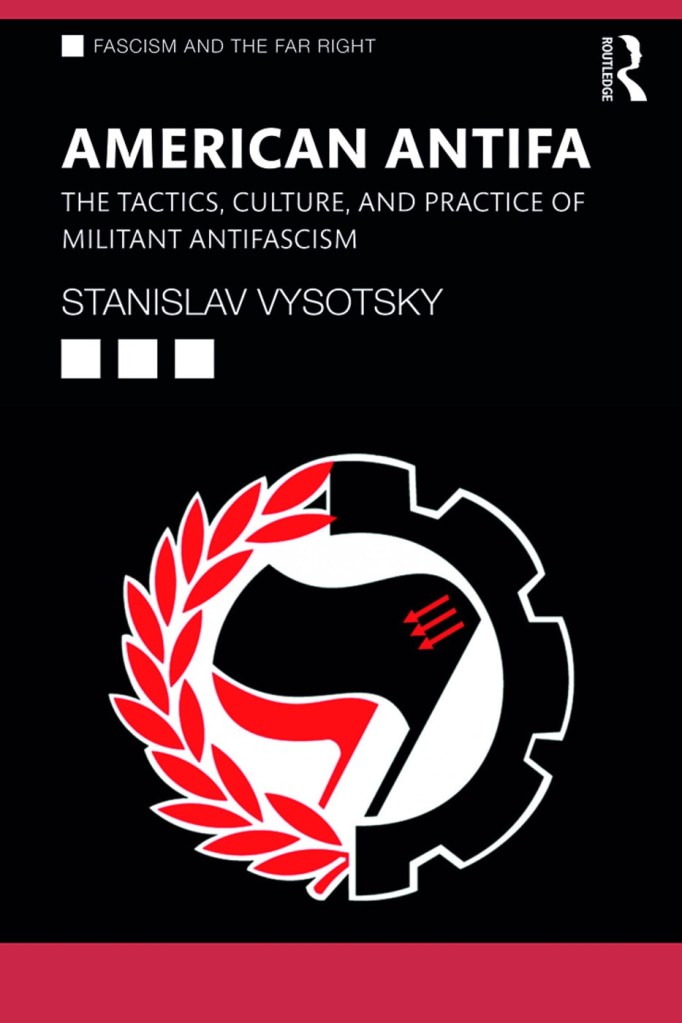
Stanislav Vysotsky, “American Antifa: The Tactics, Culture, and Practice of Militant Antifascism” (2021) – I figured I’d have a look at this new social scientific work on antifa in the US. I’m not sure what I expected but I was pleasantly surprised. It’s nice to see someone in the academic guild get something basically right about this fraught topic. The writing, predictably, plods, as social science does these days, with a lot of name checking and theoretical hedging. Vysotsky carefully classifies American antifa in relation to the literature on social movements, subcultures, etc. It’s also worth noting that Vysotsky did his primary research with antifa groups (“Old City” and “New City” Antifa) between 2007 and 2010, which is to say, years before antifa sprung into the news around the 2016 election. He has plenty to say about post-2016 antifa debates, but a lot of what he observed happened in the time when a few groups, mostly anarchists ensconced in punk scenes, were keeping the antifa thing alive.

The basic thing about antifa, Vysotsky argues, is that it is opposed to fascism. This sounds like a “duh” but given where the rhetoric around antifa has gone — and not just on the right, where it’s basically official that antifa is an underground army for communism/the Democratic Party — it is helpful to ground it some. Vysotsky describes antifa as a classic “countermovement.” The shape any given antifa group takes largely depends on its fascist opposition. Given that the research mostly took place before 2010, a lot of what this book looks at is groups dedicated to dealing with street fascists, generally open about who they are, often in and around punk scenes. This is pretty different from much of what I’ve worked on, where we deal with a range of fascists between Trump supporters and open Nazis, and are largely trying to keep their political movement from taking root in the area. But the general idea is accurate. Any antifa group that goes in already decided about what they want to look like and do, without a clear strategic purpose, won’t last long or do much good.

In any event, as Vysotsky makes clear, action other than violence — education, intelligence work, securing events, etc. — takes up more of any antifa group’s time than street fights, even for the most roughneck groups. This has certainly been true of local practice- I’m writing a book about this stuff and am worried I’ll bore audiences, there’s so little fighting. This is a nice marriage of practicality and ideology. Practically speaking, it makes sense to set some basic parameters, and within those parameters adapt your practices to the situation, when facing an enemy like fascism. Ideologically, anarchists kept the embers of the antifa flame going for a long time before it blossomed again post-Trump, and their emphasis on direct action, decentralization, and voluntarism has placed an indelible stamp on antifascism. Communist groups often participate to the extent they can hang with those values. As for us democratic socialists, well, let’s just say the decentralized decision-making structures in certain chapters of the largest democratic socialist organization stateside give us some leeway a “smaller tent” might now allow… There are times where the voluntaristic aspects of antifascist work can be frustrating, especially to the “frustrated officer” in every nerd boy. But it has answered, so far.

If anything, Vysotsky probably could have afforded to criticize antifa a little more in this book. They/we get stuff wrong. There’s infighting, posturing, ideological foolishness there the same as there is anywhere else on the left, or really in any kind of politics. Going into dangerous situations demands more organization and accountability than some organizations involved want to or can provide. But I think insofar as “American Antifa” exists as a corrective to conservative (both pop-journalistic and criminological) accounts, it is a valuable book. ****’

Review- Vysotsky, “American Antifa”

Review- Ngo, “Unmasked”

Andy Ngo, “Unmasked: Inside Antifa’s Plan to Destroy Democracy” (2021) – I know I’ve lamented before the lack of interesting voices on the contemporary right. This constitutes a problem for me on a number of levels: one of my tasks is to read this shit, good or bad, and it would be nice if more were good; historically, there have been plenty of good right-leaning writers; and I suppose some part of me still wants to find worthy opponents. I knew Andy Ngo, grifter and professional victim, wouldn’t be the guy to provide any of that stuff, when I picked up his big leap from Twitter to bound paper books. My expectations were not high. Ngo still managed to disappoint.

Remember when people talked about how slick right-wing media was, back when cable news and talk radio were still a-forming and Fox News and Rush Limbaugh were taking the world by storm? Well, presumably now that they know that their base exists in the decaying minds of the old (and the pre-decayed minds of the willfully ignorant young), it seems they don’t really try that hard anymore. Or maybe books are such loss leaders, something to give an uncle for Christmas, it just doesn’t matter?

In any event, I went in expecting slickness. I thought it would be a smooth propaganda pill. It wasn’t. “Unmasked” is a poorly organized, underedited mess. Speaking as someone who has given some thought to the mixture of reporting, political polemic, and memoirs that Ngo is attempting here, “Unmasked” is mostly a good indicator of what not to do.

The usual question in the culture at large and when dealing with the right in particular is “is this person lying, or stupid?” I asked myself that plenty of times reading “Unmasked,” but structurally, the more relevant question is often “Is Andy Ngo (and his editors) completely incompetent, or is he/are they trying to be fancy?” The ways in which this text arranges reportage, history, polemic, and Ngo’s personal story (it leans a lot on Ngo getting his ass kicked by antifa once, and his parents fleeing Vietnam after Uncle Ho stole his mom’s slaves or something) make zero sense, and there’s no introduction that tries to explain. The chapter order seems like they put them through random.org to make a table of contents, and within chapters, there’s often little rhyme or reason as to what paragraph goes where. The dispiriting conclusion I came to is that Hachette, a mainstream press (they also published antifascist Talia Lavin’s “Culture Warlords,” in the same catalog!), decided that their audience just didn’t give a damn. You’d figure Regnery might have more pride of workmanship, if not respect for their readership.

This is basically “Spooky Stories To Tell In The Dark” but aimed towards Fox News grandpas instead of towards pre-teen children. You’d figure trying to appeal to an audience that had completed their formal education, not just begun it, would make Ngo and his editors more attentive to form, not less, but alas. You could make something, not necessarily “good,” but at least interesting and provocative out of this. But no. And really, why bother? No one is reading this to learn anything, except maybe for me and some other antifascists trying to dope out what the other side is thinking.

They aren’t thinking. This is a dangerous thing for me to think- surely someone somewhere is thinking something, and if I assume they’re not I could get complacent. I’ll buy that some cops are thinking. Maybe some think tank types, and perhaps someday I’ll find an actually interesting contemporary right-wing thinker toiling away in obscurity, probably on a blog somewhere. But for the most part, no. They’re feeling and reacting. This is a Fox News segment in prose. Ever try to read the transcripts of a Fox News show? Ever try it for three hundred pages? You’re not going to get any actual thought there. The thought comes from behind the scenes- what combination of (small, often false, always decontextualized bits of) information, images, and sounds will make our target audience’s lizard brain react the way we want it to? Without images and sounds, not only does it lack anything for the human brain, but the lizard brain within the human brain is left hungry, too.

Among other things, Ngo made the baffling choice to try to do riot porn (at one point he tries to ding the left for calling it that but basically forgets his point midway through the paragraph) in text. That’s hard even for good writers. Andy Ngo is a bad writer, and his attempt to document seemingly every time a Portland teen winged a water bottle at a riot cop line just makes the whole thing tedious. To the extent there’s a method here, I guess it would be just sheer repetition to get across a sense of crisis and beat down resistance to it. It’s another Fox News standby that might work in prose from a good writer, but again, we’re stuck with Ngo.

Lying, or stupid? That question comes into play with what rhetoricians might call “ethos”- how Ngo sells himself to sell his story. The most effective post-Watergate anglophone right-wing propaganda has relied on humor. You can do gravitas and danger to get across a specific point — like “we need to invade Iraq” — but it was humor that laid the groundwork, like the meme “anyone who cares about peace is an idiot, a pussy, and a hypocrite, and poorly-dressed to boot.” Reagan’s smile, Stone and Parker’s and Judge’s jokes, the altright’s memes… well, Ngo goes in a different direction. He is completely humorless throughout. GIS reveals an older millennial who can, indeed, smile, but it’s the smile of lost livestock, not that Reaganite sneer. Ngo is harmed, not harmer. He insists he is merely center-right, whatever that means now. He probably means it, no matter how much cover he gives the likes of Patriot Prayer and the Proud Boys.

The closest thing to an intrinsic interest to “Unmasked” is in how Ngo weaponizes gormlessness. Graduate students don’t have a ton of analytical advantages beyond just time to develop them, but they’ll have an edge in understanding this: Ngo is that student who wanders into your cubicle genuinely unsure of why he got that patronizing, generous B. He deserved a B- but he wants an A- at least. He tried so hard! You can point out a few things he got wrong, some bad writing tics like overuse of passive voice (Ngo likes his passive voice). But you can’t just tell him “you said nothing and repeated cliches for five pages” without literally reading the whole damned paper aloud to him, with commentary. So you bump him up to B+ so he’ll leave your cube, unless the passive voice was so egregious you can hold on to that unadorned B.

Put a camera in your cube, and who do you think a viewer would sympathize with? The overeducated lout trying to get back to his Twitter browsing or the nice clean cut kid explaining how hard he tried? It’s precisely that dynamic Ngo tries to exploit. It’s the closest to smart he gets. Are the gormless really gormless or do they fake it for effect? One of the good lessons of the wonderful “The Good Soldier Svejk” is that it doesn’t have to be either/or. Few people are so gormless they can’t figure out basic patterns, like that when they lean into their gormlessness with a sucker, they get sympathy, or money, or better grades, and so it is with Ngo. And there’s no bigger bunch of suckers than the Fox News audience he’s cultivating.

So Ngo acts shocked, shocked! That angry people in groups he routinely denounces maybe don’t want him around and are willing to physically chase him from their presence. Shocked, shocked! That people don’t like capitalism or think maybe it has a relationship with racism. Is he really shocked, really that gormless, or is it an act meant to help get him over, differentiate him from real right-wing ideologues? Does it matter? For my money, only if you can operationalize the difference. Let know if you can.

How bad is it when a non-historian’s half-assed historical section is the best part of a book? Not a good part, mind, but it’s less actively mendacious than the rest of the book. When Ngo relates that the East German government made a big deal out of being antifascist while deploying the Stasi (the ORIGINAL cancel culture!) against its people, does he actually think that has anything to do with antifa, or is he being cynical? Who cares. One place that seems to hint against gormlessness is his consistent habit of misgendering and deadnaming. If he was that simple and non-ideological, Forrest Gump with a GoPro, he could show some basic respect. He doesn’t even bother with fun conspiratorial cork board stuff! Just notes Democrats are less febrile about antifa than Republicans and that the NLG bails them out of jail. Jesus. When you can’t even bother with that, what can you do? ‘

Review- Ngo, “Unmasked”

Review- Allen, “Skinhead”

Richard Allen, “Skinhead” (1970) – My readings on the right have brought me to this underground cult classic. It is part of the “youthsploitation” wave of pulp novels of the era, where cheap publishers rushed out material on the range of youth subcultures then making the news. Many of them were written by a middle-aged alcoholic Canadian hack named James Moffat, who wrote under numerous psuedonyms, including Richard Allen. As Allen, he wrote a dozen-odd skinhead novels that became quite popular within the subculture and became both passed-around artifacts and subjects of artistic parody.

No one has ever accused skinheads of being the most sensitive readers, and part of me is a little surprised they took to these books the way they did, given the undisguised contempt the author has for the subculture. For Moffat/Allen, skinheads were a symptom of modern culture gone awry, barbarians at the gates of a civilization too weak (due to egalitarianism and the welfare state) to fend them off. At the same time, he has a sickly fascination with the virility and violence of Joe Hawkins, his skinhead main character. Joe is something of an East End ubermensch, who takes what he pleases, be it blood, money, or sex, with violence and cunning. He does lose a fight or two but always gets revenge. One can see how the character would appeal to a certain type of young man.

This book was published in 1970, relatively early in the career of the skinhead subculture. As such, the politics involved were much more muted. Joe and his friends are racist and hate hippies and radicals, to be sure, but they care about beating up black people and Asians about as much as they care about beating up rival soccer fans. Moffat/Allen doesn’t seem to really make the connection between his preferred social order, where men are real men, hierarchy is gladly accepted, and Britain is great again, and the sickly fascination he has for Joe’s violence against shared enemies, but others would, and I wonder if the author does in later books.

Moffat/Allen clearly had some pulp writing chops and the novel zips right along. I don’t think I encountered a single sentence where the only verb was a variation of “to be,” a good sign for pulp. But there’s two major problems here that prevent me from recommending it as (highly, highly “problematic”) fun. The first is the author’s ideological hectoring. No one was (is, afaict) as attached to orderliness and The Rules as the Anglo-Canadian pedant, and Moffat/Allen makes sure to point out for every bad thing happening (which he leers and drools over), there is a social welfare policy encouraging it. This attachment to order, presumably, is what prevented him from seeing the Joe Hawkinses of the world as allies, as later far-right nerds would. More importantly, there basically isn’t a plot. The book begins with a depiction of Joe’s father and his corrupt docklands milieu, where faux-radicalism and pilfering go hand in hand and dock leaders plan strikes for malicious reasons. I thought that it would end with the skinheads attacking strikers. That would have been interesting and have dramatic unity, but no. Instead, Joe just does a bunch of crimes and gets away with them, the end. I guess that’s all you need for “youthsploitation,” but I prefer my voyeurism to at least have the decency of a plot. This is an interesting literary artifact but that’s about it. **’

Review- Allen, “Skinhead”

Review- Faye, “Archaeofuturism”

Guillaume Faye, “Archaeofuturism: European Visions of the Post-Catastrophic Age” (1998) (translated from the French by Sergio Knipe) – It’s been a while since I read an actually interesting book by a fascist. Guillaume Faye helped lead the French Nouvelle Droit in the seventies and eighties. To simplify greatly, the Nouvelle Droit exemplified the possibilities of the “suit” strategy in the far right’s “suits and boots” dichotomy. They were very “intellectual” fascists (they didn’t like being called fascists, but fuck them) looking to change politics by changing culture. The Nouvelle Droit achieved a great deal of visibility and prominence for a while in France, where they like their intellectual novelties. But it was in terminal decline for a while by the late nineties, with Faye having jumped ship some time before to work in mainstream media.

“Archaeofuturism” was Faye’s return to far-right political writing. In it, he attempts to both right the ship of the French far right and inject energy into its project. The Nouvelle Droit went wrong because it got too academic, too self-obsessed, too weird, Faye argues, citing in particular erstwhile ally Alain de Benoist’s odd religious ideas- pagan, anti-Christian, but friendly to Islam. Catastrophe is coming, Faye declares, and modernity, defined here as the combination of industrial society and egalitarian culture and politics, is doomed. One way or another we will get “archaeofuturism” – a return to archaic cultural values, social structures, and politics combined with ever-advancing science and technology. The role of the French (and broader European) far right is to help usher in and eventually rule the brave new archaeofuturist future.

Faye’s not wrong about catastrophe. As expected, he gets the valences wrong. The threat of climate change, the major thing he is right about, looms over the book, but typically low down on the list of things Faye worries about. Similarly, Faye highlights the rise of inequality, unemployment etc. He shared the anticapitalism of the Nouvelle Droit, which is to say, he was rhetorically opposed to capitalism’s culturally disintegrative tendencies and the rulers it promotes and pays lip service to its actual problems, while sharing many capitalist assumptions about worth and merit- the usual weak sauce bullshit of right anticapitalism.

But this is a right-wing book, after all, so his big worry is demographics, basically “the great replacement” the right goes on about. He takes it as given that European values and culture reside in some bio-mystical way in European genes and European land, and that allowing non-Europeans in means the death of Europe, etc etc. Islam plays the big boogie-man here, and as you often get with demon figures, there’s an admixture of admiration here. Islam, in Faye’s telling, is still a healthy, vibrant, “macho” culture, unlike weak, sickly, feminized, “ethno-masochist” Europe. If he didn’t see Islam as backwards (and wasn’t as attached to his European nativity), Faye might join his old pal de Benoist in being sort of positive about it. Of course, Faye lumps all billion or so Muslims together as sharing the same agenda, a real laugh after the last decade and a half of struggle within the Muslim world. Same with colonized people all over- they all want revenge on the colonizer and will get it through immigration. Faye doesn’t do subtlety or nuance.

Catastrophe will force archaic values to re-emerge, whether anyone wants it or not (Faye sees it as devoutly to be wished). Modernity, Faye argues, brings on the catastrophe, not so much through capitalistic profit motive but from its utopian promise that everyone can get along and live well. The planet can’t sustain it and people don’t want it- they want to advance their ethnic/religious interests, says Faye. Everything is ideology, for him and many on the far right. When modernity collapses, archaic values — hierarchy, order, valorization of warriors, a cyclical view of history, etc — will reimpose themselves upon the survivors. Faye waxes rhetorical about this at various points. He’s smart enough to avoid the usual “traditionalist” trap of valorizing everything old, or defining which culture’s folkways are really traditional and which aren’t (most of them are actually not that old in any event). Instead, Faye enlists the right’s best philosophical player, Nietzsche (and yes, he was on the right, sorry, don’t at me), and Nietzsche’s definition of the archaic values of classical Greece and Rome. That’s what we’ll all go back to, he says, though he also sees archaic values as those of medieval Europe, which doesn’t make a ton of sense and seems like a soupçon thrown to traditionalist Christians.

So does all this archaicism mean a return to archaic modes of production and technology? Yes and no. Probably Faye’s most important point and what really gets at the nut of what he contributes to the contemporary far right is that the great inequality for which the right should both prepare for and strive for is inequality in access to the fruits of science and technology. Most people should live at a roughly medieval technology level, Faye argues, but a minority should live with ever-advancing technology. Only a minority can truly benefit from technological society anyway, Faye insists. Any guesses as to the racial composition of who gets to follow a donkey cart and who gets to see the future? Well, here Faye vacillates a little. In some versions envisioning a racial hierarchy where whites and maybe East Asians get to live in future-world and browner people toil, more or less happily, in the primitive level they supposedly belong to, in others, every continental bloc/empire (it’ll all be empires, you see) will include both techno-people who run everything and a majority of happy peasants doing their folk dances in the villages, including the “Eurosiberian” empire he envisions.

This is, of course, daft, and has the classic tell of daftness (on the right, left, and center) that is overschematization- everything in the archaeofuture is clear, all could be understood easily from a simple map (like one for a video game) or PowerPoint presentation. It’s as utopian as the most hippie-dippie soft-left daydream and considerably more so than most Marxist ones, as it basically handwaves away any question of the means of production, as in, “where does the food come from?” or “where are the raw materials for all that tech coming from?” or “who cleans the toilets in the pristine future-cities?” Presumably, the peasants are farming, but Faye makes clear: intercourse between technoworld and peasant-lande is to be strictly limited, if not altogether forbidden.

Faye doesn’t bother with any of these questions. Part of this is that technology is just supposed to figure it out. The other part, I think, is more important. Faye humble-braggingly insists he’s not laying out a dogma or a plan, that the right of the future will have to sail the seas of uncertainty. That’s a smart move, both rhetorically and because it leaves unsaid his other implicit answer to questions of political economy: it’s supposed to be cruel. The techno-lords are better than the peasant-folke he patronizingly pats on the head, and so along with having nicer lives, the former will exploit and oppress the latter. They’ll do it for fun if not for profit. That’s the other part of “archaic values” – no sentimentality about the peasants and their dead babies, even while having a little sentimentality for their charming folkways. At first, in Faye’s telling, the violence of the archaeofuture would be defensive, beating back “the hordes” and making new ethno-empires. But we all know — I’m sure Faye knew — it would turn offensive, the quotidian, personalized violence of the plantation, the pimp and the john, the colonizer.

Reaffirming racialized (and gendered and class-based) inequality and its attendant cruelty as a positive value and the only meaningful response to the crises of the twenty-first century: this is what “Archaeofuturism” is about and is basically what the entire far right is about today. Take out some of the silly filigree and this is more or less what the entire right dreams of. In terms of laying out an agenda for the far right in the twenty-first century, Faye is much more lucid than many figures who get more attention than he did (he died last year). His writing makes a lot more sense and is much more applicable to today’s situation than anything Julius Evola (who died in 1974) wrote. Some of the snootier “identitarian” types, like Generation Europa, namecheck Faye as part of their inspiration from the Nouvelle Droite. But it’s Evola that gets the memes and his turgid “Revolt Against the Modern World” that zoomer fascists try to slog through, lips doubtlessly moving the while. This, when a fascist press went to all the trouble of translating Faye into English, complete with explanatory footnotes for readers who might not know what a Breton or a GDP is! Alas for him.

Many of the more interesting strategic/ideological points Faye makes “scan” from the perspective of an ambitious contemporary fascist organizer. Faye’s attitude towards homosexuality is that it’s deviant, but should be allowed to go ahead in (fun, kinky) secret but unprosecuted- sounds roughly like what Milo Yiannopolous would like. He departs from the Nouvelle Droit in seeing America less as an enemy and more as a potentially productive rival. Presumably, his American followers disagree with his assertion that America isn’t badly threatened by immigration, but that was a throwaway point, easily papered over.

Most controversially, he has little to say about Jews, and in other work came out in support of Zionism as a bulwark against Islam. On the one hand, this is a path some on the contemporary far right have taken. On the other, it illustrates one of the ways in which Faye is too clever for his own benefit. Without antisemitism, there’s a gaping hole in all far right thought: why did anything change, if premodernity was so great? Most fascists just say “the machinations of the Jews.” Faye doesn’t, and so squirms around alluding to “neo-trotskyites,” bitches about the Jacobins (the French right has a long memory), etc. The whole thing would be more wrong but also more consistent if he was an anti-semite, but given his other commitments, you can see why he took the stance he did.

So this was an interesting read. The French right has long been a source of some of the more interesting and readable right-wing writing, in spite of (because of?) never getting a unified fascist movement off the ground. In terms of reading experience, it was better than the average right-wing screed, but contained long sections of Faye just spit-balling opinions that bogged things down. The end was also disappointing, a fictional “day in the life” of a mover-and-shaker in the “Eurosiberian Empire” of the archaeofuture- this sounds like it could be fun but was just a dull recitation of the points Faye already made. Above all, this was a clear presentation of what the twenty-first century far right is about, not in the sense that many contemporary fascists follow Faye’s blueprint, but that he prefigured much of their vision. ***

Review- Faye, “Archaeofuturism”