Review links – O’Connor, “Blood Red Lines” and Greenidge, “Black Radical”

As it happens, I had two reviews published in two different outlets on the same day.

I write about journalist Brendan O’Connor’s forthcoming book on nativism and the far right, “Blood Red Lines,” for Dissent here.

I write about historian Kerri Greenidge’s biography of Boston antiracist activist William Monroe Trotter for DigBoston here.

Review links – O’Connor, “Blood Red Lines” and Greenidge, “Black Radical”

Review- Ma, “Harassment Architecture”

Mike Ma, “Harassment Architecture” (2019) – It had been a while since I had a look at any far-right literary productions, so I downloaded this self-published novel (of sorts) that’s been making the rounds. I can’t really say it’s the “hot new thing” among the nazi set, however, for a few reasons. The first is out of the author’s or anyone’s control- the unmerciful pace of events. Back in 2019 or maybe late 2018 when Ma first opened Word Trump-fatigue was cool with younger extremely online reactionaries, “traditionalist” nihilism was in- accelerationism, abandonment of society and efforts to “red pill” others, blah blah. But in 2020 Trump is the door through which reactionaries can walk into their violence fantasies, as embodied in the person of Kyle Rittenhouse, a chubby-cheeked little Trump partisan and cop-lover who probably thinks Julius Evola is a brand of olive oil. He’s done a lot more than the Boogaloo Boys, the right-wing nihilists of the type to maybe read Mike Ma, who must feel a certain impotence and shame that this little dork gets all the acclaim while they stand around in their Hawaiian shirts, scared to do anything.

In a more direct and culpable sense we can’t really call “Harassment Architecture” new or interesting because it reads like nothing so much as certain portions of the edgy internet circa 2002. The racism is less coy here than it usually was back then, and some of the references are different, but otherwise, it’s all the same shit. The philosophical maunderings of a callow young man, characterized in this instance by cheap paradoxes. He’s insincere, but aware of his own insincerity and that abates things somehow. He knows he’s been sheltered, but rages against the conformity and security of mainstream society. There’s a lot of flights of violent fantasy- probably more here as a percentage of the text than was usual back in the old days, but it’s still the same shit. These, along with delighting in bigotry and slurs, are meant to show you that the man narrating is above your liberal pieties, a real badass, though even at this late date Ma indulges in the early oughts edgelord’s game of “do I reallllly mean it or am I just edgy??” They can never commit, even to their own inability to commit. At the core, you see the same dumb paradox born of insecurity: the world is shit, and I’m going to endlessly bitch and moan about it, but I’m still the big winner in all of the conventional senses- Ma goes out of his way to remind you of how much money he has, how many women want him, how much he can lift (pictures of the author show a rather pencil-necked little dipshit, but whatever).

All of which is to say, Ma and the online boys I knew in my long ago youth are/were ripping off the same people- chiefly Bret Easton Ellis and Chuck Palahniuk. Two gay men, for whatever that’s worth. I always preferred Palahniuk out of the two — at least he came up with some entertaining high concept book ideas, more than can be said for Ellis — but with both of them you get the same tired Gen-X wrangle with irony and sincerity. I haven’t kept close track of where Palahniuk has gone with it, but can’t help but notice Ellis has basically gone the way of many edgelords of his generation- finger-wagging the younger generations about safe spaces and trigger warnings, blah blah. In any event, it’s a thin, dry vein for my entire life’s worth of supposedly innovative literary writers to have worked, and no amount of violent posturing from Mike Ma makes him any different from the stupid boys who were doing the same thing he was doing twenty years ago.

At bottom, all of these right-wing edgelords — Ellis, Ma, the ones I knew in the oughts — are prissy little bitches, too, for all their machismo and violence fantasizing. They all want a manager to complain to. Patrick Bateman wants his comped bellinis sent back and/or a God to take away his (completely contrived) pain, Ma whines about how New York smells and how he doesn’t get to live amongst “marble columns” and “great warriors.” I remember a boy who lived to make Jew jokes and show off early-oughts shock sites who was genuinely scandalized by public breast-feeding. They are not getting the consumer experience they were promised from life and raising hell on the yelp reviews. In this, only their self-consciousness separates them from the gormless suburban Kyles and Karens that make up the mainstream right, and mostly just serves to make them less sufferable.

Ma likes to fantasize about the 1990s as the last good time. Nothing really original there, either, the edgelords I knew twenty years ago idolized the eighties and seventies and sometimes even the early nineties too. Moreover, fascists always pine for a time that didn’t exist, and in typical navel-gazing, zero commitment style, Ma admits that his ideal nineties didn’t either, even as he insists people need to die because he didn’t get to experience it. His “traditionalism” is a matter of pining for some mix of the nineties and the ersatz classicism of boys raised with “Assassin’s Creed” and other video game versions of the distant past. I bring it up, out of all the unoriginal elements in this book, because I think it illustrates part of the reason we don’t get good reactionary literary writers anymore. There used to be a lot of them, but it seems the last one, Naipaul, died without an inheritor.

Ma’s pining for the nineties, and his “traditionalism” and that of his peers more generally, are the tell. The entire right, no matter how “intellectual” or “edgy,” certainly in America and possibly world-wide, has been sucked into the cheap nostalgic sentimentality that the likes of Reagan learned to weaponize for electoral purposes. You need some distance from what’s sold to the rubes to do literature, and no matter how hard they struggle to be different, the contemporary far right can no more pull it off than the most abject red state Fox News casualty. “Harassment Architecture” is supposed to be the ne plus ultra of contemporary far-right nihilism and this little shit is getting all weepy and nostalgic for nineties bike rides (never mind the nineties were an era of “stranger danger,” getting things right isn’t his strong suit). Nope, the right and toxic nostalgic sentimentality is stuck together, and good reactionary literature is just one of the many casualties of their union. ‘

Review- Ma, “Harassment Architecture”

Review- Mosse, “The Nationalization of the Masses”

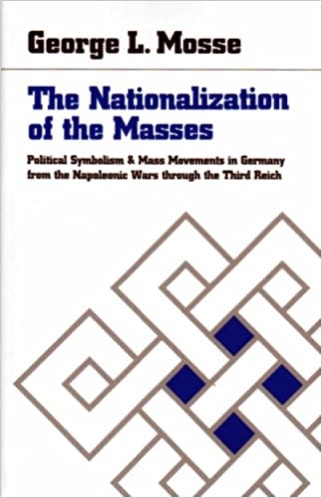
George Mosse, “The Nationalization of the Masses: Political Symbolism and Mass Movements in Germany from the Napoleonic Wars through the Third Reich” (1975) – George Mosse had the sort of career that the history profession doesn’t really allow for today. No matter how brilliant an individual historian might be, the way the profession is now structured does not allow for the kind of pivots Mosse pulled. Starting as a specialist in the Reformation, Mosse left the early modern period behind mid-career and became one of the leading historians of fascism. There’s something to be said for the way we do things now. The kind of granular analysis you see in contemporary historians of fascism, like Johann Chapoutot, is in part the product of the sort of hyper-specialization you didn’t have in Mosse’s day. But earlier methods had their advantages, too, and not just in terms of career flexibility.

What got the German people, who had lived for centuries in many separate domains and were separated along religious lines, on board with the unified German nation-state, indeed, many of them so amped for a united Germany that they went overboard and left the traditional nation-state form behind to create an apocalyptic all-conquering German empire? This is the question Mosse wrestles with in several books, including “The Crisis of the German Ideology” and “The Nationalization of the Masses.” In the former volume, he dealt with the content of the “volkish” ideology that washed over Germany in the nineteenth and early twentieth century, which unified a critical mass of the German people behind the idea of themselves as a “volk,” a race with a unique and all-important destiny. In the book under discussion here, Mosse discusses the forms that this nationalization took, what allowed for all of these people to take hold of nationality and make it meaningful to their lives.

Later scholars of nationality, like Benedict Anderson, would put a lot of emphasis on what we today call “the discourse” — back then, mostly newspapers — for its role in causing a national identity to gel. “Nationalization of the Masses” makes the interesting point that if you want to cement a given national identity as transcending time — as the nationalists of Germany did — newspapers are almost an impediment, being a reminder of the transitoriness of things. Early German nationalists, for their part, preferred to instill national feeling in the masses through architecture, ritual, and popular participation in a nationalist liturgy- a full-fledged secular religion, in Mosse’s telling.

Mosse goes on to describe the various efforts to create a national secular religion of German-ness. Until the Third Reich got a hold of it, this was mostly an unofficial project mounted by nationalism-enthusiasts. The Second Reich, under Bismarck and the Kaisers, was leery of some of the nationalistic extremes and popular enthusiasms of the movements involved, and most of these people were anti-republican and so wanted nothing to do with the Weimar Republic. So it was mostly poets, philosophers, educators, and the sort of people who like getting clubs together who formed this national religion. As such, it formed something of a hodgepodge. Classicism was popular among German nationalists, especially in architecture- lots of big white buildings with columns, etc. So too was romanticism, which you’d figure would operate at cross-purposes to classicism, but the kitschy eclecticism of the small minds of nationalism “made it work.” You see much the same dynamic on the right today, with its (mis)appropriation of both classical and medieval styles. Hitler, for his part, was a big one for classicism, or anyway massive classical kitsch; for all the Nazi regime harkened back to a mythical Germanic past, Hitler personally hated stuff like “ancient Germanic dress” and folkloric theater architecture, we find out in an interesting chapter on his personal tastes.

More than any particular artistic style, the most successful nationalizers emphasized making room for popular participation. Spaces of the national cult, like memorials to the dead in the Napoleonic wars and so on, were more successful when they had room for many people to make pilgrimages and participate in rituals. The rituals, in turn, did better when there was something for the crowd to chew on and participate in — songs, call-and-response chanting, the like — as opposed to the more didactic speeches of liberals and socialists. Groups like male choral societies (I guess women who liked to sing were shit out of luck?), sharpshooting groups, and gymnastics clubs came into the picture, giving nationalist content to leisure activities and providing bodies and content for nationalist rituals.

Mosse was a liberal — he was well known at the University of Wisconsin for both attracting and challenging student radicals through his lectures at that active campus — and is specifically arguing against a number of leftist ideas of the time in this book. This sort of cultural history in general flew in the face of the trend of econometrics-informed social “history from below” going at the time. More pertinently, he argued both that the relevant mass in German history was formed not by economic factors like industrialization but by incorporation into the national religion, and that the relationship between socialist/labor mass politics and nationalist/fascist mass politics was a two-way street. There was a commingling of influences and practices between the two groups, according to Mosse, and to the extent the nationalists wound up more successful, it was in part because they understood the dynamics of mass politics in its ritual element better than did their leftist counterparts.

I don’t know enough to judge Mosse’s conclusions there one way or another. Among other things, I’ve never had any meaningful feel for ritual myself. It all strikes me as a lot of nonsense and wasted time- the part I related to were the “volksfest” elements after the rituals where everyone gathered round to drink beer, exactly the sort of “frivolity” the more severe German nationalists tried to cut out of the movement. But people, or at least enough people, clearly like that sort of thing, enough to make it an important part of regimes like Nazism. Along with “The Crisis of the German Ideology” and “Towards the Final Solution,” this book forms a sort of triptych of Mosse’s efforts to grapple with the cultural and intellectual roots of Nazism — a regime he had to flee as a teenager — that form much of the basis for methodologically similar analyses today. *****

Review- Mosse, “The Nationalization of the Masses”

Review- Moynihan and Søderkind, “Lords of Chaos”

Michael Moynihan and Didrik Søderland, “Lords of Chaos: The Bloody Rise of the Satanic Metal Underground” (1998) – I like some metal but not generally black metal. Too screechy, too bombastic. I like metal (and rock music in general) where you can still hear its roots in the blues. It’s ironic that “black” metal is the major metal subcategory (I know there’s a million tiresome varietals of metal, and this is probably more true of one) that’s the farthest away from black music.

All of which is to say, I picked this book up out of interest in the far right rather than interest in black metal, or I guess the other point of interest, murder. The Norwegian black metal scene in the early nineties produced a small number of bodies and a larger number of burnt churches, a big deal in a country as staid and peaceful as Norway generally is. Michael Moynihan and Didrik Søderland document the scene in minute detail, in that way of rock journalism. I thought they did a reasonably ok job, journalistically, though their subjects, especially the endlessly pedantic murderer Varg Vikernes, contest this. They mostly let the people on the scene speak for themselves, which is generally the right move.

Might as well cut to the chase of my interests- the Norwegian black metal scene embraced fascism along with other “evil” trappings and accoutrements. Vikernes, sort of the philosopher or anyway the dorm room philosophy major of the bunch, adopted fascism more intellectually than the rest, including a “volkisch” worldview that others on the scene ape more or less consciously. And there’s a lot of back and forth about whether the author Michael Moynihan is a Nazi, whether his Nazism influenced the book, so on and so on.

In certain respects, it misses the point, or anyway begins unraveling the thread at the wrong end. What both Moynihan and Vikernes are is a familiar species to anyone who’s had to deal with that just slightly too-old specimen in a cultural space: they’re Gen X edgelords. Bereft of any larger struggle, the best thing they can think of to devote their lives to is offending sensibilities. They turn this into a whole philosophy and way of life, and a means to out-do each other. They’re highbrow shock jocks. Moynihan just tried to push it farther than the others by publishing Italian occultist fascist Julius Evola, Charles Manson, and for some reason Quadaffi’s little forays into the written word. The only thing that unites these people is shock and a certain degree of elitism based on who can/will stick with the nonsense and the gore. In Vikernes’ case, he took his schtick (and I definitely enjoy applying Yiddish to this particular putz) into murder.

Moynihan took it into relatively serious journalism. I don’t think “Lords of Chaos” is a particularly good piece of evidence of Moynihan’s fascist predilections, perhaps largely down to Søderkind’s influence. I see the evidence pointing to Moynihan’s fascism as being his friendship and amanuensis relationship with James Mason, the proponent of aleatoric terrorism as a means of bringing about white revolution, and Moynihan’s flogging of Julius Evola’s work. His publisher, Adam Parfrey at Feral House, was a Jew, as Moynihan’s defenders like to point out- so he rooked a credulous Jew, nothing a fascist need be ashamed of. In “Lords of Chaos,” his fascism doesn’t surface much- the idea there’s this roiling mass of discontent with society being too boring and hypocritical (as opposed to oppressive) waiting for a spark to ignite is a right-wing notion in my opinion, but that’s about it.

But what kind of fascist repeatedly denies being a fascist, as Moynihan has? Well, the pusillanimous Gen X edgelord kind. The kind whose passion for catching out supposedly-simplistic moralistic critics — every enemy is Tipper Gore to these people — belies their inability to take a stand on anything more meaningful. Both Moynihan and Vikernes claim to be more “spiritual elitist” than anything else. Moynihan, being generally the less circumspect of the two, takes that to indulging in Satanism, the ultimate rube’s philosophy. All that spiritual crap means is they’re too cowardly to take what they believe into the streets. We all know which way the “spiritual elite” bent when fascism came around the first time.

So do I think Moynihan is “fascist” as in “a real threat?” Not really. Do I think he’s “fascist” as in “fuck him and the pretenses he rode in on?” You bet. **’

Review- Moynihan and Søderkind, “Lords of Chaos”

2018 Birthday Lecture: tradition and Tradition Amongst the CHUDs

What the hell is history good for?

This is the first Peterfest, in its contemporary form, where I stand before you… not a graduate student, but a doctor of philosophy in history. I also stand in front of you fortunate- I am gainfully and remuneratively employed in something that I am reasonably ok at, but not what I went to school all those years for, exactly. But that isn’t the reason I am asking, “what the hell is history good for?” To the extent I ever really know why I ask the questions I do — never my strong suit — I think it’s out of curiosity about the other. How do people understand history, that of themselves, the societies they live in, the world as a whole? What do they talk about when they talk about history?

One of the interesting things that’s happened in the last few years is that a number of things I learned about over the course of a long and advanced history education have jumped the gap from academic obscurity to something you might hear on the news or quoted at you by a rando online. One example of this is how “American exceptionalism,” a real grad-school honker of a phrase, the sort of thing that was considered a “problem” for sententious tenured types to go back and forth over, slipped the bounds of academe and has become something that presidential candidates need to swear fealty to. As a student of the history of the far right, this happens in even more jarring ways. One example of this has been the lurching of the figure of one Julius Evola into public consciousness, culminating (so far) in news stories parsing who this guy was and why Steve Bannon talked about having been influenced by him.

By the time I started seeing his name in CNN articles, I had known about Evola for a decade. Like many subjects of my birthday lectures, I can’t remember exactly when I first heard of him, but I vaguely remember it being in some kind of a role-playing game supplement. This is fitting- Evola was, basically, a cartoon villain. He was an minor Italian nobleman who got involved both in occultism and fascism. He survived the war and was at the center of a circle of neofascists, including some terrorists, until his death in the 1970s.

In the way I often wind up with projects — picking something that happens to pop into my head and sticking with it until it’s done without quite knowing why — when I was in my very first semester of grad school at the New School, in the fall of 200coughcough, I took a class on the history of fascism and decided to write my term paper on Evola. To the extent I really had a thesis question going in, it was about the concept of “traditionalism,” a movement Evola claimed to belong to. What tradition did Evola mean- how did he conceive tradition? How would he remake society to fit his vision, how did it differ from other fascists, so on and so forth.

I remember going in thinking that Evola was basically Tolkien but mean. That he would harken back to some “traditional” way of life — that of the Italian peasantry, say, or medieval Europe — and project his ideal society on to that. It’s curious to see what people cherry pick, how they try to implement stuff like that… alas, that would be too simple. Soon after cracking open “Revolt Against the Modern World,” I found that the tradition that Evola’s traditionalism refers to is not any of the actual existing bundles of ideas and social arrangements handed down across generations that actually exist on Earth, in his time or any other. Instead, the tradition in question was a body of occult knowledge, roughly coincident with western esotericism. In the Traditionalist telling, this knowledge was handed down from teachers to students through a process of initiation since time immemorial- many of them refer to it as coming from Atlantis or Hyperborea or some such made up place. In some versions of it, the Tradition were the broadly-believed folkways of some distant past, but in recorded history, the Tradition was the property of an intellectual elite who guide society, or should anyway, in accordance with its unchanging rules.

Traditionalism, in turn, was part of a larger wave of movements in the late nineteenth and early twentieth centuries that sought to eschew western rationalism in favor of more emotionally satisfying alternatives. A lot of bored bourgeoisie on both sides of the Atlantic dabbled in one or another flavor of spiritualist or occult shenanigans at this time- this was the time that saw Helena Blavatsky and Aleister Crowley become international celebrities. Traditionalism was a few notches more intellectual than many of the esoteric fads of the time, spreading amongst theologians, anthropologists, and art historians who dedicated study to finding “timeless” spiritual truths across a variety of historical and geographical contexts.

Traditionalism is, necessarily, backwards-looking- at one point, we had humanity united in timeless spiritual wisdom, and now… we don’t. Some versions of the Traditionalist intellectual canon led down benign, hippie-ish roads; the idea that every religion leads towards the same basic truths so you should be nice to people from all of them is a Traditionalism-inflected idea- they’re all pointing back towards some primeval truth. But more often that not, Traditionalism took the intellectual trajectory that most of the irrationalist philosophies developed at its time took- violent reaction against social change. For the most part, this meant more of a passive rejection of a “Modernity” seen as corrosive of the Tradition but too advanced to take head on. So you saw the creation social networks dedicated to urging people — almost inevitably young alienated bourgeois intellectuals — down the path of initiation to… whatever kind of secret sacred knowledge which, inevitably, various Tradition-peddlers squabbled over. Eventually, this was more or less absorbed into “New Age” stuff. The furthest out on a limb the Traditionalists put themselves was Evola’s interventions in Fascist Italy, which culminated in him becoming a recruiter for Hitler’s SS, on the idea that he could steer them into becoming an initiatory order in the Traditionalist mold.

I got my copy of “Revolt Against the Modern World” from a dopey New Age press based out of Vermont. The introduction from the editor takes great pains to separate Evola from fascism, in a way that has since become familiar to me, because random fascists get mad at me because I wrote a couple of rude dismissive sentences about the book on goodreads. This happens at least once a year. Mostly they argue that Mussolini and Evola didn’t get along, that Evola looked down on fascists as low class. This is actually true enough. What they neglect to mention is that whole “worked for the SS” bit, or the fact that Evola’s problem with fascism is that it wasn’t extreme enough- did not reject modernity, did not go all the way in creating a new elite, was too willing to negotiate with authorities like the Vatican, and, at first, wasn’t racist or antisemitic enough. Evola makes clear, in “Revolt Against the Modern World” and other works, that the Tradition is the sole property of the Aryan race- that Aryan blood may not be enough to ensure initiation, but it is a prerequisite. To answer the obvious question dogging any traditionalist, whether in the big-T sense we’re talking about or the small-t sense of people who just fetishize the past, that is- if the past was so great, why did people change it? Evola provides a common enough answer- the Jews did it.

Evola survived the war, and one consequences of his disdain for Mussolini is that he was far away enough from the failures of actual existing fascism that he could become a rallying point for postwar neofascists. The story goes that all the leaders of the postwar Italian fascist party, as well as of the little groupuscules that took part in the Years of Lead, all went to Evola’s manor to kiss the ring, and an Italian cop has been quoted as saying that at one point in the seventies, finding volumes of Evola’s work in someone’s apartment was as damning as finding explosives. For my money, Evola was a snitch- he was connected to Operation Gladio, a NATO effort to train and arm “stay-behind” armies in case the Soviets invaded which, surprise surprise, mostly funded guns to right-wing groups and mafias, and there’s no way Evola would have stayed free and openly involved with fascist terrorists for so long without giving someone — the Italian police, the CIA, whoever — something. He would have been an ideal informant and control rod for when the Italian police wanted to keep control over their sometime-assets, the Italian fascist terrorist gangs. You can imagine the goodreads fascists love it when I suggest that.

I don’t quite recall when I found the second seed of this lecture, either, but it was sometime around the same time- 2008 or 2009, where I somehow found out that a prominent public figure was running around calling himself a traditionalist: Fox News host Bill O’Reilly. I was immediately tickled by a vision of this aggressively ignorant lace-curtain cretin passing what time he didn’t spend screaming on TV or sexually harassing women in a study lined with many leatherbound books and vaguely spiritual trinkets from foreign lands, leafing through the works of Evola, Rene Guenon, and Ananda Coomaraswamy as he ponders the ineffable mysteries of the perennial Tradition. While in many respects the works of the Traditionalists are fatuous, these were highly-educated people — highly-educated, kind of stupid, and profoundly amoral, the pre-1945 European upper class mold — and it shows in their writing. So it was an amusing picture, and like many of the amusing pictures in my head, made up of compound obscurities and so difficult to share with others.

Of course, O’Reilly meant no such thing. It’s not always easy to extract a kernel of consistent meaning from contemporary pundits, but as far as I can tell by “traditionalist” O’Reilly means “maintaining existing social and cultural arrangements except insofar as they harm me or people like me.” O’Reilly’s “tradition” is stoutly populist, or, anyway, based in a sentimental portrait of Reagan Democrats or the “Silent Majority,” far from the proudly elitist, intellectual bent of Traditionalism in the occult sense. But really it’s just an occasion to screech at liberals or leftists for meddling with “tradition,” as in “traditional marriage.” O’Reilly doesn’t hate gay people, he informs us, he just hates liberal judges and bureaucrats redefining tradition all on their own. The term also allows him to avoid the self-description “conservative,” thereby maintaining a fig leaf of nonpartisanship back when that still mattered.

O’Reilly’s a funny figure- in most respects, from his ignorant outer-borough bluster to his fake populism to his record of sexual harassment, he was exceeded by Donald Trump, and where O’Reilly was, eventually, punished for the latter, Trump has been continuously rewarded for it, all the way to the White House. He does seem to have played a key role in poisoning the brains of Baby Boomers who might have slipped the grasp of traditional Republican pied-pipers ala Rush Limbaugh, a sort of gateway drug for people who don’t generally start shrieking like a tea kettle when they think about unions or the estate tax but who can be rooked by a self-assured white guy telling them their resentments of a changing society are legitimate, and leading them down the path to Trumpism from there. But he clearly was not where the action was by 2016- I wonder how much his downfall was linked to the way that now that Trump was around, O’Reilly was surplus to requirements.

Certainly, the people injecting “Traditionalism” and Traditionalists into the discourse in recent years fancy themselves stronger stuff than the average Fox News host, let alone one willing to occasionally throw liberals a bone. Steve Bannon namechecking Evola is pretty close to the amusing picture of O’Reilly leafing through the Baron’s weighty tomes- Bannon is a man in much the same mold, and frankly I’m not convinced he’s read any of the books whose title he likes to throw around- maybe Jacques Raspail’s grotesque white genocide fantasy, The Camp of the Saints, but this is a guy who made his fortune out of opportunism and bluster. But it is in keeping with Bannon and other Trump hangers-on saying what was the quiet part on Fox News — white nationalism — loud. We also have the Traditionalist Workers Party, an altright formation involved in street-fighting in Charlottesville and elsewhere. TWP was founded by a nerd named Matt Heimbach, who later became famous for destroying his own group by having an affair with his right-hand man and father-in-law’s wife and getting arrested for beating several of the people involved.

Heimbach’s career as a fascist militant leader, such as it was, entailed playing what could be called trailer-park schtick, or redneckface, or something, which culminated in the sordid little tangle with his wife and father-in-law that imploded his group. Heimbach is from solidly middle class circumstances from a leafy Maryland suburb of Washington, D.C., and is a university graduate. His organization liked to posture itself as the defenders of a white working class defined culturally- a classic right-wing populist move, using race and culture to try to rope the masses into a project that will only benefit the few. This entailed a bifurcated concept of “Traditionalist.” On the one hand, Heimbach is a deeply pedantic cherry-picker of right-wing obscurity, citing figures like Evola and Romanian fascist occultist Corneliu Codreanu as influences. On the other, his movement embraced a kitschy caricature of the white working class, based in stereotypes of “rednecks,” as the object of its efforts, the “tradition” his group meant to uphold and defend. When Heimbach ordered his movement to spread out amongst the Appalachian and Rust Belt masses and make the inhabitants problems their own, like Mao but stupid, the reaction was predictable- people didn’t buy it. But Heimbach bought all the way to taking his expensively-educated corpus to a rural Indiana trailer park and undertaking the sort of domestic arrangements a deeply patronizing and none-too-bright fetishist of a stereotypical version of white America might consider appropriate for the surroundings. One wonders how many descents into the most degraded forms of identity politics are seeking that sort of LARP-ing catharsis more than any given political outcome…

Heimbach and his goons weren’t the only people on the newly effervescent fascist right to cite Traditionalism as an influence. The spread of the far right online has facilitated what I think of as the wiki-ing of political signifiers within the space. Figures that you would have to seek out in the sort of books that mostly gather dust on university library shelves now have wikipedia pages, that are often linked to the wikipedia pages of more familiar figures or movements, put on convenient curated lists of figures from given traditions and movements, and so on. This doesn’t entail a deep engagement with figures like Joseph de Maistre, Nicolas Gomez Davila, or, to cite a figure pretty popular on right-wing memes, Julius Evola. You don’t need to slog through Evola’s long-winded explanations of the descent of man from the aryan Atlantis golden age to use him in a meme on facebook communities like “Fully Esoteric Techno Fascism,” which at various points have had five-figure memberships, for whatever that’s worth. Presumably, at least a few of the fascists lapping at my goodreads heels are members.

What do these people — so many of them kids — mean when they say “tradition?” I found myself wondering if they meant it in the normative sense — roughly like what Bill O’Reilly meant — or in the sense that Evola and his peers meant it, as in a single esoteric body of thought? Well, gentle listener, you’ll no doubt be shocked to learn that some descents into their online content — primarily youtube videos, none of the ones who write essays that I found really address this — did not clarify the situation much. In fact, despite avowing themselves as followers of Tradition or Traditionalism or of specific Traditionalists like Evola, most of them seemed unaware of the bifurcation of meaning in the term. By default, this would seem to put them in the camp of meaning “tradition” in its lower case “t” sense. But they honestly weren’t even especially clear about that. Among other things, it seems like they were primarily making videos to engage each other, and so took for granted shared definitions of what is traditional and what is not. So the sort of detailing of what in specific people should do to be a traditionalist in their sense of word really wasn’t there in overview videos of “traditionalism vs cultural marxism,” say. Those just repeated some variation of “the world is bad- it’s the fault of cultural marxists, read Jews, messing things up- we need to go back to the before time,” without the latter being specified much.

A little more specific were, naturally, videos or other content that explored specific subjects. One branch of online traditionalism that probably outnumbers the Evola-fanciers are those who embrace one or another form of fundamentalist religious practice, generally unreformed versions of various conventional faiths. In classic internet style, this begin with relatively well-known denominations, like “TradCaths,” Catholic believers in various ultramontane pre-Vatican II forms of the religion some of whom can be found in real life, and has since split off into all kinds of varieties- TradProds, converts to Eastern Orthodoxy, which is seen as more traditional, people who trad so hard they become pagans (or Wahabbists), presumably somewhere there’s TradZoroastrians on some corner of the internet. The point is, some of them have something more material to say about what the tradition is. In keeping with people who are mostly teenaged recent converts who aren’t plugged in to any tradition offline, this mostly consists of things like “go to church” and “find likeminded people.” Probably most interesting were various traditionalist women. While a lot of what they said was warmed over TERF material, or stuff that insists that somewhere some mean feminist is telling them they can’t be a housewife, but there was also a lot of deeply-felt despair- the idea that feminism and modernity in general sell false promises to women, and the best they can do is transform themselves to find a good “traditional” man and attach herself to him.

My birthday lectures are typically about odd alleyways in the history of ideas, and this usually means dealing with people whose ideas were bad, or at least wrong. Pointing them out is easy. They wouldn’t be worth much if that’s all they were. I think there’s more to the story of the particular way in which these people are wrong.

When I first began looking into Traditionalism, way back when as a mere stripling masters’ student, I thought there would be some relationship between tradition as actually lived and the tradition that the Traditionalists claim to uphold. I didn’t think it would necessarily be a sensible relationship, and certainly didn’t think such a connection would justify anything politically, but I thought it would be there. I thought you could learn something from measuring the gaps between tradition as conceived by various actors, and the efforts to turn those conceptions into politics.

Many of these premises were wrong, ranging from what the Traditionalists thought tradition was, where it was located in an imaginary universal esoteric tradition as opposed to in folkways, to their interest in politics, which seldom has had anything to do with real organizing or governance. The crux of the matter — the point at which we can learn something from these loosely connected tales of mostly foolish, mean people believing mostly foolish, mean things — is both simpler and more complicated. We need a hermeneutics of bullshit here.

Let’s begin at the beginning. The wave of interest in the occult and esoteric philosophy that arose in the late nineteenth century had little meaningful connection to the western esoteric tradition that existed before the Enlightenment, which was not always a single, unitary tradition itself. Modern esotericism is a mish-mash of found parts. And there were more parts to find than ever before. The rise of the historical profession occurs in the same late nineteenth century time frame, and with it a moment that both made archives more available than before, and many of the early professional historians at the time were just as backwards-looking and conservative as the Traditionalists would be, and just as willing to cherry-pick to construct a past that suited them- leftists at this time mostly eschewed history for sociology and economics. The late nineteenth century esoteric wave is also awash in orientalism, just as its descendant, contemporary New Age thought, is today. This was the high point of European imperialism, remember, which opened up vast stretches of the world to exploitation by any bored white person with money. You can imagine given how little concern for human lives they had in the colonies how little concern they had for the actual contexts of the beliefs, practices, and in many cases actual artifacts they ripped off from colonized people. This was also the period of the second industrial revolution. Where the original industrial revolution dealt with things like textile manufacture and railroads — stuff that, while impressive, one can see reasonably easily how it works — the next wave of innovation the late nineteenth and early twentieth centuries involved advances in the use of electricity, in chemistry and chemical engineering, and early atomic experiments – that is, things that you can’t really see working, things that are explained in metaphors of “waves” and “particles” and “frequencies,” in short, stuff that looks and sounds like magic. The past, the world, and even the properties of the universe made up a vast buffet of choices to stir together whatever kind of worldview you wanted- not for nothing did the Traditionalists and other esoteric groups provide much of the intellectual window-dressing for what we today call cafeteria-style religion or spirituality.

We can, if we choose, do a “first as tragedy, then as farce” comparison with the youtube traditionalists of today. Say what one will of figures like Evola, or more prominent figures of the reaction against rationalism from Nietzsche to Henry Adams, but they were highly educated, even when they were stupid. They put a lot of effort into learning difficult things, like Sanskrit and various obscure ends of history, to put together the pastiches that they did. They were reacting to a sea change in culture and political economy brought on by the industrial revolution and the fear of the revolt of the masses, and they played their part in shaping major historical movements and events. Whereas today… well, the fact that a lot of the yelling about defending tradition takes as its object children’s cartoons tells you a lot. In the end, contemporary traditionalism is an inept copy of an inept pastiche, and part of the context they are putting it in is that education today really doesn’t prepare people to do the kind of reading to even meaningfully extract the kernels of non-wisdom in the original material. So- tragedy (though with certain farcical elements), farce (though a pretty sad one), reflecting at each other back and forth like a hall of mirrors, the end.

But… but. At risk of being one of those “what if the whole world is a simulation, MAN” guys… our traditionalists did not enter this hall of mirrors when they first started formulating or believe their ideas. Because what was the picture of history they came in with? From both, a self-regarding dream, a pastiche of elements chosen, if not always consciously then reliably, more to obscure truths than to illuminate them. Raised under the shadow of a certain specter haunting Europe, which became all too material during events like the Paris Commune, the history created by intellectuals at the time was, in many instances, an ingenious project of mystification, reifying the bulwarks of order in Europe — the nation, the state, the church, class society — backwards into the past.

We live in a similar age of reaction, but with a big difference: the sheer density of messaging that is possible given modern media technology and the comparatively clear slate that America’s unique situation affords it. Disregard the history one learns in school- lord knows enough people do, and not always for ideological reasons. Think instead of the stories about the past implicit in the very social structure and built environment of the sort of boys who are posting videos about “tradition vs cultural marxism.” Think of the sheer amount of history — from the destruction of the Native Americans to slavery to industrialization to the assimilation of European immigrants to the postwar Keynesian state to the actual invention of things like mass-produced automobiles and everything that goes with them — that is taken for granted in day to day life in the suburbs and exurbs of our broad land. I’m not even talking about avoiding guilt, though there’s enough that- I’m talking about simple mental bracketing. Naturally, the instinct of most of us here is to eschew that sort of bracketing- we are all curious people, we all want to learn, we are all critical. But as an experiment, think along the grain of the implicit sense of history of most white Americans. We can ease our way into it. I read two complementary suburban histories recently- Kevin Kruse’s “White Flight,” about the Atlanta suburbs, and Lily Geismer’s “Don’t Blame Us,” about some towns not far from where we are now. The people who formed those suburban communities in their current form drew intentionally from a variety of histories — that of the antebellum South in the case of the white-flight suburbs of Atlanta, that of a “progressive” Yankee past for Newton and Lincoln and towns like that — to help form a sense of identity for communities that were, effectively, made up of uprooted (if materially comfortable) people in a materially new way of life for them. So we start with a comparatively robust — if shallow and basically inaccurate — historical imagination of these places. Then think a few generations forward, as these stories fade into the background and the lifestyles and social orders they explained come to be seen as self-evident facts of life. Beyond “inadequate,” what would a historical sense that started from the premise that what we have is natural and normal look like?

And here, at long last, we come back to “tradition” in the Bill O’Reilly sense of the term. Clearcut all sense of context — turn everything that happened to make our collective condition possible into so many bits of color for period entertainment pieces, or else ignore it all together — to prevailing social conditions, particularly ones that benefit you, and you’re more or less there. Consider one of O’Reilly’s pet crusades, the sanctity of “traditional” Christmas. Virtually everything we associate with Christmas was incorporated into our seasonal celebrations within the time O’Reilly or at least his parents were alive. In America in particular, Christmas celebration wasn’t done much until the late nineteenth century- the Puritans didn’t like it. It was mostly German immigrants who introduced many of our christmas traditions, like the tree, and then it was capitalism that did the rest, from our image of Santa, more or less invented by a soda company, to the exchange of gifts. Same with pretty much every other culture war shibboleth, from our ideas about marriage to veneration for police and the military to appropriate sports conduct. It’s wrong to say ideas about them were more liberal or progressive, or even more conservative, than the O’Reilly’s of the world present. They were mostly just stranger, and had a logic informed by deep context of the time. Where the late nineteenth century bourgeoisie created sophisticated history and literature to create an alternative context that kept away scary ideas, nowadays, we just go without it and let commercial culture or really just any random fucking thing fill it in.

So the contemporary traditionalist teen didn’t enter the hall of mirrors of flat, context-less history: he was born into it. I would argue that traditionalism is to our culture’s collective refusal to think critically about the past what libertarian is to capitalism. Libertarianism is a philosophy of capitalist inadequacy, of petty bourgeoisie and pedants incapable of doing what the real serious capitalists do, which is make the system and especially the government work for them. Traditionalism is a little sadder than that, if anything. As the social arrangements that nurtured our shared dream of an irrelevant past fray due to economic and cultural pressures, people who benefit from the arrangement — even just to the extent of securing a mediocre sense of self despite their mediocrity — begin to panic. If the older Traditionalists lamented the lost perennial wisdom of Atlantis, your contemporary alt-right traditionalist is obsessed with what he has supposedly lost — from incel laments for the wives they think they’re entitled to to things like “a sense of adventure” which isn’t even promised by their social order- it was promised by their society’s entertainment products! — and imagines further, apocalyptic losses. It is easier to imagine the end of the world than imagine truly coming to terms with its history.

So- what the hell is history good for? I am not so precious as to refuse to call bad history history. I can’t, somehow. Selection is inevitably part of the historiographical process and selection is inevitably biased. The selections of traditionalists, of all the species discussed here — from Julius Evola to Bill O’Reilly to CrusaderPepe88 or whoever — are silly, sloppy, and paired to a morally wrong and destructive project. But I recognize enough of the impulses and the operations undertaken to see that it is in the same family of activity, just as a bad person is still a person. I’m not sure what history is doing for them- it doesn’t appear to be making them happy.

One of the great living historians, Susan Buck-Morss, once wrote: “the critical writing of history is a continuous struggle to liberate the past from within the unconscious of a collective that tends to forget the conditions of its own existence.” This forgetting, I believe, was an active, if not necessarily a conscious, process, going back at least as far as the beginnings of the project to contain the revolutionary fervor coming out of France at the turn of the nineteenth century. Traditionalism is one small piece of that process, perhaps more relevant as a morbid symptom of the failure of more robust mechanisms than as a movement in itself.

What do we gain from liberating the past, and remembering the conditions of our collective existence? Whole societies have lived in massive denial, after all- probably more than make even the most elementary kind of reckoning with their past. A critical understanding of history is no safeguard against mistakes or wrongdoing. I’m not so sanguine as to say that liberating the past from ignorance and fantasy liberates us from the past- there’s a lot more to liberation than that. But it allows the past to act as a meaningful guide, a thread to follow through the hall of mirrors and refractions of refractions of given off by those who’d have us live and die there with them.

2018 Birthday Lecture: tradition and Tradition Amongst the CHUDs

Review- Finchelstein, “Transatlantic Fascism”

Federico Finchelstein, “Transatlantic Fascism: Ideology, Violence, and the Sacred in Italy and Argentina, 1919-1945” (2010) – My former professor at the New School, Federico Finchelstein, stakes several interesting claims in this work of transatlantic history. He intervenes in several ongoing debates in fascist studies, among them the question of whether fascism even belongs as a term to anything outside of 1919-1945 Italy, whether there’s such a thing as non-European fascism, and the dreaded “fascist minimum.” His lens on these questions is the relationship between, and comparisons betwixt, Italian fascism and Argentine nacionalismo. The vistas this perspective opens up prove to be interesting ones.

Italy and Argentina had a special relationship in the early twentieth century, as something like forty percent of all Argentines were of Italian descent, product of a massive immigration wave beginning in the last decades of the nineteenth century. When Mussolini took power in Italy, he and other fascists saw Latin America in general and Argentina in particular as potential growth fields. Like a lot of fascist plans, this was more hazy projection than thought out plan, but the Italian foreign service did distribute propaganda in Argentina and try to help its far right along. Here, it was impeded by the parochialism of fascism- convinced of Italian superiority and the superiority of their form of fascism, the Italian fascists failed to make meaningful connections to the far right burgeoning in Argentina in and around the Uriburu dictatorship of 1930-1932. Various pressures kept Argentina out of World War II until it was almost over, but that was the most the country would do to help fascism.

Argentine nacionalismo was influenced by Italian fascism, Finchelstein argues, but didn’t look that much like it, and was sufficiently independent, dedicated to Argentina’s specific mission in the world, to remain an independent force. This is enough to discredit the idea — prevalent with both fascists and, according to Finchelstein, Argentine antifascists — that fascism is a purely imported idea, that Latin American fascism was purely imitative. Argentine nacionalismo had enough of its own features to be its own thing under the sun, though Finchelstein still sees it as part of the fascist spectrum of ideologies and worth being denoted as such. Among other things, nacionalismo, while believing in singular leadership as a principle, didn’t have a singular leader, in part because the first right wing dictator Uriburu died early of natural causes. This led to a cult of the dead leader whose mantle others would pick up. Argentine nacionalismo was also much more Catholic than most other fascisms, though imagined less direct role for the clergy than the Austrian or Spanish regimes.

Finally, Finchelstein argues that while nacionalismo never came to power directly in Argentina, it did definitively shape the Argentine right and the country’s future dictatorships. This includes the peculiar left-right mishmash of Peronism, but more so the military regimes before and after it. In particular, nacionalismo’s emphasis on the enemy as utterly abject, which it has in common with other fascisms like Nazism, found its way into the torture and disappearance regimes for which Argentina became notorious.

In his introduction, Finchelstein places himself as perpendicular to antifascist historiography, and I remember him doing so in the classroom as well. He saw it as distortive in its own right- he opposes fascism, but attempts to understand it in a way antifascists supposedly don’t. I’m not sure what I think of that. I’ve certainly seen some pigheaded intellectual attitudes on the part of antifascists but by and large the ones I’ve worked with have been welcoming of finely grained attempts to understand the enemy. Maybe I just know good ones? Either way, as a practicing antifascist, I recommend this book highly. Contemporary American fascism draws a lot from Latin American models, as their admiration for Pinochet attests, and especially their treatment of enemies as abject beings, so it’s good stuff for people to know about. *****

Review- Finchelstein, “Transatlantic Fascism”

Review- Snyder, “Black Earth”

Timothy Snyder, “Black Earth: The Holocaust as History and Warning” (narrated by Mark Bramhall) (2016) – What a weird book! Snyder, who is at this point a full-on hashtag-resistance intellectual, was never a stranger to controversy or to portentiousness, and cuts a broader public figure than most historians. I remember being introduced as a historian in a wedding conversation with one of the literate burghers of my hometown, and the name and title the fellow dropped to make conversation with me was Tim Snyder’s “Bloodlands.” From the killing fields to Snyder’s (impressive, by any measure) archival depths to a comfortable suburban Massachusetts living room…

Anyway, “Black Earth” continues some of the conversation begun in “Bloodlands” (with all of its flaws) and takes it still further. We return to the zones of “double occupation” (that is, lands that both the Nazis and the Soviets occupied, sometimes trading back and forth multiple times), the site of most of the Holocaust and, Snyder avows, the geospatial inspiration and permission for it. At the center of “Black Earth” are Snyder’s sweeping claims about Nazism, the Holocaust, and the state. Forget about the image of the bureaucrat rubber-stamping the camps into being, Snyder tells us. Nazism is actually a negation of the state (here, he’s echoing Hannah Arendt, with her claims that Nazism represented an eclipse of nationalism). Hitler sought to destroy states, and succeeded in doing so in Austria, Czechoslovakia, the Baltic states, and especially Poland (though not, notably enough, Germany), and was abetted by the Soviet Union in the zones of double occupation. These stateless zones then became sites where anything was possible, and that thing became the Holocaust. The state, far from the agent of genocide, is the only real protection against it, Snyder tells us.

The weak points here are many, and resemble those in “Bloodlands,” to an extent. First, Snyder’s characteristic exclusions when he’s trying to make a point: Yugoslavia, despite its massive death rate in the war, can’t be a “bloodland” because it wasn’t double-occupied; its contributions to the Holocaust get similarly short shrift in “Black Earth.” Needless to say, the many genocides perpetrated by states — like those undertaken by colonial regimes, such as the destruction of the Native Americans — aren’t mentioned. The Nazis did indeed destroy states in Eastern Europe. But the maintenance of a state is no guarantee for survival like he makes out, as the fate of the Dutch Jews or the targets of genocide by the Croatian Ustashe demonstrate. Snyder knows this but basically waves it off. The Ustashe were a state that wasn’t really a state, the Netherlands had a state but not really (but the French didn’t?), etc. etc.

This goes along with Snyder’s strange dismissal of the prevalence of prewar antisemitism and its importance to the Holocaust, placing everything on Nazism and especially the person and ideology of Hitler (Himmler comes in as second banana, and Carl Schmitt, who there’s no evidence ever wrote a thing Hitler read, comes up too). There’s some interesting stuff here on Hitler’s use and abuse of biological metaphors, his insistence on a life of struggle and violent competition (he was far from alone in this, as a perusal of Theodore Roosevelt’s writings will show), the way he depicted Jews as “super” natural, i.e. using ideas to circumvent the way of nature. But then, to use internet lingo, Snyder “capes” for interwar Poland, admitting it was antisemitic but showing how its antisemitism drove the Polish government to support the hardest core Zionists they could find, on the idea that that way they’d be rid of their Jews. The opposite of a Holocaust, you see! Or maybe you don’t, seeing as mass involuntary population transfers inevitably lead to mass death in any instance, even the Revisionist Zionist-Polish Nationalist (or contemporary Likudnik-Christian Zionist) fever dream. The stuff about the connection was pretty interesting to read, but does not bear anything like the analytical weight Snyder places on it.

Let’s meet Snyder half-way and say that state destruction did occur and was important, and antisemitism on its own doesn’t lead to genocide, but don’t buy state destruction or Hitler’s “biological anarchism”(!) as explanations. How then, a Snyder fan might ask (I wonder if that other Snyder, Zack, has read “Bloodlands” like the hometown burgher…), do I explain the different outcomes faced in different countries during the war? Well, the massive fucking land war might have something to do with it. The Nazis and the Soviets fighting for national survival in the biggest war the planet has ever known, and everywhere this happened, the Nazis introducing their war against Judeo-Bolshevism, until the latter essentially took over the war as the Nazis began to lose. This has the added benefit of including Yugoslavia, where the partisan fighting was especially fierce, and why in the western occupied areas anti-semitic genocidal violence picked up as the war got closer, as when the Italian Republic of Salo actually started taking Italy’s racial laws seriously. It’s a commonplace that the war and the genocide went together. That commonplace is good enough for me, but it doesn’t have the tendentious energy that Snyder wants to deliver.

One gets the impression from reading a lot of the reviews that not everyone read it all the way through, that they felt they got enough of the book by looking at the beginning chapters and the conclusion. They may even be right, in a lazy kind of way. The middle of the book is more or less a recitation of the history of the Holocaust from the perspective of Snyder’s preoccupations, familiar facts to anyone who knows the history with some added editorial baggage. But it made me wonder- could the whole thing have worked without the one state Hitler didn’t destroy or even really try to, the German state? Someone had to recruit and pay the Einsatzgruppe. Someone had to keep the home front going. And is it really the destruction of the state if you impose dictatorship on an area after wiping out its government? It’s the destruction of a nation-state, sure. But there does seem to be somebody with a monopoly on the means of the use of force. It doesn’t add up.

What it all doesn’t add up to is found in the conclusion, a true monument to a particular kind of conservative-liberal febrility that Snyder has continued to pursue in his work on contemporary political life. Like the rest of the book, the problem isn’t that Snyder lacks intellectual firepower- just that he has seemingly no conception of what a real target would be. So we’re treated to a discursus on the Green Revolution, which replaced Hitler’s preoccupation with the struggle for survival with plentiful cheap food (true), how food might be getting scarcer again (true-ish), and how China, Russia, and “the Middle East” could take up Hitler’s strategy of making scapegoats for ecological change and seek out new realms (Africa, for instance) for biopolitically-driven conquest. Quick, someone’s going to get genocidally, globally violent rather than face climate change, who is it? If you answer anyone other than America you’re a rube. That’s not to exclude others, but we’ve already done it by tearing apart the Middle East in part to secure an energy supply. How are you going to talk about water wars in the Middle East, as Snyder does, while neglecting Israel’s control over Palestine’s water? Talk about a stateless, vulnerable people! The real subject of climate-driven violence (one Arendt wouldn’t have neglected, say what you will about her) are the refugees it is generating, and we get very little from Snyder about that. But nope, Snyder only has eyes for states and ideologies.

We need to see the Holocaust as about ecologically-ideologically-driven state destruction, Snyder tells us, to avoid doing it again. The “left” and the right both blame the state from their various perches (“postmodernism” gets thrown around as a bad guy here) for misinterpreting the Holocaust and not getting the importance of states. We’re in grave danger, Snyder tells us, of failing to learn our lessons. I actually tend to think that’s true, even as I disagree with ehat exactly the lesson is. But again, not due to a left-right conspiracy to induce anarchy, but due to a much simpler explanation- distance in time from the events, and the Holocaust’s cooptation by Hollywood and American ideology into something bad people did because they were bad. That said, aren’t there a million other models for how states — or non-states — could engage in future atrocity? Don’t some of them seem closer than Snyder’s version of the Holocaust, or anyone else’s? I’m in favor of learning from the Holocaust. I’m also in favor of seeing it in the light of a long history of genocide and atrocity, especially against colonized and indigenous peoples, that seem to offer more immediate lessons than the very peculiar circumstances of 1930s-1940s Europe. **’

Review- Snyder, “Black Earth”

Review- Mason, “Siege”

James Mason, “Siege” (1992) – This, apparently, is what the kids on the far-right are reading these days. There’s even nice little photos of James Mason with members of Atomwaffen Division, where Mason’s is the only face not blocked out. Despite endorsing aleatoric violence and terror as the only way forward for the white race (and hence, in his view, humanity), Mason has lived all these years quietly in Colorado… for my money, drawing a federal payroll for information on the idiots who come to kiss his ring, but I’m a cynic.

“Siege” was the name of Mason’s nazi magazine, which he started in the early eighties after nearly twenty years on the nazi right. He bounced from George Lincoln Rockwell’s American Nazi Party to the National Socialist Liberation Front (it was the sixties, everyone had a liberation front) to remaining aloof from organization altogether. Many of us know the type from the left- the guy (usually a guy) just too damn smart and right about things to play ball with anyone else, and with just enough validity to his critiques of the (generally dysfunctional) movement institutions to make his stance make sense.

“Siege” took a line against mass strategy — efforts on the parts of Nazis and others on the far-right to engage a broader public — and in favor of armed struggle, but of a different kind than that in which other, actual, liberation fronts engaged. Those were generally born out of mass strategy, after all. Mason so despaired of the white masses that he believed the system needed to collapse to wake them up- or not, as the case may be, but either way, the government, economy, society as a whole needed to go up in smoke. To this end, he lauded serial and spree killers (as long as they were white) and took up a relationship with Charles Manson, on the idea that “helter skelter” was in fact coming and should come, and that Manson had done a noble thing trying to bring it about.

In most respects, the inception and reception histories of “Siege” are more interesting than the content. The content is repetitive- disses of other movement figures (though seldom by name), calls to get your shit together to be effective agents of chaos, lauding violence, rinse, repeat. What’s more, it’s not especially well-edited, and this is where we get into inception/reception history. “Siege” became a book in the first place due to the efforts of one Michael Moynihan. Moynihan is probably best known for his book “Lords of Chaos,” on the satanist/nazi Norwegian black metal scene (next up in this reading slot, as it happens). Moynihan befriended Mason and followed in many of his beliefs, including veneration for Charles Manson, and took up, edited, and released a book of pieces from “Siege” into the form we have it in today. For his part, Moynihan these days claims not to be a Nazi or far-right (part of this is lies, part is sleight of hand: Mason and other Nazis often pooh-pooh “the right wing” in the same way Communists and Socialists do with mere “liberals” or “progressives”), despite his extensive record in the space where music, occultism, and Nazism meet up. He had a lot of fans who should have known better and was published by Feral House, which features both in fond memories of nineties alternative culture and in the somewhat fevered imaginations of the dreaded “red-brown alliance,” where Nazis and Communists come together to haunt all our dreams…

There is a very eighties/nineties edgelord aspect to the whole Mason situation. He throws around hippie rhetoric about “the pig system” and so on. He blames TV for a lot and holds the supposed object of his efforts, the common white man, in pretty low esteem. Being impressed by Manson, claiming to be above right and left… you can see how his schtick would appeal to a certain kind of Gen-Xer. And we all know how those kinds of Gen-Xer/late-20th century alternative culture types like to wriggle out of their embarrassing phases in the eighties/nineties/oughts/last week, as though they never had any commitments and their words had/have no weight at all… a dispiriting tableau all around, and one we’re not shot of yet.

Anyway, to an extent I guess I read these things so you don’t have to, and with “Siege” you really don’t have to. It’s repetitive and poorly edited. Mason’s probably smarter than Moynihan and could’ve collected his own pieces, you’d figure, but c’est la vie. It’s not the worst writing on the far right- I’d still go with a tie between “Moldbug” Yarvin and Ayn Rand there. But it’s by a violence-worshipping dirthead, for violence-worshipping dirtheads, and knowing it’s out there and doing what Mason presumably wanted it to do is enough for the right-thinking population. *’

Review- Mason, “Siege”

Review- Yarvin, “A Gentle Introduction to Unqualified Reservations” and Land, “The Dark Enlightenment”

Curtis “Mencius Moldbug” Yarvin, “A Gentle Introduction to Unqualified Reservations” (2009) and Nick Land, “The Dark Enlightenment” (2013) – For my sins, I’ve committed to reading the major figures on the contemporary far right. Being me, I made the decision to read the “neoreactionary”/”Dark Enlightenment” writers well after their sell-by date. The far-right kids these days seem to be all about the aleatoric terror espoused in Mason’s “Siege” (which I will also review, so, uh, look forward to that) rather than trying to anoint a CEO-king for America or some secessionist seasteading anarcho-monarchist-capitalist utopia.

In particular, “Moldbug” Yarvin’s late-oughts internet snark has aged poorly. Someone told this dork he was funny, and Yarvin, with characteristic critical acuity, bought it. So you can’t even get your reaction straight. It needs to be hedged in by paragraphs of “ironic” observations, attempting to counter the objections the reader (imagined as an NPR-listening liberal) brings to the table, faux-erudite asides, etc. Another way “Gentle Introduction” has aged poorly is that he brought it out just before actual class politics started to make a comeback in the US, with Occupy (which presumably set off all his neuroses about “disorder”) coming soon on its heels. So he thinks he’s really blowing minds when he insists that the American Revolution wasn’t good, which is just laughable to anyone who’s spent one July on leftbook. He keeps using these exaggerated, supposedly funny medical metaphors for what his “red pill” is doing to you, the reader. It’s like nothing so much as a pseudo-intellectual version of a carnival barker outside of an especially un-scary haunted house attraction.

“But the irony is what separates the new alt-right from traditional fuddy-duddy conservatives!” I remember hearing and at least a few of you might be thinking. No, that’s just marketing. When you get into the stuff Yarvin cares about, he gets very persnickety and pedantic, and the stuff he chooses for that is telling. He was at the time a global warming denier another way this aged poorly even in its own terms- the cool thing for right-wingers now is to admit it’s happening and so we need to kill the brown people and the poors. He comes out of the Austrian reactionary economic camp, and so has a lot to say about inflation and money. And he is shit scared of black people, in that self-scaring way of online conservatives who convince themselves that they’re going to be killed on the way to the Times Square M&M Store, which would be funny if the outcomes didn’t tend towards the tragic.

What emerges from all this isn’t something new, different, or scary. These are all pretty base conservative pedantries and fears. The cutesy writing bullshit is meant to distract you from how banal his thoughts are. What are his recommendations or searing insights? Well, he continually insists that everything to the left of Hitler, more or less, is descended from seventeenth century Puritanism, which isn’t even an original way to be wrong. He goes on to mix the metaphor by referring to its modern-day descendants as “The Cathedral,” which by definition Puritans would have an antagonistic relationship towards, but actual history isn’t this asshole’s strong suit. Being impressed by the resemblance between politics and religion is an undergrad thing. Yarvin’s solution, a pseudo-monarchy of capitalist leaders, isn’t original either. He calls himself a Sith Lord but really, he just wants there to be a manager for him to complain to, presumably, as my roommate put it, to stop girls from laughing at his weird dick. Protecting capital by sealing it off from democratic pressure is the long-term project of the neoliberal right, and it’s a sign of creative decline and poor education that rich idiots like Peter Thiel look to this Yarvin guy for ways to accomplish it. Dogshit. *

Along with Peter Thiel, Yarvin managed to impress Nick Land, at one point a scholar on the frontiers of “cyberculture theory” or something like that. I’ve never gotten what Marshall McLuhan was banging on about, let alone “cyberculture” people, but people I respect seem impressed with Land’s earlier work (which I might look into at some point). Somewhere along the line, Land went crazy, moved to China, and became an anti-black racist, not necessarily in that exact order. His extended essay “The Dark Enlightenment” reframes and extends several of Yarvin and cohort’s arguments.

Land is certainly a better writer than Yarvin, though that’s mostly in the negative sense of not larding himself down with specious humor. He adds an accelerationist edge to neoreaction by joining it more forcefully than Yarvin does with out of control expansion of technology and capitalism (Land doesn’t comment on Yarvin’s climate denialism, but one gets the idea he doesn’t agree with it). Only authoritarian capitalism can meet the challenges of the future, Land tells us, and the only way to do that is through exit, secession, the thing for which the neoreactionaries provide part of the key.

The other part of the key is racism- the most interesting part of either work is Land’s extended meditation on “the Cracker Factory,” a misapplied version of Grady McWhiney and Forrest McDonald’s Celtic Thesis on the origins of southern white culture. The Cracker Factory is sort of the opposite of the Cathedral: where the Cathedral manufactures politically correct sheep and their masters, the Cracker Factory churns out violent, tribal, but existentially sound men and women who, Land implies, could be the muscle behind some of the neoreactionaries’ secessionist fantasies. Rich man’s war, poor man’s fight, the farce version! He has something of a point there, though, that there’s a social system that manufactures the potential right-wing killers of the future- he just gets which one it is wrong. It’s in the suburbs and exurbs, not the hollers and trailer parks.

In general, Land tracks Yarvin in being redundant. The sort of obfuscatory cultural theory Land used to produce was inimical enough to actual progress to begin with, without being openly racist and antidemocratic, just as there are plenty of xenophobic pedants of Yarvin’s stripe. These people are only a threat insofar as they whisper in the ears of the stupid and powerful among the tech elite and potentially help shape the ways in which said elites look to deal with us regular people. Only time will tell how much it amounts to. *’

Review- Yarvin, “A Gentle Introduction to Unqualified Reservations” and Land, “The Dark Enlightenment”