
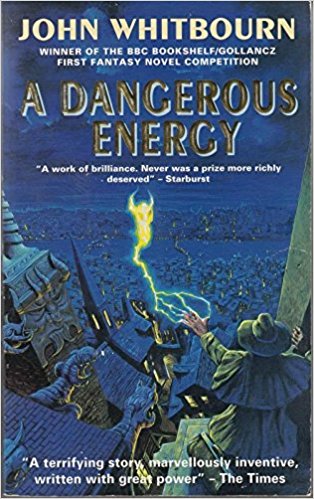
Review- Whitbourn, “A Dangerous Energy”

whitbourne

John Whitbourn, “A Dangerous Energy” (1992) – I can’t quite recall where/when I first heard of John Whitbourn. I think it was some quote from him about one of his fantasy novels being “the first Jacobite propaganda written in a century.” Somewhere else he describes himself as a “counter-reformation green anarcho-jacobite.” Let me put it this way- when I first heard of Whitbourn, those various descriptors said “whimsical and kooky,” not “probably shares pepe-oven memes and screams about white sharia” like you’d assume now from someone self-describing that way. Oh, how times change.

Either way… I finally read one of his books and it was interesting. “A Dangerous Energy” takes place in a world where the Reformation failed, capitalism and post-18th century technology never really took off (there’s railroads, but much of the world is unmapped?), and, there’s magic. The Catholic Church is the big institution, and attempts to monopolize magic by bringing its users into the priesthood (or nunhood as the case may be). The main character, Tobias Oakley, is found by some elves as a boy and learns the rudiments of magic from them, and then is recruited by the Church. The Church uses magicians in some vague research/enforcer roles.

If Whitbourn was trying to make a counter-reformation world look good, he failed abjectly- the world of the novel is cramped, ignorant, and dark. I doubt he was trying that, exactly- he evokes those feelings too well. Mostly, the world is a frame for the secular rise but spiritual fall of Tobias (yes, I did think of Tobias Funke a few times reading this). As he learns more and deeper magic, especially necromantic rituals which summon demons, Tobias leaves more and more of his humanity behind. Whitbourn isn’t clear on whether this is a consequence of Tobias’s choices, of learning magic from elves, or of learning magic, full stop.

Either way, Tobias grows increasingly amoral as his magic becomes more powerful. Magic is never powerful enough for somebody to take over by using it (it’s unclear what exactly its limits are), but it’s more than enough to help with his extracurricular activities. This starts out as simple early modern hedonism and goes on from there. He and some of his church friends get into drug-dealing, in some Ellroy-esque chapters. He joins a “crusade” against a Leveller uprising, in sections clearly influenced by accounts of the early modern wars of religion- looting, slaughter, sexual violence, and Tobias partakes in it all. Tobias grows increasingly “philosophical” — and morose — about morality and the value of human life as the story goes.

My understanding is that in most “dark” or “gritty” fantasy, or those with an anti-hero, is that there’s typically some redemption in the end- either the anti-heroes turn good, or they accomplish something good that outweighs the bad, or they just die. Well, spoiler alert- Tobias dies in the end, but there’s nothing redemptive or even cool about it. He’s just old and miserable, fully aware that he traded his soul for very little at the end of the day. In the course of the book, he goes from naif to rake to vaguely-Nietzschean amoral transgressionist to lonely old fart scared of death to actually dead. The end. It’s strange and uncomfortable — Whitbourn is clearly along for the ride with all of Tobias’s sins, and brings the reader along — but it works, in its odd internal way. This is his first novel- I’m curious what his other works are like. ****

Review- Whitbourn, “A Dangerous Energy”

Review- Jemisin, “The Fifth Season”

5thseason

N.K. Jemisin, “The Fifth Season” (2015) – Jemisin might be the biggest new force in sci-fi/fantasy writing today. She’s the winner of back-to-back Hugos for best novel in 2016 (for “The Fifth Season”) and 2017 and an active blog/social media figure. She was near the center of “Puppygate,” a social media brouhaha where multiple loose coalitions of reactionaries attempted to hijack the Hugo awards process and generally troll sci-fi/fantasy fans and writers they saw as liberal or politically correct. A successful black woman writer vocal about social justice issues both within and without the SFF community, Jemisin was a special target for the worst of the “puppies,” and received a lot of vile, high-profile abuse. Backlash against the backlash helped make her a symbolic figure for liberal fans (and probably helped her win those two Hugos, the award that served as the site of much of the controversy, which has presumably inflamed the reactionaries all the more- the circle of liiiiife).

Honestly, beyond simple racism, misogyny, and various other misplaced resentments, I don’t see what problem these people could have with Jemisin’s work that they wouldn’t have with accepted favorites like George RR Martin. “The Fifth Season” is a decent example of what seems popular in big ticket speculative fiction these days: big doorstop tomes, thickly laid-on worldbuilding, character work that’s a little bit Joseph Campbell, a lotta bit RPGs, a smidgen of zeitgeisty filigree work, and a lot of portents, both for the world-shattering apocalypses the stories either promise or are premised upon and the inevitable, equally long or longer, sequels. This is pitched as softly and straightly at contemporary readers as you can get without providing cliffnotes. So don’t let any of these Puppygate trolls tell you it’s about getting the kind of stories they want. They want exactly this kind of story, but they don’t want it from a black woman who says stuff the don’t like, especially if she gets the sort of award that helps make you the face of the genre.

Jemisin comes up with some interesting stuff (more than Martin does, in my opinion). The world of “The Fifth Season” is a world of repeated cyclical geological apocalypses. Societies are organized around their inevitable collapses. There’s also a downtrodden subsector of the population which can do magic, drawing from the energy of the overactive tectonic plates to go super saiyan (is that the term? I’ve never watched the show) and do all kinds of stuff. These magicians are hated and feared, and usually killed if a special order doesn’t find them first, to train them to use their powers. There’s a lot of “Steven Universe” in this- magical outcasts named after rocks. But sadly, it has little of the show’s whimsy (or its aesthetic- harder to pull off with the written word in any event). This is serious biz, ended worlds and lynched children and ancient secrets. It’s heavy.

Jemisin also does some interesting stuff with narrative but it doesn’t land quite as well. There are several diverging and reconverging viewpoints, which is cool, but about a third of it is in second-person. That is an experiment that doesn’t work- I found those portions took me more out of the story than the third-person parts did. And in general, “The Fifth Season” suffers from pacing issues, as it tries to shoehorn a plot into all of its worldbuilding… and, of course, set up for the inevitable sequel. It’s often unclear who is where, doing what, why, even with the handy maps and glossaries. I sympathize with wanting to lay out all of the aspects of this cool world you made (and I wonder if Jemisin ran this as an RPG at some point- I could see this as being a fun setting for one). But it’s a delicate balance between a propulsive story and a big, detailed world, and Jemisin doesn’t nail it in this one. ***

Review- Jemisin, “The Fifth Season”

Review- Moorcock, “The Sailor on the Seas of Fate”

elric2

Michael Moorcock, “The Sailor on the Seas of Fate” (1976) – This is pretty solid “van art fantasy,” to use Garrett’s felicitous phrase. It’s the second book of the adventures of Elric of Melniboné, who Moorcock — the great lefty fantasy writer, perhaps now most famous for an essay shitting on a range of genre favorites from Tolkien to Heinlein to Watership Down (for some reason) as closet Tory-fascists — created to break with the stereotypes of fantasy heroes, but who wound up the model of a type in his own right. Instead of being buff, bluff, forthright, sure of himself, and basically good (in spite of the bad things he does), in the model of a Conan or an Aragorn, Elric is slight, decadent, ironic, full of self-doubt, and only learned to be good to spite his family and society, the saturninely evil Melniboné. This eventually became the model for many identical anti-heroic sword-slingers and the underground societies that bred them (the Drow, popular villains/antiheroes of late 90s/early 00s DnD branded fantasy, come to mind), which is now roughly as common as the sunnier kind of high fantasy hero.

In this installment, Elric, cast out of Melniboné for reasons I can’t really remember from the first one but which boil down to “wouldn’t be evil,” is wandering around, getting into adventures. He winds up on some weird boat that travels amongst planes of reality and different times. Instead of the romanticism- (and medievalism)-tinged descriptions of wandering through various European-ish countrysides you get in Tolkien and his interlocutors, you get similar wanderings but with a sort of psychedelic-inspired palate. This gets into the actual action of the series, as well, as Elric has to do Steven-Universe-style body-melds with some other swordsmen to beat some evil wizards who are also buildings, and is followed around by an ominous horse. He makes various deals with devils, some of them good, some of them tragic necessities, all bound together in the kind of universalism that the sorts of dudes who paint people with swords and chainmail onto the panels of their vans can agree on. That might sound like a dig and maybe it is a little, but I can also appreciate it as an interesting historical artifact.

The story is pretty all right if you like fantasy. One major thing Moorcock does differently from his bete noir, Tolkien, is that he doesn’t write as long. That said, from my perspective, well after Moorcock’s work has been enshrined in the SF/F canon (and, more importantly, worked into the games and movies that really propagate a SF/F’s writer’s aesthetics much farther than their books generally can), the differences between him and the fantasy writers he slammed don’t seem that big. I think there’s a continuum between the sorts of writers who seek out that space, the hero’s journey through worlds dissimilar to our own in the way fantasy generally is — less organized, lonelier (though fantasy gaming has kind of disrupted both of those traits) — that makes itself felt, no matter what else they may disagree on, politically or aesthetically. ****

Review- Moorcock, “The Sailor on the Seas of Fate”