Review- Marks, “Fire Logic”

Laurie Marks, “Fire Logic” (2002) – The word I find myself reaching for to describe this fantasy novel is “mature.” It has a very mature outlook on relationships, not denying the passions of its youthful protagonist, Zanja, but also depicting studied, thoughtful portraits of older characters, addicts, people from different and rival cultures. Marks doesn’t indulge in the lengthy worldbuilding of a lot of other fantasy writers- if anything, she errs on the other side, making the rival Shaftal and their Sainnite occupiers less distinct than might make sense. But that’s probably part of the point- Marks depicts well the spiraling violence of an insurgency/counterinsurgency situation, and concludes that Shaftal and Sainnite should put aside their differences and learn to live together on the same land. I get that, I guess, but maybe being an old insurgency student myself I can’t help but think that the Sainnites invaded Shaftal and it’s on them to rectify the situation, possibly by exiting. But anyway- Zanja is not from Shaftal, but from a tribal society living nearby (which the Sainnites eventually massacre in the sort of war crime that doesn’t exactly make you agree with Marks’s peacenik agenda… unless it does, I guess). She’s trained as a diplomat, and is a fireblood- here, many people are imbued with magic from one of the four classical elements. Zanja’s fireblood makes her intuitive, lightly precognitive, as well as willful and fickle. She falls in love with an earth witch who’s addicted to a Sainnite drug, and gets involved with the Shaftal resistance to Sainnite rule, before she begins to see the futility of the situation and its conflicts with her life and those who are close to her. Marks writes decent early-modern (they have gunpowder but only for pistols?) action scenes and her depictions of same-sex relationships seem to me to hold up well now, and must have been a revelation for 2002. Sometimes, her maturity and restraint get the better of her and the narrative drags somewhat as characters go back and forth over their assorted agonizing decisions and efforts to heal. There’s worse things to drag down a narrative, but it made reading more of a slog than it needed to be. ***’

Review- Marks, “Fire Logic”

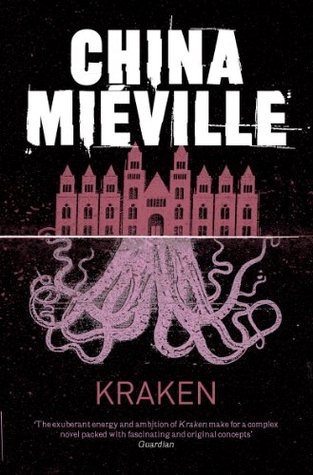
Review- Miéville, “Kraken”

China Miéville, Kraken (2010) – Gotta say… I was always a whale guy in the squid-whale dichotomy. I know, I know, the cool kids are all about cephalopods these days, but that just makes me back my mammal friends all the more. And there’s no “Moby-Dick” about squid. Miéville’s “The Kraken” ain’t it, either.

To be fair, I doubt it’s trying to be, and what it amounts to is something pretty decent. As the back copy will tell you, somebody steals a dead giant squid (and its tank) from a London museum, which sends its caretaker Billy into a world of competing cults, magical weirdos, magic cops, and assorted terrors. The big dead squid has big juju and it’s own cult of squid-worshippers, and so magical London — which is less officially hidden than generally ignored — is all in an uproar over what to do about it.

Most reviews don’t go much past the back copy, and I think there’s two reasons for that. For one, spoilers- there’s a big twist in the end and no one wants to give it away. Second, and I think more importantly, the plot swirls maniacally and is littered with all kinds of stuff China Miéville thought was cool. There are at least five agendas to attend to, including that of Billy, the closest thing to a central viewpoint character, and each of these agendas have assorted arcane obstacles and helpers, all of which require explanation.

What does some of this include? Well: a gang boss who is a sentient tattoo on someone’s back and who makes people-machine hybrids; another gang boss who’s a dead magician; some magic cops, one of which is based on Amy Winehouse, who summon cop-ghosts from old police procedurals; magic Nazis; an ancient Egyptian demiurge of trade unionism who can embody himself in statues (and action figures); a cockney embodiment of evil; an iPod that’s bad at music but good at magical protection; several apocalypses; chronically depressed teleporters; “Londonmancers” who manipulate the city in various ways; were-squid . And I’m leaving stuff out.

When the plot comes together, it ultimately works, especially knowing Miéville’s body of work and his commitments (he’s a big leftie and former ISO member, for those playing the home game). It’s a long, confusing, but mostly fun ride getting there. It all depends on what proportion of and which of the things Miéville throws against the wall make your eyes roll. Without getting into spoilers, the magic in “The Kraken” relies on metaphors, and so the denizens of magical London take metaphor extremely seriously, to the point of silliness at times. But for the most part, Miéville’s storytelling and vast powers of invention prove winning. ****

Review- Miéville, “Kraken”

Review- Whitbourn, “The Two Confessions”

John Whitbourn, “The Two Confessions” (2013) – Dipping once again into the works of “counter-reformation green anarcho-jacobite” fantasy writer John Whitbourn brought me to this, the final installment of the series his first novel, “A Dangerous Energy,” began. The world is one where magic is real and largely controlled by the Catholic Church, which in turn controls vast swathes of the planet, keeping it at a pre-industrial level of technology even into the 1990s. This world’s Britain is staunchly Catholic, ruled by the Stuarts, not at all a United Kingdom, and generally not a great advertisement for what the counter-reformation, magic, or the Jacobites do for a country. Life is squalid, limited, and dark- for characters in Whitbourn’s stories, shading towards pitch black.

Our protagonist, Samuel Trevan, is an orphan turned proto-industrialist struck down by the Church’s strict laws against over-exploiting labor (in one of this alternate universe’s more extreme points of departure, the Church doesn’t generally side with employers). He was going to make a fortune manufacturing rifled muskets (because that’s where they’re at, technologically) and then marry the upper-class girl of his dreams, but no such luck once the Church gets done with him.

Now expendable, Trevan is employed by some of the realm’s deep state fixers to fix a case of spooky mines in rural Devonshire. Trevan wants money, his handlers want discreet elimination of a problem down there. And what a problem it turns out to be- demi-devils, part human part demon, but even worse- heretics! Specifically, Bogomils- for those not versed in heresiology, these were the predecessors to the more famous Cathars, and were dualists who believed the material world was somewhere between irrelevant dross and actively evil. Our word “bugger” comes from “Bogomil” because of their supposed sexual practices (to help reduce reproduction). These Bogomils are in touch with some cask-strength Lovecraftian elder god type thing and aren’t shy about sacrificing people (in a nicely nasty touch, the Bogomils’ friends, those dastardly Unitarians, are too squeamish for it and leave before the rituals get spicy).

Trevan’s whole crew gets sacrificed, but then Trevan is saved by… not quite a deus ex machina. Is there a Latin word for elves? Either way, elves exist in this world, magical and aloof from humanity but not above messing with it (in a way that reminds me of archons from the lore of the dreaded Gnostics). This is where things get fuzzy. The elves say they save Trevan because he’s a massive threat to them. The industrial revolution he could usher in would destroy elfdom- even his touch or proximity is toxic to the fae folk. So they take him, give him all the money he wants, let him marry the girl, and try to hide him. If they’re so indifferent to humanity, why don’t they kill him, or let the Bogomils sacrifice him?

Eventually, Trevan gets doxxed and the Bogomils show up, but not to sacrifice him: to try to recruit him. They want the industrial revolution, for reasons obscure but in tune with Whitbourn’s general vibe- in his world, heresy and “progress” go hand in hand. They harass Trevan so bad he eventually has to hide in a monastery, which is where the novel ends. The end, no moral!

Well, some moral. Whitbourn is as much a horror writer as a fantasy writer, so there’s limits to how sunshine-y his worlds would be in any event, but from a “deep green” perspective the world is probably better off, and some of the filigree in the worldbuilding makes clear settler colonialism didn’t get far, either. More than anything, man is small and mostly knows his place. Whereas, Whitbourn’s antiheroes and villains are small, battened by forces beyond their comprehension, but entertain delusions about steering their own ship… that is to say, they’re moderns. And in Whitbourn’s world, the moderns lose.

They have to, because this is essentially cosmic horror — horror about the universe’s essential cruelty and pointlessness — but with precisely one out: a remote but all-powerful God who, for mysterious reasons, chooses to communicate with man through the Catholic Church. That’s where reactionaries fall apart- man is small and irretrievably corrupt, therefore let’s pick a few of them (or just one!) and give them all the power. In Whitbourn’s world, those people have the direct line to the one bare trickle of cosmic hope, so I guess it makes sense they call the shots. Still and all though- the world as Whitbourn shows it is dark, cramped, and dirty (the writing displays horniness that borders towards the cringeworthy). The Bogomils have some good points about the grossness of the world, even if, in the fine old reactionary genre formula, the more ideas they have the more awful their behavior.

Anyway… a lot going on here. I may have gotten into Whitbourn out of ideological curiosity but I’ve stuck with it because he writes genre fiction with verve and heart (and a high work rate- he has dozens of other books). This one had a pretty good dungeon-crawl and some sinister yokels, even if it also had inexplicable plot points and slow bits. It’s all part of the unique package Whitbourn delivers. And he (or someone pretending to be him for some weird reason) has commented on my blog! I emailed him about doing an interview. Fingers crossed! ****

Review- Whitbourn, “The Two Confessions”

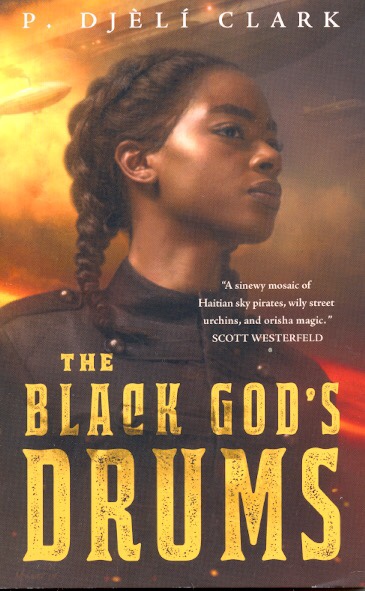
Review- Clark, “A Dead Djinn in Cairo” and “The Black God’s Drums”

P. Djélí Clark, “A Dead Djinn in Cairo” (2016) and “The Black God’s Drums” (2018) – This is a fun pair of novellas set in an alternate history 19th century by a history professor at UConn. Those who know me know I have little patience for steampunk, but I can forgive the airships and clockwork men when they’re not put to the purposes of imperialist nostalgia, as steampunk is so often. On the contrary, Clark wrote a world where anti-imperial powers — Haiti, an independent Egypt — use magic and technology against the 19th century powers that were and become major powers in their own right. The detail work on the world is pretty decent and not too badly info-dumped on the reader. The storylines are similar- plucky young black women need to figure out mysteries that threaten New Orleans (in “Drums”) or the world (“Djinn”) with destruction. These works are too short for a lot of red herrings, character work and the like and so they sometimes reminded me of one-off tabletop roleplaying game sessions with one or two player characters. Mystery, preliminaries, asking wise women, finding the final boss, besting the final boss using some special characteristic of the protagonist’s. It’s a little formulaic but the prose moves right along, not bad for a commute read. I’d be interested to see what Clark could do with this world in full-fledged novel form. ****

Review- Clark, “A Dead Djinn in Cairo” and “The Black God’s Drums”

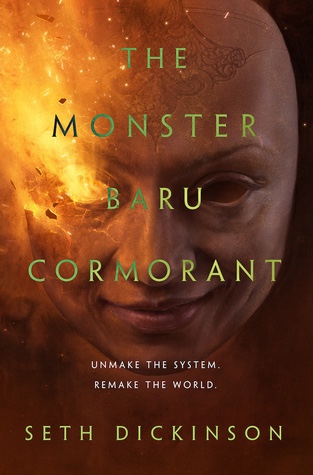
Review- Dickinson, “The Monster Baru Cormorant”

Seth Dickinson, “The Monster Baru Cormorant” (2019) – This one goes to eleven. The sequel to one of my favorite fiction reads this year, “The Traitor Baru Cormorant,” TMBC squeezes in all kinds of stuff. Six or seven viewpoint characters introduced in successive chapters at the beginning of the book! Multiple overlapping conspiracies! Multiple fictional games introduced, illustrating Themes! Currency speculation, druggings, naval chases, cancer cults! Head injuries! Dickinson doing his white-guy best with an Africa-inspired fantasy civilization, to go along with his straight-guy attempt at a lesbian main character! It’s a lot.

I’d say it’s a little bit too much, especially at the beginning where Dickinson introduces all of these characters and sets them in motion, expecting you the reader to keep track. I’m pretty good at that kind of thing and I found it stiff going. It’s hard to know how to introduce the plot, it gets so intricate. At its most basic, the titular Baru gets sworn in to a small elite of conspirators that runs the republic-empire of Falcrest after starting and betraying a rebellion in one of the empire’s provinces in the last book. She plans on trying to take down Falcrest from the inside to avenge her own homeland’s takeover, but at what cost?! Moreover, everyone in the Falcrest-running conspiracy is also conspiring against each other. This bathes everything in a kind of itchy paranoia and disdain- they can’t talk to each other without acknowledgment of the ways they despise each other. The stakes are high so the competition is lethal- in theory. Everyone trying to do each other in gets a little tedious when no one dies…

Anyway, Falcrest is in competition with another sort-of empire, Oriati Mbo. In many respects they are opposites. Falcrest, seemingly modeled after Rome and revolutionary France, is uptight, regimented, looking to remake the world in its own image, whereas the Oriati, modeled after various African societies with maybe a dash of India thrown in, is looser and more relaxed. Both are intensely concerned with health, and their approaches are symbolic- Falcrest’s obsessive hygiene which tends towards the lobotomy pick, Oriati’s lore and ritual-science derived medicines. Both grab smaller societies into their orbit, Falcrest through financial shenanigans backed by military force, the Oriati by cultural exchange which shades into confederation.

Some people want war between the two, some warn such a war would kill millions and doom civilization, others agree but want war anyway (Baru sometimes flirts with this). The action of the book is structured around Baru and the junior members of the conspiracy she’s in trying to track down a secret cult that the senior members think explains Oriati’s seemingly miraculous ability to maintain itself amidst baffling diversity. They conspire against each other as they follow a breadcrumb trail across the sea. Their efforts are punctuated by attacks from a Falcrest navy admiral and a former conspirator-turned-killing-machine who are out to get Baru for some of her previous betrayals.

It’s a lot, and it stretched my capacity to remember and to care. There’s a whole plotline of flashbacks amid all this, there’s the never-ending churn of mysterious shady conspiratorial behavior between the people on the boat Baru is on, there’s plots within plots. It’s overstuffed. That’s not to say there’s not cool stuff in it. The ending was decent, in a Grand Guignol/early modern biological warfare kind of way. Where it gives her space to breathe — apart from constant repartee with her frenemies and mulling over her guilt — Baru’s maneuverings are fun. The worldbuilding isn’t bad, there’s just too much of it for one book. The bigger problem is centering all of his world around a conspiracies of special people (the Oriati aren’t run by a conspiracy ala Falcrest as such but their destiny is in the hands of a small number of people). It took me out of the story a little- that’s one thing first book got well, making Baru feel like a small, if important, part of a world that worked according to real-world rules. This felt less credible- the book is incredible, in multiple senses of the word. ***’

Review- Dickinson, “The Monster Baru Cormorant”

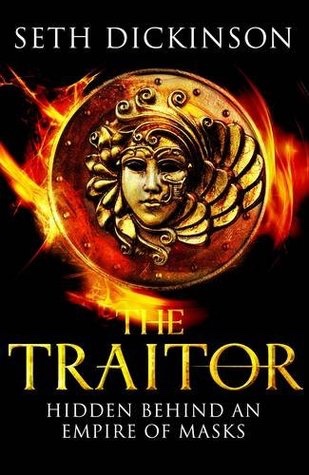
Review- Dickinson, “The Traitor Baru Cormorant”

Seth Dickinson, “The Traitor Baru Cormorant” (2015) – Does it count as fantasy if there isn’t any magic in it? That’s just one of the questions raised by this excellent novel that I’ll just go ahead and call early-modern fantasy anyway. It has a lot of fantasy tropes; a young person with a destiny/quest, an alternate world, battles with pre-modern weapons, duels. It also has twisty feudal politics galore, driving comparisons to the Game of Thrones books, but for my money Dickinson gets a lot more done creatively in fewer pages than GoT.

Baru Cormorant lives on an idyllic island — pre-contact Hawaii divides by Lesbos — as a child but we all know that can’t last. The Empire of the Masquerade gets its hooks in things via trade followed by conquest. The Masquerade is an interesting invention. The product of a sort of Jacobin/Machiavellian type revolution, it is notionally a meritocratic republic, where all civil servants wear masks to anonymize themselves as servants of the people, hence the name. They make their way to empire more through cunning introduction of innovations that favor them — monetary policy, sanitation, education, etc. — than by military might, though they have a lot of the latter. All is not well with the Masquerade, though- part of their overarching rationalism is strict eugenics and conditioning programs, which entail a rabid homophobia among other issues.

Baru gets taken in as a child to a Masquerade school, but vows to never forget her two dads who the Masquerade kills or her mom, to whom she promised vengeance. She decides she will excel at the meritocracy game, gain high place in the empire, and use it to… here she waffles between “make improvements to her home’s position” and “throw off the Masquerade yoke” but whatever, she’s like eighteen. She excels in her training (at the cost of suppressing her own sexual identity) and is eventually appointed Imperial Accountant of a different restive province, Aurdwynn. Her patrons imply that if she can help make Aurdwynn governable, then she will get to move still further up the ranks.

Aurdwynn is basically Game of Thrones’ Westeros, to an extent where I wonder if Dickinson is making sly jabs at George RR Martin. Run by a welter of dukes, each with their own involved alliances, economies, heraldry, customs and so on, it’s a mess, and one that constantly rebels. Baru has her work cut out for her.

It’s hard to know how much to say about the plot of the book without giving it away. Suffice it to say we wind up with a very interesting depiction of an early modern (they have telescopes, frigates, and eugenics but no guns- most battles are fought by phalanxes) rebellion. Dickinson takes us through the back and forth of winning over dukes, losing dukes, forming something like a guerrilla army and using it, without losing any steam in the process. It’s a good match of solid plotting and innovative worldbuilding. The language tends towards the flowery and passionate- lots of lists of things joined by “ands,” for instance. But it works pretty well for the situation, especially as Baru finds it difficult to hold together the threads of her personality, including her suppressed sexuality.

Again, avoiding spoilers, we’ll just say that the book sets itself up for the sequel that came out recently. It seems things might get a bit more magical-er as Baru peers deeper behind the Masquerade, so it might become more conventional fantasy. I hope it maintains its footing in the early modern- republics, finance, proto-versions of things like people’s war and eugenics, these things make for a worthwhile niche in the fantasy world. *****

Review- Dickinson, “The Traitor Baru Cormorant”

Review- Okorafor, “Who Fears Death”

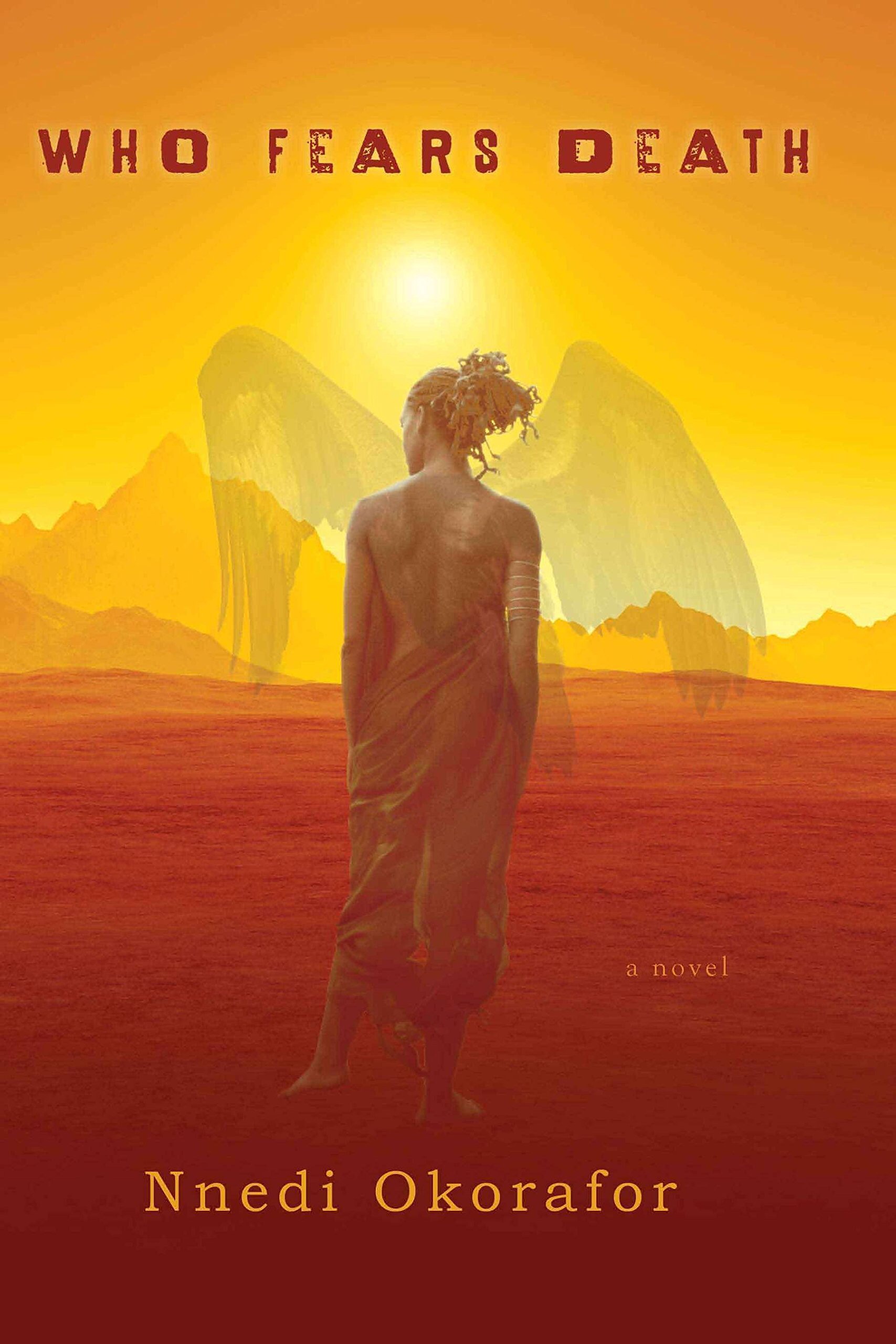
Nnedi Okorafor, “Who Fears Death” (2010) – Here we have a fantasy/scifi novel that draws from both Africa’s traditional storytelling and its contemporary issues and crises. The main character, Onyesonwu, is the product of rape as a weapon of war, in an ongoing conflict between the dominant Nuru tribe and the insurgent Okeke. Raised by her mother in an Okeke village, Onyesonwu is an outcast but develops magical powers- first shapeshifting into various animals, then numerous others.

The first third of the book is the best part, as she develops her powers, induces the local magicians to teach her against their resistance, and learns her destiny- to go among the oppressed Okeke far from home and bring an end to the fighting, as well as confronting the evil Nuru wizard who is helping spur the conflict.

The rest of the book drags, unfortunately. Okorafor is also a successful young adult fiction writer and it shows as she takes her characters out to the desert and has them get into teenage dramatics with each other. We go from learning the ins and outs of magic and ethnic conflict to protracted drama between Onyesonwu’s interchangeable friends with the suddenness that the end of “Huck Finn” becomes a hundred pages of minstrel routine. Quest narratives always have some back and forth within the group, but “Who Fears Death” loses a ton of momentum and never quite regains it. The ending has a pretty cool magical catastrophe in it but by then you can’t help but wonder at the book that could have been with this premise. ***’

Review- Okorafor, “Who Fears Death”

Review- Jama-Everett, “The Entropy of Bones”

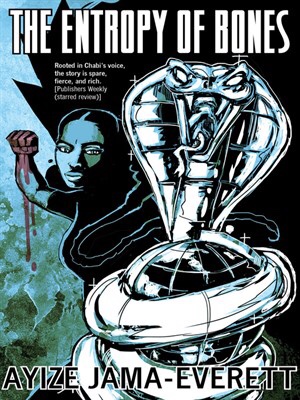
Ayize Jama-Everett, “The Entropy of Bones” (2015) – I’ve seen kung fu movies, but I’d never read a kung fu novel before this one. It’s the story of Chabi, a teenage girl growing up on a houseboat in the Bay Area who, after some training from an eccentric old Indian guy, is capable of running fifty miles in a couple of hours every day and breaking every bone in someone’s body in a matter of seconds. The latter feat is accomplished not by strength tuning in to the titular entropy already extant in the bones themselves. All of this is imparted like it’s obvious common sense, which makes it more fun.

Obviously there’s something special about Chabi in terms of her physical capabilities. She’s also mute, but can speak psychically. This didn’t make much sense to me as a character feature until a minor reveal at the end. The book in general has a kind of loose, almost conversational rhythm, like Jama-Everett is telling you these stories over beers. Loose, but well-structured (like a barroom story one has told many times)- the details of Chabi’s powers, and the world she’s a part of, come out naturally. The world of the story is similarly tossed-together in the best way: entropy beings versus “liminals,” super-powered people like Chabi, and a few demigods and time travel thrown in.

Chabi winds up working for some suspiciously pretty hotel magnates once Narayana, her sensei, disappears on her. She knows there’s something wrong with them but can’t work out what. When a friendly demigod of the wind comes from the future and hips her to the whole entropy-being thing, she puts two and two together and realizes maybe Narayana wasn’t on the side of the continued existence after all, which is a bummer. She gets it together enough to fight a bunch of other superpowered fighters in a big final tournament the baddies put on, but of course she can’t fix the whole thing or there wouldn’t be a future conflict for the wind guy to come back from, would there? No, the forces of rhythm and weed (this guy likes weed) will have to continue to battle the forces of entropy. In all, this book was pretty fun and I’m going to look up some of the rest of his work. ****’

Review- Jama-Everett, “The Entropy of Bones”

Review – Whitbourn, “To Build Jerusalem”

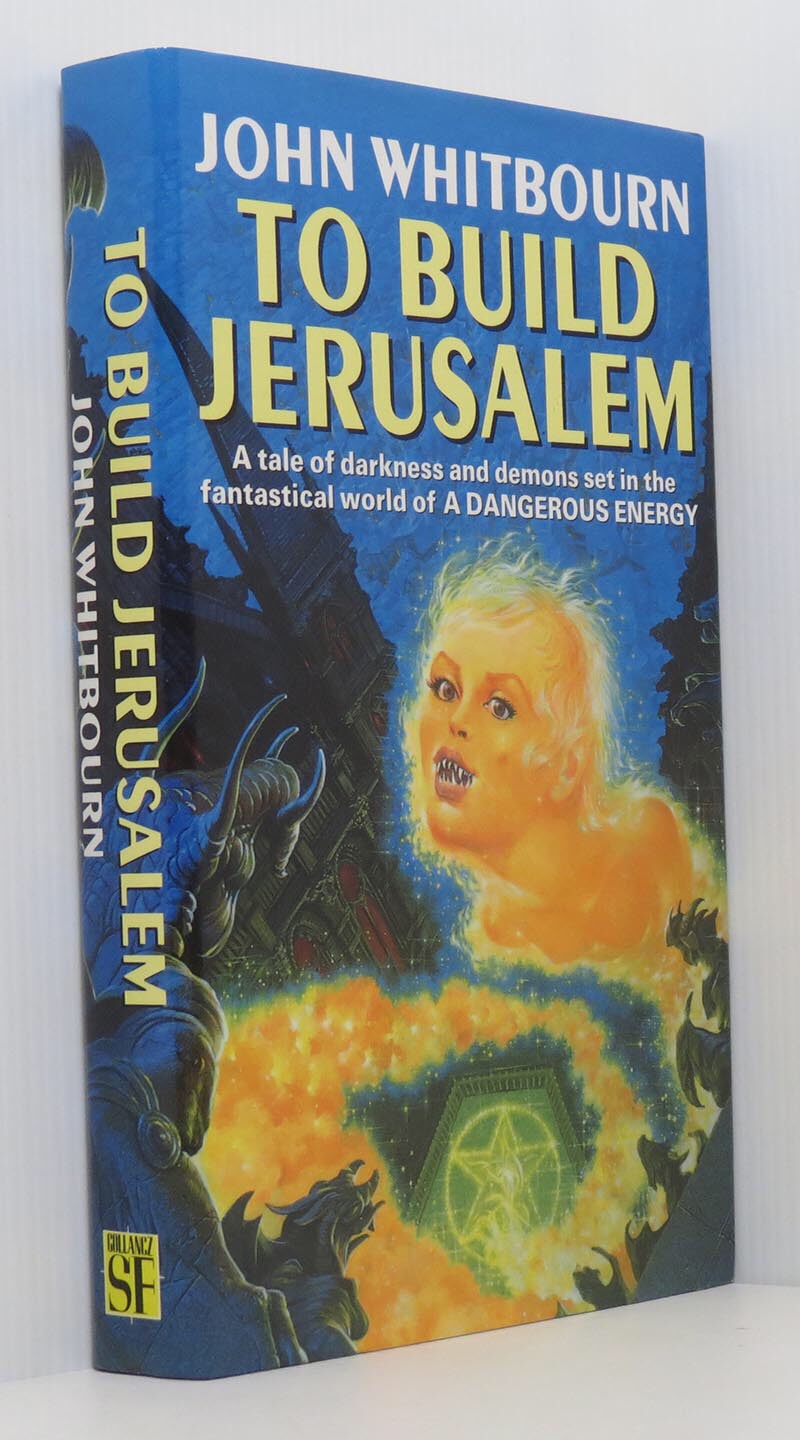
John Whitbourn, “To Build Jerusalem” (1995) – An alternative title for this one could be “Fear of a Protestant Planet.” English fantasy writer Whitbourn once described himself as a “Green Counter-Reformation Anarcho-Jacobite” (you can see why I made a point of tracking his books down). This was back in the eighties or nineties, before we would automatically assume such a person is just trying to find a way to avoid self-describing as fascist. Whitbourn’s ideas frame the worlds he writes, and they’re animated by a pulpy horror/fantasy sensibility with substantial Lovecraftian overtones.

This one in particular takes place in a world where the Reformation failed, the Catholic Church runs things in a manner reminiscent of the Emperor in Dune, and magic exists, mostly wielded by priests. Like I said when I reviewed the first book set in this world, “A Dangerous Energy,” if Whitbourn is trying to convince people that the world would be better without the Reformation, he’s found a funny way of doing it. The world is dark, cramped, and run by tyrants. It’s the late twentieth century and much of the world is unmapped and they’re just figuring out trains. To the extent Whitbourn can be said to pitch it as a “good” world, you could argue it’s more orderly- people know their place in the world and stick to it. Not my thing, but ok.

But Whitbourn is pleasingly non-didactic, and the actual point of the world seems to be that it’s a good jumping off point for horror and adventure. The main character is an enforcer for the Church, a sort of Catholic janissary named Adam. He’s sent to England because there’s a disturbance in the force- some kind of entity in the sphere of magic that is making the spells not work good. Wizards often summon demons, but it turns out, the demons they summon are small-fry compared to a big (and very horny) demon from a realm of evil beyond even the evil-realm the wizards can access. The many layers of unknowable and unholy power that exist beyond our ken are reinforcement for the idea that we need a stable order watched over by a perennial source of spiritual power…

Spoiler alert- the demon lord (never named) manifested itself to the Gideonites, the underground remnants of Protestantism in England. They bargained with it to kidnap the King and the papal legate and do a bunch of other mayhem. Whitbourn depicts the Gideonites as similar to (a conservative picture of) militant leftist movements in our timeline (including references to “democratic centralism” lol). Their overweening pride and desperation over being owned by the Church and its armies all the time leads them to believe they can use this demon-lord to bring about the End Times and hit the reset button on the whole thing. Not only that- but they’re getting into enclosure! The venal lords of England, never really faithful enough, start doing capitalism against the wishes of the church, kicking good pious peasants off the land and raising sheep for money. Both the demon’s antics and enclosure are treated as equally heinous, offenses against the sacred order of things.

The book’s a lot of fun. Naturally, our Leninist-Puritans can’t control the demon-lord, who does all kinds of nasty things. Adam develops a fun Holmes-Watson thing with a provincial English yeoman-soldier. Whitbourn throws in a lot of fun details and a real sense of place, namely Surrey and Sussex- apparently he has whole collections of macabre tales about them. The ending was kind of a cop-out. There’s some fun battles in the demon-lord’s own dimension, but they end with a literal deus ex machina (or deus ex coelum). It’s consistent with Whitbourn’s beliefs and with his vision of our world at the mercy of extra-dimensional powers above and below… but it kind of took the wind out of the book’s sails. Still, definitely worth checking out. Also, someone claiming to be Whitbourn commented on my review of his earlier volume. If you’re reading this, Mr. Whitbourn, thanks for getting in touch, and I hope your straits aren’t actually dire! I did go out and buy this book, and encourage others to do so if they like quality weird history/fantasy/horror fiction. Maybe we can do an interview? Let me know! ****’

Review – Whitbourn, “To Build Jerusalem”

Review- Moorcock, “The Weird of the White Wolf”

www

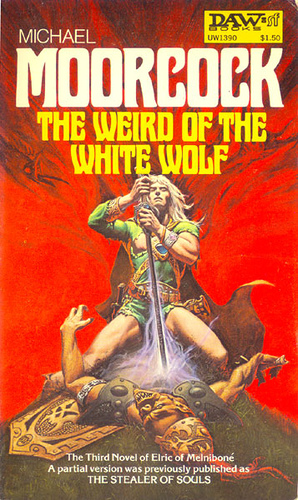
Michael Moorcock, “The Weird of the White Wolf” (1977) – People throw the word “epic” around a lot nowadays. As far as I can tell, they mostly mean it to mean “big/good/dominating,” with the implication that those traits can exculpate whatever is being described for also being sloppy, unsophisticated, or gratuitous. At this point, “epic” is also an online cringe-word, something thrown around a lot by corny people (and by people who consider themselves non-corny approximately three-to-five years ago).

Michael Moorcock has had an outsized shaping role on nerd culture (popularizing moody anti-heroic protagonists, introducing the law-chaos dichotomy as an existential principle) but sadly, his idea of “epic” has been drowned out by the more anodyne, commercially-usable meaning we have today. This is a shame, as his “Elric” stories are a pretty good example of the potential of the epic form in contemporary writing.

There’s an irony here, in that the Elric books and this one, “The Weirding of the White Wolf,” in particular lack many of the touches that make something “epic” in contemporary speech: they’re short, 150-200 pages each; they don’t do Campbell-lite character work; world-building is executed in quick, broad strokes, not the exhaustive descriptions of those elements of fictional cultures that coincidentally might feature in a game; exciting stuff happens but it’s not nearly as theatrical or action-packed as something written with an eye towards the contemporary multiplex.

What you have instead is an older type of epic, reframed by Moorcock’s pulp-fantasy/psychedelic aesthetic framework. The world is vast, old, lonely, and while elements of it are in constant flux, it’s basic nature doesn’t change. The hero, Elric, accomplishes big things — he burns down his home city, the dark (former)-imperial capital of Melniboné, accidentally kills his love interest, dallies with royalty and the forces of existential chaos — but we know, at the end of the day, he’s going to pick up his sword and move on, and the world will be the same. Elric will be more or less the same, only more so. That’s a characteristic of epics that some of the contemporary types seem to keep, the main character who becomes more and more their archetype until their achieve apotheosis/die, and it’s often basically the same thing. That’s how things are looking for Elric, as his totemic sword seems to be increasingly directing his actions in this volume, and as it’s hinted that he’ll apotheosize into a Jungian “Eternal Champion.” This is an ambivalent fate, at best.

Done right, the modern epic form accomplishes a sort of rhythm you don’t get anywhere else, worlds away (literally, in many cases) from the psychological realism/interiority of the conventional bourgeois novel form and the assumptions about the world and time that come with it. Falling into that rhythm is a major part of the appeal, along with the sword-and-sorcery stuff. You can see why this sort of fantasy literature accomplished “cross-over” to more of a mass audience — and influenced the sort of art that gets into metal album covers and onto van doors — during the era of the counterculture (in which Moorcock heavily participated), with its mainstreaming of interest in alternate modes of experience. Moorcock does it pretty well. Here’s hoping his sense of “epic” gets out there more. ****’

Review- Moorcock, “The Weird of the White Wolf”