Review- Highsmith, “Ripley Under Ground”

Patricia Highsmith, “Ripley Under Ground” (1970) – I seem to remember liking the first Ripley book, though it was a few years ago and I don’t remember much past that bare impression. This one, the sequel, was a snoozer. Ripley is enjoying life in a French suburb with a wife, nice house, and fancy art collection, having gotten away scot free with killing and for a time impersonating a dude. He gets in trouble because he’s involved with a ring of art forgers that starts to get rumbled. He impersonates a reclusive artist and also kills a guy and needs to keep the police, his wife, the victim’s wife, and various other interested parties from finding out. Highsmith has been called “the poet of apprehension” and there is a tense mood throughout but the action isn’t very exciting. Ripley puts more effort into planning the shopping with his servant lady than he does in rooking people, which I guess is meant to convey how effortless Ripley is in lying but doesn’t make things more exciting. Are the subsequent Ripleys more worth it? *’

Review- Highsmith, “Ripley Under Ground”

Review- Brunner, “Stand On Zanzibar”

John Brunner, “Stand On Zanzibar” (1968) – I’ve heard it argued that the “New Wave” of science fiction that came about in the 1960s and 1970s is better in theory than in practice- that it was a nice idea that didn’t produce all that many works that stand the test of time. I’m agnostic about that: I’d need to read more to find out, though Dhalgren stands up pretty well. As for Stand On Zanzibar… well, one of the things that people seem to evaluate when seeing whether or not a scifi book “holds up” is predictive ability. On that score, Stand On Zanzibar does pretty well for a 1968 book talking about 2010. People “dial up” computers to get information (no GUI, but what can you expect). Genetic engineering is a thing: more of a thing than in real 2010, or at least in different directions. This volume gets it right that people are a lot less fixated on space fifty years on from the Apollo missions than a lot of people in the midst of space race enthusiasm thought they might. People still have very earthly concerns, in Stand On Zanzibar.

It is very late sixties in a lot of ways. Sexual politics is one- a lot of male fecklessness disguised as sexual liberation. More prominently, its Club-of-Rome style concern with overpopulation, the idea that seven billion people would be a problem due to overcrowding (and not, say, climate change). Brunner makes use of cut-up techniques, interspersing the action of the novel with “context” chapters showing what’s going on in the way-out happening world of 2010, and it’s all grim stuff involving megacorps and baby-farming. They also, unfortunately, involve the rantings of a sociologist proclaimed by the author as a genius, who dispenses edgy bromides about people being animals in dated-hip language. Don’t proclaim the characters who dispense your extraneous thoughts on the world as geniuses, authors (Robert Anton Wilson was another one for this). It doesn’t work.

The plot also doesn’t work particularly well. A megacorp is hired to take over an African country and make it a paying concern. Much of what kept me reading was curiosity: would Brunner (a Brit, fwiw) go full neocolonial and see this is as a good or workable idea? He comes close, but a weird biochemical deus ex machina gums up the works. A secret agent tries to uncover the truth about genetic engineering in a militant Indonesia-ish country. The two plots converge, sort of, at the end. There’s some interesting stuff here, but ultimately the edgy posturing and lack of substance grates. I’m curious about Brunner’s other “Club of Rome” novels, but mostly for historical purposes. **’

Review- Brunner, “Stand On Zanzibar”

Review- Strugatsky, “Roadside Picnic”

Arkady and Boris Strugatsky, “Roadside Picnic” (1972) (translated from the Russian by Olena Bormashenko) – The site of alien contact with Earth gets all freaky and forbidding in this Soviet scifi tale. It’s the basis of the movie “Stalker” by Andrei Tarkovsky and the source of metaphor in Adam Curtis’s last documentary (which I thought was a little weak tbh). All of them carry a heavy freight of existential dread and confusion.

The main character, Red Schuhart, is a stalker- a guy who goes into the forbidden Zone to seek out artifacts the aliens left behind. No one knows what is up with the Zone or the aliens, who made no meaningful purposeful contact with humanity. The rules work differently in the Zone- the rules of physics, seemingly the rules of cause and effect, and these changes are deadly. The stalkers that go through them are a hard-bitten, cynical breed, similar to hardboiled detectives or mountain men, and Red is no exception. The Zone is reaching out to make life in the surrounding areas unsustainable, but while there’s money to be had and, one suspects, a point to be made, stalkers will stalk.

The plot and characterization isn’t really the point in the Strugatskys’s novel any more than it is in Tarkovsky’s quiet, achingly-paced film. There’s a “one last job” where Red pursues a legendary wish-granting alien orb, but by then we’ve accepted the logic of the Zone- the Zone is the Zone and while one can take precautions, it makes mock of all of man’s attempts to put a system in place in or around it. People, including Adam Curtis, have put various political spins on the Zone, including claiming that it’s a metaphor for our own incomprehensible times. I don’t know about all that, but part of the strength of the Strugatsky’s work is that they create a powerful spacial metaphor for dread and the feeling of unreality. ****’

Review- Strugatsky, “Roadside Picnic”

Review- Stephenson, “Fall; or, Dodge in Hell”

Neal Stephenson, “Fall; or, Dodge in Hell” (2019) – As it happens, I actually read this months ago. I requested a reviewers copy on the idea I could run a review in LARB or somewhere. But it turns out everyone already either had somebody to review it, weren’t interested in reviewing it, or is too political for my not-especially-political take. So it goes up on the blog instead! And I have to remember a book I read in March.

In keeping with Stephenson’s m.o., this is a big book, and has the feel of several books squashed together. I’ve argued before that Stephenson’s novels are following the trajectory of the life cycle, and we’re getting into the part where a man begins to think a lot about death (and divorce) and legacy. We start with the titular Dodge, one of the main characters in “Reamde,” in my opinion Stephenson’s weakest novel. He goes in for a routine medical procedure and comes out comatose! His will says to pull the plug but also keep his brain on ice- it turns out Dodge was in to some futurist stuff in the nineties that predicted that science would be able to resurrect people. So like Ted Williams, on ice he goes.

But his beloved grand-niece has Plans. After taking a trip through an America increasingly divided between neurasthenic automated luxury liberalism and fanatical worshippers of the “Tactical Jesus” (easily my favorite thing in the book), she decides her senior project at college is going to be simulating a human brain on quantum computers. And who better to try it with than her great uncle Dodge?

It turns out to suck to have your brain be bouncing around a computer program. It’s just static! Until, that is, Dodge starts playing Minecraft with the static. He makes the world in a way that feels right- that is, a world somewhere between the world he grew up in and the fantasy gaming milieu where he made his fortune. He minecrafts up the hilly-willies and down the hilly-willies and then eventually some other rich techies show up on the server. They create bodies for themselves and then it’s on.

Truth be told this is where I began to lose the thread. There’s an Old Testament quality to the work, down to rolling King James cadences in the Minecraft Genesis bits and that’s cool, I guess, but then it gets into something like the begets, not literally but in terms of being hard to keep track of. There’s another tech billionaire, El Shepherd, who has a Plan for the digital afterlife that Dodge’s niece set up. He doesn’t like that Dodge basically set up lightly-fantasy-Earth Minecraft in the digital afterlife and like a lot of villains, he has a point. We could be doing literally anything! The one time anyone tries something different — a kind of communal musical mindmeld — Dodge completely thunderbolts it. What’s the point of an afterlife if you have to do everything the same as in the before-life?

But in the classic way of villains in conservative-liberal fiction from Madam Defarge to Killmonger, the people with actual ideas are also dicks. El wants to be God. He casts Dodge into hell. Meanwhile, the whole earth’s population is getting obsessed with watching shit unfold in the afterlife and the tech to get in gets more and more accessible. It’s pretty interesting to see how society changes around that, people basically waiting out the clock to get into the digital afterlife club, etc. What becomes of the worshippers of the Tactical Jesus?? Stephenson doesn’t tell us. He just drops them.

At some point Dodge’s niece infiltrates the digital afterlife to, uh… there’s some stuff with an Adam and Eve pair, and a fantasy quest, and fighting the El/Peter Thiel/Bad God figure… but god help me it was mostly pretty boring by then and I can’t remember most of it. There’s some weird shit like how most people who get incarnated into the digital afterlife become weird mutant goblin-esque scrubs- is that where the Tactical Jesus people go? I also got the vague idea they were maybe third world peasants. Either way, shades of the weird eugenics Stephenson played with in “Seveneves.” That only bothers me a little — I’m fine with speculative fiction based in ideas I’m opposed to — but it was mostly confusing and inconsistent, and missed some good opportunities.

All told, there’s a lot here, some good, some bad, some just dull. His broadest point appears to be that while life can be better (or worse), the basic shape of things — from what trees grow where to what shape bodies take (for the most part- there’s always a few fun exceptions) — is handed down from on high, or by the shape of our brains perceiving ideal forms in a sort of quantum pattern-sensing, six of one, half dozen of another. The highlights of the book are the ways in which society bends before and around the digital afterlife. There’s a take on the problem of “fake news” which is both interesting and partaken of liberal bromides about how the problem works (and is completely dropped when it could have been carried into digital afterlife!). The lowlight is the mediocre fantasy novel the book becomes in its last couple hundred (!) pages. What’s next for Stephenson? Who knows but it should be conceptually interesting and worth noting, if nothing else. ***

Review- Stephenson, “Fall; or, Dodge in Hell”

Review- Manchette, “The Mad and the Bad”

Jean-Patrick Manchette, “The Mad and the Bad” (1972) (translated from the French by Donald Nicholson-Smith) – Critics see crime novelist Jean-Patrick Manchette and filmmaker Jean-Pierre Melville as mutually influential on each other, but in this crime novel by the former, there’s a certain Coen Brothers feel. A failed architect who lucked into big money tries to have his brat nephew bumped off. He hires a caretaker from a sort of anti-psychiatric mental asylum (this was when the anti-psychiatry movement in psychology was big in France) as a fall girl. She turns out to be more resilient than he anticipated. The killers are less formidable than their employer might have liked, even if they are randomly dangerous- one is hindered by a stomach ulcer, the effects of which Manchette details extensively. The girl and the nephew escape from one perilous ambush situation after another, and wind up confronting the uncle alongside the uncle’s spurned former architecture partner. The final showdown takes place at a sort of surrealist parody mansion which messes with everyone’s sense of distance and proportion. All in all, a decent, quick read that seems very much “of it’s time.” ***’

Review- Manchette, “The Mad and the Bad”

Review- Ellroy, “Hollywood Nocturnes”

James Ellroy, “Hollywood Nocturnes” (1994) – James Ellroy- the great and sometimes frustrating grand master of contemporary American crime fiction; this is a collection of some of his early 90s short fiction. His short fiction magnifies both the capabilities and the shortcomings of his distinctive style. He can be masterful at summoning up his world — noir Los Angeles, either contemporary or in the fifties — in short order. The telegraphic style works well in short form, too. His characterization can go either way- sometimes deft, sometimes cheap (I remember one where one of his identical perspective-gun-thugs was mainly characterized as being “into rhinos”). The actual action is always a crapshoot- he’s always better with smaller-scale crimes than the grand and sometimes ludicrous conspiracies he sometimes conjures as endings. There’s exceptions — “Blood’s a Rover,” which caps the seminal Underworld USA series, involves a big conspiracy that actually works with the text. But by and large, the sleaze and intimate understanding of power dynamics he displays works better than his efforts at coming up with something commensurate behind it all.

The centerpiece of “Hollywood Nocturnes” and by far the best piece is a novella, “Dick Contino’s Blues.” Dick Contino was a real guy, a famous accordion-playing pop star (I have difficulty seeing how an accordion guy can get THAT famous in America, but who knows, it was the fifties). He entered the list of aspects of LA during Ellroy’s fifties childhood that made it into the matrix of the author’s noir dreams. Contino fell on hard times after being pegged as a draft-dodger (even though he eventually finished out his hitch). Ellroy puts him through several circles of the hells he creates, much of which out of things that are supposed to be pleasant: lounge acts, rigged variety shows, negotiating with the tabloid press, working as a repo man for a crooked car dealer, “infiltrating” a hopeless left-leaning reading group, sleazy d-movie productions, finally into a phoney kidnapping scheme to get him back into the limelight in a positive way. It all ends with a car chase and an encounter with an actual serial killer, but it’s the ride that really works.

There’s another good story involving an Okie ex-cop turned fixer for Howard Hughes, playing his patron off of mobster Mickey Cohen and a college-aged femme fatale. I don’t really remember the others that well, for good or ill. As usual his stories set in the mid-20th century play better than his contemporary stories. “Dick Contino’s Blues” is worth the price of admission, a ride through the noir hellscapes Ellroy conjures better than anyone. ****’

Review- Ellroy, “Hollywood Nocturnes”

Review- Weber, “On Basilisk Station”

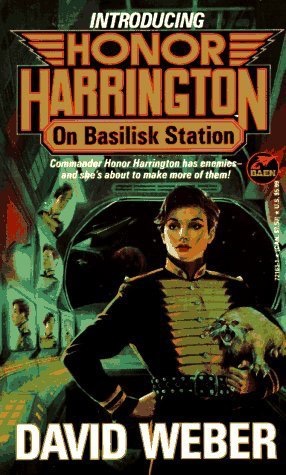
David Weber, “On Basilisk Station” (1993) – I figured I should take a crack at reading this, the first volume in the flagship series by the doyen of military scifi. In a way, this is a case of truth in advertising. It really is “military” scifi, as opposed to war scifi or action scifi, because a lot of it has to do with bureaucracy, procurement, chain of command drama, etc, the stuff of quotidian life in any military. There’s not a shot fired in anger in the first two hundred pages!

Instead, you get long descriptions of space ships and their weaponry. You get the travails of young commander Honor Harrington (presumably a descendant of Michael, continuing the socdem tradition of being soft on imperialism) as vindictive space-naval bureaucrats exile her and her ship to a remote station. Her crew dislikes her, she hasn’t got enough ships to do her job, blah blah. She serves the navy of Manticore, space-Britain to the nefarious space-Napoleonic-France of Haven, which has to conquer planets to keep its darn welfare state going. The natives are getting restless and of course no one bothers to explain why they’re bothering natives on the nearby planet when all they want is an adjacent wormhole, etc etc. Eventually the bad guys, whose only motivation is nefariousness, spring their trap, Honor proves everyone wrong, and we move on to the inevitable sequels.

Look: I’m fine with either one or the other. If it’s gonna be raygun space battles, cool (though over-adherence to a Napoleonic model of naval battles transferred to space makes everything a little stilted). I also could get into a story of someone organizing things in spite of limited resources, bureaucratic interference, etc. But we get half-assed versions of both with cardboard stock characters and uninteresting worldbuilding. It baffles me this is as popular as it is, not because it’s so awful (it beats “Starship Troopers” in novel form, for my money- at least Weber doesn’t preach, though he is literally a Methodist preacher), but because military scifi is held up as the populist, exciting counterpart to “ideas” scifi. But it’s not that exciting! LeGuin, Delany, Jemisin etc offer at least as much action and derring-do. Do the later Honor novels ramp it up? I don’t know and only curiosity about the shape of the genre would make me find out. **

Review- Weber, “On Basilisk Station”

Review- Leonard, “Maximum Bob”

Elmore Leonard, “Maximum Bob” (1991) – This is the first Elmore Leonard I’ve read, and it lives up to expectations. It maybe doesn’t live up to all the accolades thrown at Leonard over his long career, but it’s pretty good. A tale of low life in south Florida, Maximum Bob is the nickname of a local judge, a sleazeball named after his preference for maximum sentences. In classic noir style, it all starts with a simple, if poorly-conceived plan to avoid hard conversations- get a con to sneak a dead alligator onto his property so his wife, who has a phobia (beyond the normal fear) of the critters, will leave. The wife has been increasingly going off the deep end of spirituality, claiming that she shared a body with the soul of a little slave girl (imagine the trouble she’d get in if she were a poster twenty years later!). Of course, the plan goes wrong, and draws in a number of characters in and around the south Florida demimonde. The main “good” characters are a handsome pair, a lady probation officer and a dude cop, who obviously get together while trying to figure out what’s going on with the judge, people shooting at the judge, the alligator, and the judge’s wife. They’re generally less interesting than the Florida Men on both sides of the law populating the tale. And I gotta say… after reading James Ellroy, this story feels a little tame, a little easy. But still, pretty good, and I plan on looking up more Leonard in the future. ****

Review- Leonard, “Maximum Bob”

Review- Wodehouse, “Pigs Have Wings”

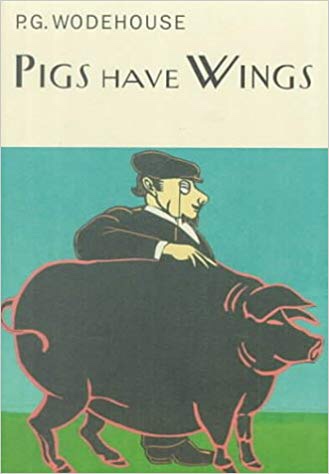
P.G. Wodehouse, “Pigs Have Wings” (1952) – What to say about P.G. Wodehouse that hasn’t already been said? His books are more-or-less pure wholesome fun. Everyone at the time liked and respected him with very few exceptions and people who read him now have the same feelings. He had a more-or-less blameless, happy life except for letting the Nazis bully him into doing self-effacing radio vignettes when they had him captured, and he never complained about the Brits being mad at him for it. Everyone in humor writing imitates him but nobody duplicated him. Even people like me inclined to dislike the British upper-crust milieu he illustrates find little fault with him, if nothing else because his characters are so ludicrous and awful (but always in a funny way). By the 1950s when this, the seventh book set at rural Blandings Castle, was published, he had been going for forty years and would go for another twenty. His later work, in my opinion, doesn’t have quite the zip or beauty of construction that characterized his mid-career stride from the twenties to the forties, but it’s still amusing and worth reading. This one is no exception- he had nailed the formula well before then. It’s the twenties, there’s a bunch of twenties-types — befuddled aristocrats, star-struck lovers, gadabouts, vicious aunts, servants of varying degrees of capability and trustworthiness — all bouncing off each other in a plot centered around two prize-winning pigs and four young people who need to be properly paired off. Everything comes together with only a few audible creaks in the machinery, and you’ve got Wodehouse set out to give- finely-crafted literary entertainment in a light vein. ****

Review- Wodehouse, “Pigs Have Wings”

Review- Dickinson, “The Traitor Baru Cormorant”

Seth Dickinson, “The Traitor Baru Cormorant” (2015) – Does it count as fantasy if there isn’t any magic in it? That’s just one of the questions raised by this excellent novel that I’ll just go ahead and call early-modern fantasy anyway. It has a lot of fantasy tropes; a young person with a destiny/quest, an alternate world, battles with pre-modern weapons, duels. It also has twisty feudal politics galore, driving comparisons to the Game of Thrones books, but for my money Dickinson gets a lot more done creatively in fewer pages than GoT.

Baru Cormorant lives on an idyllic island — pre-contact Hawaii divides by Lesbos — as a child but we all know that can’t last. The Empire of the Masquerade gets its hooks in things via trade followed by conquest. The Masquerade is an interesting invention. The product of a sort of Jacobin/Machiavellian type revolution, it is notionally a meritocratic republic, where all civil servants wear masks to anonymize themselves as servants of the people, hence the name. They make their way to empire more through cunning introduction of innovations that favor them — monetary policy, sanitation, education, etc. — than by military might, though they have a lot of the latter. All is not well with the Masquerade, though- part of their overarching rationalism is strict eugenics and conditioning programs, which entail a rabid homophobia among other issues.

Baru gets taken in as a child to a Masquerade school, but vows to never forget her two dads who the Masquerade kills or her mom, to whom she promised vengeance. She decides she will excel at the meritocracy game, gain high place in the empire, and use it to… here she waffles between “make improvements to her home’s position” and “throw off the Masquerade yoke” but whatever, she’s like eighteen. She excels in her training (at the cost of suppressing her own sexual identity) and is eventually appointed Imperial Accountant of a different restive province, Aurdwynn. Her patrons imply that if she can help make Aurdwynn governable, then she will get to move still further up the ranks.

Aurdwynn is basically Game of Thrones’ Westeros, to an extent where I wonder if Dickinson is making sly jabs at George RR Martin. Run by a welter of dukes, each with their own involved alliances, economies, heraldry, customs and so on, it’s a mess, and one that constantly rebels. Baru has her work cut out for her.

It’s hard to know how much to say about the plot of the book without giving it away. Suffice it to say we wind up with a very interesting depiction of an early modern (they have telescopes, frigates, and eugenics but no guns- most battles are fought by phalanxes) rebellion. Dickinson takes us through the back and forth of winning over dukes, losing dukes, forming something like a guerrilla army and using it, without losing any steam in the process. It’s a good match of solid plotting and innovative worldbuilding. The language tends towards the flowery and passionate- lots of lists of things joined by “ands,” for instance. But it works pretty well for the situation, especially as Baru finds it difficult to hold together the threads of her personality, including her suppressed sexuality.

Again, avoiding spoilers, we’ll just say that the book sets itself up for the sequel that came out recently. It seems things might get a bit more magical-er as Baru peers deeper behind the Masquerade, so it might become more conventional fantasy. I hope it maintains its footing in the early modern- republics, finance, proto-versions of things like people’s war and eugenics, these things make for a worthwhile niche in the fantasy world. *****

Review- Dickinson, “The Traitor Baru Cormorant”