James S. A. Corey, “Leviathan Wakes” (2011) (narrated by Jefferson Mays) – I figured I’d give the Expanse series a try. People recommend the tv show to me but I wanted to try the books first, and I do make some cursory efforts to “keep up” with what’s big in scifi. At this rate it’ll be years before I get to the show, especially if my work tasks change again and I can’t do audiobooks, but we’ll see. I haven’t got much time for hour-long tv shows these days anyway.
In any event, this wasn’t great but it was good. It’s written by two dudes (“James Corey” is a “house name”), one of whom was George R.R. Martin’s personal assistant. It appears they learned much from Martin: short chapters alternating viewpoints (with the viewpoint character’s name right up top), idealists becoming more worldly and cynics learning to believe in something, blood splashed liberally around, detailed and interesting (if not mind-blowingly original) worldbuilding.
The two main characters are Miller, a world weary cop on a habitat in the Asteroid Belt, and Holden, an idealistic officer on a merchant spaceship (truth be told, the authors kind of slather the idealism on heavy towards the end to give their duller character a personal crisis). A cluster of murders, crises, and general fuckery set the Solar System on a collision course towards war, unearth ancient evils, and of course bring the two characters together to fix things.
The Expanse takes place a few centuries from now, when Mars, much of the Asteroid Belt, various moons are settled by people (but not terraformed). There’s no “faster than light” technology propelling us to the stars- everything takes place with the good ol’ solar system. It resembles, in many ways, the workaday space setting of the “Alien” movies: megacorporations, polyglot proletarian communities of spacers, confined utilitarian environments, etc. I like that sort of thing, though I do think the authors could have mixed it up a little more. Maybe it’s just the historian in me but I’m a little irked that they depict the community feeling of “Belters” (residents of Asteroid Belt stations) as basically the sort of nationalism we see on Earth, just cut and pasted onto outer space. Especially given the ways they distinguish Belters from “Inners” (people who live on the inner planets) — they’re physically different in some ways, speak their own patois, developed a culture around the harsh necessities of space habitation — you’d think there’d be a good opportunity to see how different ideas of community might develop…
This pattern repeats itself in a few places. There’s some (rather pro forma) invocation of the wonders of space travel, but this is no final frontier and there’s nothing really that imaginative, in either the world or the plot. The closest is an ancient evil non-human intelligence that “infects” a space station and gives it an eldritch consciousness. But in the end, that mostly amounts to an opportunity for some creepy H.R. Giger-inspired body horror and a very human-scale redemption narrative. The characters are also pretty by-the-numbers. Space cop is “in love” with a dead (conventionally attractive, natch) girl he’s meant to find. Space officer/dad of misfit space family has to learn to be more flexible but not give up his moral compass. Gruff space men are gruff. But the book hits the old beats enjoyably enough, like a well-practiced barroom rock band. I’m willing to try out the next one. ****
Fritz Leiber, “A Specter is Haunting Texas” (1969) – Fritz Leiber is probably best known for his sword-and-sorcery books, which I should read some day. I picked up this scifi volume of his at a library sale, amused by the title. I knew nothing about it going in.
It turns out to be the story of Christopher “Scully” LaCruz, a ham actor from Circumluna, an orbital society of scientists and “longhairs” who escaped from a mid-twentieth century nuclear war, two hundred fifty years before the action of the book. Scully goes down to Earth (wearing a special exoskeleton to cope with the gravity) to lay claim to a mine in Canada that he inherited. He winds up in Dallas, where he finds out that Canada, and much of the rest of North America, got taken over, post-apocalypse, by Texas. Now, Texas was an empire, inhabited by hormone-fed eight-foot-tall (Scully is also tall from having lived in zero G, but skeletally thin where the Texans are beefy) back-slapping, gun-toting yahoos, every Texas stereotype come to massive, cartoonish life. I couldn’t help but picture the first Texan Scully meets, the political fixer Elmo, as a gargantuan Hank Hill. The Texans run a sort of neo-feudal empire, enslaving the Mexicans and making cyborgs out of many of them (and all of them run about four feet tall).
Scully doesn’t really care about this, he just wants his mining claim so he can have enough money to save his theater troupe or something. But he gets sucked into various plots. First, one Texan faction tries to use him against the President (every President of Texas dies by assassination, traditionally). Then ragtag revolutionaries who want to overthrow the Texans and liberate the Mexicans enlist him in their cause. He’s a reluctant revolutionary at best, but as a ham, can’t resist a crowd that sees him as El Esqueleto, the skeletal harbinger of Death- redoing the old trope of Mexicans as greeting white people from abroad as gods. Also, he wants to get laid with two revolutionary women, one a tiny Mexican and another a huge Texan. So he goes on a tour northwards towards his mining claim, inspiring uprisings and learning ghastly truths about what the Texans are doing to the Earth’s mantle.
Leiber was closing in on sixty when he wrote this book and altogether it feels somewhat painfully like a middle-aged man trying to be With It circa 1968. Though, in a way, as both a scifi writer and an actor (he came from a theater family and acted some himself), Leiber could probably claim better hedonism and mind-expansion bona fides than most of the youth at the time. I think his sympathies were probably with “the youth,” both in the novel and in society at large, but from a foggy and at times patronizing distance. Both Scully and, I think, the author, treat revolution as essentially a child’s game, theater.
The whole thing is played as farce — like the sort of comedy Scully might put on with his company, get it?! — and you get the thing you get in a lot of writing by men circa 1960s-2000s where there’s a lot of stereotyping going on and you’re not sure how much of it is “genuine” vs satirical. You’re also not sure how much it matters. The whole premise of the world of the book is reversion to type on a racial scale. The Texans are the whitest white yahoos, having assimilated the rest of the white people of the continent to their empire. Mexicans are spicy, superstitious, physically small, and given to revolutions launched by dramatic gestures. Black people have “hip republics” on the coast, and the one black character is a jive-talking Buddhist monk. Native Americans live in teepees, Russians have genetically engineered themselves into bear-people, there’s a ranting genocidal German-Texan engineer, etc. Luckily for us all the book didn’t have any Jews or Asians. Leiber would presumably point to his farcical white characters as proof he’s an equal opportunity offender. Meditations on gender, or anyway, the mentality of women, in a similar vein pop up throughout as well.
I’m less interested in offense here than I am in the fact that two hundred odd pages of ethnic farce with a bit of sex farce thrown in for variety gets old. I can almost feel people out in readerland thinking “aha! A writer who cares not for restricting moralism in prose! It must be good!” I, too, find the social moralism in a lot of contemporary criticism constraining but to borrow a contemporary phrase, “this ain’t it, chief.” The book didn’t lack for zip and it was oddly prescient, in some ways, like the prominence of Texan (and other southern) tropes and practices in reactionary white American manhood going forward. But in general, there’s not enough going on, ideas- or action-wise, to really justify the broad farcical elements. ***
Olaf Stapledon, “Star Maker” (1937) – Do people still say that things “blow their minds?” I feel like you get a lot less of that sort of rhetoric now that it’s associated with online goobers and the hucksters who fleece them. Maybe it’s just an artifact of when I grew up. I knew teens and very young adults who were into getting their minds blown and expanding them in the various by-then traditional countercultural ways. Maybe it makes sense, in my thirties, I know fewer such enthusiasts. Seemingly every surprise since 9/11 has sucked pretty hard and I think this has made my generation skeptical of the idea you’re going to surprise them in a good way, which seems pretty basic to the concept of having one’s mind blown.
So, did Olaf Stapledon “blow my mind” with “Star Maker?” To a certain extent, yes, he did. I don’t know if I can still manage the sort of feeling of a thirteen year old seeing “The Matrix” for the first time, but I did feel a certain degree of awe. Perhaps the feeling could be compared to finding an old holy text in your tradition that is new to you. None of it was truly new to me but seeing it in its original form was an interesting and even moving experience.
The feeling is both tempered and encouraged by the simplicity and starkness of the text. As Stapledon himself put it, by most literary standards, it fails as a novel. It’s closer to a fictional report. An anonymous Englishman is standing on a hill in the 1930s when all of a sudden his consciousness is flying among the stars. After a few chapters of learning to control his flight, the narrator finds intelligent life somewhere and learns to cohabitate the brains of its inhabitants. After learning of these “Other Humans” and their ways, he teaches a local philosopher how to also zoom his consciousness around and they go exploring the galaxy. By and by, they form a group mind with representatives of all of the intelligent life they find. They realize that with their minds, they not only travel faster than light, but that they travel back and forth in time. They use this to bear witness to the struggles of life in the cosmos.
And struggles there are, as the group’s mental travel, at first, only takes them to worlds experiencing something like “the crisis” as understood by someone like Stapledon, a pacifist and (non-communist) progressive of the 1930s. Industrial society leads to class and national conflicts, scientific progress undermines old spiritual verities, ideologies of both extreme individualism and extreme collectivism run rampant. In many respects, what Stapledon is getting at is a lack of balance, a concept that will become important to this sort of thought later in the century but seems wasn’t part of the vocabulary at the time. The narrator reports on various planets full of varying life forms, including plant-folk and what amount to big sentient boats, and how they cope with crises that sound a lot like what was going on on Earth at the time.
But this is a story, for much of its run anyway, about ascendance- a sort of secular scientific/spiritual “Pilgrim’s Progress.” Eventually, the group mind learns how to contact more advanced civilizations. Lead among them are a symbiotic race of fish and aquatic arachnids that seem to have both their technological and their spiritual game pretty well figured out. They can do space travel, and their minds are clear of “attachments” and distractions and aware of the interconnectedness of things- that appears to be what Stapledon means by “spiritual,” missing out in the western Buddhism craze by a few decades. But at every level of ascendance, there are pitfalls- technological disaster, the temptation of interstellar empire. The group mind witnesses terrible wars, all the more terrible as they force the enlightened civilizations to become warlike and de-civilize themselves. But advancements in technology and in spirituality, including telepathy, eventually do away with war and lead to a galactic utopia.
This is very much a story of the apotheosis of mind. Stapledon values peace and love but sees neither as necessary properties of mind. As it turns out, even the stars have minds, and have violent objections to being manipulated by the planetary powers, which nearly leads to galactic catastrophe. The nebulae have minds. Everything has a mind!
In the end, the group mind (Stapledon switches between “I” and “we” pronouns for it) encounters the titular Star Maker at the end of the cosmos. The group mind has now spent millions of years contemplating the cosmos, the way the design of it seems to point towards higher and higher complexity and unity. Stapledon makes much of how the simple human mind of the narrator, separated from the group mind, can’t even adequately describe the utopian societies (or even the more highly advanced dystopian ones). This might seem like a cop-out, but together with what Stapledon does get across, it convincingly conveys a sense of scale and grandeur. But at the same time, the group mind has witnessed untold pain and misery. For every intelligent race that made it into the galactic utopia, hundreds more got close and perished, and thousands or millions more never got beyond their own planet. Moreover, the galaxy is dying. Energy is running out, the laws of thermodynamics doing their thing. It won’t be possible for all of the galaxies of the cosmos to commune, reaching that final level up. What was the point?
Well, I don’t want to give too much away. We’ll just say the Star Maker sets the mode for the cosmos, as Stapledon understands it- mind, all the way down. Not love and not life- mind. The answers the Star Maker gives to the group mind narrator prove both deeply unsatisfactory but entirely consistent, and while the narrator briefly protests, he/they ultimately accept. He then gets beamed back to England. He knows what’s going to happen to Earth and our species and knows it’s not the happiest (or worst) story, but he’s determined to play his part in it anyway. In 1937, the light was dimming throughout the world with the rise of fascism and the threat of world war, but he ends with the two lights to guide us: the inner light of love and creativity, and the outer light of the stars, pointing to infinity, or, anyway, as close as our finite minds can get.
This book is dated in a lot of ways. Seemingly everywhere, even with the fish-sea-spider-symbiosis people, there are two sexes and two genders and they more or less map onto human men and women as understood by a (progressive) man of the time. While Stapledon respects the speed of light limit on physical travel, his mental travel is pretty magical. He gets a lot of tech stuff ahead of his time — Freeman Dyson more or less ganked the “Dyson sphere” from him — but Stapledon completely whiffs on computers or anything digital, understandably enough for 1937 I suppose, but there’s not even Capek-style robots anywhere.
Most of all, there is the more or less unquestioned hierarchy of joint technical and spiritual achievement that structures the entire book. He doesn’t shit on “primitive” people, good liberal that he was, but does pity them and consider them less than in terms of complexity. This is a stupid idea. Yes, pre-industrial people would have trouble understanding the internet if you explained it to them. But I have trouble understanding agriculture and the woods, certainly in the way people who lived their lives by them understood them. The idea that earlier times were simpler, for better or for worse, is a fallacy. Complexity comes in a lot of guises. Of course, fans of science and space exploration insist their enthusiasms are the most specialest — I mean complex! — of all things, but that doesn’t mean we need to buy it.
Still and all- I couldn’t help but be impressed and even moved by this small, strange book. I don’t quite belong to the faith tradition — space utopianism, more or less — of which it is a foundational text. It sounds nice and if life goes that way I’ll happily go along, but I don’t quite believe in it. Among other things, I think values other than mind alone have some claim on us, even if I mostly live the life of the mind myself. But I’m not a Christian (anymore) and some parts of the Bible are pretty impressive, too. As various vernacular editions of the good book laid the foundation for their respective languages’ literary traditions, so did “Star Maker” set out many of the tropes and priorities of far-future “ideas” scifi, including Ursula Le Guin, Iain Banks, Vernor Vinge, and so on. That the ur-text of the genre was set out in this simple, report-liturgy way, makes it all the more poignant, to me anyway. ****’
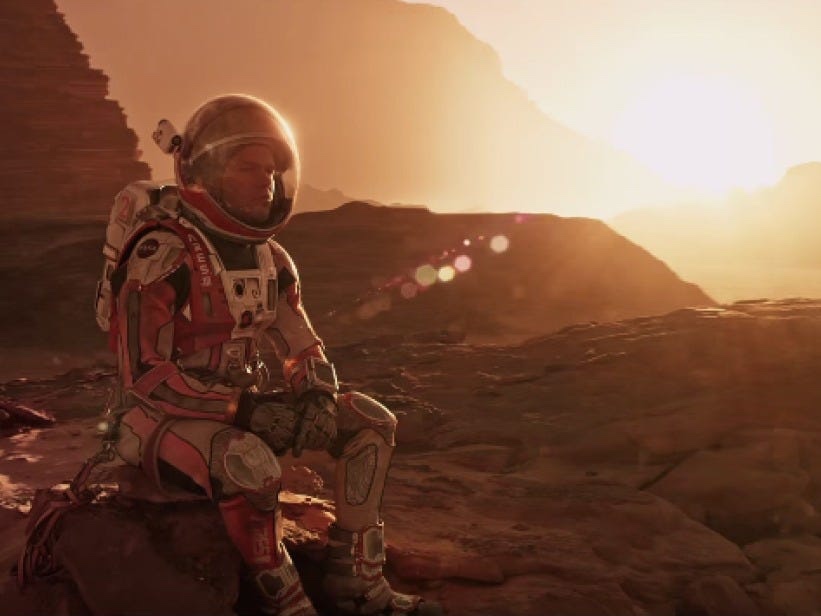
Andy Weir, “The Martian” (2011) – A scientist friend of mine described this novel as “engineering fan fiction” and I think he’s more-or-less right. In fact, “The Martian” started life on software engineer Andy Weir’s blog, where he parlayed a lifelong fascination with space travel and interest in the hardware involved into the story of astronaut Mark Watney, accidentally left for dead on Mars and forced to survive on his own. People liked it enough that he turned into a 99-cent-a-download Amazon read, which got picked up by a publisher, becoming a bestseller and a movie with Matt Damon. It’s a nice story.
Most of the story is told through Watney’s log. It’s a series of ups and downs, engineering feats and then failures that need new feats to compensate, etc. A botanist along with being an engineer (astronauts typically have multiple specialties), Watney figures out how to make soil and grow potatoes, only to lose much of it due to explosive decompression in his habitat. He picks up a previous Mars probe and uses that to communicate with NASA but then accidentally shorts it out, etc. In the end, he needs to trek across thousands of hard Mars miles to rendezvous with an escape vehicle and meet up with his old crewmates. The rhythm of challenges met and renewed keeps up pretty well throughout the book.
Watney himself is something of a cipher, a regular-guy ubermensch as understood by a male Gen X STEM guy. He makes a lot of wisecracks, few of them particularly funny. His isn’t unpleasant company to keep for a few hundred pages but it’s not really the point. The NASA people who make up most of the rest of the viewpoint characters are basically interchangeable less one defining trait apiece- the Hard Charger, the Cautious One, the Woman Concerned About the Press. But I guess that’s not the point, either. Maybe it’s just having read some pretty shitty examples of novels of interiority — Sheila Heti and Mike Ma — lately, but I couldn’t fault Weir for having more interest in the stars, or, anyway, the mechanics of Mars rovers and the like, than in his navel or the navels of fictional people. I’m not exactly a gearhead but I can appreciate other people’s enthusiasms. This is a basically enjoyable light read. ***’
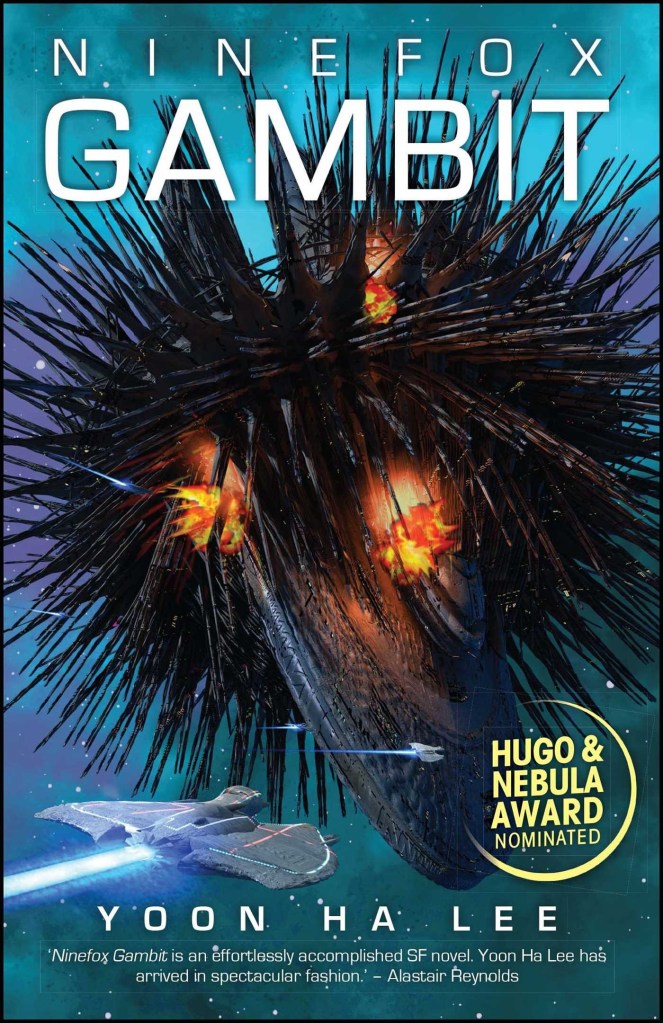
Yoon Ha Lee, “Ninefox Gambit” (2016) (narrated by Emily Woo Zeller) – This is the first in trilogy of scifi novels that have been making the rounds- I think all three were nominated for the Hugo for best novel but none of them won. The main character, Cheris, is a mid-ranking space marine officer for an empire called the Hexarchate (used to be the Heptarchate, but they lost a faction). The Hexarchate runs things according to a calendar that not only orders the days but also, in some dimly-explained way, arrays energies or something in such a way as to make certain technologies, like faster-than-light travel, feasible. This extends to battle tactics- the space marines get in these formations that allow for the use of “variant weapons” that do various freaky things, like “amputation cannons” (more or less what it sounds like) and “threshold winnowers” (sound a lot like directional neutron bombs?). If you get the math wrong on a formation or in your calendar, stuff doesn’t work right, and so “heretics” — those who want a different calendar — are brutally punished by space marines like Cheris. Heretics take over an important space base, “The Fortress of Scattered Needles” (“Ninefox Gambit” is full of names like that, from the title on down- Cheris is from “The City of Ravens Feasting”). Cheris is appointed to meld her mind with the preserved brain of a four-hundred-year-dead general, Jedao, who had previously murdered his entire command but who had never lost a battle, in order to go get the space base back.
Gotta say, this one didn’t really do it for me. I didn’t hate it, and maybe I would have liked it better in text, though the narrator does a fine job and puts some mustard on the dramatic moments. It feels unfair to put it this way, but the worldbuilding struck me as both overdone and underbaked. It’s overdone in that there’s a lot of it. The Hexarchate, for instance, is made up of six different factions, all with different attributes (kind of like Harry Potter houses in some respects). Cheris is from one, Jedao is another, the big bad behind the betrayals is from a third, etc. It’s underbaked in that a lot of it doesn’t make immediate sense. The formation/calendar stuff is not clear in my mind. Maybe it’s not supposed to be! I entertained the notion that this takes place in such a far future that everyone’s brains are uploaded onto a computer, and so it’s all an elaborate video game and the formations are part of the game, but Lee seems to make pretty clear there’s a lot of blood and physical-impact weaponry like guns around, though I guess that could all be simulated, too. It feels unfair because I’m not sure how Lee could explain all this stuff without even more worldbuilding. It’s a dilemma.
The conventional literary aspects of the book again weren’t awful but again didn’t move me. There’s some big reveals at the end but Jedao’s motivations are still foggy to me, and a lot of it seemed more about setting up the sequels than anything else. The characters are mostly stock scifi characters, which is fine, but doesn’t help amp up the book and get me past the parts I found confusing or otherwise didn’t like.
I’ve read a few of the big names in recent scifi, not enough to really say I “keep up” but some — Jemisin’s “The Fifth Season,” Leckie’s “Ancillary Justice,” and now “Ninefox Gambit” — and I’ll be honest, none of them have bowled me over or, for me, earned the high praise I’ve seen them get. I haven’t hated any of them but I haven’t loved any of them. Maybe I’m just getting old- I will say I notice how much of these works seem to be influenced by anime, gaming, and frankly, the specter of Harry Potter, and while that’s understandable and even possibly commendable (the first two influences at least), it does tend to freeze me out a little. I get the dispiriting picture of something like our national political divide in the world of scifi, with the Jemisins, Leckies, and Lees of the world, plus their boosters, taking the role of the Democrats and the various “Puppy” factions — scifi reactionaries of (somewhat) differing stripes — taking the role of the Republicans. I know which I prefer- “Puppy” writers like Larry Correia and Ted “Vox Day” Beale are just garbage, as writers and as people, and increasingly they and their fan base are proud and defiant in their garbage-ness, not unlike what you see on the contemporary right more broadly. The metaphor breaks down, of course, and the stakes are radically different. It does look like the fan culture behind the “Democrats” in this scenario are better-organized than the real life ones- there seems to be real enthusiasm behind both repudiating the “Puppies” and embracing the works of standard-bearers like Jemisin, et al. I just can’t really get into either one. It’s a good time for scifi in terms of popularity and genre acceptance, but I wonder if it’s really a good time for the genre in terms of really pushing the envelope and exploring possibilities. ***
C.J. Cherryh, “Merchanter’s Luck” (1982) – I very much enjoyed the first of C.J. Cherryh’s “Alliance-Union” series, “Downbelow Station,” a fast-paced and agreeably overstuffed scifi novel set on a trading station on a remote planet. “Merchanter’s Luck,” the next book in the series, has some of its interstellar-workaday charm, not unlike that found in the universe of the “Alien” movies. But I’ll be damned if it doesn’t drown the reader in technobabble and the particularities of gray-market interstellar trade. Sandor, the protagonist, runs a sort of tramp-steamer in space, the “Lucy,” which does various low-grade contract-shenanigan deals, staying one step ahead of the law. As far as I can tell, the plot is he falls in love with Allison, from the “Dublin Again,” a respectable family generation ship (in scenes with the family, one is tempted to cry out, “MICKS… IN… SPAAAAAACE”) that does big-time interstellar trade. He follows her spaceship on a risky “jump” to another star system, which causes attention to fall on his shady business. For some reason — love? Impressed with his dedication? — Allison convinces her bosses/grandparents to more-or-less buy “Lucy” and let her and some cousins help run the ship with Sandor and do some interstellar trade on their account. They then get entangled in some business between space-pirates and space-pirate-hunters. There’s something about a “Union” and an “Alliance,” two unhelpfully generic names for rival space empires. The characters learn to respect each other. And there’s a lot, a LOT, about the logistics of space travel. But unlike in the writings of, say, Neal Stephenson, there’s no geek-out attempt to explain these logistics. The characters just think and talk about them and expect you, the reader, to follow along with the jargon. It gets baffling and boring. I still like the overall gestalt of Cherryh’s space stories so I’m rating this higher than I might, but I hope the sequels give the readers a little more to work with. ***
Joan Vinge, “The Snow Queen” (1980) (narrated by Ellen Archer) – Do people ever call fairy-tale inspired grown-up fiction “fairy-core?” Or perhaps “tale-core?” Either way, this Hugo-award winning novel is inspired by the Hans Christian Andersen fairy tale of the same name the basics of which, characteristically, I either forgot or never really knew.
What I can tell you is that on the planet of Tiamat, there are two century-plus-long seasons, winter and summer. During winter, the Winter tribe rule, during summer, the Summer tribe, and they sacrifice each other’s rulers at the end in a big masked ceremony. Winter coincides with the periodic opening of a wormhole to the rest of the galaxy, and the arrival of interstellar travel, which brings some advanced technology and notional rule by the “Hegemony.” Summer comes and they destroy all the technology and so the cycle goes.
The current Snow Queen wants to change all that, and so has a number of clones of herself created in one of her schemes to prolong her rule. One of these clones, named Moon, lives among the idyllic Summers and becomes a sibyll, a sort of galactic hive-mind portal. She’s betrothed to her cousin Sparks, but when he fails to become a sibyll, he runs off to the big city of Carbuncle. After predictable urban-bumpkin misadventures, he catches the eye of the Queen, who sees both a potential new lover and a way to get her clone back.
This is just the setup. A lot goes on- this one of those Hugo-bait overstuffed scifi novels with plenty of bells and whistles and worldbuilding. Vinge rigs the world with a deft hand as Moon, Sparks, the Queen, and some galaxy cops all try to reach their respective ends. There’s immortality juice that comes from some local manatee-like critters who turn out to be more than they seem, galaxy cop bureaucratic back and forth, wind-control duels, space chases, secrets of the sibylls revealed, on and on.
I call it “tale-core” less because of any Andersen inspiration and more because of the feel. Moon and Sparks are star-cross’d lovers, and Moon will do anything to get back to Sparks, even after Sparks takes a pretty major heel turn. Moon isn’t some drip- she survives a lot, and takes on another lover in the meantime, but still, her goal remains the same. There’s a lot about masks, both real ones and the ones we wear in society (man) and the assumption of mythic identities. I think there might have been a fair amount of tale-core going around at the time- it was Star Wars’ time, after all, which is basically a fairy tale in space. It produced an interesting book here, though the ending more sets itself up for the inevitable sequels than anything else. ****
Ursula K. Le Guin, “The Lathe of Heaven” (1971) – George Orr dreams effectively- that is to say, some of his dreams come true, shifting reality behind them. That’s the premise of this Hugo Award winner from scifi legend Ursula K. Le Guin. Orr doesn’t want to do this anymore, and his attempts to self-medicate his dreams away lead to him being put in the care of psychiatrist Dr. Haber, who sees the potentialities of Orr’s ability when combined with Haber’s hypnosis chops. Haber soon has Orr dreaming up all kinds of things to improve their lot and that of humanity, generally leading to unintended consequences. Dreaming away overpopulation (this is the seventies, when people were worried about that) leads to a great plague obliterating much of humanity. Dreaming away war between nations leads to war between planets, and dreaming away racism leads to everyone being the same gray color (something tells me people would still develop something like racism, but hey, it’s a scifi novel). Orr, something of a natural Taoist, wants to stop getting in the way of the Way of things; Haber, almost a parody of the sort of scifi ubermensch Le Guin and the rest of the New Wave in scifi were trying to get away from (and their authors), insists on their (mostly his) ability to change the world for the better. Eventually, Haber’s faustian power grab does himself in and nearly destroys consensual reality while they’re at it. Short, effective, and moving, this one earns its place in the canon of speculative fiction. *****
Charles Stross, “Accelerando” (2005) (narrated by George Guidall) – One thing that has struck me lately is how, outside of the “New Wave” of scifi in the late sixties through the seventies, scifi will depict the most outlandish developments — often transcending the merely human plane — in fairly conservative ways, literarily speaking. Probably this is a good thing- I’m generally more interested in inventive concepts and gripping plot than I am in literary experimentation. But it is interesting, beyond prose, how often old tropes find their way into these stories of dashing future exploits.
Both family/lineage stories and, to a much lesser extent, monarchy find their way into the posthuman explorations of noted blogger and novelist Charles Stross in “Accelerando,” arguably his flagship work. “Accelerando” started life as nine short stories, linked together by three generations of the Macx family, who experience (and affect) the rapid changes of the twenty-first century. We start with Manfred Macx in a recognizable near-future and as a recognizable near-future (or present) type- the peripatetic internet entrepreneur/techno-hobo, wandering around Europe drinking beers and coming up with “six ideas before breakfast” about how to hack normal economics into post-scarcity, AI-and-human-upload-friendly forms. He makes some deals with some uploaded sentient lobsters to start mining in space, and takes real hell from his dominatrix tax lawyer wife Pamela. Their kid, Amber, does some shenanigans to divorce from her mom, moves to a Jupiter orbital platform as a teen where she eventually makes herself queen, and before long leads a group of other space-teens to an alien communications portal just outside the solar system, or uploads of their brains anyway. The son her left-behind body has, Sirhan, meanwhile tries to write the history of the post-singularity future as assorted post-humans and AIs turn out to want to make the solar system unfriendly to biological life.
There’s a lot going on here. What starts as a hippie-ish dream of “ajambic” post-scarcity gift-economy economics becomes a nightmare of sentient corporations creating “Economy 2.0” and dismantling the planets to make “matrioshka brains,” concentric rings of massive super-computers to run simulations of intelligences forever. This supposedly solves the Fermi paradox of why aliens haven’t come knocking- at a certain point, most advanced civilizations basically upload themselves up their own asses and don’t want to bother exploring away from the good bandwidth. Despite having been on the cutting edge of technology for a century, the Macx clan winds up helping to lead a relatively-technologically-backwards group of humans who want to keep their bodies into forming colonies in deep space, away from their “vile offspring.”
Probably another reviewer would want to geek out over the other technological gee-whizzery Stross comes up with, and there’s plenty of it, much of it very creative, but I want to talk about the underlying paradigm a little. Beyond the family lineage stuff and the space-monarchy (potential birthday lecture topic in future years- a brief history of space monarchies), everything is very rules-based. Getting ahead means hacking the rules. Amber essentially hacks both corporation and sharia law to liberate herself from Pamela, and Pamela hacks sharia right back to try to retrieve her. Manfred’s whole career is finding strange loopholes, creating automated corporations and doing other shenanigans. Sirhan is more conservative, more rules-attached, and by that time the “rules-based order” to borrow a phrase from international relations has gone pretty distinctly anti-human. Force seldom seems to decide anything. Hacking and shenanigans does. When parasitical aliens hijack Amber’s crew in a simulation space, they don’t just threaten to blow up her spaceship once she starts maneuvering against them, which would be pretty easy because it’s just a flying canister with computer-stuff in it. It’s a consistent vision of the future, but one that clearly gelled pre-9/11 and came into full form pre-Trump, and is more than a little eye-roll-worthy. Stross is every basically decent technie nerd that cannot, will not, understand structural conflict, especially between classes, and thinks progress is basically finding the right systems to render conflict irrelevant. He’s far from the worst in that clade and has a sense of humor about the “rapture of the nerds” — it doesn’t really work out — but still. An entertaining yarn with a lot to think about, down to both Stross’s vision and his limitations. ****
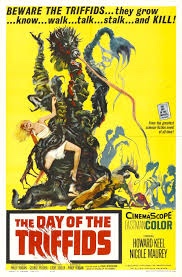
John Wyndham, “The Day of the Triffids” (1951) – I’ve heard this called the grand-daddy of post-apocalyptic fiction. On the one hand, this sounds wrong — I feel like there are earlier examples, like “The War of the Worlds” — but on the other hand feels right in a genre relevance sense. The apocalypse, unlike most, is a two-parter. First, a species of carnivorous plant called the triffids appear. This isn’t much of a problem at first, because people can control them, despite their deadly poisonous stingers and increasingly apparent ability to communicate with one another. Then one day, a mysterious shower of comets — or something that look like comets — blind the vast majority of people on Earth (one wonders if Jose Saramago read this one).
Biologist Bill is one of the lucky ones with sight- he was in the hospital with a triffid sting to the eyes and hence couldn’t see the comet shower. By the time he’s able to get up and out of the hospital, civilization is already collapsing. Wyndham effectively describes the pathos of roving gangs of blind people attempting to loot to survive, the sighted either lording it over the blind as kings, trying and failing to help them, or trying to secede from the rest of the species.
If “Day of the Triffids” created post-apocalyptic conventions, it did a very good job, as it all colors within the lines: Bill rescues a sighted girl and they promptly fall in love; they entertain but reject various humanitarian theories of how to deal with the crisis as doomed, through no fault of themselves, of course, they’re still the good guys; they meet up with a group of like-minded survivors led by someone making philosophical/sociological points that all lead to “free love;” Bill and Josella get separated and Bill undertakes all kinds of adventures getting her back.
It’s all well done. The triffids are genuinely creepy, even if a lot of surviving in the early parts of the book is more about avoiding disease and hunger than avoiding them. The anti-humanitarian lessons are contrived but not forced, in a literary sense. The characters are well-realized, especially for midcentury science fiction that doesn’t make a display of literary qualities. It’s worth reading both from a history-of-genre perspective and on its own merits. ****’




 Too Much Berard