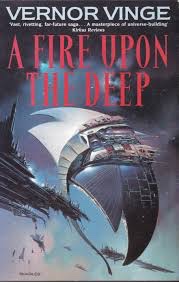
Review- Vinge, “A Fire Upon the Deep”

Vernor Vinge, “A Fire Upon the Deep” (1992) – Hard(ish) scifi space opera “goes to the dogs” in this one! Ha, ha, not figuratively, but in the sense two human children wind up in the clutches of rival factions of medieval dog-like pack-mind aliens. The action in “A Fire Upon the Deep” is split between Johanna and Jefri, last survivors of a human colony that gets eaten by a super-advanced malignant AI, and a crew of spacers hired by a human from the same society, Ravna, who goes looking for the ship they were on. The ship had to bail on dog-alien planet and, of course, also contains a way of defeating the Blight, as the evil AI is known.

This is a big (600 pages or so) book with a wide sweep. We go from hyper-advanced space colonies to dog-alien castles and encounter a number of interesting Vinge concepts along the way. Perhaps the most important are the “Zones of Thought.” As it turns out, Earth is in the Slow Zone- the closer to the galactic core you get, the slower the speed of light is, and in turn the slower do neurons fire and advanced tech becomes impossible even if it could be designed. The advanced space civilizations exist in the Beyond, where faster-than-light travel is possible, and the Transcend, inhabited by god-like energy beings. You have to be careful not to get caught in the “Slow Zone” nearer the galactic core, or in a zone storm, where your tech stops working. Vinge also tells us what the space internet looks like- a lot like usenet newsgroups from the nineties, an interesting take from the pre-social media days. The pack minds of the “Tines,” as the humans come to call the dog-aliens, are fleshed out, with gestalt personalities, telepathic communications (and confusions if packs get too close), and multi-generational layering. This is echoed in the shared mind of one of the human shipmates, who was reanimated by a Transcend god-thing that the Blight kills, and is left with some of the god’s abilities and personalities along with his reanimated baggage. Heady stuff! Vinge takes his time with all this, too, which turns out for the best even if it makes the book a little long and slightly confusing in some places.

Vinge sets up multiple ticking clocks, from the threat of the Blight, to the race between Ravna’s crew and the Blight’s fleet to seize the spaceship with the anti-Blight weapon, to the impending rumble between rival groups of Tine eugenicists (one mean, one less mean) that endangers the human children they’ve taken in. The clocks are always ticking but he still takes the time to throw in other complications: betrayals, horrifying discoveries about perfectly nice plant-people, the imperial ambitions of cute butterfly-aliens, the humans helping the Tines up the tech tree, etc. Vinge throws in a lot and most of it is good. One thing you don’t get a ton of is the libertarian posturing I’m told Vinge indulges in (he’s won the libertarian “Prometheus” scifi award multiple times), and that I can do without. All told, a decent, if perhaps overstuffed, scifi adventure with a lot of neat concepts. ****

Review- Vinge, “A Fire Upon the Deep”

AUDIOBOOK ROUNDUP – Higgins, “The Friends of Eddie Coyle” and Vance, “Planet of Adventure”

AUDIOBOOK ROUNDUP

George Higgins, “The Friends of Eddie Coyle” (1970) – This is more like it. I had read Higgins’ “Cogan’s Trade” and didn’t care much for it. But this one was much better. Encountering it in audiobook form probably helped- Higgins’ crime fiction is largely made up of dialogue. But I also got a paperback copy of the book for Christmas and it held up in hard copy, too. For one thing, this one has real characters, primarily the hapless Eddie Coyle, small-time gunrunner facing three-to-five and looking for a way out. He turns informant but his ruthless Fed handler keeps wanting more than he can give him. We spend some time in a sleazy seventies Boston of bank robbers, gun dealers (this was back before you could buy an AR-15 at Wal-Mart or wherever), faux-radicals, bartender-fixers all looking to scam each other. No one deals with more money than about fifty thousand dollars, and usually a lot less. The key information that the Feds are looking for winds up coming not from Eddie but from a pissed-off girlfriend. The voice actor, Mark Hammer, does a good job conjuring up distinguishable Boston accents for the different characters, though he stumbles on the pronunciation of town names like Billerica (“bill-erica”) and Brookline (“brooklyn”). Still, a great version of a justifiably lauded crime classic. ****’

Jack Vance, Planet of Adventure series (1968-1970) – Tschai! There’s probably supposed to be an umlaut somewhere but I don’t care enough to look it up. Jack Vance’s was a world-builder but not in the over-baked sense of the word that it conjures up today. No thousand page tomes, no pseudo-Tolkien erudition, no pandering to fans looking for something on which to project. Tschai, like other worlds Vance created before and after it, is about the permutations the human subject (to use the kind of theoretical phrase he’d never allow) can undergo under extreme conditions, about people as small, contingent things. Tschai is run by four alien races: lizard-like Chasch, frog-like Wankh (heh heh), raptor-like Dirdir and bug-like Pnume, each of which is the main antagonist in one of the volumes chronicling the trevails of stranded spaceman Adam Reith. More often than the aliens, though, he deals with humans stranded on Tschai, first brought there long ago by the Dirdir but then escaped and diffused across the planet. Each alien race has its human disciples, who try to imitate them and have various delusions about their closeness to them. On top of that there’s various independent human societies, each with its own system of cultural rules. It’s the kind of kaleidoscope world we’d reward someone for exploring in 1800 portentous pages or so, but Vance sketched everything out in about a third of that, sticking to Reith’s adventures. I never felt less than satisfied with the worldbuilding, however- and I’d take it over much of the modern stuff any day. Reith builds a human army to fight the Chasch (a trope Vance has used elsewhere), hunts the Dirdir on their own hunting grounds, tries to build or steal a spaceship to get back home, woos a lady or two, rigs an eel race- all kinds of doings, all the while playing straight man to the various deluded human-types he’s surrounded by. There’s a lot of dickering with innkeepers, all in classic Vance Wodehouse-ian punctillio dialect. It’s not the Vance I’d start with but it’s a lot of fun. ****

AUDIOBOOK ROUNDUP – Higgins, “The Friends of Eddie Coyle” and Vance, “Planet of Adventure”

Review- Haldeman, “The Forever War”

Joe Haldeman, “The Forever War” (1974) – You have to be careful with science fiction picked out by literary gatekeepers. Sometimes they’ll try to convince you that Ray Bradbury is a great scifi writer, which even Martin Prince knows is bunk. Other times you’ll see the Library of America lionize Philip K. Dick with a big rollout of his novels, which was quite welcome. Joe Haldeman’s “The Forever War” began life as an Iowa Writer’s Workshop story and my copy features praise from Junot Diaz as well as an oddly-worded endorsement from Stephen King; none of these are great signs. The title itself has become a commonplace, a term for the War on Terror after journalist Dexter Filkins filched the phrase for a book of his own.

But I am pleased to report that “The Forever War” “checks out.” It begins with adherence to some simple premises: physics and military life are defined by certain constants. In physics, that’s the speed of light and relativity; in military life, boredom, terror, thoughtless chains of command and obedience. Haldeman plays out the combination of these constants with the scifi ur-trope of interstellar war with rigor and verve.

William Mandella, the narrator, was born in the seventies and sent to the space war against the alien Taurans in the nineties, but soon enough such simple temporal denotations prove insufficient. Spaceships travel through “collapsar” portals at relativistic speeds- Mandella and his buddies age a few months but years, decades, eventually centuries go by to the “objective observers” living on Earth and the rest of human society. This brings a new spin to the age-old quandaries of reacclimating to civilian society. Mandella comes back to an Earth overpopulated (this is seventies scifi after all, gotta have some overpopulation) and crime-ridden, eventually hops forward a few centuries after another collapsar jaunt to find nearly-mandatory homosexuality! What’s a guy to do?

Well, Mandella mostly stoically rolls with the punches and reserves judgment. Except for the the military hierarchy- that gets some judgment for being ignorant, tone-deaf, and sneaky, getting Mandella and his lover MaryGay to reenlist in the war through various designs. There’s some funny early parts where the military, presumably reacting to the changes of the sixties and seventies, encourages soldiers to curse at the officers ritualistically, to sleep with each other (this is a coed fighting force) and smoke weed, but that’s all just cosmetics over the eternal reality of the military. The fighting with the Taurans gets across the boredom-terror dichotomy veterans so often refer to, and there’s no glory to be had in this space-suited combat across kilometers with a foe who is deadly but whose heart doesn’t seem to be in it. In the end, the war was a big misunderstanding- one is tempted to say “like most wars” but that might be giving people too much credit.

Haldeman is a Vietnam veteran who was wounded in combat, and it’s been argued that “The Forever War” belongs in the canon of Vietnam War literature… I’m ambivalent about that- would “Lord of the Rings” belong in WWI literature? But either way an interesting question about an interesting book. ****’

Review- Haldeman, “The Forever War”

Review- Jama-Everett, “The Liminal People”

Ayize Jama-Everett, “The Liminal People” (2011) – I got turned on to Ayize Jama-Everett by an article about writing action-y novels. This, his first book and second that I’ve read, fits the bill. It’s a novel about super-people — you really can’t say superheroes, though I guess superheroes as a genre aren’t always especially heroic these days — using their powers on one another. If anyone saw the underrated action flick “Push,” it’s a bit like that. Answering the now-trite “what if superpowers but real” question, both “Push” and Jama-Everett reply “live on the margins, dodging bigger powers and doing crimes.”

The protagonist, Taggert, is someone who can manipulate bodies on the molecular level. This makes him a healer but also capable of devastating harm- think of someone who can manipulate your nerves, your histamines, your bodily acids, etc. After healing a streak through Africa (both Taggert and Jama-Everett are black, which makes this less cringey than if a white author/protagonist did it- sorry, I don’t make the cringe rules) he gets picked up by a powered crime boss in Morocco. Boss Nordeen’s powers are vague but include being able to tell when others are lying and probably some sort of emotional manipulation. Nordeen puts Taggert to work healing and harming, more of the latter.

Taggert gets called on by an ex-lover in London to help find her missing daughter. Lo and behold, both mother and daughter are powered, but the ex-lover chose to live in the mainstream, suppressing her powers (which entailed controlling fire- fewer obvious peacetime applications). The runaway daughter, Tamara, is a telepath/telekinetic combo who ran away from an illusionist and her posse who looked to manipulate her talents.

The plot isn’t exactly the thickest but it’s a fun read nevertheless. Taggert and Tamara go on a quest for revenge, Taggert looks to shield Tamara from his boss, there’s a training montage, some big confrontations between superpowered crooks. It’s good clean fun. ****’

Review- Jama-Everett, “The Liminal People”

Review- Bujold, “Shards of Honor”

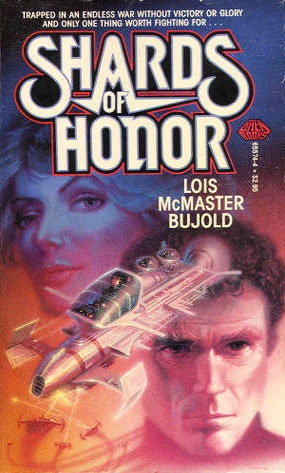
Lois McMaster Bujold, “Shards of Honor” (1986) – This is probably the closest thing to a romance novel I’ve read, unless some of the more courtship-heavy bourgeois novels count. Cordelia comes from a relatively chill spacefaring culture and Vorkosigan comes from a militaristic one. They meet when the latter takes the former prisoner but they come to rely on each other during a long trek across an alien planet and a plunge into confusing and deadly intrigue among the Barryarans, the militaristic culture. You can call Vorkosigan Mister Too Damn Honorable as he constantly gets involved in schemes to undermine less honorable Barrayarans out to do him in. The two cultures get in a war due to dishonorable machinations and Cordelia keeps on getting captured and separated from Vorkosigan and…

Honestly, I wasn’t paying attention for a lot of this. The writing is pedestrian. The characters are flat. The action isn’t bad, in some places. But between the lack of ideas or compelling prose and having read it during a dry period in my reading life, I didn’t get much out of this. The good news is that apparently this is all a prequel and the vaunted Vorkosigan Saga is actually about the main characters kid or grandkid or something. So maybe I’m not missing much if the rotation insists I revisit this particular scifi touchstone series? Who knows? **

Review- Bujold, “Shards of Honor”

Review- Brunner, “Stand On Zanzibar”

John Brunner, “Stand On Zanzibar” (1968) – I’ve heard it argued that the “New Wave” of science fiction that came about in the 1960s and 1970s is better in theory than in practice- that it was a nice idea that didn’t produce all that many works that stand the test of time. I’m agnostic about that: I’d need to read more to find out, though Dhalgren stands up pretty well. As for Stand On Zanzibar… well, one of the things that people seem to evaluate when seeing whether or not a scifi book “holds up” is predictive ability. On that score, Stand On Zanzibar does pretty well for a 1968 book talking about 2010. People “dial up” computers to get information (no GUI, but what can you expect). Genetic engineering is a thing: more of a thing than in real 2010, or at least in different directions. This volume gets it right that people are a lot less fixated on space fifty years on from the Apollo missions than a lot of people in the midst of space race enthusiasm thought they might. People still have very earthly concerns, in Stand On Zanzibar.

It is very late sixties in a lot of ways. Sexual politics is one- a lot of male fecklessness disguised as sexual liberation. More prominently, its Club-of-Rome style concern with overpopulation, the idea that seven billion people would be a problem due to overcrowding (and not, say, climate change). Brunner makes use of cut-up techniques, interspersing the action of the novel with “context” chapters showing what’s going on in the way-out happening world of 2010, and it’s all grim stuff involving megacorps and baby-farming. They also, unfortunately, involve the rantings of a sociologist proclaimed by the author as a genius, who dispenses edgy bromides about people being animals in dated-hip language. Don’t proclaim the characters who dispense your extraneous thoughts on the world as geniuses, authors (Robert Anton Wilson was another one for this). It doesn’t work.

The plot also doesn’t work particularly well. A megacorp is hired to take over an African country and make it a paying concern. Much of what kept me reading was curiosity: would Brunner (a Brit, fwiw) go full neocolonial and see this is as a good or workable idea? He comes close, but a weird biochemical deus ex machina gums up the works. A secret agent tries to uncover the truth about genetic engineering in a militant Indonesia-ish country. The two plots converge, sort of, at the end. There’s some interesting stuff here, but ultimately the edgy posturing and lack of substance grates. I’m curious about Brunner’s other “Club of Rome” novels, but mostly for historical purposes. **’

Review- Brunner, “Stand On Zanzibar”

Review- Strugatsky, “Roadside Picnic”

Arkady and Boris Strugatsky, “Roadside Picnic” (1972) (translated from the Russian by Olena Bormashenko) – The site of alien contact with Earth gets all freaky and forbidding in this Soviet scifi tale. It’s the basis of the movie “Stalker” by Andrei Tarkovsky and the source of metaphor in Adam Curtis’s last documentary (which I thought was a little weak tbh). All of them carry a heavy freight of existential dread and confusion.

The main character, Red Schuhart, is a stalker- a guy who goes into the forbidden Zone to seek out artifacts the aliens left behind. No one knows what is up with the Zone or the aliens, who made no meaningful purposeful contact with humanity. The rules work differently in the Zone- the rules of physics, seemingly the rules of cause and effect, and these changes are deadly. The stalkers that go through them are a hard-bitten, cynical breed, similar to hardboiled detectives or mountain men, and Red is no exception. The Zone is reaching out to make life in the surrounding areas unsustainable, but while there’s money to be had and, one suspects, a point to be made, stalkers will stalk.

The plot and characterization isn’t really the point in the Strugatskys’s novel any more than it is in Tarkovsky’s quiet, achingly-paced film. There’s a “one last job” where Red pursues a legendary wish-granting alien orb, but by then we’ve accepted the logic of the Zone- the Zone is the Zone and while one can take precautions, it makes mock of all of man’s attempts to put a system in place in or around it. People, including Adam Curtis, have put various political spins on the Zone, including claiming that it’s a metaphor for our own incomprehensible times. I don’t know about all that, but part of the strength of the Strugatsky’s work is that they create a powerful spacial metaphor for dread and the feeling of unreality. ****’

Review- Strugatsky, “Roadside Picnic”

Review- Stephenson, “Fall; or, Dodge in Hell”

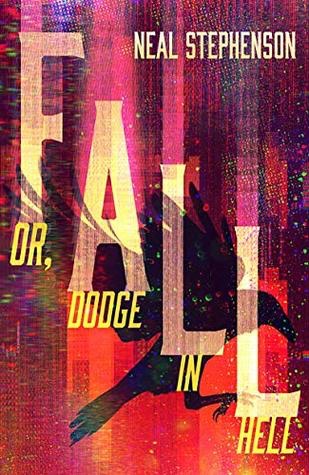
Neal Stephenson, “Fall; or, Dodge in Hell” (2019) – As it happens, I actually read this months ago. I requested a reviewers copy on the idea I could run a review in LARB or somewhere. But it turns out everyone already either had somebody to review it, weren’t interested in reviewing it, or is too political for my not-especially-political take. So it goes up on the blog instead! And I have to remember a book I read in March.

In keeping with Stephenson’s m.o., this is a big book, and has the feel of several books squashed together. I’ve argued before that Stephenson’s novels are following the trajectory of the life cycle, and we’re getting into the part where a man begins to think a lot about death (and divorce) and legacy. We start with the titular Dodge, one of the main characters in “Reamde,” in my opinion Stephenson’s weakest novel. He goes in for a routine medical procedure and comes out comatose! His will says to pull the plug but also keep his brain on ice- it turns out Dodge was in to some futurist stuff in the nineties that predicted that science would be able to resurrect people. So like Ted Williams, on ice he goes.

But his beloved grand-niece has Plans. After taking a trip through an America increasingly divided between neurasthenic automated luxury liberalism and fanatical worshippers of the “Tactical Jesus” (easily my favorite thing in the book), she decides her senior project at college is going to be simulating a human brain on quantum computers. And who better to try it with than her great uncle Dodge?

It turns out to suck to have your brain be bouncing around a computer program. It’s just static! Until, that is, Dodge starts playing Minecraft with the static. He makes the world in a way that feels right- that is, a world somewhere between the world he grew up in and the fantasy gaming milieu where he made his fortune. He minecrafts up the hilly-willies and down the hilly-willies and then eventually some other rich techies show up on the server. They create bodies for themselves and then it’s on.

Truth be told this is where I began to lose the thread. There’s an Old Testament quality to the work, down to rolling King James cadences in the Minecraft Genesis bits and that’s cool, I guess, but then it gets into something like the begets, not literally but in terms of being hard to keep track of. There’s another tech billionaire, El Shepherd, who has a Plan for the digital afterlife that Dodge’s niece set up. He doesn’t like that Dodge basically set up lightly-fantasy-Earth Minecraft in the digital afterlife and like a lot of villains, he has a point. We could be doing literally anything! The one time anyone tries something different — a kind of communal musical mindmeld — Dodge completely thunderbolts it. What’s the point of an afterlife if you have to do everything the same as in the before-life?

But in the classic way of villains in conservative-liberal fiction from Madam Defarge to Killmonger, the people with actual ideas are also dicks. El wants to be God. He casts Dodge into hell. Meanwhile, the whole earth’s population is getting obsessed with watching shit unfold in the afterlife and the tech to get in gets more and more accessible. It’s pretty interesting to see how society changes around that, people basically waiting out the clock to get into the digital afterlife club, etc. What becomes of the worshippers of the Tactical Jesus?? Stephenson doesn’t tell us. He just drops them.

At some point Dodge’s niece infiltrates the digital afterlife to, uh… there’s some stuff with an Adam and Eve pair, and a fantasy quest, and fighting the El/Peter Thiel/Bad God figure… but god help me it was mostly pretty boring by then and I can’t remember most of it. There’s some weird shit like how most people who get incarnated into the digital afterlife become weird mutant goblin-esque scrubs- is that where the Tactical Jesus people go? I also got the vague idea they were maybe third world peasants. Either way, shades of the weird eugenics Stephenson played with in “Seveneves.” That only bothers me a little — I’m fine with speculative fiction based in ideas I’m opposed to — but it was mostly confusing and inconsistent, and missed some good opportunities.

All told, there’s a lot here, some good, some bad, some just dull. His broadest point appears to be that while life can be better (or worse), the basic shape of things — from what trees grow where to what shape bodies take (for the most part- there’s always a few fun exceptions) — is handed down from on high, or by the shape of our brains perceiving ideal forms in a sort of quantum pattern-sensing, six of one, half dozen of another. The highlights of the book are the ways in which society bends before and around the digital afterlife. There’s a take on the problem of “fake news” which is both interesting and partaken of liberal bromides about how the problem works (and is completely dropped when it could have been carried into digital afterlife!). The lowlight is the mediocre fantasy novel the book becomes in its last couple hundred (!) pages. What’s next for Stephenson? Who knows but it should be conceptually interesting and worth noting, if nothing else. ***

Review- Stephenson, “Fall; or, Dodge in Hell”

Review- Weber, “On Basilisk Station”

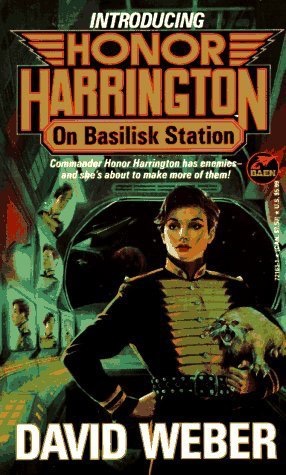
David Weber, “On Basilisk Station” (1993) – I figured I should take a crack at reading this, the first volume in the flagship series by the doyen of military scifi. In a way, this is a case of truth in advertising. It really is “military” scifi, as opposed to war scifi or action scifi, because a lot of it has to do with bureaucracy, procurement, chain of command drama, etc, the stuff of quotidian life in any military. There’s not a shot fired in anger in the first two hundred pages!

Instead, you get long descriptions of space ships and their weaponry. You get the travails of young commander Honor Harrington (presumably a descendant of Michael, continuing the socdem tradition of being soft on imperialism) as vindictive space-naval bureaucrats exile her and her ship to a remote station. Her crew dislikes her, she hasn’t got enough ships to do her job, blah blah. She serves the navy of Manticore, space-Britain to the nefarious space-Napoleonic-France of Haven, which has to conquer planets to keep its darn welfare state going. The natives are getting restless and of course no one bothers to explain why they’re bothering natives on the nearby planet when all they want is an adjacent wormhole, etc etc. Eventually the bad guys, whose only motivation is nefariousness, spring their trap, Honor proves everyone wrong, and we move on to the inevitable sequels.

Look: I’m fine with either one or the other. If it’s gonna be raygun space battles, cool (though over-adherence to a Napoleonic model of naval battles transferred to space makes everything a little stilted). I also could get into a story of someone organizing things in spite of limited resources, bureaucratic interference, etc. But we get half-assed versions of both with cardboard stock characters and uninteresting worldbuilding. It baffles me this is as popular as it is, not because it’s so awful (it beats “Starship Troopers” in novel form, for my money- at least Weber doesn’t preach, though he is literally a Methodist preacher), but because military scifi is held up as the populist, exciting counterpart to “ideas” scifi. But it’s not that exciting! LeGuin, Delany, Jemisin etc offer at least as much action and derring-do. Do the later Honor novels ramp it up? I don’t know and only curiosity about the shape of the genre would make me find out. **

Review- Weber, “On Basilisk Station”

Review- Zebrowski, “The Omega Point”

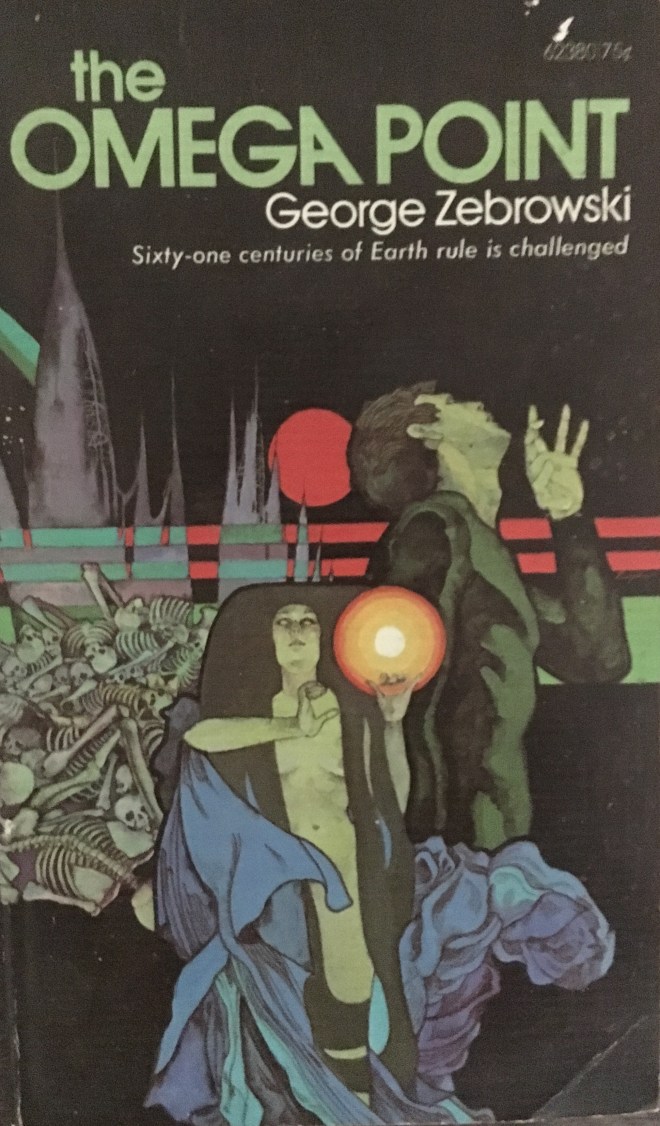
George Zebrowski, “The Omega Point” (1972) – This is a quick scifi read about Gorgias, close-to-the-last of his race of human-descended inhabitants of the Herculean cluster, who fought humanity and lost big time. The Herculeans are drawn roughly like standard fantasy elves- smaller, more elegant, more sophisticated than humans, but frailer and fewer. Gorgias has the best spaceship around and uses it to zoom around and do terrorist strikes- taking out a composer who wrote a suite about the Earth-Herculean war, zapping warp drive beacons, and so on. He’s being hunted by Kurbi, a sensitive earthling who wants to take his man alive, so as to reproduce the Herculeans. This is both as reparations for Earth genociding them and due to some theory that humans need a rival or other in order to grow, etc. Ultimately, this sort of philosophizing takes over the book. After Gorgias does his last stand, he’s absorbed into the collective unconscious or noosphere or whatever you want to call it, which is very seventies-trippy and, naturally, stored in the mind of an attractive alien lady. It feels both like Zebrowski, an old scifi (and Star Trek!) hand, both ran out of ideas and followed his vision i.e. whatever he was reading about at the time. For better and for worse, the sort of book published used to insert cigarette ads into, like my copy. ***’

Review- Zebrowski, “The Omega Point”