Review- Murakami, “Norwegian Wood”

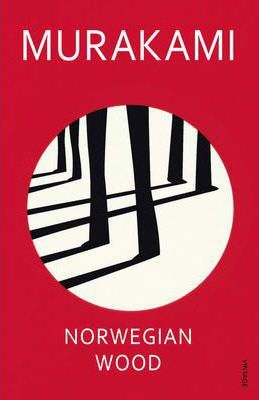
Haruki Murakami, “Norwegian Wood” (1987) (translated from the Japanese by Jay Rubin) – This is me trying to play catch-up and see what this Murakami guy is all about. Alas, I found out later that “Norwegian Wood” is not typical Murakami, lacking as it is in surreal elements. This is a pretty straightforward coming of age story about a college student named Toru Watanabe and his involvements with women in the late 1960s.

The book is fine. Watanabe is a fairly typical young male protagonist, which is to say self-absorbed and hard for anyone not in that place to really relate to, but to the extent that self-awareness can make anything better, it does so in his case. The main women in his life are Naoko, a tragic beauty who spends the novel in a progressive rest home for the mentally ill, her older friend in the hospital Reiko, and Midori, another university student who is impulsive and flighty.

Thinking about it now, most of the ways I have to describe the book make it sound bad, certainly worse than it is. Watanabe reflects on himself through the mirror provided by these women, their emotional problems, their sexuality and/or his fantasies of their sexuality. They, especially Midori, occasionally make comment on his emotional unavailability. But it’s his reserve and self-awareness that separate him from the other students (including those old reliable foils to young bourgeois individualism, student radicals) and make him notable to them and the reader. In the end, all of them are more interesting than he is, something Murakami seems aware of. So we’re back again at self-awareness as absolution… and prose, I guess. I don’t know any Japanese but the translated prose moved well and unobtrusively. All in all, basically pretty ok, good enough to make me curious about more Murakami-ish Murakami books. ***’

Review- Murakami, “Norwegian Wood”

Review- Nwaubani, “I Do Not Come To You By Chance”

Adaobi Tricia Nwaubani, “I Do Not Come To You By Chance” (2009) – This is a charming little (well, not that little, weighing in at around 400 pages) novel set in the world of Nigerian email scammers. Nwaubani takes her time getting there, though. First, she sets up our protagonist, Kingsley, and the rest of the Ibe family. Igbos living in urban-provincial Nigeria, the Ibes are a family possessed with an image of itself as upright and educated, even if they’re often broke as a result. Kingsley, the oldest son, embodies the family virtues insisted upon by his parents, even as his petrochemical engineering background fails to get him a job and his beloved leaves him for someone who can afford to set up a household and pay the traditional bride price.

Eventually (the book has some pacing issues, which makes sense given it’s the author’s first) the family arrives at such a crisis that Kingsley abandons respectability for a job with his uncle, the flamboyant lord of 419 (defrauding foreigners) violation known as Cash Daddy. In keeping with his moniker, Cash Daddy is amusing over the top, refusing to even see his nephew before buying him “decent” (read: brand name) shoes, declaiming little proverbs all over the place, and generally acting the ham. One of his main enterprises is a setup for young tech-savvy Nigerians to send out the emails for which the country has become, fairly or not, world-renowned.

Kingsley feels bad sometimes about fleecing “mugus” (a term that seems to encompass marks, foreigners, and white people simultaneously) but he proves to be good at it. That, as much as the money, is what hooks him. There’s some funny emails in the text, all in either mugu-speak or the quasi-officialese of 419 fraud emails- one about getting a Nigerian astronaut down from a space station where he had supposedly been marooned for years is a favorite. He uses his money to be a good son and brother and has plenty left over for himself. He travels to Britain to do some in-person fleecing with Cash Daddy in sections reminiscent of “The Sting” and other classic con man movies.

Of course, it can’t last. This isn’t a melodrama- Kingsley never gets caught (and what that would mean in a country where someone like Cash Daddy is a respected public figure along with being a scammer is questionable). There also isn’t a tearful reunion with the original love interest, or even much of a bad comeuppance for her. Kingsley witnesses some bad stuff happening to the near and dear, but by and large he leaves 419 fraud to run legit Internet cafes because of his innate good sense and good rearing. Same with him finding a decent wife among his sisters friends- I wonder if this is an African thing, where American stories would tie things up neater and more sentimentally. Either way, a fun book. ****

Review- Nwaubani, “I Do Not Come To You By Chance”

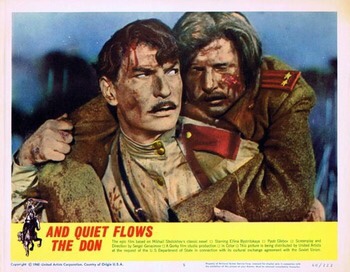
Review- Sholokhov, “And Quiet Flows the Don”

Mikhail Sholokhov, “And Quiet Flows the Don” (1940) (translated from the Russian by Stephen Garry) – This is a panoramic view of Cossack society in the turmoil of war and revolution. It’s also considered the great socialist realist Russian novel, written by an author who managed to retain Stalin’s favor despite doing things like writing him letters about how things were bad in the Ukraine.

I probably should have read “War and Peace” before reading this! Even with my cursory knowledge, it seems like Sholokhov is trying to be a socialist realist Tolstoy, and I have no idea to what extent he succeeds, or even if that’s a good goal. Guess I’ll just have to evaluate this one on its own merits!

The merits are pretty good. We start before the First World War with the inhabitants of the Cossack village of Tatarsk. The Cossacks are a people apart, a military caste, proud and poor. We mostly follow the Melekhovs, a typical Cossack family. They farm, they drink, they mess around — there’s a messy love triangle involving son and closest thing to a main character Grigori — yell at each other, and so on.

Their lives are all interrupted by World War One. Grigori and his generation of Cossacks follow their atamen (chiefs, semi-democratically elected) into the meatgrinder. Sholokhov himself was not in the war, I don’t think, but the details — cold, wet, confused, a big divide between the common Cossack and his officers — read true enough. Rumblings of discontent go through the ranks, mostly of the simple “we want to go home” variety, some shaped by Bolshevik agitators.

The Russian Revolution comes and everyone has complicated choices to make. The White officers think the Cossacks will play their traditional role as suppressors of popular uprisings, but it doesn’t work this time due to widespread dissension with the war. Defected Cossacks refuse to halt the October Revolution and start going home to the Don River territory. There, Grigori and the others go back and forth between joining the Bolsheviks and rejoining the White forces. The Bolsheviks in this book are like a positive spin on their depiction in Bulgakov’s “White Guard”: the only ones with a real plan, methodical, energetic, ruthless. Sholokhov doesn’t stint from showing Bolshevik atrocities, but the group and its ideology still runs like a red line of clarity through the confusion of the postwar situation (and that of the anachronistic Cossack mindset).

Revolution doesn’t displace love entirely in the book (there’s a romance between the primary Bolshevik character and a lady-Bolshevik that ends predictably), but it does shift the emphasis of it. I wonder if that’s part of the point- the coming of the revolution representing a new beginning. But there’s a lot of continuity language and imagery too, above all the ever-present and unchanging Don River. All in all, a pretty good read. ****

Review- Sholokhov, “And Quiet Flows the Don”

Review- Naipaul, “A Bend in the River”

V.S. Naipaul, “A Bend in the River” (1979) – Naipaul looked to hit nerves, and he hit few nerve clusters more sensitive more often than the raw bundle around colonialism. It must have been an irresistible target for a man who, say what you want about his talents, was a vicious asshole.

But he wasn’t just any asshole and it wasn’t just asshole-ery that made the postcolonial world such a compelling target. He was a postcolonial subject himself, hailing from the Asian middle classes (which were still pretty poor by our standards) in Trinidad. This put him in an odd and uncomfortable dual place that Fanon-inflected anticolonialism doesn’t account for: not with the colonizer and not really the subject that anticolonialism has in mind. He clearly resents those more clearly placed communities, the poor black majority of Trinidad and the Indians of the subcontinent, with their more straightforward relationship to colonialism, their anticolonialism into which they can easily slot, the sloppiness and complacency of thought Naipaul perceived coming with that surety.

Naipaul wasn’t sloppy and he wasn’t complacent, in thought or prose. He didn’t do the easy thing of trucking in imperial nostalgia, at least not in what I read. What he did, and what many will never forgive him for (not that he ever condescended to ask), was plainly state what was in front of him, regardless of who it embarrassed (this included himself, depicted as an obnoxious little swot who exploits his father in “A House for Mr. Biswas,” and I’d say many of his more boorish public utterances fall into that category too). He cuts no slack, except possibly (and crucially) in where he puts his camera- he never wrote a novel mocking the eminently mockable literary Tories who made his career. This made for some interesting contrasts, to put it politely, in places where many of us — people who aren’t vicious assholes — would tend to cut some slack… like in the world emerging from colonialism in the mid-20th century.

I guess I should talk about what this book is about! It’s about Salim, an Indian from a family of traders in East Africa. He ups sticks and moves up an unspecified river that’s almost surely the Congo and sets up shop at the titular bend. From here, he sees the comings and goings among his fellow expatriates and with those Africans with whom he deals. He’s partially responsible for a descendant of his family’s half-Asian, half-African slaves, and for the son of one of his African customers who comes to town to go to school. He’s drawn in to the life of intellectual expats and has an affair with a young Belgian woman married to an aging white court intellectual now out of court with the Big Man, the Mobutu-figure who rules the country.

All of these figures and situations provide ample room for Naipaul’s depiction of human folly, all in his usual sharp, smooth, gom-jabbar prose. The young men he takes care of reflect the hope and failures of Africa’s time of optimism in the 1960s, all admirable growth paired with adolescence arrested by external factors. They can never work out what to make of Salim, and vice-versa. The other merchant expats deploy various strategies of keeping it together through instability but none of them do — maybe none of them can — really join the country, they just make burger franchises there. Yvette, the Belgian woman, was drawn to Africa by the false promise of her husband the intellectual, who in turn was lured by the false promise of what the life of the mind could offer the developing world. Even allowing for the slack decent people might cut, it all feels all too real, including Salim’s inability to relate to women and Africans as equals (wonder where Naipaul drew that from, hmmmm).

There’s a good amount of incident but the book isn’t plot-driven even to the extent of the cyclical activity of “A House for Mr. Biswas.” So it’s the characters, the scene, and above all the prose that carry the reader through. In the end, Salim finds himself without a place in the world he lives in and goes in search of somewhere else. The end, no moral! ****’

Review- Naipaul, “A Bend in the River”

Review- West, “Miss Lonelyhearts”

Nathanael West, “Miss Lonelyhearts” (1933) – This is a sixty-ish page novella by the author of the great Hollywood novel “The Day of the Locust.” Miss Lonelyhearts (we never learn his real name) is an advice columnist for a contemporary — that is, Depression-era — New York newspaper. He’s assailed by the woes of his correspondents and by his own impotence to help them, and also his boss, Mr. Shrike, trolls him all the time. He tries various things — booze, country getaways, affairs — but nothing helps. The consequences of his coping mechanisms catch up with him, in the end- an ironic Christ figure, Christ but a incapable sinner who gets owned all the time, he does get his martyrdom in the end. Wikipedia describes this as “expressionist” and if this means work that’s a thinly-described bummer, that sounds about right. It’s not bad but “The Day of the Locust” is better and more fleshed out. ***

Review- West, “Miss Lonelyhearts”

Review- Malaparte, The Skin

Curzio Malaparte, “The Skin” (1949) (Translated from the Italian by David Moore) – Curzio Malaparte was born Kurt Erich Suckert in the German-speaking part of Italy. He was an early supporter of the Fascist party, although (and here this “although” is often used in an exculpatory sense, but not really by me) he clashed a lot with the Fascist authorities and later in life became both a Communist and a Catholic. Really rounding all the twentieth century bases, there! He wrote a book on coups d’etat that’s still read today by nerds into that kind of thing, and if wikipedia is to be believed, this is why he was put into internal exile by Mussolini.

Internal exile or no, he still saw a lot of World War II. “Kaputt” takes place on the Eastern Front, where Malaparte was a reporter- I read it early in grad school, my introduction to the author. “The Skin” takes place in freshly-Allied-occupied Naples in 1943. Malaparte finds himself a translator for high-ranking American officers, who he likes in a patronizing kind of way. The Americans strike him as utter innocents, unable to understand Europe, unable to understand themselves as conquerors even as people practically beg them to act as such…

Like “Kaputt,” “The Skin” is made up of chapter-length vignettes loosely connected. I remember noticing in “Kaputt” that Malaparte put a lot of emphasis on the supposed Asiatic character of a lot of the Soviets he saw. In “The Skin,” you get a similar emphasis on the amount of black soldiers deployed by the Americans and the Free French, so I think Malaparte did have his racial bugaboos. Prostitution is the central metaphor here- Naples, having been conquered so many times over, is experienced in selling itself to conquerors, but the Americans hold their noses and remain above it, even while Malaparte depicts them as wading through European decadence and corruption up to their necks. There’s several stories lingering on sex work, especially interracial sex work, and many of the rest are about an international society of decadent gays that find their way to Naples, I guess, by following their decadence-radar. I think the centrality of these poorly aged metaphors maybe serves to explain why “Kaputt” is the Malaparte go-to (to the extent people are going to Malaparte) rather than “The Skin.”

Away from these metaphors, Malaparte adeptly combines the surreal and the all-too-real. My favorite story is probably the one where the American officers are served a fancy fish dinner by the remnant of the Neapolitan aristocracy. No one can fish in Naples’ heavily-mined waters, so they get served fish from the aquarium, including mythical beasts like sirens. Malaparte’s exchanges with the Americans are also often pretty good, with a good comic rhythm that almost inevitably ends with the American officer calling Malaparte a bastard but being unable to dismiss him. In all, an idiosyncratic work less good than “Kaputt” but worth reading for people into writing from the ideological gangfuck of pre-1945 Europe. ***’

Review- Malaparte, The Skin

Review- Maugham, “Cakes and Ale”

W. Somerset Maugham, “Cakes and Ale” (1930) – I’ve fallen badly behind in reviews, so this one isn’t as fresh as one might like. Like many of Maugham’s short stories (this began its existence as a short story before becoming a shortish novel) this one has a frame that makes it a story about stories, along with whatever else it’s about. The main character is a writer tasked with helping another, more successful and more glib writer write a biography of still a third writer, Edward Driffield, a recently deceased late Victorian great probably modeled after Thomas Hardy. The main character knew Driffield in his youth before Driffield became famous, and so the biographer wants the details from the main character. This is a problem, because everything about those times is tied up with Driffield’s first wife, the disreputable but charming Rosie, and Driffield’s widow wants as little of Rosie to show up in the biography as possible.

That’s a lot of frame for a short novel but Maugham sets it up with his usual facility and eye for character. The main character knew Driffield and Rosie intimately, in more ways than one, and his recollections make up the meat of the book as he struggles with how much to tell the biographer. The main character believes (and Maugham basically decrees) that Rosie inspired Driffield’s greatest works. But she was also promiscuous, encouraged Driffield to run out on creditors (who he eventually made whole- Maugham strives to make Rosie not seem too bad), and eventually left him for a richer man, none of which Mrs. Driffield wants in the biography. The main character (and Maugham) like Rosie, and the reader basically does too- she seems like a fun old gal and neither Driffield nor the narrator can blame her too much for following the nature that made her such a charming muse to begin with. The biography is basically a framing device for Maugham to do character studies on Rosie, the biographer, and to a lesser extent some others, and Maugham always excelled at those. Worth a read for fans of Maugham or depictions of the turn of the 20th century artistic life. ****’

Review- Maugham, “Cakes and Ale”

Review- Zola, “The Sin of Abbe Mouret”

Émile Zola, “The Sin of Abbe Mouret” (1875) (translated from the French by Valerie Minogue) – This was an odd one. The fifth volume in Émile Zola’s Rougon-Macquart series, this one has the rough naturalism of the other installments for about half of the book. It begins and ends with impoverished rural France (as the modernization process Eugen Weber describes was just beginning) and the sordid doings of priests and local grandees. Abbe Serge Mouret, a relative of the family created for the series, is a priest of unusual fervor and dedication. He prays and fasts like the world depends on it, cutting off his own manhood (in Zola’s anticlerical view) symbolically to be a helpless child-lover of Mary, all to an empty church and parishioners too busy screwing each other in more ways than one to care.

He eventually prays so hard that we get to the odd middle of the book. He gets sick and his uncle doctor (a sort of hovering authorial presence in the series) takes him to an overgrown estate overseen by two hermits to get better. The first hermit is a societal reject because he still holds to a vulgar version of Enlightenment thought, and the second is his daughter, raised as a true child of nature (not quite Rousseauian- Rousseau thought mostly about boys), innocent, beautiful, free. She nurses Mouret, who loses his memory from the sickness and forgets he’s a priest, back to health. They then take to exploring the grounds, and seemingly half the book is taken up describing the grasses and trees and how the two innocents interacted with them and the childlike joy they take. There’s heavy biblical symbolism here, of course- they go looking for a special tree under which to have sex, and once they find it, the worst elements of Mouret’s former life intrude on their bliss and drag him back to reality. The rest is the inevitable sorrow and corruption of civilization, and someone gets an ear cut off. All in all, interesting in theory but in practice, one of Zola’s less engaging works. **

Review- Zola, “The Sin of Abbe Mouret”

Review- Trollope, “Phineas Redux”

Anthony Trollope, “Phineas Redux” (1873) – The British reading public must have been clamoring for more of that Phineas Finn character from one of Trollope’s previous Victorian novels of manners and institutions, because he delivered nearly six hundred fresh pages on the Irish sometimes-parliamentarian a few years later. This is the fourth book in the Palliser series, where Trollope explores the intersection between social life and parliamentary politics, in settings split between the capital and various country estates.

This one takes an odd turn halfway through. For the first half, the titular Phineas is worried getting elected to parliament (from a newly-enfranchised industrial town) and then worried about getting a cabinet office, while various side characters worry about marriages and hunting arrangements. The big drama appears to be that an old flame’s estranged husband is going crazy towards him. Then, Phineas’s rival Bonteen is murdered in the street, and (circumstantial) evidence points to Phineas Finn! And so we get an extended evidence-and-trial section of the book. Probably the most interesting part is where Trollope puts his opinions on contemporary British public life in the mouth of a brassy old public defender, and insists that midcentury mealy-mouthedness made most verdicts mere business propositions, not real judgments of public morals, etc.

As such, no one (except a few of his enemies) really wants to hang Phineas, but he might hang anyway because of a system no one has in hand. Characteristically for Trollope, it’s willful women who take a hand when Phineas’s fan club of upper echelon ladies produce evidence as to his innocence. He then marries one of them, spurning his old flame (truth be told I rooted for the one he married, the other was kind of morose and annoying), and things go back to Trollope-normal. The joy of Trollope is usually in his cutting analysis of Victorian society and that wasn’t as present here, except for the court system, but it was still basically a fine addition to his synoptic picture of bourgeois British society at the time. ***

Review- Trollope, “Phineas Redux”

Review- Vonnegut, “Jailbird”

Kurt Vonnegut, “Jailbird” (1979) – They call this Vonnegut’s “Watergate novel” – how common a subject was Watergate for major novelists of the time? Vonnegut had one, Philip Roth had one, were there a lot of others, enough to denote a subgenre?

Truth be told there’s not a ton of Watergate in this one. The main character, Walter Starbuck, is depicted as the least of all Watergate perpetrators. He’s a functionary Nixon barely recognizes who’s only involvement is that he let bigger government crooks use his underused office. That’s enough to land him in cushy white-collar jail, and not enough to attract the attention of Nixon sympathizers who might give him a book deal or sinecure when he gets out. He’s on his own.

There’s a lot more about moral compromise and the American class system, two of Vonnegut’s usual themes. Starbuck only got his Nixon job by accidentally outing an Alger Hiss-esque Harvard friend as a communist. Told in first person, Starbuck tells us about his loves, foiled and otherwise, and disappointments. Vonnegut’s Veblen-tinged utopian socialism guides the text, including his running jokes about being a Harvard man and what it meant (this having been written after Vonnegut taught there briefly).

It ends with a pretty audacious scheme by one of Starbuck’s exes, which I won’t spoil except to say that it uses corporate America’s sheer size against it, and fails. The story winds up back where it starts, another Vonnegut trope. All in all a minor Vonnegut novel, but enjoyable for all that. ****

Review- Vonnegut, “Jailbird”