Review – Wilson, “Colors Insulting to Nature”

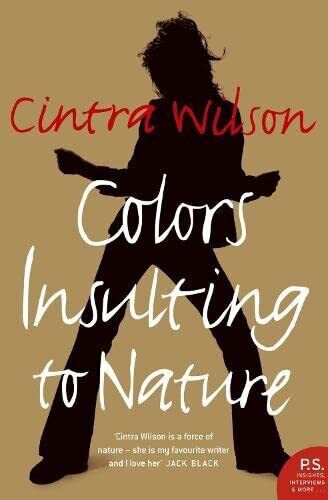
Cintra Wilson, “Colors Insulting to Nature” (2004) – This was a big, delightful surprise. This book came on my radar when I was looking into Montgomery McFate, the founder of the Human Terrain Project, a Pentagon effort to put social scientists into the field to support counterinsurgency in Iraq and Afghanistan. It was a bloody farce, as most things in those wars were. The media blitz around McFate as the program spun up added insult to injury, with a lot of emphasis on her credentials as a Bay Area punk in the eighties, raised on a houseboat by beatniks, theory geek, affecting punk style into her middle-aged aughts… one of the puff pieces brought up that a character based on her features in this novel by her friend Cintra Wilson, who upon googling turned out to be a sort of op-ed writer/style critic/general writing person. So when I decided I would write about Gen X literature for this year’s birthday lecture, I thought, perfect- a bridge between Gen X literary cynicism and support for our imperial wars, probably a piece of shit in literary terms, too. Maybe there’d be a cameo from John Dolan, aka the War Nerd, who in a very strange convergence dated McFate back when!

Well, “Colors Insulting to Nature” is none of that. The closest comparison I can make is to “A Confederacy of Dunces,” and that’s high praise. It’s a little too cute and self-aware (and, let’s be real, less relatable to me- you’ll see why) for it to quite scale the pedestal Dunces sits on for me, but it was a surprisingly great read. The story of the Normal family (you can see why I might have been rolling my eyes going in), particularly Liza Normal, and its efforts to make good with the one god that they can adhere to: fame, being on tv. Living on an arc between Las Vegas and Marin County north of San Francisco, the Normals are uniquely ill-equipped for their mission, lacking pretty much everything you would want for pre-ironic, mass-media late twentieth century fame other than one thing: “the tenacity of the cockroach,” as that one book called it. 

The book opens with Peppy Normal driving Liza, maybe age eleven or thirteen, to a hopeless audition for a commercial. Maybe I’ve been doing too much generational reading — which is ironic because a lot of the point in my lecture is about how generational analysis sucks — but I feel like in a book by a millennial author, the audition would be about how hard Liza tried to meet an impossible standard, and then either she fails (due to some certified injustice, maybe) or succeeds to find that success isn’t all it’s cracked up to be. Wilson does not do that. Liza’s audition is a train wreck, partially due to lack of talent, but mostly because the Normals are possessed with a very specific idea of fame, beauty, and glamor, an extraordinarily tacky pastiche of better-forgotten post-fifties over-sexed fashions and phrasings, so that little Liza makes some profoundly uncomfortable performances without even knowing it.

I dwell on this audition scene to show that this novel is about the subject of so many great works of humor: miscommunication. In this case, the Normals don’t want to communicate anything so prosaic as ideas, or even desires. They have visions in their heads, differing but converging in some key areas, of glory, light, love, the limelight dream (agoraphobic older brother Ned even makes Liza an actual limelight at one point, not an easy technical feat). Perhaps the most important structural prop in Liza’s dreamscape comes from an almost forgotten subgenre of movies about street youth whose natural talent and authenticity propel them to fame by just doing what they do- perhaps the only well-known artifact of this wave of media is the musical actually called “Fame.” Needless to say, their peculiar aesthetics would be hard to get across in any event. But based as they are in a “dinner theater” in Marin County, they have a singular incapacity to instantiate their visions. The harder either mother or daughter try, the more humiliatingly they fail, and the more they only attract dregs drawn by similarly deeply sincere but inane visions to their productions.

There’s a lot more incident in this book than I could cover here. The future Montgomery McFate comes up during Liza’s terrible time in high school, as Lorna, the reliable friend who introduces her to punk rock. Punk does form something like an alternative to the world of chintz and glitz, and, for a subculture that was still pretty oppositional back then, something like a stable platform of values (and a way to rebel against Peppy). But Liza can’t quite rid herself of the fame dream- that she could get revenge in some spectacular way (arguably punk’s most fundamental dream), or when that fails, an LSD-and-TV inspired dream of ultimate purity and cleanliness, where her shining whiteness (not directly racialized, but not not racialized, if that makes sense) can’t help but draw in worshipping masses.

The San Francisco portions of the book keeps up the pace of amusing incident and is also of some historical use in the bargain, I’d argue. We sometimes act like “the sixties” (metonym: hippies) kind of shifted into “the eighties” (metonym: yuppies) and “the seventies” (metonym: disco? Pet rocks?) was sort of the stomp on the clutch and yank of the e-brake that facilitated a sudden and complete transformation. But of course, it wasn’t quite that way. It wasn’t just aging acid casualties trying to hold on to some dream of counterculture, deep into the eighties, certainly not in the Bay Area. Probably my favorite section is where Liza and Lorna fall in (for the classic reason- cheap rent) with a group of the sort of DnD players your psychologist warned you about, the kind who take a lot of acid and genuinely think they’re elves. This was before nerddom — many of the subcultures I grew up with as relatively discrete categories, and which are now dissolving into the internet — gelled, and confused ex-football players looking for meaning could actually think learning Sindarin and growing their hair was a good way to get laid. The elf house gets into a three-way conflict with some techno-music alien enthusiasts and some gothy wannabe vampires. This is funny enough on its own, made funnier by the historical dynamic- we know, Wilson would have known almost twenty years ago, that these lifestyles aren’t avant-garde, they’re jokes, and soon they’ll be seen as reasonably wholesome hobbies. But only the goths on this tableau have even the slightest capacity for irony. The ex-jock elf leader keeps telling Liza she hasn’t had the vision that would allow her to be true otherkin. She has her own vision during a three-way drug-addled subculture melee in Golden Gate park, and goes back to pursuing fame.

Irony plays an interesting role, here. Wilson, who makes occasional asides to the reader, relates Liza’s failures but never entirely dismisses her vision. Her ludicrous TV dreams are no better or worse than what animates most of us, Wilson insists. Still and all, what saves Liza — and, eventually, Peppy — is irony and queers. Queer people, mostly trans women and gay men, hovered all around the story and the creative efforts of both Liza and Poppy. They provide a certain degree of sympathy — and once the Normals’ productions become ridiculous enough (to a certain extent due to mother-daughter rivalry), a certain amount of buzz, an unwanted and ambivalent form of fame for two women who desire mainstream appreciation, but something. It’s a desperate last resort that Liza starts writing queer erotic fan fiction. In this pre-internet time, you could make money doing that! This is what saves her and her mom in the end, that and a well-timed move away from overly-pretentious California and onto the self-aware, take it or leave it Las Vegas of the mid-1990s.

I’ve known people who thought Gen X basically invented irony, and that irony, essentially, invalidates history. Wilson doesn’t go that far. But it provides a sort of, err, fairy godfather, if you will, a role similar to that of kismet in the Arabian nights, that will allow one with enough persistence and luck to survive and even thrive. It’s not quite happily ever after for Liza (it might be for Lorna, who drives off east with her fiancée- and unless John Dolan was ever a tattoo artist, I’m not sure there’s a cameo there). It’s close enough. These endings are always weak points for these misprision novels, but like Confederacy of Dunces, the ending here, while not the best part of the book, does what it needs to do. All in all, a very pleasant surprise of a book, and I think a good and fun source for insight into the end of the twentieth century in the US. ****’
Review – Wilson, “Colors Insulting to Nature”

Review – Schuyler, “Black No More”

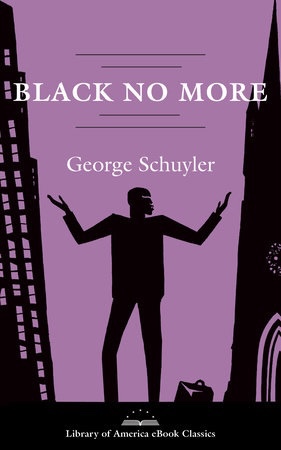
George Schuyler, “Black No More: Being An Account of the Strange and Wonderful Workings of Science in the Land of the Free, A.D. 1933-1940” (1931) – I’ve probably harped on this before in this space, but I never agreed with the nice-internet-people nostrum that satire is only satire if it “punches up,” that is, only targets people above the socioeconomic scale, vis-a-vis the author (and I guess the reader, too?). I’m not a strict prescriptivist, I don’t think we need to stick with the classical definitions of things… but I think it is a bad redefinition, the kind that trades in thousands of years of thought on something for a momentary comfort, or an edge in online arguments. This attempted redefinition only has any currency because we’ve decided that being funny is somehow sacred, in the same way that courage was once considered and still is by some, that it’s the sort of virtue you can’t apply to an enemy and see them as a real “bad guy.”Anyone is perfectly saying that they –don’t like– satire that “punches down,” against the downtrodden. I usually don’t, especially not with satire of contemporary societies! But I think it really doesn’t cut ice to say that somehow satire isn’t satire because it does something you don’t like. That’s part of the conceit of the genre, from Juvenal’s day on down – it is a mirror, it takes in society as a whole. Don’t like it? Blame light, blame glass, blame yourself for looking and being the way you are.

Well… “Black No More” is a satire in the old mold, all right. The satirical conceit is like any other conceit: it’s not literally true, like any artist the satirist makes their choices of what to depict and how. But if the satirist is smart, they can make it seem as natural as the reflection you see (and, generally, loathe, one way or another) in glass or water. George Schuyler was a Harlem Renaissance guy who grew to hate the Harlem Renaissance. Child of a black military family who knew poverty and prison before becoming a writer, Schuyler gadded about the literary scene for some time, doing journalism, travel writing, criticism, and occasional fiction. This is technically scifi- it’s about a scientist (a black scientist, if anyone’s keeping track) who invents a process for rendering black people into white people, flawlessly and cheaply. Schuyler handwaves a lot of the science (which goes along with his ideas on race more generally- more anon) away, and soon enough, new white people are taking the US by storm. 

On the one hand, Schuyler was a “race isn’t real” guy. He insists that, for instance, that differences in facial structure and accent wouldn’t give the game away for black people turned white (though I also think he has the process involve some kind of facial/bodily reconstruction? He’s vague). On the other, he has the US come close to collapse once it becomes clear that its black population is going to shrink almost to nothing. Without race, the whole culture starts to lose its grip, and massive upheavals occur in politics and society. 

We see this mostly through the person of Max Disher, a charismatic and morally flexible young black insurance agent in Harlem at the beginning of the story. When he hears of the black-no-more process, he immediately takes it, because he wants nicer things and also is obsessed with a white lady who rejected him a gin joint. Max immediately becomes a success in the white world by joining a KKK-like organization and leading it against the threat of crypto-black people. Among other things, the process is not genetic, and the offspring of ex-black people come out as black as they would otherwise (the doctor who invented the process promises that he will have special infant clinics that can “fix” that). As luck would have it, the racist group’s leader’s daughter is the mean white lady of his dreams, and he gets married to her as he grows the organization. 

As you can probably tell, the plot isn’t the point here, really. The point is Schuyler’s look, as acidic as it is panoramic, of American society and its hypocrisy around race. Schuyler depicts white racists, like Max’s new father-in-law, as stupid. But Schuyler depicts black “race leaders,” including very obvious parodies of W.E.B. Du Bois, Booker T. Washington, and Schuyler’s employer at the time, NAACP head Walter White, as utter frauds, pompous boobs living off the credulous. He shows them as willing to sell every notional value out immediately for white approval or for simple living expenses, mostly via trying to insist that black people stay black rather than de-racinating themselves. Of course, this is also what Disher’s new racist friends want. As tensions rise and white society falls on itself, trying to find a new scapegoat and mostly landing on “ex-blacks,” the movement Disher helped start finds itself in a position to take national power… only to find that racial purity, backed by anything like a “rigorous” understanding of race, doesn’t really work, either. In the end, everyone gets what’s coming to them, mostly violently. 

So Schuyler doesn’t think race matters… but it’s also at the center of the society he depicts, the identity and needs of every character, and the whole story he tells. This doesn’t make him a hypocrite, necessarily. It sort of does make him a satirist of the old school- where would Juvenal be if he lived in the supposedly clean Rome of the early Republic, what would Thackeray have to do with himself in a society less grotesquely unfair than early Victorian Britain? This does get into one of the weaknesses of satire as a genre: that its most common topic is hypocrisy, the distance between professed value and observed deeds. The more inflated the sense of virtue and the more obviously dirty the deeds beneath them, the more entertaining pricking hypocrisy with pins can be. 

Pretty much any period, given how people are, can be a good target for hypocrisy-baiting… but I’m not sure that applies to all times and places equally. Sometimes, the pretense of virtue wears thin, and it’s pretty obvious that the emperor has no clothes. Pointing it out isn’t that funny. By the time Schuyler was writing, the pretenses of white American society were pretty thin indeed. Scientific racism no longer held the stranglehold on anthropological thought it once did (though it was still a major intellectual force), the general skepticism of the Roaring 20s and the reaction to the Depression that came after was in the air… so Schuyler really has three main targets. There’s the ignorant “booboisie” (H.L. Mencken was a great publisher and booster of Schuyler, and they shared a lot of misanthropic attitudes- some called Schuyler “The Black Mencken”), mostly of the South, insisting that segregation was necessary for civilization. That’s pretty easy to lampoon. Then there’s black “race leaders.” I wouldn’t say Schuyler was “punching down” here, even if I thought such was the instant DQ some of the internet thinks it is. People like Du Bois probably had more power than a scribbler like Schuyler. I would say that, whatever their flaws, the black leadership of this class at the time was actually pretty smart, and the idea they were useless, feckless boobs really doesn’t wash- Schuyler couldn’t see the future, but he was awfully sure about the present, and the future has a tendency to knock people like that down a peg. 

Above all, though, Schuyler’s target was people in general. People are stupid, greedy, concuspient, and inevitably bring about their own doom in what can only be called parodies of tragedy. We’re back at the familiar territory, why this book belongs in “Readings on the Right,” even though Schuyler had yet to break with the NAACP and go all the way to the arms of the as-yet-unfounded National Review, as he would later do, by this point. Even though race is bullshit, it’s definitional and will collapse society if it’s taken away because people are bullshit. Race is about what we deserve- it just sucks that George Schuyler, who sucks less, has to be inconvenienced by it, and listen to other people talk about it (some of his more well-known critical essays were about how it’s wrong to classify writers by race). We know where this goes. Trying to improve things is pointless, usually perverse, almost always involves improving things for (and worse, forcing interactions with) lame, stupid people, so, most misanthropes wind up opposed, to one degree of violence or another, to attempts at liberation or amelioration. You’d figure more people would think that, if people are as lousy as all that, that you should make power arrangements as equitable as possible so no one can lord it over you (roughly my position, on bad days), but it seldom seems to work out like that, with your freestanding public cynics. 

This is one of the reasons why satire can be real iffy as a genre. As Clint Eastwood once put it, “we all got it coming, kid” – we are all, in some sense, hypocrites worthy of ridicule, or in some way or another shown up by the world around us. This applies to most of our ideas and social institutions as well. But that doesn’t mean just any “snarking” (to use a hideous newish word) does the job, or justifies a book. Among other things, it helps to either have interesting imagery (Juvenal, Ishmael Reed- the latter a big fan of Schuyler’s) or a plot (Confederacy of Dunces, Arrested Development) if you’re going to do longform satire, and Schuyler hasn’t really got either going for him. It’s funny in places and he clearly has some writing chops, but it also feels more like a phoned-in rant turned into a novel than anything else. ***

Review – Schuyler, “Black No More”

Review – Binet, “HHhH”

Haha hope you enjoyed your last Mercedes ride, my good bitch

Laurent Binet, “HHhH” (2010) (translated from the French by Sam Taylor) (read aloud by John Lee) – One thing about the Nazis, is most of them died like punks. Shooting themselves rather than facing justice, sniveling on their way to the gallows in Nuremberg or Jerusalem… Reinhard Heydrich, arguably the coldest, evilest, Nazi-est Nazi of the bunch, died ranting and raving in his hospital bed from a wound that shouldn’t have been fatal – the shitty sten gun they shot at him with didn’t work, he got horsehair upholstery lodged in himself from a mis-thrown grenade, it got infected because his doctors sucked. Fuck him.

Getting ahead of myself, here! This is a sort of meta-historical novel. French writer Laurent Binet talks about how he got fascinated with the assassination of Reinhard Heydrich, number two man in the SS, man who oversaw the planning of the Holocaust, overlord of what’s now Czechia when the Nazis seized it, one of the few Nazi leaders to even remotely resemble the “Blond Beast” Nietzschean ubermensch type. He got got by two soldiers, a Czech and a Slovak, dropped into the country by the British Special Operations Executive. After weeks on the lam, Jozef Gabcik and Jan Kubis were betrayed by a Czech resistance man, and hundreds of SS men tracked them down to a church basement. After a long siege where they shot several Nazis and refused to surrender, the two SOE men killed themselves. Among other acts of retaliation, the Nazis leveled the Czech town of Lidice and murdered all five hundred inhabitants. 

It’s a great story! I think Slayer might have written a song about it… both heroic and grim. Binet does not tell it as a straightforward, historical-fiction style narrative, and talks a lot about how he learned about the lives of the people involved, how we would like to present them, how facts compel him to present them, books he read while writing this book, how he felt insecure about Jonathan Littell’s “The Kindly Ones,” a novel of Nazism that won the Prix Goncourt while he was writing it (a novel in French written by an American, to boot!), etc etc. 

Meta stuff can go either way. I could see how one might not like it in this story. But I actually think it worked pretty well. “Showing his work” enhanced my appreciation for the story and its details. World War Two is such well-trodden territory, with so many layers of mythology drawn over it, that it can be hard to know what to think of it. Among other things, I see a trend where the smarter, more independent writers and critics kind of steer away from it. I get the impulse, but I think it’s good to not disengage… or maybe the little kid who loved WWII stuff in me simply hasn’t shut up yet. In any event! I thought this was pretty fun. ****’

Review – Binet, “HHhH”

Review – Lethem, “The Fortress of Solitude”

Jonathan Lethem, “The Fortress of Solitude” (2003) – I read this for my Birthday Lecture, which this year is going to be about the literature and generational identity of Generation X. I didn’t expect to like it. I had read one of Lethem’s other books, “Motherless Brooklyn,” and did not enjoy it. Moreover, research for birthday lectures is the reading category that, along with my readings on the right, most reliably fills the bottom rungs of my year’s reading in terms of quality. This year has been no exception- Jay McInerney, Tama Janowitz, Jim Goad, other Gen X scribblers are all near the bottom of the list (I keep lists) and I expect a few more to join them. But “The Fortress of Solitude” turned out to be very good.

This is mainly the story of Dylan Ebdus, child of first-wave gentrifiers in a part of Brooklyn variously called Gowanus (after a smelly canal, pre-gentrification) or Boerum Hill (after an old Dutch patroon who barely touched this distinctly flat part of westernmost Long Island, after gentrification took). Lethem — and his fictional analog, Dylan — will also tell you that it’s the story of Dean Street, the block where his artist parents deposit themselves and their neurotic, diffident paleface only child. Fighting trainers tell you to look at a bewildering variety of body parts to figure out what your opponent will do next: I’ve heard center-of-chest, shoulders, hips, feet, hands, and eyes. Trusting what an author says about their own work reminds me of trying to figure out an opponent’s intentions by looking at their eyes: it can tell you something, but it’s also an obvious place to fake, and even when the other isn’t faking, there’s all kinds of cultural filters around what eyes are saying. All that is to say, “The Fortress of Solitude” is kind of about the street, but really about one kid’s interactions with it. 

Dylan’s parents are a reclusive painter and a sort of general hippie gadabout lady type, the latter of whom runs away from home when Dylan is about ten, sending the occasional cryptic postcard. Gowanus is mostly black and Puerto Rican kids, not the poorest by any stretch, not quite rich or “respectable” enough to be middle class. There’s a weird old WASP-y lady who haunts the neighborhood, dreaming of rich whites “retaking” “Boerum Hill” (Lethem dramatizing the way real estate people – not necessarily revanchist biddies, but hey, it’s fiction – dug through archives for nicer-sounding names for the neighborhoods they were upselling), but it’s only well after her death that gentrification truly takes hold. So little Dylan plays stickball and whatnot, then becomes a mark for “yoking” – a sort of more-polite variant on mugging – by mostly black peers, along with another white nerd in the neighborhood. 

Not the least of Lethem’s accomplishments here are looking at this racial dynamic without quailing, catastrophizing, excuse-making, or other obfuscations. Dylan isn’t an underdog hero, he doesn’t “have it coming,” he’s just a kid, who, like most kids, is trapped in dynamics he can’t control. He’s not in especially serious danger, and this form of bullying has a sort of resigned quality to it that other forms don’t; it sucks, but adolescence (and it’s on-ramp, and it’s off) usually does. Dylan’s best friend is black (and Dylan, who may be a nerd but isn’t completely stupid when it comes to social stuff, knows better than to name-check his black friend to his black yokers), Mingus Rude, son of a declining soul singer. The basis of their friendship are shared, private adventures- buying and reading comic books, getting into graffiti, etc. Together, they see a mythic city the others don’t, complete with comic book-style superheroes. They come to believe – Lethem tells us – that they get a ring from a homeless guy that lets them fly. This seems like the kind of thing that knocked them dead in 2003 but I’ve decided that it’s mostly just a mediocre metaphor. It’s not enough to ruin the book, by a long shot. 

Others might disagree, but to me the central action in this long, sprawling novel is Dylan’s negotiation of, and eventually creation of, various worlds with other people, and the problems of living in multiple, sometimes intersecting, worlds. Dylan and Mingus (one thing I don’t love about this book is the names of characters) have their shared world. Dylan shares a world of boredom with another white nerd in the neighborhood, Arthur, and resents it when Arthur starts to move into the world with him and Mingus. Dylan has the hermetic world of his home with his Dad, who’s been shut up painting onto celluloid film for decades and doesn’t look likely to stop (he eventually starts painting covers for scifi novels he despises but which Dylan eats up- more worlds). Eventually, Dylan escapes Dean Street for a magnet arts high school in Manhattan, starts dabbling in nerdish, punk, and New Wave stuff with rich white kids, and plays a sort of cultural arbitrage between both. He winds up at a Bennington-manque, like Lethem did in real life (classmates with Donna Tartt and Bret Easton Ellis!), which, even as he only stays there the one year or so, seals his transition away from Dean Street and into… 

And here, there’s a lacuna, not the finely-detailed descriptions we got of Dylan’s youth (among other things, the book would be super-long if it kept up that level of detail). We see Dylan in then-contemporary early-aughts California. He’s a pedantic music scribbler, obsessed with black culture, up to having a black girlfriend who sees through his shit. He’s able to do this, but Mingus is in jail for a variety of mostly minor crimes. Lethem does not pretend that their worlds are equivalent, even if they grew up creating and sharing one together. Dylan did just as much stupid stuff as Mingus did, but could get out. Mingus did not have the same escape venues. 

The ending has some hijinks involving the super-powers, but they’re also a clear way for the author to get Dylan to see things, and others to do things, that would be hard to narratively arrange otherwise, but wouldn’t be impossible… that’s a vague way of saying that it didn’t interfere too much with my enjoyment. Moreover, Dylan tells us the point, as he sees it, in the end- the world-creating possibilities of his time, the worlds that got created and destroyed, leaving only remains – music, art, feelings in people who have been passed by by time – behind. People often dislike that sort of point-making in novels, but I found it worked well. I’m not mentioning all kinds of stuff that happens here – bravura passages, changes of scenery (Vermont, mostly), some funny stuff about the scifi and art scenes through Dylan’s dad – because like I said, it’s a big long book with a lot going on. It’s seldom “cute” the way Lethem could be, especially in “Motherless Brooklyn.” It took itself seriously but not at all humorlessly. I was glad to be wrong about what I thought this would be. *****

Review – Lethem, “The Fortress of Solitude”

Review – Cohen, “The Netanyahus”

Joshua Cohen, “The Netanyahus” (2021) (read aloud by the author) – Did you know that Benjamin Netanyahu lived in the US, mostly in Philadelphia and New York state, as a child with his family? I did but now have had it dramatized by Josh Cohen, one of the brighter young things out there in contemporary American letters, in this often-amusing novel. I don’t know if “bright young things” (he’s forty, I’m pretty sure, but hey, we live in a gerontocracy) want their books regarded as amusing, especially if they previously wrote what I’m told are great big difficult humdingers, but there it is. Supposedly, Cohen based this book on an anecdote told by the great old opinionmonger of American letters, Harold Bloom. Bloom loved getting in what passes for celeb gossip in wordy circles, and he liked to tell a story about hosting Benzion Netanyahu, his wife, and three preteen children, the middle of whom would grow up to be Israel’s longest-serving Prime Minister, for a disastrous job talk at a university.

Cohen’s narrator, historian of taxation Ruben Blum, doesn’t have Harold’s job or his mad self-mythologizing swagger. He’s a humbler sort, but doing pretty well for himself, holding a tenure track job at small upstate New York Corbin College, has a nice house, a wife, a high school aged daughter. But life isn’t necessarily so great for him. He speaks from the vantage point of the twenty-first century, but in the early 1960s, he has many of the insecurities of upwardly mobile, assimile American Jews (similar to those faced by writers Cohen admires, most notably Philip Roth): the general upper-middle-class malaise of the time, combined with uncertainty of how he really fit in to the culture. Blum is irked – but quiet, impotent – when his drunk WASP-y gladhandler department chair has him, the only Jew in the department, shepherd a Jew the department is considering hiring, one Benzion Netanyahu. Things only get worse when Benzion turns up on the Blum doorstep, during a snowstorm, with a wife, three pre-teen boys, and numerous ideas and eccentricities in tow. 

Cohen gets a lot of mileage out of contrasting ideas of what it is to be a Jew. Blum is the assimilationist midcentury Jew, a WWII veteran and supposedly successful assimilationist. His in-laws are upper-middle-class Manhattan German-descended Jews, and his parents reasonably well-off but less “classy” Bronx Ashkenazim, and we get minutely observed takes on both as they interact with Blum and his family. The Netanyahus represent an altogether different take on Jewishness. It’s not even so much the Jewishness of Zionism, in Cohen’s depiction – all the Jews in the book accept Zionism of some sort – as much as that of radical, revisionist Zionism… though, as someone who’s known a fair few Israelis, including little Israeli kids, in my day, the Netanyahu family in the book lived up to some cultural traits I’ve observed. They’re loud, blunt, bold. They’re a little more like the less-assimilated Blum grandparents, but with a different reaction to the fear and horrors Jews encountered in the twentieth century: straightforward aggression and truculence. The kids are funny, and there’s some slapstick as they tear-ass around the place, both more “childish” seeming and more knowing than American kids their age- that’s been my observation of Israeli kids, for what it’s worth. 

One question this brought up for me: stereotypes! Are they “good writing” if they’re used self-consciously, as they are here, by an in-group member? How about with “good intentions” by an out-group member? What makes in or out group members, anyway, for literary purposes? Where does exploring identity end and stereotype begin? Who’s to say? I wasn’t offended by any of it, but I wear my Jewishness pretty light. 

In any event, Benzion Netanyahu and his family pose challenges for the Blums, and not just logistical ones. Benzion’s work was notionally on the history of the Jews of Iberia, but really, it was about the Spanish Inquisition (unexpected, I know!). That Inquisition is weirder and creepier than most, because instead of persecuting heretics, it persecuted Christians. The Spanish Inquisition hunted Christians of Jewish descent, many of whom were in families that had been Christian for generations, from conversions made, mostly not at swordpoint, to Christianity after the Christians started conquering much of Spain and Portugal. If anything, the Inquisition undid what Christians supposedly wanted all this time: the conversion of the Jews. From this baffling situation of terror and violence, and from his immersion in the violent, tragic, fascist-leaning Revisionist Zionism of his master Ze’ev Jabotinsky, Benzion Netanyahu extracted the lesson that Jews and Christians would never live in peace together. Moreover, he came to think that the Jews were forced into history – away from a temporal order defined by scripture and myth – by the exterminationist violence of Gentiles. 

Needless to say, this is not a viewpoint which Corbin College was ready for, and one which rubs even an American Jew with as finely honed a sense of irony as our Ruben raw. Benzion irritates him, with his theories, his brusqeness, his occasional dishonesty (there’s a pretty funny bit where Benzion tries to get Ruben to lie to a rabbi about a borrowed car the Netanyahus fucked up), and his showing of Ruben’s ass. You don’t need to agree with Benzion’s Revisionism to think that maybe he has some points about the role of Jews in Western societies. Quite beyond shocking staid WASP academics and forcing Ruben into uncomfortable self-examination, the Netanyahus, Benzion’s brassy wife and half-wild children, introduce chaos into the Blum home. Ruben’s frustrated, overeducated/underemployed wife and deeply insecure daughter both wind up in the whirlwind, and publicly, in a way that scotches Benzion’s employment chances. 

All told, this was both psychologically involved – Ruben never accepts Benzion’s views or the impositions of his family, seeing them for the violent, uncouth, and disruptive forces that they are, though he can no more entirely reject Benzion’s critiques than he can boot his family into the snow they haven’t got the shoes for, until forced to – and narratively satisfying. It’s a tad “too cute” in places, in the way of literary writers who think they’re funny, but also gets some real laughs. David Duchovny is listed in the audiobook credits, for a sort of cameo he does as a rabbi who recommends Benzion (probably to get him off Philadelphia’s hands), but I’m not sure why they went with him for that? Anyway. All in all, decent. ****

Review – Cohen, “The Netanyahus”

Review – Patchett, “Bel Canto”

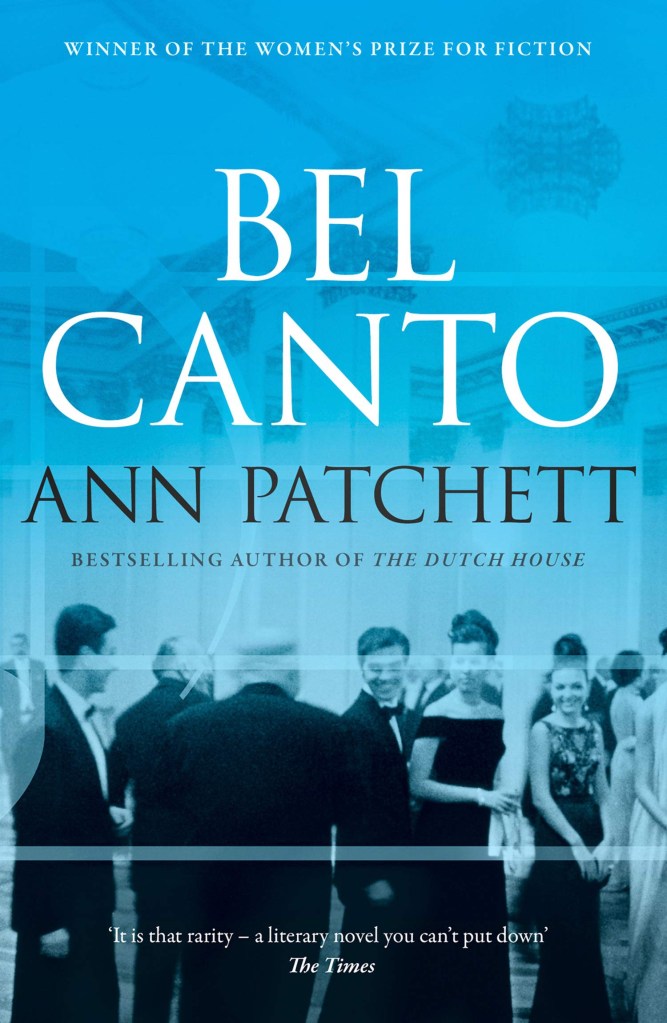
Ann Patchett, “Bel Canto” (2001) – The main question this book raised for me was this: how to describe and rate a novel that has flawless prose, from sentence level to plot construction, but that is also, fundamentally, a little boring? That takes something notionally exciting — a hostage situation! wealthy socialites held by third world guerrillas! — and makes it, mostly, a site of examination for the personal regrets, cares, and in some cases growth of some of the hostages and hostage-takers?

Fine prose is one of the keys to Ann Patchett’s reputation. Another is her real lack of pretense. She hasn’t even got that sort of stuck up pretense of rebellion a lot of writers who manage to escape more conventional pretense wind up displaying. What you see is what you get. Patchett didn’t promise a deep, searing examination of the causes or effects of terrorism, of social stratification, or of anything else. She didn’t promise literary experiment. She told a story, and on a prose level, told it with unrivaled grace. There’s not even really any kind of prose pyrotechnics: just very clear, effective, elegant writing, every word in place. 

There’s a theme, which is love. Love is put in extremis here. First, it’s a rich man’s love of opera. A Japanese executive, one of the richest men in the world, lets a small, impoverished Spanish-speaking nation bait him to a pitch meeting that the businessman doesn’t take seriously by getting the world’s greatest soprano to sing for him. The businessman is a big opera guy, you see. Once the terrorists take the dinner party over, love of art gets contrasted with the desire of the terrorists for revenge for various bad things their regime did, and the meaningless deaths that result. But the protracted siege allows hostage and hostage taker to come to some understandings. Love blossoms across these lines, and along them, little gesture of kindness depicted by Patchett with minute fineness and great emotional intelligence, especially for a scenario that could lend itself to laughable romanticism. The violence of the state comes along to take its own tax on love and humanity, but it goes on… for some, anyway.

Well… it’s not a bad plot. I didn’t find it especially compelling, especially as the characters, while elegantly sketched and differentiated, also weren’t super-interesting, and only had a limited range of action, given the circumstances Patchett put them in. I guess my main critique was that it’s almost too smooth. There’s no real “biting point,” nothing to chew on. Me and my eating metaphors! Surely, Patchett deserves a great deal of credit for her chops, in any event. ****’

Review – Patchett, “Bel Canto”

Review – Lockwood, “No One Is Talking About This”

Patricia Lockwood, “No One Is Talking About This” (2021) (read aloud by Kristen Sieh) – Well… I listened to this at a time where a fair few things came together for me. Whatever other effects this confluence had, it has made me very, very impatient with this book. I am informed, by people whose taste I respect, that Patricia Lockwood is a very talented writer, largely on the strength of her memoirs “Priestdaddy,” which I perhaps will one day read. I could see glimpses of it in this work, a smooth prose style and bits of humor. I have also been told she is a “master of Twitter.” This is probably part of the problem. I did not enjoy, like, or respect this book.

A friend of mine — a friend I’ve known exclusively online, if that matters, one I’ve known for years and shared writing and other intimacies with — did something extraordinarily self-destructive recently. His stated motivation for so doing, the way he went about it, and the formats in which he informed his friends, all simultaneously critiqued and reflected the sort of internet zeitgeist that seems to be one of the main topics of contemporary literary attention. His critique, and what he did in response, struck home not just for his perspicacity, though he is quite perceptive, or the extremity of his action, though it was quite extreme. It also struck home because at bottom, he and I are in similar positions- failed writer/intellectuals. People flinch from that word, “failed,” “failure” (like a certain other “f” word that I freely self-apply, “fat”). They point to my accomplishments, and they — I — point to his. They’re real. But there’s also no getting around the fact that neither my friend nor I can make a living from writing, academia, or any of the other societally-approved venues to cash out wordy oddballs. 

So much for the material! I usually play straight man to this friend. In our dynamic, based as it is on discussing ideas and aesthetics, I’m the stolid one, considering the implications, striving for consistency, trying to be “real,” he’s the zany one, throwing such mundane concerns to the wind, even to the point where he’d dispute this characterization. No pigeon hole for him! Maybe this is the way to put it: I make statements; he makes gestures. Another way to put it: we discussed depression, once, and he told me some facts about narcissistic depression, the depression of people capable of making flashy gesture and big deals out of themselves (as you can tell, my psychological vocabulary is… impoverished), whereas my depression, my family’s depression, was more the self-obviating kind. 

This friend would try to destroy himself all over again, I bet, before he accepted any kind of descriptor that said he, and his attempted last performance, were part of any kind of zeitgeist. Well, he doesn’t have to accept it. The thing that made me most angry as I read through his lengthy manifesto was the unsaid thesis: that he is above the real, above the quotidian. I answer emails about 3D printer failures forty hours a week, and try to eke out time for what I care about — writing, reading, organizing, fun time with friends and family — when I can. I can live with my failure to be a professional writer, and try to convert it into success, and this dude… 

Well. This is not a request for an explainer on the realities of depression and suicide. I get it, please believe me, intellectually at least, and you’re hardly going to get me to grok it emotionally more than the last week or so already has, so please, please don’t try. Among other things, and here it’s hard to see how much my friend “meant it” — he is a long-term practitioner of the “Schrodinger’s Joke” — but his manifesto included instructions for his posthumous acclaim. 

He’s not a “get famous or die trying” guy, exactly (he has invested a lot of energy in being hard to pin down). That’s made explaining this difficult, when I’ve tried to talk about what’s going on to other friends. I think it would be fair to say he is a “live in extraordinary fashion or try to die in extraordinary fashion” guy, or was, anyway. Surviving the experience seems to have woken him up to the fact that people care about him, and that living like the rest of us relatively-normie scrubs might indeed be preferable to death and mutilation. 

So, getting back to “No One Is Talking About This” (including me for the last thousand plus words, hey-o!), it’s not a fame thing, exactly. It’s not an internet thing, exactly, though most of my friend’s relationships seem to take place there, and a good portion of his friend network do appear to be internet-damaged millennials. It’s a hands-up-thrown refusal of concrete reality that can’t, even, really commit to its own lack of commitment. That’s what I see, both in internet discourse and in the discourse about the discourse. Half-digested nth-generation tropes from continental ding dong philosophers who barely even meant it themselves, circulated and recirculated like old coins until even the names wear off… glibly talking like nothing is real and nothing is worth speaking seriously about even as they milk everything from derogated social media platforms to climate catastrophe for cheap bathos… well, my friend wasn’t down with that, either. And in his attempted final act, he tried to put some chits on a commitment, of sorts. But a commitment to what, exactly? 

“No One Is Talking About This” is about an unnamed female narrator who becomes moderately famous via “The Portal,” i.e., Twitter, but, like seemingly everyone else who is connected to said social media platform, is unsure whether she likes it or hates it. It certainly has a profound effect on how she processes reality and communicates with others! This is gotten across in the text through a first half dominated by little vignettes, tweet-length remarks, no real plot, less “nods” or “winks” at James Joyce and more just Lockwood pointing openly at Joyce and saying “yeah, I’m doing that, but more so, because our TIME is just more so, you know?” 

We do get a pivot to something like the real, due to a family crisis. The narrator has a family, the family has a crisis. It’s not really a plot, but it’s something other than a social media scroll (self-conscious, because, you know, we’re all so self-conscious now!!). That’s the thing… they really can’t manage either, these “we live in discourse hell” writers, whether fiction writers like Patricia Lockwood and Lauren Oyler or the legion of nonfiction commentators that shade into the overly-online people on your feed. They can’t do the all-pretend world that some cyber-boosters of the eighties and nineties promised, but they can’t really do the real, either. And they’ll insist that their inability mirrors a human inability, or at least a contemporary inability… and they’re not wrong. It’s an old theme and it’s been done reasonably well. What’s real, how much do our feelings determine at least the subjective reality of experience versus what’s “actually” in front of us blah blah blah.

Look- I’m not some “I fucking love science” dork or an objectivist. I’m a reader, trying to read something interesting. And “discourse hell” isn’t cutting it anymore, to the extent it ever did, and pivoting to noticing how hard it is to take a family tragedy totally seriously because you spend too much time online- that’s not gonna get you over, not with me, anyway. Maybe I should be able to do it. Maybe this really is “the human condition,” with an earned definite article and everything. Maybe every rejoinder I could make to that is a cliche about how we should read about Bangladeshi factory workers instead (it isn’t, but the internet smallfolk can make you feel that way, when they’re all saying the same shit- we are social apes, after all), maybe I’m the stupid, blockheaded socialist realist next to the beautiful thoughtful modernists in the thirties tableau (the latter already on their way to neoconservatism but later for that). 

But I don’t think that’s how it is. 

I said there was a confluence of factors that, perhaps unfairly to Lockwood, rendered me incapable of enjoying or respecting this book. One was my friend’s situation. Another, longer-term one, is that I am, sort of, recovering from depression. I’ve felt better the last few years than I have in a long time. Life is far from perfect, but I experience more feelings (and I’ll say it- whatever set me up for success in terms of family and friend support and talk therapy, antidepressants landed the most important blows). One of those is anger. I’ve gotten used to suppressing it, got used to thinking of it as a self-indulgent gesture of my adolescent self (which, when I was an adolescent, it often enough was). But let’s put it this way: I experience anger as impatience. And I can still be very, very patient, when the thing I am being asked to contribute is just time, or honest effort.

My patience for dishonesty, though, is gone. My patience for glibness is gone. Worn through. My patience for bullshit is mostly gone, the only thing keeping it from being entirely effaced is an appreciation for funny bullshit. You can do what you want. You can be as glib as you want, act as though it’s all just performance and I’m just doing a dishonest (hypocritical!) glibness myself. You can “cringe” (there, using it as a verb, not an adjective, like we’re supposed to). You can fuck off, or not. But I’m not doing it anymore. Not with Lockwood, who is intermittently funny but not funny enough, not here, and not with you. 

Because on top of whatever else it is — genuine cris de coeur over authenticity! Artistic expression of your experience! Funny memes! — the glibness of the “we live in the hell of discourse” thing is intensely disrespectful. It does not live in peace, as I would live in peace with the internet people. It oversteps, by nature. It disrespects life, disrespects effort, personally disrespects everyone who tries to live something better than a shitty day on any given “hell site.” And they generally haven’t even got the integrity to admit that they are spitting in your face. A number of internet strangers recently, and at least one or two IRL acquaintances, have behaved disrespectfully to me, impugned my intelligence and my integrity, and, my patience gone, I asked or told them to stop, and I got earfuls about my “defensiveness.” “U mad, bro?!” gone to therapy. Fuck off. I see you, and I’m not playing. Not now, not anymore. 

Ironically, my self-destructive friend discussed a fair amount of what I’m saying now in an essay of his on… well, notionally on David Foster Wallace, but really on the whole literary scene circa 2010, around when it was written. His major thesis is that because hipster writers (this is back when hipster discourse was a thing) live such cushy lives that they have no real suffering to write about, and so write about a fake suffering, the feeling of inauthenticity. I have a number of friendly critiques of that article but I think, if anything, the situation has degenerated since then, even if we’ve made the relative advance of ditching hipster discourse. Now, books like this one, and “Fake Accounts” and I tend to imagine many others, somehow manage to be “about” ever less, and to be corrosively hateful to even the possibility of being about anything at all, and somehow, somehow! managing to dump themselves into the same old same old of familial sentimentality or careerist pseudo-heroism in the end.

I can agree with the internet scribblers about this much- it is a discouraging picture. But I have a better solution than they have- turning the fucking page. The exigencies of my reading scheduling, a fun little game for me, has led to my next audiobook being about the Armenian militants who hunted down and shot the Turkish pashas who led the genocide against their people. A perfect palate-cleanser!

I turned definitively against this book after Lockwood, culminating a series of little jokes about how being political is stupid — I get the impression she is meant to be a somewhat serious leftist, who knows, I don’t care — belittled people’s reactions to the killing of Heather Heyer at Unite the Right in Charlottesville. A good friend of mine was a medic on the scene. She split a vuvuzela in half to manufacture a splint for someone’s broken leg. Why are we telling the story of some dumb internet person’s inability to be honest about their, or any, situation, again? Why are we telling it over and over again? I don’t care what a commie you think you are, this whole fucking business is fash nonsense.

What did we do when the altright manifested itself out of the discourse? We — the actually committed, the ones who know we’re imperfect and fucked up and still drag our asses out into the productive real, no matter how “cringe” it makes us — dragged it into reality and we kicked the shit out of it and now, no one, not even Richard Spencer, will admit to being altright. There’s still fascists, and we’re working on them, but that bridge burned, because we burned it. That’s the reality I’m interested in. That’s the reality I live in, and I’m not going to take disrespect for living in it, even — especially — if it’s sly, sneaky disrespect that acts like I’m just being “defensive.” Lockwood gets an extra half star over her rival, Oyler, for being funny, sometimes. But I’m done. Quite done. **

Review – Lockwood, “No One Is Talking About This”

Review – Mailer, “The Naked and the Dead”

Norman Mailer, “The Naked and the Dead” (1948) – For most of my life thinking about literature, I thought of Norman Mailer as one of the great overrated buffoons of American letters. I thought this mostly on the strength of his nonfiction. This included his pseudo-gonzo reportage from riots in Miami and Chicago but the text of his I saw the most was “The White Negro.” People invariably cite this essay in histories of American culture and thought in the late twentieth century, and in the culture-drowned internet discussions about race of twenty-first century- Norman, the archdevil of white appropriation of black culture, along with Moynihan, the devil of pathologization of the black family.

Well, “The White Negro” might be needlessly flogged but it is also, to borrow a usage I dislike, deeply “cringe.” It is genuinely a bad piece of work, and his reportage sucks hard, too, especially when Hunter S. Thompson was around, showing what was possible in the same vein. Mailer’s performance of self after the sixties is impossible to take seriously: bloviating, macho, homophobic, Hemingway without the pretense of elegance. And he stabbed his wife (and pretty much the whole of New York literati at the time, including at least one contemporary progressive saint figure in the person of James Baldwin, signed statements to let him off). That’s the Mailer who serves as midcentury New York literary foil to Gore Vidal, in the minds of internet people with some stake in being literate, little time or interest in reading long old books, and an awareness that Mailer was the straight buffoon and Vidal was the queer guy with the bon mots and the fine taste in enemies. 

So I wasn’t sure what to expect when I picked up Mailer’s first novel, “The Naked and the Dead,” written a full decade and a half before he punched Vidal, stabbed his wife, or ran for office. What I got is actually pretty stellar, and even more impressive considering that this was a first novel from a twenty-five year old just coming back from a grueling wartime experience. It seems like a shame to me, now, that Mailer’s later reputation in many ways overshadows his first book, though Mailer himself can take most of the blame for that.

“The Naked and the Dead” tells the story of an American campaign to take a fictional South Pacific island from the Japanese, part of the “island hopping” strategy. Most of the viewpoint characters are part of a reconnaissance platoon. The island is hot and wet, the men are mostly sweaty, horny, contentious, and when not terrified, bored. We get insight into the private lives of at least a dozen members of the platoon as well as frequent visits to the general leading the campaign and his psychological war with his aide de camp. These include “time machine” sections where we get insight into the men’s lives before the war (Gore Vidal sneered at these in his dismissal of this book, saying they were second rate Dos Passos knock offs- Vidal was wrong here, and wrong about the book as a whole, which shows he takes Ls in this game, too). 

The plot isn’t complicated. The platoon lands on the island and gets shot at. The platoon hangs out on the island for a while when the campaign stalemates. The platoon gets sent on a cockamamie long-range patrol, ordered and run according to agendas that have little to do with winning the battle winds up determining their fate. Some of them survive, most of them don’t. 

More than the plot, the point of the book is the situation and the characters, a study of men — gendered pronoun used intentionally, there are no women on the island (there are also apparently no indigenous people- I’m not sure whether there any islands that big that were uninhabited out there, but whatever) — in an extreme situation around other men. Ever wanted to know what was going on in the heads of all those members of those multiethnic (but no black people) squads of WWII dogfaces, before we decided that generation was too Great to have internal lives? Mailer tells us, by the expedient of throwing them all in with each other and adding numerous stressors. 

You can see some of where Mailer’s gendered bullshit later in his career comes from, but in a larval form, arguably a form that could have had a very different growth. The root, in a predictable enough pattern, is in insecurity. All of the men in the platoon, and the general and everyone else, is in one way or another insecure in their masculinity. Even the sergeant who leads the platoon (it’s without a lieutenant for a while), Croft, a self-contained autochthon made of rage and competence, feels insecure, is constantly on guard from challenges to his manliness. The other characters — especially Mailer’s two Jewish characters, who, like him, live in the shadow of the “nice Jewish boy” stereotype (and of raw antisemitism) — don’t stand a chance. 

So, they rub up against each other, emotionally if not physically (one way the macho buffoon Mailer of later decades shows himself here is the clear association he makes between heterosexual sex and happiness, if not necessarily wholesomeness, and homosexuality — as represented by the ruthless, mind-game-playing general — and a sinister devaluing of human life). They complain about their wives and sweethearts, and fantasize about female infidelity even as they undertake many of their own. They get in little pissing contests. Much of the action are the attempts of the men to get out of doing difficult and dangerous things, and the way the Army makes their lives worse, whether they manage to get out of the firing line or not. 

As a dude who hangs out with a lot of other dudes, it all rang pretty true. The prose was good, with some pyrotechnics in places but little of the pretense Mailer with which Mailer would come to stultify us. It felt honest and immersive. I spent a long time reading this, partially because I’ve been busy (especially in my traditional novel-reading time, evenings after work), but by the end, because I was savoring it. My plan now is to read down Mailer’s oeuvre chronologically to see when he went from this guy to the guy he became. *****

Review – Mailer, “The Naked and the Dead”

Review – Kunzru, “Red Pill”

Hari Kunzru, “Red Pill” (2020) (narrated by the author) – Well, well! This one inspired many thoughts and feelings in me. More of them, written down, are derogatory-sounding than this book deserves. In that respect it reminds me of another, somewhat similar book, Ben Lerner’s “The Topeka School.” Maybe I don’t have it in me to straightforwardly praise contemporary literary fiction (maybe I just don’t have practice!). In particular, anything that treads the waters of “what the fuck is happening/rise of fascism” is going to bring up a lot of weird stuff for most anyone who reads them, especially if they don’t follow some predictable line (“love wins”).

I thought, maybe four fifths through listening to this book, that maybe Kunzru was verging towards a predictable line, after all. But I guess I should say what happens in this book a little before going into that! We’ve got an unnamed narrator, a South Asian British man living in Brooklyn, early middle age, wife and kid, a freelance writer of cultural criticism, maybe a cut above the NPR type, call it the N+1 type, and let’s go ahead and call our narrator “Hari.” Hari is feeling weltschmerz but wins a fellowship to do some study in Germany. Off he goes, promising his wife that he’ll return with a book manuscript on “the poetic I” and a head free of angst. 

Well, naturally, the fellowship is not all it seems. It was founded by some ex-Wehrmacht Christian Democrat industrialist with funny ideas, that entail Hari having to do a bunch of shit he’d rather not: work in an open plan office and eat meals with fellow fellows, most notably an obnoxious evopsych professor. I gotta say, it’s pretty funny that Hari’s nightmare is basically what office workers like me take for granted: a cubicle, supervision, meals eaten with people not your choosing (I will say my employer isn’t so bad about the latter). Does Kunzru get that? Probably, though whether he “groks” it… 

Anyway! Things get increasingly sinister. Among other things, the fellowship center is smack in the middle of the Berlin neighborhood of Wannsee. Wannsee, of course, is best known for the Wannsee Conference, called by Reinhard Heydrich to plan the logistics of the “final solution.” It was also a sort of fashionable vacation spot (back then, any crappy old lake — like the “see” in Wannsee — a short-ish distance from a city was a destination) for romantic poets like Heinrich von Kleist, a spicy type Hari is studying for his project. Von Kleist shot a lady friend and then himself around the lake. Bad vibes! Hari walks around and around the lake. It’s winter in Berlin. His book isn’t getting anywhere.

Where can Hari take refuge other than in streaming TV? He obsessively watches a cop show — I imagine it being a lot like “The Shield” except maybe with Dolph Lundgren in the main role — marked by extreme violence and occasional apostrophes to the viewership in the form of speeches Hari realizes are drawn from reactionary philosophers of the past: Emil Cioran, Joseph de Maistre, the like. It’s all stuff about how life is a pointless bloodbath, etc etc. 

Things really take a turn, as they so often do, when the internet goes down. Hari tries to get it fixed but the IT guy is probably in the altright and they’re probably also watching all the fellows when they sleep (or is Hari having a breakdown?). Plus also those dang German ordoliberals with their ironclad fellowship contract are probably cutting off his internet because they can see he’s not doing enough work! Fuck!! He’s gotta get to the bottom of this!

Hari does not for a good gentleman detective make. He tries to get one of the cleaning ladies to tell him stuff. She tells him a long story about how she was a punk in East Germany, was stalked and mind-fucked by a stasi officer into being an informant on the scene, and also had a very shitty post-reunification life, as did most of the people involved in her story. All that, and she doesn’t drop any useful hints! She just gets mad at Hari! Can it get any worse?

A cool black gay guy at the fellowship invites Hari out to a charity gala for refugees and things can, indeed, get worse. Hari, disgusted by the money and obviously fake concern on display, tries to help out a refugee and his daughter who he sees on the street and botches the approach. He goes back to the gala and meets Anton, the dude who makes the cop show, and asks him about all the weird quotes. 

Insofar as all the dread Kunzru builds up has a payoff, it is in the antagonism between Hari and Anton. Anton is a Nazi, or anyway, a nihilist who sees that the premises of Nazism and reactionary ideology more generally is the way towards his preferred social order- the strong ruling over the weak, and getting to caper and shout and be worshipped while doing so (you get the impression, in this book and elsewhere, that it’s the capering these people really want, and I guess a redefinition of “strength” and the ruling privileges that go with it towards parameters more amenable to themselves). And — and here it’s worth noting that while this book was published in 2020, it takes place in 2015 and 2016, the lead up to Trump’s win in the election — he owns Hari pretty good. Invites him out with his Nazi pals, makes fun of him, doesn’t leave many holes that someone of Hari’s intellectual background can exploit (I saw plenty — he’s a precious little fellow, Anton, with his undercut and his elaborate joke of going to a kebab place and not eating, and anything precious is delicate — but of course my circumstances are different). Then Anton and a Nazi friend show up at the fellowship center, do some Nazi troll shit, and get Hari booted! 

The dynamic, here, is that Hari is the sort of ineffectual left-leaning intellectual, pondering poetry in abstruse little journals, that right-wing man’s men who don’t care about anything, man, can walk right over. Well- that is, certainly, a thing in the world! One of the feelings I felt while reading this is a familiar one I’ve never put a name to (perhaps the Germans have a word). It’s a feeling of almost seeing my perspective in someone else, or my circumstances, but also missing it by a mile. I’m a leftist intellectual worried about a rising tide of reactionary violence as crises converge. But like… I also don’t fetishize my own helplessness, as Hari does, as a fair few leftists and liberals I know have, and do. I don’t “forget about” fascists, the way “sensible” liberals and moderates would have me do- there, Hari and I agree. But my version of living my values entails being able to do something about them in the world, as best one can.

The world — the pre-1945 world, the world of the Cold War, the prefiguring of the crises of the 21st century that the altright represents — crashes in on Hari, in a personal and offensive way. To Kunzru’s credit, he does not linger long on the Brooklyn world that tears like tissue paper once Hari is expected to work under normal circumstances and then meets a troll. He doesn’t wallow in its fecklessness, just let’s a few features — Hari’s wife’s work for the Hillary Clinton campaign, a few cultural markers, mostly Hari’s utter inability to cope — do the work for him. Interestingly, he doesn’t altogether crumble in the face of the world… or, well, maybe he does. In all likelihood he has a paranoid break with reality. He becomes obsessed with Anton, stalks his online circle (how many of which are just Anton-bots, replicating his posts?), and basically comes to conceive, saying outright at least once, that Anton is the Moriarty to Hari’s Holmes. He thinks Anton leaves breadcrumb clues to find Anton on an island off the coast of Scotland. Hari acts weird there, with a knife, and gets arrested. His wife and brother find him, put him on a plane back home, have him committed for a while, and then he returns home to a tentative, painful peace. Then Trump gets elected!

When I say that Hari doesn’t completely come undone, I mean that at least he does something. He doesn’t do something smart. But given that the failure mode that defined his existence so far was inaction, going to confront the symbol he created for the dread he felt — a dread I hold he is right to feel — seems… like a step in the right direction? I don’t know, isn’t facing fear a good thing? 

And that’s what I mean when I say, way back in the second paragraph of this review, that Kunzru seemed to veer towards a conventional conclusion about the conflicts that characterize our time. He doesn’t do a “love overcomes” thing. He comes close to doing a “paying attention and trying to fight emerging fascism will drive you mad, so, don’t” thing. As it happens, I think the last fifth or so of the book, where Trump wins the election and it becomes clear that the forces of conventional liberal reasoning — mostly represented by women who call Hari crazy, like his wife and his psychiatrist — can’t keep the wolf from the door, takes us away from this conclusion. Maybe it’s just me being politically happy with that, but I do think it shows some artistry on Kunzru’s part. Of course, a Brooklyn intellectual, confronted (away from home and what community he has and in a bad way emotionally) with fascism, would do some dumb bullshit like construe that the fascist set an elaborate online trap for him, and try to confront the fascist, in the trap, like a dumb movie. Hari’s subject is literally “the poetic I!” Individualism is his whole thing.

It’s not a just so story- Hari doesn’t, say, join any kind of community defense effort or something, which he dismisses with lines like “I was learning poetry when I should have (he doesn’t actually mean this) learned to field strip an AR-15” etc. He’s not any better off for his brush with fascism. That reads true, as well, and in keeping with the general sense of contemporary dread that Kunzru shares with Roberto Bolaño, Michel Houellebecq, and, well, the news and the internet. Nobody learns anything. Nobody’s capable of learning anything, and it’s too late if they are. 

Kunzru deserves to be in Bolaño’s company, and that of the early, compelling Houellebecq, in terms of crafting an intelligent, readable narrative that rings true to our times. It is a compelling listen/read. I’d even say Hari is “Berard Complete” – he feels real without being tediously fleshed out, or anyway, more than a first-person narrator of his kind would flesh himself out in the course of telling a harrowing personal tale. I guess, at some point, I would like a story, one that isn’t about superheroes or people who might as well be, who see that fighting people who would oppress you, while not easy on the soul, is possible, sometimes necessary, and maybe not even a road to automatic emotional ruin and distance from your loved ones. Just for variety! I understand it doesn’t make sense to ding an author for the story they didn’t write, and this book certainly held my interest and inspired respect for its craft more than most recent literary books do. So, I won’t ding it that half star I was considering for my horror movie fan-style frustration with the Haris of the world, yelling at the book, “just punch him, you asshole! It worked on Richard Spencer!” *****

Review – Kunzru, “Red Pill”

Review – McGurl, “The Program Era”

Mark McGurl, “The Program Era: Postwar Fiction and the Rise of Creative Writing” (2009) – The short story workshop! For a certain kind of liberal arts student, no setting conjures up quite that same combination of dread and hope. One such class was the only literature or writing class I took in college. It was my second semester, freshman year. I scribbled some stupid high-concept alternate history nonsense, then a twee family thing. Some other people did some ok stuff. I don’t remember if anyone was particularly nasty. The teacher was a decent sort (he might be reading this!) who seemed to genuinely believe in the type of stories that come out in those “best American short story” books- not that he liked all of them uncritically, just that he believed in the project.

I hadn’t formed an opinion on the project, but I would. I learned literature, to the extent that I have, because I was learning history. I’d say I did it on my own, but that’s not quite right. I did it by the light of a few constellations: sometimes friends and family, but most often, publications like the old Baffler and the Exile. Their style of criticism – erudite but irreverent, aiming to wound and not just to act as an adjunct to the publishing industry – spoke to something in my young-adult soul. I gobbled up their archives, and worked on learning literature along two tracks: their recommendations (and sometimes, their denunciations), and “the canon.” Test and control. Taking this task seriously meant honest, rigorous engagement not just with the works, but with myself, the critics, the world around me. It’s a test, given the many ways all of us can – I think all of us do, however temporarily – decide to lay down in the snow and nap, faced with the blizzard of bullshit and easy outs that surrounds critical discourse, at any time but it feels especially totally now. 

Woof! This took a turn. The point is- all of my teachers after that nice fellow in Dalrymple (who may or may not be reading this- hello if you are!) despise the project of the contemporary establishment literary short story of the kind published in the “best of” series. Most of them despise it hard enough to have developed critical frameworks that also condemn most official alternatives to said establishment- these have a way of getting folded in, after all. Moreover, most of the people I’ve met post-undergrad who participate in literature in any way are also deeply skeptical of the entire literary enterprise as it currently exists. Some have fled for the Croatoan of alternative literature of various kinds, and seem to be doing ok out there. Others keep “playing the game” as best they can, compelled by a love for the act of writing and reading and trying their best to “keep the faith” (and ironic distance). All of them are at the least ironic about contemporary Anglophone literature, and most of them are strongly critical of how it is produced: the publisher, the pitch, the agent, the query, the review, the blog, the tweet, the MFA, and above all, the workshop. 

The workshop has become symbolic for much of what is wrong with contemporary American fiction. Somehow managing to manifest both a gummy sort of Disney-populism (“anyone can write!!”) alongside tacky elitism (“for a price!!”), grad-school pretense and high-school social dynamics, the workshop is widely considered unpleasant to participate in, not notably good at improving people’s writing, deleterious to the quality of American letters, and also a scam. And it’s hard to disagree, really. Look at the state of American literature, and of English language literature in general. It’s really not great! And a lot of the problems do feel pretty “workshop” – self-indulgence, predictability, stylistic conformity. I’ve said so- so have numerous literary friends with many more workshops under their belt than mine (and more to come!). And I mean… a dozen-odd people, mostly kids, who want to be writers, posturing and passive-aggressively sniping at each other, ridden herd by some poor son of a bitch who believes in literature? Woof!

So! Whomst amongst us would defend the workshop, or anyway, the workshop’s centrality to the production of contemporary American literary fiction? It’s too much to say that literary historian and critic Mark McGurl defends the workshop, or the MFA programs that use the workshop as their basis. But he does complicate our critiques – which are borderline received wisdom in critical circles – in the process of illuminating the contours of post-WWII American literary history. 

McGurl begins with that would have seemed – what did seem – like a paradox: programmed creativity, especially in a university setting. The hierophants of literary modernism, especially the Americans, mostly fled universities, which they considered (rightly) to be strongholds of hidebound literary traditionalism. Hemingway hated school; Faulkner spent more time on Hollywood studio lots than in a classroom; everyone who could fled not just American schoolrooms, but America, for Paris. Paris, London, New York- that was the “school” for modernist writers. 

In discussing the history of the writing program, McGurl takes the fiendishly simple step of wondering why the critiques so common to us of program writing would not have occurred to the people who created these programs. More than asking a probing question of the past, McGurl’s move here is a showing up of the anti-program cliches we live with. In other words- it’s not that profound to figure out that critiques like “creativity can’t be taught” would have occurred to Wallace Stegner and other godfathers of the creative writing program, but it is an interesting lacuna that people go on making that criticism as though their interlocutors hadn’t heard it. In many ways, us critics of the writing program have taken its existence, and our antinomy to it, for granted, like it’s always been there, even though the implied teleology of it all – once, there were writers, then the MFA came along to corral them into conformity – implies a “before.”

In short, McGurl is a historicizer, an erudite and witty one, operating in a field that neither its proponents in literature nor critics like me on the outs have really put in its context. He’s got something like a fresh field, and he makes the most of it. As it turns out, very, very few literary writers, even those nursed in its gardens, have unambiguously good feelings about writing programs. The people who founded them, often in a fit of Dewey-an enthusiasm and thinking it would be a good way for returning WWII vets to “process their feelings” and maybe get a start at writing, weren’t sure they would work, and often proved ambiguous about their product. One such was Wallace Stegner, who carried on a long feud with his writing workshop protege, Ken Kesey. Kesey, you’d figure, would be a big critic of programmatic creativity, and he was- but McGurl points to many ways in which the “Magic Bus” experience comes closer to the workshop than anyone would like to admit. Famous writers who supplemented their incomes with workshop money (Roth, Vonnegut), others who got their start with workshops (Momaday, Cisneros), long-time critics (Reed), all of them had careers and writings that defy simple schematization.

This is ultimately because, in McGurl’s take, the writing program is more than just a way of producing literature that one can agree or disagree with, accept or refuse. It is an institution in, around, outside, against, parallel to, perpendicular to, orthogonal to, running screaming away from, has helped define American literature in its period because the concerns with which that literature dealt found echoes in its structures and practices… and vice-versa. McGurl tracks a dozen or more currents or movements within the literature of the time pertaining to “the program,” one way or another, all of them his own invention, at least retooling well-known critical concepts if not making them up himself. Questions of race, class, gender, the role of the writer in public life, the Cold War, capitalism, and more don’t just get isolated chapters like they do in a lot of cultural histories- they are all woven together into a single strand. More than a history of literature (which it is a fantastic example of), “The Program Era” stands as an example of a truly holistic history, a work that understands that protagonists, antagonists, and the entire ecosystem of other actors exist inseparably from each other in any given historical form- absent one, and the form is not that form, but another (systems theory is one of McGurl’s inspirations here). It’s a real bravura performance, and I took my time with it, not just because I was busy but because I was really enjoying it. 

McGurl is probably somewhat more sanguine about American literary fiction of the postwar period (and ours- we are, indeed, post-WWII, but are we still “postwar”?), and the possibilities of the writing program. He doesn’t really take on the literary fiction/genre fiction divide. It comes up but it’s not his subject. If it were… well, it would be that other form I talked about, and the picture might involve more dichotomous antagonisms – the forces that kept scifi, fantasy, crime, romance, etc. on the margins of respectability while creating this vast edifice of literary fiction that now no one knows what to do with, a white elephant from previous generations – than what McGurl wants in this project. Still and all! A fascinating and toothsome read. *****

Review – McGurl, “The Program Era”