
Review – Chapoutot, “The Law of Blood”

Johann Chapoutot, “The Law of Blood: Thinking and Acting as a Nazi” (2018) (translated from the French by Miranda Richmond Mouillot) – I’m behind on reviews. I finished this one at least a week ago. “‘It was a lot,’ the reviewer said with all the eloquence one has come to expect of millennials.” Johann Chapoutot brings the approach of the new cultural history (well, not that new anymore, but newer than the old cultural history ala Burckhardt) to Nazism. He combs over Nazi novels (acknowledging a major debt to Klaus Theweleit, who did something similar with a gendered reading of Freikorps literature), policy manuals, legal arguments, and so on to reconstruct “the mental universe in which Nazi crimes took place and held meaning.”

Chapoutot locates the source of meaning for Nazi ideology in a succession of bad biological metaphors popular in the late nineteenth and early twentieth centuries. The “struggle for existence” is a big one, as is stuff about nature’s balance, purity, the kind of stuff popular in contemporary pop evo-psych, etc. Unlike Enlightenment philosophers who used the concept of the “body politic” to argue for a rationally organized state, the Nazis understood the social body as answering to romantic imperatives of blood, with predictable results. Chapoutot isn’t an intellectual historian- he doesn’t trace these ideas back to a source (though others, like George Mosse, do). Instead he explores their development and application by people like Nazi lawyers, SS bureaucrats, SA memoirists, etc. They have the naivety one sees in the self-justification of doltish men with power. I think there’s a lot to this approach — call it the intellectual history of dullards — and would like to see it more broadly applied.

The worldview and the actions taken to sustain or instantiate it exist in a permanent feedback loop. Trying to suss out which came first is a chicken-egg question, the kind historians spend pointless decades on. Take Nazi legal theory. The Nazis believed in something like “natural law,” not in the sense Aquinas might have meant it but in an altogether dumber way. The law of nature is that which allows the best to thrive; Aryans are the best, the peak of creation; ergo, what is good for Aryans is the law. Thinking of law as an actual set of rules with meaning was just a Jewish mania for dead abstractions that the legal profession needed to guard against. This was both deeply felt and highly expedient for a dictatorship that didn’t want fetters on its behavior, both domestic and foreign. In the typical fashion of ambitious dolts making up rules as they go according to aesthetics, this tended to bite them in the ass. Their ideas about racial conflict dictated they had to be as cruel as possible to the Slavic inhabitants of the places they conquered in their war with the Soviets- by the time they realized they were only multiplying their problems with partisans, it was too late to do anything about it.

Over four hundred pages of this! There’s some interesting tid bits… arguing for the “ideology over function” side, did you know that the Nazis didn’t really pursue non-Germans for homosexuality? They considered it a problem for Germans because it took men away from their breeding responsibilities, but if French or Polish people or whoever did it, they didn’t care- let them weaken the rival races. Nazis also paid little attention to lesbianism, considering it a temporary expedient produced by the loss of men during the war(!) that they’d soon fix. Chapoutot enlivens the proceedings with a little sarcasm here and there, something of a relief- enough for at least one fashy goodreads reviewer I saw to get all huffy about it, worth a laugh on its own…

The picture that emerges here is not the sinister iron men of the Indiana Jones movies or whatever, or even the heel-clicking bureaucrats of popular comedic imagination. The picture of lockstep conformity and control that earlier depictions of Nazism stressed seems increasingly dated. Nazism according to Chapoutot and other recent historians isn’t any kind of fulfillment of western modernist bureaucratic rationality, but an attempt to re-enchant the world by marrying the means and methods of modernity with the (fraudulent, made-up) primeval values of blood and soil. That, in their view, implied giving ultimate power to the Fuhrer and through him his henchmen- that’s not the same thing as subjecting everything to rules, laws, procedures etc., which were specifically eschewed as unnatural and limiting. It was actually crazier than that: rule by vague concepts — blood, race, volk — that Chapoutot argues were meant less to guide and define than to act as incantations, mantras to guide one into a certain frame of mind that was the Nazi end goal. One gets the sneaking suspicion that many of the earlier drafts of interpretations of the Nazis had a lot more to do with what was expedient — for the Cold War, among other things — than what made sense.

Listen… I get that Nazi comparisons are lame and overdone. But I think that at least part of the problem with them is that we use them to distance unpleasant things from a supposedly good normative universe, because we’re using the Nazi as alien-monster-robot paradigm. Even arguments about the “banality of evil” and the “ordinary men” who committed the crimes can be used in this way- anyone can lose their humanity and become Nazis instead if they’re not careful.

But even if we and Chapoutot agree that Nazism was “inhuman” as in “extremely bad,” the picture that emerges from “The Law of Blood” is quite human, in the sense of being a muddle of contingency and misplaced sincerity, self-serving and fanatical by turns, the sort of thing we can easily imagine the sort of dopes who really go in for a certain kind of sentimental, chintzy conceptions of meaning buying into. We see similar arguments from nature all the time- think about the familiar cop spiels about them being “sheepdogs,” guarding us “sheep” from those evil “wolves.” Think about the sheer yearning, always there but which burbles to the surface at certain times, to violently dispense with everything — laws, norms, truth, science, history — that prevents a certain kind of people from living out some fatuous heroic narrative, articulated (if you want to call it that) in uncountable mutually-exclusive personal imaginings, but somehow all converging on the same sort of destruction… that’s where Nazism takes its place, in the long history of reactionary fantasy and efforts to make it reality. These fantasies share elements across modernity, and efforts to make them real share many elements too, regardless of how many people have abused comparison by doing it poorly. *****


Review – Chapoutot, “The Law of Blood”

Review – Sedgwick, “Against the Modern World”

Mark Sedgwick, “Against the Modern World: Traditionalism and the Secret Intellectual History of the Twentieth Century” (2004) – Historians of esoteric or occult thought generally go around with a chip on their shoulder about the way their field is ignored and, allegedly, ridiculed by historians writ large. There’s some truth to it, and some make a good case for the importance of their field to intellectual history writ large- Earl Fontainelle on his very enjoyable podcast, “The SHWEP” (Secret History of Western Esotericism Podcast), for instance. But in some cases the desire to prove that esoteric thought was important, relevant, and like other intellectual movements, with lineages and everything, overwhelms whatever other analytical point a given work might try to make.

In some cases, it looks like a case of a historian being captured by their sources- they begin to sound like the sort of people who insist, not so much that magic is real, but that keep an open mind, and in other cases like the squabbling of the sort of real world occultists they write about, forever going back and forth on who has the legit secret knowledge, etc. They get cute about whether they themselves believe in it or not, as though their personal belief in magic is actually what people care about. Sometimes it’s like “Masters of Atlantis” but not funny.

Historian Mark Sedgwick’s book on the traditionalists is more in the latter camp. Traditionalism is an esoteric philosophy that, as Sedgwick contends, traveled far, especially (well, almost exclusively) in elite circles in the early twentieth century. The basic idea of Traditionalism is this: there is a set of unified spiritual truths that everyone once knew about and that held society — in some far distant prehistoric time — in perfect harmony. Something happened and now we have modernity, which isn’t perfect, unified, or spiritual. Bits of the tradition are scattered amongst the world’s religions and spiritual movements. A spiritual elite should piece together the Tradition for themselves and… well, most of the time, the next step is form clubs and bicker with each other about who’s being properly traditional, but at least some thought about trying to spread the message more broadly. Some of these ideas went into New Age spirituality, though major Traditionalist figures like Guenon, Coomaraswamy or Evola would doubtless sneer mightily at New Agers over… whatever differences they have.

If I already didn’t know about Traditionalism at least a little from prior research, this book would have been borderline incomprehensible. Sedgwick doles out definitions of what they actually believe almost grudgingly. He does very little analysis of the many texts the Traditionalists produced. The bulk of the book is made up of talking about the Traditionalists, how they knew each other, their connections to other belief systems (particularly Sufism, of which Sedgwick is a scholar), etc. etc. This is of little intrinsic interest, especially considering the big claims Sedgwick makes early on of Traditionalism forming a key part of twentieth century intellectual life as proven by the big names who got into it… but the big names basically aren’t there. He goes out of his way to say Carl Jung wasn’t one, appearances to the contrary. That’s about as big as we get, unless Mircea Eliade is an especially big deal to you.

The frustrating thing is, as a peculiar ideology for elites with at least some pull, I could buy an argument for saying that Traditionalism might have had some importance, in much the same way similarly elitist (and basically nonsensical) ideologies like Objectivism have. Sedgwick barely makes it. The closest he comes is the way figures like Eliade and Coomaraswamy helped popularize the idea that all religions have a core of truth (which is the Tradition handed down from olden days) and all are worth studying. That’s interesting, but he doesn’t develop it much.

Similarly, Traditionalism’s connections with fascism and the European far right, as exemplified by the person of Julius Evola, who was in the news recently because Steve Bannon thought to name drop him (if he’s actually gotten through a volume of the Baron’s fatuous oeuvre, I’ll give him… I don’t know, a penny and a shot of Scope to quell the shakes? I’m not giving that guy shit). Sedgwick does the annoying thing New Age people (including Evola’s English translators) do where they try to take Evola’s snobbish disdain for the plebian Mussolini as a sign he wasn’t a fascist. No- if anything, he was just even more violently attached to hierarchy, and put Traditionalism together with racial hierarchies in the most obvious combination since plastic explosives and roofing nails. Sedgwick can’t quite stay away from the story of how Evola-inspired neofascists contributed more than their fair share to the Years of Lead in 1970s Italy- after all, there’s that delicious line about the cops finding an Evola volume in your flat being more damning than if they found C4. But again- it’s stories, anecdotes, connections, no real analysis of the ideas or how they interacted. It’s a shame because Traditionalism and other marginal ideas of that kind have more to tell us if we trace their dynamics than if we try to insist they’re not marginal, or anything else they manifestly are. **

Review – Sedgwick, “Against the Modern World”

Review- Belew, “Bring the War Home”

Kathleen Belew, “Bring the War Home: The White Power Movement and Paramilitary America” (2018) – This is a very interesting and provocative book, both for the many qualities that have earned it much praise and for some issues it raises in my mind. It is, among other things, an important new sally in the historical profession’s march on the 1980s and 1990s. Belew traces the development and growth of what she calls the White Power movement, an umbrella term for racist groups both old (like the Klan) and new (paramilitaries like the Order), militias, anti-immigrant and anti-government radicals, etc.

“Bring the War Home” advances a few theses worth talking about, and the one that I think works the best is also the one most of the reviews I’ve read emphasize. Belew periodizes the White Power movement as having its origins with the end of the Vietnam War. The end of the war brought together a number of elements: anti-communism; fear and resentment of social movements (especially those led by women and people of color); a sense of shame, defeat, and betrayal, and a number of young men experienced in brutal guerilla war now at home and at loose ends; and angst over the defeat in Vietnam. Between them, a new variation on the old theme of white reactionary violence was born. So instead of mobs of whites burning down black neighborhoods, you had white paramilitaries forming (sometimes people like Louis Beam paramilitarizing preexisting groups like the Klan, sometimes new groups) to pursue a sort of guerrilla war against a wide variety of enemies. Sometimes this meant fighting leftists at home, sometimes this meant signing up to fight leftists abroad in Central America or Southern Africa, which brought the emerging white supremacist paramilitary culture into contact with the American intelligence establishment (not always for the first time).

Eventually, the main target for the White Power paramilitary culture became the US government itself. Belew argues that this was a transition- that the White Power movement before the early 1980s understood itself as helping the government against communism. She’s a little fuzzy as to why — mostly alluding to disappointment in Ronald Reagan — and I’m not sure I buy it. There was a lot of anti-fed sentiment coming out of the sixties, due to the genuine crimes of the FBI and, in the right, the federal governments role in ending formal segregation. I grant that the emphasis of the movements attentions might have changed… or maybe it’s better to say it congealed more into a movement during the eighties, though again, the why is a little unclear. We know what we saw, though- Klansmen and Neonazis burying the hatchet (the former used to regard the latter as unpatriotic) and both making common cause with skinheads, “race realists,” militia types etc.

Belew’s most debatable thesis, for me, is that the White Power movement acts as a body, much more so than most analysis lets on. I want to be careful here. I one hundred percent agree that the movement as a whole is responsible for the supposed “lone wolves” who commit much of its violence. And I agree that there is much more collusion among groups than is commonly understood. Belew does admirable pick and shovel work, especially with the early far-right internet (they were enthusiastic early adopters of BBS systems, etc) and the distribution of cash by the Order, a notorious neonazi gang who mounted a massive armored car robbery in the eighties and who spent years wandering around, giving stacks of greenbacks to every fascist asshole who promised to make trouble with it.

I still think she overstates her case. Not in terms of culpability- as far as I’m concerned, they can all hang together. But I think positing that people like McVeigh or the Order were soldiers acting as part of an army that links the whole white power movement misses important organizational aspects of what makes the far right what it is. It also leads Belew to stretch her reasoning more than she does in most of the book- not out of bounds, but some. But I think there is an altogether different organizational logic to far-right violence… the nongovernmental kind, anyway.

I think of it as milieux- overlapping social circles with varying degrees of institutionalization and porous boundaries with other in-milieu groups. It’s not uncommon to see someone in the klan and in a Nazi group, or a “Proud Boy” and a III percenter for that matter, at the same time. Action is more often motivated by dreams and fantasies — like the omnipresent Turner Diaries, which many of these people are literally trying to act out — than by a political program. When actions are based in concrete logic, they’re usually something local and grubby- terrorizing Vietnamese refugee fisherman for an easy win (didn’t turn out so easy once the SPLC got involved) or knocking over armored cars. Moving forward means walking a fine line between entertaining the fantasies and working with realities. This model works especially well for right-wing militants. Even if they want to destroy an established order (in the name of a better, older one), they don’t generally need to go all the way their own- they can destabilize the social order and let “natural” hierarchy reassert itself, something the left generally can’t do unless they’re going full Khemer Rouge.

I can’t really blame Belew for not getting into this organizational stuff, both because she has her own ideas around which she already wrote a very good book, and because I find it at the edge of my ability to articulate in any event. There’s also the risk of going to the culturalist extreme, analyzing the fantasies at the expense of the concrete realities. But I don’t think it should be insurmountable, and I hope later histories that tackle the same subject give some more thought to the way that political vision, circumstances, and practice inform each other to create many varieties of new forms. ****’

Review- Belew, “Bring the War Home”

Review- Parsons, “Ku-Klux”

Elaine Frantz Parsons, “Ku-Klux: The Birth of the Klan during Reconstruction” (2015) – This is a very strong, subtle, and frightening work of cultural history. “Ku-Klux” is a history of an organization that has been defined in no small part by the specters and myths it generates. Parsons manages a very intricate task in reading the very real, material violence the Klan afflicted (and it’s material consequences) in relation to the Klan as an idea, a set of narratives and images deployed by a number of different actors to various ends (note- Parsons uses “Ku-Klux” instead of “Klan,” in keeping with practice during the nineteenth century- I’m using “Klan” out of convenience).

It’s important to note that Parsons is writing specifically about the Reconstruction-era Klan, or the “First Klan” as it’s sometimes called. Much of our imagery of the Klan comes from the “Second” (1920s) or “Third” (civil rights era) Klans. The early klan was much more loosely organized, and did not have a standardized appearance- the uniform white sheets and hoods. Instead, local klan groups self-organized, and dressed in a bewildering variety of costumes, from pretty basic hoods to what were basically clown costumes to full-on drag. Basically, Halloween- like those creepy old Halloween pictures.

And that might be the central point Parsons gets across- the early Klan very cleverly manipulated the line between serious and playful and between truth and myth. The bizarre costuming and other ritual aspects of the early Klan served a number of purposes, and weren’t as good at anonymizing their members as you may think. What they did do was create a space where the normal rules, not just of law and morality but of reality in general, didn’t apply. The message was clear- any attempt to challenge white dominance would not only lead to violence, but to a nightmarish overturning of order in general. It wasn’t enough to beat, maim, rape, and kill- the Klan also forced its victims into sadistic fantasy tableaux of white dominance.

Parsons also makes clear the ways in which politicians and publics in the north helped constitute the Klan as a concept- and in a way that helped make the Klan’s efforts successful. From the start, the Klan borrowed from northern commercial culture, most notably taking elements of gothic fiction and minstrel shows to structure their statements and rituals. Northern politicians and newspapers eagerly followed stories of Klan atrocities, especially when they could use them to argue for increased Republican power over the South. But as time wore on, several elements of the Klan’s cultural operations began to warp the story in directions favorable to them. Democrats and rival Republican factions began casting doubt on Klan stories- and one of the ways in which their outlandish ritual character helped the Klan was in sowing that seed of doubt.

Worst of all, Republican politicians waving the bloody shirt insisted on the image of pitiful black victims, and often literally shushed black survivors who attempted to tell their stories of resistance, even just to the point of refusing to play along with the Klan’s ritual grotesquerie. Along with amplifying the Klan’s cultural power by making resistance seem impossible, it eventually created a picture of the South where blacks were, always and inevitably, simple victims of the violence that’s just generated, like maggots from old meat, by white revanchism- and that there’s nothing anyone, certainly not northern politicians, could do to help. This dovetailed nicely with the declining Republican interest in the Reconstruction project, and helped make itself a self-fulfilling prophecy.

Historical analogy is a tricky game in any event. It’s made worse by the blindness to the many-fold axes of comparison that our language (and, one suspects, popular culture) encourages. So, the very first thing anyone goes to to dismiss an analogy that makes them uncomfortable are differences in size and scale- thing A can’t be like thing B because B effected more people, lasted longer, etc. And there’s often good reason to do this- think about the reductio ad hitlerum arguments that fly all over the place… though now that it’s the right that cries genocide much of the time, I guess we might rename it reductio ad stalinum (or maoum).

But… especially for a book published and 2015, and presumably conceived and written years before, there’s a lot here that illuminates dynamics in the contemporary far right. I know that will be enough of a stretch for some people, but if I really wanted to stretch, I’d say something like: the Klan is a notch in the belt of a specifically Anglo-Protestant modality of irregular war, attuned to the lifeways of the people pursuing it in the same way the Mongols’ way of war was essentially their way of surviving on the steppe, militarized.

But we’ll stick with the shorter stretch for now. The most obvious is the Klan’s use of performance, irony, and the prevailing pop culture narratives of the day, and the way that finds echoes in the contemporary altright. This practice creates multiple faces for different audiences, making it hard to get a grip on the phenomenon as a whole, and more than that works to confuse people and lead them to believe the rules aren’t working anymore- witness the altright belief in “meme magic.” And in a sense, it does work- not for their maximalist goals, which are absurd, but for making the society that much more violent and paranoid and making it harder to make any real social progress.

A related unfortunate parallel is the way portions of the commentariat who really should know better can’t seem to get their heads around the fact that people can be silly and ironic and also deadly earnest and violent. I wonder where that comes from. Did they not go to high school? Hell, I didn’t go to real high school and even I know that!

On a somewhat more positive note, there were people with power at the time who took the Klan seriously. Parsons tells the story of a Major Lewis Merrill, a Union army intelligence man who did the obvious things in his area of operations in South Carolina. He formed relationships with and gained the trust of the part of the community that he could work with (i.e., the black people), created a network of informants, arrested the Klan leaders they accurately fingered (it’s a myth that people didn’t know who was leading these things- these are small communities), and supported efforts to build a political base for a non-white-supremacist system. Remarkable how these things work with a clear head, some solid working partnerships, and a little elbow grease. *****

Review- Parsons, “Ku-Klux”

Review- Mishima, “Runaway Horses”

Yukio Mishima, “Runaway Horses” (1969) (translated from the Japanese by Michael Gallagher) – The details of Yukio Mishima’s life and especially his death have a tendency to bleed over into evaluations of his work. Killing yourself after a quixotic fascist coup attempt will do that. Mishima has some advantages in terms of posthumous reputation that the other great fascist writer of the twentieth century, Louis-Ferdinand Celine, lacked. Most notably he had no record of public racist statements. Though lord knows Koreans, Chinese et al probably didn’t find his emperor-worship to be the harmless or merely psychologically tragic affectation as it’s depicted, say, in the “about the author” in the Vintage edition I have of this book, or in the film “Mishima: a Life in Four Chapters.”

The Mishima-biography quicksand is especially grabby in the case of “Runaway Horses.” It’s the second book in the “Sea of Fertility” tertralogy, the last works Mishima ever wrote- he finished the last volume and then set out on his last trip. Moreover, it primarily concerns a young man attempting to mount a quixotic right-wing coup against a corrupt and feckless Japanese government, in this case in the early 1930s, just before Japan took its big leap into war.

You’d assume that what amounted to an extended suicide note by a fascist depicting something like what he planned on doing before dying would basically be a Mary Sue story of strength and violence. Probably the greatest living American fascist artist (which isn’t saying much) is Frank Miller (see?). Imagine how over the top his last comic would be if he had a year to work on it before putting his money where his mouth is?

Funny thing is, that’s not how “Runaway Horses,” or any of Mishima’s work as far as I can tell, reads. For one thing, the main viewpoint character isn’t the young imperialist rebel but a somewhat anhedonic middle class lawyer, Honda. He becomes convinced that Isao, a young kendo student, is the reincarnation of his childhood best friend, who died due a failed romance in the previous chapter. Isao, it turns out, is obsessed with a failed samurai rebellion against the Meiji restoration and organizes some of his high school buddies (with disingenuous help from some army officers) to reproduce the same sort of quixotic uprising. At age nineteen, the only worthwhile thing he can think to do with his life is to die for the Emperor, in a gesture the actual existing Emperor would probably fail to appreciate it. The second clause of that sentence is why I’d earn Isao’s scorn, as do most adults in his world.

There’s a lot of generational repetition and a lot of longing after death. There’s a certain amount of dwelling on violence, but less than you’d think. One funny thing Mishima does is reproduce an entire pamphlet on the historical doomed samurai uprising and have everyone praise it to the skies, despite it being much duller and more didactic prose. Almost everything surrounding Isao’s big move threatens to compromise the purity of gesture he envisions- putting the vision into words lessens it; the planning seems futile and cheap; his inevitable capture and the light sentence he receives for being a good boy overwhelmed by patriotic fervor renders his experience humiliating. Even nobler moments — the support of the other boys and a sort of-girlfriend figure, Honda’s sympathetic quasi-mystical understanding of Isao’s character and fate — become liabilities tying him to earth.

Mishima’s delicate psychological realism meets up with his ideology in the registers of disgust, frustration, and desire for the perfect gesture. The only way out for Isao is to eschew not just his family and social norms — that’s a given — but even his friends and his political goals, if he’s going to get that big perfect gesture/death. Subtler than most fascists, Mishima sees the impediment to beauty and purity of gesture as impersonal forces — time, society, human frailty — rather than a given group. But he shares with them the enshrining of aesthetics — specifically, an aesthetics of death and bloodshed — over morals and norms.

I’ll admit- there’s little more alien to me than the idea of substituting aesthetics for norms anywhere in “real life,” troublesome though that distinction is. I haven’t even really got an aesthetic to plug in there if I wanted to. But it’s a pretty important part of modernist literature (and of fascism), and Mishima lays one way that can go with unusual clarity. ****’

Review- Mishima, “Runaway Horses”

From “Suits and Boots” to “Suits and Shoots” on the Altright

https://www.splcenter.org/…/class-conflict-dividing-america…

A few observations prompted by this article:

– it’s pretty good but basically accepts the altright’s premises about class on face value, undoubtedly without meaning to. They look at class like liberals do- as a set of cultural markers. There’s little structural difference between the TWP people moaning about how altright psuedo-intellectualism turns off the white working class people the TWP seeks (and fails) to organize, and tumblr liberals tsk tsking about the “classism” of serving quinoa at functions.

If you understand class more substantively, as a structural relationship to production, then the whole argument about the issue within altright circles becomes ludicrous. Neither side are working class, either structurally or “culturally” if that means anything — the TWP leadership is all lifestylist voluntarily downwardly-mobile children of petty bourgeoisie — and few of their supporters are, either. The argument is, as the article does manage to get across, all about optics and narcissism. That narcissism does have a real-world effect in terms of what strategies people pursue with the little power they have, and who will work with whom, but…

– it’ll be interesting to see where the street-fighting element of the altright, the “boots” in the “boots and suits” dichotomy, will go in the wake of all of this. My guess will be some of them will continue on, especially the Proud Boys and similar groups, who can bridge the optics divide somewhat- they brawl, but don’t wear swastikas. But for the most part I think the violence level will bifurcate. Groups like Identity Europa and other “suit” groups will attempt to channel their violence through influencing the political and corporate power structures. On the other end, individuals or loose groups like Atomwaffen will occasionally spin out a gun or bomb attack. Instead of “suits and boots” it could be “suits and shoots.”

What should the left make of this? The relatively clear thing is to continue to expose and disrupt the suits (and what “boots” are still around). Keep them off balance. Make them continually adjust. At present, there’s little we can do about the aleatoric violence of the “shoots.” I have some ideas but they’d take a degree of effort and risk we can’t presently afford, especially given the whole “trying to advance socialism” thing we’re trying to do at the same time.

– Horseshoe theory is bullshit. BUT… I have to say the way these people tear into each other over optics, valuations of long-dead historical figures, situations over which they have no influence (the civil war in Syria, for instance), what they WOULD do had they the people/money/power, organizational strategies they are nowhere near implementing even remotely successfully… kinda familiar. It’s sad.

From “Suits and Boots” to “Suits and Shoots” on the Altright

Review- Herf, “Reactionary Modernism”

Jeffrey Herf, “Reactionary Modernism: Technology, Culture, and Politics in Weimar and the Third Reich” (1984) – Sometimes a book succeeds so well in getting its ideas across that in subsequent decades it doesn’t hold the fascination it might once have had. Historian Jeffrey Herf coined the phrase “reactionary modernism” to describe the combination of disdain for rationalism, yearning for the past, fascination with technology, and future-oriented vision that you saw in Nazi ideology. Arguably, he did so well that this is no longer really that odd-seeming to us. The idea that ideology can bend itself to include these seemingly paradoxical elements — like thinking that science disenchants the world but technology re-enchants it — doesn’t really seem that mind-blowing, especially when applied to people like the Nazis.

Herf was writing in the 1980s in a tradition of historical sociology steeped in functionalism. Functionalist history and sociology seemingly en bloc decided that the Nazis were a revolt against modernity, and that’s much of the reason they failed- their form (this whacked out mythologized racial imperialism) failed to correspond with functions (running a modern state). There was (is) much truth to this, but it was more complicated than that, as functionalists like Franz Neumann tried to illustrate. But functionalism came out of root-sociology: Weber, Durkheim, Simmel et all trying to figure out capital-M Modernity. Anti-modern modernism threw their inheritors for a loop.

Herf remains loyal to his roots, sticking with his framework for all its flaws and piously averring Marxist and Frankfurt School explanations, which, truth be told, don’t always get to the heart of the matter either. Needless to say, his methodological conservatism doesn’t get him anywhere close to post-structuralism or anything else that might break down the ideology-structure-function relationship. You have to figure the propagation of other ways of looking at the relationship between ideas and power probably helped get the meme of “reactionary modernism” across in the thirty years since this book came out, but Herf wasn’t having any of it.

But he does pretty good anyway. He methodically goes through a number of German intellectuals of the Weimar period — Ernst Junger, Werner Sombart, Carl Schmitt, Oswald Spengler, various others — and examines their attitudes towards different aspects of modernity. The rough lineaments of the “reactionary modernist” attitude he draws from them are like this: German “kultur” is about the superior truth of Life and Will against the technical but lame truth of facts and reason. “Real” worthwhile science (and politics and literature) etc engages this sense of life and defies rationality. The other, lame kind explains away and demystifies thing. The former is associated with Germans, the latter with Americans, French, and above all, you guessed it, the Jews. This creates a dyad of good, German aspects of modernity — technology (a lot of rhapsodizing the power of engines, the clean lines of skyscrapers etc), “productive” entrepreneurship, mechanized warfare — with their bad, vaguely Jewish opposites: abstract science, mere “circulatory” capitalism, parliamentary politics, and so on.

This scheme became widely popular in right-leaning circles in Germany during the Weimar period. It caught on especially well with engineers, who started feeling their political muscle at the time. It got more or less officially interwoven into the ideology of the Third Reich. Among its more famous results was the rejection of the “Jewish physics” of general and special relativity, which would come back to bite the Nazi regime pretty hard.

Sometimes you still get people — people who write about these things, people who should know better — scratching their heads at how avowed despisers of modernity embrace certain aspects of it, especially technology, so hard. This isn’t just the Nazis- the Confederacy, for all of its maudlin rural nostalgia, was very interested in modern capitalism and technological improvement. ISIS fighters may refuse to use toothbrushes, preferring the chewing twig the Prophet and his followers supposedly used, but nothing in their peculiar reading of the holy books says anything about not using social media to recruit more jihadis.

So this stuff shouldn’t surprise us, and Herf’s book has been an important part of helping us all get that. Ironically, people have probably taken it further than Herf himself would like. He got pretty close to being able to say that the relationship between ideology and social function maybe isn’t as tight as his school of historical sociology would have it, and maybe new methods of investigating these things are called for… but no such luck. Herf tried to dunk on both Marxists and the totalitarianism school by insisting that reactionary modernism was a purely German thing, and that proves that the German case of fascism was truly unique, etc. Well, the obvious applicability of the phrase to the contemporary altright, especially in the US, sort of gives the lie to that. Herf went on to become a liberal hawk, Iraq War booster, and his historical work has an increasingly rabid Zionist bent. But now the world has his concept, and we can use it how we like. ****

Review- Herf, “Reactionary Modernism”

Review- Wolin, “Heidegger’s Children”

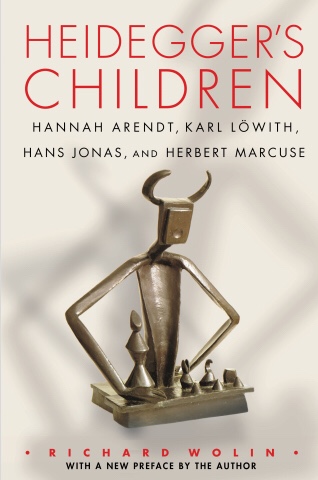
Richard Wolin, “Heidegger’s Children: Hannah Arendt, Karl Löwith, Hans Jonas, Herbert Marcuse” (2001) – There’s no saltiness quite like that of an academic vindicated in a long-held, long-dismissed belief. Intellectual historian Richard Wolin had been beating the drum about the Nazi past of Martin Heidegger, the greatest (in the sense of being a big deal) philosopher of the twentieth century, for years. Heidegger is as big of a deal as he is because his influence goes well beyond philosophy departments into… well, other university departments- literature, architecture, etc. His phenomenological framework is sufficiently powerful, flexible, and more than anything else, glamorously incomprehensible, that he was useful and appealing to a lot of people. They all knew he was a Nazi party member. Most of them probably knew that his excuses for it — he felt pressure, he tried to avoid politicizing the university, etc etc — were specious at best. They must have noticed certain, shall we say, elective affinities between Heidegger’s critique of modernity and some of the “Völkisch” tendencies that went into Nazism. But it was all vague enough to be waved away, at least during Heidegger’s lifetime.

Wolin didn’t buy it in the nineties, when he became embroiled in the Heidegger Controversy (it gets caps- Wolin edited a collection on it) and when he was writing “Heidegger’s Children,” and his exasperation with the defenses of the Black Forest Sage shines through the text. It examines four of Heidegger’s major students – Hannah Arendt and Herbert Marcuse being the best known, though I’d say Löwith is also worth reading – all of whom were Germanized Jews, and their relationships with their teacher. Even his pre-Black Notebook defenders admit Heidegger had an anti-semitic streak (not that it stopped him from sleeping with his grad student Hannah Arendt, which, you know, not exactly what you want in a sage either). But evidently his charisma and philosophical powers were enough that it attracted these students. Wolin argues that the degree and kind of assimilation on the part of middle-class German Jews played a crucial role in allowing these relationships to take place despite the master’s distaste for Jews. I don’t know enough about German culture at the time to say, but it sounds both basically accurate and overstated, perhaps majorly so.

Wolin goes through each one, considers parts of their oeuvure, and in each case condemns the philosopher in question for not separating themselves far enough from Heidegger and his elitist anti-modernism. He attributes the flaws in Arendt’s “Eichmann in Jerusalem” and her bien-pensant liberal elitism to the same flaws that led her to play a weird double game for Heidegger even after their affair. Hans Jonas (whose work I don’t know) seeded the German Green movement with bizarre and unhelpful antimodern sentiments drawn from Heidegger, the master he abandoned decades before. Marcuse managed to escape his gravitational pull more — he had more independence from Heidegger, in large part due to his Marxist commitments – but still meandered through efforts to square the circle of reconciling Heidegerrian phenomenology and Marxism. Löwith… I don’t remember what his issue was and I haven’t got the book in front of me. He did something wrong, and it was the fault of whatever it was drew the guy to Heidegger.

All this, in 2001, before the Black Notebooks came to be published to the extent they have, and Heidegger’s genuine enthusiasm for Nazism became impossible to hide! My edition has an extended preface where Wolin relishes dunking on Heidegger’s assorted defenders. It’s hard not to appreciate his enthusiasm- even if you take something from the philosopher’s work, his academic defenders were a trendy lot (there’s a hipster architecture magazine called “Dwell,” a self-conscious nod to one of Heidegger’s later philosophical hobby-horses), their prevarication was pretty weak, and it’s satisfying to see the historical record get its due. That being said, it leaves a larger question – what do we do with important cultural figures with abhorrent political views? – unanswered.

Several times, Wolin insists on Heidegger’s brilliance and importance, while also condemning his work tout court as fruit of the poison tree of German reaction. We are left with no idea of how to reconcile that. For my money, he’s right- Heidegger is both brilliant and toxic. We make use of many toxic, dangerous substances, and the work and ideas of those who walked on the dark side of modernity – by no means restricted to fascism – should qualify, if radioactive materials do. Heidegger asked a lot of questions in a very provocative way, and helped break up the staid academic philosophy of the early twentieth century (with a lot of help, including from mentors he spited, like Husserl). He isn’t someone you should take moral (or political) advice from, and maybe this is just my materialism talking, but that seems to be the problem more than anything. Both Wolin and the Heideggerians he puts on the dock tried to get usable morals out of a twentieth century philosopher. Classic mistake! ***’

Review- Wolin, “Heidegger’s Children”

Review- Tenold, “Everything You Love Will Burn”

tenold

Vegas Tenold, “Everything You Love Will Burn: Inside the Rebirth of White Nationalism in America” (2018) – My efforts to “keep up” with the literature on the altright has brought me to this effort by a Norwegian journalist. So far, he’s been the one with the most access out of the lot. He started out writing curiosity stories about neonazis and klan groups- kind of like those episodes of Maury every nineties kid will remember, where he’d have on some absurdly kitted-out racists for everyone to gawk and yell at. Later, he began following Matt Heimbach, leader of the “Traditional Workers Party,” around, as he toured the country, got hyped for the Trump election, and right up to Charlottesville.

Like a lot of books on the altright (though Tenold defines his subjects as being adjacent to, not in, the altright- the definitional stuff can be a pain) this has something of a thrown-together quality. In part, this is because the story changed and grew as Tenold was following it- from freak curiosity in 2010 to the white nationalists’ guy in the White House (though not because of them) in 2017. So he can never quite tell if he’s depicting a freak show, like those episodes of Maury, or if he’s doing one of those soft-focus New York Times profiles, or is trying to depict a movement. This results in some jarring tonal shifts, like between following some white trash klansmen straight of central casting, and then trying to take Heimbach seriously as a political actor.

Heimbach provides the closest thing to a connective thread. A tubby middle-class nerd (I know the sort, believe me) who reinvented himself as the white nationalist savior of Appalachia, he is trying some things that are strategically interesting, in his grotesque, hapless way. There’s a certain deeply vulgar Maoism to his strategy- send his cadres out to poor white areas, make the problems of the people’s theirs, gain their trust, and then build a base to eventually mount an insurgency. This probably wouldn’t work in any event and would never work helmed by the sort of guy whose idea of communicating to the people he wants to ally with is haranguing them about Assad and interwar Romanian fascism, but it is one of the classic insurgent strategic models.

We don’t see as much of that in the book, but we do see his other big strategic idea- form a united front on the far right, get all the squabbling tribes in one tent. This provides a frame for the book, as Tenold follows Heimbach around as tries to get various klan, Nazi, and skinhead groups to come together and follow his vision, what would eventually become the Nationalist Front, which is indeed a thing now. In many respects this runs counter to the “organize the people” strategy, as those other groups are even more of a liability than Heimbach’s nerds are in terms of appealing to people. But it does provide a narrative frame for Tenold’s journey around the movement, where he gives little mini-profiles of various neonazi types (who Heimbach sees as out of date), Richard Spencer (who Heimbach sees as a snob and a fake), etc. It’s a decent narrative device.

But in the process, Tenold is coopted somewhat by Heimbach. Heimbach seems more reasonable than the other fascists, less eliminationist in his racism- he sometimes tells the klansmen or whoever that black people, too, deserve an ethnostate, that he’s not a white supremacist merely a white nationalist, yadda yadda. While the inter-right squabbling is interesting to follow — and let’s just say I’m familiar with the dynamic of “these assholes in the other sect are wrong and corny, but fuck it, we need the numbers” — Tenold takes Heimbach’s claims of not being a white supremacist, merely a nationalist, much too much at face value. There’s no such thing as a non-bigoted, non-violent white nationalist: that’s just the shit they say to confuse people. They know forming ethnostates would be massively violent, and that’s why they like it. Tenold acknowledges Heimbach is a racist and, basically, bad — if nothing else, he is openly, unabashedly antisemitic — but some journalistic (or liberal, or perhaps Scandinavian) scruple prevents him from connecting the dots a bit more between the image his subject presents, his political project, and the larger context. It’s not quite NYT profile bad — at least Tenold is willing to laugh at his subjects some — but it’s in the ballpark. ***

Review- Tenold, “Everything You Love Will Burn”

Review- Sandifer, “Neoreaction a Basilisk”

sandifer

Philip Sandifer, “Neoreaction a Basilisk: Essays On and Around the Alt-Right” (2017) – It says something about the state of play that the best book-length treatment of the altright qua altright that I have yet found was published online and written by a man best known for blogging endlessly about the television shows “Dr. Who” and “Hannibal.” But here we are!

Sandifer, a prolific blogger who operates in the space between nerd culture, Marxism, critical theory, and the occult, dives deep and wanders far. The bulk of the book is his grapple with the “neoreactionaries” or “dark enlightenment.” People on this end of the altright are blog-bound and unlikely to wind up in the streets wearing a softball helmet, but also the closest you get to an intellectual vanguard for the altright as a whole. He focuses on three figures: software engineer-cum-white nationalist monarchist Curtis “Moldbug” Yarvin, former leftish critical theorist and current whacked-out prophet of fascist techno-apocalypse Nick Land, and a third figure who arguably doesn’t belong- AI blogger Eliezer Yudkowsky, who isn’t an open bigot or fascist but who does share certain elements of the neoreactionary imagination. Namely, all three produce works that could be understood as horror texts, both in terms of the feelings that produced them and the feelings they induce in others (including believers). Sandifer closely reads all three with a profoundly skeptical eye but a participatory spirit. Beyond the horror-show posturing, Sandifer tries to bring out the real weirdness, the Deleuzean “monster offspring” that lingers behind the (anti-)heroic fantasies and feverish system-building, and finds…

Honestly, I’m not 100% sure. He does something like a thirty page disquistion on Blake’s visionary poems (and before then loops in a number of other theorists, such as Frantz Fanon, Thomas Ligotti, and the aforementioned Gilles Deleuze) and god help me I lost track of what he was saying, and even looking at it again, still can’t tell. Sandifer clearly comes from the same whacked-out online horror/theory/geek-culture place that Land and to a lesser extent the others come from. “Send a maniac to catch a maniac,” as it’s said in scifi classic probably a little too basic for our boy. I’m fine with maniacs — some of my best friends, etc. — but it could use some editing, is all I’m saying.

As best I can make out, his conclusion is something like the following. If there’s one thing that freaks all three of his subjects out (with the possible exception of Land, the smartest of the lot, who might just be doing an elaborate bit) it’s the fear of infection by the Other and the collapse of established categories. They want the future but they don’t want it to be weird, or rather they want it weird in a way they can control. They’re not going to get their wish, Sandifer tells us. The general fucked-ness of the future means that they can’t control it any more than the rest of us can, and their brittleness won’t be an asset- isn’t, now. Whereas understandings based on radical empathy have proven to be considerably more resilient… though it might still not be enough.

Fair enough, but the whole thing could be clearer. As I hope the preceding indicated, it’s less that Sandifer winds up going down rabbit holes so much as the whole book is rabbit holes, and I get the idea Sandifer wouldn’t want it any other way. That’s fine; admirable in certain respects, even. You learn a lot, about the specific altright people he deals with (he does a similar, if much shorter, type of existential alley-oop with gamergaters, Austrian economics, TERFs, etc) and about all kinds of random stuff. He’s discursive, chatty even. It’s fun and reasonably quotable but not necessarily the most usable text in the world. And it’s notable that beyond a chapter on Trump, he sticks to the most Extremely Online portions of the altright spectrum. These are interesting to me but I find things get clearer and more grounded (and more interesting, for my money) when you bring things offline a little. But I don’t think Sandifer wants clear and grounded. This can be frustrating.

Still- at least here we have a work that takes the altright seriously as a subject of analysis. Much of the rest of the long-form writing on the subject essentially uses it as an occasion or frame for inter-left axe-grinding, or as an example or test-case for some other set of ideas. This proceeds in a spirit — a surfeit, if anything — of intellectual daring and passionate engagement. We need that, as well as rigor and a useful political analysis, to meet our weird, probably bad, future. ***’

Review- Sandifer, “Neoreaction a Basilisk”