Review- Okorafor, “Who Fears Death”

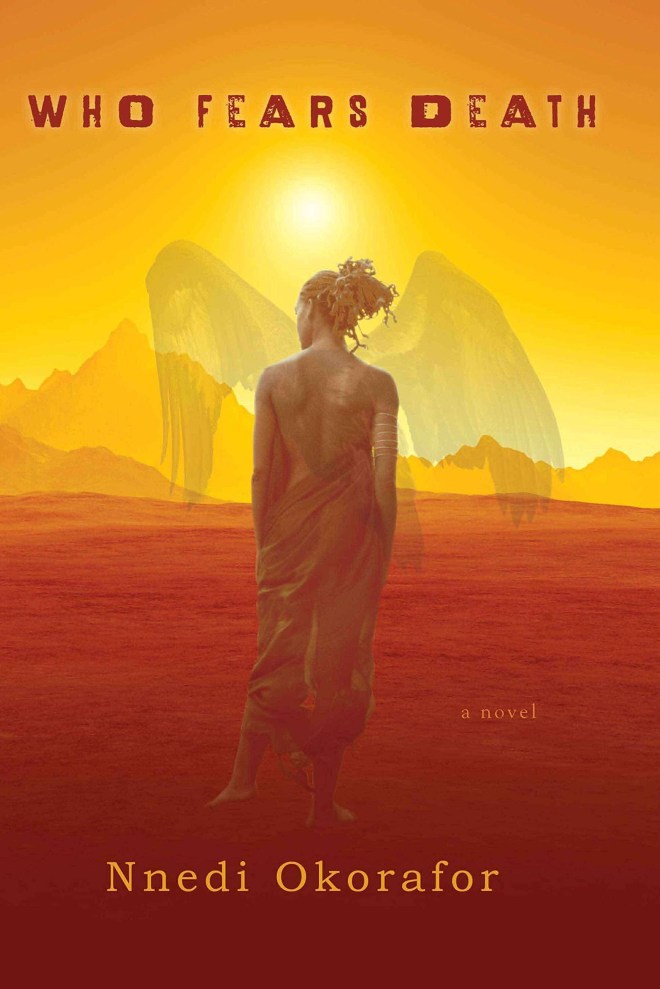
Nnedi Okorafor, “Who Fears Death” (2010) – Here we have a fantasy/scifi novel that draws from both Africa’s traditional storytelling and its contemporary issues and crises. The main character, Onyesonwu, is the product of rape as a weapon of war, in an ongoing conflict between the dominant Nuru tribe and the insurgent Okeke. Raised by her mother in an Okeke village, Onyesonwu is an outcast but develops magical powers- first shapeshifting into various animals, then numerous others.

The first third of the book is the best part, as she develops her powers, induces the local magicians to teach her against their resistance, and learns her destiny- to go among the oppressed Okeke far from home and bring an end to the fighting, as well as confronting the evil Nuru wizard who is helping spur the conflict.

The rest of the book drags, unfortunately. Okorafor is also a successful young adult fiction writer and it shows as she takes her characters out to the desert and has them get into teenage dramatics with each other. We go from learning the ins and outs of magic and ethnic conflict to protracted drama between Onyesonwu’s interchangeable friends with the suddenness that the end of “Huck Finn” becomes a hundred pages of minstrel routine. Quest narratives always have some back and forth within the group, but “Who Fears Death” loses a ton of momentum and never quite regains it. The ending has a pretty cool magical catastrophe in it but by then you can’t help but wonder at the book that could have been with this premise. ***’

Review- Okorafor, “Who Fears Death”

Review- Zebrowski, “The Omega Point”

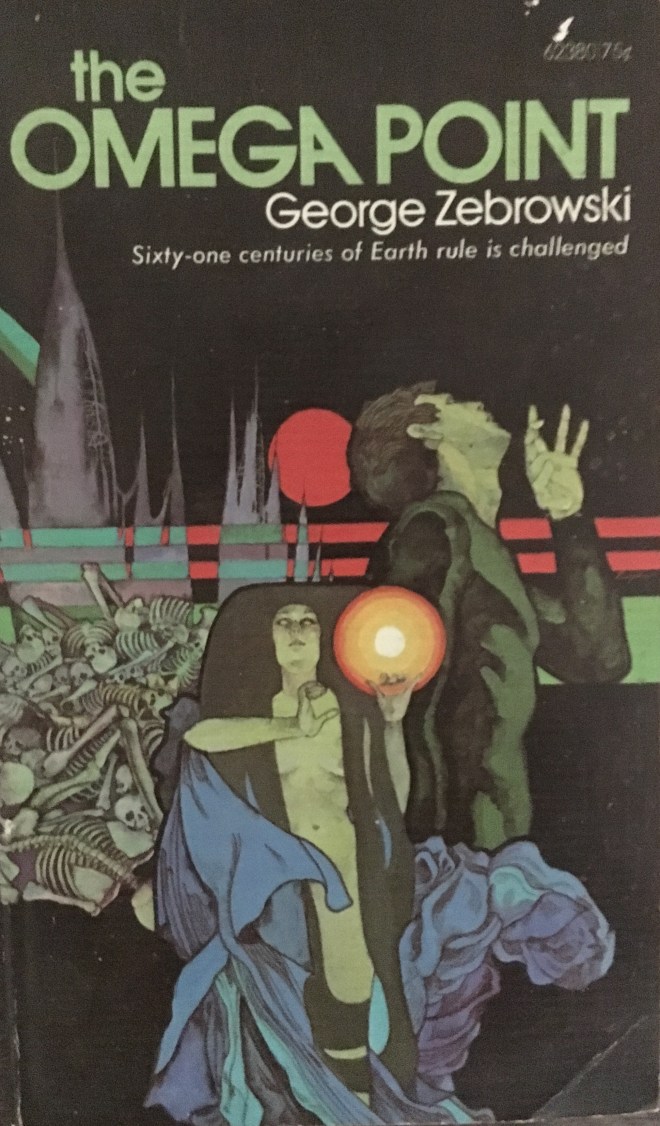
George Zebrowski, “The Omega Point” (1972) – This is a quick scifi read about Gorgias, close-to-the-last of his race of human-descended inhabitants of the Herculean cluster, who fought humanity and lost big time. The Herculeans are drawn roughly like standard fantasy elves- smaller, more elegant, more sophisticated than humans, but frailer and fewer. Gorgias has the best spaceship around and uses it to zoom around and do terrorist strikes- taking out a composer who wrote a suite about the Earth-Herculean war, zapping warp drive beacons, and so on. He’s being hunted by Kurbi, a sensitive earthling who wants to take his man alive, so as to reproduce the Herculeans. This is both as reparations for Earth genociding them and due to some theory that humans need a rival or other in order to grow, etc. Ultimately, this sort of philosophizing takes over the book. After Gorgias does his last stand, he’s absorbed into the collective unconscious or noosphere or whatever you want to call it, which is very seventies-trippy and, naturally, stored in the mind of an attractive alien lady. It feels both like Zebrowski, an old scifi (and Star Trek!) hand, both ran out of ideas and followed his vision i.e. whatever he was reading about at the time. For better and for worse, the sort of book published used to insert cigarette ads into, like my copy. ***’

Review- Zebrowski, “The Omega Point”

Review- Farmer, “To Your Scattered Bodies Go”

Philip José Farmer, “To Your Scattered Bodies Go” (1971) – My first go at one of the grand masters of scifi and the beginning of the “Riverworld” series. It was… fine. Certainly the concept is arresting. Someone took the whole population of humanity and reincarnated them into new, young, naked bodies along the course of an endless river. Everyone who ever lived is there, scattered in quasi-random linguistic/temporal groupings. They get food (and booze, and weed) from magic lunchpails someone issued them, and other than bamboo and stone, there’s not much to make stuff with.

I emphasize that last bit because Farmer emphasizes it, a lot. Way more of this book than I would have figured is about the quotidian act of survival in this comparatively-easy-to-survive world. You’d figure given the sheer scope of the setup, Farmer would have jumped to the implications of their situation a little more quickly… but instead we get a lot of speculation about how much you can do with bamboo, rocks, and fish (and human!) parts.

Either way, we get our narrative viewpoint from the newly-reincarnated Richard Francis Burton, the Victorian traveler, linguist (he could supposedly speak twenty or thirty languages or something like that) and writer with many a legendary exploit under his name. Naturally, he takes charge of the surviving-and-organizing business of his little band, that includes the grown-up inspiration for Lewis Carroll’s Alice (for whom Burton obviously gets horny), a Holocaust survivor, an alien, a caveman, some Italians, a know-it-all who provides periodic infodumps on Burton or assorted others, etc.

Burton had had a vision where he met with the organizers of the Riverworld, and is determined to find them again. He and his band make a raft and head upriver. Because this is midcentury scifi, naturally everyone has set to warring with one another, even though (because?) their material needs are basically met. One set of slaver warlords led by Hermann Goering capture Burton and his band. They escape, but it sets up a dynamic wherein Burton and Goering get killed and reincarnated time and again, generally in close proximity to each other. Burton is doing it because he thinks being randomly distributed somewhere on the river is a more efficient means of travel than trying to sail through the rival factions, so he kills himself over and over again, getting newly reincarnated each time. Goering does it because he’s addicted to both heroin and a special “dreamgum” issued in their rations and tries killing himself when he can’t kick successfully, even when he’s otherwise turned a new leaf.

Once it gets going the action is commendably out there, though with enough of that midcentury scifi flavor — the omni-competent ubermensch protagonist, the women and their hangups (Farmer was something of a pioneer in bringing explicit sex into science fiction), the faceless hordes fighting for no reason, etc. — to dampen the originality some. In all, good enough to have a look at the sequels. ***’

Review- Farmer, “To Your Scattered Bodies Go”

Review- Brin, “Startide Rising”

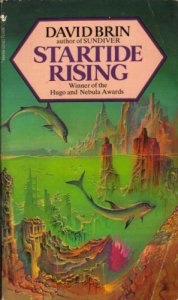
David Brin, “Startide Rising” (1983) – This was some pretty fun scifi about a sticky situation in which some slick critters find themselves. The first starship commanded by dolphins — well, genetically enhanced neo-dolphins, anyway — stumbles upon some ancient artifacts for which numerous powerful galactic civilizations will gladly kill. They hide out on a water planet and try to figure shit out while the various intergalactic factions — spider people, lizard people, bug people, etc — kill each other in orbit over the planet.

In this particular universe, humans play the role they often do of cocky new kids on the galactic block. Every other spacefaring civilization, it seems, were “uplifted” into tool use and other advances by a patron species, going all the way back to the Progenitors billions of years ago. The humans can’t trace back a patron, which makes them out of place in a universe defined by lineages and attachment to ancient knowledge. That doesn’t stop plucky humanity from uplifting chimpanzees and dolphins, though, and all three species are present in the ship. Can humanity and our mammal bros make it in a cold, hierarchical universe? Brin’s philosophical about it but not too much. In the classic scifi fashion, pluck and ingenuity find a way.

This is an enjoyably overstuffed scifi read, with a half dozen primary viewpoint characters, numerous places where they’re all at that get hard to keep track of, plots and subplots, efforts at fleshing out dolphin culture (kind of hippie-ish but very eager), so on and so forth. The final plan to get out of the trap the aliens have them in is pretty cool, and fails (and is fixed) in some fun ways. All in all, good clean scifi fun. ****’

Review- Brin, “Startide Rising”

Review- Mankell, “Faceless Killers”

Henning Mankell, “Faceless Killers” (1991) (translated from the Swedish by Steven Murray) – Well, SPOILER ALERT, the killers are indeed faceless. Ciphers, flotsam from the fall of the Iron Curtain washed up on Sweden’s all-too-welcoming shores. I understand Mankell was a leftie — was on the Gaza flotilla that got shot up by the IDF, for instance — but this book seems pretty critical of Sweden’s lax border policies. Maybe that’s just an indication of how well Mankell gets into the mindspace of his cop protagonist, Kurt Wallander, in this first of several Wallander mysteries.

But there’s an extent to which everyone is faceless, here. Life in Sweden as depicted in this book (and, to my understanding, the burgeoning Scandinavian crime fiction scene) as social democratic purgatory, but without the dynamic element purgatory usually has. Everyone is bored and boring and kind of sad. The only thing that distinguishes Wallander is that he likes opera- that’s his only character trait that distinguishes him from the “lonely divorced murder police” archetype (and come to think of it, I don’t think he’s the only one of those with a yen for classical music). Only cruel death and the threat of sectional (immigrant vs native) violence seems to wake anyone up from their daily rounds of unsatisfying, unpunished vices (gambling, philandering) and jobs.

In keeping with the overall tone, this book is deeply procedural except in a few flashes of action. There’s a good half-dozen cops involved in the investigation but they’re pretty much all indistinguishable except for Rydberg (who’s old) and Wallander (who’s the protagonist). That seems accurate and as someone who likes overstuffed fictional universes I relate to the impulse, but if I was supposed to think of them as anything other than Scandinavian names, I failed that test.

Maybe it’s just politics but I was more interested in the B case: an immigrant ambushed and killed in revenge for the A case, a brutal murder of an old farm couple where signs point to foreign killers. I don’t think it’s politics, though- I think the B case was better structured. The A case only comes together due to nearly-blind chance near the end of the book, almost a deus ex machina. There’s much more satisfying detecting in the B case. In all, this was a fast read, good not great, but I hear the Wallander mysteries get better as they go on. I’ll pick up the next one if I see it on a free shelf, like this one. ***

Review- Mankell, “Faceless Killers”

Review- Butler, “Xenogenesis”

Octavia Butler, “Xenogenesis” trilogy (1987-1989) – The premise of these books is a funny one — people have to have brain-sex with alien tentacle monsters to repopulate the earth after a nuclear war — but is played completely straight, with stakes of species-level life, death, and love. The novels “Dawn,” “Adulthood Rites,” and “Imago” explore a wholly alien society, it’s mixture with humanity, and questions of what life, humanity, and family are. Heavy stuff!

First, the aliens, known as the Oankali. They’re basically gene-stealing aliens but (notionally) benevolent. They go from world to world swapping genes with the species they find, modifying both themselves and the others to adapt to whatever circumstances they find. They do this with humanity after the species is almost destroyed in a nuclear war. Humanity’s choice is either accept the Oankali trade or die as a species.

The whole Oankali frame of reference, from its concept of time to the basic value it places on life qua life, is different from humanity. They think in centuries, are obsessed with genes (which they can read like text), and have three sexes- male, female, and ooloi. The ooloi sort of get between the other two, stick them with pleasure-inducing tentacles, and then mix up the baby’s genes before implanting it in the female.

The aliens fix earth and put people back onto it, but at a price. People can now only breed if they do it the Oankali way, complete with ooloi help. As it turns out, ooloi sex is deeply fulfilling, but it also seems wrong and vaguely gay to most humans, so they refuse to go along with it, instead running off to the woods to lead unhappy, sterile lives. Those who stay with the Oankali settlements live complicated but fruitful and long (the Oankali can easily fix most human diseases) lives.

I get that this is meant to be a tale of adaptation. The first novel in the trilogy, “Dawn,” is told from the perspective of Lilith, the first human to agree to be part of the Oankali program. She’s deeply conflicted about the whole thing, but agrees with the Oankali that the continuation of life — and the adaptations that entail — are more important than species pride. The next, “Adulthood Rites,” is told from the perspective of one of her “construct” — part human, but remixed by an ooloi — children, and the third, “Imago,” from another of her kids, the first ooloi born of a human woman. This is about new forms of life, life dedicated to the perpetuation and adaptation not just of themselves but of life in general. There’s a reason these books are a touchstone of the queer (and generally more diverse) turn in scifi.

I don’t see the Oankali as all that benevolent; moreover, I’m not convinced Butler did, either. Part of this, I admit, resulted from confusion on my part. I thought the sterility of non-Oankali-aligned humans at the end of “Dawn” was a side effect of the war or something. But then I realized midway through “Adulthood Rites” that it wasn’t- that the Oankali sterilized the other humans. That’s kind of fucked up! Akin, Lilith’s child, convinces the Oankali to let non-sterilized humans settle Mars, but still.

The excuse is our self-destructiveness. We have the capital-c Contradiction of intelligence and hierarchical behavior that, the Oankali insist, will doom is every time until they breed it out of us. But the Oankali clearly have a hierarchy too, which begins with Oankali>Human! Sure, they say they love us — they think we’re spicy and dangerous, genetically interesting — but the British said the same stuff about the people of India. Moreover, internally, the Oankali hierarchy is much flatter and fairer than most of ours, but it exists- older and more talented people have more power. Someone gets chosen for important tasks. That’s hierarchy. It’s inescapable- just like the other two principles of organization, exchange and communalism, are inescapable. Everything has a little of all three, admit it or not.

Lilith, to her and Butler’s credit, admits it, admits the Oankali used her without her consent, even as she falls genuinely in love with an ooloi and adapts to her hybrid society. She’s deeply ambivalent. I think this is a story at least as much about race, integration, and imperialism as it is about gender. Octavia Butler was the only prominent black woman scifi writer in her time. She was widely feted, but she tackled the contradictions and confusion of pluralism in her own life.

And she never came up with easy answers, which is possibly her greatest strength as a writer. The Oankali are right- people are self-destructive. Just look at us! Though it’s worth nothing the Oankali endgame for Earth is the kind of thing that Elon Musk would come up with, and for which we’d all mock him. The narrow-minded prejudice that drives much of human resistance to the Oankali is wrong, but from many of the resisters, it’s about living according to their own choices, not just space-racism. It’s complicated- much like the Oankali-Human reproduction system, which involves five beings and could probably use a diagram. And like it, it holds out the promise of radically new forms of life, endless possibilities.

I don’t think the reading that identifies uncomplicatedly with the Oankali is wrong. I think Butler’s strength is that, aside from the wantonly destructive, she allows us to identify with multiple radically different perspectives. To me, there are no good choices in this series — I’m not crazy about bending the knee to those who pretend to know what’s good for me, no matter where they’re from or what they look like — but there’s an array of stunningly-imagined possibilities. ****’

Review- Butler, “Xenogenesis”

Review- Jama-Everett, “The Entropy of Bones”

Ayize Jama-Everett, “The Entropy of Bones” (2015) – I’ve seen kung fu movies, but I’d never read a kung fu novel before this one. It’s the story of Chabi, a teenage girl growing up on a houseboat in the Bay Area who, after some training from an eccentric old Indian guy, is capable of running fifty miles in a couple of hours every day and breaking every bone in someone’s body in a matter of seconds. The latter feat is accomplished not by strength tuning in to the titular entropy already extant in the bones themselves. All of this is imparted like it’s obvious common sense, which makes it more fun.

Obviously there’s something special about Chabi in terms of her physical capabilities. She’s also mute, but can speak psychically. This didn’t make much sense to me as a character feature until a minor reveal at the end. The book in general has a kind of loose, almost conversational rhythm, like Jama-Everett is telling you these stories over beers. Loose, but well-structured (like a barroom story one has told many times)- the details of Chabi’s powers, and the world she’s a part of, come out naturally. The world of the story is similarly tossed-together in the best way: entropy beings versus “liminals,” super-powered people like Chabi, and a few demigods and time travel thrown in.

Chabi winds up working for some suspiciously pretty hotel magnates once Narayana, her sensei, disappears on her. She knows there’s something wrong with them but can’t work out what. When a friendly demigod of the wind comes from the future and hips her to the whole entropy-being thing, she puts two and two together and realizes maybe Narayana wasn’t on the side of the continued existence after all, which is a bummer. She gets it together enough to fight a bunch of other superpowered fighters in a big final tournament the baddies put on, but of course she can’t fix the whole thing or there wouldn’t be a future conflict for the wind guy to come back from, would there? No, the forces of rhythm and weed (this guy likes weed) will have to continue to battle the forces of entropy. In all, this book was pretty fun and I’m going to look up some of the rest of his work. ****’

Review- Jama-Everett, “The Entropy of Bones”

Review- Robinson, “The Years of Rice and Salt”

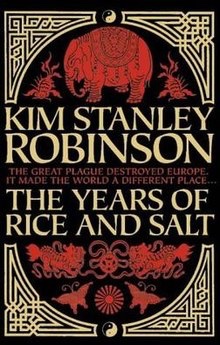
Kim Stanley Robinson, “The Years of Rice and Salt” (2002) – Kim Stanley Robinson joins the exalted company of Faulkner, Proust, and Garcia-Marquez in the category of writers that I respect but do not particularly like reading. He might be the only scifi writer in that category. He seems like a mensch. His ideas are interesting. It’s good someone is tackling big, hard scifi, be it about Mars colonization, interstellar travel, climate change, or in this instance, what modernity would look like not dominated by Europe. I respect the amount of research and work he puts into things. But his books run long and schematic. In “Years of Rice and Salt,” it was pretty easy to see what each part would be coming in in this history after the Black Death takes out almost all Europeans instead of a third of them. Samarkand alchemists, must be here’s the scientific revolution, here’s the world war equivalent, etc. etc.

Like most alternate histories it’s way too neat and schematic. This is probably an advantage over sloppy and dull (ala Harry Turtledove) but it usually doesn’t grab me. The players in the history are different — Chinese, Indians, Arabs, and Native Americans — which is a fine change, but the roles are mostly recycled. That might be part of Robinson’s whole Buddhist take- the idea is the characters are reincarnations of the characters in the first set, throughout history. None of it is bad and clearly a lot of it is well-meaning, depicting Muslims and assorted other “Others” of modernity as just as capable of enlightenment and modernity as anyone else. But it could have done more to show how modernity would have been different, beyond lines and names on the map and the demographics of who’s involved. Presumably those changes would have changed what modernity itself was all about. I give it credit for what I’m probably missing, because KSR seems like a good dude, and it’s good to have alternate history not about how cool the Nazis and/or Confederates were. ***

Review- Robinson, “The Years of Rice and Salt”

Review- Cook, “Crisis Boy”

Garrett Cook, “Crisis Boy” (2018) – After several novels — most prominently “Murderland,” “A God of Hungry Walls,” and the bravura “Time Pimp” — Garrett Cook (interest declared- a friend of mine and I once rescued him from Punxsutawney Pennsylvania, true story) has established a distinctive horror voice. This comes through most clearly in his latest, a story about a boy who can survive gunshots and explosions, who is deployed to the sites of terrorist attacked and mass shootings to be killed, over and over again. He’s a crisis actor, except he actually gets hurt, and the events he undermines actually happen.

Cook comes to us from the “bizarro” horror scene, a sort of dada/pop-surrealist offshoot of extreme horror. Truth be told, I don’t get much out of the genre- a lot of strikes me as try-hard edginess. I’m hardly the target audience- I always cocked a snoot at horror in general. I was reading about the Holocaust at six and spent years of my life with Vietnam war documents. I play board games about bloody counterinsurgency wars for fun. Serial killers don’t mean that much to me.

So needless to say I was square enough going in that, friendship with Garrett aside, I was unsure about the premise. “Why,”said the reviewer, like a square, “would they need crisis actors if the massacres happen, in gruesome detail?” Well, because fuck you, that’s why, Cook tells us. Because the world is run by monsters of every conceivable type and they just want to fuck with people, get people online convinced that what they see isn’t real, and squabble over which parts are or aren’t.

John the Crisis Boy decides to try to turn the tables because he meets a pretty girl. Of course, it gets all messed up, and even though he kills the monster — a slasher villain turned patriotic superhero, a nice touch — he winds up demonized as the sort of killer who has killed him numerous times, and in a crumbling reality to boot. It’s hard to tell what exactly goes on in this crumbling reality and whether his existence is real or a projection of the sort of damaged psyche his existence is meant to inflame. That’s something of a problem with this sort of fiction- endings. Especially if you’re not going to go with a nihilistic copout, which Cook generally refuses to do.

All of this — the crumbling reality, John’s teenaged angst, and the scenes of gore and extreme depravity — are carried along by Cook’s voice, which makes everyone a knowing but predetermined actor in the grand guignol of life in a Garrett Cook story. The narrator and most of the characters accept the absurd dream logic of their given scenarios and speak them aloud. This helps avoid letting things get too cute or too melodramatic, a difficult balancing act. Whatever you want to say about this sort of horror as a whole, Garrett’s provocations are part of something larger he’s doing, and the last thing he ever was was a try-hard. ****

Review- Cook, “Crisis Boy”

Review- Bacigalupi, “The Water Knife”

Paolo Bacigalupi, “The Water Knife” (2015) – On the surface, this book is very much “my shit.” Set in a near-future where the Colorado River has largely dried up and the Southwest states fight underground wars to keep the water coming in and refugees out, it’s the sort of crime-scifi mix that I tend to enjoy.

It turned out pretty good. The titular “water knife” is Angel, a former gangster and now enforcer for Las Vegas’s water rights. Vegas is the second banana in all things western water-related, able to maintain its casino-arcologies but always in the shadow of the big daddy, California (the tune “California Uber Alles” came to mind several times while reading this). The big losers have been Texas, hit by both drought and hurricanes and the source of most of the refugees trying to cross over into California and Nevada, and Arizona, where Phoenix is in the process of dying a slow death. This book was first recommended to me by a friend on a post I made about how seeing Phoenix out of an airplane window freaked me out- all that perfectly geometrical green sprawl against that stark desert… this depicts that society in collapse once both nature and politics started restricting the water. Refugees, gangs, dust storms, bags for converting piss into drinking water, all in the shadow of arcology towers built by the Chinese.

But some Las Vegas agents are getting bumped off in Phoenix, in increasingly grotesque ways, and Angel has to go and find out why. Of course, he can’t trust anybody, and there’s a lot of running away from shadowy “Calies” and fights and the like. He gets embroiled with a reporter looking into the murders (they hook up, natch) and a Texan refugee looking for her ticket out, who gives us a grounds-eye view of refugee life. It turns out the whole thing revolves around “senior” water rights- water rights granted so far back that they would allow the holder (originally Arizona) priority over all the water in the basin. It’s worth billions of dollars, and of course, a good many betrayals and torture-murders.

The plot was basically fine from a crime fiction angle, not the best but good. There are some parts of it that make little sense. This novel depicts the states getting into all but open war with each other over water rights. California and Nevada National Guards routinely invade and blow up waterworks taking “their” water, including a bravura scene at the beginning where Angel leads a helicopter raid. The Constitution has been changed such that states can enforce state borders, generally with violence. Why would they care about a deal Arizona made with the Pima Indians that long ago if force seems to be what decides things? Why care about the letter of the law? I guess you need a McGuffin and this is a reasonably fun one.

The other thing is this… it’s hard to believe that US state origin would suddenly matter more than race. I know, I know, the Dust Bowl and the anti-Okie stuff, but still. I’d have difficulty believing this stuff wouldn’t be racialized, with Latino and black refugees treated the way they are in this book, and white refugees not nearly as bad. White people across the southwest seem to relate to each other more than people of color from their own state. It think that would structure how they deal with these crises. There’s a lot of people of color in the story, but beyond some cultural stuff it doesn’t seem to make much of a difference, certainly much less than which state you come from. This rings untrue. That’d be less of a problem in a gauzier scifi novel, but the tone of this novel is so gritty and “real” that kind of thing sort of hurts the realism. All in all though, a decent read. ****

Review- Bacigalupi, “The Water Knife”