Review- Vance, “The Book of Dreams”

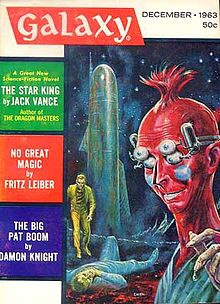
Jack Vance, “The Book of Dreams” (1981) – Jack Vance’s Demon Princes saga ends with the taking down of the last and probably most interesting of the five space pirates who destroyed Kirth Gessen’s home village way back when. Howard Alan Treesong, like Viole Falushe, one of the previous baddies, just can’t get over high school. Born on a planetary backwater that sounds a lot like the upper Midwest or some descriptions I’ve heard of rural New Zealand, an imaginative and willful boy, he gets the works from the locals and dedicates his life to revenge. He gets far enough to become a sort of “Mr. Big” of galactic crime and nearly becomes something like space-Jesuit-General. But of course, he’s no match for Kirth Gessen’s focus and grit (and unlimited money he secured whilst taking out a previous Demon Prince).

Hero and villain both live for revenge. Kirth lives to avenge his family and home; Treesong lives to get his vengeance on his high school class and to make the universe as much like his adolescent fantasies (in the titular book, which Kirth eventually finds and uses as bait). The latter option seems to lead to a somewhat more colorful, if nefarious, existence for Treesong (and his fellow space pirates), but the latter provides the drive necessary to go through all the hoops to eliminate the former. In this installment, they range from a fake magazine contest to identify the one known picture of Treesong to the shenanigans with the lost diary to Kirth having to pretend to be a flautist to infiltrate the band at the high school reunion Treesong interrupts with dire theatrical revenge. Sometimes, the difference between hero and villain is how they go through the rigamarole.

The Demon Princes books are pretty cool. Vance clearly made more world than he could really fit in to these fairly conventional detective stories, as evidenced by the long epigraphs to his chapters full of lore from his universe. You mostly get the worlds through the odd planets Kirth visits, which showcase Vance’s fascination with the plasticity of people and societies, where oddballs in backwaters keep getting odder due to their cultural — and their planet’s ecological — logic. I ultimately prefer the Cugel and Anome books, but these are also cool. ****’
Review- Vance, “The Book of Dreams”

Review – Whitbourn, “To Build Jerusalem”

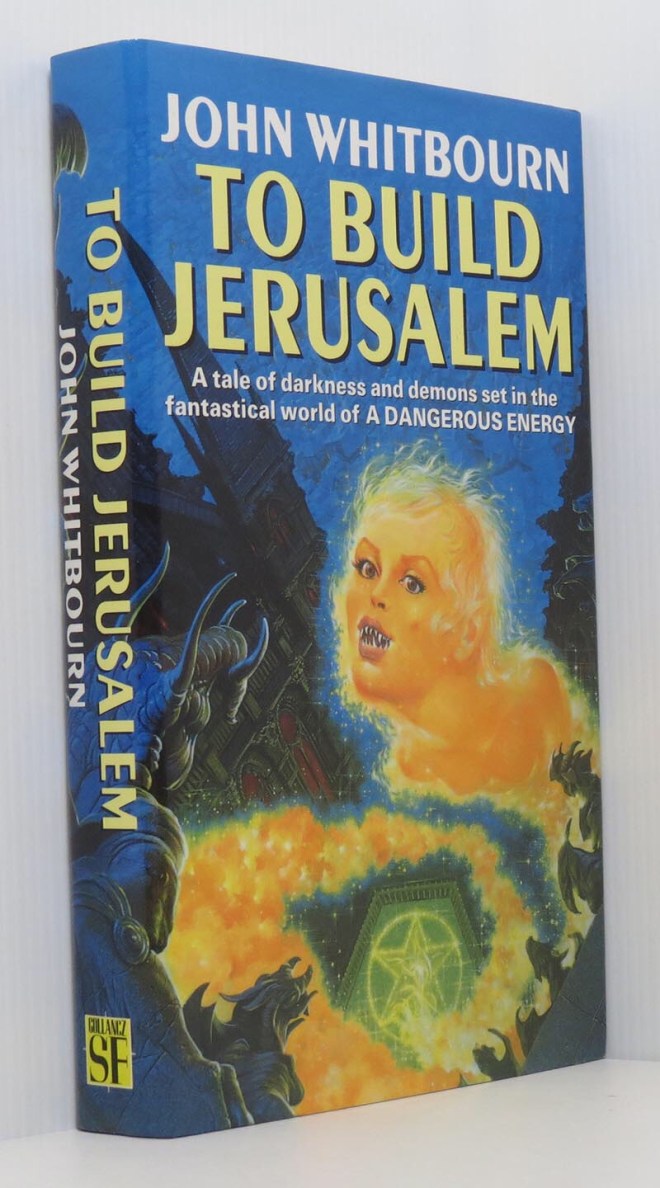
John Whitbourn, “To Build Jerusalem” (1995) – An alternative title for this one could be “Fear of a Protestant Planet.” English fantasy writer Whitbourn once described himself as a “Green Counter-Reformation Anarcho-Jacobite” (you can see why I made a point of tracking his books down). This was back in the eighties or nineties, before we would automatically assume such a person is just trying to find a way to avoid self-describing as fascist. Whitbourn’s ideas frame the worlds he writes, and they’re animated by a pulpy horror/fantasy sensibility with substantial Lovecraftian overtones.

This one in particular takes place in a world where the Reformation failed, the Catholic Church runs things in a manner reminiscent of the Emperor in Dune, and magic exists, mostly wielded by priests. Like I said when I reviewed the first book set in this world, “A Dangerous Energy,” if Whitbourn is trying to convince people that the world would be better without the Reformation, he’s found a funny way of doing it. The world is dark, cramped, and run by tyrants. It’s the late twentieth century and much of the world is unmapped and they’re just figuring out trains. To the extent Whitbourn can be said to pitch it as a “good” world, you could argue it’s more orderly- people know their place in the world and stick to it. Not my thing, but ok.

But Whitbourn is pleasingly non-didactic, and the actual point of the world seems to be that it’s a good jumping off point for horror and adventure. The main character is an enforcer for the Church, a sort of Catholic janissary named Adam. He’s sent to England because there’s a disturbance in the force- some kind of entity in the sphere of magic that is making the spells not work good. Wizards often summon demons, but it turns out, the demons they summon are small-fry compared to a big (and very horny) demon from a realm of evil beyond even the evil-realm the wizards can access. The many layers of unknowable and unholy power that exist beyond our ken are reinforcement for the idea that we need a stable order watched over by a perennial source of spiritual power…

Spoiler alert- the demon lord (never named) manifested itself to the Gideonites, the underground remnants of Protestantism in England. They bargained with it to kidnap the King and the papal legate and do a bunch of other mayhem. Whitbourn depicts the Gideonites as similar to (a conservative picture of) militant leftist movements in our timeline (including references to “democratic centralism” lol). Their overweening pride and desperation over being owned by the Church and its armies all the time leads them to believe they can use this demon-lord to bring about the End Times and hit the reset button on the whole thing. Not only that- but they’re getting into enclosure! The venal lords of England, never really faithful enough, start doing capitalism against the wishes of the church, kicking good pious peasants off the land and raising sheep for money. Both the demon’s antics and enclosure are treated as equally heinous, offenses against the sacred order of things.

The book’s a lot of fun. Naturally, our Leninist-Puritans can’t control the demon-lord, who does all kinds of nasty things. Adam develops a fun Holmes-Watson thing with a provincial English yeoman-soldier. Whitbourn throws in a lot of fun details and a real sense of place, namely Surrey and Sussex- apparently he has whole collections of macabre tales about them. The ending was kind of a cop-out. There’s some fun battles in the demon-lord’s own dimension, but they end with a literal deus ex machina (or deus ex coelum). It’s consistent with Whitbourn’s beliefs and with his vision of our world at the mercy of extra-dimensional powers above and below… but it kind of took the wind out of the book’s sails. Still, definitely worth checking out. Also, someone claiming to be Whitbourn commented on my review of his earlier volume. If you’re reading this, Mr. Whitbourn, thanks for getting in touch, and I hope your straits aren’t actually dire! I did go out and buy this book, and encourage others to do so if they like quality weird history/fantasy/horror fiction. Maybe we can do an interview? Let me know! ****’

Review – Whitbourn, “To Build Jerusalem”

Review – Chu, “Time Salvager”

Wesley Chu, “Time Salvager” (2015) – This was fun. It’s set in the 2500s after humanity has fled a toxic Earth into a precarious existence on space stations and in outer moons like Europa. A profoundly unequal, megacorp-dominated society fighting a losing battle against economic and social decay, they use time travel technology developed in earlier, better days to essentially loot the past for raw materials and the types of goods they can’t manufacture anymore.

Of course, like any time travel story, there’s a bunch of more or less arbitrary rules, both to time travel itself and the way the time-looting agency, ChronoCom, uses it. In order to protect the integrity of the time stream, you can’t give the secret away, or cause major ripple effects. In the book, this means they wind up looting a lot from people who are about to die imminently, particularly at the sites of battles or disasters. Looting engines from spaceships about to blow, for instance, or art (of course, the megacorps commission custom jobs) from a cathedral about to be shelled. You also can’t bring people back, but that turns out to be more of a political rule. There’s a bunch of other rules that basically are there for story purposes- as Time Pimp informs us, “Nobody knows or cares how time travel works.”

Of course, somebody has to break the rules, and of course, that somebody is a grizzled veteran of ChronoCom who’s seen many a disaster, on top of an already rough life. The main character, James, is your basic gunslinger character put into this time-travel story. Everything changes when he meets the love interest, a scientist named Elise who works on a doomed experimental ocean station in the late 21st century. She’s nice to him, so when the station is destroyed, after looting the stuff he was sent for, James saves Elise. This is a big no-no, so they become fugitives among the tribes of the toxic Earth, with both a megacorp and James’s chronoman buddies after them. Despite being stranded amongst the primitive scavenger tribes of post-apocalyptic Boston, on an Earth where every ecological disaster was turned up to 11 over a few centuries, Elise discovers a potential way to save the Earth. Naturally, it ties in with what she was doing before she got time-napped, which of course ties in to various dark secrets of time travel, etc. etc.

This isn’t Philip K. Dick or Octavia Butler here. Hell, it’s hardly Shakespeare, even. The characters are pretty basic- James the hard-drinking vet who’s seen some shit, Elise the optimistic scientist who’s tougher than she looks, Levin the by-the-book enforcer whose honor compels him to hard choices, etc. etc. The prose doesn’t sparkle, especially the dialogue. But it’s fast and fun. I also think the various futures we see (Chu makes the interesting, and I think smart, choice to have the characters go back more often to the future history — the period between now and the time the main action is set — rather than doing our past) are assembled out of found parts, but well-assembled without too much exposition. The action is fun- close escapes, fights with assorted future technology, etc. It’s a good subway/beach read that plays familiar rhythms well. ****

Review – Chu, “Time Salvager”

Review – Vance, “The Face”

Jack Vance, “The Face” (1979) – In this installment of Vance’s space-detective-western series, Kirth Gessen knocks off the fourth of the five Demon Princes that sacked his home planet. Space pirate Lens Larque hails from Dar Sai, a desert planet the climate of which breeds a harsh and haughty people. Think the Fremen from “Dune.” Herbert built his worlds like an engineer, with everything serving some purpose (however obscure) or making a point (however pedantic), and his desert nomads are an austere product of pure adaptation. Vance, more of a writer’s writer, makes his desert-dwellers capricious and proudly difficult, full of orientalist filigree like special sports and mating rituals. The reader spends a lot of time on this planet as Kirth attempts to track down stock certificates for a worthless company that Larque once controls which somehow will winkle Larque out of hiding, or provide information as to his whereabouts, or… something. It’s not very clear and it even gets tedious at times, which Vance usually doesn’t. There’s some encounters, including Vance beating the Darsh at their weird wrestling-diplomacy game, and the usual love-plot, in this instance with a winsome member of an elitist society colonizing Dar Sai for minerals. This would be the least inspired volume in the series so far if it didn’t build to a very satisfying and amusing end, when we find out what Larque was up to with all of his money-making and planetary construction schemes. It’s a gesture even Kirth has to respect- after getting his man, of course. ****

Review – Vance, “The Face”

Review – Mcdonald, “Fletch”

Gregory Mcdonald, “Fletch” (1974) – The best thing about this book is the way that it illuminates the genuine pleasures of crime fiction, beyond rubber-necking at the low life. The pleasure of ratiocination and exposition, the thrill of the chase, some well-executed action scenes, characters that may fit archetypes (read- cliches) but add their own wrinkles, a bit of local color, some laffs, some spills, and so on. This is what brings us, or me anyway, back to crime fiction.

“Fletch” had me thinking about these pleasures due to their almost complete lack in the book. The title character isn’t a compelling antihero: he’s a rancorous, thinly-drawn asshole. An investigative reporter (this is immediately after Watergate, when they were the coolest dudes around), he conveys that he’s a maverick by radiating hostility towards everyone, which everyone reciprocates in kind. Most of the conversations are a collection of seventies assholes snarling at each other, larded with newly-uncensored cusses. I believe this is meant to convey what “real life” is like in the hungover 1970s. But it’s basically like if you took Joss Whedon (who I don’t like already), lobotomized him, gave him… whatever makes people mean… and asking him to write a mystery. We spend all our time in the book with Fletch: Fletch screwing strung-out underage girls and then having the gall to act persecuted when his ex-wives demand their alimony; Fletch bragging about how great he is at journalism; Fletch playing cruel pranks; Fletch complaining about his female boss, who is described but not meaningfully depicted as incompetent; Fletch having wistful moments with an old man he’s fleecing for information about the Bronze Star Fletch won, proof he didn’t used to be a feckless lout, but which basically builds his character not at all. It’s honestly a drag.

In terms of story structure, “Fletch” is also a mess. Mcdonald solves the exposition problem by having Fletch talk his thoughts on his cases into a tape recorder, so we get even more of this prick just dumping pageloads of exposition on our lap. The B plot — concerning Fletch getting to the bottom of who’s supplying the local beach bums with heroin — is comparatively well put together, and earns this book what esteem I can give it. The A plot — the (relatively) famous bit where some guys asks Fletch to kill him — is a mess. I wanted to like this book. Gregory Mcdonald seems like he was an all right guy. He organized an anti-Klan group in Tennessee (afaict they mostly arranged to vacate town centers where racists marched, which isn’t exactly my idea of bashing the fash, but what can you do). But this book sucks. *’

Review – Mcdonald, “Fletch”

Review- Brin, “Sundiver”

David Brin, “Sundiver” (1980) – I picked this one up at a library sale because it is the first of the Uplift War series, and A. I like to have a crack at many of the big SFF series and B. I’ve heard good things about its sequel, “Startide Rising.” “Sundiver” wasn’t great but does leave some hope that the fans of the sequel is as good as people say.

The premise of the series is interesting- a few centuries from now, Earth develops faster-than-light travel and comes into contact with a highly developed interstellar society made up of many varying civilizations. All of these civilizations were “uplifted” — brought to sentience and guided along all the way from banging rocks together to spaceships by a more advanced species. The oldest and most advanced species, in turn, claim to have been uplifted billions of years ago by the very first interstellar life forms. But humanity, playing the plucky upstart role it often does in this sort of scifi, not only developed space travel on its own but even began “uplifting” species on Earth (chimpanzees, dolphins, etc) without even knowing about the broader galactic social order. And so they mesh fitfully, if peacefully, in the galaxy, and people are still working out what to make of them.

This is all in the background. Mainly, this is a story about a crew of people and aliens investigating energy-beings on the Sun. Some people (and aliens) think these Sun-beings uplifted humans long ago, thereby fitting them into the normal galactic evolutionary scheme, some people… don’t… to be honest, it got kind of foggy (ironic, given that most of the story takes place between Mercury and the Sun!). There’s a sinister teddy-bear alien who wants to knock the earth-men down a few pegs, and a LOT of details about how to make a spaceship that can fly really close to the sun, some schemes, some really interchangeable characters… In the end, science prevails, and the mean aliens are kept from turning the neutral Sun-aliens against people. It’s slow. But it’s a promising setup, and I’m told the latter installments are brisker and take more advantage of the setup, so I’ll grab the sequel when it turns up on a used pile somewhere. **

Review- Brin, “Sundiver”

Review – Dantec, “Babylon Babies”

Maurice Dantec, “Babylon Babies” (1999) (translated from the French by Noura Wedell) – It’s not a great sign when the title of your experimental cyberpunk novel — published by “semiotext(e),” MIT’s theory imprint, yet! — has a title that makes you think of the Muppet Babies except everyone is in those big hats and beards. I thought maybe it’d be better in French — “Enfants de Babylone” doesn’t sound so dumb — but nope! Dantec gave it that English title despite the novel itself being in French.

Anyway… for a 560 page novel replete with references to literature, history, and especially high theory like Deleuze (presumably by it got translated into English by a theory-specialist academic press), I haven’t got that much to say about the actual plot. A magical girl holds the key to a future of Deleuzean schizo-something or other, where the boundaries between people, machines, animals, plants, et al break down and everything gets all freaky and liberated (but in a scary way) somehow. I don’t hate that kind of theory in the way vengeful nerds often do. Some of it I even get something out of. But more of it strikes me as posturing obfuscation, not offensive so much as uninteresting. Perhaps in keeping with the muddle of this kind of postmodern thought, it’s not entirely clear how the girl, or one of multiple hard-to-distinguish cults with an interest in her, is going to effect this change- something about viruses and genetically engineered babies? Who knows.

This magical girl (Marie- natch) needs to be escorted by the main character, Toorop, a Flemish mercenary with a philosophical bent, initially hired by the Russian mob but then wooed away to save the girl and one of the nicer cults, or… something. Honestly it got hard to keep track. At 560 pages and numerous digressions into High Theory you’re not doing cyberpunk, you’re doing cyberprog. There’s some cool stuff in here; it’s not the worst laid out near-future dystopia I’ve seen, and there’s some good twisty crime stuff. But it gets overwhelmed by sheer volume of (basically indistinguishable) characters, digressions, and just words. It’s too long and confusing to work as a novel. The translation doesn’t help- among other things, there’s mistakes even someone who can maybe quarter-read French could pick up, like translating “ancien,” as in “former,” to “ancient,” so you get stuff like “Toorop was an ancient soldier” when really he’s a retired, hence former, soldier, only in his forties. Sloppy, or “post-modern”? You decide!

I will say I’m curious about this Dantec figure. He died a few years back, but apparently cut quite a swath in French-language literature, a sort of love-him-or-hate-him kind of guy. Supposedly his real magnum opus is where he pulls a Leon Bloy and wrote something like 3000 pages about how all of the rest of contemporary French literature is awful, and written by awful people. Untranslated, alas, and even the wikipedia article in French isn’t that informative- seems to be one of those literary fights waged fiercely in its circles and not making its way out, certainly not to Anglophone schlubs like me. Apparently, Dantec was on the political right, a supporter of the Iraq War and Israel. He selects some interesting backgrounds for his characters- Toorop fought for the Chechens against the Russians and the Bosnian Muslims against the Serbs, and his two friends on his mission are an American emigrant to Israel and a Protestant militant from Belfast… the romance of small nationalisms? A lot of our contemporary very-online far right seems to prefer big nationalisms against smaller forces seen as disintegrative, ala Russia, the US, Syria… but you do get the other side too, the fantasy of breaking apart the liberal global monolith through multiple secessions of militant nationalities, eccentric enclaves and ministates, and so on, which is pretty in keeping with cyberpunk tropes… anyway, who knows if that’s what Dantec was in to, but I’m basically more interested in that than the theory-inflected stuff. **’

Review – Dantec, “Babylon Babies”

Review- Vance, “Star King” and “The Killing Machine”

Jack Vance, “Star King” and “The Killing Machine” (1964) – I read these two on two flights back and forth cross-country. At about 160 fast-paced pages, they worked out pretty well for that time slot. They’re the first two volumes in the Demon Princes series, named after the gang of five space pirates who destroyed the village and killed the family of Kirth Gessen (related to that n+1 guy, one wonders?) who, naturally, vows revenge, one novel per Demon Prince.

The setting is classic Vance- far future, interplanetary, but comparatively low tech (there’s hand-wavey faster than light travel, but everyone still deals in cash), and a crazy quilt of planets with radically different cultures and environments. One of the conceits is that anyone with a spaceship can lift off and find an inhabitable planet, so every oddball sect or separatist group settles its own world, and stuff gets weird out there after a few thousand years.

Into this welter goes Kirth, his life given relatively straightforward meaning and rationality by his quest for revenge. The Demon Princes themselves belong to a kind of competitor species to humanity, asexual amphibians characterized by an innate drive to imitate and eventually excel the most sophisticated species they can find- which, this being midcentury sci-fi, soon comes to mean humans. They even adapted themselves to look like us. Apparently, most people aren’t that worried about it, but these Demon Princes guys decided to pursue sneaky lives of spectacular crime.

This means along with sci-fi with a certain western element (the revenge quest, frequent visits to the untamed frontiers where all the weirdest planets are), there’s a certain detective story element to each of the books, as Kirth needs to poke through clues to figure out who each of the Demon Princes are. In the first one, he finds that his quarry is hiding among academic administrators(!), and uses the promise of rights to a lucrative planet, along with some good old-fashioned goon suborning, to winkle him out. In the other, the bad guy is hiding on a planet stuck in the Middle Ages, so Kirth needs to do some knight and princess biz.

The set ups are fun and the books are quick. They give plenty of range for Vance’s worldbuilding and his baroquely courteous but sinister dialogue- like Wodehouse’s evil twin. A particular favorite, after he gets a story out of an old flunky of one of his quarries who belongs to a cult that eats rotten food and is on his way out the door: “Gersen said thoughtfully, ‘I shall now take all your money, and throw your vile food into the sea.’” The Demon Princes, naturally, rant like Bond villains on acid when caught, and their henchmen are pretty good, too.

Hard boiled heroes of the Chandler or Hammett mold are often somewhere between standing aloof from the sordid worlds they deal with and being their apex predators. Something similar can be said for many of Vance’s heroes, including Mirth. One interesting difference- Vance’s sci-fi/fantasy worlds are rendered sordid by the forces of time, decay, and petty narcissism, especially the narcissism of difference, than by exploitation as in the noir. Vance wasn’t a comrade and tended to see people as amusing, amoral beings who do a variety of fun tricks.

As the story develops it becomes clear that the Demon Princes were undone by the constant striving after greatness that their species is prone to- they can’t just enjoy life, they need to be constantly chasing more, and in their case, it’s more refined wickedness. The bad guy in the second book, the titular Killing Machine, seeks out a medieval world because he has some long-winded theory about producing the perfect kind of fear. Kirth is a relatively straightforward type, but of course, he’s aware his whole life, too, is dedicated to killing, and what happens if it’s ever over? Presumably, we’ll learn more about that in subsequent volumes. ****’

Review- Vance, “Star King” and “The Killing Machine”

Review – Dick, “The World Jones Made”

Philip K. Dick, “The World Jones Made” (1956) – Philip K. Dick! This is the 23rd PKD novel I’ve read and there’s still plenty to go. On the one hand, that sort of productivity is an accomplishment in its own right. On the other hand, the production schedule he was on — 44 novels and 141 short stories in 30 years — almost certainly helped shorten his life. The whole noble-downtrodden-genre fiction vs bad-snooty-literary fiction thing has gotten pretty tired in recent years as geek culture — much of it as pretentious, formulaic, and just generally lame as any product of the high culture bad ol’ days — has swallowed the planet. Still… you can’t help but think about how literary writers with barely a fraction of Dick’s talent or work ethic lived much cushier and longer lives. I guess there’s some compensation in that PKD lives on not just as a writer but as a legend, where his literary contemporaries are, at best, whited sepulchers foisted on poor unsuspecting English students…

Anyway! “The World Jones Made” is classic Dick, a little before he hit his best period in the early-to-mid 1960s. In the beginnings of his sci-fi career, Dick cranked out novels and stories of post-nuclear wastelands. These weren’t the kind of fun lawless zones of Mad Max. These were the sort of dour postwar scenarios imagined by the likes of Herman Kahn and other nuclear strategists- buckled down, regimented, productivity-driven, stolidly trying to ignore the horrors of environmental destruction and mutation. Dick could turn the crank and produce one of these horrifying worlds as a setting, and then drop in something odd, something philosophical and uncanny.

In “The World Jones Made,” there’s two such somethings. In something of an aside that joins the main plot in the end, we read of the tiny lives of humanoid creatures genetically engineered to live on Venus, with the usual angst about being created beings. But the major premise of the story is the titular Jones, a small time carnival sideshow who turns out to be able to predict the future perfectly- but only one year at a time. The post-war world had been ruled over by a global regime espousing “relativism” — the war having been caused by political and religious fanatics, the world government locks up anyone who declares their opinions to be fact, unless the holder of the opinion can prove it. Well, Jones can, and a movement rapidly springs up around him which overturns the regime. Dick thought hard, if not necessarily in a professional academic vein, about Nazism, and there are shades of that here… and shades of them overthrowing a global-oriented “relativist” elite that can’t see it coming. Maybe Jones wasn’t the only one who could see the future…

But, there’s some disadvantages to seeing one year and one year only into the future. For one thing, Jones can’t change anything. He, and everyone else, is locked in. This makes him a miserable, sour fatalist, along with whatever else. Within a year of his death, Jones starts seeing — experiencing — his own decay, and no one does the horror of decay like PKD. Moreover, Jones can’t deliver on any of his promises to his adoring crowds… and he knows it. The best he can do is wreck the previous system, seemingly more out of spite than any other reason.

Most of the viewpoint characters other than Jones are standard early-Dick protagonists, nondescript cops or investigators with considerably more interesting women in their lives providing a certain degree of uncertainty (PKD was married five times). How Jones’s precognition fails — how he gets killed — isn’t made that clear. Writing his way out of his own premises was never PKD’s strong suit.

What PKD was nearly uniquely gifted at, and what assures his place in the pantheon of great sci-fi, was constructing worlds of dread and fascination. Some people ding his prose style and character work, not without reason. But the things he wanted to get across — on the positive side possibility, on the other hand the lived experience of fear, decay, being trapped, living paradoxes — he gets across as well as any writer, and he does so in fine form here. His stories make us ask questions about our own experiences, and without the pretense or hippy-dippy rigamarole that “questioning reality” literature usually implies. *****

Review – Dick, “The World Jones Made”

Review- Fleming, “Casino Royale” (1953)

casino royale

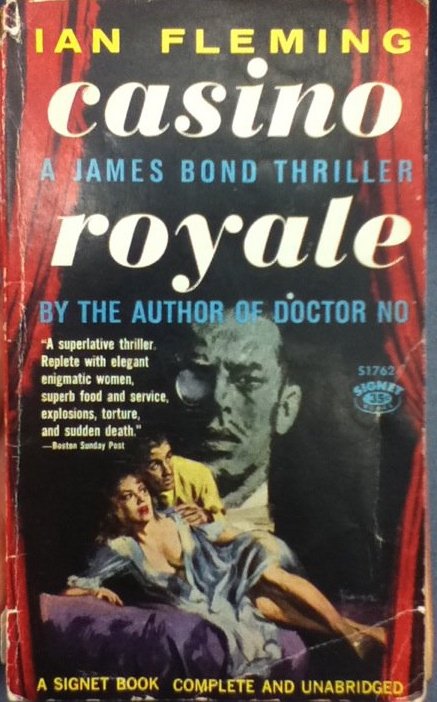
Ian Fleming, Casino Royale (1953) – Bond was never my favorite spy. He’s probably the first I heard of, but I never really got into him, either sincerely or for camp reasons. As alluded to in an earlier review, I’m a Bourne guy, despite my acknowledgment of its overly-earnest quality. But when the first Bond novel came up on a library free pile, I figured I’d give it a try. Among other things, I’m interested in how the installments came to be such an established, almost ritualized formula.

When people talk about the pleasures of “genre” narratives rather than “literary” fiction or “art” films, one of the things they go to is plot. Genre focuses on tight plots that deliver the goods in fine prescribed formula, rather than futzing around with experiments. Of course, the way genre fiction tends to sprawl sometimes, especially lately thanks to your George R.R. Martins, Robert Jordans, Steig Larssons et al, so “tight genre plots” aren’t all they used to be.

But I gotta say… the plot in “Casino Royale” was “tight” to the point of being nonexistent. A Soviet agent, Le Chiffre, ripped off his operating funds (for his evil Communist labor union!) and is trying to get it back by gambling. MI-6 sends James Bond over to rook him at cards, preventing Le Chiffre from making good. The stupid thing is… Bond beats Le Chiffre (at baccarat- the filmmakers changed it to poker, and for good reason, baccarat sounds boring), Le Chiffre and his goons kidnap and torture Bond, and then… the Soviets just come and kill Le Chiffre anyway, and let Bond go. The end. MI-6 could just have waited for the Soviets to clean up their own mess.

So, presumably, the plot isn’t the point. The point is to inhabit Bond’s world. Though, being the beginning of the series, it’s much less elaborate than it eventually becomes. The SMERSH network of which Le Chiffre is part is borderline scifi in its omnipresence, but none of the scifi gadgets or anything are in play yet. Bond isn’t jetting around the world- all the action takes place in one faded resort town in the south of France. He only sleeps with one woman, who of course turns out to be both a useless impediment AND a spy and who kills herself out of guilt after she falls in love with Bond.

I didn’t think it was anything special but you can tell why readers would like it. It’s short and moves along quickly. For readers in post-imperial Britain just emerging from wartime austerity, a character who affirms traditional British values, lives it up, and asserts British geopolitical relevance while doing so must have been appealing. And Fleming does develop a distinctive narrative voice for Bond. It’s an adaptation of older British spy protagonists like John Buchan’s Richard Hannay: upper-crust British gentleman as ubermensch. He’s “over” as in superior to almost everything and just sort of bored and blase. He’s demonstrably cultured (at least in a consumer sense- clothes, cars, food and wine) but also something like Nietzsche’s “blond beast”- brutal, violent, rapacious, lordly. That parallels the other cheap pathos-generating technique you get in this kind of narrative- Bond thinks feelings don’t matter, but inevitably, in every story, he has feelings of some kind… and they matter a lot because the feelings of a guy who normally doesn’t have them are worth more on the pathos exchange. I’ve often thought a lot of pop works on those sort of emotional antinomies.

At this early stage, it seems like Fleming is wavering between embracing Bond-as-we-know-him and experimenting with a more noir sensibility, where the whole enterprise is seen as dirty and morally compromised. You get the idea that maybe we’re not supposed to really like Bond. But in between bouts of post-genital-torture freshman philosophizing in his hospital bed and quickly falling in and out of love with the lady spy, Bond entertains and rejects both moral relativism and romantic love. I’m not going to run out and buy the next installment, but if turns up on a library pile, I’ll probably pick it up, if nothing else to trace the developments. **’


Review- Fleming, “Casino Royale” (1953)