Review- Thompson, “The Grifters”

Jim Thompson, “The Grifters” (1963) – Gotta say… for a book about grifters, there’s precious little grifting in this one. Jim Thompson was the standard bearer for pulp hardboiled crime fiction in the 1950s and 1960s, picking up where Chandler and Hammett left off (and sharing the latter’s Popular Front sympathies- I’m not sure how he avoided the blacklist, possibly through avoiding writing for pictures?). Among other things, he carried forward the existentialism-inflected psychological bent of earlier hardboiled writers. I’d argue it goes a little too much in the psychological direction in this one.

It makes sense- these sort of noir stories were always more about the people than the crimes. And the particular grifts in this book are almost shockingly banal and small time; stuff like rolling loaded dice for drinks and asking for change for twenties and then pocketing both the twenty and the change. Not exactly interesting crimes here. So I guess from that perspective it makes sense that the book focuses largely on the tangled inner lives of short-con grifter Roy Dillon, his mother Lilly, and his lover Moira.

The problem is, at the end of the day, the inner life stuff is pretty midcentury paint by numbers. A lot of pop-Freud (you can guess what Roy’s relationship with his hustler mom is like), a lot of what we’d now call “generational trauma” but what at the time they’d call something like “bad home environment” leading to antisocial behavior, a little bit of the holocaust kind of wedged in and then left alone. Thompson’s clever enough to play a little with the Code-era combination of leering fascination with squalor and edifying excuses for gawking that both writers and readers indulged. But it’s still feels rote at times.

It’s a brisk 189 pages and Thompson is a good enough prose stylist to keep you reading. Some of the stuff about the milieu — the community of short-con operators, with its oral traditions and fleeting (and inevitably betrayed) connections — and its connections to square society are interesting. But more should have happened. I wasn’t ready to start doodling bongs in the margins, but it could’ve used a little more action. ***’

Review- Thompson, “The Grifters”

Review- Cantoral, “Cartoons in the Suicide Forest”

leza

Leza Cantoral, “Cartoons in the Suicide Forest” (2016) – The internet has been good for horror literature, it seems, both as material and as means of propagation for independent producers. That could be nonsense- horror, like video games and Star Trek, is one of those things that really defines the culture of much of my friend group but on which I basically missed the boat. But I think this collection of short surrealist horror fiction (by an old school pal! We once rescued another horror writer from central Pennsylvania. Fun story!) backs me up on this assertion.

That said, not all of the stories in “Cartoons in the Suicide Forest” are directly about the internet or computers- avoiding the literal-mindedness that dogs “Black Mirror” in its more pedestrian moments. There’s all kinds of weird shit packed into this slender container: mermaids fleeing a collapsing earth, Eva Braun in Nazi Oz, and some scathing realist material, too. Leza doesn’t stint on body horror, and there’s an iridescent quality to her prose in those moments of horrifying nightmare logic.

In the titular story, the main character makes reference to a “Queen in Yellow.” That might ring some bells from “True Detective,” who in turn borrowed the “King in Yellow” myth from turn of the century horror/fantasy writer Robert Chambers. This story, of a play (perhaps based in some older legends) that led to the death of anyone who saw or read it, encapsulates the major theme of that influential period in horror writing: the confrontation between the supposedly rational civilization of the turn of the twentieth century and its own knowledge of the vastness, oldness, and irrationality of the world and the cosmos.

Contemporary social and technological changes have brought us face to face with a whole new side of our irrationality and the world’s unknowability, and this is part of why horror has become as important as it has to a lot of people. Leza brings out the aesthetic and gendered elements of the ways in which the internet (well, the pedant in me insists on saying “the internet under capitalism” but let’s just take that as read) and the culture around it contributes to our situation. “The internet runs on women’s misery,” someone smart once said, and the difficulty of escaping gendered victim-victimizer dynamics animates most of the stories in the collection.

For Chambers’ generation, the vastness of the universe ruled out an escape from existential dread- build up “progress” as much as you like, you’re still a dying speck of dust on the cosmic scale, etc. In Leza’s work, there simply isn’t an outside, or if there is — like the suicide forest which makes its sad girl visitors into surreal, dancing, bloody cartoons — it’s just the logic of these bounded universes taken to their conclusion. That should sound pretty contemporary, I think. ****

Review- Cantoral, “Cartoons in the Suicide Forest”

Review- Sagan, “Contact”

contact.jpg

Carl Sagan, “Contact” (1985) – Carl Sagan seems like he was a good old guy. Everyone loves “Cosmos.” He was a humanist of the old, gentle school, like Kurt Vonnegut and Stephen Jay Gould, before things got as mean as they’d become around the beginning of the twenty-first century. One account I’ve heard says Sagan deliberately fudged the science to depict nuclear winter as more of a possibility than it really was. If that’s true, good for him- any nuclear war would be bad for people in general, but if the elites with their fingers on the buttons thought they could’ve gotten away with such a move with their power intact, they would have been more likely to try it.

So, he was a good guy. A novelist he really wasn’t. In theory, “Contact” is about, well, contact between Earth and aliens. But you get a lot less of that and a lot more of meetings. These are mostly meetings between assorted science bureaucrats and government bureaucrats, mostly. A lot of stories from the 1980s and 1990s dwelled lovingly on various large bureaucratic organizations — corporations, the Pentagon, the presidency, especially the FBI — that framed what were meant to be thrillers. This works less well in prose than on the screen. While it’s doubtless true that there would be a lot of international bureaucratic wrangling as assorted actors figure out how to deal with a message from Vega, it’s not even particularly conflictual in the book. He introduces characters with paragraphs-long infodumps about their institutional trajectories and hobbies. It’s something of a slog.

There’s a little more in the way of religion-science conflict once assorted preachers start exploiting contact-mania and interfering with efforts to respond to the message. But even then, the main religious guy is actually pretty sympathetic and mostly challenges the worldview of the scientist main character in a positive way- a notable difference from what you’d probably say if one of our current generation of public scientist figures gave that plotline a whirl. The other likely point of interest in such a story — the big reveal of the aliens — is reasonably interesting and meshes nicely with Sagan’s broader concerns- peace, progress, unity, etc. But little enough really comes of it. In all, an interesting concept by a good guy but it doesn’t really work as a novel. **

Review- Sagan, “Contact”

Review- Moorcock, “The Weird of the White Wolf”

www

Michael Moorcock, “The Weird of the White Wolf” (1977) – People throw the word “epic” around a lot nowadays. As far as I can tell, they mostly mean it to mean “big/good/dominating,” with the implication that those traits can exculpate whatever is being described for also being sloppy, unsophisticated, or gratuitous. At this point, “epic” is also an online cringe-word, something thrown around a lot by corny people (and by people who consider themselves non-corny approximately three-to-five years ago).

Michael Moorcock has had an outsized shaping role on nerd culture (popularizing moody anti-heroic protagonists, introducing the law-chaos dichotomy as an existential principle) but sadly, his idea of “epic” has been drowned out by the more anodyne, commercially-usable meaning we have today. This is a shame, as his “Elric” stories are a pretty good example of the potential of the epic form in contemporary writing.

There’s an irony here, in that the Elric books and this one, “The Weirding of the White Wolf,” in particular lack many of the touches that make something “epic” in contemporary speech: they’re short, 150-200 pages each; they don’t do Campbell-lite character work; world-building is executed in quick, broad strokes, not the exhaustive descriptions of those elements of fictional cultures that coincidentally might feature in a game; exciting stuff happens but it’s not nearly as theatrical or action-packed as something written with an eye towards the contemporary multiplex.

What you have instead is an older type of epic, reframed by Moorcock’s pulp-fantasy/psychedelic aesthetic framework. The world is vast, old, lonely, and while elements of it are in constant flux, it’s basic nature doesn’t change. The hero, Elric, accomplishes big things — he burns down his home city, the dark (former)-imperial capital of Melniboné, accidentally kills his love interest, dallies with royalty and the forces of existential chaos — but we know, at the end of the day, he’s going to pick up his sword and move on, and the world will be the same. Elric will be more or less the same, only more so. That’s a characteristic of epics that some of the contemporary types seem to keep, the main character who becomes more and more their archetype until their achieve apotheosis/die, and it’s often basically the same thing. That’s how things are looking for Elric, as his totemic sword seems to be increasingly directing his actions in this volume, and as it’s hinted that he’ll apotheosize into a Jungian “Eternal Champion.” This is an ambivalent fate, at best.

Done right, the modern epic form accomplishes a sort of rhythm you don’t get anywhere else, worlds away (literally, in many cases) from the psychological realism/interiority of the conventional bourgeois novel form and the assumptions about the world and time that come with it. Falling into that rhythm is a major part of the appeal, along with the sword-and-sorcery stuff. You can see why this sort of fantasy literature accomplished “cross-over” to more of a mass audience — and influenced the sort of art that gets into metal album covers and onto van doors — during the era of the counterculture (in which Moorcock heavily participated), with its mainstreaming of interest in alternate modes of experience. Moorcock does it pretty well. Here’s hoping his sense of “epic” gets out there more. ****’

Review- Moorcock, “The Weird of the White Wolf”

Review- Whitbourn, “A Dangerous Energy”

whitbourne

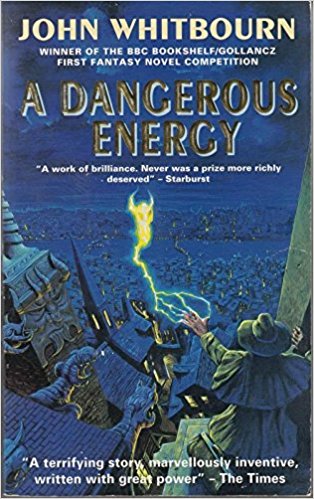
John Whitbourn, “A Dangerous Energy” (1992) – I can’t quite recall where/when I first heard of John Whitbourn. I think it was some quote from him about one of his fantasy novels being “the first Jacobite propaganda written in a century.” Somewhere else he describes himself as a “counter-reformation green anarcho-jacobite.” Let me put it this way- when I first heard of Whitbourn, those various descriptors said “whimsical and kooky,” not “probably shares pepe-oven memes and screams about white sharia” like you’d assume now from someone self-describing that way. Oh, how times change.

Either way… I finally read one of his books and it was interesting. “A Dangerous Energy” takes place in a world where the Reformation failed, capitalism and post-18th century technology never really took off (there’s railroads, but much of the world is unmapped?), and, there’s magic. The Catholic Church is the big institution, and attempts to monopolize magic by bringing its users into the priesthood (or nunhood as the case may be). The main character, Tobias Oakley, is found by some elves as a boy and learns the rudiments of magic from them, and then is recruited by the Church. The Church uses magicians in some vague research/enforcer roles.

If Whitbourn was trying to make a counter-reformation world look good, he failed abjectly- the world of the novel is cramped, ignorant, and dark. I doubt he was trying that, exactly- he evokes those feelings too well. Mostly, the world is a frame for the secular rise but spiritual fall of Tobias (yes, I did think of Tobias Funke a few times reading this). As he learns more and deeper magic, especially necromantic rituals which summon demons, Tobias leaves more and more of his humanity behind. Whitbourn isn’t clear on whether this is a consequence of Tobias’s choices, of learning magic from elves, or of learning magic, full stop.

Either way, Tobias grows increasingly amoral as his magic becomes more powerful. Magic is never powerful enough for somebody to take over by using it (it’s unclear what exactly its limits are), but it’s more than enough to help with his extracurricular activities. This starts out as simple early modern hedonism and goes on from there. He and some of his church friends get into drug-dealing, in some Ellroy-esque chapters. He joins a “crusade” against a Leveller uprising, in sections clearly influenced by accounts of the early modern wars of religion- looting, slaughter, sexual violence, and Tobias partakes in it all. Tobias grows increasingly “philosophical” — and morose — about morality and the value of human life as the story goes.

My understanding is that in most “dark” or “gritty” fantasy, or those with an anti-hero, is that there’s typically some redemption in the end- either the anti-heroes turn good, or they accomplish something good that outweighs the bad, or they just die. Well, spoiler alert- Tobias dies in the end, but there’s nothing redemptive or even cool about it. He’s just old and miserable, fully aware that he traded his soul for very little at the end of the day. In the course of the book, he goes from naif to rake to vaguely-Nietzschean amoral transgressionist to lonely old fart scared of death to actually dead. The end. It’s strange and uncomfortable — Whitbourn is clearly along for the ride with all of Tobias’s sins, and brings the reader along — but it works, in its odd internal way. This is his first novel- I’m curious what his other works are like. ****

Review- Whitbourn, “A Dangerous Energy”

Review- Jemisin, “The Fifth Season”

5thseason

N.K. Jemisin, “The Fifth Season” (2015) – Jemisin might be the biggest new force in sci-fi/fantasy writing today. She’s the winner of back-to-back Hugos for best novel in 2016 (for “The Fifth Season”) and 2017 and an active blog/social media figure. She was near the center of “Puppygate,” a social media brouhaha where multiple loose coalitions of reactionaries attempted to hijack the Hugo awards process and generally troll sci-fi/fantasy fans and writers they saw as liberal or politically correct. A successful black woman writer vocal about social justice issues both within and without the SFF community, Jemisin was a special target for the worst of the “puppies,” and received a lot of vile, high-profile abuse. Backlash against the backlash helped make her a symbolic figure for liberal fans (and probably helped her win those two Hugos, the award that served as the site of much of the controversy, which has presumably inflamed the reactionaries all the more- the circle of liiiiife).

Honestly, beyond simple racism, misogyny, and various other misplaced resentments, I don’t see what problem these people could have with Jemisin’s work that they wouldn’t have with accepted favorites like George RR Martin. “The Fifth Season” is a decent example of what seems popular in big ticket speculative fiction these days: big doorstop tomes, thickly laid-on worldbuilding, character work that’s a little bit Joseph Campbell, a lotta bit RPGs, a smidgen of zeitgeisty filigree work, and a lot of portents, both for the world-shattering apocalypses the stories either promise or are premised upon and the inevitable, equally long or longer, sequels. This is pitched as softly and straightly at contemporary readers as you can get without providing cliffnotes. So don’t let any of these Puppygate trolls tell you it’s about getting the kind of stories they want. They want exactly this kind of story, but they don’t want it from a black woman who says stuff the don’t like, especially if she gets the sort of award that helps make you the face of the genre.

Jemisin comes up with some interesting stuff (more than Martin does, in my opinion). The world of “The Fifth Season” is a world of repeated cyclical geological apocalypses. Societies are organized around their inevitable collapses. There’s also a downtrodden subsector of the population which can do magic, drawing from the energy of the overactive tectonic plates to go super saiyan (is that the term? I’ve never watched the show) and do all kinds of stuff. These magicians are hated and feared, and usually killed if a special order doesn’t find them first, to train them to use their powers. There’s a lot of “Steven Universe” in this- magical outcasts named after rocks. But sadly, it has little of the show’s whimsy (or its aesthetic- harder to pull off with the written word in any event). This is serious biz, ended worlds and lynched children and ancient secrets. It’s heavy.

Jemisin also does some interesting stuff with narrative but it doesn’t land quite as well. There are several diverging and reconverging viewpoints, which is cool, but about a third of it is in second-person. That is an experiment that doesn’t work- I found those portions took me more out of the story than the third-person parts did. And in general, “The Fifth Season” suffers from pacing issues, as it tries to shoehorn a plot into all of its worldbuilding… and, of course, set up for the inevitable sequel. It’s often unclear who is where, doing what, why, even with the handy maps and glossaries. I sympathize with wanting to lay out all of the aspects of this cool world you made (and I wonder if Jemisin ran this as an RPG at some point- I could see this as being a fun setting for one). But it’s a delicate balance between a propulsive story and a big, detailed world, and Jemisin doesn’t nail it in this one. ***

Review- Jemisin, “The Fifth Season”

Review- Moorcock, “The Sailor on the Seas of Fate”

elric2

Michael Moorcock, “The Sailor on the Seas of Fate” (1976) – This is pretty solid “van art fantasy,” to use Garrett’s felicitous phrase. It’s the second book of the adventures of Elric of Melniboné, who Moorcock — the great lefty fantasy writer, perhaps now most famous for an essay shitting on a range of genre favorites from Tolkien to Heinlein to Watership Down (for some reason) as closet Tory-fascists — created to break with the stereotypes of fantasy heroes, but who wound up the model of a type in his own right. Instead of being buff, bluff, forthright, sure of himself, and basically good (in spite of the bad things he does), in the model of a Conan or an Aragorn, Elric is slight, decadent, ironic, full of self-doubt, and only learned to be good to spite his family and society, the saturninely evil Melniboné. This eventually became the model for many identical anti-heroic sword-slingers and the underground societies that bred them (the Drow, popular villains/antiheroes of late 90s/early 00s DnD branded fantasy, come to mind), which is now roughly as common as the sunnier kind of high fantasy hero.

In this installment, Elric, cast out of Melniboné for reasons I can’t really remember from the first one but which boil down to “wouldn’t be evil,” is wandering around, getting into adventures. He winds up on some weird boat that travels amongst planes of reality and different times. Instead of the romanticism- (and medievalism)-tinged descriptions of wandering through various European-ish countrysides you get in Tolkien and his interlocutors, you get similar wanderings but with a sort of psychedelic-inspired palate. This gets into the actual action of the series, as well, as Elric has to do Steven-Universe-style body-melds with some other swordsmen to beat some evil wizards who are also buildings, and is followed around by an ominous horse. He makes various deals with devils, some of them good, some of them tragic necessities, all bound together in the kind of universalism that the sorts of dudes who paint people with swords and chainmail onto the panels of their vans can agree on. That might sound like a dig and maybe it is a little, but I can also appreciate it as an interesting historical artifact.

The story is pretty all right if you like fantasy. One major thing Moorcock does differently from his bete noir, Tolkien, is that he doesn’t write as long. That said, from my perspective, well after Moorcock’s work has been enshrined in the SF/F canon (and, more importantly, worked into the games and movies that really propagate a SF/F’s writer’s aesthetics much farther than their books generally can), the differences between him and the fantasy writers he slammed don’t seem that big. I think there’s a continuum between the sorts of writers who seek out that space, the hero’s journey through worlds dissimilar to our own in the way fantasy generally is — less organized, lonelier (though fantasy gaming has kind of disrupted both of those traits) — that makes itself felt, no matter what else they may disagree on, politically or aesthetically. ****

Review- Moorcock, “The Sailor on the Seas of Fate”

Review- Heinlein, “Starship Troopers”

starship-troopers

Robert Heinlein, “Starship Troopers” (1959) – At bottom, science fiction is about exploring possibilities. The corpus of scifi has explored an exhaustive range of facets of existence, playing with everything from consumer technology to the structures of race and gender to the nature of time and space, in the full range of emotional registers. And it’s a project shared across the spectrum of writers, from exalted masters ala Le Guin, Delaney, and Dick to the lowliest fanfic scribbler. It’s genuinely one of the nice things about the twentieth century, warts and all, and one of the few we actually got to keep, in a real, vital way, in to the twenty-first.

So what possibilities does acclaimed science fiction icon Robert Heinlein imagine for us in “Starship Troopers,” then? Where does he go from that established jumping-off point for limitless possibility, humanity’s exploration of the stars? Well, mostly, he imagines boot camp. Endless endless boot camp, described by Heinlein’s impersonation of a happy-go-lucky grunt (Heinlein was an Annapolis grad and a navy officer who never saw combat), an update of Rudyard Kipling’s cockney Tommy ventriloquism. There’s a huge war in space going on — multiple wars, it seems — but none of that matters except as a rationale for boot camp and for a society seemingly organized around boot camp. There’s maybe fifteen pages of battle in the whole book, including maybe ten pages in the beginning. The rest is boot camp, and a lot of that is actually lectures about life and society. This is closer to a pedagogical novel than a war story.

The content of these lectures Heinlein puts in the voice of older authority figures bestowing wisdom unto the perspective-dullard — the primacy of force and the existential validity of its wielders — is less off-putting than the tone and context in which it’s delivered. Heinlein may have seen himself as critiquing late-1950s consumer society but his philosophers of the spartan life speak like they came off the tv of his period; bluff, bouncy schmaltz, scout-master-meets-snake-oil salesman. The society in which Heinlein’s rules have been applied — only veterans can vote, corporal punishment is liberally applied, and most of all, old fucks who think like him are paid and encouraged to babble at length and totally own anyone who challenges them — isn’t really all that different from the society in which Heinlein lived, except people are as a whole happier. Sometimes evil aliens will paste a city but we all know the powersuit boys will paste them right back (not that Heinlein is going to let us enjoy much of it).

What that contrast tells me is that Heinlein means it. He’s not doing a thought experiment, he’s not doing satire, we don’t need to apply “Niven’s Rule” (Niven was another middlebrow fascist slug, anyway) of separating the views of the author from the views of the narrator. If this shit was imaginary for him, he’d try extending his imagination. If anything, the idea of “service-guarantees-citizenship” is much less grotesque than the combination of unimaginativeness, dullness (seriously- just give us some fucking space battles, dude), and chipper banality with which his ideas are expressed.

The militarism is just a vehicle for what Heinlein really cares about in this book- the defense and extension of a world that suits him (1950s America but a little hornier and in space), and the humiliation and extinction of people with ideas that make him uncomfortable. To be honest, I think the dynamic we see here — people smart enough to think about the world around them but deeply scared of the implications of what they think seeking intellectualized schmaltz to form a security blanket — drives an increasing amount of right-wing thought today. It’s a sad irony a lot of those people invest in science fiction, which is supposed to be about impetuous imagination.

I wanted to like this book, or at least like it a little more than I did. I like a lot of work I disagree with much more than the actual content of this book (the boy scout tone really is skin-crawlingly off for me, I’ll admit). Heinlein also helped keep Philip K. Dick solvent, even after PKD made fun of him all the time, so I want to like the guy. He seems like a good sport. And there are a lot of great right-leaning speculative fiction writers: Lovecraft, Tolkien, Herbert, Vance, Wolfe, Simmons, Stephenson. They create imaginative worlds, mount incisive criticisms, weave intricate plots, are compelling writers. None of this applies to “Starship Troopers” (and only applied a little bit more to “Stranger In A Strange Land,” the only other Heinlein I’ve read, which is best described as “‘Starship Troopers’ for horniness instead of the military”).

Paul Verhoeven showed a much greater degree of fealty to what science fiction is supposed to be about when he took this dull book for raw material for an actually great scifi movie, which is a brilliant satire of the fascist undercurrents both in the book (and scifi in general) and in our society. The movie has humor, it has the courage and brio of Verhoeven’s insane choice to make a movie undermining it’s own source material in what’s supposed to be a dumb action movie, and it has actual… space… battles which, I’d like to stress, the novel basically lacked. Having read the source material, I can now definitively say “Starship Troopers” beats out “The Godfather” or “Children of Men” for the ultimate case of a movie being better than the book.

Gotta say… nothing disappoints more than getting boring fascism when you expect the more interesting literary kind. *’

Review- Heinlein, “Starship Troopers”

Review- Perich, “Too Late to Run”

mara3

John Perich, “Too Late To Run” (2014) – the adventures of Mara Cunningham ratchet up a notch in this, the latest and to date last installment of my friend/comrade’s Boston-based crime-thriller series. She has to cope with arsonists, militia dudes (out in Worcester County, natch), smarmy crooked FBI people, and the occasional fuckboy.

Looming behind it all is a big bank! The normal subprime shenanigans weren’t enough for one banker, so they go a few further notches into open criminality, setting off a chain of events involving deadly arson and the taking down of a local crime boss with whom Mara had a tense but reasonable relationship. She winds up caught between her day job at a dying newspaper, her side gig working with the crime boss’s charming retainer trying to figure out what happened, and an offer to work at something like buzzfeed. She’s got a lot on her plate, and people keep burning stuff down around her.

I’d say this latest volume is the best in terms of having a lot of bravura scenes. I especially liked Mara leading a crowd of Occupyish protesters to chant the name of an evil banker she needed to flush out, and a scene where someone tries to arsonize the main character on a MBTA train car was memorable, considering how much time I’ve spent on them. There’s a lot of interesting facets and characters, which I like. I’m a little foggy as to exact details of the scheme Mara stumbled upon- this happens with me and crime fiction sometimes. But the main gist is that Mara, and a number of ordinary people, are caught in the gears of a ruthless capital machine, between big impersonal crooks like the bank and small crooks with a face, like a crime boss. Ultimately, none of them are good for society as a whole, and will take everything you’ve got- as Mara finds out personally. She has lost a lot by the end of the book, and I’m curious to see how she comes out of it. ****’

Review- Perich, “Too Late to Run”

Review- Liu, “Death’s End”

deaths_end

Liu Cixin, “Death’s End” (translated from the Chinese by Ken Liu) (2010) – At one point in Kurt Vonnegut’s “God Bless You, Mr. Rosewater,” his roving guilt-ridden alcoholic millionaire narrator Eliot Rosewater crashes a science fiction convention. He drunkenly praises the assembled writers as “the only ones who’ll talk about the really terrific changes going on,” “the only ones zany enough to agonize over time and distances without limit.” Eliot admits that the scifi writers “couldn’t write for sour apples” but still holds them in high esteem next to the modernist boobs his foundation generously funds: “the hell with the talented sparrowfarts who write delicately of one small piece of one mere lifetime, when the issues are galaxies, eons, and trillions of souls yet to be born.”

Liu Cixin is exactly the sort of writer Vonnegut had in mind, fifty years after the fact. His “Remembrance of Earth’s Past” trilogy (though apparently everyone in China — where apparently it’s near Harry Potter levels of popularity — just calls them the Three Body Problem books) spans hundreds of years (technically millions) and concerns at least three or four interstellar civilizations and dozens of important characters. “Death’s End,” the last, longest volume, could easily be a trilogy itself, dealing with at least three distinct phases of Earth’s struggle with its first alien contactees, Trisolaris, and against the predatory Hobbesian chaos which Liu depicts as the cosmic baseline. The scale — and the abandon with which Liu throws himself into it — is worth the price of admission for people with that particular itch. You know who you are.

Liu also fulfils the other part of Eliot Rosewater’s soliloquy on scifi. It’s too much to say he “can’t write for sour apples.” Among other things, he might be a shit-hot prose stylist in Chinese and get lost in translation, but even with that he gets across some of his crazy shit in space in fine aesthetic fashion. But his characters are, by-and-large, thinly drawn, especially in this last volume as compared to the first. It’s almost as though as the action leaves Earth, the characters leave human emotional reality… which is something Liu would agree with, to judge from some events in the book (generation-ship passengers getting all weird), but not in the way I mean.

At bottom, characters in “Death’s End” are extensions of and stand-ins for Liu’s main concern, technological models for humanity’s future in space. The main character, Cheng Xin, is an astrophysicist from our time who, due to (oddly convenient) hibernation technology, winds up alive, awake, and relevant to stages in human development centuries apart. She is also the receptacle for Liu’s ideas about gender, which take a much more central role in this book than in its two predecessors.

Cheng Xin is brilliant and morally good- too good, Liu argues, basically because she’s a woman. Twice, her compassion and unwillingness to end lives lead her to immensely destructive decisions. The first time she refuses to hit a deadman’s switch that would lead to the destruction of both Earth and its Trisolaran invaders. Trisolaris nearly destroys humanity but is stopped by people — men — outside of Cheng’s decisionmaking power doing some dimensional biz. The second time, she does the one thing a nerd like Liu will never forgive- she declines to invest in faster-than-light travel. There’s many risks involved in FTL (including potentially alerting uber-powerful galactic neighbors), and once again, Cheng’s femininity won’t let her take them. Then, wouldn’t you know it? Some other alien species entirely sends a weird thing that turns the Solar System into a flat stanley — a dimensional weapon — and people can only get away on faster than light ships! If only that lady hadn’t stood in the way of science with her lady-concerns!

For what it’s worth, Liu doesn’t indulge in the troweling-on you get in other (Anglophone) scifi. In fact, he doesn’t clearly blame Cheng at all- several surviving characters (there are still a few humans around, due to earlier interstellar voyages) point out that the decisions she made were complicated and no one could know the right choice. They also point out that an interstellar future for humanity isn’t necessarily an unalloyed blessing- the universe is a dark place, full of super-powerful, amoral space powers constantly doing insane things to each other like turning other civilizations into Flat Stanleys or slowing down the speed of light somehow. But the basic conflict in the book still hinges on gender essentialism- Cheng’s essential femininity (in the storied tradition of gender essentialism, held to be the sole possessor of virtues men like to profess as good but don’t want to actually have, like compassion) vs the cold hard logic of men/the cosmos.

I don’t know where the gender conversation is at in China, or where Liu is in the Chinese gender conversation. But you don’t need to be a radical critic of gender roles to get that there’s some pretty hard women (and a lot of men who maybe aren’t the suicide-bomber type) out there. You’d figure anyone would be able to consult their own experience — or, failing that, watch the news — to get that point. Like Paul Cao, who tipped me off to this aspect of the book when I reviewed its predecessor on here, I look forward to reading a thorough feminist critique of the series. I’m not equipped to do that myself.

So, where are we at the end of the Three Body Problem? We’re in a space of infinite possibility — Liu has a gift for imagining awe- (and terror)-inspiring feats of science and engineering — and bottomless fear. There’s no real solution to the Hobbesian mess of the “Dark Forest.” No one opts for Iain Banks’ fully-automated gay space luxury communism, or if they do they don’t last. The more advanced space civilizations — the kind that can unilaterally rob a solar system of one of its dimensions — aren’t any more enlightened than the Red Guards whose actions in the Cultural Revolution impel Ye Wenjie to start Earth down the path into the Dark Forest to begin with. A certain degree of escape is possible — if you can flatten three-dimensional space, you can also carve out bubbles in time — but even that endangers the rest of the universe (though you have to wonder why anyone with the opportunity to quit the game would care about the other players- that’s kind of the point). Arguably, we need to chuck the universe and start again at a higher dimensional plane- that’s the closest to hope Liu holds out.

What happens to the Solar System and most of humanity due to Cheng’s soft-headed refusal is depicted in such a horrific, pathos-laden manner that it’s hard not to reflexively wish Cheng hadn’t put the kibosh on lightspeed. But on the time scale of the universe, he tells us, it barely matters. There’s still almost a hundred pages of book left after the Solar System and most of humanity gets 2-d’d, after all. Liu clearly sympathizes with the hard-headed (read- nerdish) men who want to take to the stars. But his pessimistic take on the universe won’t let him depict expansion as the key to utopia. Survival is closer to a universal law in Liu’s world than anything else (certainly more than the supposedly base-line speed of light!)… but survival, and the universe, is morally disinterested and highly dangerous in its own right… and we’re stuck with it. ****’
Review- Liu, “Death’s End”