Review- Farmer, “To Your Scattered Bodies Go”

Philip José Farmer, “To Your Scattered Bodies Go” (1971) – My first go at one of the grand masters of scifi and the beginning of the “Riverworld” series. It was… fine. Certainly the concept is arresting. Someone took the whole population of humanity and reincarnated them into new, young, naked bodies along the course of an endless river. Everyone who ever lived is there, scattered in quasi-random linguistic/temporal groupings. They get food (and booze, and weed) from magic lunchpails someone issued them, and other than bamboo and stone, there’s not much to make stuff with.

I emphasize that last bit because Farmer emphasizes it, a lot. Way more of this book than I would have figured is about the quotidian act of survival in this comparatively-easy-to-survive world. You’d figure given the sheer scope of the setup, Farmer would have jumped to the implications of their situation a little more quickly… but instead we get a lot of speculation about how much you can do with bamboo, rocks, and fish (and human!) parts.

Either way, we get our narrative viewpoint from the newly-reincarnated Richard Francis Burton, the Victorian traveler, linguist (he could supposedly speak twenty or thirty languages or something like that) and writer with many a legendary exploit under his name. Naturally, he takes charge of the surviving-and-organizing business of his little band, that includes the grown-up inspiration for Lewis Carroll’s Alice (for whom Burton obviously gets horny), a Holocaust survivor, an alien, a caveman, some Italians, a know-it-all who provides periodic infodumps on Burton or assorted others, etc.

Burton had had a vision where he met with the organizers of the Riverworld, and is determined to find them again. He and his band make a raft and head upriver. Because this is midcentury scifi, naturally everyone has set to warring with one another, even though (because?) their material needs are basically met. One set of slaver warlords led by Hermann Goering capture Burton and his band. They escape, but it sets up a dynamic wherein Burton and Goering get killed and reincarnated time and again, generally in close proximity to each other. Burton is doing it because he thinks being randomly distributed somewhere on the river is a more efficient means of travel than trying to sail through the rival factions, so he kills himself over and over again, getting newly reincarnated each time. Goering does it because he’s addicted to both heroin and a special “dreamgum” issued in their rations and tries killing himself when he can’t kick successfully, even when he’s otherwise turned a new leaf.

Once it gets going the action is commendably out there, though with enough of that midcentury scifi flavor — the omni-competent ubermensch protagonist, the women and their hangups (Farmer was something of a pioneer in bringing explicit sex into science fiction), the faceless hordes fighting for no reason, etc. — to dampen the originality some. In all, good enough to have a look at the sequels. ***’
Review- Farmer, “To Your Scattered Bodies Go”

Review- Brin, “Startide Rising”

David Brin, “Startide Rising” (1983) – This was some pretty fun scifi about a sticky situation in which some slick critters find themselves. The first starship commanded by dolphins — well, genetically enhanced neo-dolphins, anyway — stumbles upon some ancient artifacts for which numerous powerful galactic civilizations will gladly kill. They hide out on a water planet and try to figure shit out while the various intergalactic factions — spider people, lizard people, bug people, etc — kill each other in orbit over the planet.

In this particular universe, humans play the role they often do of cocky new kids on the galactic block. Every other spacefaring civilization, it seems, were “uplifted” into tool use and other advances by a patron species, going all the way back to the Progenitors billions of years ago. The humans can’t trace back a patron, which makes them out of place in a universe defined by lineages and attachment to ancient knowledge. That doesn’t stop plucky humanity from uplifting chimpanzees and dolphins, though, and all three species are present in the ship. Can humanity and our mammal bros make it in a cold, hierarchical universe? Brin’s philosophical about it but not too much. In the classic scifi fashion, pluck and ingenuity find a way.

This is an enjoyably overstuffed scifi read, with a half dozen primary viewpoint characters, numerous places where they’re all at that get hard to keep track of, plots and subplots, efforts at fleshing out dolphin culture (kind of hippie-ish but very eager), so on and so forth. The final plan to get out of the trap the aliens have them in is pretty cool, and fails (and is fixed) in some fun ways. All in all, good clean scifi fun. ****’

Review- Brin, “Startide Rising”

Review- Butler, “Xenogenesis”

Octavia Butler, “Xenogenesis” trilogy (1987-1989) – The premise of these books is a funny one — people have to have brain-sex with alien tentacle monsters to repopulate the earth after a nuclear war — but is played completely straight, with stakes of species-level life, death, and love. The novels “Dawn,” “Adulthood Rites,” and “Imago” explore a wholly alien society, it’s mixture with humanity, and questions of what life, humanity, and family are. Heavy stuff!

First, the aliens, known as the Oankali. They’re basically gene-stealing aliens but (notionally) benevolent. They go from world to world swapping genes with the species they find, modifying both themselves and the others to adapt to whatever circumstances they find. They do this with humanity after the species is almost destroyed in a nuclear war. Humanity’s choice is either accept the Oankali trade or die as a species.

The whole Oankali frame of reference, from its concept of time to the basic value it places on life qua life, is different from humanity. They think in centuries, are obsessed with genes (which they can read like text), and have three sexes- male, female, and ooloi. The ooloi sort of get between the other two, stick them with pleasure-inducing tentacles, and then mix up the baby’s genes before implanting it in the female.

The aliens fix earth and put people back onto it, but at a price. People can now only breed if they do it the Oankali way, complete with ooloi help. As it turns out, ooloi sex is deeply fulfilling, but it also seems wrong and vaguely gay to most humans, so they refuse to go along with it, instead running off to the woods to lead unhappy, sterile lives. Those who stay with the Oankali settlements live complicated but fruitful and long (the Oankali can easily fix most human diseases) lives.

I get that this is meant to be a tale of adaptation. The first novel in the trilogy, “Dawn,” is told from the perspective of Lilith, the first human to agree to be part of the Oankali program. She’s deeply conflicted about the whole thing, but agrees with the Oankali that the continuation of life — and the adaptations that entail — are more important than species pride. The next, “Adulthood Rites,” is told from the perspective of one of her “construct” — part human, but remixed by an ooloi — children, and the third, “Imago,” from another of her kids, the first ooloi born of a human woman. This is about new forms of life, life dedicated to the perpetuation and adaptation not just of themselves but of life in general. There’s a reason these books are a touchstone of the queer (and generally more diverse) turn in scifi.

I don’t see the Oankali as all that benevolent; moreover, I’m not convinced Butler did, either. Part of this, I admit, resulted from confusion on my part. I thought the sterility of non-Oankali-aligned humans at the end of “Dawn” was a side effect of the war or something. But then I realized midway through “Adulthood Rites” that it wasn’t- that the Oankali sterilized the other humans. That’s kind of fucked up! Akin, Lilith’s child, convinces the Oankali to let non-sterilized humans settle Mars, but still.

The excuse is our self-destructiveness. We have the capital-c Contradiction of intelligence and hierarchical behavior that, the Oankali insist, will doom is every time until they breed it out of us. But the Oankali clearly have a hierarchy too, which begins with Oankali>Human! Sure, they say they love us — they think we’re spicy and dangerous, genetically interesting — but the British said the same stuff about the people of India. Moreover, internally, the Oankali hierarchy is much flatter and fairer than most of ours, but it exists- older and more talented people have more power. Someone gets chosen for important tasks. That’s hierarchy. It’s inescapable- just like the other two principles of organization, exchange and communalism, are inescapable. Everything has a little of all three, admit it or not.

Lilith, to her and Butler’s credit, admits it, admits the Oankali used her without her consent, even as she falls genuinely in love with an ooloi and adapts to her hybrid society. She’s deeply ambivalent. I think this is a story at least as much about race, integration, and imperialism as it is about gender. Octavia Butler was the only prominent black woman scifi writer in her time. She was widely feted, but she tackled the contradictions and confusion of pluralism in her own life.

And she never came up with easy answers, which is possibly her greatest strength as a writer. The Oankali are right- people are self-destructive. Just look at us! Though it’s worth nothing the Oankali endgame for Earth is the kind of thing that Elon Musk would come up with, and for which we’d all mock him. The narrow-minded prejudice that drives much of human resistance to the Oankali is wrong, but from many of the resisters, it’s about living according to their own choices, not just space-racism. It’s complicated- much like the Oankali-Human reproduction system, which involves five beings and could probably use a diagram. And like it, it holds out the promise of radically new forms of life, endless possibilities.

I don’t think the reading that identifies uncomplicatedly with the Oankali is wrong. I think Butler’s strength is that, aside from the wantonly destructive, she allows us to identify with multiple radically different perspectives. To me, there are no good choices in this series — I’m not crazy about bending the knee to those who pretend to know what’s good for me, no matter where they’re from or what they look like — but there’s an array of stunningly-imagined possibilities. ****’

Review- Butler, “Xenogenesis”

Review- Robinson, “The Years of Rice and Salt”

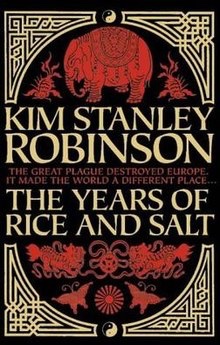
Kim Stanley Robinson, “The Years of Rice and Salt” (2002) – Kim Stanley Robinson joins the exalted company of Faulkner, Proust, and Garcia-Marquez in the category of writers that I respect but do not particularly like reading. He might be the only scifi writer in that category. He seems like a mensch. His ideas are interesting. It’s good someone is tackling big, hard scifi, be it about Mars colonization, interstellar travel, climate change, or in this instance, what modernity would look like not dominated by Europe. I respect the amount of research and work he puts into things. But his books run long and schematic. In “Years of Rice and Salt,” it was pretty easy to see what each part would be coming in in this history after the Black Death takes out almost all Europeans instead of a third of them. Samarkand alchemists, must be here’s the scientific revolution, here’s the world war equivalent, etc. etc.

Like most alternate histories it’s way too neat and schematic. This is probably an advantage over sloppy and dull (ala Harry Turtledove) but it usually doesn’t grab me. The players in the history are different — Chinese, Indians, Arabs, and Native Americans — which is a fine change, but the roles are mostly recycled. That might be part of Robinson’s whole Buddhist take- the idea is the characters are reincarnations of the characters in the first set, throughout history. None of it is bad and clearly a lot of it is well-meaning, depicting Muslims and assorted other “Others” of modernity as just as capable of enlightenment and modernity as anyone else. But it could have done more to show how modernity would have been different, beyond lines and names on the map and the demographics of who’s involved. Presumably those changes would have changed what modernity itself was all about. I give it credit for what I’m probably missing, because KSR seems like a good dude, and it’s good to have alternate history not about how cool the Nazis and/or Confederates were. ***

Review- Robinson, “The Years of Rice and Salt”

Review- Bacigalupi, “The Water Knife”

Paolo Bacigalupi, “The Water Knife” (2015) – On the surface, this book is very much “my shit.” Set in a near-future where the Colorado River has largely dried up and the Southwest states fight underground wars to keep the water coming in and refugees out, it’s the sort of crime-scifi mix that I tend to enjoy.

It turned out pretty good. The titular “water knife” is Angel, a former gangster and now enforcer for Las Vegas’s water rights. Vegas is the second banana in all things western water-related, able to maintain its casino-arcologies but always in the shadow of the big daddy, California (the tune “California Uber Alles” came to mind several times while reading this). The big losers have been Texas, hit by both drought and hurricanes and the source of most of the refugees trying to cross over into California and Nevada, and Arizona, where Phoenix is in the process of dying a slow death. This book was first recommended to me by a friend on a post I made about how seeing Phoenix out of an airplane window freaked me out- all that perfectly geometrical green sprawl against that stark desert… this depicts that society in collapse once both nature and politics started restricting the water. Refugees, gangs, dust storms, bags for converting piss into drinking water, all in the shadow of arcology towers built by the Chinese.

But some Las Vegas agents are getting bumped off in Phoenix, in increasingly grotesque ways, and Angel has to go and find out why. Of course, he can’t trust anybody, and there’s a lot of running away from shadowy “Calies” and fights and the like. He gets embroiled with a reporter looking into the murders (they hook up, natch) and a Texan refugee looking for her ticket out, who gives us a grounds-eye view of refugee life. It turns out the whole thing revolves around “senior” water rights- water rights granted so far back that they would allow the holder (originally Arizona) priority over all the water in the basin. It’s worth billions of dollars, and of course, a good many betrayals and torture-murders.

The plot was basically fine from a crime fiction angle, not the best but good. There are some parts of it that make little sense. This novel depicts the states getting into all but open war with each other over water rights. California and Nevada National Guards routinely invade and blow up waterworks taking “their” water, including a bravura scene at the beginning where Angel leads a helicopter raid. The Constitution has been changed such that states can enforce state borders, generally with violence. Why would they care about a deal Arizona made with the Pima Indians that long ago if force seems to be what decides things? Why care about the letter of the law? I guess you need a McGuffin and this is a reasonably fun one.

The other thing is this… it’s hard to believe that US state origin would suddenly matter more than race. I know, I know, the Dust Bowl and the anti-Okie stuff, but still. I’d have difficulty believing this stuff wouldn’t be racialized, with Latino and black refugees treated the way they are in this book, and white refugees not nearly as bad. White people across the southwest seem to relate to each other more than people of color from their own state. It think that would structure how they deal with these crises. There’s a lot of people of color in the story, but beyond some cultural stuff it doesn’t seem to make much of a difference, certainly much less than which state you come from. This rings untrue. That’d be less of a problem in a gauzier scifi novel, but the tone of this novel is so gritty and “real” that kind of thing sort of hurts the realism. All in all though, a decent read. ****

Review- Bacigalupi, “The Water Knife”

Review- Vance, “The Book of Dreams”

Jack Vance, “The Book of Dreams” (1981) – Jack Vance’s Demon Princes saga ends with the taking down of the last and probably most interesting of the five space pirates who destroyed Kirth Gessen’s home village way back when. Howard Alan Treesong, like Viole Falushe, one of the previous baddies, just can’t get over high school. Born on a planetary backwater that sounds a lot like the upper Midwest or some descriptions I’ve heard of rural New Zealand, an imaginative and willful boy, he gets the works from the locals and dedicates his life to revenge. He gets far enough to become a sort of “Mr. Big” of galactic crime and nearly becomes something like space-Jesuit-General. But of course, he’s no match for Kirth Gessen’s focus and grit (and unlimited money he secured whilst taking out a previous Demon Prince).

Hero and villain both live for revenge. Kirth lives to avenge his family and home; Treesong lives to get his vengeance on his high school class and to make the universe as much like his adolescent fantasies (in the titular book, which Kirth eventually finds and uses as bait). The latter option seems to lead to a somewhat more colorful, if nefarious, existence for Treesong (and his fellow space pirates), but the latter provides the drive necessary to go through all the hoops to eliminate the former. In this installment, they range from a fake magazine contest to identify the one known picture of Treesong to the shenanigans with the lost diary to Kirth having to pretend to be a flautist to infiltrate the band at the high school reunion Treesong interrupts with dire theatrical revenge. Sometimes, the difference between hero and villain is how they go through the rigamarole.

The Demon Princes books are pretty cool. Vance clearly made more world than he could really fit in to these fairly conventional detective stories, as evidenced by the long epigraphs to his chapters full of lore from his universe. You mostly get the worlds through the odd planets Kirth visits, which showcase Vance’s fascination with the plasticity of people and societies, where oddballs in backwaters keep getting odder due to their cultural — and their planet’s ecological — logic. I ultimately prefer the Cugel and Anome books, but these are also cool. ****’

Review- Vance, “The Book of Dreams”

Review – Chu, “Time Salvager”

Wesley Chu, “Time Salvager” (2015) – This was fun. It’s set in the 2500s after humanity has fled a toxic Earth into a precarious existence on space stations and in outer moons like Europa. A profoundly unequal, megacorp-dominated society fighting a losing battle against economic and social decay, they use time travel technology developed in earlier, better days to essentially loot the past for raw materials and the types of goods they can’t manufacture anymore.

Of course, like any time travel story, there’s a bunch of more or less arbitrary rules, both to time travel itself and the way the time-looting agency, ChronoCom, uses it. In order to protect the integrity of the time stream, you can’t give the secret away, or cause major ripple effects. In the book, this means they wind up looting a lot from people who are about to die imminently, particularly at the sites of battles or disasters. Looting engines from spaceships about to blow, for instance, or art (of course, the megacorps commission custom jobs) from a cathedral about to be shelled. You also can’t bring people back, but that turns out to be more of a political rule. There’s a bunch of other rules that basically are there for story purposes- as Time Pimp informs us, “Nobody knows or cares how time travel works.”

Of course, somebody has to break the rules, and of course, that somebody is a grizzled veteran of ChronoCom who’s seen many a disaster, on top of an already rough life. The main character, James, is your basic gunslinger character put into this time-travel story. Everything changes when he meets the love interest, a scientist named Elise who works on a doomed experimental ocean station in the late 21st century. She’s nice to him, so when the station is destroyed, after looting the stuff he was sent for, James saves Elise. This is a big no-no, so they become fugitives among the tribes of the toxic Earth, with both a megacorp and James’s chronoman buddies after them. Despite being stranded amongst the primitive scavenger tribes of post-apocalyptic Boston, on an Earth where every ecological disaster was turned up to 11 over a few centuries, Elise discovers a potential way to save the Earth. Naturally, it ties in with what she was doing before she got time-napped, which of course ties in to various dark secrets of time travel, etc. etc.

This isn’t Philip K. Dick or Octavia Butler here. Hell, it’s hardly Shakespeare, even. The characters are pretty basic- James the hard-drinking vet who’s seen some shit, Elise the optimistic scientist who’s tougher than she looks, Levin the by-the-book enforcer whose honor compels him to hard choices, etc. etc. The prose doesn’t sparkle, especially the dialogue. But it’s fast and fun. I also think the various futures we see (Chu makes the interesting, and I think smart, choice to have the characters go back more often to the future history — the period between now and the time the main action is set — rather than doing our past) are assembled out of found parts, but well-assembled without too much exposition. The action is fun- close escapes, fights with assorted future technology, etc. It’s a good subway/beach read that plays familiar rhythms well. ****

Review – Chu, “Time Salvager”

Review – Vance, “The Face”

Jack Vance, “The Face” (1979) – In this installment of Vance’s space-detective-western series, Kirth Gessen knocks off the fourth of the five Demon Princes that sacked his home planet. Space pirate Lens Larque hails from Dar Sai, a desert planet the climate of which breeds a harsh and haughty people. Think the Fremen from “Dune.” Herbert built his worlds like an engineer, with everything serving some purpose (however obscure) or making a point (however pedantic), and his desert nomads are an austere product of pure adaptation. Vance, more of a writer’s writer, makes his desert-dwellers capricious and proudly difficult, full of orientalist filigree like special sports and mating rituals. The reader spends a lot of time on this planet as Kirth attempts to track down stock certificates for a worthless company that Larque once controls which somehow will winkle Larque out of hiding, or provide information as to his whereabouts, or… something. It’s not very clear and it even gets tedious at times, which Vance usually doesn’t. There’s some encounters, including Vance beating the Darsh at their weird wrestling-diplomacy game, and the usual love-plot, in this instance with a winsome member of an elitist society colonizing Dar Sai for minerals. This would be the least inspired volume in the series so far if it didn’t build to a very satisfying and amusing end, when we find out what Larque was up to with all of his money-making and planetary construction schemes. It’s a gesture even Kirth has to respect- after getting his man, of course. ****

Review – Vance, “The Face”

Review- Brin, “Sundiver”

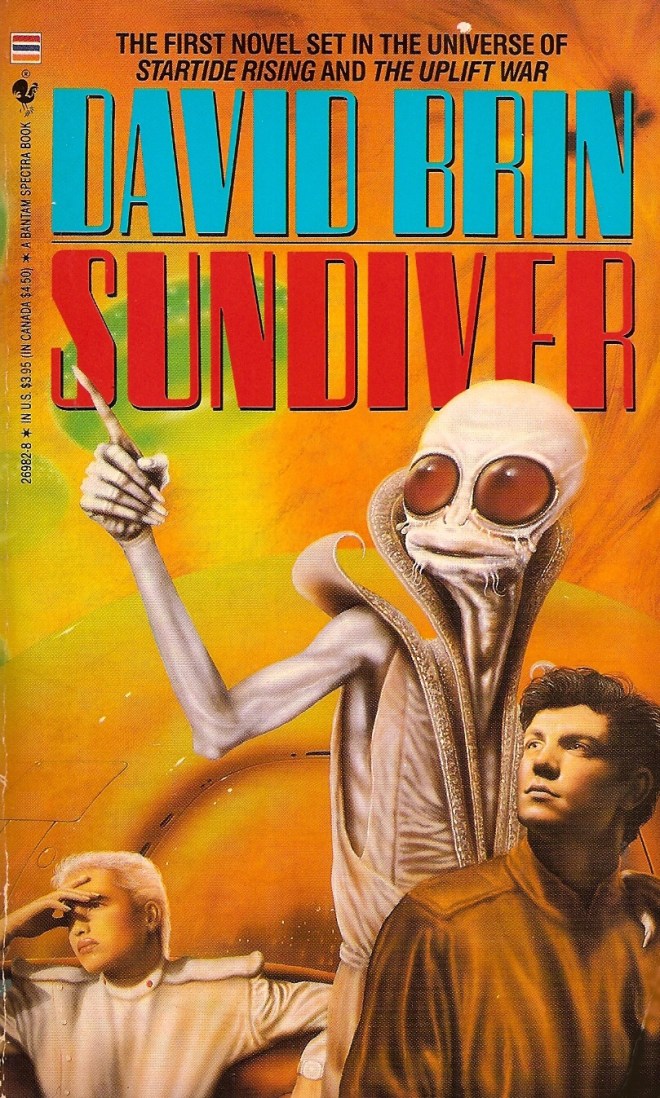
David Brin, “Sundiver” (1980) – I picked this one up at a library sale because it is the first of the Uplift War series, and A. I like to have a crack at many of the big SFF series and B. I’ve heard good things about its sequel, “Startide Rising.” “Sundiver” wasn’t great but does leave some hope that the fans of the sequel is as good as people say.

The premise of the series is interesting- a few centuries from now, Earth develops faster-than-light travel and comes into contact with a highly developed interstellar society made up of many varying civilizations. All of these civilizations were “uplifted” — brought to sentience and guided along all the way from banging rocks together to spaceships by a more advanced species. The oldest and most advanced species, in turn, claim to have been uplifted billions of years ago by the very first interstellar life forms. But humanity, playing the plucky upstart role it often does in this sort of scifi, not only developed space travel on its own but even began “uplifting” species on Earth (chimpanzees, dolphins, etc) without even knowing about the broader galactic social order. And so they mesh fitfully, if peacefully, in the galaxy, and people are still working out what to make of them.

This is all in the background. Mainly, this is a story about a crew of people and aliens investigating energy-beings on the Sun. Some people (and aliens) think these Sun-beings uplifted humans long ago, thereby fitting them into the normal galactic evolutionary scheme, some people… don’t… to be honest, it got kind of foggy (ironic, given that most of the story takes place between Mercury and the Sun!). There’s a sinister teddy-bear alien who wants to knock the earth-men down a few pegs, and a LOT of details about how to make a spaceship that can fly really close to the sun, some schemes, some really interchangeable characters… In the end, science prevails, and the mean aliens are kept from turning the neutral Sun-aliens against people. It’s slow. But it’s a promising setup, and I’m told the latter installments are brisker and take more advantage of the setup, so I’ll grab the sequel when it turns up on a used pile somewhere. **

Review- Brin, “Sundiver”

Review – Dantec, “Babylon Babies”

Maurice Dantec, “Babylon Babies” (1999) (translated from the French by Noura Wedell) – It’s not a great sign when the title of your experimental cyberpunk novel — published by “semiotext(e),” MIT’s theory imprint, yet! — has a title that makes you think of the Muppet Babies except everyone is in those big hats and beards. I thought maybe it’d be better in French — “Enfants de Babylone” doesn’t sound so dumb — but nope! Dantec gave it that English title despite the novel itself being in French.

Anyway… for a 560 page novel replete with references to literature, history, and especially high theory like Deleuze (presumably by it got translated into English by a theory-specialist academic press), I haven’t got that much to say about the actual plot. A magical girl holds the key to a future of Deleuzean schizo-something or other, where the boundaries between people, machines, animals, plants, et al break down and everything gets all freaky and liberated (but in a scary way) somehow. I don’t hate that kind of theory in the way vengeful nerds often do. Some of it I even get something out of. But more of it strikes me as posturing obfuscation, not offensive so much as uninteresting. Perhaps in keeping with the muddle of this kind of postmodern thought, it’s not entirely clear how the girl, or one of multiple hard-to-distinguish cults with an interest in her, is going to effect this change- something about viruses and genetically engineered babies? Who knows.

This magical girl (Marie- natch) needs to be escorted by the main character, Toorop, a Flemish mercenary with a philosophical bent, initially hired by the Russian mob but then wooed away to save the girl and one of the nicer cults, or… something. Honestly it got hard to keep track. At 560 pages and numerous digressions into High Theory you’re not doing cyberpunk, you’re doing cyberprog. There’s some cool stuff in here; it’s not the worst laid out near-future dystopia I’ve seen, and there’s some good twisty crime stuff. But it gets overwhelmed by sheer volume of (basically indistinguishable) characters, digressions, and just words. It’s too long and confusing to work as a novel. The translation doesn’t help- among other things, there’s mistakes even someone who can maybe quarter-read French could pick up, like translating “ancien,” as in “former,” to “ancient,” so you get stuff like “Toorop was an ancient soldier” when really he’s a retired, hence former, soldier, only in his forties. Sloppy, or “post-modern”? You decide!

I will say I’m curious about this Dantec figure. He died a few years back, but apparently cut quite a swath in French-language literature, a sort of love-him-or-hate-him kind of guy. Supposedly his real magnum opus is where he pulls a Leon Bloy and wrote something like 3000 pages about how all of the rest of contemporary French literature is awful, and written by awful people. Untranslated, alas, and even the wikipedia article in French isn’t that informative- seems to be one of those literary fights waged fiercely in its circles and not making its way out, certainly not to Anglophone schlubs like me. Apparently, Dantec was on the political right, a supporter of the Iraq War and Israel. He selects some interesting backgrounds for his characters- Toorop fought for the Chechens against the Russians and the Bosnian Muslims against the Serbs, and his two friends on his mission are an American emigrant to Israel and a Protestant militant from Belfast… the romance of small nationalisms? A lot of our contemporary very-online far right seems to prefer big nationalisms against smaller forces seen as disintegrative, ala Russia, the US, Syria… but you do get the other side too, the fantasy of breaking apart the liberal global monolith through multiple secessions of militant nationalities, eccentric enclaves and ministates, and so on, which is pretty in keeping with cyberpunk tropes… anyway, who knows if that’s what Dantec was in to, but I’m basically more interested in that than the theory-inflected stuff. **’

Review – Dantec, “Babylon Babies”