Review- Vance, “Star King” and “The Killing Machine”

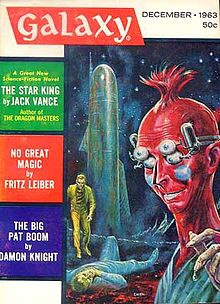
Jack Vance, “Star King” and “The Killing Machine” (1964) – I read these two on two flights back and forth cross-country. At about 160 fast-paced pages, they worked out pretty well for that time slot. They’re the first two volumes in the Demon Princes series, named after the gang of five space pirates who destroyed the village and killed the family of Kirth Gessen (related to that n+1 guy, one wonders?) who, naturally, vows revenge, one novel per Demon Prince.

The setting is classic Vance- far future, interplanetary, but comparatively low tech (there’s hand-wavey faster than light travel, but everyone still deals in cash), and a crazy quilt of planets with radically different cultures and environments. One of the conceits is that anyone with a spaceship can lift off and find an inhabitable planet, so every oddball sect or separatist group settles its own world, and stuff gets weird out there after a few thousand years.

Into this welter goes Kirth, his life given relatively straightforward meaning and rationality by his quest for revenge. The Demon Princes themselves belong to a kind of competitor species to humanity, asexual amphibians characterized by an innate drive to imitate and eventually excel the most sophisticated species they can find- which, this being midcentury sci-fi, soon comes to mean humans. They even adapted themselves to look like us. Apparently, most people aren’t that worried about it, but these Demon Princes guys decided to pursue sneaky lives of spectacular crime.

This means along with sci-fi with a certain western element (the revenge quest, frequent visits to the untamed frontiers where all the weirdest planets are), there’s a certain detective story element to each of the books, as Kirth needs to poke through clues to figure out who each of the Demon Princes are. In the first one, he finds that his quarry is hiding among academic administrators(!), and uses the promise of rights to a lucrative planet, along with some good old-fashioned goon suborning, to winkle him out. In the other, the bad guy is hiding on a planet stuck in the Middle Ages, so Kirth needs to do some knight and princess biz.

The set ups are fun and the books are quick. They give plenty of range for Vance’s worldbuilding and his baroquely courteous but sinister dialogue- like Wodehouse’s evil twin. A particular favorite, after he gets a story out of an old flunky of one of his quarries who belongs to a cult that eats rotten food and is on his way out the door: “Gersen said thoughtfully, ‘I shall now take all your money, and throw your vile food into the sea.’” The Demon Princes, naturally, rant like Bond villains on acid when caught, and their henchmen are pretty good, too.

Hard boiled heroes of the Chandler or Hammett mold are often somewhere between standing aloof from the sordid worlds they deal with and being their apex predators. Something similar can be said for many of Vance’s heroes, including Mirth. One interesting difference- Vance’s sci-fi/fantasy worlds are rendered sordid by the forces of time, decay, and petty narcissism, especially the narcissism of difference, than by exploitation as in the noir. Vance wasn’t a comrade and tended to see people as amusing, amoral beings who do a variety of fun tricks.

As the story develops it becomes clear that the Demon Princes were undone by the constant striving after greatness that their species is prone to- they can’t just enjoy life, they need to be constantly chasing more, and in their case, it’s more refined wickedness. The bad guy in the second book, the titular Killing Machine, seeks out a medieval world because he has some long-winded theory about producing the perfect kind of fear. Kirth is a relatively straightforward type, but of course, he’s aware his whole life, too, is dedicated to killing, and what happens if it’s ever over? Presumably, we’ll learn more about that in subsequent volumes. ****’

Review- Vance, “Star King” and “The Killing Machine”

Review – Dick, “The World Jones Made”

Philip K. Dick, “The World Jones Made” (1956) – Philip K. Dick! This is the 23rd PKD novel I’ve read and there’s still plenty to go. On the one hand, that sort of productivity is an accomplishment in its own right. On the other hand, the production schedule he was on — 44 novels and 141 short stories in 30 years — almost certainly helped shorten his life. The whole noble-downtrodden-genre fiction vs bad-snooty-literary fiction thing has gotten pretty tired in recent years as geek culture — much of it as pretentious, formulaic, and just generally lame as any product of the high culture bad ol’ days — has swallowed the planet. Still… you can’t help but think about how literary writers with barely a fraction of Dick’s talent or work ethic lived much cushier and longer lives. I guess there’s some compensation in that PKD lives on not just as a writer but as a legend, where his literary contemporaries are, at best, whited sepulchers foisted on poor unsuspecting English students…

Anyway! “The World Jones Made” is classic Dick, a little before he hit his best period in the early-to-mid 1960s. In the beginnings of his sci-fi career, Dick cranked out novels and stories of post-nuclear wastelands. These weren’t the kind of fun lawless zones of Mad Max. These were the sort of dour postwar scenarios imagined by the likes of Herman Kahn and other nuclear strategists- buckled down, regimented, productivity-driven, stolidly trying to ignore the horrors of environmental destruction and mutation. Dick could turn the crank and produce one of these horrifying worlds as a setting, and then drop in something odd, something philosophical and uncanny.

In “The World Jones Made,” there’s two such somethings. In something of an aside that joins the main plot in the end, we read of the tiny lives of humanoid creatures genetically engineered to live on Venus, with the usual angst about being created beings. But the major premise of the story is the titular Jones, a small time carnival sideshow who turns out to be able to predict the future perfectly- but only one year at a time. The post-war world had been ruled over by a global regime espousing “relativism” — the war having been caused by political and religious fanatics, the world government locks up anyone who declares their opinions to be fact, unless the holder of the opinion can prove it. Well, Jones can, and a movement rapidly springs up around him which overturns the regime. Dick thought hard, if not necessarily in a professional academic vein, about Nazism, and there are shades of that here… and shades of them overthrowing a global-oriented “relativist” elite that can’t see it coming. Maybe Jones wasn’t the only one who could see the future…

But, there’s some disadvantages to seeing one year and one year only into the future. For one thing, Jones can’t change anything. He, and everyone else, is locked in. This makes him a miserable, sour fatalist, along with whatever else. Within a year of his death, Jones starts seeing — experiencing — his own decay, and no one does the horror of decay like PKD. Moreover, Jones can’t deliver on any of his promises to his adoring crowds… and he knows it. The best he can do is wreck the previous system, seemingly more out of spite than any other reason.

Most of the viewpoint characters other than Jones are standard early-Dick protagonists, nondescript cops or investigators with considerably more interesting women in their lives providing a certain degree of uncertainty (PKD was married five times). How Jones’s precognition fails — how he gets killed — isn’t made that clear. Writing his way out of his own premises was never PKD’s strong suit.

What PKD was nearly uniquely gifted at, and what assures his place in the pantheon of great sci-fi, was constructing worlds of dread and fascination. Some people ding his prose style and character work, not without reason. But the things he wanted to get across — on the positive side possibility, on the other hand the lived experience of fear, decay, being trapped, living paradoxes — he gets across as well as any writer, and he does so in fine form here. His stories make us ask questions about our own experiences, and without the pretense or hippy-dippy rigamarole that “questioning reality” literature usually implies. *****

Review – Dick, “The World Jones Made”

Review- Sagan, “Contact”

contact.jpg

Carl Sagan, “Contact” (1985) – Carl Sagan seems like he was a good old guy. Everyone loves “Cosmos.” He was a humanist of the old, gentle school, like Kurt Vonnegut and Stephen Jay Gould, before things got as mean as they’d become around the beginning of the twenty-first century. One account I’ve heard says Sagan deliberately fudged the science to depict nuclear winter as more of a possibility than it really was. If that’s true, good for him- any nuclear war would be bad for people in general, but if the elites with their fingers on the buttons thought they could’ve gotten away with such a move with their power intact, they would have been more likely to try it.

So, he was a good guy. A novelist he really wasn’t. In theory, “Contact” is about, well, contact between Earth and aliens. But you get a lot less of that and a lot more of meetings. These are mostly meetings between assorted science bureaucrats and government bureaucrats, mostly. A lot of stories from the 1980s and 1990s dwelled lovingly on various large bureaucratic organizations — corporations, the Pentagon, the presidency, especially the FBI — that framed what were meant to be thrillers. This works less well in prose than on the screen. While it’s doubtless true that there would be a lot of international bureaucratic wrangling as assorted actors figure out how to deal with a message from Vega, it’s not even particularly conflictual in the book. He introduces characters with paragraphs-long infodumps about their institutional trajectories and hobbies. It’s something of a slog.

There’s a little more in the way of religion-science conflict once assorted preachers start exploiting contact-mania and interfering with efforts to respond to the message. But even then, the main religious guy is actually pretty sympathetic and mostly challenges the worldview of the scientist main character in a positive way- a notable difference from what you’d probably say if one of our current generation of public scientist figures gave that plotline a whirl. The other likely point of interest in such a story — the big reveal of the aliens — is reasonably interesting and meshes nicely with Sagan’s broader concerns- peace, progress, unity, etc. But little enough really comes of it. In all, an interesting concept by a good guy but it doesn’t really work as a novel. **

Review- Sagan, “Contact”

Review- Heinlein, “Starship Troopers”

starship-troopers

Robert Heinlein, “Starship Troopers” (1959) – At bottom, science fiction is about exploring possibilities. The corpus of scifi has explored an exhaustive range of facets of existence, playing with everything from consumer technology to the structures of race and gender to the nature of time and space, in the full range of emotional registers. And it’s a project shared across the spectrum of writers, from exalted masters ala Le Guin, Delaney, and Dick to the lowliest fanfic scribbler. It’s genuinely one of the nice things about the twentieth century, warts and all, and one of the few we actually got to keep, in a real, vital way, in to the twenty-first.

So what possibilities does acclaimed science fiction icon Robert Heinlein imagine for us in “Starship Troopers,” then? Where does he go from that established jumping-off point for limitless possibility, humanity’s exploration of the stars? Well, mostly, he imagines boot camp. Endless endless boot camp, described by Heinlein’s impersonation of a happy-go-lucky grunt (Heinlein was an Annapolis grad and a navy officer who never saw combat), an update of Rudyard Kipling’s cockney Tommy ventriloquism. There’s a huge war in space going on — multiple wars, it seems — but none of that matters except as a rationale for boot camp and for a society seemingly organized around boot camp. There’s maybe fifteen pages of battle in the whole book, including maybe ten pages in the beginning. The rest is boot camp, and a lot of that is actually lectures about life and society. This is closer to a pedagogical novel than a war story.

The content of these lectures Heinlein puts in the voice of older authority figures bestowing wisdom unto the perspective-dullard — the primacy of force and the existential validity of its wielders — is less off-putting than the tone and context in which it’s delivered. Heinlein may have seen himself as critiquing late-1950s consumer society but his philosophers of the spartan life speak like they came off the tv of his period; bluff, bouncy schmaltz, scout-master-meets-snake-oil salesman. The society in which Heinlein’s rules have been applied — only veterans can vote, corporal punishment is liberally applied, and most of all, old fucks who think like him are paid and encouraged to babble at length and totally own anyone who challenges them — isn’t really all that different from the society in which Heinlein lived, except people are as a whole happier. Sometimes evil aliens will paste a city but we all know the powersuit boys will paste them right back (not that Heinlein is going to let us enjoy much of it).

What that contrast tells me is that Heinlein means it. He’s not doing a thought experiment, he’s not doing satire, we don’t need to apply “Niven’s Rule” (Niven was another middlebrow fascist slug, anyway) of separating the views of the author from the views of the narrator. If this shit was imaginary for him, he’d try extending his imagination. If anything, the idea of “service-guarantees-citizenship” is much less grotesque than the combination of unimaginativeness, dullness (seriously- just give us some fucking space battles, dude), and chipper banality with which his ideas are expressed.

The militarism is just a vehicle for what Heinlein really cares about in this book- the defense and extension of a world that suits him (1950s America but a little hornier and in space), and the humiliation and extinction of people with ideas that make him uncomfortable. To be honest, I think the dynamic we see here — people smart enough to think about the world around them but deeply scared of the implications of what they think seeking intellectualized schmaltz to form a security blanket — drives an increasing amount of right-wing thought today. It’s a sad irony a lot of those people invest in science fiction, which is supposed to be about impetuous imagination.

I wanted to like this book, or at least like it a little more than I did. I like a lot of work I disagree with much more than the actual content of this book (the boy scout tone really is skin-crawlingly off for me, I’ll admit). Heinlein also helped keep Philip K. Dick solvent, even after PKD made fun of him all the time, so I want to like the guy. He seems like a good sport. And there are a lot of great right-leaning speculative fiction writers: Lovecraft, Tolkien, Herbert, Vance, Wolfe, Simmons, Stephenson. They create imaginative worlds, mount incisive criticisms, weave intricate plots, are compelling writers. None of this applies to “Starship Troopers” (and only applied a little bit more to “Stranger In A Strange Land,” the only other Heinlein I’ve read, which is best described as “‘Starship Troopers’ for horniness instead of the military”).

Paul Verhoeven showed a much greater degree of fealty to what science fiction is supposed to be about when he took this dull book for raw material for an actually great scifi movie, which is a brilliant satire of the fascist undercurrents both in the book (and scifi in general) and in our society. The movie has humor, it has the courage and brio of Verhoeven’s insane choice to make a movie undermining it’s own source material in what’s supposed to be a dumb action movie, and it has actual… space… battles which, I’d like to stress, the novel basically lacked. Having read the source material, I can now definitively say “Starship Troopers” beats out “The Godfather” or “Children of Men” for the ultimate case of a movie being better than the book.

Gotta say… nothing disappoints more than getting boring fascism when you expect the more interesting literary kind. *’

Review- Heinlein, “Starship Troopers”

Review- Liu, “Death’s End”

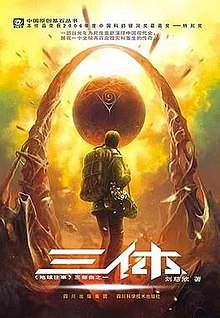
deaths_end

Liu Cixin, “Death’s End” (translated from the Chinese by Ken Liu) (2010) – At one point in Kurt Vonnegut’s “God Bless You, Mr. Rosewater,” his roving guilt-ridden alcoholic millionaire narrator Eliot Rosewater crashes a science fiction convention. He drunkenly praises the assembled writers as “the only ones who’ll talk about the really terrific changes going on,” “the only ones zany enough to agonize over time and distances without limit.” Eliot admits that the scifi writers “couldn’t write for sour apples” but still holds them in high esteem next to the modernist boobs his foundation generously funds: “the hell with the talented sparrowfarts who write delicately of one small piece of one mere lifetime, when the issues are galaxies, eons, and trillions of souls yet to be born.”

Liu Cixin is exactly the sort of writer Vonnegut had in mind, fifty years after the fact. His “Remembrance of Earth’s Past” trilogy (though apparently everyone in China — where apparently it’s near Harry Potter levels of popularity — just calls them the Three Body Problem books) spans hundreds of years (technically millions) and concerns at least three or four interstellar civilizations and dozens of important characters. “Death’s End,” the last, longest volume, could easily be a trilogy itself, dealing with at least three distinct phases of Earth’s struggle with its first alien contactees, Trisolaris, and against the predatory Hobbesian chaos which Liu depicts as the cosmic baseline. The scale — and the abandon with which Liu throws himself into it — is worth the price of admission for people with that particular itch. You know who you are.

Liu also fulfils the other part of Eliot Rosewater’s soliloquy on scifi. It’s too much to say he “can’t write for sour apples.” Among other things, he might be a shit-hot prose stylist in Chinese and get lost in translation, but even with that he gets across some of his crazy shit in space in fine aesthetic fashion. But his characters are, by-and-large, thinly drawn, especially in this last volume as compared to the first. It’s almost as though as the action leaves Earth, the characters leave human emotional reality… which is something Liu would agree with, to judge from some events in the book (generation-ship passengers getting all weird), but not in the way I mean.

At bottom, characters in “Death’s End” are extensions of and stand-ins for Liu’s main concern, technological models for humanity’s future in space. The main character, Cheng Xin, is an astrophysicist from our time who, due to (oddly convenient) hibernation technology, winds up alive, awake, and relevant to stages in human development centuries apart. She is also the receptacle for Liu’s ideas about gender, which take a much more central role in this book than in its two predecessors.

Cheng Xin is brilliant and morally good- too good, Liu argues, basically because she’s a woman. Twice, her compassion and unwillingness to end lives lead her to immensely destructive decisions. The first time she refuses to hit a deadman’s switch that would lead to the destruction of both Earth and its Trisolaran invaders. Trisolaris nearly destroys humanity but is stopped by people — men — outside of Cheng’s decisionmaking power doing some dimensional biz. The second time, she does the one thing a nerd like Liu will never forgive- she declines to invest in faster-than-light travel. There’s many risks involved in FTL (including potentially alerting uber-powerful galactic neighbors), and once again, Cheng’s femininity won’t let her take them. Then, wouldn’t you know it? Some other alien species entirely sends a weird thing that turns the Solar System into a flat stanley — a dimensional weapon — and people can only get away on faster than light ships! If only that lady hadn’t stood in the way of science with her lady-concerns!

For what it’s worth, Liu doesn’t indulge in the troweling-on you get in other (Anglophone) scifi. In fact, he doesn’t clearly blame Cheng at all- several surviving characters (there are still a few humans around, due to earlier interstellar voyages) point out that the decisions she made were complicated and no one could know the right choice. They also point out that an interstellar future for humanity isn’t necessarily an unalloyed blessing- the universe is a dark place, full of super-powerful, amoral space powers constantly doing insane things to each other like turning other civilizations into Flat Stanleys or slowing down the speed of light somehow. But the basic conflict in the book still hinges on gender essentialism- Cheng’s essential femininity (in the storied tradition of gender essentialism, held to be the sole possessor of virtues men like to profess as good but don’t want to actually have, like compassion) vs the cold hard logic of men/the cosmos.

I don’t know where the gender conversation is at in China, or where Liu is in the Chinese gender conversation. But you don’t need to be a radical critic of gender roles to get that there’s some pretty hard women (and a lot of men who maybe aren’t the suicide-bomber type) out there. You’d figure anyone would be able to consult their own experience — or, failing that, watch the news — to get that point. Like Paul Cao, who tipped me off to this aspect of the book when I reviewed its predecessor on here, I look forward to reading a thorough feminist critique of the series. I’m not equipped to do that myself.

So, where are we at the end of the Three Body Problem? We’re in a space of infinite possibility — Liu has a gift for imagining awe- (and terror)-inspiring feats of science and engineering — and bottomless fear. There’s no real solution to the Hobbesian mess of the “Dark Forest.” No one opts for Iain Banks’ fully-automated gay space luxury communism, or if they do they don’t last. The more advanced space civilizations — the kind that can unilaterally rob a solar system of one of its dimensions — aren’t any more enlightened than the Red Guards whose actions in the Cultural Revolution impel Ye Wenjie to start Earth down the path into the Dark Forest to begin with. A certain degree of escape is possible — if you can flatten three-dimensional space, you can also carve out bubbles in time — but even that endangers the rest of the universe (though you have to wonder why anyone with the opportunity to quit the game would care about the other players- that’s kind of the point). Arguably, we need to chuck the universe and start again at a higher dimensional plane- that’s the closest to hope Liu holds out.

What happens to the Solar System and most of humanity due to Cheng’s soft-headed refusal is depicted in such a horrific, pathos-laden manner that it’s hard not to reflexively wish Cheng hadn’t put the kibosh on lightspeed. But on the time scale of the universe, he tells us, it barely matters. There’s still almost a hundred pages of book left after the Solar System and most of humanity gets 2-d’d, after all. Liu clearly sympathizes with the hard-headed (read- nerdish) men who want to take to the stars. But his pessimistic take on the universe won’t let him depict expansion as the key to utopia. Survival is closer to a universal law in Liu’s world than anything else (certainly more than the supposedly base-line speed of light!)… but survival, and the universe, is morally disinterested and highly dangerous in its own right… and we’re stuck with it. ****’

Review- Liu, “Death’s End”

Review- Liu, “The Dark Forest”

darkforest

Liu Cixin, “The Dark Forest” (2008) (translated from the Chinese by Joel Martinsen) – At the end of “The Dark Forest,” we’re something like 900 pages in to Liu’s trilogy of contact between Earth and an alien civilization, and no Earthling has laid eyes on a Trisolaran! But in many respects, that’s beside the point. Here, Liu provides a new take on one of the classic themes that scifi tackles and that literary fiction occasionally dips a dilatory toe in: the horror of scale, the disjuncture between the sense of proportion — in terms of space, time, complexity, diversity, our own expectations, you name it — that we carry with us and what our discoveries tell us about the universe.

The book sprawls across multiple centuries and a number of attempts to come to grips with the coming invasion. They call Liu a “hard” scifi writer, as in he tries to keep things closely tethered to real science. I don’t know science well enough to say how much he does or doesn’t, but it seems science-y enough… though major new technologies come about at pretty convenient times. So cryogenic hibernation allows viewpoint characters — like feckless sociologist and possible savior Luo Ji — to hang around various important points in the four hundred years between when Earth discovers the aliens and when they show up.

A lot of interesting stuff — anti-alien schemes mooted (by “Wallfacers,” charged with coming up with planetary defense schemes in secret) and betrayed (by “Wallbreakers,” who aren’t the Kool-Aid Man no matter how much it sounds like it), tragic failures, rises and falls of global societies, terrible space massacres — occurs but the broad scale is also setup for the point Liu it trying to make. Jeet Heer, of all people, wrote something interesting recently where he said “hard” scifi, even more than “soft,” almost invariably has a religious charge to it. It reflects the desire to see science and technology take the role religion once did in promising transcendence.

Liu is deeply skeptical of humanist values in the face of the problems of scale upon which he built this series. The thing that saves Earth — for a time — isn’t any particularly clever scheme or bold move. It’s Luo Ji, the last Wallfacer (who mostly used his powers to acquire a waifu — Liu’s gender perspective isn’t much more encouraging than the rest of his worldview — and mess around) who comes to see the Hobbesian nature of galactic-scale life. He saves the day by essentially holding both Earth and Trisolaris hostage by the simple expedient of threatening to advertise their position to the wider universe and all of its predators. This is the titular “Dark Forest” — the universe.

That sounds depressing — it is depressing — but from Augustine’s day to Flannery O’Connor’s to Liu’s, some of the people with the most depressing worldviews hold out some of the highest hopes of existential deliverance from outside of consciousness and ego. Somewhere between emptiness and love, Liu carves out a space for hope at the end of this generally quite dark, “Empire Strikes Back” part of his trilogy. All of that is a little too Buddhist for me to really get whether it makes sense or not but it works pretty well as far as these novels go. ****’

Review- Liu, “The Dark Forest”

Review- Liu, “The Three-Body Problem”

3body

Liu Cixin, “The Three-Body Problem” (2007) (translated from the Chinese by Ken Liu) – When you think about it, for most of human history, if the aliens came and wanted to talk to anyone, they’d probably want to talk to China. It just so happens that the rise of scifi as a genre occurred at a time when China was weak and domineered by other powers. Liu Cixin corrects the imbalance in this book, and reconstructs the classic contact narrative while doing it.

The first two thirds of the book involve two narratives told in tandem. We hear the story of Ye Wenjie, an astrophysicist who witnesses the chaos of the Cultural Revolution but who survives to get involved in China’s revolutionary version of SETI (Search for Extra Terrestrial Intelligence). We also follow a contemporary scientist, Wang Miao, as various weird stuff starts happening. Scientists are killing themselves in numbers, Wang and others suffer weird hallucinations, and he gets sucked into a sinister online game where players try to solve one of the hardest problems in astrophysics- working out the gravitational pattern of the titular three bodies. Wang and other gamers try increasingly ingenious schemes to save a planet from getting messed up by its three suns in various ghastly ways, but always wind up getting owned. Liu makes good use of a classic post-classical scifi trope, the sinister-ass video game.

The stories come together as it becomes clear something with power greater than anything on earth is making itself felt. We learn a secret channel has been established between Earth and its nearest interstellar neighbors, and without giving too much away, this link is animated by dangerous combinations of disgust with life on their respective planets with delusions about what can make things better. Both Earth and Trisolaris (the other planets) are harsh worlds, inhabited by people who can only see salvation off of their respective planets, both sets of whom are bound to be disappointed. One way or another, the collision between the two worlds has been set in motion.

For the most part, the book is setup for the sequels, when the cards come to be more on the table and perhaps we see how this conflict shapes up. This leads to a certain anticlimactic quality. Liu writes in very straightforward prose with occasional rhetorical flourishes that wander into naivety- not unlike some engineers I know, when they want to make a point. At first this can be distracting. It starts to really work, though, as a fitting mode for the paranoia, cosmic insignificance, and intimations of (deserved, transformative, in some cases longed-for) doom that his scenario entails. Two beautiful scenes in particular — one where Ye confronts the Red Guards who murdered her father only to find old, haggard, unrepentant people insisting that history would forget, and another where Wang endures the peculiar sort of reassurance offered by a Chinese scifi writer’s depiction of a Marine officer during a horrendous calamity — I think will stick with me for some time. In general, there’s good reason to believe the Liu hype (I feel I say that a lot about writers- what can I say? I pick good ones) and I look forward to reading the next one. ****’

Review- Liu, “The Three-Body Problem”

Review – Vance, “The Asutra”

asutra

Jack Vance, “The Asutra” (1974) – The end of the Durdane series takes the hero, Gastel Etzelwane, far from home to figure out the secret of who’s been sending weird murderous aliens to mess with his homeland. Accompanied, sometimes, by a supercilious and self-serving historian from Earth, he first ventures to a distant continent and then is shanghaied to a faraway planet.

He finds out the truth, but one thing about Vance is that he’s a pretty strong skeptic of the notion that the truth sets anyone free. Enslaved on a faraway planet, Gastel finds that his world was little but a source of raw (mostly human) material and a site for experiment for two rival but symbiotic alien societies. The titular Asutra, brainbugs that exist parasitically on other species, and the Ka, a put-upon society from a gross swamp planet that used to be enslaved by the Asutra before turning the tables, have shaped the destiny of numerous planets in their efforts, mainly to dicker each other out of one crappy swamp world. The Asutra want the world because they had it before and think it’s nice (they have others); the Ka want the world because it’s their ancient homeland, and their entire culture is encapsulated in a 20,000-canto epic about how shitty it is but how much they love it. The depiction of the Ka is one of the better scifi depictions of wounded, small-nation nationalism I’ve ever seen.

Gastel, enslaved by the Ka, does his thing- looks for opportunities, and plays music (specifically, the Song of the Ka- the Ka reward slaves with leniency if they can learn bits of the Song). For the second time in three books, Gastel overcomes the inertia of an imprisoned people to lead a rebellion. For the second time, he succeeds. But for the second (and for the series, final) time, he finds that while rebellion improves his personal fortunes, the structures remain unchanged. After daring escapes and desperate battles, he and his fellow prisoners slaves are freed essentially as the result of an unseen negotiation process that didn’t have them in mind at all. He returns to Shant and the parliament he put in place is bickering. He — and his homeworld — are just as caught in the dynamics of history (not just human, but natural history too) as they ever were. The best he can do is take up music again.

The Durdane series (and much of his other work) places Vance squarely in the tradition of universal pessimism that runs like a black thread through speculative fiction. Unlike others in the tradition, like Lovecraft, he handles it with a light touch- inspired by that other great artist of the circular life, P.G. Wodehouse. He very cleverly uses the traditional tropes of pulp scifi — the individualist hero, the bold rebellions, the implementation of “progressive” change — to engage the reader in a bait and switch. It’d be easy to write the hero failing. But the hero succeeding, and for it not to matter in the face of a big, weird cosmos? And for the whole thing to be a lot of fun anyway? That’s what sets Vance apart and what makes the Durdane series more than the sum of it’s parts. ****’

Review – Vance, “The Asutra”

Review- Vance, “The Brave Free Men”

tbfm

Jack Vance, “The Brave Free Men” (1973) – I’m a sucker for a weird subgenre of story- those about someone organizing and leading a small, unlikely army and overthrowing one or another long-held societal arrangement. Bonus points if it’s ideologically simpatico — a revolutionary people’s army, say — but I’ll take it even if it’s just private kingdom building. What can I say, I like a good story about delegation! Usually the prose is disappointing in these stories and the dorks who write them — often frustrated wannabe (or actual) military officers — can’t restrain themselves from going on at tedious length about maneuvers across imaginary, indifferently-related maps. But I’ll still give them a look when I see them.

The second installment of Jack Vance’s “Durdane” series finds our hero, Gastel, organizing just such a force, the titular “Brave Free Men,” to repel a rapacious horde of not-quite-orcs, the Roguskhoi, from destroying Shant. He has his work cut out for him. Shant has plenty of aristocrats (and killers) but no military tradition. The descendants of religious and ideological enthusiasts dumped onto a colony planet millennia ago, the inhabitants of its Shant’s various cantons concern themselves with maintaining their various arbitrary cult rules and general societal stasis.

Anyone familiar with midcentury scifi knows much of what happens next. Gastel and the few men he can trust have to overcome the hokum and conservatism of their backward culture. They do this largely by freeing indentured servants and enlisting them in the titular army. There are various technical challenges to overcome, betrayals both suspected and real, people telling them Shant can’t change and the heroes telling them it has to, etc.

What distinguishes Vance’s take on this plot is skepticism of the enterprise. In the end, the mobilized people of Shant beat back the hordes. Gastel sets up a new government with a parliament (but with no house apportioned by population, I noticed!). But the big reveal in the end — where the Roguskhoi came from — reframes the whole existence of Shant. Without giving too much away, it’s revealed that the hordes that almost destroyed the planet were somewhere between a joke and a speculative venture by powers much bigger and colder than anything Gastel can conjure up. If Shant is nothing but a dumping ground or playpen for amoral interstellar empires, then what larger purpose does change serve? Well, presumably we’ll get some kind of answer in the third and last book. ****’

Review- Vance, “The Brave Free Men”

Review- Vance, “The Anome”

anome

Jack Vance, “The Anome” (1973) – Vance was a master of building baroque worlds of stasis, decay, and a sickly kind of wonder. In the Durdane trilogy, he depicts the realm of Shant, a long-abandoned colony planet divvied up into cantons, each governed by a different cult rigorously pursuing one or another set of arbitrary rules. Overseeing all is the “Faceless Man” or “Anome,” who enforces the division and cultural stasis of Shant through the simple expedient of a device that explodes the heads of anyone he pleases. It’s implied this state of affairs has gone on for some time.

Vance never stints on the human element of what makes his societies go, mostly in terms of the personal dynamics of domination and collaboration. The canton the hero grows up in is run by a cult of misogynist male ascetics, who loll around on hallucinogens while forcing women and children to do all the productive and reproductive labor. The vanity of degeneration is one of the affects Vance is best at conveying, and it’s at its skin-crawling (and sometimes hilarious, in a harsh kind of way) best here.

Anyone who knows classic scifi knows what comes next- the individualist hero, a bold, moody young man with big dreams and a disregard for established mores, strikes out on his own. Gastel Etzelwane skips out on the cult (refuses to be a “Pure Boy,” which I kept reading as “Proud Boy”- I’m sure the canton authorities also frowned on masturbation lol) because they make him abandon his mom and are generally dicks. He has various misadventures out in the world, which to be honest are a little disappointing- I would have rather seen less airship shenangians and more depictions of different cantons with their own weird rules and cults, at which Vance excels. Shit gets real when barbarians roughly in the orc mold — the Rogushkoi, big, ugly, mean, rapacious — invade Shant, killing various extras and also Etzelwane’s mom. The Anome doesn’t do anything about it, presumably because organizing an army between all his weird little cults would be too disruptive.

Etzelwane has to find a way to prevail upon the Faceless Man to do something. But how to find a dude who is faceless? Is this rando who keeps popping up in his life to alternately frustrate or aid him the Faceless Man, or just a rando? Will all this mean that Etzelwane will have to take power himself, and then disrupt the shit out of this classic scifi backwards-irrational planet with some good old-fashioned bourgeois revolution? You know it will- in the sequels. ****

Review- Vance, “The Anome”