Review- Ngũgĩ, “A Grain of Wheat”

grain

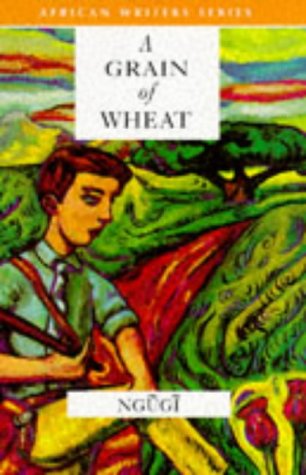
Ngũgĩ wa Thiong’o, “A Grain of Wheat” (1967) – Few people really know what to do with Kenya’s decolonization struggle. No one looks good. The British “won,” but did so through the application of mass internment and terror- years after a British judge sat in judgment at Nuremberg and sent the leaders of a rival empire to the gallows for similar crimes. They covered it up well, largely by publicizing the bloodier Mau Mau killings, but these things reemerge. The Kenyan government, which was essentially handed power by the British a few years later in exchange for major concessions, doesn’t like its people to think too much about Mau Mau. The international Left doesn’t really know to process an uprising by an autochtonous, secretive, semi-religious group with few links to any of the established strands of thought or organizing- “The Kenyan Revolution” isn’t even a phrase, as I’ve seen. The Mau Mau themselves and the Kikuyu people they emerged from were, of course, brutally suppressed and terrorized and then lived under dictatorship of Kenyan leaders unfriendly to the memory of the uprising, and didn’t have the best avenues to tell their stories.

One who found a way to tell some of the story is the great Kikuyu writer Ngũgĩ wa Thiong’o, and he paid for his impertinence- he was jailed by the Kenyan government and exiled after that for twenty years. In “A Grain of Wheat,” Ngũgĩ tells the story of several members of a rural Kikuyu community on the eve of the formal handover of power. The Union Jack is going to come down, the red, green, and black of Kenya is going to come up, and presumably everyone should be happy.

Of course, people are actually unhappy. One of the great strengths of this book is getting across the sheer trauma of going through a brutal insurgency war like the Mau Mau Uprising. There’s the trauma of having fought, having seen friends die, being interned and tortured, and there’s the terrorizing of the community as a whole. Counterinsurgency works by turning communities against themselves, and the British were viciously effective at this, across much of the world but especially in Kenya. You get flashbacks to the war, but more affecting to me was the description of the aftermath. Ngũgĩ masterfully takes you into the experience of characters like Mugo, hailed as a martyr for having gone through the camps, who wants to be left alone in his hut, and Karanja, who experiences the terror of having collaborated with the British — this overwhelming source of power and terror — only to have them leave without so much as a goodbye.

Most of all, Ngũgĩ depicts the ways in which insurgent struggle renders any sort of life we would normally choose to live impossible. Mugo is defined by two choices that would be completely ordinary under normal circumstances. A man came into his house with a gun after having shot somebody and made him an accomplice in hiding him, so he alerted the authorities; a soldier was abusing an old woman, so he spoke up. One of those actions made him a traitor, the other made him a martyr, and between the two they tear his life apart. Everyone in “A Grain of Wheat” is riven by similar experiences.

And what’s worse, there’s the sinking feeling throughout the book that independence will not be all its cracked up to be. The British cut their deals with moderates and sharp dealers to keep the rich agricultural land they stole from being redistributed to the people as a whole. The old guerrillas, with their odd noms de guerre and comparative lack of interiority, still mouth the old slogans but are clearly trying to clean house, get their revenge on traitors, before a new regime acceptable to the superpowers comes in and forecloses both on their possibilities (and likely freedom) and on the promise of decolonization. Kenya doesn’t offer easy answers, and neither does Ngũgĩ. *****

Review- Ngũgĩ, “A Grain of Wheat”

Review- Alexievich, “Zinky Boys”

zinky

Svetlana Alexievich, “Zinky Boys: Soviet Voices from the Afghanistan War” (1991) (translated from the Russian by Julia and Robin Whitby) – This is a real damn bummer, even for someone like me used both to bummer reads in general and bummers about grinding occupation wars specifically. Nobel-winning journalist Svetlana Alexievich compiled a short, brutal selection of accounts of the disastrous Soviet war in Afghanistan from soldiers, civilian workers, and most crushing of all, mothers of soldiers. Alexievich won acclaim for positing war as a social phenomenon, and particularly by putting forward the experiences of women in the Soviet Union’s wars. This produces a much richer perspective on war than one usually gets. “Zinky Boys” (so named for the cheap zinc coffin so many Soviets came back from Afghanistan in) forms a sort of phenomenological experiment in understanding the Soviet experience of this war.

Almost the entirety of the book is first-hand accounts, with brief paragraphs of framing from Alexievich’s perspective in a handful of places. I’m used to reading accounts from Vietnam, the war most often compared to the Soviet-Afghan war. There are similarities: the terror and confusion of guerrilla war where you can’t separate friend from foe; the guilt, or defiance of guilt, or sometimes both in the same person, over a failed war fought under false pretenses but which inevitably becomes a meaning-freighted experience for the people who went over; the naive patriotism and desire to live up to memories of WWII exploited and betrayed; the breakdown in morale among the troops, corruption, drug abuse, hazing, the general feeling of a lawless nether zone. The soldiers are caught between their own feelings of guilt and betrayal and their determination to be treated as people, not as victims or criminals or symbols- also familiar to Americans from Vietnam and after.

But there were some salient differences, and perhaps this is just me being determinist, but a lot of them seem to boil down to the difference between a power at the height of its strength undertaking a wasteful guerrilla war and one doing the same as it’s in terminal decline, as the Soviet Union was. The American effort In Vietnam was confused and wasteful, but with nothing like the complete failures in supply and logistics the Soviets experienced- if anything, the Americans were oversupplied. This made major differences for Soviet troops, many of whose accounts involve scrounging or bartering for necessary supplies, or running afoul of veteran gangs who monopolized food or ammunition. There was significantly more feeling of being overwhelmed by the enemy in “Zinky Boys” than you get in Vietnam accounts, where it was always understood the Americans were stronger, just unable to bring its strength to bear.

The weakness of the Soviet state going into Afghanistan can also be viewed ideologically. Most of the soldiers going in to the war report they believed what they were told about it, but when they came back, they ceased to believe in pretty much anything but, perhaps, the validity of their own experience. You saw some of this in the US as well, but the post-Vietnam state was strong enough — and the conservative movement opportunistic enough — to turn feelings of post-Vietnam angst into a bolster for the American security state, where once it threatened to undermine it. The closest the Soviets came to a similar trick was the police turning to gangs of “Afgantsi” to beat up troublemakers, but that was more of a sign of decline than anything else. Maybe part of it was it was harder in the USSR to pretend that the soldiers had been “stabbed in the back” by civilian protest, which wasn’t much of a factor. Alexievich got plenty of criticism from Soviet patriots, but most of it of the “stop making us look bad” variety.

More than anything, this is an important document because Alexievich got people to speak very frankly, and then stood aside and let them speak for themselves. There’s a lot of raw honesty here; painfully raw especially from the mothers, who are open about their grief in a way I can’t say I’ve seen anywhere else. I know I just wrote a bunch of analysis — force of habit — but really, this is more of a book to be experienced. *****

Review- Alexievich, “Zinky Boys”

Review- Ha Jin, “War Trash”

war trash

Ha Jin, “War Trash” (2004) – This is a pretty good novel set during the Korean War. The protagonist is a Chinese “volunteer” officer who is captured by the Americans. I’ve read a few memoirs and novels about war by people who were there, and I suspect Ha Jin has too. He gets across a lot of the main themes you get from works from people who actually go through war and/or internment: confusion; weariness, and especially hunger, and the concomitant joy of food; small funny moments in what is largely a very bleak world; complex social dynamics driven by despair, officiousness, and petty sadism. You don’t get the fake redemptive narratives or triumphalism or other sentimentalisms you get in war writing from those who write about it from a distance (see: Hollywood).

The human element in “War Trash” mainly plays out in the dilemma faced by Yu Yuan, the main character- align himself with the Communists, who run his homeland, or the Nationalists, who run the camps with the connivance of the Americans. Yuan mostly just wants to go home to his fiancée and mother and is not notably ideological. War and camp conditions make both sides bitter, fierce, and vindictive. There’s a theatricality to the Nationalists’ atrocities — showy torture-killings of those prisoners who’d rather go home to China rather than repatriate to Chiang’s Taiwan, forcibly tattooing waverers with anticommunist slogans to make it impossible to send them home — lacking in their Communist counterparts. That, and his desire to return to the mainland, send Yuan to the Communists. They’re depicted as having their shit together, relatively speaking. But ideology has its costs- knowing that they’re depicted back home as traitors and insufficient communists for the crime of having been captured, the communist leaders in the camp mount increasingly foolhardy and bloody resistance campaigns, getting dozens of their own people killed for pretty much nothing and ruthlessly suppressing criticism.

In the end, it’s all for nothing- the war ends, the prisoners are repatriated, and for all the sacrifices the communist prisoners made to resist their captors, they’re still treated as officially suspect. If anything, it’s easier for Yuan, not having been a party member before- he had less to live up to. Yuan is depicted as writing the story as a memoir when he’s an old man in America, staying with his kids. The Americans in “War Trash” come off as somewhat ignorant and childish — one of the officers who interrogated Yuan at one point has a plaster bust of his own stupid head he paid a prisoner to make — but the closest to satisfaction Yuan finds is sending his kids to their country for school and then going himself. This might borrow from Ha Jin’s own experience- one of the major literary figures of the generation that came to prominence around the Tiananmen Square massacre, he currently teaches at BU and lives, in all places, in my hometown of Foxborough. These sort of war stories usually lack a “good” Hollywood resolution, and this ones not an exception. ****

Review- Ha Jin, “War Trash”

Review- Jamba, “Patriots”

jamba

Sousa Jamba, “Patriots” (1990) – As John Dolan (from whom I learned about this book) has observed, the messier a war is, the more productive it typically is in literary terms. World War I was pointless and inconclusive compared to World War II, but writings from the former is definitive to modern literature and writing from the latter isn’t. The Vietnam War was better for literature than the Persian Gulf War, and so on.

The Angolan Civil War from 1975 to 1990 (and with subsidiary fighting lasting until 2002) was profoundly messy. Three major factions, spillovers into neighboring countries, foreign boots on the ground, funding and support from actors ranging from the US to China to Israel to Mobutu’s regime in Zaire, tribal politics, somewhere around a million dead and the country littered with landmines… Alas, Angolan writers have fewer connections with the rich-country publishing world than those involved in America’s sticky wars.

So we’re lucky to have Sousa Jamba, who got out of Angola and told his story. Like some of the best books to come out of internecine wars — I’m thinking of Hasek’s “The Good Soldier Svejk” and Babel’s “Red Cavalry” — much of it consists of stories people tell that the narrator collects. Wars — especially the sort of wars that rove widely across a country and generate refugee flows — pick people up and move them around, and when they stop for a minute, many want to tell what happened to them. Hosi, the narrator, is a good straight man for these various taletellers. He had been in a refugee camp in Zambia for much of the war, and came back to Angola to fight for UNITA (the US-backed side) both with considerable resources his peers lack (mainly education) and a lot of misapprehensions about Angolan reality. So many of the people he meets traveling to the UNITA camp, or those in it, relish in telling him about Angolan reality, and he’s not shy about giving his own opinions, equal parts blinkered and perceptive, back.

It’d be too much to even give an overview of the stories exchanged. Jamba has a superb ear for them. Often they’re fascinating mixes of the dreams the post-independence moment have birth to and the harsh realities of division, poverty, and war that Angolans faced. Angolans are always people, first and foremost, in “Patriots.” They’re not objects for pity or scorn. Maybe that’s why Jamba isn’t as well known as should be…

Non-Africans often reduce civil wars in African countries to tribal conflicts. Tribe is very important in many of these wars but it’s possible to overstate. There was certainly a tribal dimension to the Angolan civil war. One of the three major factions, FNLA, was more-or-less the tribal army of the Bakongo (who used to have an important kingdom before the coming of the Portuguese). UNITA got a lot of its backing from the Ovimbundu, many of whom thought the Marxist MPLA (the eventual winner) was a force for the Kimbundu and worse still, mixed-race, deracinated urban dwellers to lord it over them. But one thing Jamba drives home is that for all the vociferousness of tribal conflict, those who fought the war thought of themselves as Angolans, and want to define a future for Angola as a whole. That makes it all the sadder that all of these patriots tear the country apart, allow foreign interventions (especially UNITA’s devil’s bargain with apartheid South Africa), sow their country with landmines, etc.

Hosi considers what to make of a country in many respects defined by civil war as he takes in the perspectives of his comrades on the matter. He quickly grows alienated from UNITA, where worship of the leader (referred to only as The Elder- MPLA leader Agostinho Neto gets namechecked by Savimbi was still alive and vengeful when this was being written), support from the US and South Africa, and indulgence in customs like witch-burning compound the irrationality that comes with any war. Hosi is a familiar type from this sort of literature- clever, feckless, wanting what most young men want — adventure, glory, attention — but increasingly disengaged from what would allow him to get it, mainly unswerving support for the party line and willingness to suffer and make others suffer.

Nearly everyone Hosi talks to has a heroic vision of Angola. This typically involves a heroic version of themselves. But in the end, people have to deal with the reality, both of Angola and themselves, and the normal, unheroic nature of life. This is especially a problem for UNITA, which Jamba depicts as more or less an extension of Jonas Savimbi’s power fantasies, with a little bit of Ovimbundu particularism to back it up. The MPLA, whatever its weaknesses, can at least present a somewhat more realistic and appealing vision of a free Angola.

In the end, this leads Hosi away from his own heroic fantasies — where he is minister of culture or tourism in some future UNITA government — and towards something more prosaic: escape. In the end, what both Hosi and his opposite number (his half-brother Osvaldo, an MPLA fighter who takes over the viewpoint role for some chapters at the end) want is to get out of Angola. In 1990, with the war still going, that must have seemed like the only solution to someone like Jamba who wanted to write freely and live well. Jamba managed to do so- apparently he lives in Jacksonville today. Among the many tragedies of the Angolan Civil War and other legacies of colonialism and the Cold War were the many people, proud of their countries and cultures, turned into exiles (or worse) because of the struggles to define what their societies would be. *****

Review- Jamba, “Patriots”

Review- Amis, “Lucky Jim”

Amis_Lucky_Jim

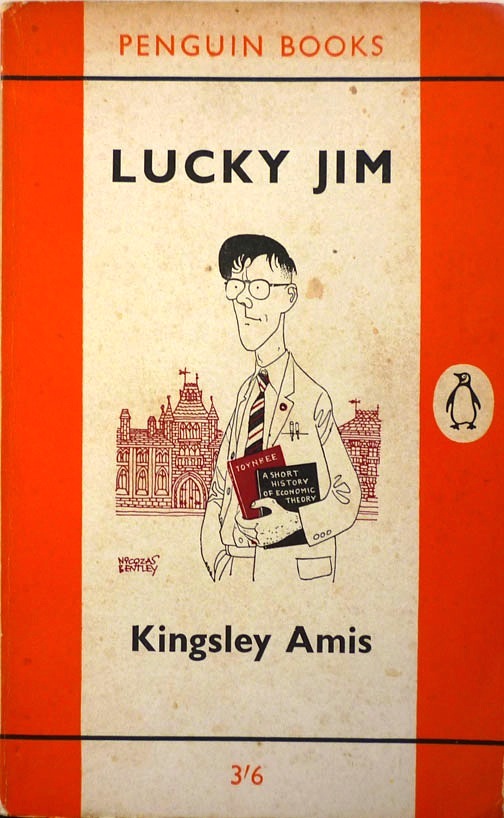
Kingsley Amis, “Lucky Jim” (1954) – It’s probably for the best I read the great comic novel of academic fecklessness at the end of my grad student career (and, odds are, my academic career more generally) rather than at the beginning. I’ve spoken with people who say “Lucky Jim” speaks to their contemporary academic experience, and more-or-less believe them. But truth be told, the actual action in the novel is pretty far from my experience. Not that much happens, I find, and I’ve probably been lucky but the faculty I’ve worked with have all been very encouraging of me (probably a little more than makes sense given the market, but hey- I still appreciate it) and I don’t hate any of them.

But the overarching themes ring pretty true. Above all, there’s contrast between the high-minded idealistic palaver of what the university is all about, and the grubby reality based in very material things- money, sex, status, power in the most basic sense of being able to impose one’s will on others. I’m not sure that the actual grubbiness is any more grubby than any other field. But the contrast is as strong as any… though I get the idea that tech might give it a run for its money these days.

Maybe some of the difference is context. I have to admit, I find it a little hard to feel bad for our hero Jim, even beyond his own flaws, because the profession as it was ascending in the early 1950s can’t possibly be as grim as the 2010s, as humanities academia is slowly dying out. But Amis sells it pretty well. I get the impression he fell off after his first novel, but he has a sharp caricaturist’s eye. He also has the amoral sensibility with the tiny seed (or maybe infection) of moral outrage that makes classical satire work from Juvenal’s day onward. This results in a near-equal number of people who deserve it and those who don’t getting cuttingly caricatured. Amis operates in a target-rich environment of the first category — pompous academics, careerist snitches, pretensious artists — and he doesn’t spare the second category, either, mainly consisting of women just in general. Amis is a misanthrope, but the thing with misanthropy (in men anyway) is that it usually turns out to be misogyny with extra steps.

“Lucky Jim” was written while Amis was still at least drifting along with the far-left politics fashionable in British cultural circles at the time, though he quickly turned rightward, hard. There’s a vulgar class politics at work in the novel. Jim and the few people he likes are by-and-large working class people attempting to climb one or another pole greased not just by class hierarchy but by the very pretenses of progressiveness the notionally-more-cultured ends of that hierarchy like to display. Though it’s hard to say why Jim was in academia in the first place- he clearly hates history (though Amis gets across the fact, as true today as it was then, that actually giving a shit about your topic is by no means necessary for academic success). Why is he bothering?

Short answer- he doesn’t, for long. In the end, Jim is basically saved from the consequences of his own fuck-ups via the deus-ex-machina of an independently wealthy guy who finds him funny. This gets to an important pattern. The problem isn’t really with the social order- it’s with the wrong people (signified by wrong taste, which usually follows a wrong soul) being empowered by it. This is the message of most right-leaning satire, from South Park to Amis and, not that right-left distinctions mean much in such a distant past, but it was basically Juvenal’s point too. Maybe this is more a reflection of my own (historical) experience than anything else, but I think that’s a powerful rhetorical mode we can’t just wish away in the hopes something fairer and more structurally-woke will take its place. I’m not so sure we should, either. ****

Review- Amis, “Lucky Jim”

Review- Atwood, “The Handmaid’s Tale”

handmaid

Margaret Atwood, “The Handmaid’s Tale” (1986) – Expectation management is always a factor when first reading a popular classic. I know a lot of fans of this book, but also know that the high school/college classics are often best read in high school or college, if then (have a look at “Ender’s Game” recently? You can still sense what’s good in it, but still).

“Handmaid’s Tale” delivered in an unexpected way. Structurally, it’s much more similar to the classic dystopias, like the big three of “1984,” “Brave New World,” and “We,” than I was expecting. If you told me that before starting, it would have dampened my enthusiasm. But it actually works out pretty well. It shows up some of the gaps in the classics (especially their depictions of women, a pretty serious gap in all three). Literary dystopias are always more about interventions in (and evocations of) the present than they are predictions or even really looking forward at possibilities (scifi writers get that stuff “right” much more often than their literary cousins).

The Republic of Gilead works pretty well as a nightmare pastiche- the disparate elements drawn from the evangelical revival of the 1980s, biblical and Puritan imagery, post-revolutionary Iran, and aspects of consumerist and pop culture of the period age well together and remain relevant (unfortunately). The particular configuration of elements — the castes, the costumes, the infertility, it all apparently occurring in Boston? — aren’t likely, but if the last few years have taught us anything, it’s that the dystopia will hardly be likely, except perhaps in retrospect.

Atwood’s prose is very fine, though with a lot of the sort of description that should wow me but never does (makes 19th century novels pretty hard). Characterization is as strong as is appropriate for a novel about stripping people and especially women of their individuality and free will, and the relationship between “Offred” and Moira in particular feels real and important. The relationship with Nick was a funny one, for me- in Orwell and Zamyatin, at least, the women who lead to liberation and/or betrayal are early precursors of the manic pixie dream girl. Atwood’s take — a boy who can shut up every once and again — is a good rejoinder. It’d be pretty cool if this book got nerds as worked up about women’s rights and autonomy as the classic dystopias get them about surveillance and, I dunno, ads. ****’

Review- Atwood, “The Handmaid’s Tale”

Review- Lessing, “The Four-Gated City”

4 gate city

Doris Lessing, “The Four-Gated City” (1969) – after five books and almost twenty years, Doris Lessing wrapped up the “Children of Violence” series with a notice from a post-apocalyptic bureaucrat. The series followed Martha Quest (based on the author) from her girlhood in settler Rhodesia to her middle years in London in the 1960s, and in a long “appendix,” to the years after a variety of wars and environmental catastrophes kill much of humanity.

The book follows Martha’s life in London, which she comes to from Rhodesia in her late 20s, shortly after the end of WWII, through the paranoid Cold War 1950s and eventually the thaw and revival of consumer prosperity that leads to “swinging London” of the later 1960s. The first third or so is Martha exploring immediate postwar London, which in many respects prefigures the post-apocalypse the book ends with- bomb-damaged, lingering under austerity, seemingly with no way to get better. Eventually, Martha becomes resident-secretary-cum-coparent for a writer and gets involved with his family, the Coldridges, a big, rich, high-profile public progressive clan riven internally by resentment and other emotional issues. A central part of the incompletely-drawn apocalypse Lessing posits occurring in the mid-1970s is rapid human mutation in response to environmental strain. In the end of the book, this entails telepathy and other strange powers. But it’s prefigured by the terrarium of difficult over-educated Brits Martha has access to in the Coldridge house, many of whom are maladapted by any meaningful definition — there’s a Jane Eyre-esque madwoman in the attic who becomes a friend of hers, one of the kids is a kleptomaniac, etc — but which prove helpful to the unsettled lives they (and more and more people) are made to live. Martha herself experiences a breakdown — in many respects a break with reality — and this is what allows her to see the coming of the end and survive it while helping others- at least for a while. It doesn’t make for a happy life, being a mutant in Lessing’s world, but little enough does.

Lessing wrote her magnum opus, “The Golden Notebook,” in the midst of writing the “Children of Violence” series. In many respects, “The Golden Notebook” is a shorter, somewhat more elegant version of the series, which does in one book what the series does in five. You get much of the same stuff: girlhood in settler Africa, falling in and out of love with various people and causes, move to London, and a breakdown surrounding the central issue of maintaining a sense of self when both society and personal life tend to fracture the self, and a recovery of sorts. I’m not sure how much the apocalypse adds. She makes it fit reasonably well, and it prefigures her move into scifi, which I look forward to digging into (and which I’m pretty sure was highly influential on later generations of scifi writers, especially feminist scifi). It was also pretty prescient, especially about mass computer-based surveillance and the way groups would try to buy their way out of catastrophes. But it’s also literally an appendix, and much of it isn’t from Martha’s perspective. It’s a little jarring, where “The Golden Notebook” manages its transitions perfectly.

I have a little theory that part of the reason behind Lessing ending the series with an apocalypse is that she might have seen it as a false start, a prolonged draft for “The Golden Notebook.” Stuck with the series after she already said what it was supposed to say, she spikes it, and its entire world. That’s probably not really true- if nothing else, at over 600 pages, “The Four-Gated City” is a serious work in its own right. There’s little like Lessing given the chance to depict a group of people over a long term, the evolutions of their relations, the various ways they repeat patterns while imagining themselves having broken free and recreated themselves. Lessing is a maestra of disappointment, which makes it all the more poignant when something good does happen, and someone can break away. So even if “The Golden Notebook” is tighter than “Children of Violence,” the longer form suits her well. *****

Review- Lessing, “The Four-Gated City”

Review- Dolan, “The War Nerd Iliad”

iliad

Homer/John Dolan, “The War Nerd Iliad” (2017) – It would be hard to overstate the impact John Dolan has had on my education. I began reading the War Nerd, written under the identity of “Gary Brecher,” after a friend linked one of his articles to me early on in my time in college- early enough that I was one of the ding dongs speculating, “COULD Brecher be Dolan???” While I pay my homage to the Gary Brecher persona, I’d have to say the Dolan half was probably more important to my education.

There’s a simple reason for this- I went to hippie school, sans requirements, and loaded my plate with history and sociology classes. I never took a literature class. Dolan’s writings were Lit 101 (and a few extra classes alongside) for me. The list of writers I picked up because of his recommendations is nearly coextensive with the list of my favorite writers. So I get why the man himself might prefer Gary Brecher, but I’ll always have a soft spot for Dolan. I’m glad the interests of the two — literature and war — coincided for this particular volume. Moreover, it’d also be hard to overstate how important the Iliad — or, anyway, the children’s Iliad I had — was to me as a child. It was my favorite story, though I was disappointed to find that the grown-up versions were generally slogs. Probably worth it, especially for people whose interest in literature comes to a large extent through history, but slogs nevertheless.

Dolan sees the slog quality as an injustice to the poem. The Iliad was meant to be recited aloud- closer a to campfire tale than a school poem. It’s meant to be gripping, a real emotional rollercoaster, and it’s not meant to stint on the goods- gore, gloating, gods, descriptions of riches, feasts, and other things that bored peasants passing some time in the winter want to imagine. Dolan tries to bring this quality back to the Iliad for modern readers of English. He does so via prose translation. Dolan argues that sentence and paragraph structure does form modern readers what meter and rhyme did for our ancestors… and moreover, who reads epic poems today (I know, I know… a few of my fb friends)? He wants this read.

He delivers, right to a sweet spot that few works really go for these days (arguably, Fury Road did). The characters are more alive than ever before (in English, anyway)- angst teen death-dealer Achilles, aggrieved manager Odysseus, decent doomed Hector, vain late-stage-mob-boss Agamemnon, original fuckboi Paris, etc. He does something really special with the gods- their human qualities come through clearly but they never lose a truly weird, eerie quality. The granular, cynical grasp on the politics of war that made the War Nerd such a success comes out in his depictions of the Greek war effort, all squabbling chiefs, mission drift, and chaos. And he delivers the goods- the battle scenes have all the chaos, blood, pain, confusion you could want, but also the sheer joy of rage and action that draws so many to this story and stories like it. Dolan may have chosen prose here, but the poet is still there in his similes and apostrophes and probably other figures I’m missing because, you know, didn’t take any literature classes.

At bottom, the Iliad is about an alien world, but with just enough familiar features to give us moderns some grasping points. Often, these points encourage — delude — people (whole generations, in some instances- cf the British ruling class in the 18th and 19th centuries) into thinking that these alien people actually were like us, or like what we could (or even should) be. Sometimes, sick of that, people go the opposite direction- claiming it’s all so different you’ll never understand it, except maybe if you immerse yourself in these languages, become a difficult prig about it, etc. In his take on the Iliad, Dolan illuminates an alien world in all of its splendor and terror — a lot of both — in a way that is relatable to us today, while never losing sight of the gulf between us and the Homeric. That balancing act alone is supremely difficult, let alone making it readable and entertaining. But Dolan has been making the alien seem familiar and the familiar alien, in his literary, historical, and (for lack of a better term) political writing for a long time now- and making it look easy, the sure sign of a master. *****

Review- Dolan, “The War Nerd Iliad”

Review- Lessing, “Landlocked”

landlocked

Doris Lessing, “Landlocked” (1965) – the fourth of Lessing’s “Children of Violence” series, Landlocked takes the story of Martha Quest (based on Lessing herself) to the end of her time in the colonized Rhodesia in which she was raised. The little group of reds, marooned in a provincial capital, among whom Martha tried to find meaning and companionship loses what little traction it had with the masses once WWII ends and Cold War anticommunist paranoia — racialized, naturally, in this white settler colony — takes hold. Quest continues trying to do her bit from the movement, even as her German Stalinist husband takes up open philandering (and in very progressive, “civilized” fashion, he encourages her to find her own boyfriend while they await his citizenship papers, which in turn will allow a divorce) and the little red scene in their town continues to split between stalinists, trotskyites, zionists, etc. In some of those painful scenes Lessing does so well, all of them try to reach out to the great prize, the black population, all painfully patronizing to varying degrees and completely unsuccessful. The whites are growing increasingly paranoid, the blacks are going to go their own way without much input from middle class white leftists, and no one’s fantasies or half-measures will cut it anymore. People also start to die at an alarming rate- some of sickness, some by violence, like the Greek RAF men posted to Rhodesia for the war, going back to Greece knowing that they will fight and die alongside their fellow communists in the civil war.

Lessing knew whereof she spoke when it came to sectarian backbiting and half-hearted efforts at living out values, and it shows, in this book and the previous installment, “A Ripple From the Storm.” She also depicts, like no other, living multiple lives- that was what her magnum opus, “The Golden Notebook,” is about, and in “Landlocked” we see her furiously pedaling her bike between her many lives: activist, thankless peacekeeper between activists, working secretary, wife, lover, daughter in a fraught relationship with a dying father and hypochondriac mother. The whole time, Martha is dreaming of making her way to Britain and escape- and she does get on the boat to Britain, in any event. This gives the whole installment a certain “running out the clock” feel, especially when you know that this is the penultimate book in the series, but Lessing can be relied upon to make even a feeling like that come alive. ****’

Review- Lessing, “Landlocked”

Review- Kundera, “The Unbearable Lightness of Being”

kundera

Milan Kundera, “The Unbearable Lightness of Being” (translated from the Czech by Michael Henry Heim) (1984) – Boring. And not in the way that people in my generation (and those younger) call things boring because they’re offended by something and want to brush it off. Genuinely not interesting, causing me to woolgather more than usual while reading it. Was/is the craze for Kundera part of the pre(?)-history of the Eastern Bloc — and the Czech lands in particular — being seen by westerners as a site of dispassionate, decadent sexual libertinage? Did this schmancy postmodern book prefigure the way in which the Czech Republic is synonymous with grindingly formulaic pseudo-amateur porn for millions of deeply lonely millennials whose main cultural outlet is the ‘tubes? Probably not! But thinking about that problem is more interesting than the comings and goings of Horny Czech, Horny Lady Czech, Lady Czech Who Believes In Love But Is Also Horny, Horny German Who Isn’t Quite Horny Enough To Make Anyone — Especially Women, Who Need A Real Man No Matter What They Say — Happy, etc. Or his philosophical maunderings, all of which are based on the idea that if everything happens but once, that means all of it is meaningless and hence, weightless. That seems exactly backwards for me. If everything is unique, wouldn’t that make everything rare and weighty? Probably he says something like that towards the end — this seems like the kind of book that deploys rope-a-dope epiphanies towards the end like so many ejector seats on a F117 meeting its first Serbian militias — but honestly, I wasn’t paying much attention towards the end. **

Review- Kundera, “The Unbearable Lightness of Being”