Review- Naipaul, “A Bend in the River”

V.S. Naipaul, “A Bend in the River” (1979) – Naipaul looked to hit nerves, and he hit few nerve clusters more sensitive more often than the raw bundle around colonialism. It must have been an irresistible target for a man who, say what you want about his talents, was a vicious asshole.

But he wasn’t just any asshole and it wasn’t just asshole-ery that made the postcolonial world such a compelling target. He was a postcolonial subject himself, hailing from the Asian middle classes (which were still pretty poor by our standards) in Trinidad. This put him in an odd and uncomfortable dual place that Fanon-inflected anticolonialism doesn’t account for: not with the colonizer and not really the subject that anticolonialism has in mind. He clearly resents those more clearly placed communities, the poor black majority of Trinidad and the Indians of the subcontinent, with their more straightforward relationship to colonialism, their anticolonialism into which they can easily slot, the sloppiness and complacency of thought Naipaul perceived coming with that surety.

Naipaul wasn’t sloppy and he wasn’t complacent, in thought or prose. He didn’t do the easy thing of trucking in imperial nostalgia, at least not in what I read. What he did, and what many will never forgive him for (not that he ever condescended to ask), was plainly state what was in front of him, regardless of who it embarrassed (this included himself, depicted as an obnoxious little swot who exploits his father in “A House for Mr. Biswas,” and I’d say many of his more boorish public utterances fall into that category too). He cuts no slack, except possibly (and crucially) in where he puts his camera- he never wrote a novel mocking the eminently mockable literary Tories who made his career. This made for some interesting contrasts, to put it politely, in places where many of us — people who aren’t vicious assholes — would tend to cut some slack… like in the world emerging from colonialism in the mid-20th century.

I guess I should talk about what this book is about! It’s about Salim, an Indian from a family of traders in East Africa. He ups sticks and moves up an unspecified river that’s almost surely the Congo and sets up shop at the titular bend. From here, he sees the comings and goings among his fellow expatriates and with those Africans with whom he deals. He’s partially responsible for a descendant of his family’s half-Asian, half-African slaves, and for the son of one of his African customers who comes to town to go to school. He’s drawn in to the life of intellectual expats and has an affair with a young Belgian woman married to an aging white court intellectual now out of court with the Big Man, the Mobutu-figure who rules the country.

All of these figures and situations provide ample room for Naipaul’s depiction of human folly, all in his usual sharp, smooth, gom-jabbar prose. The young men he takes care of reflect the hope and failures of Africa’s time of optimism in the 1960s, all admirable growth paired with adolescence arrested by external factors. They can never work out what to make of Salim, and vice-versa. The other merchant expats deploy various strategies of keeping it together through instability but none of them do — maybe none of them can — really join the country, they just make burger franchises there. Yvette, the Belgian woman, was drawn to Africa by the false promise of her husband the intellectual, who in turn was lured by the false promise of what the life of the mind could offer the developing world. Even allowing for the slack decent people might cut, it all feels all too real, including Salim’s inability to relate to women and Africans as equals (wonder where Naipaul drew that from, hmmmm).

There’s a good amount of incident but the book isn’t plot-driven even to the extent of the cyclical activity of “A House for Mr. Biswas.” So it’s the characters, the scene, and above all the prose that carry the reader through. In the end, Salim finds himself without a place in the world he lives in and goes in search of somewhere else. The end, no moral! ****’
Review- Naipaul, “A Bend in the River”

Review- Bujold, “Shards of Honor”

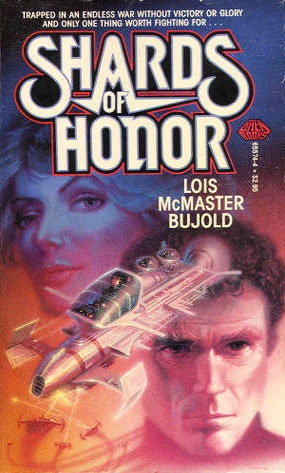
Lois McMaster Bujold, “Shards of Honor” (1986) – This is probably the closest thing to a romance novel I’ve read, unless some of the more courtship-heavy bourgeois novels count. Cordelia comes from a relatively chill spacefaring culture and Vorkosigan comes from a militaristic one. They meet when the latter takes the former prisoner but they come to rely on each other during a long trek across an alien planet and a plunge into confusing and deadly intrigue among the Barryarans, the militaristic culture. You can call Vorkosigan Mister Too Damn Honorable as he constantly gets involved in schemes to undermine less honorable Barrayarans out to do him in. The two cultures get in a war due to dishonorable machinations and Cordelia keeps on getting captured and separated from Vorkosigan and…

Honestly, I wasn’t paying attention for a lot of this. The writing is pedestrian. The characters are flat. The action isn’t bad, in some places. But between the lack of ideas or compelling prose and having read it during a dry period in my reading life, I didn’t get much out of this. The good news is that apparently this is all a prequel and the vaunted Vorkosigan Saga is actually about the main characters kid or grandkid or something. So maybe I’m not missing much if the rotation insists I revisit this particular scifi touchstone series? Who knows? **

Review- Bujold, “Shards of Honor”

Review- West, “Miss Lonelyhearts”

Nathanael West, “Miss Lonelyhearts” (1933) – This is a sixty-ish page novella by the author of the great Hollywood novel “The Day of the Locust.” Miss Lonelyhearts (we never learn his real name) is an advice columnist for a contemporary — that is, Depression-era — New York newspaper. He’s assailed by the woes of his correspondents and by his own impotence to help them, and also his boss, Mr. Shrike, trolls him all the time. He tries various things — booze, country getaways, affairs — but nothing helps. The consequences of his coping mechanisms catch up with him, in the end- an ironic Christ figure, Christ but a incapable sinner who gets owned all the time, he does get his martyrdom in the end. Wikipedia describes this as “expressionist” and if this means work that’s a thinly-described bummer, that sounds about right. It’s not bad but “The Day of the Locust” is better and more fleshed out. ***

Review- West, “Miss Lonelyhearts”

Review- Gay, “The Education of the Senses”

Peter Gay, “The Education of the Senses” (1984) – When you think “psychoanalytic history of the Victorian period” you think “let’s get a load of these repressed freaks,” right? Well, that’s not what Peter Gay provides in this, the first of his five volume psychoanalysis-inspired cultural history of the “bourgeois century.” Instead of Victorians having freakouts because table legs were too sexy, we have Gay excavating the diaries and letters of bourgeois Europeans and Americans and finding them surprisingly frank about sexual matters- euphemistic, “proper,” but not neurotically avoidant… in private, anyway.

Gay emphasizes that many of the insistences of the bourgeois at that time were coping mechanisms directed towards anxiety over rapid social change. The ideology of separate gendered spheres of activity, as both a societal and a medical necessity, was the keystone of these. Along with it came the divide between the public and private sphere. So did idealism- Gay discusses pornography (in classic Freudian fashion dismissing it as essentially immature) but doesn’t touch on sex work extensively, or really any kind of sexuality that doesn’t have love attached to it, even where it’s extra-marital. His Victorians are forever searching out a higher, perfect love, which is expressed physically as well as emotionally.

In short, Gay’s Victorians are good Freudian patients, with plenty of issues to chew on analytically but essentially in agreement with what I understand to be the psychoanalytic definition of what makes a whole person. There’s an overdetermined quality to Gay’s portrait here. For one thing, focusing solely on the bourgeoisie robs us of the perspective of that class’ interaction with those outside, which I think would make things look altogether different and cleaner than the picture of sensuality Gay gives us. Maybe that comes in later volumes? But it also seems like a weakness of “inner history.” Where does the inner end and the navel begin, as far as the gaze goes?

I came to this several years after reading Gay’s two-volume history of the Enlightenment, which is considered pretty dodgy these days but is a classic of its type and much less psychoanalytic than his Victorian work. I appreciate Gay’s historical spadework and sympathetic depth analyses of cultural figures. That said, this took a lot to get through, in part due to stuff going on in my own life, unlike the Enlightenment books which I remember enjoying more. I don’t think he’s quite knocked Lytton Strachey off of his pedestal as guy who defines the inner history of the Victorian upper/middle classes, though I guess I’ve only seen a fifth of Gay’s attempt. ***

Review- Gay, “The Education of the Senses”

Review- Harris, “Kids These Days”

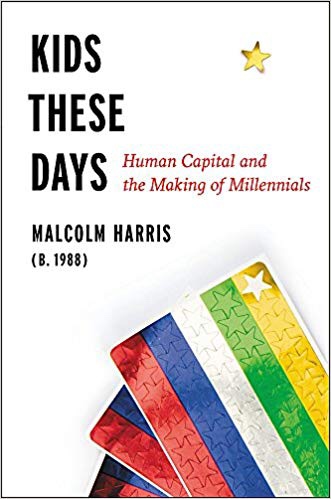
Malcolm Harris, “Kids These Days: Human Capital and the Making of Millennials” (2017) – Millennials! What remains to be said about them- about us, I should say? Well, “anything based on the facts of socioeconomic structure as opposed to stereotypes” might be the answer to that, and that’s what Malcolm Harris does in this book. He’s not a sociologist himself- he’s a millennial scribbler, part of the New Inquiry posse, not my favorite internet clique by a long shot. But little of their preciousness or obscurantism finds its way into “Kids These Days.” Harris instead sticks to the literature produced by sociologists and economists and connects it to a set of dynamics he doggedly sticks to. This is a practical book, praise be.

Productivity goes up- wages stay stagnant. Productivity goes up, wages stay stagnant. Spool that out in its implications and apply it to the other (epi)-phenomena you find, and you have an explanation of Millennials that actually makes sense and isn’t insulting or insultingly simple-minded. Millennials are some of the most intensely capitalized people ever produced, almost engineered to be pliant, highly productive workers in a capitalist system where the rate of change is ever-accelerating. Every generational change from intensive parenting to high-stakes testing regimes to over-policing has worked to produce workers adaptive to late capitalism- and to keep them from changing it.

It’s simple and convincing. What are participation trophies if not previews of the cheap (or free) quasi-rewards we get in lieu of better wages or shorter hours to go with our increasing productivity, ala free breakroom cereal? What’s phone addiction other than a generation unable to let go of its productivity-boosting tools for an hour, always being “on”? Boosting human capital is the one answer politicians, pundits, and for the most part parents have to the question of securing a decent life for the youth. But what happens when the qualified pool of labor expands — and it has, we’re the most schooled generation in history — but opportunities shrink? We’re finding out, and it’s not pretty. Harris sketches out some fun future scenarios including student-debt-peonage and climate apartheid.

Harris doesn’t, as they say, provide easy answers to this. In his final chapter he goes through the standard responses we’re told to try for unjust situations, from ethical buying to protest, and finds them all thwarted by the same logic that produced millennials in the first place- the logic of capital, with its main concomitant the terror of the carceral state. Harris doesn’t come out and say “revolution” as the alternative — if nothing else, the lack of popular organization and scariness of our police state come up often enough in the book — but he does call himself a communist before anything else in his “about the author.” Whatever it looks like, we need to come up with something, soon. ****’

Review- Harris, “Kids These Days”

Review- Malaparte, The Skin

Curzio Malaparte, “The Skin” (1949) (Translated from the Italian by David Moore) – Curzio Malaparte was born Kurt Erich Suckert in the German-speaking part of Italy. He was an early supporter of the Fascist party, although (and here this “although” is often used in an exculpatory sense, but not really by me) he clashed a lot with the Fascist authorities and later in life became both a Communist and a Catholic. Really rounding all the twentieth century bases, there! He wrote a book on coups d’etat that’s still read today by nerds into that kind of thing, and if wikipedia is to be believed, this is why he was put into internal exile by Mussolini.

Internal exile or no, he still saw a lot of World War II. “Kaputt” takes place on the Eastern Front, where Malaparte was a reporter- I read it early in grad school, my introduction to the author. “The Skin” takes place in freshly-Allied-occupied Naples in 1943. Malaparte finds himself a translator for high-ranking American officers, who he likes in a patronizing kind of way. The Americans strike him as utter innocents, unable to understand Europe, unable to understand themselves as conquerors even as people practically beg them to act as such…

Like “Kaputt,” “The Skin” is made up of chapter-length vignettes loosely connected. I remember noticing in “Kaputt” that Malaparte put a lot of emphasis on the supposed Asiatic character of a lot of the Soviets he saw. In “The Skin,” you get a similar emphasis on the amount of black soldiers deployed by the Americans and the Free French, so I think Malaparte did have his racial bugaboos. Prostitution is the central metaphor here- Naples, having been conquered so many times over, is experienced in selling itself to conquerors, but the Americans hold their noses and remain above it, even while Malaparte depicts them as wading through European decadence and corruption up to their necks. There’s several stories lingering on sex work, especially interracial sex work, and many of the rest are about an international society of decadent gays that find their way to Naples, I guess, by following their decadence-radar. I think the centrality of these poorly aged metaphors maybe serves to explain why “Kaputt” is the Malaparte go-to (to the extent people are going to Malaparte) rather than “The Skin.”

Away from these metaphors, Malaparte adeptly combines the surreal and the all-too-real. My favorite story is probably the one where the American officers are served a fancy fish dinner by the remnant of the Neapolitan aristocracy. No one can fish in Naples’ heavily-mined waters, so they get served fish from the aquarium, including mythical beasts like sirens. Malaparte’s exchanges with the Americans are also often pretty good, with a good comic rhythm that almost inevitably ends with the American officer calling Malaparte a bastard but being unable to dismiss him. In all, an idiosyncratic work less good than “Kaputt” but worth reading for people into writing from the ideological gangfuck of pre-1945 Europe. ***’

Review- Malaparte, The Skin

Review- Higgins, “Cogan’s Trade”

George Higgins, “Cogan’s Trade” (1974) – George Higgins was a Boston College law professor and, according to Wikipedia anyway, “raconteur” who also wrote numerous crime novels set in Boston. He’s credited with helping form the crime-fiction picture of Boston that’s now so popular in books and movies: a gritty world where all the institutions are connected by corruption and inhabited by highly verbal crooks, and where nearly everyone, in contrast to actual Boston, is white. I can’t say whether Higgins first charted this territory in crime fiction but he definitely shaped it for inheritors like Dennis Lehane.

One thing Lehane didn’t do, to the best of my knowledge anyway, is write a novel almost entirely out of dialogue, like Higgins did in “Cogan’s Trade.” The plot is sparse — low-level hoods rob a card game, the city’s organized crime element tracks them down and kills them — and doesn’t seem to be the point of the exercise. Instead, we’re treated to long dialogues between characters on various sides of this interaction, their attempts at planning crimes and surmounting the inconveniences put in their way, and just generally shooting the shit. The dialogue is very “authentic,” i.e., stylized differently than middle class “realist” fiction and generally more uncouth. The dialogues halt for brief moments for actual crimes to be committed and then picks up again.

I’ll probably read more Higgins because I’m curious about the genealogy of genre depictions of Boston, but this didn’t do much for me. Like any middle-class crime fiction reader, I like to rubberneck at the low life, but this feels especially low-stakes. There’s only so many conversations about characters who aren’t really present in the story or about having sex with sex workers or stealing dogs that I want to sit through. It got tedious and that’s a cardinal sin in crime fiction, the kind of thing a Lehane character (though not a Higgins, from this sample) would feel somewhat overdone catholic guilt for. There’s an admirable consistency to the whole thing — keeping it if not real than real to the reality of the world Higgins builds — but it ultimately amounts to little in this instance. **’

Review- Higgins, “Cogan’s Trade”

Review- Maugham, “Cakes and Ale”

W. Somerset Maugham, “Cakes and Ale” (1930) – I’ve fallen badly behind in reviews, so this one isn’t as fresh as one might like. Like many of Maugham’s short stories (this began its existence as a short story before becoming a shortish novel) this one has a frame that makes it a story about stories, along with whatever else it’s about. The main character is a writer tasked with helping another, more successful and more glib writer write a biography of still a third writer, Edward Driffield, a recently deceased late Victorian great probably modeled after Thomas Hardy. The main character knew Driffield in his youth before Driffield became famous, and so the biographer wants the details from the main character. This is a problem, because everything about those times is tied up with Driffield’s first wife, the disreputable but charming Rosie, and Driffield’s widow wants as little of Rosie to show up in the biography as possible.

That’s a lot of frame for a short novel but Maugham sets it up with his usual facility and eye for character. The main character knew Driffield and Rosie intimately, in more ways than one, and his recollections make up the meat of the book as he struggles with how much to tell the biographer. The main character believes (and Maugham basically decrees) that Rosie inspired Driffield’s greatest works. But she was also promiscuous, encouraged Driffield to run out on creditors (who he eventually made whole- Maugham strives to make Rosie not seem too bad), and eventually left him for a richer man, none of which Mrs. Driffield wants in the biography. The main character (and Maugham) like Rosie, and the reader basically does too- she seems like a fun old gal and neither Driffield nor the narrator can blame her too much for following the nature that made her such a charming muse to begin with. The biography is basically a framing device for Maugham to do character studies on Rosie, the biographer, and to a lesser extent some others, and Maugham always excelled at those. Worth a read for fans of Maugham or depictions of the turn of the 20th century artistic life. ****’

Review- Maugham, “Cakes and Ale”

Review- Highsmith, “Ripley Under Ground”

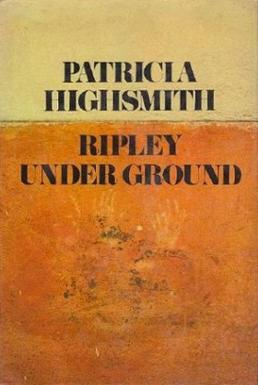
Patricia Highsmith, “Ripley Under Ground” (1970) – I seem to remember liking the first Ripley book, though it was a few years ago and I don’t remember much past that bare impression. This one, the sequel, was a snoozer. Ripley is enjoying life in a French suburb with a wife, nice house, and fancy art collection, having gotten away scot free with killing and for a time impersonating a dude. He gets in trouble because he’s involved with a ring of art forgers that starts to get rumbled. He impersonates a reclusive artist and also kills a guy and needs to keep the police, his wife, the victim’s wife, and various other interested parties from finding out. Highsmith has been called “the poet of apprehension” and there is a tense mood throughout but the action isn’t very exciting. Ripley puts more effort into planning the shopping with his servant lady than he does in rooking people, which I guess is meant to convey how effortless Ripley is in lying but doesn’t make things more exciting. Are the subsequent Ripleys more worth it? *’

Review- Highsmith, “Ripley Under Ground”

Review- Karp, “This Vast Southern Empire”

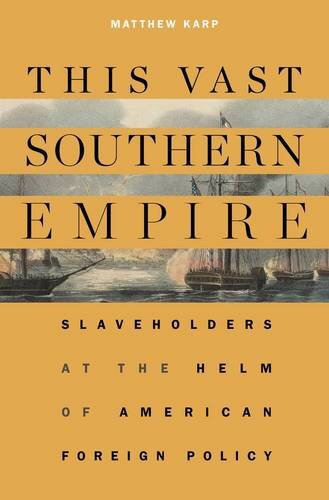
Matthew Karp, “This Vast Southern Empire: Slaveholders at the Helm of American Foreign Policy” (2016) – This is part of a new body of historical literature insisting on the essential modernity — arguably an alternative modernity, but a modernity nevertheless — of the antebellum slave system in the American south. Karp focuses on the foriegn policy of slavery. While we associate this with the efforts of the Confederacy to gain foreign recognition, Karp argues persuasively that the most influential diplomatic efforts of the slave power understood the United States, not a separate nation, as its greatest asset. Southern slaveholders dominated the congressional committees that oversaw foreign affairs and the military and were more influential in the diplomatic corps than one might expect. The leading politicians pushing military reform and expansion in the antebellum years were slaveholders, such as Abel Upshur and Jefferson Davis, who Karp argues saw US foreign policy and the policy of their class as one and the same.

The slave south had a foreign policy agenda that stressed a “hemispheric defense of the institution of slavery.” They were overwhelmingly concerned about the stability of their “peculiar institutions” in the South itself and understood its security as being tied in with slavery’s security in the rest of the Americas, particularly in Cuba and Brazil. Karp persuasively argues that while many southerners (and other Americans) desired Cuba and other foriegn territories, for southern slaveholders, maintaining Cuba as a slave state was more important than who directly owned it. Loyalty to the institution fits with what the slaveholders eventually did as an endgame, seceding from a union that ultimately was a second comer, at best. Karp shows how consistently the slave class worked towards its own interest in foreign policy, which when you think about it, makes sense- foreign policy has always been the field of American politics that responds the most to elite pressure and the least to pressure from below. Much of what southern politicians did in foreign policy only makes sense from a perspective of defense of slavery, as when Britain went from abolitionist villain in the 1830s to cotton-consumer potential ally of slavery in the 1850s.

What Karp is trying to do in this book is to force the reader to take a hemispheric and future-oriented perspective on slavery, the one he argues the south actually had. We’re used to thinking of slavery as a continental US question and as organized around defending an institution of the past, not the future, but that’s not how the southerners saw it. It’s hard to include everything in a book and I would have been interested in knowing more how the Republicans or other earlier opponents of the foriegn policy of slavery articulated an alternative foreign policy, but that would have detracted from the focus of the book, I guess. All in all, a fascinating work. ****’

Review- Karp, “This Vast Southern Empire”