Review- Nwaubani, “I Do Not Come To You By Chance”

Adaobi Tricia Nwaubani, “I Do Not Come To You By Chance” (2009) – This is a charming little (well, not that little, weighing in at around 400 pages) novel set in the world of Nigerian email scammers. Nwaubani takes her time getting there, though. First, she sets up our protagonist, Kingsley, and the rest of the Ibe family. Igbos living in urban-provincial Nigeria, the Ibes are a family possessed with an image of itself as upright and educated, even if they’re often broke as a result. Kingsley, the oldest son, embodies the family virtues insisted upon by his parents, even as his petrochemical engineering background fails to get him a job and his beloved leaves him for someone who can afford to set up a household and pay the traditional bride price.

Eventually (the book has some pacing issues, which makes sense given it’s the author’s first) the family arrives at such a crisis that Kingsley abandons respectability for a job with his uncle, the flamboyant lord of 419 (defrauding foreigners) violation known as Cash Daddy. In keeping with his moniker, Cash Daddy is amusing over the top, refusing to even see his nephew before buying him “decent” (read: brand name) shoes, declaiming little proverbs all over the place, and generally acting the ham. One of his main enterprises is a setup for young tech-savvy Nigerians to send out the emails for which the country has become, fairly or not, world-renowned.

Kingsley feels bad sometimes about fleecing “mugus” (a term that seems to encompass marks, foreigners, and white people simultaneously) but he proves to be good at it. That, as much as the money, is what hooks him. There’s some funny emails in the text, all in either mugu-speak or the quasi-officialese of 419 fraud emails- one about getting a Nigerian astronaut down from a space station where he had supposedly been marooned for years is a favorite. He uses his money to be a good son and brother and has plenty left over for himself. He travels to Britain to do some in-person fleecing with Cash Daddy in sections reminiscent of “The Sting” and other classic con man movies.

Of course, it can’t last. This isn’t a melodrama- Kingsley never gets caught (and what that would mean in a country where someone like Cash Daddy is a respected public figure along with being a scammer is questionable). There also isn’t a tearful reunion with the original love interest, or even much of a bad comeuppance for her. Kingsley witnesses some bad stuff happening to the near and dear, but by and large he leaves 419 fraud to run legit Internet cafes because of his innate good sense and good rearing. Same with him finding a decent wife among his sisters friends- I wonder if this is an African thing, where American stories would tie things up neater and more sentimentally. Either way, a fun book. ****

Review- Nwaubani, “I Do Not Come To You By Chance”

Review- Stern, “Proud Boys and the White Ethnostate” and HoSang and Lowndes, “Producers, Parasites, Patriots”

Alexandra Minna Stern, “Proud Boys and the White Ethnostate: How the Alt-Right Is Warping the American Imagination” (2019) and Daniel Martinez HoSang and Joseph Lowndes, “Producers, Parasites, Patriots: Race and the New Right-Wing Politics of Precarity” (2019) – Another two promising but at bottom disappointing attempts to explain the contemporary far right. I’d argue that Stern’s work is both the more promising of the two and ultimately the most disappointing. She starts to grapple with interesting topics like how the alt-right looks at time and the centrality of gender panics on the far right but ultimately does not interrogate either nearly enough. The Proud Boys barely enter into it at all, despite the title and the efforts of the group to intimidate the author.

Instead, we get definitions of things like “ethnostates” and “trad” as a descriptor, which Stern accuses the alt-right and its enablers like Tucker Carlson with smuggling in to the American imagination. This begs the question- where do the ideas in question come from, and why does anyone listen, if anyone does (and who is that anyone)? The alt-right emerges as an actor a lot like the liberals’ idea of Russia, an existential force for chaos and evil, poisoning an otherwise noble body politic. I think this is backwards- the alt-right is a morbid symptom, not the disease itself. Stern’s overview of alt-right facts is probably useful for some (in many ways, this is a brief primer, like Angela Nagle’s work without the twitter-beef baggage and shoddy editing) but it’s a missed opportunity for a real scholar (Stern is a professor of obstetrics and a historian, an interesting combo) to sink their teeth in to what we’re seeing. **’

HoSang and Lowndes fare little better. “Producers, Parasites, Patriots” was exciting to me because I thought it would get to grips with how concepts have changed on the right due to the historical conditions of the last twenty years or so. It does so, a little, especially in an early chapter on the racial politics of producerism. But ultimately, it is a book of inside baseball amongst the critical race theorists. HoSang and Lowndes have a point — that racial signifiers are increasingly migrating from strictly being applied to PoC to being applied to categories of white people and vice versa as neoliberal precarity screws with everything — and they hammer it home, to the exclusion of other worthwhile avenues (where does climate change enter into the precarity-driven differentiation scheme?). Moreover, to avoid accusations that they’re downplaying the significance of the white-on-black racism we’re used to seeing, every chapter and many sub-chapters have ponderous warning labels about how racism is still racism even if racists like Allen West, etc. **’

Coda: what, then, do I want out of books on the contemporary far right? Easier to say what I don’t want. I don’t want inter-left axe-grinding and the interference with thought that produces, like you see in Nagle. I don’t want Cletus Safari where we gawk at the yokels like in Vegas Tenold. I don’t want the tepid social science toe-dipping, like these two books and one or two others like it. I don’t want sneering dismissal or febrile fear-mongering.

Alexander Reid Ross comes closer to the ideal with “Against the Fascist Creep,” but he gets into axe-grinding territory against anyone who’s gotten a little tired of hearing of him and others calling red-brown alliance wolf. Elizabeth Sandifer makes a noble effort in “Neoreaction a Basilisk” but at the end of the day it’s too narrowly focused on a relatively minor current, the titular neoreactionaries, to bear that much weight.

All this begs for the approach of critical intellectual history. Is it possible to attain at the moment? I’ll fudge and say “partially.” We lack the sort of distance in time that the best historical writing needs. Any conclusions are necessarily tentative. But you can start with a granular understanding of the forces at work in recent history, an ability to depict the dynamics of a moving target rather than static pictures, and a desire to encapsulate something large and diverse as both a coherent whole and a changing, fluid thing. Someone who can bring these to bear could really make the topic their own.

Review- Stern, “Proud Boys and the White Ethnostate” and HoSang and Lowndes, “Producers, Parasites, Patriots”

Review- Clark, “A Dead Djinn in Cairo” and “The Black God’s Drums”

P. Djélí Clark, “A Dead Djinn in Cairo” (2016) and “The Black God’s Drums” (2018) – This is a fun pair of novellas set in an alternate history 19th century by a history professor at UConn. Those who know me know I have little patience for steampunk, but I can forgive the airships and clockwork men when they’re not put to the purposes of imperialist nostalgia, as steampunk is so often. On the contrary, Clark wrote a world where anti-imperial powers — Haiti, an independent Egypt — use magic and technology against the 19th century powers that were and become major powers in their own right. The detail work on the world is pretty decent and not too badly info-dumped on the reader. The storylines are similar- plucky young black women need to figure out mysteries that threaten New Orleans (in “Drums”) or the world (“Djinn”) with destruction. These works are too short for a lot of red herrings, character work and the like and so they sometimes reminded me of one-off tabletop roleplaying game sessions with one or two player characters. Mystery, preliminaries, asking wise women, finding the final boss, besting the final boss using some special characteristic of the protagonist’s. It’s a little formulaic but the prose moves right along, not bad for a commute read. I’d be interested to see what Clark could do with this world in full-fledged novel form. ****

Review- Clark, “A Dead Djinn in Cairo” and “The Black God’s Drums”

Review- Thompson, “Whigs and Hunters”

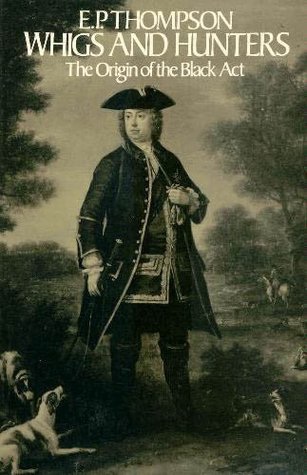
E.P. Thompson, “Whigs and Hunters: The Origin of the Black Act” (1975) – The Black Act passed in British parliament in 1723 mandated the death penalty for a variety of offenses ranging from deer poaching to destroying fruit trees to being in a forest in disguise. It also mandated collective punishment for villages suspected of holding people guilty of these crimes, and summary execution for anyone indicted of these crimes who did not show up for summons after forty days. In short, it made Britain’s penal codes, already harsh, much harsher.

The great social historian E.P. Thompson delves into the context of this act in this monograph, his first after “The Making of the English Working Class.” Conventional history says that the Black Act was what it said it was- a reaction to the depredations of the Blacks, gangs of poachers who rode in gangs and in disguise to steal deer and violently intimidate gamekeepers. You’d figure such a big change in the laws would be a response to a massive crisis, but Thompson shows that the Blacks made remarkably little impact and don’t show up much in the historical record outside of the Black Act and its enforcement.

At the end of the day, this is because blacking was a minor phenomenon, the act of a few dozen people in and around the royal park at Windsor and the aristocratic estates in Hampshire. If I have my English geography right, they went on to become nice outer suburbs of London. At the time, though, as Thompson shows us, these were forest communities, where traditional understandings of property rights were clashing with newer, capitalistic ones. Big money was moving in, buying up forests to turn into deer parks. The deer would then go around eating the crops of local villagers. Between that and the high price of venison, deer were irresistible targets for local men familiar with the forest. Resistance from the landowners’ gamekeepers escalated the situation and fights, sometimes deadly ones, broke out.

Why was ordinary English law — not exactly soft on property crimes to begin with — not up to the task of dealing with these small groups of bandits? Well, Thompson argues, it was- blacking was largely suppressed as a practice before the Black Act could be passed. The perpetrators of the most violent acts were executed or transported (to Maryland- this was before transportation to Australia).

But the cases inconvenienced the coming power in the land, namely the Whigs. Coming off the back of the Hanoverian succession (where they had to fob off a German king on England to avoid a Stuart restoration) and the crash of the South Seas Company bubbles, the Whigs, led by Robert Walpole, were feeling both their oats and somewhat insecure. In the cold damp banana republic that was early modern Britain, Thompson tells us, the Whigs and their backers in the city (and City) of London were pushing the bounds of fungibility of property. This entailed making things long understood as property of a less flexible kind — common lands and royal/parliamentary offices — more like cash money or negotiable instruments.

This was impossible under traditional long-standing arrangements in the countryside. So impelled by personal pique at their estates being trespassed upon (the Walpoles had estates in blacking areas, and Robert Walpole basically invented the modern role of prime minister), a small group of Whigs used their parliamentary positions to advance the clarification of property relations. If fungibility was the watchword for property, terror — replacing all previous arrangements — became the basic principle of enforcing property boundaries.

Thompson does his thing of bringing the long-ignored and despised English poor to life by building a detailed picture of the forest communities in the first three quarters of the book before moving on to the titular Whig hunters. He finds that in general the Blacks were men of small property, often backed by local gentry, against less the big landowners themselves and more their local enforcers. It’s written with characteristic verve even if the details bog down a bit. Perhaps it’s part of the point- the lifelike, chaotic welter of arrangements constructed over centuries by forest communities (which were quite hierarchical in their own right, Thompson doesn’t romanticize them) contrasted to the deadly simplicity of capitalism? Either way, a small but worthwhile installment in the canon of social history. ****’

Review- Thompson, “Whigs and Hunters”

Review- Dickinson, “The Monster Baru Cormorant”

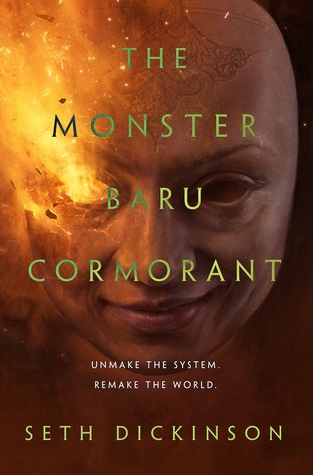
Seth Dickinson, “The Monster Baru Cormorant” (2019) – This one goes to eleven. The sequel to one of my favorite fiction reads this year, “The Traitor Baru Cormorant,” TMBC squeezes in all kinds of stuff. Six or seven viewpoint characters introduced in successive chapters at the beginning of the book! Multiple overlapping conspiracies! Multiple fictional games introduced, illustrating Themes! Currency speculation, druggings, naval chases, cancer cults! Head injuries! Dickinson doing his white-guy best with an Africa-inspired fantasy civilization, to go along with his straight-guy attempt at a lesbian main character! It’s a lot.

I’d say it’s a little bit too much, especially at the beginning where Dickinson introduces all of these characters and sets them in motion, expecting you the reader to keep track. I’m pretty good at that kind of thing and I found it stiff going. It’s hard to know how to introduce the plot, it gets so intricate. At its most basic, the titular Baru gets sworn in to a small elite of conspirators that runs the republic-empire of Falcrest after starting and betraying a rebellion in one of the empire’s provinces in the last book. She plans on trying to take down Falcrest from the inside to avenge her own homeland’s takeover, but at what cost?! Moreover, everyone in the Falcrest-running conspiracy is also conspiring against each other. This bathes everything in a kind of itchy paranoia and disdain- they can’t talk to each other without acknowledgment of the ways they despise each other. The stakes are high so the competition is lethal- in theory. Everyone trying to do each other in gets a little tedious when no one dies…

Anyway, Falcrest is in competition with another sort-of empire, Oriati Mbo. In many respects they are opposites. Falcrest, seemingly modeled after Rome and revolutionary France, is uptight, regimented, looking to remake the world in its own image, whereas the Oriati, modeled after various African societies with maybe a dash of India thrown in, is looser and more relaxed. Both are intensely concerned with health, and their approaches are symbolic- Falcrest’s obsessive hygiene which tends towards the lobotomy pick, Oriati’s lore and ritual-science derived medicines. Both grab smaller societies into their orbit, Falcrest through financial shenanigans backed by military force, the Oriati by cultural exchange which shades into confederation.

Some people want war between the two, some warn such a war would kill millions and doom civilization, others agree but want war anyway (Baru sometimes flirts with this). The action of the book is structured around Baru and the junior members of the conspiracy she’s in trying to track down a secret cult that the senior members think explains Oriati’s seemingly miraculous ability to maintain itself amidst baffling diversity. They conspire against each other as they follow a breadcrumb trail across the sea. Their efforts are punctuated by attacks from a Falcrest navy admiral and a former conspirator-turned-killing-machine who are out to get Baru for some of her previous betrayals.

It’s a lot, and it stretched my capacity to remember and to care. There’s a whole plotline of flashbacks amid all this, there’s the never-ending churn of mysterious shady conspiratorial behavior between the people on the boat Baru is on, there’s plots within plots. It’s overstuffed. That’s not to say there’s not cool stuff in it. The ending was decent, in a Grand Guignol/early modern biological warfare kind of way. Where it gives her space to breathe — apart from constant repartee with her frenemies and mulling over her guilt — Baru’s maneuverings are fun. The worldbuilding isn’t bad, there’s just too much of it for one book. The bigger problem is centering all of his world around a conspiracies of special people (the Oriati aren’t run by a conspiracy ala Falcrest as such but their destiny is in the hands of a small number of people). It took me out of the story a little- that’s one thing first book got well, making Baru feel like a small, if important, part of a world that worked according to real-world rules. This felt less credible- the book is incredible, in multiple senses of the word. ***’

Review- Dickinson, “The Monster Baru Cormorant”

Review- Sholokhov, “And Quiet Flows the Don”

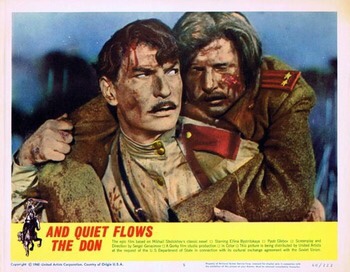
Mikhail Sholokhov, “And Quiet Flows the Don” (1940) (translated from the Russian by Stephen Garry) – This is a panoramic view of Cossack society in the turmoil of war and revolution. It’s also considered the great socialist realist Russian novel, written by an author who managed to retain Stalin’s favor despite doing things like writing him letters about how things were bad in the Ukraine.

I probably should have read “War and Peace” before reading this! Even with my cursory knowledge, it seems like Sholokhov is trying to be a socialist realist Tolstoy, and I have no idea to what extent he succeeds, or even if that’s a good goal. Guess I’ll just have to evaluate this one on its own merits!

The merits are pretty good. We start before the First World War with the inhabitants of the Cossack village of Tatarsk. The Cossacks are a people apart, a military caste, proud and poor. We mostly follow the Melekhovs, a typical Cossack family. They farm, they drink, they mess around — there’s a messy love triangle involving son and closest thing to a main character Grigori — yell at each other, and so on.

Their lives are all interrupted by World War One. Grigori and his generation of Cossacks follow their atamen (chiefs, semi-democratically elected) into the meatgrinder. Sholokhov himself was not in the war, I don’t think, but the details — cold, wet, confused, a big divide between the common Cossack and his officers — read true enough. Rumblings of discontent go through the ranks, mostly of the simple “we want to go home” variety, some shaped by Bolshevik agitators.

The Russian Revolution comes and everyone has complicated choices to make. The White officers think the Cossacks will play their traditional role as suppressors of popular uprisings, but it doesn’t work this time due to widespread dissension with the war. Defected Cossacks refuse to halt the October Revolution and start going home to the Don River territory. There, Grigori and the others go back and forth between joining the Bolsheviks and rejoining the White forces. The Bolsheviks in this book are like a positive spin on their depiction in Bulgakov’s “White Guard”: the only ones with a real plan, methodical, energetic, ruthless. Sholokhov doesn’t stint from showing Bolshevik atrocities, but the group and its ideology still runs like a red line of clarity through the confusion of the postwar situation (and that of the anachronistic Cossack mindset).

Revolution doesn’t displace love entirely in the book (there’s a romance between the primary Bolshevik character and a lady-Bolshevik that ends predictably), but it does shift the emphasis of it. I wonder if that’s part of the point- the coming of the revolution representing a new beginning. But there’s a lot of continuity language and imagery too, above all the ever-present and unchanging Don River. All in all, a pretty good read. ****

Review- Sholokhov, “And Quiet Flows the Don”

Review- Steel, “Walter Lippmann and the American Century”

Ronald Steel, “Walter Lippmann and the American Century” (1980) – I’m interested in Walter Lippmann as a homegrown example of anti-democratic thought. People will plotz if you describe him as a fascist or a reactionary, and they’d have some reason to- Lippmann was a consummate liberal, so much so that the forerunner to the ur-neoliberal gathering, the Mont Pelerin Society, was originally called the Colloque Walter Lippmann. But he partook of a project similar to that of such forerunners of fascism as the Italian elitist school of critics of democracy- analyzing the weak points of mass democracy in the context of a rapidly changing, growing, and ever more complex society. He was the guy who introduced the study of “public opinion” into American discourse, complete with inventing our use of the word “stereotype” to mean what the average man had in his head instead of thoughts. Lippmann, like the erstwhile liberals in the Italian elitist school (and the Fabian socialists he associated with), believed that society needed to be run by experts, who could dispassionately take in the whole of society scientifically. Who were these experts? Well, mostly they looked a lot like Lippmann and his friends.

Biographer Ronald Steel appears to be interested in Walter Lippmann primarily because of Lippmann’s wide range of friends and associates, which included a dozen-odd presidents and numerous major political figures in America and across the Atlantic. More than Lippmann the thinker, he’s interested in Lippmann the institution of Atlantic establishment liberalism. We get analyses of Lippmann’s books- it’s a thick biography. But we get a lot more of Lippmann’s career as a journalist and the figures with whom it brought him into contact. This makes sense- that’s where the emphasis and the drama of Lippmann’s life lay. From helping Woodrow Wilson lay out the Fourteen Points to breaking with Lyndon Johnson over the Vietnam War, Lippmann was there for a lot of the high (and low) points of drama in the titular “American century.”

Steel lays all this out admirably enough but it can’t help but replicate Lippmann’s own shallowness and to a degree, his elitism. From youth as a moderately rich NYC brat and Harvard wunderkind, Lippmann’s thought was in the service of the “best” people, even when he was notionally a socialist as a youth. “Best” here was determined not (directly) by hereditary status or wealth — after all, Steel and other Lippmann-involved people would remind us, he was no simple reactionary — but by intelligence and “seriousness” as defined by Harvard people, more or less. There was no idea that Lippmann really believed in, just a class whose interest he defended. This gives his back and forth on the issues of the day — from big government proponent to New Deal opponent, from neutrality-booster to war hawk and back again any number of times over a half-century — a unity it would otherwise lack.

Moreover, Lippmann wasn’t a major decisionmaker himself. He was a behind the scenes guy at best, recommending people to other people, and more often an observer and shaper of (mostly elite) opinion. So he wasn’t stuck with many decisions. This winds up giving the narrative of the book the character of one damn thing after another with little consequence, as Lippmann’s calculation of who represented the sort of elite he had in mind and what they should be up to shifted, and his relationships shifted with them. If I didn’t have a background in twentieth century history, a lot of it would be meaningless- who cares what Newton Baker or Bernard Baruch or Dean Acheson thought of things or what people thought of them? Well, I do, a little. But I care a lot less about that and more about how Lippmann’s ideas and worldview came to be and came to become influential, which this book is less strong on. ***

Review- Steel, “Walter Lippmann and the American Century”

Review- Sonnie and Tracy, “Hillbilly Nationalists, Urban Race Rebels, and Black Power”

Amy Sonnie and James Tracy, “Hillbilly Nationalists, Urban Race Rebels, and Black Power: Community Organizing in Radical Times” (2011) – This is a history of several groups of white working class radicals in the 1960s and 1970s, most of whom were part of a genealogical tree going back to the Students for a Democratic Society’s efforts to organize among poor whites in the slums of Chicago. The most spectacular of these groups was the Young Patriots Organization, the titular “hillbilly nationalists.” They adapted the Black Panthers’ analysis of oppressed groups as internal colonized nations to poor white Appalachians (both those in Appalachia and those who moved to cities) and formed a key part of the short-lived original “Rainbow Coalition” with the Chicago Panthers and the Puerto Rican nationalists in the Young Lords. Lacking some of the charismatic dimensions of the Patriots but lasting longer were groups like Rise Up Angry, the October 4th Organization in Philadelphia, and White Lightning in the Bronx. Sonnie and Tracy chart all of these groups in less than two hundred pages, including undergrad-friendly explanations of well-trod historical territory such as the breakup of SDS and the rise of black power as a frame for action.

This is a very interesting and little-known history, though impressionistically it seems that accounts of the Young Patriots, at least, have entered radical lore since 2011, probably in no small part due to this book. Then and now (one wonders what the hillbilly nationalists in YPO would make of “Hillbilly Elegy,” or maybe one doesn’t), there was significant doubt about whether the white working class can radicalize or whether it’s worth anyone’s time to try. People have developed whole theories, from “Settlers” to certain applications of privilege-thought (maybe not that far of a range, now that I think of it), to answering in the negative.

The groups in this book were determined to prove the nay-sayers wrong and to doing so on their own terms. Just as the radical end of the civil rights movement was debating what to do with white middle-class student organizers, white working class organizers in Chicago were debating the same thing, and came to a similar decision- they needed to go it alone. At first, this led to a more-or-less mutually agreed-upon take over of Jobs or Income Now (JOIN), originally an SDS organizing project, by the poor whites it was meant to mobilize. JOIN spun off and/or inspired the other groups in the book.

These groups faced similar arrays of problems, from the practical to the conceptual. Assuming they weren’t a lot of racist yokels and/or Archie Bunkers, just what was the relationship between white working class radicals and the larger movement? The YPO, which coalesced from local youth gangs that had been involved in JOIN, provided one answer- they would be emulators of groups like the Panthers, and provide backup for them. By most accounts, the Patriots did pretty well at the latter. This despite their cringe-worthy name and even more cringe-worthy decision to try to redeem the Confederate flag! Fred Hampton, Cha Cha Rodriguez and the other Rainbow Coalition leaders accepted the Patriots at a time when they had every reason — other than effective organizing — not to. The YPO did its own community projects to go with the berets and the guns. A favorite of mine was “Hank Williams Village,” a model community for Appalachian migrants to replace the slums they lived in. They even raised funds for it before the city reneged on their promises and shut the whole thing down.

The other groups profiled had their own approaches — October 4th’s focus on workplace organizing in the industrial Kensington neighborhood of Philadelphia, White Lightning’s organizing of addicts against both the heroin trade and dehumanizing treatment approaches — but I want to concentrate on the conceptual issues they shared and to which the YPO provided the most extreme answers. Ok, emulate the Panthers: serve the people, take no shit, wear cool outfits. The Panthers and groups like them — increasingly, the Black Power movement as a whole — was based on a theory of revolution adapted from Mao, Fanon, and other sources. What it amounted to was an application of the politics of decolonization — the big change between the end of the Second World War and the rise of neoliberalism — to the American scene. Oppressed nationalities were to be the vanguard of the revolution. American groups like the Panthers (mostly) underplayed the territorial aspects of nationalism — most of them weren’t looking for borders, a capital, an Olympic team, etc — in favor of political self-determination within the larger polity.

No one definitively answered how exactly this would work. They also didn’t answer who exactly counted as an oppressed nationality and why, or what the relationship between oppressed nationalities and the oppressed within privileged nationalities (i.e. the poor) would look like. Somewhere between the confusion on the latter two questions you got answers like “hillbilly nationalism,” which seems to our ears (well, mine anyway) on first hearing like a baroque way of not making sense. People have been trying this from the right lately, after all. You can see other gradations of solution to the question of who is the revolutionary subject in the efforts to get at a way to define the white poor and working class by some kind of identity tag- White Lightning and its efforts with those living with and around the effects of the heroin trade come to mind.

Fred Hampton, chief architect and theorist of the Rainbow Coalition, seemed to have been working his way towards a theory of revolution that placed capitalism at the center, rescuing unified working class organization from the student groups and the big complicit labor unions of the time. But then the Chicago police assassinated him. That’s another thread that runs through the whole thing, and they’re related. Massive police violence derailed all attempts to work through the questions of organizing the one way that works- through organizing. That’s hard to do when your people are getting killed, jailed on trumped-up charges, and endlessly surveilled.

We know that the Rainbow Coalition concept in specific scared J. Edgar Hoover and the Chicago red squad, and they came down on its constituent parts, including the white parts, like a ton of bricks. The same thing with less severity occurred in Philadelphia and New York. What the police didn’t do, urban renewal did, like through the destruction of much of neighborhood Bronx and Uptown in Chicago, the Appalachian neighborhood. Sonnie and Tracy don’t exactly put it this way, but for kids learning the ABCs of radicalism, wrestling with knotty questions of interracial solidarity that still bedevil movements, and facing massive repression, that they did anything at all was an accomplishment. This book is an accomplishment, too, for raising questions if not necessarily for answering them. *****

Review- Sonnie and Tracy, “Hillbilly Nationalists, Urban Race Rebels, and Black Power”

Review- Burke, “A Philosophical Enquiry into the Origins of Our Ideas of the Sublime and the Beautiful”

Edmund Burke, “A Philosophical Enquiry into the Origin of Our Ideas of the Sublime and the Beautiful” (1757) – This is an interesting text that Burke wrote in his twenties, before he became one of the fathers of modern conservatism in the wake of the French Revolution. It sits astride the Enlightenment and Romanticism, with a foot in both. In classic Enlightenment fashion, Burke goes systematically through the questions of beauty and sublimity, including discussions of 18th century ideas of how the eye and brain functioned. But he rejects such Enlightenment notions of the origins of beauty, such as proportionality and utility. Moreover, he placed an ineffable, terrifying sublime over beauty. Included in the sublime are mountains, storms, abandoned ruins, and other things that would take a prominent role in romantic (to say nothing of gothic) imagery. The beautiful, in Burke’s scheme, is small, bright, pleasant, relaxed- we’d probably say “cute.” The sublime is big, gloomy, scary, charged with energy. It’s clear Burke thinks the latter is higher than the former. I read this because I’m co-leading a reading group in reactionary thought for socialists, and we’re doing Burke (and de Maistre) next. You can definitely see the point Corey Robin makes about Burke seeing the Old Regime that fell to the sans-culottes as beautiful — ornamental, pleasing — whereas what he thought was needed wasa regime that inspired the sublime. Part of his distinction between the two, after all, is that the sublime is imbued with power where the beautiful is not. Interesting stuff, though hard to rate given the usual anachronisms. ***’

Review- Burke, “A Philosophical Enquiry into the Origins of Our Ideas of the Sublime and the Beautiful”

Review- McCurry, “Confederate Reckoning”

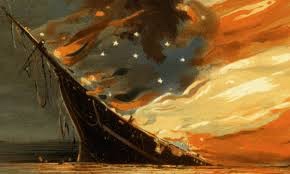
Stephanie McCurry, “Confederate Reckoning: Power and Politics in the Civil War South” (2010) – The entire point of the Confederate project was to create a polity that excluded black people and, to a lesser extent, women (women being formally excluded from the polis in the US as well). But in an ironic turn, historian Stephanie McCurry argues, the war that inevitably (in her telling- I’m less sure but she’s probably right) followed wound up creating conditions for women and slaves to agitate for themselves, making them political actors in spite of it all.

There are two main stories here. Both were made possible by the strain of the war and the massive reach the Confederate government developed to deal with it, the taxation and conscription policies unlike anything the US would see until the period of the world wars, with some unique characteristics like the rule saying men with more than twenty slaves were exempt from the draft. McCurry makes clear the stakes of internal conflict in the CSA, including domestic counterinsurgency (avant la lettre) against unionists and deserters that involved brutal massacres against civilian populations in the mountain south.

One story is the rise of the soldier’s wife as a political subject in the CSA. Farm families faced the dire double squeeze of their men being conscripted away and their reduced agricultural output being taxed more heavily than ever before. Women found themselves acting in the political sphere out of sheer desperation, writing their political representatives and groping towards the most effective framing of their grievances- they were the wives of the soldiers risking their lives for the Confederacy, much of the rhetoric of which was about protecting women and children, and here were both going hungry. This politics culminated in at least a dozen food riots throughout the CSA, where well-organized groups of women seized grain from merchants and speculators and forced the Confederacy to spare scarce men to protect the markets.

The other story is that of what was supposed to be one of the great strengths of the Confederacy, its millions of slaves, becoming a massive liability. As it turned out, there was no way to mobilize the slaves in such a way to bolster Confederate military efforts that worked politically. Masters and slaves both resisted slaves being torn from their homes to do dangerous military labor, and the military wasn’t crazy about their troops treating spadework as beneath them, the realm of slaves, either. Being close to the line, slaves working in war zones had more opportunity to escape to the north, especially once the US instituted the contraband rules that freed slaves who made it across to them. Moreover, slave resistance spiked as the war went on, especially after the Emancipation Proclamation, once again forcing the CSA to dilute its strategic resources to keep the home front in line. It all culminated in a debate over enlisting slave soldiers, which the CSA ultimately steered away from doing in any systematic way- protecting the racial caste system was more important to the Confederate leadership than southern nationalism, states rights, or any of that crap.

This is a very interesting book that raises a lot of questions about how the Confederacy negotiated with the strains that defined modern politics in the nineteenth century. Is there a version of the Confederacy that could have survived? Signs point to no, at least not against really determined northern opposition- the strains of war is really what did the CSA in, domestically arguably more than militarily. I don’t know whether that means states organized around the systematic exclusion of much of its population from political decisionmaking is always doomed, but the Civil War prefigured the total wars of the 20th century and the mass mobilization those entailed, which always meant a negotiation between state and society. This was something the Confederacy couldn’t manage. *****

Review- McCurry, “Confederate Reckoning”