Review- Johnson, “Street Justice”

Marilynn Johnson, “Street Justice: A History of Police Violence in New York City” (2003) – A former professor of mine wrote this book. A work of social history, it makes use of the archive left by complaints against the NYPD (both official and unofficial) and the defenses and reforms mounted by the police and their supervisors over the years- which is to say, a lot of the story isn’t and can’t be told, as it’s already been swept under the rug, in some cases for over a century. There’s a dispiriting regularity to how waves of police reform go. The police engage in systematic violence, from “clubbing” passers-by in the nineteenth century to the “third degree” in interrogation in the early twentieth with violent ethnic/racial/class profiling throughout. Coalitions of affected groups, liberal, leftists, and reformers get together to reign things in. You get some questioning of what the police are for and what they’re doing, but in the end discourses against the abuse of “respectable” citizens (implicitly approving of roughing up everyone else) and “professionalism” take the fore, being pressed by more organized and wealthier groups. The police squawk at both radicals and reformers and insist the sky will fall if they can’t torture suspects/club people when they feel like it/profile black people/whatever. But in the end, they wind up becoming quite cozy with the more moderate reformers, many of whom wind up giving police more resources and control in the name of professionalism. The structural issues are left in place, violence finds more permissible targets, and the cycle begins again. In this moment, the forces pressing for structural change seem stronger than they have in a long time, but the dynamics of reform are still depressingly similar. ****

Review- Johnson, “Street Justice”

Review- Maurer, “The Big Con”

David Maurer, “The Big Con: the Story of the Confidence Man” (1940) – Who doesn’t like old-timey flim-flam men? David Maurer was a linguist who approached the underworld of his time in search of its peculiar argot. Along the way, he got to know dozens of con men, who became his sources for this book. As the title promises, it focuses on the “big” con games, defined by “the send” – the act of sending the mark home to get more money. Ten thousand dollars was considered the minimum score for a big con, and Maurer regales us with tales — typically told by the conmen themselves in their dialect — of routinely taking rich men for hundreds of thousands of dollars, back in the twenties and thirties when that was the equivalent of millions.

Maurer lingers on the details of the craft: the division of labor within the con mobs, the rules of the different games (which all seemed pretty much the same to me- maybe I’m just a poor mark!), the setup of “stores”: fake gambling clubs and stock brokerages where ropers took marks to get fleeced. More than the simpler short cons, the big con relies on the complicity of the mark. Everything about the mob’s performance and the shop setting is designed to “stir the larceny in the mark’s blood.” “You can’t cheat an honest man,” they say- all the games rely on telling the mark that the conmen are bringing them in on the real, i.e. underhanded, way to make big money. They make use of the greed and pride of men who fancy themselves big wheels because favored by the big game of capitalism, but who have niggling suspicions that they’re not in on the real action.

Maurer sued the makers of the movie “The Sting” for allegedly ripping off his book (they settled out of court). You can see why- I thought the elaborate fake storefront they used in that movie was unrealistic, but I guess not. You already need a big bankroll to start a big con game, to pay for premises, help, and fixing the police. That’s another way the con games mirror capitalism as a whole- those with the money to start with are in the best position to gain more. I wonder what an updated version looks like- as far as I can tell, the big con has mostly turned into stock swindles, and the short con is everywhere online, but who knows? Either way, a good read both in content and tone. ****’

Review- Maurer, “The Big Con”

Review- Wodehouse, “Pigs Have Wings”

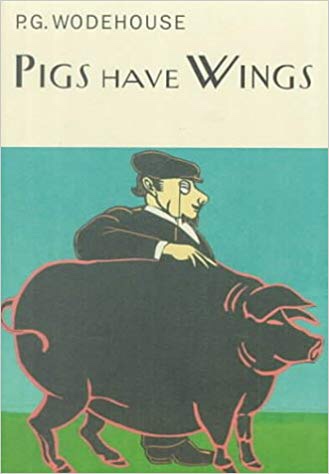
P.G. Wodehouse, “Pigs Have Wings” (1952) – What to say about P.G. Wodehouse that hasn’t already been said? His books are more-or-less pure wholesome fun. Everyone at the time liked and respected him with very few exceptions and people who read him now have the same feelings. He had a more-or-less blameless, happy life except for letting the Nazis bully him into doing self-effacing radio vignettes when they had him captured, and he never complained about the Brits being mad at him for it. Everyone in humor writing imitates him but nobody duplicated him. Even people like me inclined to dislike the British upper-crust milieu he illustrates find little fault with him, if nothing else because his characters are so ludicrous and awful (but always in a funny way). By the 1950s when this, the seventh book set at rural Blandings Castle, was published, he had been going for forty years and would go for another twenty. His later work, in my opinion, doesn’t have quite the zip or beauty of construction that characterized his mid-career stride from the twenties to the forties, but it’s still amusing and worth reading. This one is no exception- he had nailed the formula well before then. It’s the twenties, there’s a bunch of twenties-types — befuddled aristocrats, star-struck lovers, gadabouts, vicious aunts, servants of varying degrees of capability and trustworthiness — all bouncing off each other in a plot centered around two prize-winning pigs and four young people who need to be properly paired off. Everything comes together with only a few audible creaks in the machinery, and you’ve got Wodehouse set out to give- finely-crafted literary entertainment in a light vein. ****

Review- Wodehouse, “Pigs Have Wings”

Review- Sciascia, “The Moro Affair”

Leonardo Sciascia, “The Moro Affair” (1978) (translated from the Italian by Sacha Rabinovich) – The kidnapping and murder of Italian statesman Aldo Moro by the Red Brigades in 1978 gave the squalor of the “Years of Lead” a symbolic central narrative. Novelist/journalist Leonardo Sciascia did a lot to define that narrative with his book on the topic. For the most part, Sciascia allows both the Red Brigades and Moro speak for themselves, and for the Italian state to speak for itself through its silences and obfuscations. Moro had the chance to write several public letters while in Red Brigade captivity for almost two months. He starts out relatively resolute and gets more and more unbelieving that the state — run by the party he dedicated his life to, the Christian Democrats — would not negotiate for his release. The C-Dems developed, all of a sudden, an aversion to prisoner swaps that Moro and Sciascia saw as antithetical to what philosophy the party could be said to have.

Of course, that’s largely the point- Christian Democracy was essentially the court philosophy of the people who ran the Italian state, and so was not particularly Christian or democratic. Sciascia suggests that the Red Brigades, while otherwise a vain and bloody-minded lot with more in common with the Mafia than they’d like to admit, didn’t particularly want to kill Moro- they wanted a prisoner exchange and to make a point. But Giulio Andreotti and the others running Italy wanted to make a point, too, and so Moro wound up dead. Sciascia translates everyone’s communiques into something like actual communication, and it all said that for everyone who mattered at the key moment, Moro dead was worth more than Moro alive. ****

Review- Sciascia, “The Moro Affair”

Review- Traverso, “Fire and Blood”

Enzo Traverso, “Fire and Blood: The European Civil War 1914-1945” (2007) (translated from the French by David Fernbach) – Italian historian Enzo Traverso lobs the logic of civil war like a bomb at the warmed over totalitarian-school readings that were big stuff in the first decade of the twenty-first century, and which look to be coming ‘round again after Trump et al. In many respects, this book is an extension of Arno Mayer’s great work, “The Furies.” Mayer argued that rather than illustrating the danger of ideology as a free-floating concept, the great ideological bloodlettings between the French Revolution and today show that violence is the inevitable concomitant of change- that “violence is the midwife of history.” This goes along with the blind eye liberal anti-totalitarian scholarship turns towards massive violence that did not proclaim its ideological nature (or, more cynically, didn’t happen to white people)- the violence of imperialism, for instance. Imperialism, revolution, industrialization, all among the main movers of modern history, all substantially violent, so sticking at one type of violence as unavoidably tragic and wrong makes little sense. “If all civil wars are tragedies, some deserve commitment,” as Traverso puts it.

Mayer wrote about the French and Russian revolutions, Traverso writes about the arc of violence in Europe that began with World War One, extended through the waves of revolutions and counterrevolutions in the 20s and 30s, and ended with World War Two. There’s a few reasons to see this as a long European civil war, along the lines of the Thirty Years War in the seventeenth century or the French revolutionary/Napoleonic wars at the dawn of the nineteenth. Civil wars are proverbially ferocious, calling forth degrees of commitment (both in scale and depth) seldom seen in other types of war. They tend to be layered conflicts- regional, ideological, international, local, religious fault lines are all activated by civil wars and interact in complex ways. Case in point, the way the age of crises between 1914 and 1945 affected every society in Europe (and beyond- one weakness of the book is that it’s unabashedly eurocentric).

I tend to agree with Traverso about his framing of the early twentieth century, and am always down with a tilt at liberal historiography. This book had a kind of assembled, essayistic feel to it which wasn’t awful or anything but which doesn’t compare with works like “The Furies,” as Traverso himself would probably agree. ****

Review- Traverso, “Fire and Blood”

Review- Mahfouz, “Palace of Desire”

Naguib Mahfouz, “Palace of Desire” (1957) (translated from the Arabic by William Maynard Hutchins, Lorne Kenny, and Olive Kenny) – The second volume of Mahfouz’s Cairo trilogy follows the al-Jawads into the mid-1920s. There are a number of viewpoint switches but most of what we see we see through aging patriarch Sayyid Ahmed and his two sons, the sybarite Yasin and the young idealistic Kamal. Disappointment is a big theme in this one. Mahfouz gets soap-opera-esque when Yasin and Ahmed wind up dating the same woman, and he does a pretty good job with the sensation of unrequited love, contrasting Kamal’s flowery inner monologues about “the beloved” with the more mundane realities that surround him and preoccupy his friends. It’s not that exciting a read and somewhat unbalanced (much less of the women’s perspective than in “Palace Walk”). Ultimately, a pretty good book with reliably deft use of language. ****

Review- Mahfouz, “Palace of Desire”

Review- Zipp, “Manhattan Projects”

Samuel Zipp, “Manhattan Projects: The Rise and Fall of Urban Renewal in Cold War New York” (2010) – Another book from my comps list I haven’t actually read until now… I’m not sure how to judge it because I have all the spatial sense of a dead horseshoe crab. I admire architects in much the same way I admire mathematicians and pole vaulters, as people who might as well be doing magic as far as my abilities to do the same go.

I guess I better judge based on the historical narrative, then, because architectural details are lost on me. In that, the book is fine, though a tad thesis-heavy: major urban renewal projects in Manhattan were influenced by the Cold War, in that planners wanted both to prove they could do (x planning task) better than the Soviets and as they sought to make New York the capital of 20th century modernity. This is true of the UN HQ, the Stuyvesant Town housing project, Lincoln Center, and the East Harlem housing projects. All of these are “superblocks,” lifted out of the street grid on oversized plots of land and one way or another isolated from the rest of the city to form self-contained units. All of them were major top-down projects that made heavy use of eminent domain to clear out slums in order to make these modernist utopian constructions.

All of them faced resistance, along an accelerating course- less for the UN HQ and then steadily more until the East Harlem projects got caught up in years of political fighting. In part, this was the resistance of people displaced from these “slums,” in part it was other people resisting the divisive results of slum clearance and new building in terms of race and class. The Stuyvesant Town apartments were only desegregated after a protracted fight, and the drive to rebuild the city in general entailed breaking up some of the city’s more racially diverse neighborhoods and kicking thousands of people, disproportionately black and Puerto Rican, out of their homes.

The usual story is that urban critic Jane Jacobs came along and curbed the abuses of “high modernist” superblock neighborhood-destroying city planning in favor of more human-scaled, mixed-use development strategies. But Zipp shows it was much more complex than that. Well before Jacobs, there were those arguing for the value of messy-seeming urban arrangements. Moreover, the equation (city rebuilding support = racism and classism) always and everywhere wasn’t right, either. There was widespread support for rebuilding the city’s housing stock among working-class, poor, and communities of color in New York in the late 1940s- their housing stock was generally dilapidated, after all. Most of them just wanted improvements within their communities, not getting bulldozed out of the way, but they didn’t share the nostalgic aspect of the vulgar Jacobs-ism, which has foisted on us the “creative city,” with its “mixed” use of luxury condos and the kind of coffee shops luxury condo dwellers like. All in all, a solid book, as far as my non-expert, spatially-challenged self can tell. ****

Review- Zipp, “Manhattan Projects”

Review- Dickinson, “The Traitor Baru Cormorant”

Seth Dickinson, “The Traitor Baru Cormorant” (2015) – Does it count as fantasy if there isn’t any magic in it? That’s just one of the questions raised by this excellent novel that I’ll just go ahead and call early-modern fantasy anyway. It has a lot of fantasy tropes; a young person with a destiny/quest, an alternate world, battles with pre-modern weapons, duels. It also has twisty feudal politics galore, driving comparisons to the Game of Thrones books, but for my money Dickinson gets a lot more done creatively in fewer pages than GoT.

Baru Cormorant lives on an idyllic island — pre-contact Hawaii divides by Lesbos — as a child but we all know that can’t last. The Empire of the Masquerade gets its hooks in things via trade followed by conquest. The Masquerade is an interesting invention. The product of a sort of Jacobin/Machiavellian type revolution, it is notionally a meritocratic republic, where all civil servants wear masks to anonymize themselves as servants of the people, hence the name. They make their way to empire more through cunning introduction of innovations that favor them — monetary policy, sanitation, education, etc. — than by military might, though they have a lot of the latter. All is not well with the Masquerade, though- part of their overarching rationalism is strict eugenics and conditioning programs, which entail a rabid homophobia among other issues.

Baru gets taken in as a child to a Masquerade school, but vows to never forget her two dads who the Masquerade kills or her mom, to whom she promised vengeance. She decides she will excel at the meritocracy game, gain high place in the empire, and use it to… here she waffles between “make improvements to her home’s position” and “throw off the Masquerade yoke” but whatever, she’s like eighteen. She excels in her training (at the cost of suppressing her own sexual identity) and is eventually appointed Imperial Accountant of a different restive province, Aurdwynn. Her patrons imply that if she can help make Aurdwynn governable, then she will get to move still further up the ranks.

Aurdwynn is basically Game of Thrones’ Westeros, to an extent where I wonder if Dickinson is making sly jabs at George RR Martin. Run by a welter of dukes, each with their own involved alliances, economies, heraldry, customs and so on, it’s a mess, and one that constantly rebels. Baru has her work cut out for her.

It’s hard to know how much to say about the plot of the book without giving it away. Suffice it to say we wind up with a very interesting depiction of an early modern (they have telescopes, frigates, and eugenics but no guns- most battles are fought by phalanxes) rebellion. Dickinson takes us through the back and forth of winning over dukes, losing dukes, forming something like a guerrilla army and using it, without losing any steam in the process. It’s a good match of solid plotting and innovative worldbuilding. The language tends towards the flowery and passionate- lots of lists of things joined by “ands,” for instance. But it works pretty well for the situation, especially as Baru finds it difficult to hold together the threads of her personality, including her suppressed sexuality.

Again, avoiding spoilers, we’ll just say that the book sets itself up for the sequel that came out recently. It seems things might get a bit more magical-er as Baru peers deeper behind the Masquerade, so it might become more conventional fantasy. I hope it maintains its footing in the early modern- republics, finance, proto-versions of things like people’s war and eugenics, these things make for a worthwhile niche in the fantasy world. *****

Review- Dickinson, “The Traitor Baru Cormorant”

Review- Okorafor, “Who Fears Death”

Nnedi Okorafor, “Who Fears Death” (2010) – Here we have a fantasy/scifi novel that draws from both Africa’s traditional storytelling and its contemporary issues and crises. The main character, Onyesonwu, is the product of rape as a weapon of war, in an ongoing conflict between the dominant Nuru tribe and the insurgent Okeke. Raised by her mother in an Okeke village, Onyesonwu is an outcast but develops magical powers- first shapeshifting into various animals, then numerous others.

The first third of the book is the best part, as she develops her powers, induces the local magicians to teach her against their resistance, and learns her destiny- to go among the oppressed Okeke far from home and bring an end to the fighting, as well as confronting the evil Nuru wizard who is helping spur the conflict.

The rest of the book drags, unfortunately. Okorafor is also a successful young adult fiction writer and it shows as she takes her characters out to the desert and has them get into teenage dramatics with each other. We go from learning the ins and outs of magic and ethnic conflict to protracted drama between Onyesonwu’s interchangeable friends with the suddenness that the end of “Huck Finn” becomes a hundred pages of minstrel routine. Quest narratives always have some back and forth within the group, but “Who Fears Death” loses a ton of momentum and never quite regains it. The ending has a pretty cool magical catastrophe in it but by then you can’t help but wonder at the book that could have been with this premise. ***’

Review- Okorafor, “Who Fears Death”

Review- Dobbs, “Teamster Rebellion”

Farrell Dobbs, “Teamster Rebellion” (1972) – The Minneapolis general strike of 1934 has gone down into radical lore, especially among Trotskyites whose ideological forebears provided much of the leadership for it. Farrell Dobbs was one of them, a true product of the radicalization wave of the 1930s, who went from a Hoover voter to a Communist League (not to be confused with the Stalinist Communist Party!) member within a couple of years of coping with the Depression and the bosses of Minneapolis. He was a key organizer of the Minneapolis strikes, which began with the Teamsters but spread widely among employed and unemployed workers in the city.

What this reminds me of are classic command memoirs like Ulysses Grant’s and Tom Barry’s, though I did notice Dobbs uses passive voice much more often than either. At first, I wondered if this was a matter of how often the three authors were talking about collectives versus individuals- Grant seemingly never uses passive voice when referring to the actions of individual generals, but will use it for armies. But no, Dobbs uses it for individuals including himself. I figure he probably learned to write in large part by writing reports to a party that used a lot of passive voice.

Anyway, enough about the writing, which is straightforward throughout with only occasional lapses into (relatively simple) jargon. The story is incredible. Minneapolis was an open shop town, in Dobbs’ telling, with most of the few union leaders in the pockets of a well-organized capitalist class. Work in the trucking industry was hard, unremunerative, and divided into numerous squabbling trade-based cliques — ice drivers vs coal drivers vs loaders etc — each jealously guarding their own scraps of privilege. Dobbs illustrates piece by piece how the drivers were transformed into an engine of class struggle.

More than anything, Dobbs and the other radicals — some party cadre, some not — worked by expanding the site of struggle. Where the American Federation of Labor bosses encouraged a defensive crouch for each subsection of workers, the radicals in the Teamsters worked to reach out, first across the boundaries within the trade, and then to other trades, and to people outside of conventional employment: women, the great masses of unemployed created by the Depression, etc. Not unlike Grant, the teamster radicals were masters of the strategic offensive melded with the tactical defensive. They could move to organize a given sector and let the bosses break their heads reacting to each, which strengthened the connections between Local 574 (the Teamster locus) and its allies.

It’s also worth noting that these were desperate times when the state was much weaker than it is today. Imagine roving pickets of men stopping trucking in a major city today without armed police stopping them at once! That’s eventually what the city fathers did, leading to the Minneapolis police firing on a peaceful, unarmed crowd (Dobbs and the others were capable of cold calculating- they specifically left their clubs at home when the cops came with guns), wounding dozens and killing two. It wasn’t enough. It also helped that Minnesota’s governor, Floyd Olson, was a Farmer-Labor party guy, by no means a radical (Dobbs doesn’t trust him at all) but unable politically to call out the National Guard until the Teamsters had organized nearly the whole city. This was also before WWII, when FDR started seriously repressing threatening industrial strikes much harder. In the end, bosses came to the table and recognized 574.

This is a short, action-packed book- adjusting the plan on the fly, getting the whole community involved (one way in which Hollywood actually deploys a collective orientation instead of an individualist one is the way they use this trope), attempted Stalinist cooptation/sabotage, pitched hand to hand battles, the rough humor of people used to hard knocks… more than anything, the excitement a people marshaling itself for struggle. Dobbs credits his organization and its ideas but seldom in a way that obscures the role of the people themselves in the victory. All in all, a very impressive book, and I look forward to reading the sequels even if I know the story of the Teamsters isn’t always a happy one. *****

Review- Dobbs, “Teamster Rebellion”