Review- Slotkin, “The Fatal Environment”

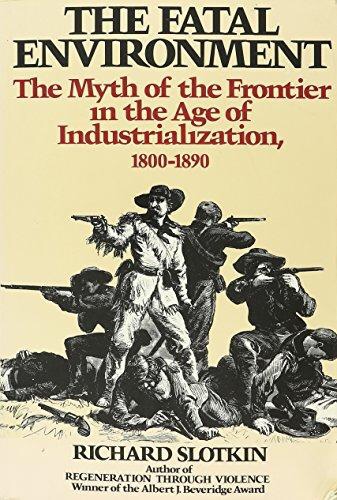
Richard Slotkin, “The Fatal Environment: The Myth of the Frontier in the Age of Industrialization, 1800-1890” (1985) – This is the second in Richard Slotkin’s trilogy of books on the myth of the frontier in American life. This one covers the nineteenth century, and benefits from Slotkin having gotten most of the theory — especially the Jung and Campbell — out of his system in the first volume. Slotkin reads the literature of nineteenth century America — especially the sort of frontier writing we tend to forget but which was much more popular than the rarified names like Melville and Hawthorne we remember — along the lines of the historical crises of the frontier.

The frontier myth — the notion that social conflict can be resolved by people moving to the frontier, wherever it is instead of resolving issues at home — is one of the most powerful ideological solvents we’ve seen in modern history. But it’s considerably more delicate than we appreciate. The frontier can also be seen as a site of degeneration and danger. More pressingly in the nineteenth century, there’s always been the threat of the frontier closing. This was true both in the imagination — how “open” a frontier is is a question of opinion, after all — and in fact. Americans in the mid-nineteenth century were genuinely unsure about their expansive possibilities, between Mexican and British opposition and the sheer size and climatological variance of the trans-Mississippi West.

This led to some interesting ideological fantasies. Some Philadelphian wrote a sort of Philadelphia-apocalypse where, without the safety valve of the west, urban industrial society loses all financial and sexual morality until mobs just roam the street burning everything. Northerners tried to sell the Lowell mills and Southerners tried to pitch the plantations as potential solvents for the sort of social conflict westward expansion was supposed to solve.

Of course, the US wound up stealing half of Mexico and convincing Britain that Oregon wasn’t worth it. But something funny happened- Mexico didn’t quite fit the American frontier fantasy. It was too densely populated- Americans worried that they would wind up like their image of the Spanish, mixing with the Mexicans and ruling them over in a way that degenerated their faculties or whatever the nineteenth century racist jargon would be. Along with that, the Mexican conquest brought in enough territory to set north and south fighting over whose social system would prevail in the spoils, especially California. Both were terrified of a societal collapse if the wrong system prevailed in the west. We know how that wound up.

There’s also a lot of stuff in here about Custer, but truth be told that was less interesting to me. Slotkin is a somewhat “thesis-heavy” writer, and the Custer-as-metaphor thing is something he leans heavy on in the second half of the book. But when he gets away from that, his encyclopedic knowledge of American cultural history returns dividends to the reader. Among other things, I really want to read that Philadelphia apocalypse book and see if it features Gritty. ****’

Review- Slotkin, “The Fatal Environment”

Review- Levison, “Dog Eats Dog”

Iain Levison, “Dog Eats Dog” (2008) – Bank robbers, FBI agents, and worst of all, humanities professors populate this fast little crime read. Bank robber Dixon winds up in New Hampshire after a botched bank robbery, with a gunshot wound and a quarter million in cash. He stumbles across Professor Elias White — the sort of young academic utterly uninterested in his subject area (history!) but very interested in career climbing many of us have encountered — in the act with an underage girl. Dixon blackmails White into hiding him and helping out. An FBI agent driven to cynicism by her sexism-stalled career comes up to New Hampshire chasing dirty bills and White now has multiple sides to play.

The book is fun, and deeply cynical, a crime novel without the center of a comparatively good character, a detective or whatever. If anything, Dixon comes across the best as he’s least dishonest or sadistic, though he also forces people to do things at gunpoint. White is a well-realized slimeball and if Levison doesn’t get the gritty details of the history profession exactly right, he gets it right enough. Lupo, the fed, has less clear motivations than the others, but the siren song of easy advancement through crooked mean calls to her too. All in all, a good, rotten airplane read. ****

Review- Levison, “Dog Eats Dog”

Review- Jama-Everett, “The Entropy of Bones”

Ayize Jama-Everett, “The Entropy of Bones” (2015) – I’ve seen kung fu movies, but I’d never read a kung fu novel before this one. It’s the story of Chabi, a teenage girl growing up on a houseboat in the Bay Area who, after some training from an eccentric old Indian guy, is capable of running fifty miles in a couple of hours every day and breaking every bone in someone’s body in a matter of seconds. The latter feat is accomplished not by strength tuning in to the titular entropy already extant in the bones themselves. All of this is imparted like it’s obvious common sense, which makes it more fun.

Obviously there’s something special about Chabi in terms of her physical capabilities. She’s also mute, but can speak psychically. This didn’t make much sense to me as a character feature until a minor reveal at the end. The book in general has a kind of loose, almost conversational rhythm, like Jama-Everett is telling you these stories over beers. Loose, but well-structured (like a barroom story one has told many times)- the details of Chabi’s powers, and the world she’s a part of, come out naturally. The world of the story is similarly tossed-together in the best way: entropy beings versus “liminals,” super-powered people like Chabi, and a few demigods and time travel thrown in.

Chabi winds up working for some suspiciously pretty hotel magnates once Narayana, her sensei, disappears on her. She knows there’s something wrong with them but can’t work out what. When a friendly demigod of the wind comes from the future and hips her to the whole entropy-being thing, she puts two and two together and realizes maybe Narayana wasn’t on the side of the continued existence after all, which is a bummer. She gets it together enough to fight a bunch of other superpowered fighters in a big final tournament the baddies put on, but of course she can’t fix the whole thing or there wouldn’t be a future conflict for the wind guy to come back from, would there? No, the forces of rhythm and weed (this guy likes weed) will have to continue to battle the forces of entropy. In all, this book was pretty fun and I’m going to look up some of the rest of his work. ****’

Review- Jama-Everett, “The Entropy of Bones”

Review- Washington, “Up From Slavery”

Booker T. Washington, “Up From Slavery” (1903) – I picked this up at a library sale because it’s historically important, and Modern Library ranked it #3 on its list of great nonfiction works of the 20th century- the highest black writer, ranked above works by W.E.B. Du Bois, Malcolm X, Richard Wright, and so on. To be fair it is a pretty conservative list, with “The Education of Henry Adams” topping it. But still, a big claim.

It’s not my place to adjudicate political fights within communities not my own. I will say that Washington has not gained in popularity since the 1960s, where the introducer to my copy discusses him as someone worth reading basically out of opposition. I’m told there’s an edition with an introduction by Ishmael Reed, a politically protean and contrarian figure, which I’d like to read. His rival, Du Bois, is name checked with more and more frequency, from where I’m sitting, and Washington primarily exists as a foil to him and the black freedom struggle.

Washington doesn’t do himself many favors in this book. His writing working class black people speaking in minstrel dialect would be enough to cost him legitimacy if he wrote even a few decades later. “Up From Slavery,” which is largely repackaged from his speeches, contains a kernel of an interesting story- Washington was indeed born a slave and wound up a quasi-official spokesman for his community, running a sort of millet system out of his school, the Tuskegee Institute.

But you don’t really learn much about how this happened. As far as Washington is concerned, it happened because he wanted it, he worked for it, and some white people were nice to him. That’s it. It gets more interesting when Washington spitefully depicts — often enough imagines — the dreadful fates of black people who pursue other values, like formal education, political power, and simple human enjoyment. Respectability and work — whatever work the white man deigns to give him — is the black man’s only way forward. Washington believes this to the point of intentionally degrading black political efforts during Reconstruction, bragging about seeing former black politicians reduced to servile work and drunkenness. It’s fucked up. Apparently, he took that attitude to Tuskegee, to the point where he scolded some of his own professors for carrying books around.

It’s possible to spare a little sympathy for the impossible position figures like Washington were in after the failure of Reconstruction. I wasn’t kidding in comparing his situation to the millet system- a minority at the mercy of a capricious and violent ruling majority, he tried, like the Armenian leadership before the Ottomans turned to genocide, to make himself and his community into whatever shape wouldn’t call down heat. Of course, it didn’t work, not for the Armenians or the German Jews or Iraqi Shia or American black people. How to rate something like this? A historical document written in fairly pompous late 19th century oratorical style, about disputes in a community not my own but touching on historical questions which effect us all… well, I base these ratings in the last case off of enjoyment, and this was a grim read. **

Review- Washington, “Up From Slavery”

Review- Payne, “I’ve Got the Light of Freedom”

Charles Payne, “I’ve Got the Light of Freedom: the Organizing Tradition and the Mississippi Freedom Struggle” (1995) – You can learn a lot about what some very small groups of twenty-somethings were up to in the 1960s, if you’re so inclined. Students for a Democratic Society and its offshoots and the LSD evangelists in the counterculture have dozens of monographs and memoirs dedicated to them as representative figures of their generation. There’s a growing literature on the conservative movement emerging out of the Goldwater campaign. To me, the most interesting of these small groups that have gotten so much historiographical attention are the civil rights workers in the Deep South in the early to mid 1960s, coalescing around the Student Nonviolent Coordinating Committee, or SNCC.

I’ve already read enough about SNCC to recognize the basic narrative arc — humble beginnings, perseverance in organizing, bold stands, national profile, splits, disillusionment even as they become a model for much of organizing thereafter — and a lot of the names. Charles Payne’s book situates SNCC and the campaigns it ran within a tradition and a place. SNCC didn’t invent the community organizing model — radical internal democracy, self-education, nonviolence, above all the encouragement of local grassroots leadership — but it did promulgate it throughout the Deep South and from there to sixties “movement” culture. Payne depicts the organizing tradition as bearing the deep stamp of Ella Baker, a massive behind-the-scenes influence on generations of civil rights and labor leaders. She was a transmission point of lessons learned in the earlier twentieth century to the young people who formed the backbone of SNCC.

Focusing specifically on the Mississippi Delta, Payne also embeds the SNCC story in place. It’s not as though SNCC just appeared and made change. Even in the most oppressed parts of the south, black people had organized themselves where they could, often under the NAACP (which was more or less legally purged out of existence in much of the south after the Brown decision). The organizing model SNCC employed melded well with the local organizing traditions of older Mississippi black activists, even if there were always points of conflict.

“I’ve Got the Light of Freedom” is essentially social history of an old school bent, though differing from the classic British social historians in that it deals with material that living people could detail to the historian. You get very granular stories of what happened, when and why, in Greenwood and other Delta towns, tied in to thematic chapters. Payne demurs when it comes to explaining SNCC’s divisions and downfall, except to repudiate the idea that we should be focused on the decision to get white people out of the movement- as he points out, it’s not as though the black people in it were all of accord, before or after that decision. He seems to point to the idea that beyond a certain scope of both time and organizational size, dedication to the slow, patient work this sort of organizing entails is hard to maintain. People want something bigger, both in terms of results and in terms of personal reward. This makes sense, and raises questions for this model, as important and inspirational as it’s been ever since. ****’

Review- Payne, “I’ve Got the Light of Freedom”

Review- Shaw, “The Nazi Hunter”

Bynum Shaw, “The Nazi Hunter” (1968) – I picked this up off the free pile at the Brookline Public Library based on its cover and title. It was written in the wake of the capture and trial of Adolf Eichmann, along with debates about the scanty denazification of West Germany. Shaw was an American journalist who worked West Germany for a number of years, and it shows. He has opinions about cities (Bonn, Cologne, etc) and writes very “German” Germans, declarative, rules-bound, and still willing to vote for ex-Nazis. The titular character, who goes most of the novel with the name Streik, is a glowering Czech camp survivor who, well, hunts Nazis. He works with a Wiesenthal-style organization but is a little too hardcore for them. It’s hinted he was involved with the Eichmann capture but for the most part he kills Nazis and makes it look like an accident. For the most part, Streik is a standard midcentury super-spy in the Bond/Bourne mold. Closer to Bourne- the beige post-war Europe he works in, his tragic backstory, etc. Moreover, uh, spoilers I guess: he has a tragic end, where his devotion to killing Nazis lets him do massive collateral damage to get the big bad, and some of that collateral damage is his love interest. Was Shaw trying to get across the idea of “antinazism, but too much?” In real life, these Nazi-hunters were pretty scrupulous about getting the right man and only the right man and taking them alive- the Israelis could have killed Eichmann several times over with all the effort they put into getting him out of the country for trial. Probably, this is more about how revenge is bad, the usual thing. This is a fast, reasonably fun read but nothing mind-blowing. ***

Review- Shaw, “The Nazi Hunter”

Review- Robinson, “The Years of Rice and Salt”

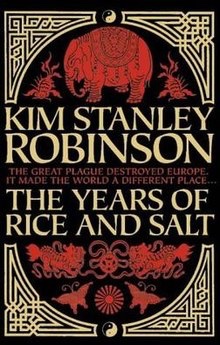
Kim Stanley Robinson, “The Years of Rice and Salt” (2002) – Kim Stanley Robinson joins the exalted company of Faulkner, Proust, and Garcia-Marquez in the category of writers that I respect but do not particularly like reading. He might be the only scifi writer in that category. He seems like a mensch. His ideas are interesting. It’s good someone is tackling big, hard scifi, be it about Mars colonization, interstellar travel, climate change, or in this instance, what modernity would look like not dominated by Europe. I respect the amount of research and work he puts into things. But his books run long and schematic. In “Years of Rice and Salt,” it was pretty easy to see what each part would be coming in in this history after the Black Death takes out almost all Europeans instead of a third of them. Samarkand alchemists, must be here’s the scientific revolution, here’s the world war equivalent, etc. etc.

Like most alternate histories it’s way too neat and schematic. This is probably an advantage over sloppy and dull (ala Harry Turtledove) but it usually doesn’t grab me. The players in the history are different — Chinese, Indians, Arabs, and Native Americans — which is a fine change, but the roles are mostly recycled. That might be part of Robinson’s whole Buddhist take- the idea is the characters are reincarnations of the characters in the first set, throughout history. None of it is bad and clearly a lot of it is well-meaning, depicting Muslims and assorted other “Others” of modernity as just as capable of enlightenment and modernity as anyone else. But it could have done more to show how modernity would have been different, beyond lines and names on the map and the demographics of who’s involved. Presumably those changes would have changed what modernity itself was all about. I give it credit for what I’m probably missing, because KSR seems like a good dude, and it’s good to have alternate history not about how cool the Nazis and/or Confederates were. ***

Review- Robinson, “The Years of Rice and Salt”

Review- Maugham, “Of Human Bondage”

W. Somerset Maugham, “Of Human Bondage” (1915) – This one hurt. The only comparison I can think of is Celine’s “Death on the Installment Plan.” Maugham and Celine are on utterly opposite sides when it comes to style: Celine, the great prose innovator of the twentieth century, Maugham, the master of conventional, easy-reading style in whichever medium he used. But both were in medicine before they took up writing, and both knew pain, both taking it and inflicting it. Both wrote great books putting versions of themselves through the wringer of youth.

The main character, Philip, has a rough time from the beginning- he’s got a clubfoot and his parents both die before he turns ten. He’s adopted by a basically indifferent elderly uncle and aunt. He goes to boarding school, which is hard enough when you’re not sensitive and clubfooted, but sucks extra hard when you’re both. He’s the wrong sort of middle class, just enough money to avoid learning anything useful or being able to easily adjust to normal working life, but not enough money to actually skate through.

Leaving school, he tries accountancy, hates it, and then tries to be an artist in Paris at the fin de siecle. Impressionism is just getting off the ground and everyone wants to be an artiste. Maugham draws a grimly convincing portrait of the life of people who want to live the bohemian lifestyle but aren’t quite up to it, artistically or in terms of resources. There are schools everywhere willing to rook credulous anglophones out of their pounds sterling by telling them they’ll teach them how to draw and paint and then blaming their lack of talent — which basically amounts to soul, in this world — when they fail. As Maugham has Philip explicate later, lack of money doesn’t ennoble- it makes money take on hideous proportions, makes you mean and calculating. Throw artistic pretensions on top of it, and Philip gets another beating from life and returns to Britain.

But the pivot of the novel is a Philip’s relationship with one Mildred, a waitress at a coffee shop (shades of Charlie Kelly!). People have wondered about how Maugham, who was gay, portrayed the pitfalls of heterosexual romance as well as he did. Some speculate he had a male Mildred in his life- I think that’s possible but also think that he was a sharp observer, that straight romance is really none too subtle at the end of the day, and that what he’s pointing towards is damn near universal.

Philip essentially uses Mildred as a means of torturing himself. He falls in love with her nearly instantly. I don’t entirely grasp what writers of this generation mean by “falling in love.” Philip has other lovers that he lists off all kinds of positive feelings for, including a sense of loyalty and respect that I associate with love, but insists he’s not “in love” with them. In this book, “love” is a sort of sickness, a fever (to use hackneyed language, sorry), an alibi for all kinds of awful behavior.

Due to his “love” for Mildred, Philip winds up in an array of situations that, a hundred years later, the internet invented any number of crude terms for, from “cuck” to a quite literal “Captain Save-a-ho” scenario. Shows how our language for romance has degraded! This is a six-hundred page novel and charting all the ins and outs of this torturous non-relationship is more than I can do. He gets in other relationships with good women but leaves them because he’s “in love” with Mildred. He literally gives his best buddy money to take Mildred away for a holiday to bone after he introduces them to each other. In the end it takes a public health emergency and an inheritance to finally give Philip the escape velocity to leave her orbit.

Mildred is one of the better literary depictions of a cipher, a cruel and essentially misogynistic depiction but brilliantly realized. She has just enough humanity to see what she does to Philip is cruel, but between her own callowness and the real limits Edwardian England put on women’s agency, she can’t help but reel him back in again and again. Blame really lies with Philip, and he knows it, but because of the sickness of “love,” he can’t help it. In the end, he basically burns himself, winding up content with a good relationship (though with what we’d see as a sketchy age differential) that isn’t “love” and deciding that’s good enough. Unrequited love is its own peculiar, humiliating type of hell, and Maugham is the Virgil leading us through it. *****

Review- Maugham, “Of Human Bondage”

Review- Scott, “The Politics of the Veil”

Joan Wallach Scott, “The Politics of the Veil” (2007) – Like Joan Scott, I come to the veil controversies from an American perspective, where you basically let people wear whatever. The idea you need to strip yourself of communal identifiers — so, ironically enough, you can be an Enlightenment-style individual — to be part of the national community doesn’t make much sense to me. I’ve run into it here, of course. During some of my shittier jobs I was subjected to rants about how people should only fly other countries flags if they flew the American flag at the same height, blah blah. The usual nationalistic nonsense from nationalisms that purport to be about freedom of expression.

AFAICT the biggest irritant here to Joan Scott, a major feminist historian, is that unlike American xenophobia it’s hard to dismiss the French version as just ignorant people being ignorant. Real intellectuals and serious statespeople in France were in favor of the headscarf ban in schools, and later the body-covering ban (which apparently also does unitards? Stupid rules). So Scott tackles the particulars of French universalism that allow for this situation to pass. It’s a picture that doesn’t lack for pathos, even as it veils (heh) xenophobia. The universalist dream isn’t entirely a bad one. The problem is they made (implicitly Catholic, or ex-Catholic) white French men the model of the universal and expect everyone to conform to that. I found myself wondering, “why not mandate baguette eating or cigarette smoking while you’re at it?” if there’s this supposed French way of being everyone needs to do to be French? The answer to that is the usual depressing stuff about racism and colonialism, France’s long war with the Muslims of North Africa. But I guess having grown up free-range, one human thing I have difficulty really grasping is the insistence everyone play the game your way. ****

Review- Scott, “The Politics of the Veil”

Review- Cook, “Crisis Boy”

Garrett Cook, “Crisis Boy” (2018) – After several novels — most prominently “Murderland,” “A God of Hungry Walls,” and the bravura “Time Pimp” — Garrett Cook (interest declared- a friend of mine and I once rescued him from Punxsutawney Pennsylvania, true story) has established a distinctive horror voice. This comes through most clearly in his latest, a story about a boy who can survive gunshots and explosions, who is deployed to the sites of terrorist attacked and mass shootings to be killed, over and over again. He’s a crisis actor, except he actually gets hurt, and the events he undermines actually happen.

Cook comes to us from the “bizarro” horror scene, a sort of dada/pop-surrealist offshoot of extreme horror. Truth be told, I don’t get much out of the genre- a lot of strikes me as try-hard edginess. I’m hardly the target audience- I always cocked a snoot at horror in general. I was reading about the Holocaust at six and spent years of my life with Vietnam war documents. I play board games about bloody counterinsurgency wars for fun. Serial killers don’t mean that much to me.

So needless to say I was square enough going in that, friendship with Garrett aside, I was unsure about the premise. “Why,”said the reviewer, like a square, “would they need crisis actors if the massacres happen, in gruesome detail?” Well, because fuck you, that’s why, Cook tells us. Because the world is run by monsters of every conceivable type and they just want to fuck with people, get people online convinced that what they see isn’t real, and squabble over which parts are or aren’t.

John the Crisis Boy decides to try to turn the tables because he meets a pretty girl. Of course, it gets all messed up, and even though he kills the monster — a slasher villain turned patriotic superhero, a nice touch — he winds up demonized as the sort of killer who has killed him numerous times, and in a crumbling reality to boot. It’s hard to tell what exactly goes on in this crumbling reality and whether his existence is real or a projection of the sort of damaged psyche his existence is meant to inflame. That’s something of a problem with this sort of fiction- endings. Especially if you’re not going to go with a nihilistic copout, which Cook generally refuses to do.

All of this — the crumbling reality, John’s teenaged angst, and the scenes of gore and extreme depravity — are carried along by Cook’s voice, which makes everyone a knowing but predetermined actor in the grand guignol of life in a Garrett Cook story. The narrator and most of the characters accept the absurd dream logic of their given scenarios and speak them aloud. This helps avoid letting things get too cute or too melodramatic, a difficult balancing act. Whatever you want to say about this sort of horror as a whole, Garrett’s provocations are part of something larger he’s doing, and the last thing he ever was was a try-hard. ****

Review- Cook, “Crisis Boy”