Review- Wolin, “Heidegger’s Children”

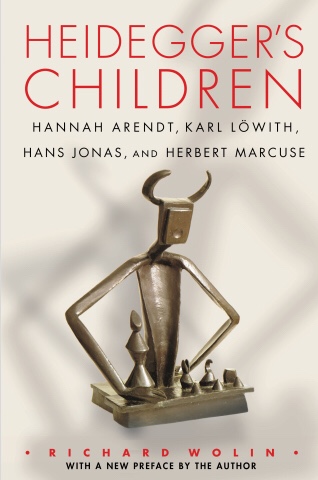
Richard Wolin, “Heidegger’s Children: Hannah Arendt, Karl Löwith, Hans Jonas, Herbert Marcuse” (2001) – There’s no saltiness quite like that of an academic vindicated in a long-held, long-dismissed belief. Intellectual historian Richard Wolin had been beating the drum about the Nazi past of Martin Heidegger, the greatest (in the sense of being a big deal) philosopher of the twentieth century, for years. Heidegger is as big of a deal as he is because his influence goes well beyond philosophy departments into… well, other university departments- literature, architecture, etc. His phenomenological framework is sufficiently powerful, flexible, and more than anything else, glamorously incomprehensible, that he was useful and appealing to a lot of people. They all knew he was a Nazi party member. Most of them probably knew that his excuses for it — he felt pressure, he tried to avoid politicizing the university, etc etc — were specious at best. They must have noticed certain, shall we say, elective affinities between Heidegger’s critique of modernity and some of the “Völkisch” tendencies that went into Nazism. But it was all vague enough to be waved away, at least during Heidegger’s lifetime.

Wolin didn’t buy it in the nineties, when he became embroiled in the Heidegger Controversy (it gets caps- Wolin edited a collection on it) and when he was writing “Heidegger’s Children,” and his exasperation with the defenses of the Black Forest Sage shines through the text. It examines four of Heidegger’s major students – Hannah Arendt and Herbert Marcuse being the best known, though I’d say Löwith is also worth reading – all of whom were Germanized Jews, and their relationships with their teacher. Even his pre-Black Notebook defenders admit Heidegger had an anti-semitic streak (not that it stopped him from sleeping with his grad student Hannah Arendt, which, you know, not exactly what you want in a sage either). But evidently his charisma and philosophical powers were enough that it attracted these students. Wolin argues that the degree and kind of assimilation on the part of middle-class German Jews played a crucial role in allowing these relationships to take place despite the master’s distaste for Jews. I don’t know enough about German culture at the time to say, but it sounds both basically accurate and overstated, perhaps majorly so.

Wolin goes through each one, considers parts of their oeuvure, and in each case condemns the philosopher in question for not separating themselves far enough from Heidegger and his elitist anti-modernism. He attributes the flaws in Arendt’s “Eichmann in Jerusalem” and her bien-pensant liberal elitism to the same flaws that led her to play a weird double game for Heidegger even after their affair. Hans Jonas (whose work I don’t know) seeded the German Green movement with bizarre and unhelpful antimodern sentiments drawn from Heidegger, the master he abandoned decades before. Marcuse managed to escape his gravitational pull more — he had more independence from Heidegger, in large part due to his Marxist commitments – but still meandered through efforts to square the circle of reconciling Heidegerrian phenomenology and Marxism. Löwith… I don’t remember what his issue was and I haven’t got the book in front of me. He did something wrong, and it was the fault of whatever it was drew the guy to Heidegger.

All this, in 2001, before the Black Notebooks came to be published to the extent they have, and Heidegger’s genuine enthusiasm for Nazism became impossible to hide! My edition has an extended preface where Wolin relishes dunking on Heidegger’s assorted defenders. It’s hard not to appreciate his enthusiasm- even if you take something from the philosopher’s work, his academic defenders were a trendy lot (there’s a hipster architecture magazine called “Dwell,” a self-conscious nod to one of Heidegger’s later philosophical hobby-horses), their prevarication was pretty weak, and it’s satisfying to see the historical record get its due. That being said, it leaves a larger question – what do we do with important cultural figures with abhorrent political views? – unanswered.

Several times, Wolin insists on Heidegger’s brilliance and importance, while also condemning his work tout court as fruit of the poison tree of German reaction. We are left with no idea of how to reconcile that. For my money, he’s right- Heidegger is both brilliant and toxic. We make use of many toxic, dangerous substances, and the work and ideas of those who walked on the dark side of modernity – by no means restricted to fascism – should qualify, if radioactive materials do. Heidegger asked a lot of questions in a very provocative way, and helped break up the staid academic philosophy of the early twentieth century (with a lot of help, including from mentors he spited, like Husserl). He isn’t someone you should take moral (or political) advice from, and maybe this is just my materialism talking, but that seems to be the problem more than anything. Both Wolin and the Heideggerians he puts on the dock tried to get usable morals out of a twentieth century philosopher. Classic mistake! ***’

Review- Wolin, “Heidegger’s Children”

Review- Ashby, “Company Town”

Madeline Ashby, “Company Town” (2016) – The great David Forbes, of the Asheville Blade, recommended this sci-fi novel, and they did not steer me wrong. To me, more than the tech or the trippy stuff or the aesthetic (I’ve got the aesthetic sense of a dying eel), what made the few undeniably great works of cyberpunk great was the marriage of science fiction and hardboiled crime fiction. That describes “Neuromancer,” “Blade Runner,” and the work of early precursor Alfred Bester. This particular combo is surprisingly hard to do well. It’s also really easy to parody, especially when it winds up hanging its conceptual hat on rapidly dated ideas about technology- William Gibson’s cassette-driven VR internet, for instance. But it’s not just the tech- cyberpunk ‘tude came to be seen as pretty passé around the time the internet started to be an actual thing, and Neal Stephenson and his cohort came around to bury the genre. Stephenson edited a collection of intentionally optimistic sci-fi stories a few years back, declaring that dystopian speculative fiction was inhibiting our ability to dream or something. That came out late in 2014- hell of a sense of timing.

Well… as it turns out, a suspicion that technology-driven social change in a context of deep structural inequality, institutional stagnation, and ecological catastrophe isn’t exactly a recipe for happiness doesn’t seem as silly now as it might have seemed to people in the nineties who could get paid six figures because they knew what a modem is. So that aperture between technological potential and social reality that cyberpunk worked with is open wide for artists to walk through.

A long prelude to discussing a reasonable-length, punchy book! Madeline Ashby’s titular company town is a series of towers built around old oil infrastructure in the North Atlantic. Technically Canadian territory, a variety of social forms have organically glommed on to the towers, looking for work or from refuge from climate disasters- this could take place anywhere between ten and a hundred years from now. The protagonist, Hwa, is an enforcer for the sex worker’s union local — making sure that the workers come back from their assignations safe and that customers are respectful and prompt with payment — before she gets mixed up with a megacorp that comes to buy the city. The corporate guys like her because she’s a native, and also completely unmodified- no genetic tailoring, no custom-grown parts, no cybernetic implants. Among other things, this means she can’t be hacked.

Ashby weaves the sci-fi and the crime elements together masterfully. The guy in charge of the megacorp is a dying patriarch surrounded by decadent bloodsucker heirs, like General Sternwood in “The Big Sleep” – but was raised on an “anti-science commune” in California and is haunted by the singularity and Roko’s Basilisk. Hwa gets access to surveillance software that Sam Spade could only dream of, but her shady employers know about it every time she uses it. There’s a… I guess the term would be homme fatal? A potentially dangerous love interest, an all-too-perfect corporate dude (I imagine him played by Alex Sarsgaard or else Zach Wood- I know they’re opposites in many respect, lay off me) who may or may not be the one killing Hwa’s friends, and may or may not have been grown in a vat. It’s creative, and a lot of fun.

I don’t want to give away the ending but it’s pretty good and getting there is brutal. Ashby clearly has a pretty contemporary liberal social conscience but that doesn’t keep her from the crime fiction tradition of having a lot of women brutally murdered in her crime stories. There’s also a little bit of the “chosen one” stuff in there, borrowed from the dystopian speculative fiction that came to replace cyberpunk- young adult apocalyptic novels. But in the end, to the extent Hwa is special, it’s due to her embededness in a larger community of outcasts and the exploited, clinging to their precarious lives in the rising sea. Something tells me people can relate to that. ****’

Review- Ashby, “Company Town”

Review- Lowry, “Under the Volcano”

lowry

Malcolm Lowry, “Under the Volcano” (1947) – There’s a few categories of book I’m not good at reviewing (“yeah, books with words in ‘em!” I can hear you smart alecs saying). One is nonfiction books that are just generally good, and where I don’t have a critique or an entry point into the debates surrounding it. Another is literary fiction I can tell is “good” in some sense of depth, inventive language, etc. but which doesn’t especially move or interest me.

It’s a somewhat embarrassing roster of heavy hitters I can say that about: most of the Dostoyevsky I’ve read (I like “Notes From Underground” and need to get around to “Demons”), Faulkner (which makes it the two writers one of my best friends wrote his senior thesis on, sorry Aaron), Gunter Grass, Proust, Garcia Marquez, and most of Joyce (I like his short fiction). Maybe I’m intimidated by their name value into saying I recognize their value, but I’m perfectly willing to say I flatly dislike some serious writers (Updike, Plath, Franzen), so I don’t think that’s it. What can I say? I’m a simple historian at the end of the day.

I think I can pretty definitively put Malcolm Lowry on that honored roster. “Under the Volcano” has a lot going on, and some interesting hallucinatory language. There was some interesting stuff about Mexican and international (mostly Spanish Civil War) politics, which I clung to like a life raft. It got across a sense of hungover dread pretty well. But… I didn’t know what was going on much of the time, or felt invested in the story at all. The language wasn’t interesting or aesthetic enough to make up for that. I just wound up waiting for the volcano to blow up, literally or figuratively. Spoiler alert: it’s figurative. I’d put him on the low end of the bench of team “‘good’ literature I can’t get in to,” if Dostoyevsky and Garcia Marquez are among its starters.

It’s interesting to read Lowry’s story of a drunken British consul in a small Mexican city next to another “great” British novel set in revolutionary Mexico, Graham Greene’s “The Power and the Glory.” Greene could theoretically belong on the roster with Lowry, but there’s a clear bifurcation at work. I actually quite like Greene’s “entertainments,” like “Our Man in Havana.” He should’ve stuck to crime/spy fiction, in my opinion- it’s in his “novels” where he tries to say something about the human condition that he got into trouble. Both “Under the Volcano” and “The Power and the Glory” use post-revolutionary Mexico as a backdrop for the existential crises of English alcoholics. The contrasts are instructive: conservative Catholic-convert Greene writes the story you see a few times in his “serious” work- the apotheosis of a cowardly drunk through the workings of ineffable grace. The writing is quite clear, whatever else you want to say about it. Lowry, who seems like he was vaguely left-leaning when that was cool in the thirties but was basically checked out (and mired in the bottle) in the last years when he was writing this, both lacks the epiphanies that make Greene hard to swallow, but also lacks the clarity that makes it possible to swallow at all.

Not to be all tumblr or anything, but I gotta say- presumably stuff was happening in Mexico in the thirties to Mexicans, not just to sad British drunks. Do we have “classic” novels that fit that description? Those, I’d like to have a look at. **’

Review- Lowry, “Under the Volcano”

Review- Tenold, “Everything You Love Will Burn”

tenold

Vegas Tenold, “Everything You Love Will Burn: Inside the Rebirth of White Nationalism in America” (2018) – My efforts to “keep up” with the literature on the altright has brought me to this effort by a Norwegian journalist. So far, he’s been the one with the most access out of the lot. He started out writing curiosity stories about neonazis and klan groups- kind of like those episodes of Maury every nineties kid will remember, where he’d have on some absurdly kitted-out racists for everyone to gawk and yell at. Later, he began following Matt Heimbach, leader of the “Traditional Workers Party,” around, as he toured the country, got hyped for the Trump election, and right up to Charlottesville.

Like a lot of books on the altright (though Tenold defines his subjects as being adjacent to, not in, the altright- the definitional stuff can be a pain) this has something of a thrown-together quality. In part, this is because the story changed and grew as Tenold was following it- from freak curiosity in 2010 to the white nationalists’ guy in the White House (though not because of them) in 2017. So he can never quite tell if he’s depicting a freak show, like those episodes of Maury, or if he’s doing one of those soft-focus New York Times profiles, or is trying to depict a movement. This results in some jarring tonal shifts, like between following some white trash klansmen straight of central casting, and then trying to take Heimbach seriously as a political actor.

Heimbach provides the closest thing to a connective thread. A tubby middle-class nerd (I know the sort, believe me) who reinvented himself as the white nationalist savior of Appalachia, he is trying some things that are strategically interesting, in his grotesque, hapless way. There’s a certain deeply vulgar Maoism to his strategy- send his cadres out to poor white areas, make the problems of the people’s theirs, gain their trust, and then build a base to eventually mount an insurgency. This probably wouldn’t work in any event and would never work helmed by the sort of guy whose idea of communicating to the people he wants to ally with is haranguing them about Assad and interwar Romanian fascism, but it is one of the classic insurgent strategic models.

We don’t see as much of that in the book, but we do see his other big strategic idea- form a united front on the far right, get all the squabbling tribes in one tent. This provides a frame for the book, as Tenold follows Heimbach around as tries to get various klan, Nazi, and skinhead groups to come together and follow his vision, what would eventually become the Nationalist Front, which is indeed a thing now. In many respects this runs counter to the “organize the people” strategy, as those other groups are even more of a liability than Heimbach’s nerds are in terms of appealing to people. But it does provide a narrative frame for Tenold’s journey around the movement, where he gives little mini-profiles of various neonazi types (who Heimbach sees as out of date), Richard Spencer (who Heimbach sees as a snob and a fake), etc. It’s a decent narrative device.

But in the process, Tenold is coopted somewhat by Heimbach. Heimbach seems more reasonable than the other fascists, less eliminationist in his racism- he sometimes tells the klansmen or whoever that black people, too, deserve an ethnostate, that he’s not a white supremacist merely a white nationalist, yadda yadda. While the inter-right squabbling is interesting to follow — and let’s just say I’m familiar with the dynamic of “these assholes in the other sect are wrong and corny, but fuck it, we need the numbers” — Tenold takes Heimbach’s claims of not being a white supremacist, merely a nationalist, much too much at face value. There’s no such thing as a non-bigoted, non-violent white nationalist: that’s just the shit they say to confuse people. They know forming ethnostates would be massively violent, and that’s why they like it. Tenold acknowledges Heimbach is a racist and, basically, bad — if nothing else, he is openly, unabashedly antisemitic — but some journalistic (or liberal, or perhaps Scandinavian) scruple prevents him from connecting the dots a bit more between the image his subject presents, his political project, and the larger context. It’s not quite NYT profile bad — at least Tenold is willing to laugh at his subjects some — but it’s in the ballpark. ***

Review- Tenold, “Everything You Love Will Burn”

Review- Faubion, “The Shadows and Lights of Waco”

faubion

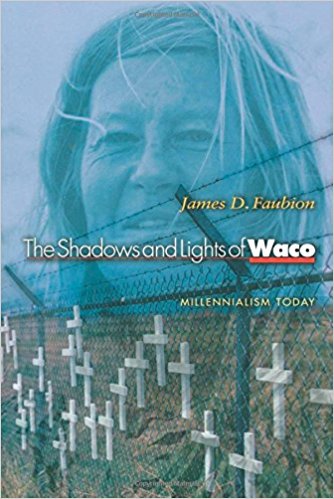
James Faubion, “The Shadows and Lights of Waco: Millenarianism Today” (2001) – I don’t 100% “get” what anthropology is, especially as distinct from sociology. But an anthropological approach to the Branch Davidians sounded pretty interesting. What can we learn about the broader human condition at the turn of the millennium from a group best known for doomsday prophecies, a charismatic lecher messiah, an armed standoff, and the conflagration of eighty of its members (many of them kids) at the hands of the federal government? I distinctly remember the Waco siege, seeing footage of the tanks and the fires on tv. It felt like part of a larger zeitgeist of fin de siecle madness, even to my child self. Clearly, there was a lot going on.

Anthropologist James Faubion found a pretty good source in the person of one Amo Paul Bishop Roden. She was the leader of one of the sects resulting in a confusing multipart schism within Branch Davidianism. Among other things, the BDs believe in prophets, not just as mouthpieces of the divine but as divinely-appointed (and arguably inheritable, through bloodlines) leadership. Amo Roden was one such claiming prophetic status and arguing — and sometimes getting in gunfights over — fine points of interpretation, ritual practice, and good old fashioned disputes over wills. Faubion never provides us with even a historical sketch of this stuff, but it’s clear that Roden both lost — much of the congregation went with charismatic con man David Koresh — and won — she did not go with Koresh and his followers to their fiery death. She mostly speaks in bible quotes, in a manner reminiscent of nothing so much as the Ascians from the “Book of the New Sun,” who speak solely in quotes from their Fearless Leader. What isn’t bible quotes is mostly sad personal anecdotes of a mundanely miserable life given meaning by a strange belief system.

So, there’s a good, if narrow, source (Faubion relates stories of trying to get other BDs to talk to him- all unsuccessful). And Faubion gives her room to talk- arguably, too much. He doesn’t interpret her words so much as place long chunks of her biblical ramblings in the middle of the text, and then theorize them- or, anyway, around them. There wasn’t much in the way of close reading. He has a lot more to say about various anthropological or critical theorists than about the actual Branch Davidians. At risk of being “that guy,” it was just gristly, unclear writing in much of those sections. I’m a humanities grad student, I can read dense stuff. I’ve grown to despise the anti-theoretical bent you see in history sometimes, as performatively ignorant (trust me, I’ve been that guy, it’s a performance) as theory can be performatively opaque. But… there’s a limit, and I’d say the limits is reached when the prose and emphasis on theory overwhelms the subject, and I think that happens here.

Faubion gestures towards some interesting points — mainly, the relationship between ethics, knowledge, and time that millenarianism does strange things with — but instead of really diving into that, we get an immense amount of theoretical bet-hedging. You wind up with a pretty dispiriting contrast- a woman who can only talk in biblical citations, and a man who can only write in clotted theory-speak. It’s a shame, because there’s an interesting story here and Faubion shows, when he can let himself write clearly (and isn’t getting cute about how weird he feels about potentially patronizing his subject), he’s capable of some insight. I’ll be curious to see how historians follow up the story of the Branch Davidians and millenarianism in the late twentieth century. ***

Review- Faubion, “The Shadows and Lights of Waco”

Review- Ballard, “Crash”

crash

J.G. Ballard, “Crash” (1973) – British cringe-comedy “Peep Show” had a few good Easter egg jokes that paid off only to obsessive viewers like me. One of the better ones is where posh dilettante actress Big Suze says she is auditioning for “a stage version of the movie ‘Crash,’” twice, multiple seasons apart. One of them is the undeserved-Oscar-winning movie about race, and the other is about “people who get sexy about road traffic accidents.” In a grim irony, the actress who played Big Suze, Sophie Winkleman, was in a terrible car accident last year and fractured her spine. She’s expected to make a full recovery, thankfully.

But Big Suze had it right- Ballard’s “Crash,” the basis of the 1996 David Cronenberg movie, is indeed about people getting sexy about road traffic accidents. In the world of the novel, an actress being in a play about such people would inevitably wind up in a terrible crash, and people would get sexy about that, too. To the extent that the book works at all, it works as a hermetically-sealed world (almost all of it takes place in featureless non-places: airports, hospitals, highways) revolving around the way people and cars break together, and how horny that makes everyone.

It doesn’t work, really, as a novel. I know I’m something of a literary prude. I’ve never read a sex scene in fiction that I thought improved things (I’ve read a few that didn’t detract much, fwiw). But I think even if I wasn’t, I’d find the sheer copiousness and repetitiveness of the narrator’s sexual descriptions of everything trying. Think the way Patrick Bateman narrates in “American Psycho” (I get the idea Ellis probably, er, borrowed a lot from Ballard), except with much more use of the phrase “natal cleft.” The narrator — also called Ballard — is both seethingly horny and deadpan clinical. This clinical depthlessness extends to the plot. It could actually be pretty interesting — a band of fetishists seeking to recreate fatal celebrity car crashes — but Ballard sticks with the whole “anhedonic postmodern” thing and so it’s both thinly fleshed out and drowned in the narrators surface patter about jerkin’ it and car metaphors.

At this point, everyone would have been better off if he went Borges-style and wrote a capsule review of this novel as a theoretical object, because basically that’s what this is. It’s a stunt, meant to prove a point, at tedious length. I think a lot of writers and critics confuse stunts and pranks with innovation. That’s an unfortunate import from the worst parts of modern art — the kind of thing that has made most of the plastic arts a reserve for jaded rich kids to doodle in a masturbatory fashion for each other — into literature. As it happens, we have the happy information that Ballard is capable of more- of genuinely doing something new and interesting, rather than alluding to the possibility of doing it. **

Review- Ballard, “Crash”

Review- Cantoral, “Cartoons in the Suicide Forest”

leza

Leza Cantoral, “Cartoons in the Suicide Forest” (2016) – The internet has been good for horror literature, it seems, both as material and as means of propagation for independent producers. That could be nonsense- horror, like video games and Star Trek, is one of those things that really defines the culture of much of my friend group but on which I basically missed the boat. But I think this collection of short surrealist horror fiction (by an old school pal! We once rescued another horror writer from central Pennsylvania. Fun story!) backs me up on this assertion.

That said, not all of the stories in “Cartoons in the Suicide Forest” are directly about the internet or computers- avoiding the literal-mindedness that dogs “Black Mirror” in its more pedestrian moments. There’s all kinds of weird shit packed into this slender container: mermaids fleeing a collapsing earth, Eva Braun in Nazi Oz, and some scathing realist material, too. Leza doesn’t stint on body horror, and there’s an iridescent quality to her prose in those moments of horrifying nightmare logic.

In the titular story, the main character makes reference to a “Queen in Yellow.” That might ring some bells from “True Detective,” who in turn borrowed the “King in Yellow” myth from turn of the century horror/fantasy writer Robert Chambers. This story, of a play (perhaps based in some older legends) that led to the death of anyone who saw or read it, encapsulates the major theme of that influential period in horror writing: the confrontation between the supposedly rational civilization of the turn of the twentieth century and its own knowledge of the vastness, oldness, and irrationality of the world and the cosmos.

Contemporary social and technological changes have brought us face to face with a whole new side of our irrationality and the world’s unknowability, and this is part of why horror has become as important as it has to a lot of people. Leza brings out the aesthetic and gendered elements of the ways in which the internet (well, the pedant in me insists on saying “the internet under capitalism” but let’s just take that as read) and the culture around it contributes to our situation. “The internet runs on women’s misery,” someone smart once said, and the difficulty of escaping gendered victim-victimizer dynamics animates most of the stories in the collection.

For Chambers’ generation, the vastness of the universe ruled out an escape from existential dread- build up “progress” as much as you like, you’re still a dying speck of dust on the cosmic scale, etc. In Leza’s work, there simply isn’t an outside, or if there is — like the suicide forest which makes its sad girl visitors into surreal, dancing, bloody cartoons — it’s just the logic of these bounded universes taken to their conclusion. That should sound pretty contemporary, I think. ****

Review- Cantoral, “Cartoons in the Suicide Forest”

Review- Sagan, “Contact”

contact.jpg

Carl Sagan, “Contact” (1985) – Carl Sagan seems like he was a good old guy. Everyone loves “Cosmos.” He was a humanist of the old, gentle school, like Kurt Vonnegut and Stephen Jay Gould, before things got as mean as they’d become around the beginning of the twenty-first century. One account I’ve heard says Sagan deliberately fudged the science to depict nuclear winter as more of a possibility than it really was. If that’s true, good for him- any nuclear war would be bad for people in general, but if the elites with their fingers on the buttons thought they could’ve gotten away with such a move with their power intact, they would have been more likely to try it.

So, he was a good guy. A novelist he really wasn’t. In theory, “Contact” is about, well, contact between Earth and aliens. But you get a lot less of that and a lot more of meetings. These are mostly meetings between assorted science bureaucrats and government bureaucrats, mostly. A lot of stories from the 1980s and 1990s dwelled lovingly on various large bureaucratic organizations — corporations, the Pentagon, the presidency, especially the FBI — that framed what were meant to be thrillers. This works less well in prose than on the screen. While it’s doubtless true that there would be a lot of international bureaucratic wrangling as assorted actors figure out how to deal with a message from Vega, it’s not even particularly conflictual in the book. He introduces characters with paragraphs-long infodumps about their institutional trajectories and hobbies. It’s something of a slog.

There’s a little more in the way of religion-science conflict once assorted preachers start exploiting contact-mania and interfering with efforts to respond to the message. But even then, the main religious guy is actually pretty sympathetic and mostly challenges the worldview of the scientist main character in a positive way- a notable difference from what you’d probably say if one of our current generation of public scientist figures gave that plotline a whirl. The other likely point of interest in such a story — the big reveal of the aliens — is reasonably interesting and meshes nicely with Sagan’s broader concerns- peace, progress, unity, etc. But little enough really comes of it. In all, an interesting concept by a good guy but it doesn’t really work as a novel. **

Review- Sagan, “Contact”

Review- Rowbotham, “Women, Resistance, and Revolution”

wrr

Sheila Rowbotham, “Women, Resistance, and Revolution: A History of Women and Resistance in the Modern World” (1972) – Sheila Rowbotham did a lot to initiate the early engagement between 1970s Women’s Liberation and the socialist feminist tradition in this sweeping history of, well, women in resistance and revolutionary movements in the modern world. In this history, she finds many patterns and problems that would emerge in the Women’s Liberation movement and continue to be with us to this day.

The primary example of this is the difficult rhetorical and organizational balancing act between emphasizing women’s special oppression and attacking the oppressive social systems, such as capitalism, racism, imperialism, etc. in which patriarchy is embedded. Routinely, socialist movements, in and out of power, paid lip service, if that, to women’s oppression and little more. Just as frequently, emphasis on attacking sexism apart from the larger context of oppression leads to the dead end of bourgeois feminism. It is tricky. In tracing this dynamic as it played out in the beginnings of the revolutionary period, in the 19th century socialist and suffragette movements, and in the Soviet Union and other revolutionary regimes, Rowbotham demonstrates that the issues surrounding women’s liberation are one of the fundamental dynamics of modern politics, alongside the other perennial quandaries that many of Rowbotham’s peers among the midcentury leftist historians identified.

This is the sort of book I don’t have a ton to say about- it’s informative, well-written, useful both for all of the historical examples it brings together and for its analysis. It’s poignant in a lot of places too, not least in its depictions of women in third world liberation struggles, written in the period of high hopes for the global transformative potential of those movements. Another poignant testimony is that whenever I read a feminist writer from the second wave that I get a lot out of, I find myself crossing my fingers and hoping to hell she got through the bad decades that have followed, and also avoided becoming a TERF. Rowbotham is still with us and writing, and Google doesn’t say anything about Rowbotham having gone down that fell road… fingers crossed, I guess. *****

Review- Rowbotham, “Women, Resistance, and Revolution”

Review- Moorcock, “The Weird of the White Wolf”

www

Michael Moorcock, “The Weird of the White Wolf” (1977) – People throw the word “epic” around a lot nowadays. As far as I can tell, they mostly mean it to mean “big/good/dominating,” with the implication that those traits can exculpate whatever is being described for also being sloppy, unsophisticated, or gratuitous. At this point, “epic” is also an online cringe-word, something thrown around a lot by corny people (and by people who consider themselves non-corny approximately three-to-five years ago).

Michael Moorcock has had an outsized shaping role on nerd culture (popularizing moody anti-heroic protagonists, introducing the law-chaos dichotomy as an existential principle) but sadly, his idea of “epic” has been drowned out by the more anodyne, commercially-usable meaning we have today. This is a shame, as his “Elric” stories are a pretty good example of the potential of the epic form in contemporary writing.

There’s an irony here, in that the Elric books and this one, “The Weirding of the White Wolf,” in particular lack many of the touches that make something “epic” in contemporary speech: they’re short, 150-200 pages each; they don’t do Campbell-lite character work; world-building is executed in quick, broad strokes, not the exhaustive descriptions of those elements of fictional cultures that coincidentally might feature in a game; exciting stuff happens but it’s not nearly as theatrical or action-packed as something written with an eye towards the contemporary multiplex.

What you have instead is an older type of epic, reframed by Moorcock’s pulp-fantasy/psychedelic aesthetic framework. The world is vast, old, lonely, and while elements of it are in constant flux, it’s basic nature doesn’t change. The hero, Elric, accomplishes big things — he burns down his home city, the dark (former)-imperial capital of Melniboné, accidentally kills his love interest, dallies with royalty and the forces of existential chaos — but we know, at the end of the day, he’s going to pick up his sword and move on, and the world will be the same. Elric will be more or less the same, only more so. That’s a characteristic of epics that some of the contemporary types seem to keep, the main character who becomes more and more their archetype until their achieve apotheosis/die, and it’s often basically the same thing. That’s how things are looking for Elric, as his totemic sword seems to be increasingly directing his actions in this volume, and as it’s hinted that he’ll apotheosize into a Jungian “Eternal Champion.” This is an ambivalent fate, at best.

Done right, the modern epic form accomplishes a sort of rhythm you don’t get anywhere else, worlds away (literally, in many cases) from the psychological realism/interiority of the conventional bourgeois novel form and the assumptions about the world and time that come with it. Falling into that rhythm is a major part of the appeal, along with the sword-and-sorcery stuff. You can see why this sort of fantasy literature accomplished “cross-over” to more of a mass audience — and influenced the sort of art that gets into metal album covers and onto van doors — during the era of the counterculture (in which Moorcock heavily participated), with its mainstreaming of interest in alternate modes of experience. Moorcock does it pretty well. Here’s hoping his sense of “epic” gets out there more. ****’

Review- Moorcock, “The Weird of the White Wolf”