Review- Ellroy, “Clandestine” and le Carré, “The Spy Who Came In from the Cold”

AUDIOBOOK ROUNDUP: AESTHETICS OF ANTICOMMUNISM AND COUNTERREVOLUTION EDITION

James Ellroy, “Clandestine” (1982) (narrated by William Roberts)

John le Carré, “The Spy Who Came In From The Cold” (1963) (narrated by Michael Jayston)

We’ll start with Ellroy’s “Clandestine,” his second novel, despite the fact that it’s twenty years younger than le Carre’s work- I read “Clandestine” first and it’s set earlier. This was the beginning of Ellroy’s dip into his mythic realm, the noir Los Angeles of the 1950s, the world about which he spent his wayward youth wandering around the city fantasizing. Eventually, Ellroy’s dream-nightmare-LA would be the scene for the epic “L.A. Confidential” quartet; extrapolated to embrace the US, the gestalt he formed would be the basis for his greatest work, the “Underworld USA” trilogy.

But “Clandestine” is his first swing at it, and it shows. His main character is Frank Underhill, the sort of SoCal ubermensch Ellroy wrote (and sometimes writes) when he was projecting the man he wanted to be, not the man he was as he wrote later. Underhill is tall, handsome, athletic, a super-cop and a scratch golfer to boot. He’s a cop because he gets to experience something called “the wonder” (I wonder if it’s capitalized in print- I plan on ordering a hard copy for my library so I guess we’ll find out). He’s an appropriately meat-headed expounder of what “the wonder” is and we never quite get at it, despite Underhill waxing rhapsodic about it multiple times. As far as I can tell, “the wonder” is voyeuristic rubber-necking along the disasters that people’s lives become, the cheapness of life and death, the small pseudo-poignant details which tend to dissolve into death-kitsch; the sort of thing you get to see a lot of as a cop or other first responder. In later works, Ellroy gave up on characters telling “the wonder” and simply showed them basking in it. That’s an improvement.

Voyeurism and schlock are important parts of the Ellroy gestalt. Belonging is another key part- being one of the few that get to peek behind the curtain and act on what they find there. There’s someone killing women in LA and Underhill is brought in to a special LAPD unit led by Irish psycho Dudley Smith, who turns up frequently in Ellroy’s later work. Smith’s unit is essentially a death squad. Underhill has reservations about this but goes along with it anyway through the middle of the book, by far it’s strongest part. Ellroy tries to be whimsical in the first part, with poetry-spouting cops and cute dogs (punctuated by the killing of some Mexicans). That all goes out the window once Underhill gets in with Smith and tortures a confession out of an innocent man who goes on to kill himself before the evidence can clear him. Underhill tries to keep his distance and even double-crosses Smith, but not before taking a fascinated ride through the great domestic war of midcentury America, where crime, vice, simple nonconformity, and communist subversion are understood to constitute each other. Underhill gets to be one of the men engaging in the terror campaign this entails, while keeping some part of himself above it- Ellroy does better than that when we return to the domestic counterrevolution in “Underworld USA.” There, there’s escape, but no getting above the terror whilst keeping a foot in it.

The last part of the book is more interesting from a biographical perspective than anything else, now that Ellroy has written some fascinating and wrenching autobiographical works. Ellroy’s mother was murdered — a case still unsolved — and he was raised by a negligent father. Spoiler alert: a character seemingly based on Ellroy’s dad is the mastermind behind the women murders, which involves a whole convoluted plot with drug dealing, secret gay pacts, Nietzscheian delusions, etc. He kills someone a lot like Ellroy’s mother, and there’s a whole section where Underhill goes to Wisconsin (where Ellroy’s mother was from) and tracks down a whole massive crime epic story about the woman victim and her family. Moreover, they had a kid who sounds a lot like young Ellroy: obsessed with crime, unable to get along with other kids (and a genius, natch). It’s a lot!

In theory, Underhill and the other cops are part of the thin blue line between civilization and savagery. The thesis of the midcentury counterrevolution is that crime and subversion go hand in hand. Maybe Dudley Smith believes that (though it’s also a convenient thing for a sadist to believe), but I’m not sure Underhill does, or Ellroy. That’s just jive for public consumption. The real point is for power to reproduce itself, to continue the cyclical world of violence and chintz that makes up “the wonder,” which in turn justifies the violence (and chintz) of men like Ellroy’s cops. This is the joy of the domestic counterrevolution, and I think one reason why Ellroy is an important artist is that he brings that home better than anyone. He hadn’t quite nailed the delivery yet in “Clandestine,” but he would in time. ***’

What to say about “The Spy Who Came In from the Cold”? It’s a masterpiece for a reason. It hit me right in that Michael Mann sweet spot: the meticulous attention to details in the depiction of tradecraft, the masculine pathos, the deft scene-setting. And it’s paced better than anything Mann has ever done except, perhaps, “Thief.”

I’ve chosen to write about these two works together not just because I listened to them close to each other but because they have themes in common. Anticommunism is at the center of the world of le Carré’s work just as anti-subversion/crime is in Ellroy’s. But in both of them (or at least in this one of le Carré’s books- I haven’t read any others but will) the ideology is in most respects besides the point. Where Ellroy’s men find themselves in the battle to keep the domestic population in line, le Carré’s spies reach existential epiphany on the foreign fronts of the Cold War. Not for nothing is one of the main LAPD stations called “ramparts” and not for nothing is the then newly-built Berlin Wall one of the main symbols in “The Spy Who Came In from the Cold.” The ramparts don’t just separate Us from Them- in these novels, that’s not even the main purpose. The act of manning the ramparts separates those who see from those who can’t.

It might seem the more appropriate pairing with Ellroy’s crime fiction is the other side of the spy-fiction spectrum, James Bond. Sex, violence, and over-the-top schlock are what Bond is all about, after all. Well, A. I’m not sure that’s the case with the early novels and I intend to read them in order and B. I think the contrast with le Carré is more interesting. Both Ellroy and le Carré are interested in the introspections of the hard men who watch the ramparts in a way Ian Fleming doesn’t seem to care about. More than that, between them, Ellroy and le Carré span a near-comprehensive array of the affective appeal of the right side of the Cold War, in the Anglo genre world at least.

Le Carré is proper and sparse where Ellroy is over-the-top and leering. This extends to story form, as well. “Clandestine” involves stories within stories and sprawls all over the map, and so do many of Ellroy’s later works. “The Spy Who Came In from the Cold” is a story as well contained as the Soviet Union turned out to be in Eastern Europe. Le Carré sketches in his characters with a few telling details where Ellroy concocts vast fictional biographies.

Enough comparison! What is “The Spy Who Came In from the Cold” about? It’s a simple story. British intelligence wants to eliminate a dangerous leader in the East German counterintelligence apparatus. They get their former Berlin station chief, Leamas, to pretend to defect. They don’t do it with any phony damascene road conversion to Khrushchev-era communism. They have Leamas pretend to dissipate into drink and disrepair, complete with short prison stint. Le Carré goes through the whole routine of vetting and bringing in a new defector asset, and before you know it Leamas is face to face with East German intelligence… and finding out the mission isn’t all it seems. There’s some great back and forth between Leamas and his communist opposite numbers, a lot of subtle spycraft, it’s great fun.

It says something about how good this is that I don’t want to spoil this book that’ll soon be old enough to collect social security. And the plot, while supremely well-constructed and enjoyable, is somewhat beside the point for this essay. The spies in this care about communism or anticommunism about as much as Ellroy’s cops- more a matter of instinctive reflex and team loyalty than anything else, and le Carré makes it clear that goes on both sides of the iron curtain. Believers — like Leamas’s British communist girlfriend — are just dupes, pawns in waiting.

It’s too much to say le Carré’s spies believe in the game, but it’s something like that. More than what they believe, they get to be Tragic Men, men defined by being forced into choices that ordinary men never have to think about. No day job, excitement, and the opportunity to wax tragic, significant- that’s as appealing in its own way as Ellroy’s cop power trips. Higher-toned, perhaps- that’s a market niche all its own. *****

Conservative/reactionary/counterrevolutionary, take your pick, politics wouldn’t work if they didn’t speak to people somewhere deep. Conservative genre fiction — and my understanding is le Carré isn’t a raving Tory but I think his fiction leans right, so to speak — is part of the worldbuilding project of the global right, and a guide to the affective pressure points that make the whole thing tick. Probably, I should read the other half — romance fiction — to really get a comprehensive vision, but hey- one thing at a time.

Review- Ellroy, “Clandestine” and le Carré, “The Spy Who Came In from the Cold”

Review- Whitbourn, “The Two Confessions”

John Whitbourn, “The Two Confessions” (2013) – Dipping once again into the works of “counter-reformation green anarcho-jacobite” fantasy writer John Whitbourn brought me to this, the final installment of the series his first novel, “A Dangerous Energy,” began. The world is one where magic is real and largely controlled by the Catholic Church, which in turn controls vast swathes of the planet, keeping it at a pre-industrial level of technology even into the 1990s. This world’s Britain is staunchly Catholic, ruled by the Stuarts, not at all a United Kingdom, and generally not a great advertisement for what the counter-reformation, magic, or the Jacobites do for a country. Life is squalid, limited, and dark- for characters in Whitbourn’s stories, shading towards pitch black.

Our protagonist, Samuel Trevan, is an orphan turned proto-industrialist struck down by the Church’s strict laws against over-exploiting labor (in one of this alternate universe’s more extreme points of departure, the Church doesn’t generally side with employers). He was going to make a fortune manufacturing rifled muskets (because that’s where they’re at, technologically) and then marry the upper-class girl of his dreams, but no such luck once the Church gets done with him.

Now expendable, Trevan is employed by some of the realm’s deep state fixers to fix a case of spooky mines in rural Devonshire. Trevan wants money, his handlers want discreet elimination of a problem down there. And what a problem it turns out to be- demi-devils, part human part demon, but even worse- heretics! Specifically, Bogomils- for those not versed in heresiology, these were the predecessors to the more famous Cathars, and were dualists who believed the material world was somewhere between irrelevant dross and actively evil. Our word “bugger” comes from “Bogomil” because of their supposed sexual practices (to help reduce reproduction). These Bogomils are in touch with some cask-strength Lovecraftian elder god type thing and aren’t shy about sacrificing people (in a nicely nasty touch, the Bogomils’ friends, those dastardly Unitarians, are too squeamish for it and leave before the rituals get spicy).

Trevan’s whole crew gets sacrificed, but then Trevan is saved by… not quite a deus ex machina. Is there a Latin word for elves? Either way, elves exist in this world, magical and aloof from humanity but not above messing with it (in a way that reminds me of archons from the lore of the dreaded Gnostics). This is where things get fuzzy. The elves say they save Trevan because he’s a massive threat to them. The industrial revolution he could usher in would destroy elfdom- even his touch or proximity is toxic to the fae folk. So they take him, give him all the money he wants, let him marry the girl, and try to hide him. If they’re so indifferent to humanity, why don’t they kill him, or let the Bogomils sacrifice him?

Eventually, Trevan gets doxxed and the Bogomils show up, but not to sacrifice him: to try to recruit him. They want the industrial revolution, for reasons obscure but in tune with Whitbourn’s general vibe- in his world, heresy and “progress” go hand in hand. They harass Trevan so bad he eventually has to hide in a monastery, which is where the novel ends. The end, no moral!

Well, some moral. Whitbourn is as much a horror writer as a fantasy writer, so there’s limits to how sunshine-y his worlds would be in any event, but from a “deep green” perspective the world is probably better off, and some of the filigree in the worldbuilding makes clear settler colonialism didn’t get far, either. More than anything, man is small and mostly knows his place. Whereas, Whitbourn’s antiheroes and villains are small, battened by forces beyond their comprehension, but entertain delusions about steering their own ship… that is to say, they’re moderns. And in Whitbourn’s world, the moderns lose.

They have to, because this is essentially cosmic horror — horror about the universe’s essential cruelty and pointlessness — but with precisely one out: a remote but all-powerful God who, for mysterious reasons, chooses to communicate with man through the Catholic Church. That’s where reactionaries fall apart- man is small and irretrievably corrupt, therefore let’s pick a few of them (or just one!) and give them all the power. In Whitbourn’s world, those people have the direct line to the one bare trickle of cosmic hope, so I guess it makes sense they call the shots. Still and all though- the world as Whitbourn shows it is dark, cramped, and dirty (the writing displays horniness that borders towards the cringeworthy). The Bogomils have some good points about the grossness of the world, even if, in the fine old reactionary genre formula, the more ideas they have the more awful their behavior.

Anyway… a lot going on here. I may have gotten into Whitbourn out of ideological curiosity but I’ve stuck with it because he writes genre fiction with verve and heart (and a high work rate- he has dozens of other books). This one had a pretty good dungeon-crawl and some sinister yokels, even if it also had inexplicable plot points and slow bits. It’s all part of the unique package Whitbourn delivers. And he (or someone pretending to be him for some weird reason) has commented on my blog! I emailed him about doing an interview. Fingers crossed! ****

Review- Whitbourn, “The Two Confessions”

AUDIOBOOK ROUNDUP – Higgins, “The Friends of Eddie Coyle” and Vance, “Planet of Adventure”

AUDIOBOOK ROUNDUP

George Higgins, “The Friends of Eddie Coyle” (1970) – This is more like it. I had read Higgins’ “Cogan’s Trade” and didn’t care much for it. But this one was much better. Encountering it in audiobook form probably helped- Higgins’ crime fiction is largely made up of dialogue. But I also got a paperback copy of the book for Christmas and it held up in hard copy, too. For one thing, this one has real characters, primarily the hapless Eddie Coyle, small-time gunrunner facing three-to-five and looking for a way out. He turns informant but his ruthless Fed handler keeps wanting more than he can give him. We spend some time in a sleazy seventies Boston of bank robbers, gun dealers (this was back before you could buy an AR-15 at Wal-Mart or wherever), faux-radicals, bartender-fixers all looking to scam each other. No one deals with more money than about fifty thousand dollars, and usually a lot less. The key information that the Feds are looking for winds up coming not from Eddie but from a pissed-off girlfriend. The voice actor, Mark Hammer, does a good job conjuring up distinguishable Boston accents for the different characters, though he stumbles on the pronunciation of town names like Billerica (“bill-erica”) and Brookline (“brooklyn”). Still, a great version of a justifiably lauded crime classic. ****’

Jack Vance, Planet of Adventure series (1968-1970) – Tschai! There’s probably supposed to be an umlaut somewhere but I don’t care enough to look it up. Jack Vance’s was a world-builder but not in the over-baked sense of the word that it conjures up today. No thousand page tomes, no pseudo-Tolkien erudition, no pandering to fans looking for something on which to project. Tschai, like other worlds Vance created before and after it, is about the permutations the human subject (to use the kind of theoretical phrase he’d never allow) can undergo under extreme conditions, about people as small, contingent things. Tschai is run by four alien races: lizard-like Chasch, frog-like Wankh (heh heh), raptor-like Dirdir and bug-like Pnume, each of which is the main antagonist in one of the volumes chronicling the trevails of stranded spaceman Adam Reith. More often than the aliens, though, he deals with humans stranded on Tschai, first brought there long ago by the Dirdir but then escaped and diffused across the planet. Each alien race has its human disciples, who try to imitate them and have various delusions about their closeness to them. On top of that there’s various independent human societies, each with its own system of cultural rules. It’s the kind of kaleidoscope world we’d reward someone for exploring in 1800 portentous pages or so, but Vance sketched everything out in about a third of that, sticking to Reith’s adventures. I never felt less than satisfied with the worldbuilding, however- and I’d take it over much of the modern stuff any day. Reith builds a human army to fight the Chasch (a trope Vance has used elsewhere), hunts the Dirdir on their own hunting grounds, tries to build or steal a spaceship to get back home, woos a lady or two, rigs an eel race- all kinds of doings, all the while playing straight man to the various deluded human-types he’s surrounded by. There’s a lot of dickering with innkeepers, all in classic Vance Wodehouse-ian punctillio dialect. It’s not the Vance I’d start with but it’s a lot of fun. ****

AUDIOBOOK ROUNDUP – Higgins, “The Friends of Eddie Coyle” and Vance, “Planet of Adventure”

Review- Haldeman, “The Forever War”

Joe Haldeman, “The Forever War” (1974) – You have to be careful with science fiction picked out by literary gatekeepers. Sometimes they’ll try to convince you that Ray Bradbury is a great scifi writer, which even Martin Prince knows is bunk. Other times you’ll see the Library of America lionize Philip K. Dick with a big rollout of his novels, which was quite welcome. Joe Haldeman’s “The Forever War” began life as an Iowa Writer’s Workshop story and my copy features praise from Junot Diaz as well as an oddly-worded endorsement from Stephen King; none of these are great signs. The title itself has become a commonplace, a term for the War on Terror after journalist Dexter Filkins filched the phrase for a book of his own.

But I am pleased to report that “The Forever War” “checks out.” It begins with adherence to some simple premises: physics and military life are defined by certain constants. In physics, that’s the speed of light and relativity; in military life, boredom, terror, thoughtless chains of command and obedience. Haldeman plays out the combination of these constants with the scifi ur-trope of interstellar war with rigor and verve.

William Mandella, the narrator, was born in the seventies and sent to the space war against the alien Taurans in the nineties, but soon enough such simple temporal denotations prove insufficient. Spaceships travel through “collapsar” portals at relativistic speeds- Mandella and his buddies age a few months but years, decades, eventually centuries go by to the “objective observers” living on Earth and the rest of human society. This brings a new spin to the age-old quandaries of reacclimating to civilian society. Mandella comes back to an Earth overpopulated (this is seventies scifi after all, gotta have some overpopulation) and crime-ridden, eventually hops forward a few centuries after another collapsar jaunt to find nearly-mandatory homosexuality! What’s a guy to do?

Well, Mandella mostly stoically rolls with the punches and reserves judgment. Except for the the military hierarchy- that gets some judgment for being ignorant, tone-deaf, and sneaky, getting Mandella and his lover MaryGay to reenlist in the war through various designs. There’s some funny early parts where the military, presumably reacting to the changes of the sixties and seventies, encourages soldiers to curse at the officers ritualistically, to sleep with each other (this is a coed fighting force) and smoke weed, but that’s all just cosmetics over the eternal reality of the military. The fighting with the Taurans gets across the boredom-terror dichotomy veterans so often refer to, and there’s no glory to be had in this space-suited combat across kilometers with a foe who is deadly but whose heart doesn’t seem to be in it. In the end, the war was a big misunderstanding- one is tempted to say “like most wars” but that might be giving people too much credit.

Haldeman is a Vietnam veteran who was wounded in combat, and it’s been argued that “The Forever War” belongs in the canon of Vietnam War literature… I’m ambivalent about that- would “Lord of the Rings” belong in WWI literature? But either way an interesting question about an interesting book. ****’

Review- Haldeman, “The Forever War”

Review- Jama-Everett, “The Liminal People”

Ayize Jama-Everett, “The Liminal People” (2011) – I got turned on to Ayize Jama-Everett by an article about writing action-y novels. This, his first book and second that I’ve read, fits the bill. It’s a novel about super-people — you really can’t say superheroes, though I guess superheroes as a genre aren’t always especially heroic these days — using their powers on one another. If anyone saw the underrated action flick “Push,” it’s a bit like that. Answering the now-trite “what if superpowers but real” question, both “Push” and Jama-Everett reply “live on the margins, dodging bigger powers and doing crimes.”

The protagonist, Taggert, is someone who can manipulate bodies on the molecular level. This makes him a healer but also capable of devastating harm- think of someone who can manipulate your nerves, your histamines, your bodily acids, etc. After healing a streak through Africa (both Taggert and Jama-Everett are black, which makes this less cringey than if a white author/protagonist did it- sorry, I don’t make the cringe rules) he gets picked up by a powered crime boss in Morocco. Boss Nordeen’s powers are vague but include being able to tell when others are lying and probably some sort of emotional manipulation. Nordeen puts Taggert to work healing and harming, more of the latter.

Taggert gets called on by an ex-lover in London to help find her missing daughter. Lo and behold, both mother and daughter are powered, but the ex-lover chose to live in the mainstream, suppressing her powers (which entailed controlling fire- fewer obvious peacetime applications). The runaway daughter, Tamara, is a telepath/telekinetic combo who ran away from an illusionist and her posse who looked to manipulate her talents.

The plot isn’t exactly the thickest but it’s a fun read nevertheless. Taggert and Tamara go on a quest for revenge, Taggert looks to shield Tamara from his boss, there’s a training montage, some big confrontations between superpowered crooks. It’s good clean fun. ****’

Review- Jama-Everett, “The Liminal People”

Review- Cain, “Mildred Pierce”

James Cain, “Mildred Pierce” (1941) – This is a record of economic survival during the Depression and of brutal intra-family psychological warfare. James Cain hated being called a “crime” or “hardboiled” writer, and from “Mildred Pierce” you can see why: there’s very little crime in the novel, and the heroine is a housewife-turned-businesswoman, not a detective. But if it doesn’t answer exactly to the “crime” descriptor, “Mildred Pierce” definitely answers to “hardboiled.” In terms of brute realities played straight, sans romanticism or even excess griminess, this one is as hardboiled as they come.

The titular Mildred starts out the novel in Glendale, making pies and kicking her unfaithful, feckless, jobless husband Bert to the curb. This leaves her alone with her two daughters, happy-go-lucky Ray and haughty, preternaturally self-possessed Veda. She has a hard time committing to either a relationship that could bring her back to her kept state (not that the men in her life are so gallant) or the sort of job that would mark her as “low class”- anything in a uniform. She swallows her pride, though, and becomes a waitress. Maybe this is just me, but I found those parts almost as harrowing as the family conflicts that would come later. Cain invokes all of the tenseness and discouragement of fruitless job searching and all of the stress of working shitty new jobs, reaffirming along the way my decision to avoid the food service industry like the plague even if it lands me in fluorescent office hell…

But it’s not all doom and gloom, or rather, Cain knows that life likes to let the fish run out the line sometimes. Mildred becomes as successful as you can as a waitress, and with some pluck (and under the lash of Veda’s snobbish disapproval) works up to running her own chain of chicken restaurants. This is another difference from the standard hardboiled noir- this one takes place over a series of years instead of a few days or weeks. Mildred romances Monty, a down-at-the-heels California aristocrat and suffers personal tragedy, but the red thread that runs through it all is her determination to provide her daughter Veda with what she thinks she deserves.

But of course, it’s never enough. It’s not things or anyway not just things that Veda wants- she wants to be a different person, to come from different people, and is willing to betray her mother in escalatingly brutal ways to approximate that fantasy version of herself. Veda has a sociopath’s luck- she’s not exactly talented, musically, but has looks and a special type of inborn vocal capability that allows her, with help from money Mildred increasingly doesn’t have, to achieve escape velocity from Glendale and all that it represents for her. Mildred’s sacrifice not just of her love and money but of her own pride — she marries and supports Monty just to get closer to Mildred — are nothing but chits, and cheap ones, in Veda’s games. The depiction of Veda could easily become hackneyed, a bigger version of a child with the gimmies, but the dynamic between her and Mildred feels real. While she’s awful to betray Mildred as she does so often for frequently such small stakes, there’s a grain of real need in her desire to get away from a mother who insists on doing everything for her. All of that adds to the claustrophobic feel of the book, this raging war fought with gestures of kindness and cruelty between two utterly committed opponents. All in all, a great read. *****

Review- Cain, “Mildred Pierce”

Review- Clark, “A Dead Djinn in Cairo” and “The Black God’s Drums”

P. Djélí Clark, “A Dead Djinn in Cairo” (2016) and “The Black God’s Drums” (2018) – This is a fun pair of novellas set in an alternate history 19th century by a history professor at UConn. Those who know me know I have little patience for steampunk, but I can forgive the airships and clockwork men when they’re not put to the purposes of imperialist nostalgia, as steampunk is so often. On the contrary, Clark wrote a world where anti-imperial powers — Haiti, an independent Egypt — use magic and technology against the 19th century powers that were and become major powers in their own right. The detail work on the world is pretty decent and not too badly info-dumped on the reader. The storylines are similar- plucky young black women need to figure out mysteries that threaten New Orleans (in “Drums”) or the world (“Djinn”) with destruction. These works are too short for a lot of red herrings, character work and the like and so they sometimes reminded me of one-off tabletop roleplaying game sessions with one or two player characters. Mystery, preliminaries, asking wise women, finding the final boss, besting the final boss using some special characteristic of the protagonist’s. It’s a little formulaic but the prose moves right along, not bad for a commute read. I’d be interested to see what Clark could do with this world in full-fledged novel form. ****

Review- Clark, “A Dead Djinn in Cairo” and “The Black God’s Drums”

Review- Dickinson, “The Monster Baru Cormorant”

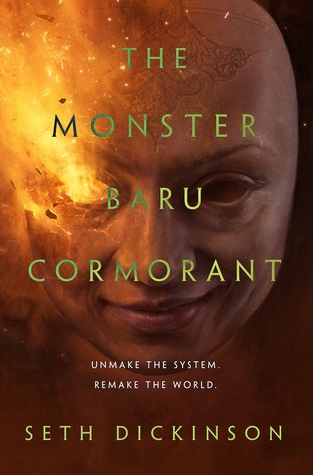
Seth Dickinson, “The Monster Baru Cormorant” (2019) – This one goes to eleven. The sequel to one of my favorite fiction reads this year, “The Traitor Baru Cormorant,” TMBC squeezes in all kinds of stuff. Six or seven viewpoint characters introduced in successive chapters at the beginning of the book! Multiple overlapping conspiracies! Multiple fictional games introduced, illustrating Themes! Currency speculation, druggings, naval chases, cancer cults! Head injuries! Dickinson doing his white-guy best with an Africa-inspired fantasy civilization, to go along with his straight-guy attempt at a lesbian main character! It’s a lot.

I’d say it’s a little bit too much, especially at the beginning where Dickinson introduces all of these characters and sets them in motion, expecting you the reader to keep track. I’m pretty good at that kind of thing and I found it stiff going. It’s hard to know how to introduce the plot, it gets so intricate. At its most basic, the titular Baru gets sworn in to a small elite of conspirators that runs the republic-empire of Falcrest after starting and betraying a rebellion in one of the empire’s provinces in the last book. She plans on trying to take down Falcrest from the inside to avenge her own homeland’s takeover, but at what cost?! Moreover, everyone in the Falcrest-running conspiracy is also conspiring against each other. This bathes everything in a kind of itchy paranoia and disdain- they can’t talk to each other without acknowledgment of the ways they despise each other. The stakes are high so the competition is lethal- in theory. Everyone trying to do each other in gets a little tedious when no one dies…

Anyway, Falcrest is in competition with another sort-of empire, Oriati Mbo. In many respects they are opposites. Falcrest, seemingly modeled after Rome and revolutionary France, is uptight, regimented, looking to remake the world in its own image, whereas the Oriati, modeled after various African societies with maybe a dash of India thrown in, is looser and more relaxed. Both are intensely concerned with health, and their approaches are symbolic- Falcrest’s obsessive hygiene which tends towards the lobotomy pick, Oriati’s lore and ritual-science derived medicines. Both grab smaller societies into their orbit, Falcrest through financial shenanigans backed by military force, the Oriati by cultural exchange which shades into confederation.

Some people want war between the two, some warn such a war would kill millions and doom civilization, others agree but want war anyway (Baru sometimes flirts with this). The action of the book is structured around Baru and the junior members of the conspiracy she’s in trying to track down a secret cult that the senior members think explains Oriati’s seemingly miraculous ability to maintain itself amidst baffling diversity. They conspire against each other as they follow a breadcrumb trail across the sea. Their efforts are punctuated by attacks from a Falcrest navy admiral and a former conspirator-turned-killing-machine who are out to get Baru for some of her previous betrayals.

It’s a lot, and it stretched my capacity to remember and to care. There’s a whole plotline of flashbacks amid all this, there’s the never-ending churn of mysterious shady conspiratorial behavior between the people on the boat Baru is on, there’s plots within plots. It’s overstuffed. That’s not to say there’s not cool stuff in it. The ending was decent, in a Grand Guignol/early modern biological warfare kind of way. Where it gives her space to breathe — apart from constant repartee with her frenemies and mulling over her guilt — Baru’s maneuverings are fun. The worldbuilding isn’t bad, there’s just too much of it for one book. The bigger problem is centering all of his world around a conspiracies of special people (the Oriati aren’t run by a conspiracy ala Falcrest as such but their destiny is in the hands of a small number of people). It took me out of the story a little- that’s one thing first book got well, making Baru feel like a small, if important, part of a world that worked according to real-world rules. This felt less credible- the book is incredible, in multiple senses of the word. ***’

Review- Dickinson, “The Monster Baru Cormorant”

Review- Bujold, “Shards of Honor”

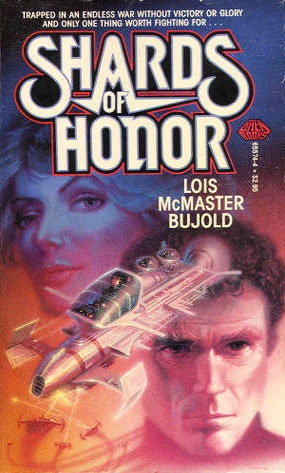
Lois McMaster Bujold, “Shards of Honor” (1986) – This is probably the closest thing to a romance novel I’ve read, unless some of the more courtship-heavy bourgeois novels count. Cordelia comes from a relatively chill spacefaring culture and Vorkosigan comes from a militaristic one. They meet when the latter takes the former prisoner but they come to rely on each other during a long trek across an alien planet and a plunge into confusing and deadly intrigue among the Barryarans, the militaristic culture. You can call Vorkosigan Mister Too Damn Honorable as he constantly gets involved in schemes to undermine less honorable Barrayarans out to do him in. The two cultures get in a war due to dishonorable machinations and Cordelia keeps on getting captured and separated from Vorkosigan and…

Honestly, I wasn’t paying attention for a lot of this. The writing is pedestrian. The characters are flat. The action isn’t bad, in some places. But between the lack of ideas or compelling prose and having read it during a dry period in my reading life, I didn’t get much out of this. The good news is that apparently this is all a prequel and the vaunted Vorkosigan Saga is actually about the main characters kid or grandkid or something. So maybe I’m not missing much if the rotation insists I revisit this particular scifi touchstone series? Who knows? **

Review- Bujold, “Shards of Honor”

Review- Higgins, “Cogan’s Trade”

George Higgins, “Cogan’s Trade” (1974) – George Higgins was a Boston College law professor and, according to Wikipedia anyway, “raconteur” who also wrote numerous crime novels set in Boston. He’s credited with helping form the crime-fiction picture of Boston that’s now so popular in books and movies: a gritty world where all the institutions are connected by corruption and inhabited by highly verbal crooks, and where nearly everyone, in contrast to actual Boston, is white. I can’t say whether Higgins first charted this territory in crime fiction but he definitely shaped it for inheritors like Dennis Lehane.

One thing Lehane didn’t do, to the best of my knowledge anyway, is write a novel almost entirely out of dialogue, like Higgins did in “Cogan’s Trade.” The plot is sparse — low-level hoods rob a card game, the city’s organized crime element tracks them down and kills them — and doesn’t seem to be the point of the exercise. Instead, we’re treated to long dialogues between characters on various sides of this interaction, their attempts at planning crimes and surmounting the inconveniences put in their way, and just generally shooting the shit. The dialogue is very “authentic,” i.e., stylized differently than middle class “realist” fiction and generally more uncouth. The dialogues halt for brief moments for actual crimes to be committed and then picks up again.

I’ll probably read more Higgins because I’m curious about the genealogy of genre depictions of Boston, but this didn’t do much for me. Like any middle-class crime fiction reader, I like to rubberneck at the low life, but this feels especially low-stakes. There’s only so many conversations about characters who aren’t really present in the story or about having sex with sex workers or stealing dogs that I want to sit through. It got tedious and that’s a cardinal sin in crime fiction, the kind of thing a Lehane character (though not a Higgins, from this sample) would feel somewhat overdone catholic guilt for. There’s an admirable consistency to the whole thing — keeping it if not real than real to the reality of the world Higgins builds — but it ultimately amounts to little in this instance. **’

Review- Higgins, “Cogan’s Trade”