Review- Ghosh, “Flood of Fire”

Amitav Ghosh, “Flood of Fire” (2015) – The “Ibis” trilogy concludes with the end of the first Opium War. The series had lingered on Calcutta and Canton, two important sites of their era of globalization, and ends with the creation of a third, colonial Hong Kong. There were three main viewpoint characters in this outing. Shireen Modi is the wife of a Parsi opium merchant who died in Canton under mysterious circumstances. Kesri Singh is a proud sepoy (and relative of some of the characters in the earlier books) sent out to fight in the war. Zachary Reed is a part (and secretly) black American sailor who decides to get into the opium business. Their ultimate fates can be seen as representing three different responses to the massive forces in which they and everybody else were/are swept up. Shireen goes the path of cultural mestizage when she married an Armenian merchant; Kesri goes for escape when his unit is accused of crimes a white British unit did, fleeing for Mauritius and pastures new. Most disturbing is Zachary, who spent the previous two books as a basically relatable character, whose descent into the amorality of the opium trade and of capitalism more generally leads him to become an avatar of the “kali yuga” or age of waste of Hindu mythology.

There’s a lot of loose ends by the close of the book, most of them intentional. There’s some head scratchers- like I could have sworn Karabedian, Shireen’s Armenian beau and friend of her late husband, already had two families, one in Cairo and one in Colombo. Surely that should have come up somewhere? Or is that just a surprise for Shireen to find out about? Similarly, Zachary’s descent sometimes seems a little hasty, but I guess the combination of dashed love (he had a bad affair with a memsahib) and the opium trade will do that. All in all, the Ibis trilogy is more than the sum of its parts. The immersion in another world it provides — one with many parallels to our own — and its compassionate understanding of a vast swath of human reactions to the inhuman forces that move us all overcome whatever minor quibbles I can make. The series is well worth the investment in time they take. *****

Review- Ghosh, “Flood of Fire”

Review- Herrera, “Kingdom Cons”

Yuri Herrera, “Kingdom Cons” (2004) (translated from the Spanish by Lisa Dillman) – Here we have a sort of lightly-magical-realist crime fable. The characters are all named for Types- the Artist, the King, the Witch, the Journalist, etc. etc. The Artist is the main character, a street performer who the King takes a fancy to and brings in to his compound as part of his court. There, the Artist composes narco-corridos to the greater glory of the King and his cartel. There’s no depiction of the inner workings of the industry or anything like that. All the drug dealing takes place off scene, and we only see the aftermaths of killings. The Artist eventually writes the wrong corrido and woos the wrong maiden (the Commoner, the Witch’s daughter) and is forced to flee. This is a short book and not a ton happens in it but it does maintain a sustained atmosphere of menace throughout. People praise Herrera highly but this, it turns out, was his first book- I’m somewhat curious what the others are like. ***

Review- Herrera, “Kingdom Cons”

Review- Ghosh, “River of Smoke”

Amitav Ghosh, “River of Smoke” (2011) – The best part of Amitav Ghosh’s Ibis trilogy is its immersiveness in the worlds connected by early nineteenth century globalization, especially the areas around Calcutta and Canton, the two geographical loci of the story. In “River of Smoke,” the second volume, we spend most of our time in Canton on the eve of the First Opium War. Ghosh doesn’t so much throw away many of the characters from the first volume as much as puts them aside to concentrate on a few, old and new. A disgraced former raja becomes a functionary for Bahram Moddie, a Parsi opium trader and arguably the central character in this sprawling book. As a Parsi in Canton, Moddie exists in several worlds at once: the Parsi community in Bombay, the traders quarter in “Fanqui Town” (the enclave for outsiders the Chinese allowed to exist in Canton), he dabbled in the actually Chinese part of China (having a son with a Chinese woman), and he exists in the space between the three, where he’s not Chinese but not European, even if he’s a respected player in the same trade as they.

He’s staked everything on one big opium shipment, and wouldn’t you know it? The Manchu regime finally appointed a mandarin serious about stomping out the opium business, Lin Zexu (a real figure). Lin starts seriously interfering with the trade and refusing to be bought off, the Europeans want war to open things up, Moddie and his functionary are caught in the middle. Like it’s predecessor, this one was a lot of fun. Two slight criticisms: there’s a lot about various plants, and one character basically spends her whole time on a plant-based subplot which goes nowhere; andone of the viewpoint characters is a gay painter, which is cool, but Ghosh writes him as contemporary white male gay, including having his letters swishily emphasize words in italics, etc. It’s a little gauche and takes you out of the story some. In all, though, a worthy follow-up. ****’

Review- Ghosh, “River of Smoke”

Review- Ghosh, “Sea of Poppies”

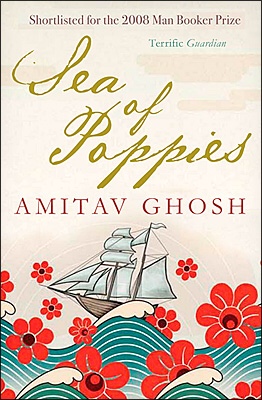
Amitav Ghosh, “Sea of Poppies” (2008) – This was very good. Taking place in Bengal in the 1830s, “Sea of Poppies” follows a variety of characters — indebted Bengali farmers, a disgraced former rajah, a mixed-race American sailor, a French orphan in Calcutta’s European quarter — as the forces of mid-nineteenth century globalization suck them in. The farmers of Bengal have been forced by the British East India Company to grow poppies almost as a monocrop- the Company foists debts on the farmers, and the only thing that grows for cash is poppy. Poppy, in turn, gets turned into opium. Opium (mostly- there’s still a subculture of Indian addicts) gets traded to China, which had previously only accepted silver as a trade item, an arrangement on which the British were none too keen. Meanwhile, debt peonage crushes the Bengali peasantry- there were massive famines in the 1790s, and forty years later you see peasants selling themselves into indentured servitude to go to places like Mauritius, to replace newly-freed African slaves in growing cash crops.

This makes it sound like it’s about the history, which it isn’t entirely. It is about characters getting swept up in forces beyond their control, from political economy to love to addiction. It’s also about the rough and ready adjustments people make on the fly to clashes of culture. Ghosh delights in the different dialects, including trade pidgin and the argot of the lascars, the sailors of the Indian Ocean. The characters are all pretty compelling, or anyway, “Berard Complete” – compelling without being tediously psychologized. It’s a longish book, but it moves at a reasonable clip. Eventually, everyone meets on former slave ship the Ibis, which carries its load of indentured Indians (who discover an identity as Indians, as opposed to one limited by region or caste, in their precarious position) into both literal and figurative storms, left to fates unknown. This is the first in a trilogy so if you’re looking for a conclusive ending this book won’t satisfy that, but otherwise it’s a great read. *****

Review- Ghosh, “Sea of Poppies”

Review- Himes, “If He Hollers Let Him Go”

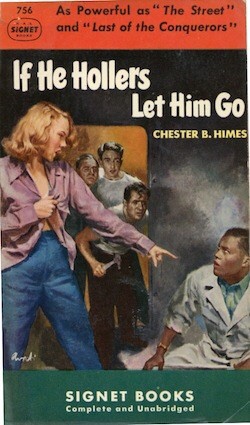
Chester Himes, “If He Hollers Let Him Go” (1945) – Chester Himes takes us through the deeply uncomfortable racial atmosphere of Los Angeles during the Second World War in this, his first novel. Bob Johnson, the main character, works on building warships. Both black and white migrants from the South crowd Los Angeles and his workplace, causing the prevailing racism to reach a degree of ubiquity that haunts every action and interaction at Johnson’s workplace and elsewhere. Living in space involuntarily vacated by interned Japanese, Bob and other black workers work in segregated crews, most often with white leaders. Bob, who has had some college, is appointed the first black crew leader, a sort of experiment on the part of paternalistic management. This does nothing to ease the racial tensions on the production floor, as Bob is continually stonewalled by white colleagues when he needs their cooperation. Sex enters the mix as well- no one (other than some ineffectual Communist sympathizers) is willing to touch the toxic dynamic created by racist white women workers taking advantage of their position to terrorize black male coworkers. Bob’s resentments and desires intertwine to make both volatile- he considers killing a white coworker who attacked him during a card game, has a messed-up relationship with a woman from LA’s tiny black elite, and in general can never figure out if he wants to be accepted by society or to blow it all off. In the end, he gets the fate he had been trying to dodge- a forced enrollment in a Jim Crow institution, acceptance of a racist society whether he’s willing or not. A vivid, compelling read. ****’

Review- Himes, “If He Hollers Let Him Go”

Review- Mahfouz, “Sugar Street”

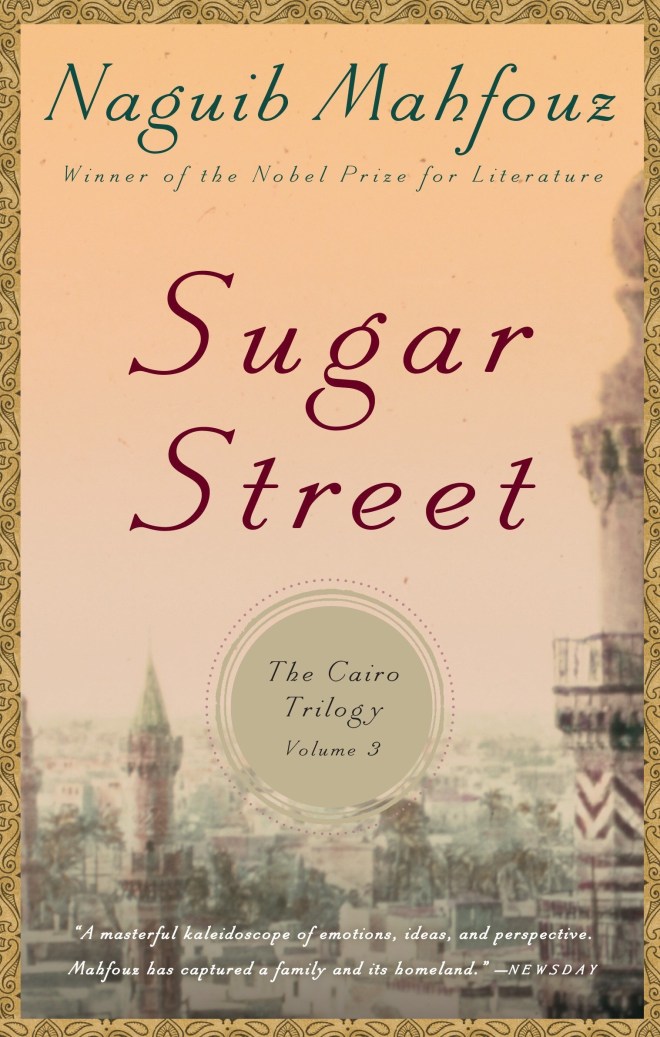
Naguib Mahfouz, “Sugar Street” (1957) (translated from the Arabic by William Hutchins, Olive Kenny, and Angele Botros Samaan) – The end of Naguib Mahfouz’s Cairo trilogy finds us at the tail end of the Egyptian monarchy with a new generation — the grandchildren of the people who started the series — poised to take center stage. This generation includes a communist and a member of the Muslim Brotherhood, unthinkable positions for the comfortably bourgeois Al-Jawad family a few decades before. The series as a whole and especially this volume takes a panoramic view of the family’s experiences, and the closest to a main character is Kamal, part of the second generation, who we last saw in “Palace of Desire” in the throes of unrequited love. As he enters his twenties and eventually thirties (“Sugar Street” covers more time faster than the other two volumes), Kamal becomes an increasingly detached intellectual, remaining in touch with his family but becoming a skeptic about everything, including love. He was about Mahfouz’s age; one wonders how much this is based on him. There’s an autumnal feeling to this book, as the older generation dies off, the hopes of the second generation either decline or are fulfilled in odd ways, and the third generation heads into what will become, as Mahfouz is writing, the Nasser era. All in all, a decent enough series in the Dickensian “chunk of life in a big city” tradition. ****

Review- Mahfouz, “Sugar Street”

Review- Mahfouz, “Palace of Desire”

Naguib Mahfouz, “Palace of Desire” (1957) (translated from the Arabic by William Maynard Hutchins, Lorne Kenny, and Olive Kenny) – The second volume of Mahfouz’s Cairo trilogy follows the al-Jawads into the mid-1920s. There are a number of viewpoint switches but most of what we see we see through aging patriarch Sayyid Ahmed and his two sons, the sybarite Yasin and the young idealistic Kamal. Disappointment is a big theme in this one. Mahfouz gets soap-opera-esque when Yasin and Ahmed wind up dating the same woman, and he does a pretty good job with the sensation of unrequited love, contrasting Kamal’s flowery inner monologues about “the beloved” with the more mundane realities that surround him and preoccupy his friends. It’s not that exciting a read and somewhat unbalanced (much less of the women’s perspective than in “Palace Walk”). Ultimately, a pretty good book with reliably deft use of language. ****

Review- Mahfouz, “Palace of Desire”

Review- Reed, “The Free-Lance Pallbearers”

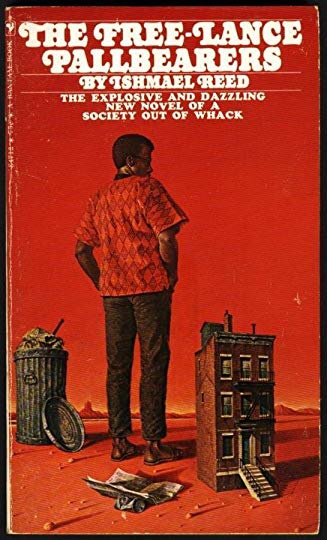
Ishmael Reed, “The Free-Lance Pallbearers” (1967) – Ishmael Reed is a fascinating and frustrating figure, who’s in the news again at the moment, having written a play critical of musical sensation “Hamilton” and its creator. At one point considered to be something like the future of American literature, between changes in fashion and his own pugnacious relationship with other writers, the years since the early 70s have seen his star wane, though never extinguish completely. I don’t have the space to do a full examination of Reed’s career, though I plan on writing about him extensively in my next birthday lecture. What I feel confident in saying is that Reed worked to build a first, countercultural, and rough (in multiple senses of the word) draft of multiculturalism- and doesn’t play well with the other versions.

Most of that was in the future when Reed published “The Free-Lance Pallbearers,” his first novel. Set in the city state of HARRY SAM, named after its dictator HARRY SAM (both always in all caps), it’s the tale of naive young theologian Bukka Doopeyduk. He encounters various types- surreal satirical versions of black radicals, black and white liberals, nosy neighbors, mean in-laws, etc. One of those in-laws hits him with a “hoodoo” that gives him horns and generally collapses his life. He gets cured, finds his way to the (toilet) seat of power, uncovers its dreadful secrets, leads a mob against it and is turned against by the mob. All in just over 150 pages!

In my experience, Reed isn’t read for plot. He came to describe his novels as “conjurings,” using language to summon up alternate states of being, visions of a different world, that he walks characters through, rather than undertaking plot and character development in the traditional sense. It’s experimental, but in a way that’s both intelligent and pleasingly non-highbrow, borrowing from history, pop culture, jazz, and the long history of black art on both sides of the Atlantic. You don’t always get what’s going on but it’s generally an interesting ride, and very self-assured for a first novel. Some of what would characterize Reed’s later difficult turns — issues with women, contrariness for its own sake, a sort of spiritually-elitist disdain — is there in seed form here. But the sting is part of the experience of this particular part of American literature. ****

Review- Reed, “The Free-Lance Pallbearers”

Review- Mahfouz, “Palace Walk”

Naguib Mahfouz, “Palace Walk” (1956) (translated from the Arabic by William Maynard Hutchins and Olive Kenny) – The first Arab winner of the Nobel prize in literature brings us to WWI-era Cairo in this, the beginning of the Cairo trilogy, which is the main work of his you can find in English. The al-Jawads, a respectable middle-class Shiite family (at least I assume Shiite by the way they constantly refer to the martyr Husayn), undergoes trials and tribulations.

At the center is Ahmad al-Jawad, family patriarch. He’s a man of contradictions, not to mention a hypocrite. Tyrannically traditional at home, glad handing with friends, and compulsively lascivious behind closed doors, Ahmad is set up for numerous falls in this book and probably more in the latter two. He has managed to cow his wife and five children but not truly shape them, except by accident, as various of his children inherit parts of his personality but inevitably take them in directions he dislikes. This ranges from lasciviousness with lower-class women to involvement in the Egyptian national struggle that heats up after the war ends. Moreover, he’s an emperor with no clothes to his family — sometimes almost literally — but as yet, they are in a stalemate between his hypocrisy and the terror he’s instilled in them through decades of harsh treatment.

Mahfouz has been compared to Dickens and I can see it, certainly Cairo is a living character for him the same way London was for Dickens. But it’s also a response-to-modernity novel of the kind you get from a lot of colonized places around this time. It’s interesting to watch the clash between Fahmy, the representative of 20th century style nationalism, and his parents Ahmad and Amina, both of whom want the British gone from Egypt… but the older generation regards any action towards that end as overly risky and vaguely impious, almost a non sequitur. Especially interesting in light of Mahfouz’s own relationship with Egyptian nationalism, as a latter day convert to Nasserism and a man stabbed almost to death for his support of Sadat and the Camp David accord. In general, a pretty good literary novel if you like that kind of thing. ****

Review- Mahfouz, “Palace Walk”

Review- O’Hara, “Appointment in Samarra”

John O’Hara, “Appointment in Samarra” (1934) – Time to come clean- I thought this would be about American skullduggery in Samara, Russia, maybe around the Russian Civil War, or else Samarra, Iraq, maybe as a prelude to our oil politics there. I saw it on that Modern Library 100 best novels of the twentieth century list — pretty high up too as I recall — and my mind just… made the leap!

Well, it wasn’t about that. It’s about Julian English, who’s basically Gatsby divided by Babbitt, living in Pennsylvania and screwing up his life during the jazz age. It’s fine, for what it is, but I can’t help but notice how much more interesting it would be if “Ju” English were an agent of the nascent American security state in 1919 Russia or Iraq…

Anyway, Julian seems to have it all- wife who only resents him some of the time, successful car dealership, didn’t take too bad of a bath in the stock market crash, firmly ensconced in the boozy upper classes of his small Pennsylvania city. But dang it, he’s just sick of it all, so on a whim he starts fucking stuff up- throwing drinks in faces, nailing mob molls, getting in fights with one-armed vets. He’s looking for a way out, and he finds it.

Julian’s a cipher. The side characters, like his wife and his bootlegger pal, are more interesting and O’Hara does an ok job depicting them. But honestly, what was so interesting about jazz age pathos when the whole world — and the rest of the country — was on fire? **

Review- O’Hara, “Appointment in Samarra”