Review- MacLean, “Democracy In Chains”

Nancy MacLean, “Democracy in Chains: the Deep History of the Radical Right’s Stealth Plan for America” (2017) – Now that the brouhaha around this book has died down a bit, it might be possible to look at it more objectively. The “deep history” and “radical right” the book’s breathless subtitle refers to is the relationship between economist James Buchanan, father of public choice theory, and Charles Koch, billionaire bankroller of the libertarian right. Aspects of public choice theory, which argues that governments should be understood as economic actors looking to maximize their returns through rent-seeking and other bad behaviors, has entered common sense widely in this country and elsewhere, especially among elites. Koch money has played a pivotal role in watering the fields where the assumptions of public choice could grow into policy, buying think tanks and politicians and generally advancing the genuinely unpopular tenets of free market conservatism on the country.

A lot of the brouhaha around this book was, essentially, tone-policing. MacLean writes of the collaboration between right-wing talent and money as a grand plan to destroy democracy. She summons up the ghosts of the Old South and Pinochet’s Chile, delves much further into the present than is usual scholarly practice, and if you believe the detractors, is highly selective with her quotes. The thing is, big picture, she’s not that far off the money. Buchanan and other free market political economists do disdain democracy. There has been a lot of money poured into making their position popular- all of which got, as they say, “owned” by a nativist tv show host with a second-grade vocabulary. Supposedly, Buchanan didn’t support Pinochet at first, but he certainly warmed enough to him later. The fact that a lot of the backlash came from people connected with George Mason, a university the Kochs and Buchanan lifted out of obscurity as an academic font for their ideas, is telling.

Tone is part of what we judge in a book, after all, and I do think the tone — breathless j’accusery — does detract from the argument, and symbolizes at least some of the analytical problems here. “Democracy In Chains” shows the limitations of approaching the history of the late twentieth century from a liberal, even a left-liberal, framework. In short, all this stuff is a lot less shocking if you have a class analysis that shows that this is a ruling class — not just a couple of guys — doing what ruling classes do. It’s not a question of a philosophical battle over the role some reified thing called “the government” — that’s strictly kayfabe, even if libertarian nerds take it seriously. The question is about power, in and out of the state, and who wields it.

If you can get over the shock of it you can do more, analytically, as people who’ve tackled adjacent material like Kim Phillips-Fein and Quinn Slobodian show. Maybe you can say MacLean exchanged sophistication for mass readability. But she gets into some weedsy stuff — especially about Buchanan and co’s emphasis in constitutional design as a way to “encase” (using Slobodian’s terms) the market from democracy — and makes it clear enough. I think she could have done more with stuff like that. That’s why historians are different from journalists. ***’

Review- MacLean, “Democracy In Chains”

Review- Gourevitch, “From Slavery to Collective Commonwealth”

Alex Gourevitch, “From Slavery to Cooperative Commonwealth: Labor and Republican Liberty in the Nineteenth Century” (2015) – Who doesn’t love them some classical republicanism? Well, “a lot of people” is the answer to that, but I’m not among them. I find it historically fascinating and politically compelling, a way to conceptualize freedom apart from liberalism. Of course, the latter comes with some major caveats, which is why I identify as a socialist with republican leanings rather than, say, the other way around. Most glaring is the way the republicanism of Cicero and Machiavelli depends on an economic analysis that doesn’t match industrial, let alone post-industrial, realities.

Connected to that, classical republicanism is dogged by its own elitism. Despite being pretty good for the time, most republics were slave states (including the early United States) and all of them held some people capable/worthy of republican liberty and others not. This, despite using the language of slavery and freedom to argue for their own liberties, crying “slavery” whenever anyone raises taxes or whatever. It’s galling! Those who have sought to resurrect republicanism as either a historical object or as a living political theory struggle with how to transcend the theory’s original contradictions.

Alex Gourevitch argues that an under-studied limb of the republican tree holds some (but not all) answers- the labor republicans of late nineteenth century America, most notably the Knights of Labor. The Knights and their fellow travelers imagined what a republicanism that maintained the ideology’s traditional abhorrence of domination could look like in the industrial era. At the height of the concept of liberty-as-contract, where many abolitionist Republicans (both big and small r) believed that self-ownership and free contracting already won republican liberty, the labor republicans attacked the wage system as inherently a system of domination and control.

Above and beyond collective bargaining, they envisioned a cooperative commonwealth, where management answered to labor and labor guaranteed citizenship. The Knights sought, through educational efforts (this is where the eight hour day comes in- to give workers time to learn) and other base-building techniques, to construct collective power. Rather than rely on the government to build the commonwealth, labor republicans wanted the government to stay out of the way so they could build it. They further modified the republican ideology in terms of their understanding of economic freedom- where austere classical republicans feared luxury, labor republicans saw private goods (if not the sort of obscene wealth seen in the gilded age) as complementary to public virtue.

As is often the case for the nineteenth century, the Knights and other labor republicans got tripped up on race. They were progressive in terms of organizing with black people, risking lives to organize sugar cane field workers in Louisiana in the 1880s, but disdained Chinese workers as lacking republican virtue or whatever other bullshit people say to justify prejudices like that. One wonders what could have been had they had less racism and more critically developed class consciousness- something your Marxian intellectual veggies are good for. All told, this is a fascinating reconstruction of an overlooked and intermittently inspiring area of history, and a great contribution to the rich field of republican studies. *****

Review- Gourevitch, “From Slavery to Collective Commonwealth”

Review- Ghosh, “Sea of Poppies”

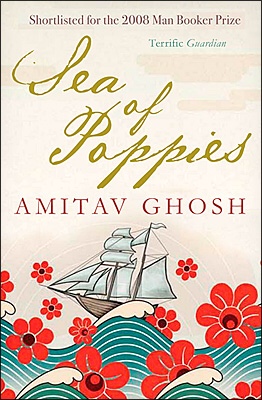
Amitav Ghosh, “Sea of Poppies” (2008) – This was very good. Taking place in Bengal in the 1830s, “Sea of Poppies” follows a variety of characters — indebted Bengali farmers, a disgraced former rajah, a mixed-race American sailor, a French orphan in Calcutta’s European quarter — as the forces of mid-nineteenth century globalization suck them in. The farmers of Bengal have been forced by the British East India Company to grow poppies almost as a monocrop- the Company foists debts on the farmers, and the only thing that grows for cash is poppy. Poppy, in turn, gets turned into opium. Opium (mostly- there’s still a subculture of Indian addicts) gets traded to China, which had previously only accepted silver as a trade item, an arrangement on which the British were none too keen. Meanwhile, debt peonage crushes the Bengali peasantry- there were massive famines in the 1790s, and forty years later you see peasants selling themselves into indentured servitude to go to places like Mauritius, to replace newly-freed African slaves in growing cash crops.

This makes it sound like it’s about the history, which it isn’t entirely. It is about characters getting swept up in forces beyond their control, from political economy to love to addiction. It’s also about the rough and ready adjustments people make on the fly to clashes of culture. Ghosh delights in the different dialects, including trade pidgin and the argot of the lascars, the sailors of the Indian Ocean. The characters are all pretty compelling, or anyway, “Berard Complete” – compelling without being tediously psychologized. It’s a longish book, but it moves at a reasonable clip. Eventually, everyone meets on former slave ship the Ibis, which carries its load of indentured Indians (who discover an identity as Indians, as opposed to one limited by region or caste, in their precarious position) into both literal and figurative storms, left to fates unknown. This is the first in a trilogy so if you’re looking for a conclusive ending this book won’t satisfy that, but otherwise it’s a great read. *****

Review- Ghosh, “Sea of Poppies”

Review- Payne, “Falange”

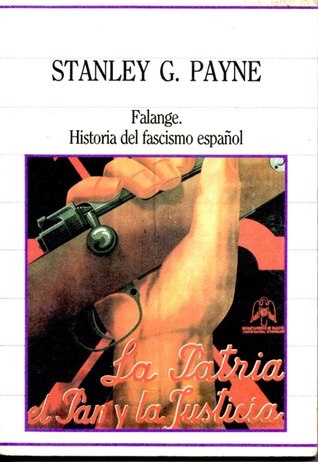
Stanley Payne, “Falange: A History of Spanish Fascism” (1961) – Stanley Payne is one of the big figures in the historiography of fascism, and he built his career by studying the Spanish example. Spanish fascism is tricky, and gets right into the differences between academic and popular uses of the word “fascism.” In the popular sense, the Franco regime was fascist- violent, authoritarian, right-wing. In the academic sense, most definitions of fascism don’t include Franco or his Portuguese neighbor Salazar, instead defining them as authoritarians. There’s a number of reasons for this, starting with both dictators lack of interest in remaking society or fighting aggressive wars (both of which are more iffy than the model implies- just ask the Angolans). There’s also the differentiation between the Franco regime and the Spanish Falange party, the country’s premier fascist movement. For a brief period during the civil war the Falange played a prominent role in Franco’s coalition, but Payne shows that the general always worked to sideline the noisy and anti-clerical followers of Primo de Rivera, son of a former authoritarian leader. Once Franco consolidated power, he ruled through traditional institutions like the army and the church, and the Falange became something more like a club than a ruling party.

Marxists have done themselves few favors in defining the history of fascism by sticking with a few talking points defined by Trotsky, Gramsci, and a few other canonical figures and not going very far past them. Scholars like Enzo Traverso, Arno Mayer, and Domenico Losurdo have done more in that vein lately, but more liberal writers have a substantial head start in the historiography, Payne being one of the major figures writing since the early sixties. So I think we’re in a situation where real and necessary historical nuance comes with a politicization defined by Cold War liberalism. Fascists need to be destroyed; authoritarians can be negotiated with; the former are rare and the latter are easy to be found, including with America’s Cold War allies. What I wonder is if we can keep the nuanced taxonomy of far-right regimes but keep the urgency of anti-fascism. It’s not like right-wing authoritarianism (any authoritarianism) is some picnic we should tolerate. I think calling Franco “fascist” as in “intolerably right-wing” makes sense even if he’s not “fascist” in the academic sense.

Anyway- this is a fine book for what it is but I read it a little while ago and most of the thoughts it provoked were about the historiography. But hey, I don’t see anyone else reviewing the books around here! ****

Review- Payne, “Falange”

Review- Leonard, “Maximum Bob”

Elmore Leonard, “Maximum Bob” (1991) – This is the first Elmore Leonard I’ve read, and it lives up to expectations. It maybe doesn’t live up to all the accolades thrown at Leonard over his long career, but it’s pretty good. A tale of low life in south Florida, Maximum Bob is the nickname of a local judge, a sleazeball named after his preference for maximum sentences. In classic noir style, it all starts with a simple, if poorly-conceived plan to avoid hard conversations- get a con to sneak a dead alligator onto his property so his wife, who has a phobia (beyond the normal fear) of the critters, will leave. The wife has been increasingly going off the deep end of spirituality, claiming that she shared a body with the soul of a little slave girl (imagine the trouble she’d get in if she were a poster twenty years later!). Of course, the plan goes wrong, and draws in a number of characters in and around the south Florida demimonde. The main “good” characters are a handsome pair, a lady probation officer and a dude cop, who obviously get together while trying to figure out what’s going on with the judge, people shooting at the judge, the alligator, and the judge’s wife. They’re generally less interesting than the Florida Men on both sides of the law populating the tale. And I gotta say… after reading James Ellroy, this story feels a little tame, a little easy. But still, pretty good, and I plan on looking up more Leonard in the future. ****

Review- Leonard, “Maximum Bob”

Review- Johnson and Quinlan, “You’re Doing It Wrong!”

Bethany Johnson and Margaret Quinlan, “You’re Doing It Wrong!: Mothering, Media, and Medical Expertise” (2019) – Motherhood! Not easy, especially as everyone seems to have an opinion about how it should go, from how to get pregnant onwards. “You’re Doing It Wrong!” defies standard categorization- it’s part history, part communications study, and part relating the personal experiences of the two writers, both of whom are mothers of young children. It ranges from the mid-19th century until our own period of online expertise and social media to discuss how people think about various stages of early motherhood. Surprise surprise- as the title implies, from then until now, on every conceivable issue, experts believe that mothers are doing it wrong, and issue welters of contradictory advice. I had no idea how controversial cold cuts for expectant mothers were before this book! Moreover, Johnson and Quinlan illustrate the ways different categories of expert — from medical professionals to people with opinions — shade into each other, tread on each other’s territory, dispense similar (and similarly muddled) advice, etc. This was just as true in the days of patent medicine as it is today in our time of social media, which amplifies every dynamic the writers discuss. All in all, an interesting and methodologically novel read in a subject I don’t know well. ****’

Review- Johnson and Quinlan, “You’re Doing It Wrong!”

Review- Himes, “If He Hollers Let Him Go”

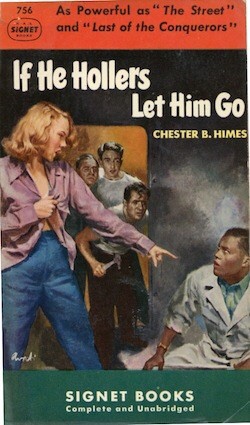
Chester Himes, “If He Hollers Let Him Go” (1945) – Chester Himes takes us through the deeply uncomfortable racial atmosphere of Los Angeles during the Second World War in this, his first novel. Bob Johnson, the main character, works on building warships. Both black and white migrants from the South crowd Los Angeles and his workplace, causing the prevailing racism to reach a degree of ubiquity that haunts every action and interaction at Johnson’s workplace and elsewhere. Living in space involuntarily vacated by interned Japanese, Bob and other black workers work in segregated crews, most often with white leaders. Bob, who has had some college, is appointed the first black crew leader, a sort of experiment on the part of paternalistic management. This does nothing to ease the racial tensions on the production floor, as Bob is continually stonewalled by white colleagues when he needs their cooperation. Sex enters the mix as well- no one (other than some ineffectual Communist sympathizers) is willing to touch the toxic dynamic created by racist white women workers taking advantage of their position to terrorize black male coworkers. Bob’s resentments and desires intertwine to make both volatile- he considers killing a white coworker who attacked him during a card game, has a messed-up relationship with a woman from LA’s tiny black elite, and in general can never figure out if he wants to be accepted by society or to blow it all off. In the end, he gets the fate he had been trying to dodge- a forced enrollment in a Jim Crow institution, acceptance of a racist society whether he’s willing or not. A vivid, compelling read. ****’

Review- Himes, “If He Hollers Let Him Go”

Review- Mahfouz, “Sugar Street”

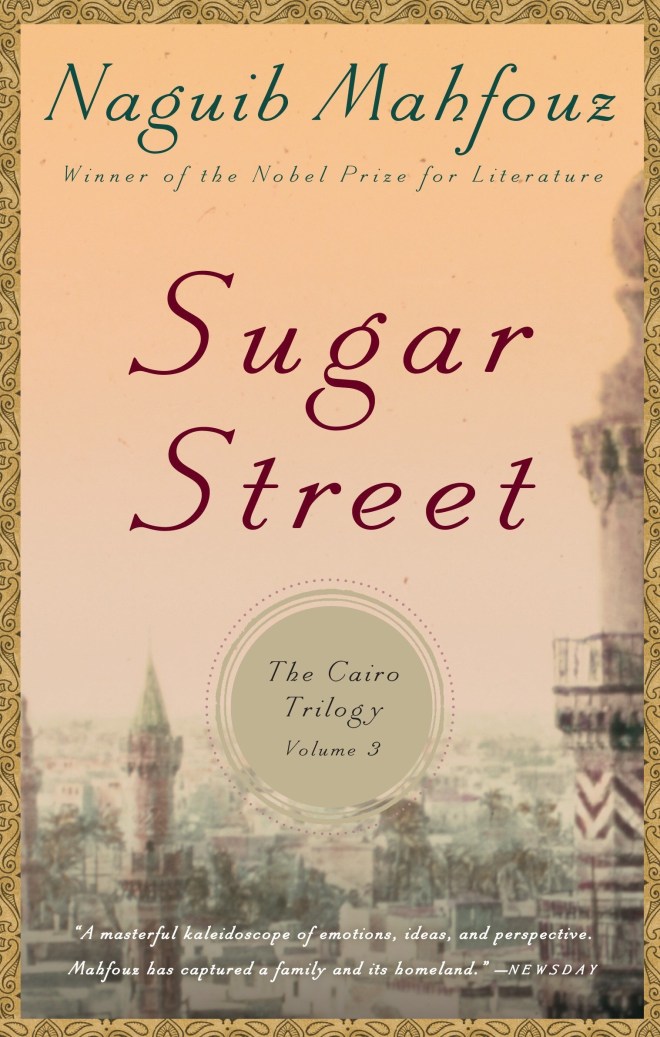
Naguib Mahfouz, “Sugar Street” (1957) (translated from the Arabic by William Hutchins, Olive Kenny, and Angele Botros Samaan) – The end of Naguib Mahfouz’s Cairo trilogy finds us at the tail end of the Egyptian monarchy with a new generation — the grandchildren of the people who started the series — poised to take center stage. This generation includes a communist and a member of the Muslim Brotherhood, unthinkable positions for the comfortably bourgeois Al-Jawad family a few decades before. The series as a whole and especially this volume takes a panoramic view of the family’s experiences, and the closest to a main character is Kamal, part of the second generation, who we last saw in “Palace of Desire” in the throes of unrequited love. As he enters his twenties and eventually thirties (“Sugar Street” covers more time faster than the other two volumes), Kamal becomes an increasingly detached intellectual, remaining in touch with his family but becoming a skeptic about everything, including love. He was about Mahfouz’s age; one wonders how much this is based on him. There’s an autumnal feeling to this book, as the older generation dies off, the hopes of the second generation either decline or are fulfilled in odd ways, and the third generation heads into what will become, as Mahfouz is writing, the Nasser era. All in all, a decent enough series in the Dickensian “chunk of life in a big city” tradition. ****

Review- Mahfouz, “Sugar Street”

Review- Reynolds, “Beneath the American Renaissance”

David Reynolds, “Beneath the American Renaissance: the Subversive Imagination in the Age of Emerson and Melville” (1988) – This is a pretty interesting book about the well-trod territory of the American Renaissance writers, here defined by a big seven: Melville, Emerson, Dickinson, Whitman, Poe, Thoreau, and Hawthorne. Rather than isolated geniuses acting out against the strictures of a conventional god-fearing culture, Reynolds argues convincingly that the American Renaissance writers drew strongly from the popular culture at the time. In particular, he claims, they drew from the “subversive imagination.” This was the late eighties, when “subversive” was a word to swear by in criticism, though it seemed more about subverting literary expectations than anything social or political.

The subversive imagination encompassed new, more emotive methods of preaching, more radical reform movements, and an array of more-or-less scandalous popular literatures from bloody war stories to “city-mysteries” quasi-exposés to outright literary pornography. Reynolds is at his strongest excavating the pop literature of the nineteenth century and such figures as radical writer George Lippard (who apparently wrote the mother of all American city-mysteries about Philadelphia, a work I’d like to look at) and the sailor’s preacher Edward Taylor. The book shows that the major writers were all influenced by this popular culture of grotesquerie, sensationalism, and irrationality to one degree or another (he’s stronger on this with Whitman, Melville, and Poe than with Dickinson and Thoreau, say).

He also argues they transcended the merely subversive to become truly literary. Instead of the hit-you-over-the-head ironies of pastors behaving poorly, you have the introspection of “The Scarlet Letter”; Whitman transfiguring the prurient literature of the day in “Leaves of Grass”; Melville transforming adventure stories into high art and Poe doing the same with sensationalist gothic crime stories, etc etc. Reynolds’ idea seems to that you wash the genre stink off, slap on some capital-T Themes, and you’ve got yourself genuine literature.

On the one hand, I’m an admirer of much of the American Renaissance (Melville, Poe, and Hawthorne- I’ve got little use for Emerson or Thoreau). On the other, this sounds like the kind of artistic hierarchy that leads to praising dullards and shortchanging hardworking genre artists. It also tends to be politically enervating- Reynolds sees Whitman’s and Emerson’s posturing as far more literary, hence worthy, than taking firm sides on something like abolitionism. And Dickinson is to a certain degree shoehorned in with some unsolicited advice for feminist scholarship. Still, agree with it or not, it is the sort of big, toothsome read I enjoy on a topic that interests me. ****’

Review- Reynolds, “Beneath the American Renaissance”

Review- Delbanco, “The Puritan Ordeal”

Andrew Delbanco, “The Puritan Ordeal” (1989) – I think I’m stuck with the Puritans the same way other people see themselves stuck with their lineages. Which is funny, because my actual lineage is a rogues gallery of the sorts of Catholics the Puritans feared and loathed most, along with Jews, who the Puritans thought they had essentially replaced. I don’t believe in blood magic but I do believe in history, not just as something taught in schools but something written into the texture of everyday life.

I’m not going to pretend that over and above everything else, I’m not a product of late twentieth century undifferentiated American capitalist culture. But New England, one way or another, shapes my thoughts, expectations, etc., in a way I relate to when, say, John Dolan writes about California. The Puritans loom over New England in a weak echo of the way God loomed over the Puritans. Several major habituses — from the urban ethnic one pioneered by the Irish the Puritans despised to the suburban liberalism that the Puritans’ descendants played a strong role in shaping — have developed to give New England a culture specifically in reaction to the problems in Puritanism. They’ve by and succeeded but the Puritan grapple with God, man, and time still lives on. It’s there in the way the towns are set up, in the weather, the way people interact, what you learn when you’re little, the niggling worries about abstractions in the back of your head.

I think I’m also stuck with the early American Studies scholars, despite the fact I agree with them about as much as I agree with seventeenth century Calvinism. I still find myself pulling their books or books about them from shelves. Another set of overachieving ancestors who were wrong-headed in some fundamental ways, they also baked themselves into the definition of American culture even as they were writing about how the Puritans did the same thing. Both had a faith in the power of canonical texts that verged on the psychotic. Part of me wonders if both weren’t playing some deeper game, the kind of thing you could make a scifi plot out of… the Puritans are much likelier and more interesting candidates for protagonists, I grant.

Well, anyway, this book. Not strictly an early American Studies text but something of a throwback; Andrew Delbanco, later to become Melville’s biographer, writing an exegesis on Puritan spiritual/social practice while the 1980s culture war raged all around him. His main argument is that while the Puritans are (again, for the most part rightly- there’s good reason to dislike them) associated with the idea of evil as a force in and of itself, operative in the world, that earlier on many of them were believers in Augustine’s idea of evil as the absence of good, or privative evil as it’s called. This carries along with it an idea of human perfectibility that is far from the dour self-hatred we associate with the Puritans from Hawthorne and the witch trials. The fall from this privative sensibility and millenarian vision, Delbanco argues, came with the pressures on the new colony and the efforts of its leaders to control it socially.

He makes a broader point about immigrant generations, citing the way immigrant Jews often felt that their American-born children fell away from the truth and the way immigrant children feel small next to their ancestors. This sounds like an overgeneralization. But I think, in his… knowing, half-ironically filiopietistic Nth generation American Studies way, Delbanco got at something of the way the Puritans achieved their remarkable “stickiness,” to use some Silicon Valley jargon. They colonized not just this cold appendage of America, but the whole practice of relating introspection to social structure, as undisentangleable as western philosophy is from what a few Athenians thought a long time ago. I don’t think it’s just me and a few other pedants stuck with them, in the end. ****’

Review- Delbanco, “The Puritan Ordeal”